Action For Adrenal Disease

Watch online Saturday April 16 at 1:00 PM eastern at https://plus.google.com/events/cpjbd8celcbfgngp8und662s198?hl=en
Secondary Adrenal Insufficiency and Addison’s Disease can be deadly, mostly because of the lack of education and awareness. We have lost too many and need to be proactive in preventing unnecessary deaths! Join us as we educate on what these diseases are, how easily they can become deadly and preventive measures we can all take to help this community. Brought to you by the National Adrenal Disease Foundation, with speakers who have personal experience with these diseases.

Our program will include:

Senior Administrator Nichole Klute Rushton••• of the Addison’s Disease Support Group (https://www.facebook.com/groups/addisons.support/) on Facebook, will speak in detail about the unfortunate adrenal insufficient patients who have tragically passed, reminding us that the danger of loss of life is a reality for every person with adrenal insufficiency who doesn’t receive the vital hormones they need

Administrator Debby Hunter ••• of the Living With Addison’s Disease Support on Facebook (https://www.facebook.com/groups/LivingWithAddisonsDisease/) who will give us tips on how we can approach our local emergency facilities and hospitals with information about adrenal insufficiency and its care in a crisis situation. She will also share her own personal experience with going through an adrenal crisis.

Deputy Sheriff Chris Spires••• who will speak on life as the husband of an Addison’s disease patient, and share with us how the law enforcement community views adrenal insufficient patients

Melanie Wong ••• National Adrenal Disease Foundation (http://www.NADF.us) Executive Director, who will speak about the recent tragic losses, and the vital importance of reminding the medical community about adrenal insufficiency, as well as NADF’s latest project to get NADF Adrenal Crisis Care posters displayed in every emergency room facility in the United States.

Adrenal Insufficiency Patients Require More Education on Adrenal Crisis

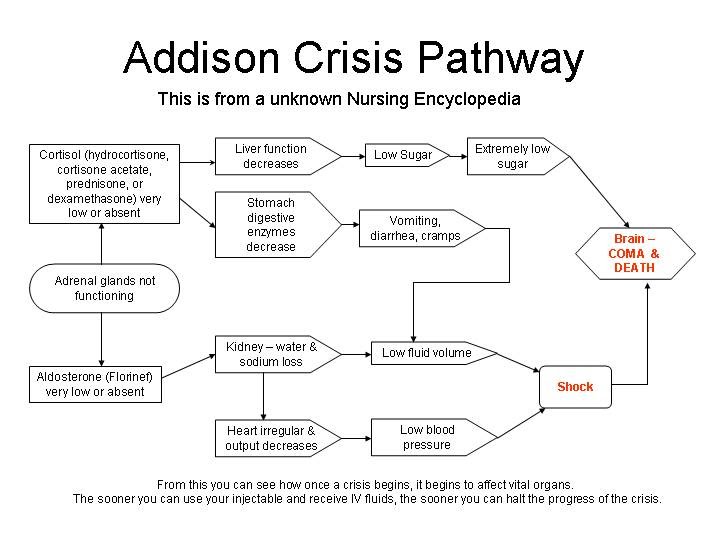
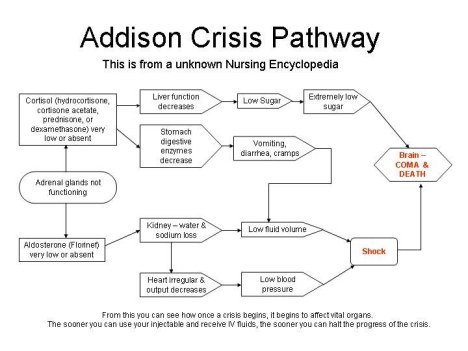
adrenalcrisispathway

Greater efforts to educate patients with adrenal insufficiency and their families about prevention of adrenal crisis may be necessary, according to data presented at the American Association of Clinical Endocrinologists (AACE) 24th Annual Scientific & Clinical Congress.

Additionally, the researchers, who looked at patients treated for adrenal insufficiency, found that many are not being adequately trained or equipped to deal with an adrenal crisis.

“These patients can crash and we are not doing enough to help prevent problems,” study investigator Nitika Malhotra, MD, endocrinologist in Lansing, Michigan, said. “We did this study because we think this is a big problem.”

Malhotra, who presented the study findings at the meeting, explained that patients with adrenal insufficiency are at risk for developing adrenal crisis, and it is now estimated that 8% of patients with adrenal insufficiency are hospitalized for adrenal crisis each year.

The problem, according to Malhotra, is that far too many patients are failing to receive crises prevention education. Moreover, they are not receiving emergency glucocorticoid kits.

“All of the families need to be taught and that is not happening,” Malhotra said in an interview with Endocrinology Advisor. “It will reduce the morbidity and mortality and the hospitalization, and it may improve the quality of life of patients too.”

For their study, Malhotra and her colleagues collected data from patients with adrenal insufficiency who were seen at a single institution between March 2009 and March 2014.

The investigators conducted a retrospective chart review and examined age, gender, causes of adrenal insufficiency, glucocorticoid dose, and monitoring for hyponatremia and hyperkalemia. They also looked at postural blood pressure, crises prevention education for glucocorticoid dose adjustments during stress, and whether patients had a Medic Alert ID or a parenteral glucocorticoid kit.

The researchers identified 85 patients (29 males and 56 females) with adrenal insufficiency. Of these patients, 33 patients had primary adrenal insufficiency (38.8%) and 52 had secondary adrenal insufficiency (61.2%). The mean age of the patients was 55.8 years.

Among the 85 patients, 23 (27%) had postural blood pressures checked — five of whom were positive (21.7%). Seventy-seven patients (90.6%) were monitored for electrolytes, and 41 patients (48.2%) were on steroid doses above 20 mg per day.

However, the researchers found that only 57 patients (67.1%) had received steroid dose adjustment instructions. In addition, only 29 patients (34.1%) had a Medic Alert ID, and only 17 patients (20%) were setup with emergency parenteral glucocorticoid kits.

Even though this study has many inherent limitations, Malhotra said, it appears that the preventive strategies for adrenal crisis in patients with adrenal insufficiency are not being consistently followed.

Patient education is paramount for achieving a successful prevention strategy for adrenal crisis, and endocrinologists have a responsibility to make sure that all patients with adrenal insufficiency have a Medic Alert ID and access to emergency glucocorticoid kits, according to Malhotra.

Furthermore, she said families should receive adequate education about parenteral steroid administration and steroid dose adjustments in stressful situations.

At her institution, Malhotra said, endocrinologists are introducing an automated electronic alert in their electronic medical records to determine if this electronic prompt will improve adherence.

Reference

  1. Malhotra N et al. Abstract #102. Presented at: American Association of Clinical Endocrinologists (AACE) 24th Annual Scientific & Clinical Congress; May 13-17, 2015; Nashville, Tenn.


From http://www.endocrinologyadvisor.com/aace-2015/adrenal-crisis-in-adrenal-insufficiency/article/415123/

Severe fatigue, decreased physical activity in patients with Addison’s disease

van der Valk ES, et al. Clin Endocrinol. 2016;doi:10.1111/cen.13059.

Dutch adults with primary adrenal insufficiency reported abnormal or severe fatigue, reduced physical activity and significantly reduced quality of life vs. healthy controls, according to recent survey results.

In a cross-sectional study, Eline S. van der Valk, MD, of Amphia Hospital in Breda, the Netherlands, and colleagues also found that patients with Addison’s disease reported physical activity levels that were significantly lower than those reported by other Dutch chronically ill patients.

“The clinical relevance of the impaired [quality of life] and increased fatigue found in our study is supported by the size of the differences in scores and the restriction in physical activity in patients with [Addison’s disease], an important activity in daily life,” the researchers wrote. “Physical inactivity could be very detrimental in [Addison’s disease] because the prevalence of other cardiovascular risk factors is already increased, and it has been demonstrated that patients with [Addison’s disease] have an up to twofold increased mortality rate from [CVDs].”

Researchers analyzed survey data from 328 Dutch adults with Addison’s disease on stable glucocorticoid replacement therapy with hydrocortisone or cortisone acetate (mean age, 53 years; 223 women; mean duration of disease after diagnosis, 15.6 years). Participants attended outpatient clinics at University Medical Center Utrecht and Radboud University Nijmegen Medical Centre, or were members of the Dutch Association of Addison and Cushing Patients. They completed general and health-related quality of life (Short Form 36; Checklist Individual Strength) and physical activity questionnaires. Scores were compared with a random sample of 1,718 adults who completed a Dutch National Health Survey (controls).

Within the cohort, 53% of participants had isolated Addison’s disease; 74.1% received hydrocortisone therapy; 25.9% received cortisone acetate therapy; 87.2% received fludrocortisone therapy; and 23.2% received dehydroepiandrosterone replacement therapy.

Researchers found that 45.7% of participants with Addison’s disease met the standard of physical activity (Dutch standard of healthy physical exercise, defined as moderately intensive physical exercise for 30 minutes daily 5 days per week; “Fitnorm,” defined as 20 minutes of intensive physical exercise at least 3 days per week) vs. 67.8% of controls (P < .01). Researchers found 61% of participants with Addison’s disease reported abnormal fatigue, and 43% reported severe fatigue. Mean fatigue scores were significantly higher vs. controls (mean difference, 32.6; 95% CI, 24-41).

In both men and women with Addison’s disease, researchers found that quality of life scores in all component summaries were significantly decreased compared with controls, particularly in participants aged 65 years and younger. – by Regina Schaffer

Disclosure: The researchers report no relevant financial disclosures.

From http://www.healio.com/endocrinology/adrenal/news/online/%7Ba8914384-d40e-41ab-aa1c-134d856d2edd%7D/severe-fatigue-decreased-physical-activity-in-patients-with-addisons-disease

Rare Disease Day, 2016!

rare-disease-day-robin

There are events all over the world today.  What are *You* doing to raise awareness for Cushing’s, Addison’s or other rare disease you have?

Many thanks to Robin for the great graphic!


The USA joined Rare Disease Day in 2009, making the campaign a truly international affair. Diverse events and campaigns have been organised since then, including educational programmes in schools and a collection of photographs entitled “Handprints across America” with the Rare Disease logo across the USA. In 2013 President Barack Obama sent a letter proclaiming his support of the day. In 2015, the day was a nation-wide affair, with events everywhere from California to New York to Texas. More than 35 states participated, holding conferences, artistic events, fundraising walks, and benefit dinners. In Chicago, a “Rock Rare Diseases” event created a playlist that was featured at many hospitals on the special day.

NORD, the National Organization for Rare Disorders, is committed to the identification, treatment, and cure of rare diseases through programmes of education, advocacy, research and patient services. They can be contacted directly to help you find a patient organisation locally which may have more information about a specific rare disease or disorder. Find their contact information on the bottom of this page.

You can also get involved! Do you know of any events not listed here? Email us at rarediseaseday@eurordis.org.

On Monday, February 29th, Rare Disease Week on Capitol Hill kicks off! Hundreds of advocates from around the country will be in Washington, D.C. for a full week of events. Space remains for the Caucus Briefing on Thursday March 3rd and the Rare Artist Reception. Can’t make it to Washington D.C.? NORD is helping coordinate State House Events across the U.S.

On Wednesday, March 2nd, the EveryLife Foundation for Rare Diseases is holding a Virtual Lobby Day for advocates who cannot attend the events in D.C. The event will ask advocates to contact Congress and ask that they co-sponsor the OPEN ACT, legislation to double the number of rare disease treatments. Please share widely on social media.

On Thursday, March 3rd, the first bicameral Congressional Rare Disease Caucus briefing will be held in the Auditorium of the U.S. Capitol Visitor Center at noon. Attendees will hear from the co-chairs of the Caucus and a panel discussion featuring key thought-leaders from the patient, regulatory, and industry communities who will discuss the Rare Disease Ecosystem.

On Wednesday, March 9th, the Senate Health, Education, Labor, and Pensions Committee (HELP) will hold its second hearing as part of its biomedical innovation initiative. To date, the Advancing Hope Act (Priority Review Voucher program at FDA) is scheduled for consideration. The final hearing is slated for April 6th, although no bills have been announced for consideration.

On Wednesday, March 16th, the EveryLife Foundation for Rare Diseases will hold a public webinar on newborn screening. The Foundation has just launched newborn screening legislation in California to expand and streamline screening for rare diseases.

On Wednesday, March 23rd, RDLA will hold its next monthly webinar. The agenda is OPEN! Please send suggestions for action items or policy issues to Vignesh Ganapathy at vganapathy@everylifefoundation.org.

Medic Alert Bracelets

This was posted today on Facebook from Jeannie Middlebrooks, an EMS provider.  She says “Anyone can message me with questions too!”
I have seen alot of people recently asking for advice as to what to put on their Medic Alert Bracelets, What Kind to buy, etc.
The most common things I see are that bracelets are being bought that look like “normal jewelry” because they don’t want it to stick out.
The other thing is that they are putting the IMPORTANT information on the BACK of the bracelet
Guys I have been in EMS 16 years, and recently Diagnosed SAI this past april. so I have a few things to say on this subject. You can take it for what it’s worth, but please understand this is coming from someone who lives in the heat of the moment taking care of people like us when that moment counts.. When we find an unconscious patient we have several things that we are attempting to do to save that patient, granted looking for a medic alert tag is important, but it is not more important that keeping a compromised airway open, checking vitals, getting an IV, asking family for a history, etc. Looking for a medic alert is usually done en route to the hospital if it is not blatantly obvious upon arrival.
#1 Anything that looks pictures I have posted below, I can 100% promise you, will be looked over in the heat of the moment if you are unconscious. Your family will more than likely be on edge and forget to tell us, or you will be by yourself and no one will know to tell us to look. It looks like standard jewelry.. so I’m not going to look at it.. therefore missing your life threatening emergency.. and if I am one of MILLIONS of first responders that are unfamiliar with Adrenal Insufficiency, I will NOT recognize the signs and symptoms, and you will NOT get the care you need pre-hospital.. leaving your body without the necessary cortisol for that much longer.
#2- If you place your Pertinent information on the back of your bracelet, PLEASE make sure that the medic alert symbol is on the front of the bracelet, BIG AND RED… don’t make it small and pink, or the same color as the bracelet.. yet again. we will overlook it in the moment..
#3- Necklaces are a bad idea.. They almost always get tucked into a shirt, and we almost NEVER see them. they are easily moved.
#4- Your medic alert tag should have your name. What you Suffer From, That you are Steroid Dependant. Where your Injection Kit is location (if applicable), Instructions to give the meds or you will die.. (This alerts bystanders to give you the injection as well.. I can say this because I had a bystander do it based solely on my Medic Alert tag.. she found it, drew it up, and gave it to me), and an emergency contact who can give responders information they need. If you have more than one Critical condition. List the most life threatening in order.
Please Please Please don’t take this post the wrong way. I am saying all of this coming from someone who lives in these moments every day. I know how many first responders are not familiar with the disease that can so easily kill us, and if you are willing to risk your life for the sake of a “pretty” bracelet, then I can’t stop you.. nor can anyone here.. Just know that it is a HUGE risk…