Day 9, Cushing’s Awareness Challenge

Uh, Oh – I’m nearly a day late (and a dollar short?)…and I’m not yet sure what today’s topic will be.  I seem swamped by everything lately, waking up tired, napping, going to bed tired, waking up in the middle of the night, traveling, work, starting all over again…and my DH was recently diagnosed with cancer which makes everything more hectic and tiring.

It’s been like this since I was being diagnosed with Cushing’s in the mid-1980’s.  You’d think  things would be improved in the last 29 years.  But, no.

My mind wants things to have improved, so I’ve taken on more challenges, and my DH has provided some for me (see one of my other blogs, MaryOMedical).

Thank goodness, I have only part-time jobs (4 0f them!), that I can mostly do from home.  I don’t know how anyone post-Cushing’s could manage a full-time job!

I can see this post morphing into the topic “My Dream Day“…

I’d wake up refreshed and really awake at about 7:00AM and take the dog out for a brisk run.

Get home about 8:00AM and start on my website work.

Later in the morning, I’d get some bills paid – and there would be enough money to do so!

After lunch, out with the dog again, then practice the piano some, read a bit, finish up the website work, teach a few piano students, work on my church job, then dinner.

After dinner, check email, out with the dog, maybe handbell or choir practice, a bit of TV, then bed about 10PM

Nothing fancy but NO NAPS.  Work would be getting done, time for hobbies, the dog, 3 healthy meals.

Just a normal life that so many take for granted. Or, do they?

me-tired

Day 6: Cushing’s Awareness Challenge

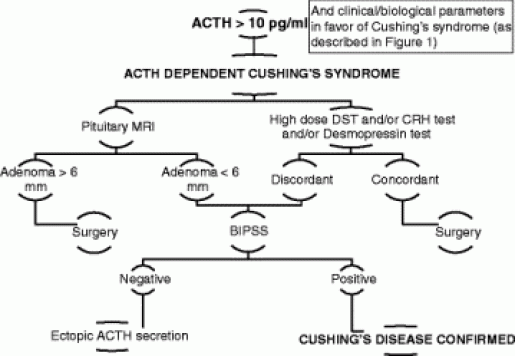
cushings-diagnosis.gif?resize=515%2C356

The above is the official Cushing’s path to a diagnosis but here’s how it seems to be in real life:

Egads!  I remember the naive, simple days when I thought I’d give them a tube or two of blood and they’d tell me I had Cushing’s for sure.

Who knew that diagnosing Cushing’s would be years of testing, weeks of collecting every drop of urine, countless blood tests, many CT and MRI scans…

Then going to NIH, repeating all the above over 6 weeks inpatient plus an IPSS test, an apheresis (this was experimental at NIH) and specialty blood tests…

The path to a Cushing’s diagnosis is a long and arduous one but you have to stick with it if you believe you have this Syndrome.

stick-with-it.jpeg?resize=575%2C87&ssl=1

maryo-blue.gif?resize=228%2C70&ssl=1

Day 1: Cushing’s Awareness Challenge

April is always Cushing’s Awareness Challenge month because Dr. Harvey Cushing was born on April 8th, 1869.

30-posts

Thanks to Robin for this wonderful past logo!  I’ve participated in these 30 days for Cushing’s Awareness several times so I’m not quite sure what is left to say this year but I always want to get the word out when I can.

As I see it, there have been some strides the diagnosis or treatment of Cushing’s since last year.  More drug companies are getting involved, more doctors seem to be willing to test, a bit more awareness, maybe.


April Fool's Day

How fitting that this challenge should begin on April Fool’s Day.  So much of Cushing’s  Syndrome/Disease makes us Cushies seem like we’re the April Fool.  Maybe, just maybe, it’s the doctors who are the April Fools…

Doctors tell us Cushing’s is too rare – you couldn’t possibly have it.  April Fools!

All you have to do is exercise and diet.  You’ll feel better.  April Fools!

Those bruises on your legs?  You’re just clumsy. April Fools!

Sorry you’re growing all that hair on your chin.  That happens as you age, you know.  April Fools!

Did you say you sleep all day?  You’re just lazy.  If you exercised more, you’d have more energy. April Fools!

You don’t have stretch marks.  April Fools!

You have stretch marks but they are the wrong [color/length/direction] April Fools!

The hump on the back of your neck is from your poor posture. April Fools!

Your MRI didn’t show a tumor.  You couldn’t have Cushing’s. April Fools!

This is all in your mind.  Take this prescription for antidepressants and go home.  April Fools!

If you have this one surgery, your life will get back to normal within a few months. April Fools!

What?  You had transsphenoidal surgery for Cushing’s?  You wasted your time and money. April Fools!

I am the doctor.  I know everything.  Do not try to find out any information online. You could not have Cushing’s.  It’s too rare…  April FOOL!

All this reminds me of a wonderful video a message board member posted a while ago:

So now – who is the April Fool?  It wasn’t me.  Don’t let it be you, either!

Identification Of Potential Markers For Cushing’s Disease

Endocr Pract. 2016 Jan 20. [Epub ahead of print]

Abstract

OBJECTIVE:

Cushing’s disease (CD) causes a wide variety of nonspecific symptoms, which may result in delayed diagnosis. It may be possible to uncover unusual combinations of otherwise common symptoms using ICD-9-CM codes. Our aim was to identify and evaluate dyads of clinical symptoms or conditions associated with CD.

METHODS:

We conducted a matched case-control study using a commercial healthcare insurance claims database, designed to compare the relative risk (RR) of individual conditions and dyad combinations of conditions among patients with CD versus matched non-CD controls.

RESULTS:

With expert endocrinologist input, we isolated 10 key conditions (localized adiposity, hirsutism, facial plethora, polycystic ovary syndrome, abnormal weight gain, hypokalemia, deep venous thrombosis, muscle weakness, female balding, osteoporosis) with RR varying from 5.1 for osteoporosis to 27.8 for hirsutism. The RR of dyads of these conditions ranged from 4.1 for psychiatric disorders/serious infections to 128.0 for hirsutism/fatigue in patients with vs. without CD. Construction of uncommon dyads resulted in further increases in RR beyond single condition analyses, such as osteoporosis alone had RR of 5.3, which increased to 8.3 with serious infections and to 52.0 with obesity.

CONCLUSION:

This study demonstrated that RR of any one of 10 key conditions selected by expert opinion was ≥5 times greater in CD compared to non-CD, and nearly all dyads had RR≥5. An uncommon dyad of osteoporosis and obesity had an RR of 52.0. If clinicians consider the diagnosis of CD when the highest-risk conditions are seen, identification of this rare disease may improve.

KEYWORDS:

Cushing’s disease; delay in diagnosis; disease markers; insurance claims; relative risk

PMID:
26789346
[PubMed – as supplied by publisher]

From http://www.ncbi.nlm.nih.gov/pubmed/26789346

Morning Medical Update – Cushing’s Disease

Cushing’s Disease can be treated, but only with the right doctor and diagnosis.

We explore the barriers that make some patients endure years of symptoms before finding relief.