Simultaneous Pituitary and Adrenal Adenomas in a Patient with Non ACTH Dependent Cushing Syndrome

Highlights

Cushing syndrome (CS) is a rare disorder with a variety of underlying etiologies.

CS is expected to affect 0.2 to 5 people per million per year.

Adrenal-dependent CS is an uncommon variant of CS.

This study reports a rare occurrence of pituitary and adrenal adenoma with CS.

Abstract

Introduction

Cushing syndrome is a rare disorder with a variety of underlying etiologies, that can be exogenous or endogenous (adrenocorticotropic hormone (ACTH)-dependent or ACTH-independent). The current study aims to report a case of ACTH-independent Cushing syndrome with adrenal adenoma and nonfunctioning pituitary adenoma.

Case report

A 37–year–old female presented with amenorrhea for the last year, associated with weight gain. She had a moon face, buffalo hump, and central obesity. A 24-hour urine collection for cortisol was performed, revealing elevated cortisol. Cortisol level was non-suppressed after administering dexamethasone. MRI of the pituitary revealed a pituitary microadenoma, and the CT scan of the abdomen with adrenal protocol revealed a left adrenal adenoma.

Discussion

Early diagnosis may be postponed due to the variety of clinical presentations and the referral of patients to different subspecialists based on their dominant symptoms (gynecological, dermatological, cardiovascular, psychiatric); it is, therefore, critical to consider the entire clinical presentation for correct diagnosis.

Conclusion

Due to the diversity in the presentation of CS, an accurate clinical, physical and endocrine examination is always recommended.

Keywords

Cushing syndrome
Cushing’s disease
Adrenal adenoma
Pituitary adenoma
Urine free cortisol

1. Introduction

Cushing syndrome (CS) is a collection of clinical manifestations caused by an excess of glucocorticoids [1]. CS is a rare disorder with a variety of underlying etiologies that can be exogenous due to continuous corticosteroid therapy for any underlying inflammatory illness or endogenous due to either adrenocorticotropic hormone (ACTH)-dependent or ACTH-independent [2][3]. Cushing syndrome is expected to affect 0.2 to 5 people per million per year. Around 10% of such cases involve children [4][5]. ACTH-dependent glucocorticoid excess owing to pituitary adenoma accounts for the majority (60–70%) of endogenous CS, with primary adrenal causes accounting for only 20–30% and ectopic ACTH-secreting tumors accounting for the remaining 5–10% [6]. Adrenal-dependent CS is an uncommon variant of CS caused mostly by benign (90%) or malignant (8%) adrenal tumors or, less frequently, bilateral micronodular (1%) or macronodular (1%) adrenal hyperplasia [7].

The current study aims to report a case of ACTH-independent Cushing syndrome with adrenal adenoma and nonfunctioning pituitary adenoma. The report has been arranged in line with SCARE guidelines and includes a brief literature review [8].

2. Case report

2.1. Patient’s information

A 37–year–old female presented with amenorrhea for the last year, associated with weight gain. She denied having polyuria, polydipsia, headaches, visual changes, dizziness, dryness of the skin, cold intolerance, or constipation. She had no history of chronic disease and denied using steroids. She visited an internist, a general surgeon, and a gynecologist and was treated for hypothyroidism. She was put on Thyroxin 100 μg daily, and oral contraceptive pills were given for her menstrual problems. Last time, the patient was referred to an endocrinology clinic, and they reviewed the clinical and physical examinations.

2.2. Clinical examination

She had a moon face, buffalo hump, central obesity, pink striae over her abdomen, and proximal weakness of the upper limbs. After reviewing the history and clinical examination, CS was suspected.

2.3. Diagnostic assessment

Because the thyroid function test revealed low thyroid-stimulating hormone (TSH), free T3, and freeT4, the patient was sent for a magnetic resonance imaging (MRI) of the pituitary, which revealed a pituitary microadenoma (7 ∗ 6 ∗ 5) mm (Fig. 1). Since the patient was taking thyroxin and oral contraceptive pills, the investigations were postponed for another six weeks due to the contraceptive pills’ influence on the results of the hormonal assessment for CS. After six weeks of no medication, a 24-hour urinary free cortisol (UFC) was performed three times, revealing elevated cortisol levels (1238, 1100, and 1248) nmol (normal range, 100–400) nmol. A dexamethasone suppression test was done (after administering dexamethasone tab 1 mg at 11 p.m., serum cortisol was measured at 9 a.m.). The morning serum cortisol level was 620 nmol (non-suppressed), which normally should be less than 50 nmol. The ACTH level was below 1 pg/mL.

Fig. 1

  1. Download : Download high-res image (103KB)
  2. Download : Download full-size image

Fig. 1. Contrast enhanced T1W weighted MRI (coronal section) showing small 7 mm hypo-enhanced microadenoma (yellow arrow) in right side of pituitary gland with mild superior bulge.

Based on these findings, ACTH independent CS was suspected. The computerized tomography (CT) scan of the abdomen with adrenal protocol revealed a left adrenal adenoma (33 mm × 25 mm) without features of malignancy (Fig. 2).

Fig. 2

  1. Download : Download high-res image (168KB)
  2. Download : Download full-size image

Fig. 2. Computed tomography scan of the abdomen with IV contrast, coronal section, showing 33 mm × 25 mm lobulated enhanced left adrenal tumor (yellow arrow), showing absolute washout on dynamic adrenal CT protocol, consistent with adrenal adenoma.

2.4. Therapeutic intervention

The patient was referred to the urologist clinic for left adrenalectomy after preparation for surgery and perioperative hormonal management. She underwent laparoscopic adrenalectomy and remained in the hospital for two days. The histopathology results supported the diagnosis of adrenal adenoma.

2.5. Follow-up

She was released home after two days on oral hydrocortisone 20 mg in the morning and 10 mg in the afternoon. After one month of follow-up, serum cortisol was 36 nmol, with the resolution of some features such as weight reduction (3 kg) and skin color (pink striae became white).

3. Discussion

Cushing’s syndrome is a serious and well-known medical condition that results from persistent exposure of the body to excessive glucocorticoids, either from endogenous or, most frequently, exogenous sources [9]. The average age of diagnosis is 41.4 years, with a female-to-male ratio of 3:1 [10]. ACTH-dependent CS accounts for almost 80% of endogenous CS, while ACTH-independent CS accounts for nearly 20% [10]. This potentially fatal condition is accompanied by several comorbidities, including hypertension, diabetes, coagulopathy, cardiovascular disease, infections, and fractures [11]. Exogenous CS, also known as iatrogenic CS, is more prevalent than endogenous CS and is caused by the injection of supraphysiologic glucocorticoid dosages [12]. ACTH-independent CS is induced by uncontrolled cortisol release from an adrenal gland lesion, most often an adenoma, adrenocortical cancer, or, in rare cases, ACTH-independent macronodular adrenal hyperplasia or primary pigmented nodular adrenal disease [13].

The majority of data suggests that early diagnosis is critical for reducing morbidity and mortality. Detection is based on clinical suspicion initially, followed by biochemical confirmation [14]. The clinical manifestation of CS varies depending on the severity and duration of glucocorticoid excess [14]. Some individuals may manifest varying symptoms and signs because of a rhythmic change in cortisol secretion, resulting in cyclical CS [15]. The classical symptoms of CS include weight gain, hirsutism, striae, plethora, hypertension, ecchymosis, lethargy, monthly irregularities, diminished libido, and proximal myopathy [16]. Neurobehavioral presentations include anxiety, sadness, mood swings, and memory loss [17]. Less commonly presented features include headaches, acne, edema, abdominal pain, backache, recurrent infection, female baldness, dorsal fat pad, frank diabetes, electrocardiographic abnormalities suggestive of cardiac hypertrophy, osteoporotic fractures, and cardiovascular disease from accelerated atherosclerosis [10]. The current case presented with amenorrhea, weight gain, moon face, buffalo hump, and skin discoloration of the abdomen.

Similar to the current case, early diagnosis may be postponed due to the variety of clinical presentations and the referral of patients to different subspecialists based on their dominant symptoms (gynecological, dermatological, cardiovascular, psychiatric); it is, therefore, critical to consider the entire clinical presentation for correct diagnosis [18]. Weight gain may be less apparent in children, but there is frequently an arrest in growth with a fall in height percentile and a delay in puberty [19].

The diagnosis and confirmation of the etiology can be difficult and time-consuming, requiring a variety of laboratory testing and imaging studies [20]. According to endocrine society guidelines, the initial assessment of CS must include one or more of the three following tests: 24-hour UFC measurement; evaluation of the diurnal variation of cortisol secretion by assessing the midnight serum or salivary cortisol level; and a low-dose dexamethasone suppression test, typically the 1 mg overnight test [21]. Although UFC has sufficient sensitivity and specificity, it does not function well in milder cases of Cushing’s syndrome [22]. In CS patients, the typical circadian rhythm of cortisol secretion is disrupted, and a high late-night cortisol serum level is the earliest and most sensitive diagnostic indicator of the condition [23]. In the current case, the UFC was elevated, and cortisol was unsuppressed after administration of dexamethasone.

All patients with CS should have a high-resolution pituitary MRI with a gadolinium-based contrast agent to prove the existence or absence of a pituitary lesion and to identify the source of ACTH between pituitary adenomas and ectopic lesions [24]. Adrenal CT scan is the imaging modality of choice for preoperatively localizing and subtyping adrenocortical lesions in ACTH-independent Cushing’s syndrome [9]. MRI of the pituitary gland of the current case showed a microadenoma and a CT scan of the adrenals showed left adrenal adenoma.

Surgical resection of the origin of the ACTH or glucocorticoid excess (pituitary adenoma, nonpituitary tumor-secreting ACTH, or adrenal tumor) is still the first-line treatment of all forms of CS because it leaves normal adjacent structures and results in prompt remission and inevitable recovery of regular adrenal function [12][25]. Laparoscopic (retroperitoneal or transperitoneal) adrenalectomy has become the gold standard technique for adrenal adenomas since it is associated with fewer postoperative morbidity, hospitalization, and expense when compared to open adrenalectomy [17]. In refractory cases, or when a patient is not a good candidate for surgery, cortisol-lowering medication may be employed [26]. The current case underwent left adrenalectomy.

Symptoms of CS, such as central obesity, muscular wasting or weakness, acne, hirsutism, and purple striae generally improve first and may subside gradually over a few months or even a year; nevertheless, these symptoms may remain in 10–30% of patients [27]. Glucocorticoid replacement is essential after adrenal-sparing curative surgery until the pituitary-adrenal function returns, which might take up to two years, especially if adrenal adenomas have been resected [25]. Chronic glucocorticoid excess causes lots of new co-morbidities, lowering the quality of life and increasing mortality. The most common causes of mortality in CS are cardiovascular disease and infections [28]. After one month of follow-up, serum cortisol was 36 nmol, and several features, such as weight loss (3 kg) and skin color, were resolved (pink striae became white).

In conclusion, the coexistence of adrenal adenoma and pituitary adenoma with CS is a rare possibility. Due to the diversity in the presentation of CS, an accurate clinical, physical and endocrine examination is always recommended. Laparoscopic adrenalectomy is the gold standard for treating adrenal adenoma.

Consent

Written informed consent was obtained from the patient’s family for publication of this case report and accompanying images. A copy of the written consent is available for review by the Editor-in-Chief of this journal on request.

Provenance and peer review

Not commissioned, externally peer-reviewed.

Ethical approval

Approval is not necessary for case report (till 3 cases in single report) in our locality.

The family gave consent for the publication of the report.

Funding

None.

Guarantor

Fahmi Hussein Kakamad, Fahmi.hussein@univsul.edu.iq.

Research registration number

Not applicable.

CRediT authorship contribution statement

Abdulwahid M. Salh: major contribution of the idea, literature review, final approval of the manuscript.

Rawa Bapir: Surgeon performing the operation, final approval of the manuscript.

Fahmi H. Kakamad: Writing the manuscript, literature review, final approval of the manuscript.

Soran H. Tahir, Fattah H. Fattah, Aras Gh. Mahmood, Rawezh Q. Salih, Shaho F. Ahmed: literature review, final approval of the manuscript.

Declaration of competing interest

None to be declared.

References

What Do *You* Think? Smartwatch Measures Cortisone

Share your thoughts here.

The human body responds to stress, from the everyday to the extreme, by producing a hormone called cortisol.

To date, it has been impractical to measure cortisol as a way to potentially identify conditions such as depression and post-traumatic stress, in which levels of the hormone are elevated. Cortisol levels traditionally have been evaluated through blood samples by professional labs, and while those measurements can be useful for diagnosing certain diseases, they fail to capture changes in cortisol levels over time.

Now, a UCLA research team has developed a device that could be a major step forward: A smartwatch that assesses cortisol levels found in sweat—accurately, noninvasively and in real time. Described in a study published in Science Advances, the technology could offer wearers the ability to read and react to an essential biochemical indicator of stress.

“I anticipate that the ability to monitor variations in cortisol closely across time will be very instructive for people with psychiatric disorders,” said co-corresponding author Anne Andrews, a UCLA professor of psychiatry and biobehavioral sciences, member of the California NanoSystems Institute at UCLA and member of the Semel Institute for Neuroscience and Human Behavior. “They may be able to see something coming or monitor changes in their own personal patterns.”

Cortisol is well-suited for measurement through sweat, according to co-corresponding author Sam Emaminejad, an associate professor of electrical and computer engineering at the UCLA Samueli School of Engineering, and a member of CNSI.

“We determined that by tracking cortisol in sweat, we would be able to monitor such changes in a wearable format, as we have shown before for other small molecules such as metabolites and pharmaceuticals,” he said. “Because of its small molecular size, cortisol diffuses in sweat with concentration levels that closely reflect its circulating levels.”

The technology capitalizes on previous advances in wearable bioelectronics and biosensing transistors made by Emaminejad, Andrews and their research teams.

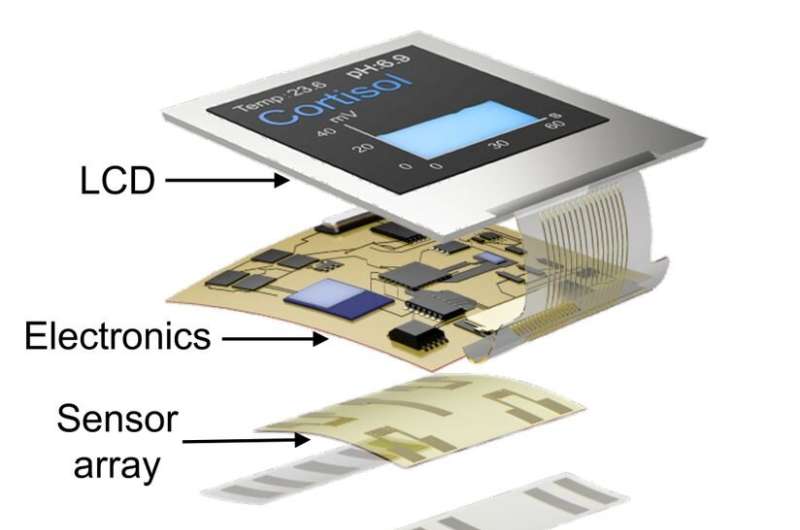
In the new smartwatch, a strip of specialized thin adhesive film collects tiny volumes of sweat, measurable in millionths of a liter. An attached sensor detects cortisol using engineered strands of DNA, called aptamers, which are designed so that a cortisol molecule will fit into each aptamer like a key fits a lock. When cortisol attaches, the aptamer changes shape in a way that alters electric fields at the surface of a transistor.

The invention—along with a 2021 study that demonstrated the ability to measure key chemicals in the brain using probes—is the culmination of a long scientific quest for Andrews. Over more than 20 years, she has spearheaded efforts to monitor molecules such as serotonin, a chemical messenger in the brain tied to mood regulation, in living things, despite transistors’ vulnerability to wet, salty biological environments.

Sweating the small stuff: Smartwatch developed at UCLA measures key stress hormone
The technology capitalizes on previous work by Sam Emaminejad, Anne Andrews and their UCLA research teams. Credit: Emaminejad Lab and Andrews Lab/UCLA

In 1999, she proposed using nucleic acids—rather than proteins, the standard mechanism—to recognize specific molecules.

“That strategy led us to crack a fundamental physics problem: how to make transistors work for electronic measurements in biological fluids,” said Andrews, who is also a professor of chemistry and biochemistry.

Meanwhile, Emaminejad has had a vision of ubiquitous personal health monitoring. His lab is pioneering wearable devices with biosensors that track the levels of certain molecules that are related to specific health measures.

“We’re entering the era of point-of-person monitoring, where instead of going to a doctor to get checked out, the doctor is basically always with us,” he said. “The data are collected, analyzed and provided right on the body, giving us real-time feedback to improve our health and well-being.”

Emaminejad’s lab had previously demonstrated that a disposable version of the specialized adhesive film enables smartwatches to analyze chemicals from sweat, as well as a technology that prompts small amounts of sweat even when the wearer is still. Earlier studies showed that sensors developed by Emaminejad’s group could be useful for diagnosing diseases such as cystic fibrosis and for personalizing drug dosages.

One challenge in using cortisol levels to diagnose depression and other disorders is that levels of the hormone can vary widely from person to person—so doctors can’t learn very much from any single measurement. But the authors foresee that tracking individual cortisol levels over time using the smartwatch may alert wearers, and their physicians, to changes that could be clinically significant for diagnosis or monitoring the effects of treatment.

Among the study’s other authors is Janet Tomiyama, a UCLA associate professor of psychology, who has collaborated with Emaminejad’s lab over the years to test his wearable devices in clinical settings.

“This work turned into an important paper by drawing together disparate parts of UCLA,” said Paul Weiss, a UCLA distinguished professor of chemistry and biochemistry and of materials science and engineering, a member of CNSI, and a co-author of the paper. “It comes from us being close in proximity, not having ego problems and being excited about working together. We can solve each other’s problems and take this technology in new directions.”

The paper’s co-first authors are UCLA postdoctoral scholar Bo Wang and Chuanzhen Zhao, a former UCLA graduate student. Other co-authors are Zhaoqing Wang, Xuanbing Cheng, Wenfei Liu, Wenzhuo Yu, Shuyu Lin, Yichao Zhao, Kevin Cheung and Haisong Lin, all of UCLA; and Milan Stojanović and Kyung-Ae Yang of Columbia University.

From https://techxplore.com/news/2022-02-small-newly-smartwatch-key-stress.html

Medullary thyroid cancer with ectopic Cushing’s syndrome: A multicentre case series

First published: 06 November 2021

Abstract

Objective

Ectopic Cushing′s syndrome (ECS) induced by medullary thyroid cancer (MTC) is rare, and data on clinical characteristics, treatment and outcome are limited.

Design

Retrospective cohort study in three German and one Swiss referral centres.

Patients

Eleven patients with MTC and occurrence of ECS and 22 matched MTC patients without ECS were included.

Measurements

The primary endpoint of this study was the overall survival (OS) in MTC patients with ECS versus 1:2 matched MTC patients without ECS.

Results

The median age at diagnosis of ECS was 59 years (range: 35–81) and the median time between initial diagnosis of MTC and diagnosis of ECS was 29 months (range: 0–193). Median serum morning cortisol was 49 µg/dl (range: 17–141, normal range: 6.2–18). Eight (73%) patients received treatment for ECS. Treatment of ECS consisted of bilateral adrenalectomy (BADX) in four (36%) patients and adrenostatic treatment in eight (73%) patients. One patient received treatment with multityrosine kinase inhibitor (MKI) to control hypercortisolism. All patients experienced complete resolution of symptoms of Cushing’s syndrome and biochemical control of hypercortisolism. Patients with ECS showed a shorter median OS of 87 months (95% confidence interval [95% CI]: 64–111) than matched controls (190 months, 95% CI: 95–285). Of the nine deaths, four were related to progressive disease (PD). Four patients showed PD as well as complications and comorbidities of hypercortisolism before death.

Conclusion

This study shows that ECS occurs in advanced stage MTC and is associated with a poor prognosis. Adrenostatic treatment and BADX were effective systemic treatment options in patients with MTC and ECS to control their hypercortisolism. MKI treatment achieved complete remission of hypercortisolism and sustained tumour control in one treated case.

1 INTRODUCTION

Medullary thyroid cancer (MTC) arises from calcitonin-producing parafollicular C-cells of the thyroid gland and accounts for 2%–5% of all thyroid malignancies.1 In about 25% of cases, MTC occurs in a hereditary manner as a part of multiple endocrine neoplasia type 2 (MEN2) caused by oncogenic germline REarranged during Transfection (RET)-mutations. Up to 65% of patients with the sporadic disease have somatic RET-mutations, among which RETM918T is the most common and associated with adverse outcome.25 At diagnosis, cervical lymph node metastases are present in about half of patients and distant metastases in around 10% of MTC patients.6 While the localized disease has a 10-year disease-specific survival (DSS) of 96%, 10-year DSS is only 44% in cases with distant metastases.79

Besides calcitonin and carcinoembryonic antigen (CEA), C-cells may also ectopically secrete corticotropin-releasing hormone (CRH) or adrenocorticotropic hormone (ACTH). Cushing’s syndrome (CS) due to ectopic CRH or ACTH secretion induced by MTC is rare and data on clinical characteristics, treatment and outcome are limited and mostly from case studies. In a retrospective study of 1640 adult patients with MTC, ectopic Cushing’s syndrome (ECS) due to ACTH secretion was reported in only 0.6% of patients, whereas previous studies reported a higher prevalence, possibly due to selection bias.1012 ECS mostly occurs in metastatic cases and significantly impairs prognosis: around 50% of the mortality in patients with ECS has been attributed to complications of hypercortisolism.12 Diagnosis of ECS is difficult and includes a combination of clinical assessment, dynamic biochemical tests (e.g., 24 h urinary-free cortisol, midnight salivary cortisol, 1 and 8 mg dexamethasone suppression test), inferior petrosal sinus sampling (IPSS) and multimodal imaging.13

This retrospective study aims at describing clinical characteristics, treatment and prognosis of 11 patients with MTC and ECS at 3 German and 1 Swiss tertiary care centres and to illustrate effective treatment in this ultrarare condition.

2 PATIENTS AND METHODS

2.1 Setting

This registry study was conducted as part of the German Study Group for Rare Malignant Tumours of the Thyroid and Parathyroid Glands. Data were obtained from records of patients diagnosed with MTC between 1990 and 2020 and concomitant ECS diagnosed between 1995 and 2020 in three German and one Swiss tertiary care centres. All patients provided written informed consent and the study was approved by the ethics committee of the University of Würzburg (96/13) and subsequently by the ethics committees of all participating centres.

2.2 Data acquisition

Eligible patients were 11 adults with histopathological evidence of MTC and the diagnosis of ECS at initial diagnosis (synchronous CS) or during the course of disease (metachronous CS). This group was matched with 22 patients with histologically confirmed MTC without evidence of ECS by sex, age at MTC diagnosis (±5 years), tumour stage and calcitonin doubling time (CDT).

The diagnosis of ECS was established by standard endocrine testing according to international guideline recommendations,14 local good clinical practice procedures and laboratory assays in participating centres. The primary endpoint of this study was the assessment of overall survival (OS) in MTC patients with ECS from the date of MTC-diagnosis and the date of ECS-diagnosis versus matched MTC patients without ECS (1:2 ratio). The secondary endpoints were assessment of progression-free survival (PFS) and efficacy of multityrosine kinase inhibitors (MKIs) treatment (based on routine clinical imaging in analogy to RECIST 1.0 and 1.1). Treatment and follow-up of patients were performed according to the local practice of participating centres. Efficacy was assessed locally by imaging (positron emission tomography/computed tomography [PET/CT], CT, magnetic resonance imaging [MRI] of the liver and bone scintigraphy) and measurement of serum calcitonin and CEA levels every 3–6 months. Clinical data were recorded by trained personnel at all sites. Tumour stage was defined according to the American Joint Committee on Cancer TNM classification, seventh edition,15 based on clinical and histopathological assessments.

2.3 Statistical analysis

PFS and OS probabilities were estimated using the Kaplan–Meier method. The log-rank test was not used to test the difference between the study group and the control group due to the paired sample design. For the comparison of nonnormally distributed data, we used the Mann–Whitney U test. p Values less than .05 were considered statistically significant. Statistical analyses were performed with SPSS Version 26 (IBM).

3 RESULTS

3.1 Clinical characteristics of patients with ECS

Eleven patients (five male and six female) with histopathological evidence of MTC with ECS in three German and one Swiss tertiary care centres were included. Twenty-two controls with histologically confirmed MTC without the diagnosis of ECS matched by sex, age at MTC diagnosis (±5 years), tumour stage and CDT were enroled. Baseline clinical characteristics of the study population and the control group are shown in Table 1. In patients with ECS, median follow-up from initial MTC diagnosis was 6.3 years (range: 0–17) and median follow-up from diagnosis of ECS 7 months (range: 0–110). Median age at initial diagnosis of sporadic MTC was 45 (range: 31–67, n = 7) and 52 years (range: 35–55, n = 3) for patients with germline RET mutant MTC.

Read more at https://onlinelibrary.wiley.com/doi/10.1111/cen.14617

Paraneoplastic Cushing Syndrome in Gastrointestinal Neuroendocrine Tumour

Abstract

Ectopic production of adrenocorticotropic hormone (ACTH) by gastrointestinal neuroendocrine tumours (NETs) is relatively uncommon. We report a rare case of a liver metastatic G1 low-grade NET of the intestine that induced hypercortisolism after surgical resection. A 50-year-old man was admitted for an intestinal obstruction caused by a tumour of the intestine. Paraneoplastic Cushing syndrome was diagnosed more than a year later following the appearance of cushingoid symptoms, despite stable disease according to RECIST criteria but chromogranin A increase. Ketoconazole and sandostatin medical treatment and liver chemoembolization never managed to control the hypercortisolism unlike the bilateral adrenalectomy. The identification and effective management of this uncommon statement of ectopic ACTH secretion is important to improve the patient’s prognosis and quality of life.

© 2021 The Author(s). Published by S. Karger AG, Basel


Introduction

Neuroendocrine tumours (NETs) are a relatively rare and heterogeneous tumour type, comprising about 2% of all malignancies [1]. The gastrointestinal (GI) and pancreatic tract and lungs are the most common primary tumour sites, with 62%–67% and 22%–27%, respectively, and within the GI tract, most of them occurs in the small bowel or the appendix [23]. Since 2010 and the latest version of the WHO classification, GI and pancreatic NETs are subdivided according to their mitotic count or Ki67 index, associated with cellular proliferation. Well-differentiated NETs are relatively low-aggressive tumours, with a rather indolent disease course and a good prognosis in most patients. Nevertheless, some NETs with a low-grade histologic appearance may behave aggressively with rapid growth and metastasis proliferation [45]. Because of this low incidence, tumour heterogeneity, lack of awareness, and non-uniform classifications, GI and pancreatic NETs remain a poorly understood disease, and delayed diagnosis is common among these [67].

Paraneoplastic Cushing syndrome (PCS) represents approximately 10% of all Cushing syndrome and is frequently caused by NETs [89]. While PCS is common with lung NETs (>50% of PCS), this paraneoplastic syndrome is relatively uncommon associated with GI NETs and only described in isolated case reports. Nevertheless, knowing the indolent course of low-grade NETs and the clinical symptoms of cushingoid appearance resulting from prolonged exposure to excessive glucocorticoids, PCS is typically present before cancer detection [8], and surgery is curative in >80% of patients [1011]. For the remaining 20%, effective management is necessary, given the risk of infections and thromboembolic events due to the immunosuppressive effect and the hypercoagulable state [11]. For patients with medically unmanageable hypercortisolism, synchronous bilateral adrenalectomy is an effective and safe treatment [12]. We describe a case of typical metastatic intestinal NETs associated with a late ectopic Cushing syndrome, which was managed with synchronous bilateral adrenalectomy.

Case Presentation

We describe the case of a 50-year-old man admitted to the emergency department for an intestinal obstruction caused by an intestinal tumour. Anatomopathological analysis of the resected specimen and lymph nodes revealed an NET. Three nodes out of 12 removed were positive for cancer localization. The tumour presented serosa infiltration and perineural, vascular and lymphatics vessel invasion. The primary location could not be confirmed histologically between the ileum and appendix. Our diagnosis was pT3N1 according to the American Joint Committee on Cancer (AJCC) classification. An immunohistochemistry analysis revealed a Ki-67 expression <2%. Mitotic count/10 was 2 × 10 high-power fields, and cells showed well differentiation. So, according to the WHO classification, this tumour was classified as G1 NET. 111In-Octreoscan (Octreoscan) revealed lymph node and multifocal liver metastases.

After discussion with a multidisciplinary team, the patient was started treatment with somatostatin analogue. Twelve months later, although computerized tomography (CT) scan showed stable disease, patient physical examination revealed facial puffiness with fatty tissue deposits in the face, generalized oedema, muscle weakness, and wasting. He also reports polydipsia, insomnia, and balance disorders. We noted however a discreet increase in the chromogranin A (CgA) value, from 55 ng/mL to 199 ng/mL (with a diagnostic value of 1,700 ng/mL) without an increase in the urinary 5-HIAA level.

Laboratory tests revealed an 8.00 a.m. cortisol level of 888 nmol/L, an adrenocorticotropic hormone (ACTH) level of 96.5 pg/mL, and 24-h urine free cortisol of 1,494 μg. A high-dose dexamethasone suppression test showed no cortisol suppression. The patient was diagnosed with ACTH-dependent Cushing syndrome. Magnetic resonance imaging (MRI) of the brain showed a normal pituitary gland, confirming the PCS diagnosis. Ketoconazole treatment associated with sandostatin alleviated hypercortisolism within a month, with a cortisol level within normal laboratory ranges. Two months later, secondary diabetes mellitus was discovered and managed effectively with insulin glargine.

Four months later and despite stable disease according to RECIST criteria, cortisol levels increased considerably, with cortisol values similar to diagnosis without ketoconazole increased response. Moreover, diabetes became complicated to manage. Also we noted an increase in CgA value, from 165 ng/mL to 393 ng/mL. Chemoembolization was performed on liver metastases without any effectiveness on hypercortisolism. Adding targeted therapy with mTOR inhibitor (everolimus) was considered. Nevertheless, given the magnitude of drug interaction, the use of everolimus should be avoided in ketoconazole-treated patients, or vice versa.

Considering the risks for the patient and expected benefits, synchronous bilateral adrenalectomy was performed. It resolved hypercortisolism and permitted to stabilize diabetes (shown in Fig. 1). Everolimus treatment has been started 1 month after the surgery. Twelve months after everolimus initiation, the patient CT scan still showed stable disease, according to RECIST criteria and a stable CgA value.

Fig. 1.

Histogram of 8:00 a.m. plasmatic cortisol, ACTH, 24-h urinary cortisol, and CgA levels from Cushing syndrome diagnosis to bilateral adrenalectomy. ACTH, adrenocorticotropic-hormone; ULN, upper limit of normal; 8:00 a.m. cortisol normal ranges (172–497) nmol/L; ACTH normal ranges (7–63) ng/L; 24-h urinary cortisol normal ranges (20–50) µg/24 h; CgA normal ranges (27–94) ng/mL. ACTH, adrenocorticotropic hormone; CgA, chromogranin A.

/WebMaterial/ShowPic/1364794

Discussion

Approximately 10% of Cushing syndrome is paraneoplastic and may result in many tumours, preferentially lung cancer (50–60% of time), with 1–2% of lung NET and about 5% of small-cell lung cancer associated with Cushing syndrome [81113]. Others reported sites of malignancy include the thymus, thyroid, pancreas, and adrenals. Except for the pancreas, PCS secondary to GI NET (appendix, duodenum, ileum, colon, and anal canal) is extremely rare, and only isolated case reports have described this syndrome.

In paraneoplastic endocrine syndrome cases, symptoms are due to secretion of hormones by malignant cells or secondary to the impact of neoplastic cell antibodies on normal cells. PCS arises from tumour secretion of ACTH or CRH, resulting in production and release of cortisol from the adrenal glands. Unlike paraneoplastic endocrine syndromes that present most of the time after cancer diagnosis, PCS typically appears before cancer detection and similarly relapse may herald tumour recurrence [1114]. In our case, no symptoms related to hypercortisolaemia led the patient to consult before obstructive syndrome. The occurrence of hypercortisolaemia 12 months after diagnosis was not linked to imaging progression according to RECIST criteria. However, concurrent CgA increase should be noted.

Commonly measured tumour markers in NETs include serum CgA and 5-HIAA, the final secreted product of serotonin, levels in a 24-h urine sample. Elevated levels of circulating of CgA have been associated with almost all types of NETs, including those arising from GI tract but also pheochromocytomas [15]. The clinical sensitivity of CgA has been demonstrated to depend on the threshold cut-off, on NET primary location, and on the spread of the disease, especially the existence of liver metastases [16]. Indeed, a higher sensitivity was found in patients with midgut NETs and liver metastases, as in our patient. Moreover, with our cut-off level (94 ng/mL) approximately the same as used in 2 studies [1617], sensitivity was 62%–67% and specificity was 96%. Furthermore, Korse et al. [18]. postulated that serum CgA was superior to urinary 5-HIAA concerning the prognostic relevance in the follow-up of metastatic midgut NETs. These data are consistent with our patient outcomes for which 5-HIAA was not increased unlike CgA. However, although CgA is currently the best available tumour marker indicating tumour recurrence [19], there are many comorbidities and drugs that may increase CgA levels and lead to false-positive results. As a result, it is questionable whether the CgA increase in our patient was not rather secondary to cardiovascular or GI disorders, inflammatory diseases, diabetes, or even food intake before CgA measurement [162021]. Similarly, many drugs, foods, natural stimulants, and comorbidities may alter the level of 24-h urinary 5-HIAA, positively or negatively.

Cushing syndrome is due to hypercortisolism. Two-thirds of endogenous elevated cortisol is caused by ACTH-secreting pituitary tumours, 15% by primary adrenal glands and 15% by ectopic PCS [22]. The first step is laboratory tests with cortisol and ACTH levels to differentiate ACTH-dependent or ACTH-independent Cushing syndrome. When ACTH-dependent Cushing syndrome is confirmed, differentiation between PCS and Cushing disease can be difficult. The high-dose dexamethasone suppression tests help distinguish Cushing disease from PCS, as in our presented case. Indeed, no decrease in blood cortisol during the high-dose test and high ACTH levels are consistent with PCS. Nevertheless, 21–26% of ectopic ACTH secretions have a positive suppression, about one-third of MRI scans for pituitary adenoma exclusion are false-negative, and occult ectopic ACTH-secreting tumours have been described in about 15% of adult patients [2326]. In our patient, both MRI and high-dose dexamethasone suppression test are consistent with PCS. The gold standard diagnosis – inferior petrosal sinus sampling – that demonstrates gradient in ACTH concentration between the affected side sinus and the periphery in pituitary lesions, whereas the absence of this gradient in PCS was not performed because of its invasiveness and its neurological accident risks [27]. Note however although the ACTH level at diagnosis suggests ACTH-dependent Cushing syndrome, the occurrence of adrenal metastasis few months after the diagnosis and explaining the sudden deregulation could be possible and consistent with the CgA increase but refuted by adrenal gland histology.

Clinical features of PCS depend on the source of production and rate of ACTH synthesis. Characteristically, these patients have severe hypercortisolaemia, leading to low serum potassium levels, diabetes, generalized infections, hypertension, and psychosis. To confirm whether rapidly growing tumours produce sudden onset of symptoms, gradual physical signs are noticed in slower growing tumours [28], as for our patient for whom we suppose that liver metastases started to produce ACTH ectopically. An option for non-resectable neuroendocrine liver lesions, given that the majority of them are hypervascular, is hepatic directed procedures, which include ablative therapy, transarterial embolization, transarterial chemoembolization, and selective internal radiation therapy with yttrium-90 microspheres [29]. Hepatic artery chemoembolization for the treatment of liver metastases from NETs is useful for tumour size reduction and symptom palliation and can be associated with prolonged survival [30]. Nevertheless, chemoembolization on NET liver metastasis-producing ACTH is not well documented. Given the fact that hepatic metastasis chemoembolization was ineffective on hypercortisolism and despite Octreoscan results, there is still a small chance that he harbours somewhere else metastasis-producing ACTH. Indeed, PET-CT imaging with 68Gallium-DOTATATE has recently replaced Octreoscan as the new gold standard with a higher detection rate in GI NETs [31].

Hypercortisolism requires a prompt therapeutic management to reduce the risk of development of a potentially fatal emergency. Synchronous bilateral adrenalectomy is an effective and safe treatment for patient with unmanageable ACTH-dependent hypercortisolism [12]. Taking account of the risks to the patient and the lack of effective medical therapeutic possibilities, we have chosen to perform this surgery.

According to the recent consensus guidelines for digestive NETs of the jejunum and ileum, the 5-year survival rate is 36% in patients with distant metastases [32]. Several analyses suggest a significant survival benefit in patients who received surgery for the primary tumour even in the presence of metastasis [33]. Moreover, the impact of liver resection or liver-directed therapies on the survival of patients with liver metastasis is unclear with conflicting results [33]. PCS can cause a poor clinical outcome due to various complications with an increase in susceptibility to infection and GI ulceration. Indeed, for small-cell lung cancer and gynaecological malignancies, PCS is associated with accelerated decompensation and poorer response to chemotherapy (Mitchell et al. [14]). Whether these findings can be extrapolated to other malignancies is unknown. However, an early diagnosis and a prompt management can improve patient outcomes through earlier cancer diagnosis or relapse and thus earlier administration of treatment, as was the case with our patient.

Conclusion

We report an uncommon case with PCS due to a GI NET. The identification of this rare cause of ectopic ACTH secretion can be challenging, but aggressive management is critical to prevent or decelerate the acute decompensation of cancer patients and prolong overall survival. In this context, synchronous bilateral adrenalectomy may be the unique answer.

Statement of Ethics

Written informed consent was obtained from the patient for publication of this case report and any accompanying images. A copy of the written consent is available for review by the editor-in-chief of this journal.

Conflict of interest Statement

The authors have no conflict of interest to declare.

Funding Sources

No funding was received for this study.

Author Contributions

L.M. conceived the study and participated in data collection. L.V. performed the literature search and wrote the manuscript. L.M. and R.B. critically revised the manuscript for important intellectual content. All authors read and approved the final manuscript version.

Data Availability Statement

The datasets used and analysed during the current study are available from the corresponding author on reasonable request.

From https://www.karger.com/Article/FullText/518316

Sparrow Pharmaceuticals Hopes To Change The Future Of Endocrinology

By Ed Miseta, Chief Editor, Clinical Leader
Follow Me On Twitter @EdClinical

Go ahead and continuously improvement iStock-1295289697

Sparrow Pharmaceuticals is an emerging biopharma company on a mission to help patients suffering from an excess of corticosteroids, with a focus on Cushing’s syndrome, autonomous cortisol secretion (ACS), and polymyalgia rheumatica (PMR).

Cushing’s and ACS are both caused by an excess of cortisol produced by tumors. Patients with Cushing’s can present physically with a fatty hump between their shoulders, a rounded face, and pink or purple stretch marks on their skin. Cushing’s syndrome and ACS can both result in high blood pressure, bone loss, type 2 diabetes, weight gain, and mood, cognition, and sleep disorders. Any of those symptoms may be side effects for patients with conditions such as PMR who rely on long-term treatment with corticosteroid medications such as prednisone.

“Cushing’s syndrome impacts around 20,000 patients in the U.S. alone,” says David Katz, Chief Scientific Officer for Sparrow. “Approximately 50% of those patients can be cured by surgery, but some will develop another tumor years later. ACS is an under-recognized condition, but it may affect up to 3 million patients in the U.S. There are also around 2 million people in the U.S. who rely on long-term use of corticosteroid medications to control autoimmune diseases and other conditions.”

The treatments being developed by Sparrow are based on recognition that cortisol and corticosteroid medications are activated in certain tissues such as the liver, bone, fat, and brain, where in excess they act to cause toxicity. The company’s investigational drugs inhibit HSD-1, the enzyme responsible for that activation.

Sparrow is about to launch a Phase 2 trial for Cushing’s syndrome. In early 2022 the company will also begin two additional Phase 2 trials for ACS and PMR, a common autoimmune disease in elderly patients. PMR is an arthritic syndrome characterized by a phenomenon known as claudication, which means the more you use a limb, the more it hurts and the harder it is to use. “For example, the more a PMR patient walks, the more painful and stiff their legs will become,” says Katz. “If they’re trying to do anything with their arms, the arms will get stiffer and more painful. The disease is pretty debilitating in terms of physical function. The only approved treatment for PMR is steroids, which have side effects such as diabetes, hypertension, osteoporosis, and fractures.”

Unknown Clinical Challenges

Katz is excited about the clinical trials for ACS and PMR because no sizable interventional trials have been reported in either of those conditions.

“We’re going into a completely new area, and we don’t know what we’re going to encounter in terms of patient recruitment and retention,” says Katz. “There is also no strong precedent for how to get approval for a drug in these conditions. The only treatment indicated for PMR is steroids, and that came without any efficacy clinical trials. There are no drugs approved for ACS. It’s hard to anticipate the challenges we will face when we are in an area that is very new.”

Patient centricity is a topic that is very important to Katz, and he spends a lot of time thinking about how to make trials a more pleasant experience for patients by limiting the burden placed on them. He notes that can sometimes be a difficult trade-off because of the procedures that must be performed to meet regulatory standards.

“In Cushing’s syndrome clinical care and clinical trials, the standard way for someone’s cortisol level to be measured is a 24-hour urine collection,” states Katz. “That involves looking at the amount of cortisol in the urine over a 24-hour period. That collection is inconvenient and burdensome, and the patient must then carry it somewhere to be analyzed.”

Sparrow hopes to shift that collection to a spot urine sample, like what patients would experience during a physical. The patient would urinate into a cup and hand it off to a clinic employee for analysis. The process would be much simpler and less burdensome for the patient. Sparrow will first need to prove that in a clinical trial the spot sample will work as well or better than the 24-hour collection. Subjects in the initial clinical trials will have to contribute the 24-hour collections so that Sparrow can demonstrate that future patients will not need to do so.

The Future of Endocrinology

Katz has a positive outlook on the future of endocrinology. Sparrow’s leading drug candidate, SPI-62, is an oral, small-molecule HSD-1 inhibitor. In four clinical trials, it demonstrated potent targeting of HSD-1 in both the brain and liver, and significantly lowered cortisol levels in the liver. The studies also showed a favorable safety and tolerability profile.

“If we are successful at developing SPI-62, I believe it will change the field of endocrinology,” says Katz. “We aim to shift the focus in Cushing’s syndrome to intracellular cortisol as the main driver of symptoms. What I mean by that is if we find that SPI-62 substantially reduces symptoms and that the degree of inhibition of our target HSD-1 correlates well with clinical improvement, then we can get to a new standard of care. We can potentially get rid of the 24-hour urine collections, which will be a big relief to patients. Additionally, many of today’s drugs have a side effect called adrenal insufficiency, which results when the drugs either reduce cortisol too much or completely block activity. Many of today’s drugs also require frequent monitoring and dose titration to prevent adrenal insufficiency. We believe that with HSD-1 inhibition we might avoid adrenal insufficiency as well.”

Katz is hopeful patients treated with SPI-62 will not require monitoring and dose titration. That proof will take years and lots of clinical trials. Sparrow may also produce the first targeted therapy for ACS. That could improve the recognition of ACS as a prevalent form of hypercortisolism and a substantial cause of morbidity and mortality.

“ACS is probably the most under-recognized condition in endocrinology based on recent epidemiological studies,” adds Katz. “It’s possible that as few as 3% of patients who have ACS actually have a diagnosis.  That is shocking for a condition that is associated with a lot of cardiometabolic and bone morbidity, negative effects on mood and cognition, sleep, and muscle strength, and is associated with excess mortality. We want to bring attention to this condition by bringing out a targeted therapy to treat a spectrum of symptoms by getting to the root cause of them.”

From https://www.clinicalleader.com/doc/sparrow-pharmaceuticals-hopes-to-change-the-future-of-endocrinology-0001