Therapeutic Options for the Prevention of Thromboses in Cushing’s Syndrome

Abstract

Introduction

Cushing’s syndrome, or hypercortisolism, occurs after prolonged exposure to excess cortisol, and can be characterized by moon facies, central fat redistribution, proximal limb muscle weakness and wasting, and abdominal striae. Medical literature points to a relationship between hypercortisolism and hypercoagulability, with higher rates of venous thromboembolism noted. Current guidelines recommend prophylaxis with low-molecular weight heparin (LMWH), but there is little evidence to support LMWH over other forms of anticoagulation.

Methods

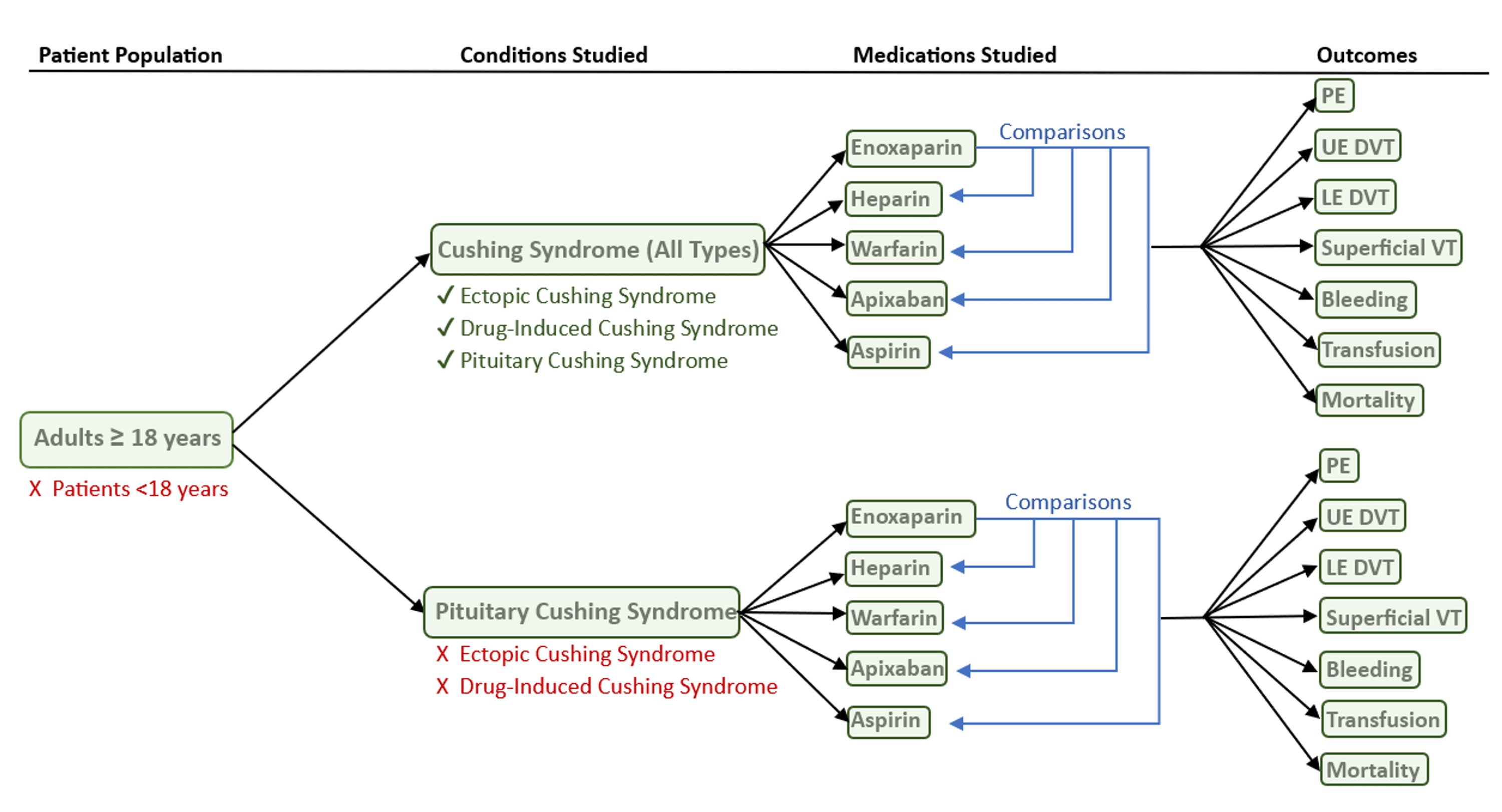
We utilized TriNetX US Collaborative Network (TriNetX, LLC, Cambridge, Massachusetts, United States) to investigate the efficacy of different forms of anticoagulation in patients with hypercortisolism, defined by International Classification of Diseases, Tenth Revision (ICD-10) codes. Adult patients with hypercortisolism and prescribed enoxaparin, a form of LMWH, were compared to patients with hypercortisolism prescribed unfractionated heparin, warfarin, apixaban, and aspirin at 81 mg. Groups were propensity-matched according to age at index event, sex, race, ethnicity, and comorbid conditions. The outcomes studied included pulmonary embolism (PE), upper extremity deep vein thrombosis (UE DVT), lower extremity deep venous thrombosis (LE DVT), superficial venous thrombosis (superficial VT), bleeding, transfusion, and all-cause mortality.

Results

No significant differences in outcomes were noted between enoxaparin and heparin, warfarin, or apixaban in patients with hypercortisolism of any cause. Uniquely, the enoxaparin cohort had significantly higher risk of PE, LE DVT, and all-cause mortality compared to the aspirin 81 mg cohort (PE: hazard ratio (HR) 1.697, 95%CI 1.444-1.994, p=0.0345; LE DVT: HR 1.492, 95%CI 1.28-1.738, p=0.0017; mortality: HR 1.272, 95%CI 1.167-1.386, p=0.0002). With further sub-analysis of pituitary-dependent (Cushing’s Disease), enoxaparin continued to demonstrate a higher risk for LE DVT (HR 1.677, 95%CI 1.353-2.079, p=0.0081), and all-cause mortality (HR 1.597, 95%CI 1.422-1.794, p=0.0005).

Conclusion

Although LMWH is currently recommended as the gold standard for anticoagulation in patients with hypercortisolism, our evidence suggests that low-dose antiplatelets such as aspirin 81 mg could outperform it. Further research is warranted to confirm and replicate our findings.

Introduction

Cortisol is produced within the zona fasciculata of the adrenal cortex and is typically released under stress [1]. Cushing’s Syndrome, first defined in 1912 by American neurosurgeon Harvey Cushing, is a state of prolonged hypercortisolism, presenting with classic phenotypic manifestations, including moon facies, central fat deposition, proximal limb muscle weakness and muscle wasting, and abdominal striae [2]. Cushing’s syndrome can be exogenous (medication-induced/iatrogenic) or endogenous (ectopic adrenocorticotrophic hormone (ACTH), pituitary-dependent, or adrenal adenoma/carcinoma) [3]. Pituitary adenomas causing ACTH-dependent cortisol excess account for 80% of endogenous cases of Cushing’s Syndrome and are more specifically termed Cushing’s Disease [4]. Overall, however, the most common cause of Cushing’s Syndrome is iatrogenic, from exogenous corticosteroid administration [5].

Hypercortisolism has also been demonstrated to affect coagulation, though the mechanism is unclear [6]. Both venous thromboemboli and pulmonary emboli rates are increased among these patients [7]. The Endocrine Society Guidelines for Treatment of Cushing Syndrome describe altered coagulation profiles that take up to one year to normalize [8]. As a result, limited guidelines recommend prophylactic anticoagulation in Cushing syndrome; while low-molecular-weight heparin (LMWH) is the gold standard, there is little evidence behind this recommendation [9]. Furthermore, few studies assessed individual Cushing’s Syndrome subtypes and associated clotting risks or anticoagulation impact. It is currently unknown whether the antagonistic effects of cortisol will be augmented or hindered by anticoagulation other than LMWH.

This retrospective multicenter study aimed to address this paucity in data by analyzing differences among various forms of anticoagulation. Patients with Cushing syndrome who were on one of three common anticoagulants, or aspirin, were compared to patients with Cushing’s Syndrome on enoxaparin, an LMWH considered the gold standard for prophylaxis in this population. Primary objectives included end-points concerning thromboses (such as pulmonary embolism (PE), upper and lower extremity deep vein thromboses (DVTs), and superficial venous thrombosis (VT)). Secondary objectives included analyzing safety profiles (bleeding, transfusion requirements, and all-cause mortality).

Materials & Methods

Eligibility criteria

TriNetX Global Collaborative network (TriNetX, LLC, Cambridge, Massachusetts, United States), a nationwide database of de-identified health data across multiple large healthcare organizations (HCOs), was utilized to compile patients according to International Classification of Diseases, Tenth Revision (ICD-10) codes (Figure 1).
Flow-chart-for-inclusion-and-exclusion-criteria-for-the-study

ICD-10 codes included those related to Cushing’s Syndrome and one of five studied medications: enoxaparin, heparin, apixaban, warfarin, and aspirin, included in Tables 1 and 2, respectively. ICD-10 codes also included those related to outcomes, including PE, upper extremity (UE) DVT, lower extremity (LE) DVT, superficial VT, bleeding, transfusion, and all-cause mortality (Table 3). Measures of association involved calculating risk differences and relative risks (RRs) with 95% confidence intervals (CIs) to compare the proportion of patients experiencing each outcome across cohorts.

Cushing’s Syndrome Type ICD-10 Code
Cushing Syndrome (unspecified) Drug-Induced Cushing Syndrome (UMLS:ICD10CM:E24.2)
Other Cushing Syndrome (UMLS:ICD10CM:E24.8)
Cushing Syndrome, Unspecified (UMLS:ICD10CM:E24.9)
Pituitary-Dependent Cushing Disease (UMLS:ICD10CM:E24.0)
Cushing Syndrome (UMLS:ICD10CM:E24)
Ectopic ACTH Syndrome (UMLS:ICD10CM:E24.3)
Cushing Syndrome (pituitary) Pituitary-Dependent Cushing Disease (UMLS:ICD10CM:E24.0  )
Medication ICD-10 Code
Enoxaparin NLM:RXNORM:67108
Warfarin NLM:RXNORM:11289
Heparin NLM:RXNORM:5224
Apixaban NLM:RXNORM:1364430
Aspirin NLM:RXNORM:1191
Outcome ICD-10 Codes
Pulmonary Embolism Pulmonary Embolism UMLS:ICD10CM:I26
Upper Extremity DVT Acute embolism and thrombosis of deep veins of unspecified upper extremity UMLS:ICD10CM:I82.629
Chronic embolism and thrombosis of deep veins of unspecified upper extremity UMLS:ICD10CM:I82.729
Acute embolism and thrombosis of deep veins of right upper extremity UMLS:ICD10CM:I82.621
Acute embolism and thrombosis of deep veins of left upper extremity UMLS:ICD10CM:I82.622
Acute embolism and thrombosis of deep veins of upper extremity, bilateral UMLS:ICD10CM:I82.623
Chronic embolism and thrombosis of deep veins of right upper extremity UMLS:ICD10CM:I82.721
Chronic embolism and thrombosis of deep veins of left upper extremity UMLS:ICD10CM:I82.722
Chronic embolism and thrombosis of deep veins of upper extremity, bilateral UMLS:ICD10CM:I82.723
Lower Extremity DVT Acute embolism and thrombosis of unspecified deep veins of unspecified lower extremity UMLS:ICD10CM:I82.409
Chronic embolism and thrombosis of unspecified deep veins of unspecified lower extremity UMLS:ICD10CM:I82.509
Chronic embolism and thrombosis of unspecified deep veins of lower extremity UMLS:ICD10CM:I82.50
Chronic embolism and thrombosis of unspecified deep veins of lower extremity, bilateral UMLS:ICD10CM:I82.503
Acute embolism and thrombosis of unspecified deep veins of lower extremity UMLS:ICD10CM:I82.40
Acute embolism and thrombosis of unspecified deep veins of left lower extremity UMLS:ICD10CM:I82.402
Acute embolism and thrombosis of unspecified deep veins of right lower extremity UMLS:ICD10CM:I82.401
Chronic embolism and thrombosis of unspecified deep veins of left lower extremity UMLS:ICD10CM:I82.502
Chronic embolism and thrombosis of unspecified deep veins of right lower extremity UMLS:ICD10CM:I82.501
Chronic embolism and thrombosis of left femoral vein UMLS:ICD10CM:I82.512
Chronic embolism and thrombosis of right femoral vein UMLS:ICD10CM:I82.511
Acute embolism and thrombosis of right iliac vein UMLS:ICD10CM:I82.421
Chronic embolism and thrombosis of femoral vein, bilateral UMLS:ICD10CM:I82.513
Chronic embolism and thrombosis of unspecified deep veins of unspecified distal lower extremity UMLS:ICD10CM:I82.5Z9
Chronic embolism and thrombosis of unspecified tibial vein UMLS:ICD10CM:I82.549
Acute embolism and thrombosis of deep veins of lower extremity UMLS:ICD10CM:I82.4
Chronic embolism and thrombosis of deep veins of lower extremity UMLS:ICD10CM:I82.5
Chronic embolism and thrombosis of other specified deep vein of unspecified lower extremity UMLS:ICD10CM:I82.599
Acute embolism and thrombosis of unspecified deep veins of unspecified proximal lower extremity UMLS:ICD10CM:I82.4Y9
Superficial VT Embolism and thrombosis of superficial veins of unspecified lower extremity UMLS:ICD10CM:I82.819
Acute embolism and thrombosis of superficial veins of unspecified upper extremity UMLS:ICD10CM:I82.619
Chronic embolism and thrombosis of superficial veins of unspecified upper extremity UMLS:ICD10CM:I82.719
Bleeding Hematemesis UMLS:ICD10CM:K92.0
Hemoptysis UMLS:ICD10CM:R04.2
Hemorrhage from respiratory passages UMLS:ICD10CM:R04
Hemorrhage from other sites in respiratory passages UMLS:ICD10CM:R04.8
Hemorrhage from other sites in respiratory passages UMLS:ICD10CM:R04.89
Melena UMLS:ICD10CM:K92.1
Hemorrhage of anus and rectum UMLS:ICD10CM:K62.5
Epistaxis UMLS:ICD10CM:R04.0
Transfusion Transfusion of Nonautologous Whole Blood into Peripheral Vein, Percutaneous Approach UMLS:ICD10PCS:30233H1
Transfusion of Nonautologous Whole Blood into Central Vein, Percutaneous Approach UMLS:ICD10PCS:30243H1
Transfusion of Nonautologous Red Blood Cells into Peripheral Vein, Percutaneous Approach UMLS:ICD10PCS:30233N1
Transfusion, blood or blood components UMLS:CPT:36430
Transfusion of Nonautologous Red Blood Cells into Central Vein, Percutaneous Approach UMLS:ICD10PCS:30243N1
Transfusion of Nonautologous Frozen Red Cells into Peripheral Vein, Percutaneous Approach UMLS:ICD10PCS:30233P1
Transfusion of Nonautologous Red Blood Cells into Peripheral Artery, Percutaneous Approach (deprecated 2020) UMLS:ICD10PCS:30253N1
Transfusion of Nonautologous Frozen Red Cells into Central Vein, Percutaneous Approach UMLS:ICD10PCS:30243P1
Transfusion of Nonautologous Red Blood Cells into Central Artery, Percutaneous Approach (deprecated 2020) UMLS:ICD10PCS:30263N1
Transfusion of Nonautologous Frozen Red Cells into Peripheral Artery, Percutaneous Approach (deprecated 2020) UMLS:ICD10PCS:30253P1
Transfusion of Nonautologous Frozen Red Cells into Central Artery, Percutaneous Approach (deprecated 2020) UMLS:ICD10PCS:30263P1
Transfusion of blood product UMLS:SNOMED:116859006
Transfusion of red blood cells UMLS:SNOMED:116863004
Mortality Deceased Deceased (demographic)

Cohort definitions

For each medication listed, two cohorts were compared: (i) a cohort of patients with hypercortisolism on enoxaparin and (ii) a cohort of patients with hypercortisolism on heparin, warfarin, apixaban, or aspirin at 81 mg (Table 4). The cohorts strictly assessed only adult patients (defined as at least 18 years of age); pediatric patients were not analyzed.

Cohort Run
Enoxaparin 146 HCOs with 99 providers responding with 12,885 patients
Heparin 145 HCOs with 97 providers responding with 16,376 patients
Warfarin 145 HCOs with 82 providers responding with 3,230 patients
Apixaban 146 HCOs with 91 providers responding with 3,982 patients
Aspirin (81 mg) 144 HCOs with 51 providers responding with 8,200 patients

Statistical analysis

Index events and time windows were defined to analyze patient outcomes. The index event was defined as the first date a patient met the inclusion criteria for a cohort. The time window was defined as the five years after the index event during which a pre-defined outcome could occur. Outcomes of interest were identified using ICD-10 codes as outlined in Table 1, and included PE, UE DVT, LE DVT, superficial VT, bleeding, transfusion, and all-cause mortality. Cohorts were propensity score-matched 1:1 according to age at index event, sex, race and ethnicity, and comorbid conditions, including endocrine, cardiac, pulmonary, gastrointestinal, and genitourinary conditions (Table 5). Propensity score-matching was performed using TriNetX, with a greedy (nearest) neighbor matching algorithm (caliper of 0.1 pooled standard deviations).

Variable ICD-10 Code
Demographics Age at Index (AI)
Female (F)
Black/African American (2054-5)
Male (M)
White (2106-3)
American Indian/Alaskan Native (1002-5)
Unknown Race (UNK)
Native Hawaiian/Other Pacific Islander (2076-8)
Unknown Gender (UN)
Not Hispanic/Latino (2186-5)
Hispanic/Latino (2135-2)
Other Race (2131-1)
Asian (2028-9)
Diagnosis Endocrine, nutritional and metabolic diseases (E00-E89)
Factors influencing health status and contact with health services (Z00-Z99)
Diseases of the musculoskeletal system and connective tissue (M00-M99)
Diseases of the circulatory system (I00-I99)
Diseases of the digestive system (K00-K95)
Diseases of the nervous system (G00-G99)
Diseases of the respiratory system (J00-J99)
Diseases of the genitourinary system (N00-N99)
Diseases of the blood and blood-forming organs and certain disorders involving the immune mechanism (D50-D89)
Neoplasms (C00-D49)
Diseases of the skin and subcutaneous tissue (L00-L99)

Three analytical approaches were performed for this study, including measures of association, survival analysis, and frequency analysis. The measure of association analysis involved calculating RRs (and risk differences) with 95%CIs, comparing the proportion of patients across each cohort experiencing an outcome. Survival analysis was performed with Kaplan-Meier estimators (evaluating time-to-event outcomes), with Log-Rank testing incorporated to compare the survival curves. Furthermore, Cox proportional hazard models were incorporated to provide an estimate of the hazard ratios (HR) and 95%CIs. Patients who exited a cohort before the end of the time window were excluded from the survival analysis. The frequency analysis was performed by calculating the proportion of patients in each cohort who experienced an outcome during the defined period of five years.

For statistically significant associations, an E-value was calculated to assess the potential impact of unmeasured confounders, quantifying the minimum strength of association that would be required by an unmeasured confounder to explain the observed effect (beyond our measured covariates); an E-value of above 2.0 was considered modestly robust, and above 3 was considered strongly robust. Additionally, a limited sensitivity analysis assessing Pituitary Cushing’s (the most common cause of endogenous Cushing’s Syndrome) was performed. All analyses were conducted through TriNetX, with statistical significance defined as a p-value < 0.05.

Results

Cushing’s syndrome, unspecified

Enoxaparin and Heparin

After propensity-score matching, 8,658 patients were identified in each cohort. The average age at index event for the enoxaparin cohort was 54.5 + 16.5 years, compared to 53.1 + 17.3 years for the heparin cohort. The enoxaparin cohort had 6,216 females (71.8%), compared to 6,000 (69.3%) in the heparin cohort. Within the enoxaparin cohort, 6035 (69.7%) were Caucasian patients, followed by 987 (11.4%) African American patients, 753 (8.7%) Hispanic/Latino patients, and 216 (2.5%) Asian patients. The heparin cohort was similar in ethnicity, with 5,800 (67.0%) Caucasian patients, 1,099 (12.7%) African American patients, 753 (8.7%) Hispanic/Latino patients, and 268 (3.1%) Asian patients. The enoxaparin and heparin cohorts demonstrated no significant differences in PE (HR 1.171, 95%CI 1.017-1.348, p=0.1797), UE DVT (HR 1.067, 95%CI 0.837-1.362, p=0.8051), LE DVT (HR 1.066, 95%CI 0.931-1.222, p=0.1922), superficial VT (HR 0.974, 95%CI 0.672-1.41, p=0.4576), bleeding (HR 0.948, 95%CI 0.855-1.05, p=0.3547), transfusion (HR 0.873, 95%CI 0.786-0.969, p=0.1767), or all-cause mortality (HR 1.036, 95%CI 0.966-1.11, p=0.9954). A comprehensive summary of the results is demonstrated in Table 6.

p-value Medication 1 Medication 2 PE UE DVT LE DVT S VT Bleeding Transfusion Mortality
enoxaparin heparin 0.1797 0.8051 0.1922 0.4576 0.3547 0.1767 0.9954
enoxaparin warfarin 0.3828 0.6 0.1963 0.0995 0.7768 0.5715 0.15
enoxaparin apixaban 0.6491 0.6275 0.723 0.4198 0.4356 0.4299 0.2628
enoxaparin aspirin 81 mg 0.0345 0.587 0.0017 0.4218 0.246 0.2057 0.0002
HR Medication 1 Medication 2 PE UE DVT LE DVT S VT Bleeding Transfusion Mortality
enoxaparin heparin 1.171 1.067 1.066 0.974 0.948 0.873 1.036
enoxaparin warfarin 0.936 0.969 0.708 0.655 0.961 1.127 1.042
enoxaparin apixaban 0.798 0.666 0.684 4.059 0.933 1.089 1.041
enoxaparin aspirin 81 mg 1.697 1.398 1.492 1.718 1.107 1.347 1.272
95% CIs Medication 1 Medication 2 PE UE DVT LE DVT Superficial VT Bleeding Transfusion Mortality
enoxaparin heparin 1.017-1.348 0.837-1.362 0.931-1.222 0.672-1.41 0.855-1.05 0.786-0.969 0.966-1.11
enoxaparin warfarin 0.755-1.161 0.692-1.356 0.583-0.859 0.376-1.142 0.812-1.137 0.95-1.336 0.93-1.167
enoxaparin apixaban 0.608-1.047 0.431-1.03 0.593-0.788 1.156-14.258 0.771-1.129 0.892-1.33 0.912-1.189
enoxaparin aspirin 81 mg 1.444-1.994 1.06-1.845 1.28-1.738 1.011-2.92 0.986-1.243 1.185-1.532 1.167-1.386

Enoxaparin and Warfarin

After propensity-score matching, 2,786 patients were identified in each cohort. The average age at index event for the enoxaparin cohort was 54.8 + 16.4 years, compared to 58.9 + 15.9 years for the warfarin cohort. The enoxaparin cohort had 2,020 female patients (72.5%) compared to 1,861 (66.8%) in the warfarin cohort. Within the enoxaparin cohort, 2,000 (71.8%) were Caucasian patients, followed by 334 (12.0%) African American patients, 220 (7.98%) Hispanic/Latino patients, and 64 (2.3%) Asian patients. The warfarin cohort was similar, with 2,056 (73.8%) Caucasian patients, 312 (11.2%) African American patients, 170 (6.1%) Hispanic/Latino patients, and 92 (3.3%) Asian patients. The enoxaparin and warfarin cohorts demonstrated no significant differences in PE (HR 0.936, 95%CI 0.755-1.161, p=0.3828), UE DVT (HR 0.969, 95%CI 0.692-1.356, p=0.6), LE DVT (HR 0.708, 95%CI 0.583-0.859, p=0.1963), superficial VT (HR 0.655, 95%CI 0.376-1.142, p=0.0995), bleeding (HR 0.961, 95%CI 0.812-1.137, p=0.7768), transfusion (HR 1.127, 95%CI 0.95-1.336, p=0.5715), or all-cause mortality (HR 1.042, 95%CI 0.93-1.167, p=0.15) (Table 6).

Enoxaparin and Apixaban

After propensity-score matching, 2,429 patients were identified in each cohort. The average age at index event for the enoxaparin cohort was 54.6 + 16.4 years, compared to 61.2 + 15.2 years for the apixaban cohort. The enoxaparin cohort had 1,746 female patients (71.9%) compared to 1,571 (64.7%) in the apixaban cohort. Within the enoxaparin cohort, 1632 (67.2%) were Caucasian patients, 318 (13.1%) African American patients, 219 (9.0%) Hispanic/Latino patients, and 68 (2.8%) Asian patients. A similar composition was noted in the apixaban cohort, with 1,683 (69.3%) Caucasian patients, 321 (13.2%) African American patients, 141 (5.8%) Hispanic/Latino patients, and 53 (2.2%) Asian patients. The enoxaparin and apixaban cohorts demonstrated no significant differences in PE (HR 0.798, 95%CI 0.608-1.047, p=0.6491), UE DVT (HR 0.666, 95%CI 0.431-1.03, p=0.6275), LE DVT (HR 0.684, 95%CI 0.593-0.788, p=0.723), superficial VT (HR 4.059, 95%CI 1.156-14.258, p=0.4198), bleeding (HR 0.933, 95%CI 0.771-1.129, p=0.4356), transfusion (HR 1.089, 95%CI 0.892-1.33, p=0.4299), or all-cause mortality (HR 1.041, 95%CI 0.912-1.189, p=0.2628) (Table 6).

Enoxaparin and Aspirin 81 mg

After propensity-score matching, 6,433 patients were identified in each cohort. The average age at index event for the enoxaparin cohort was 54.5 + 16.6 years, compared to the aspirin 81 mg cohort at 58.8 + 14.9 years. The enoxaparin cohort had 4664 female patients (72.5%) compared to 4,445 (69.1%) in the aspirin 81 mg cohort. Within the enoxaparin cohort, 4,522 (70.3%) were Caucasian patients, followed by 766 (11.9%) African American patients, 521 (8.1%) Hispanic/Latino patients, and 193 (3.0%) Asian patients. Similar demographics were noted within the Aspirin 81 mg cohort, with 4,670 (72.6%) Caucasian patients, 817 (12.7%) African American patients, 425 (6.6%) Hispanic/Latino patients, and 167 (2.6%) Asian patients. The enoxaparin cohort demonstrated a significantly higher risk of PE (HR 1.697, 95%CI 1.444-1.994, p=0.0345), LE DVT (HR 1.492, 95%CI 1.28-1.738, p=0.0017), and all-cause mortality (HR 1.272, 95%CI 1.167-1.386, p=0.0002) compared to the aspirin 81 mg cohort (Figure 2). There was no significant difference in rates of UE DVT (HR 1.398, 95%CI 1.06-1.845, p=0.587), superficial VT (HR 1.718, 95%CI 1.011-2.92, p=0.4268), bleeding (HR 1.107, 95%CI 0.986-1.243, p=0.246), or transfusion (HR 1.347, 95%CI 1.185-1.532, p=0.2057) (Table 6). Due to a significant difference between enoxaparin and Aspirin 81 mg, an E-value was calculated for PE (E-value = 2.783), LE DVT (E-value = 2.348), and all-cause mortality (E-value = 1.860).
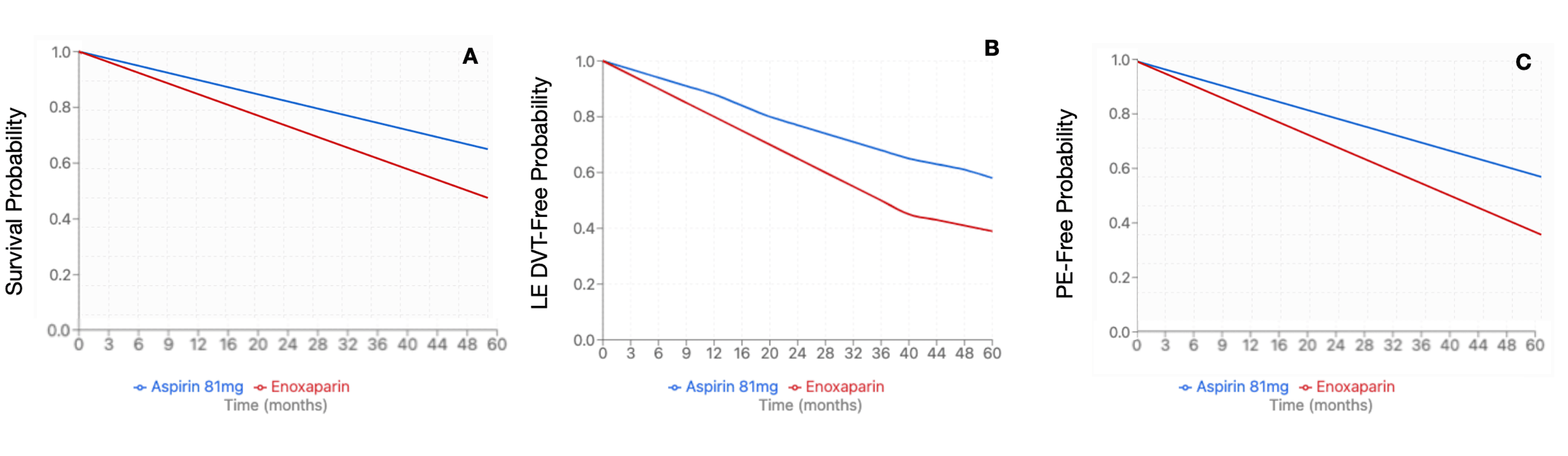
Kaplan-Meier-survival-curve-for-pituitary-Cushing's-subtype-(mortality,-LE-DVT,-and-PE)

Pituitary hypercortisolism (Cushing’s disease)

Enoxaparin and Heparin

Propensity-score matching identified 5,602 patients per cohort. The average age at index for the enoxaparin cohort was 53.9 + 16.7 years, compared to 53.7 + 16.9 years in the heparin cohort. The enoxaparin cohort had 4,088 female patients (72.97%) compared to 4,066 (72.58%) in the heparin cohort. The enoxaparin cohort was predominantly Caucasian patients (n=3,948; 70.47%), followed by 641 (11.45%) African American patients, 424 (7.57%) Hispanic/Latino patients, and 139 (2.48%) Asian patients. The heparin cohort was also predominantly Caucasian (n=3,947; 70.46%), followed by 669 (11.94%) African American patients, 401 (7.16%) Hispanic/Latino patients, and 148 (2.64%) Asian patients. There were no significant differences in rates of PE (HR 1.208, 95%CI 1.007 – 1.451, p=0.5803), UE DVT (HR 1.156, 95%CI 0.841 – 1.59, p=0.6863), LE DVT (HR 1.246, 95%CI 1.063 – 1.46, p=0.8996), superficial VT (HR 1.347, 95%CI 0.874 – 2.075, p=0.3731), bleeding (HR 0.916, 95%CI 0.809 – 1.037, p=0.1578), transfusion (HR 0.912, 95%CI 0.798 – 1.042, p=2119), or all-cause mortality (HR 1.02, 95%CI 0.935 – 1.112, p=0.8734). A comprehensive summary of the results is demonstrated in Table 7.

p-value Medication 1 Medication 2 PE UE DVT LE DVT Superficial VT Bleeding Transfusion Mortality
enoxaparin heparin 0.5189 0.2468 0.7586 0.7708 0.5894 0.6273 0.8433
enoxaparin warfarin 0.4842 0.7763 0.9651 0.682 0.1996 0.5309 0.399
enoxaparin apixaban 0.1047 0.0423 0.647 0.4824 0.2698 0.1122 0.1044
enoxaparin aspirin 81 mg 0.9651 0.6358 0.8448 0.9765 0.1167 0.4854 0.5001
HR Medication 1 Medication 2 PE UE DVT LE DVT Superficial VT Bleeding Transfusion Mortality
enoxaparin heparin 1.186 1.332 1.232 1.183 0.876 0.963 1.016
enoxaparin warfarin 0.804 0.76 0.688 0.815 1.008 1.009 0.976
enoxaparin apixaban 0.875 0.761 0.954 3.068 1.084 1.359 1.115
enoxaparin aspirin 81 mg 1.173 1.157 1.226 1.165 0.908 0.915 1.028
95% CIs Medication 1 Medication 2 PE UE DVT LE DVT Superficial VT Bleeding Transfusion Mortality
enoxaparin heparin 0.983-1.433 0.941-1.885 1.032-1.47 0.776-1.803 0.769-0.998 0.808-1.147 0.929-1.112
enoxaparin warfarin 0.612-1.055 0.467-1.235 0.539-0.877 0.447-1.489 0.816-1.246 0.76-1.34 0.843-1.13
enoxaparin apixaban 0.659-1.162 0.456-1.271 0.736-1.236 0.843-11.166 0.845-1.381 0.962-1.921 0.944-1.317
enoxaparin aspirin 81mg 0.969-1.419 0.827-1.619 1.03-1.46 0.763-1.78 0.797-1.035 0.772-1.085 0.938-1.127

Enoxaparin and Warfarin

Propensity-score matching was performed with 1,694 patients per cohort identified. The average age at index for the enoxaparin cohort was 58.1 + 15.8 years, compared to 58.1 + 15.9 years in the warfarin cohort. The enoxaparin cohort had 1,142 female patients (67.41%) compared to 1,143 (67.47%) in the warfarin cohort. Within the enoxaparin cohort, 1,224 (72.2%) were Caucasian patients, followed by 194 (11.45%) African American patients, 97 (5.73%) Hispanic/Latino patients, and 57 (3.37%) Asian patients. The warfarin cohort had similar demographics, with 1,223 (72.2%) Caucasian patients, followed by 194 (11.45%) African American patients, 102 (6.02%) Hispanic/Latino patients, and 65 (3.84%) Asian patients. There were no significant differences in rates of PE (HR 0.907, 95%CI 0.694 – 1.186, p=0.8117), UE DVT (HR 0.988, 95%CI 0.628 – 1.555, p=0.9848), LE DVT (HR 0.739, 95%CI 0.589 – 0.929, p=0.4445), superficial VT (HR 0.815, 95%CI 0.44 – 1.511, p=0.8098), bleeding (HR 1.001, 95%CI 0.814 – 1.231, p=0.0987), transfusion (HR 1.106, 95%CI 0.889 – 1.376, p=0.4904), or all-cause mortality (HR 0.951, 95%CI 0.83 – 1.089, p=0.1656) (Table 7).

Enoxaparin and Apixaban

Propensity-score matching identified 1,489 patients per cohort. The enoxaparin cohort was 61.1 + 15.1 years old at the index event, versus the apixaban cohort at 61.4 + 14.9 years. The enoxaparin cohort had 1,054 (70.79%) female patients compared with 1,029 (69.11%) in the apixaban cohort. The enoxaparin cohort was primarily Caucasian patients (n=1,105; 74.21%), followed by 179 (12.02%) African American patients, 74 (4.97%) Hispanic/Latino patients, and 27 (1.81%) Asian patients. The apixaban cohort demonstrated similar demographics with 1,080 (72.53%) Caucasian patients, followed by 180 (12.09%) African American patients, 76 (5.1%) Hispanic/Latino patients, and 27 (1.81%) Asian patients. There were no significant differences in rates of PE (HR 0.949, 95%CI 0.673 – 1.339, p=0.4372), UE DVT (HR 0.832, 95%CI 0.472 – 1.466, p=0.1538), LE DVT (HR 1.166, 95%CI 0.869 – 1.566, p=0.8595), superficial VT (HR 5.323, 95%CI 1.19 – 23.815, p=0.493), bleeding (HR 1.218, 95%CI 0.948 – 1.565, p=0.4021), transfusion (HR 1.319, 95%CI 0.993 – 1.753, p=0.1663), or all-cause mortality (HR 1.131, 95%CI 0.966 – 1.325, p=0.0839) (Table 7).

Enoxaparin and Aspirin 81 mg

Propensity-score matching revealed 3,475 patients per cohort. The enoxaparin cohort was 58.8 + 15.3 years at index event, compared to the aspirin cohort at 58.2 + 14.3 years. The enoxaparin cohort had 2,438 (70.16%) female patients compared to the aspirin cohort with 2,445 (70.36%). Within the enoxaparin cohort, 2,539 (73.06%) were Caucasian patients, followed by 378 (10.88%) African American patients, 182 (5.24%) Hispanic/Latino patients, and 74 (2.13%) Asian patients. The aspirin cohort demonstrated similar demographics with 2,554 (73.5%) Caucasian patients, followed by 363 (10.45%) African American patients, 196 (5.64%) Hispanic/Latino patients, and 68 (1.96%) Asian patients. The enoxaparin cohort demonstrated significantly increased risk of LE DVT (HR 1.677, 95%CI 1.353 – 2.079, p=0.0081) and all-cause mortality (HR 1.597, 95%CI 1.422 – 1.794, p=0.0005) (Figure 3). There were no significant differences in rates of PE (HR 1.74, 95%CI 1.354 – 2.236, p=0.2408), UE DVT (HR 1.773, 95%CI 1.108 – 2.837, p=0.8625), superficial VT (HR 4.273, 95%CI 1.969 – 9.273, p=0.5196), bleeding (HR 1.093, 95%CI 0.937 – 1.275, p=0.8554), or transfusion (HR 1.896, 95%CI 1.556 – 2.311, p=0.2609) (Table 7). Due to a significant difference between enoxaparin and Aspirin 81 mg, an E-value was calculated for LE DVT (E-value = 2.744) and all-cause mortality (E-value = 2.574).
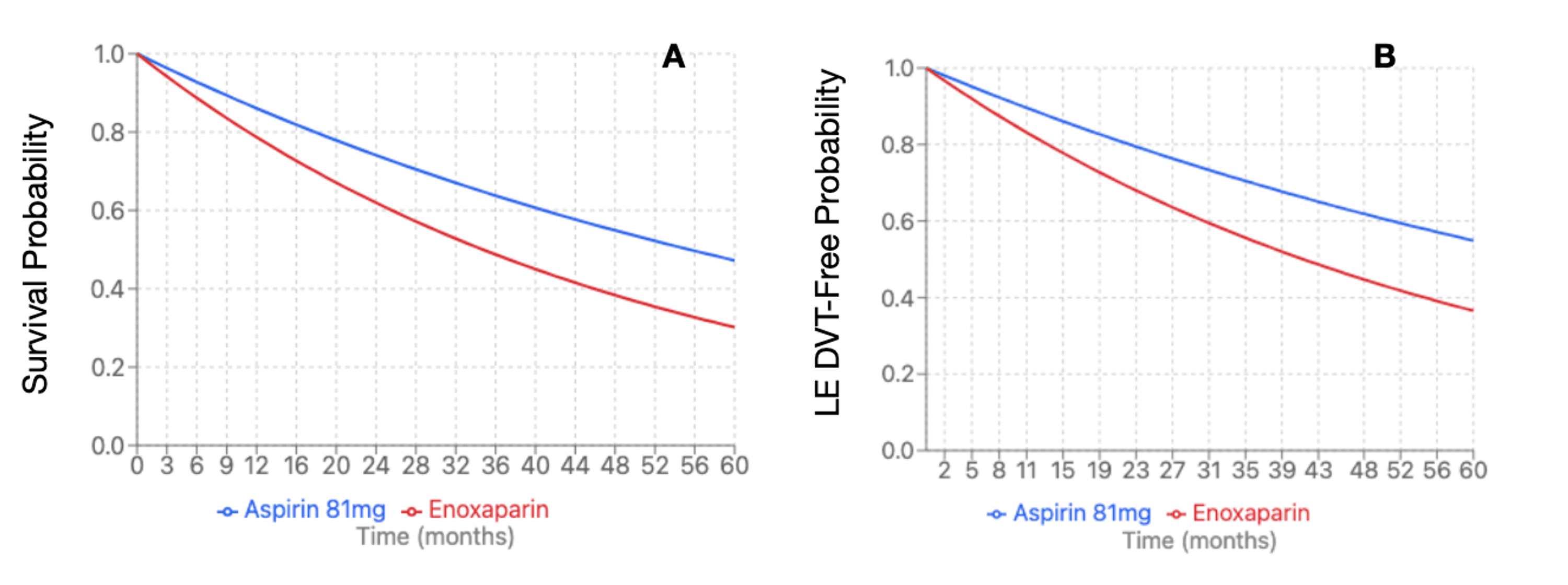
Kaplan-Meier-survival-curve-for-pituitary-Cushing's-subtype-(mortality-and-LE-DVT)

Discussion

The concept of hypercoagulability in the setting of hypercortisolemia has been documented since the 1970s [10]. Estimates suggest an 18-fold risk of venous thromboembolism in patients with Cushing’s syndrome compared to the general population [11]. Furthermore, venous thromboembolism accounts for up to 11% of all deaths in Cushing’s syndrome [12]. Patients are often noted to have a “coagulation paradox” in Cushing’s syndrome, whereby there is a heightened risk for thrombosis, with concurrent bruising of the skin; thromboembolism is due to an imbalance between pro- and anti-coagulant pathways, whereas bruising is due to atrophy of the skin and capillary fragility [11]. As noted by Feelders and Nieman, two prominent phases for the development of thromboembolic events include the untreated (active) hypercortisolemia and the postoperative phases [11]. Population-based studies have demonstrated a heightened risk for venous thromboembolism prior to diagnosis (in some studies as early as three years before diagnosis) [9].

Despite this heightened risk for venous thromboembolic events, there appears to be a lack of awareness amongst institutions (and individual practitioners), along with improper management. Fleseriu and colleagues, however, do note that in 2020, the awareness of hypercoagulability in Cushing’s syndrome increased around fourfold in two years, with routine prophylaxis increasing to 75% (from 50%) perioperatively (however, most patients only received prophylaxis for up to two weeks postoperatively) [13]. Another survey was performed by the European Reference Network on Rare Endocrine Conditions, noting concerns of heterogeneity with timing, type, and duration of prophylaxis, noting most centers do not have a thromboprophylaxis protocol (identifying only one reference center had a standardized thromboprophylaxis protocol for Cushing’s syndrome) [14]. From the European survey, it was noted that prophylaxis was initiated at diagnosis in 48% of patients, with 17% preoperatively, 26% on the day before (or of) surgery, 13% postoperatively, and 9% “depending on the presentation”. With regards to discontinuation of thromboprophylaxis, in centers with a standardized protocol (35% of reference centers), 38% of centers stopped at one month post-operatively, 25% between two and four weeks, and 37% between one week before and two weeks after surgery, between four and six days postoperatively, and at three months postoperatively. When cessation was individualized (in the remaining 65% of reference centers), 60% discontinued thromboprophylaxis once the patient was mobile, 40% with achievement of remission, 27% regarding patient status, and 7% dependent upon hemostatic parameters [14].

There is limited guidance concerning thromboprophylaxis recommendations in Cushing’s syndrome. For example, the Endocrine Society merely recommends assessing the risk of thrombosis in Cushing’s syndrome and administering perioperative prophylaxis if undergoing surgery, but provides no further recommendations [8]. The Pituitary Society highlights the absence of standardized practice for both pre- and postoperative thromboprophylaxis in patients with Cushing’s syndrome [15]. There appears to only be one set of guidelines for thromboprophylaxis in Cushing’s syndrome, known as the “Delphi Panel Consensus”, which forms the basis for the guidelines from the European Society for Endocrinology [9]. The Delphi Panel Consensus recommends considering anticoagulation for all patients with Cushing’s syndrome (in the absence of contraindications), regardless of the underlying etiology, and is recommended in the presence of risk factors [9]. Moreover, thromboprophylaxis is advised to begin at the time of diagnosis [9]. Currently, there is not enough evidence to provide a recommendation for thromboprophylaxis in mild autonomous cortisol secretion [9]. As with any medical patient, thromboprophylaxis should be initiated in all patients with active Cushing’s syndrome who are hospitalized (without contraindications) [9, 15]. Apart from chemical prophylaxis, anti-embolic stockings are not recommended due to the risk of skin fragility and friability [9]. The Delphi Consensus Panel furthermore advises to continue prophylactic anticoagulation for at least three months after biochemical remission (eucortisolemia) has occurred, and note those without additional risk factors (such as obesity, immobility, prior history of venous thromboembolism, or cardiac risk factors) can be considered candidates to stop the medication; one caveat, however, is for patients medically managed with mitotane (which can alter liver function and coagulation factor metabolism), there is an increased risk of bleeding, for which careful monitoring of renal function and bleeding risk is advised [9]. The Pituitary Society provides additional recommendations, such as discontinuing estrogen therapy in women (if used for contraception) [15]. While the Delphi Consensus Panel does not comment upon pediatric patients, the Pituitary Society advises against the use of thromboprophylaxis in the pediatric population due to bleeding risks [15].

The Delphi Consensus Panel furthermore recommend considering thromboprophylaxis at the time of inferior petrosal sinus sampling (if not started before this), due to the risk of thrombosis associated with this intervention; for those who are receiving prophylaxis, it is recommended to continue throughout the procedure, however, if has not been started, it is advised to initiate 12 hours post procedure. Similarly, if thromboprophylaxis was not considered earlier in a patient’s course, it should be reconsidered in the perioperative period, with the last dose of LMWH administered 24 hours prior to surgery and reinitiated 24 hours postoperatively [9]. Isand et al. recommend continuing thromboprophylaxis for three months after cortisol levels normalize (< 5 μg/dL) and when patients can mobilize [9]. In patients for whom a venous thromboembolism develops, patients are advised to receive a therapeutic dose of anticoagulation (preferably LMWH) for three to six months, followed by prophylaxis for three months after resolution of Cushing’s syndrome [9]. The Delphi Consensus Panel provides a summary of their recommendations, shown in Figure 4.
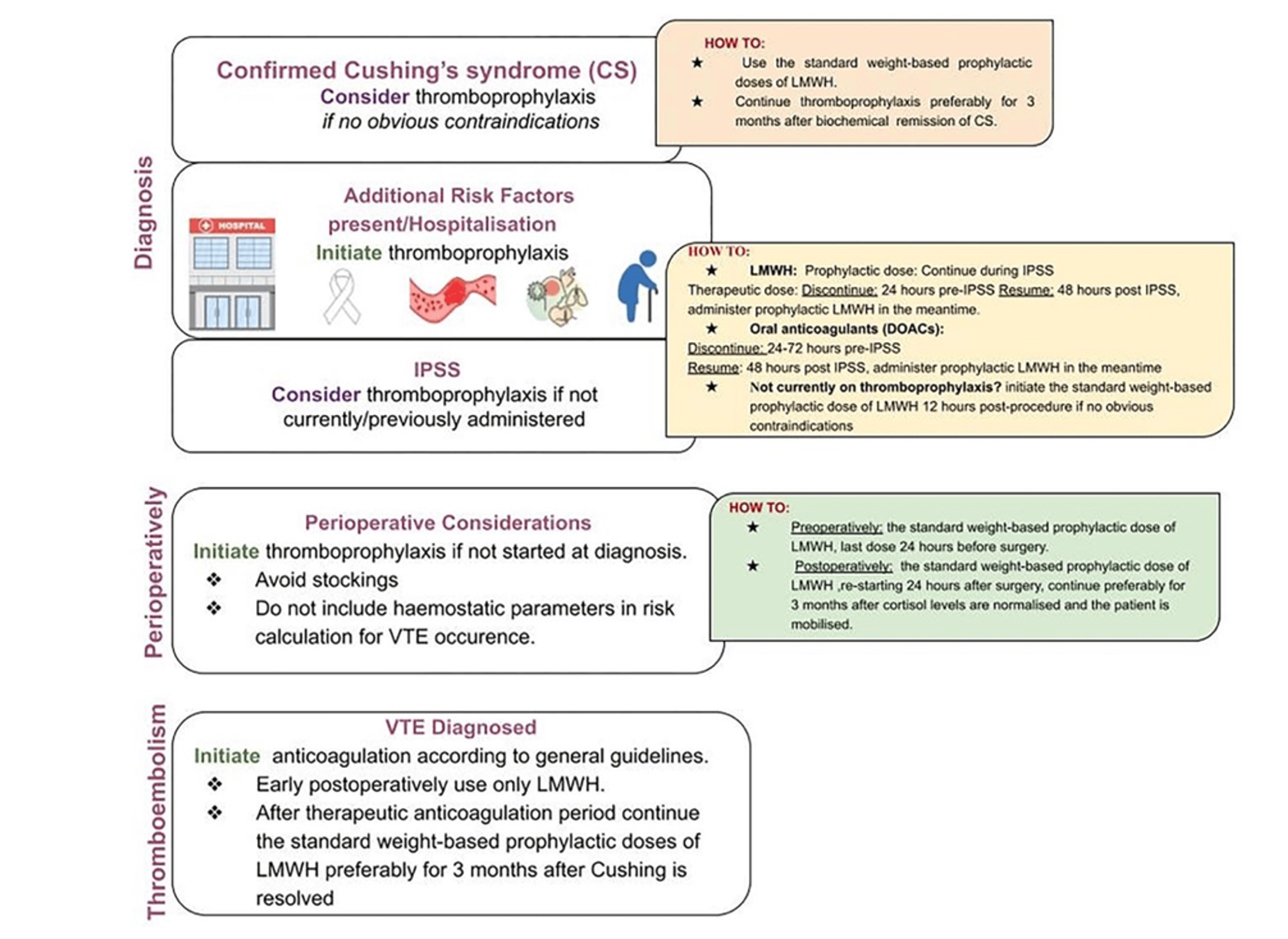
Algorithm-for-thromboprophylaxis-in-Cushing's-syndrome

Although intuitively, one may expect the procoagulant profile of Cushing’s syndrome to resolve upon attainment of eucortisolemia with medical management, studies have failed to demonstrate a reduction in venous thromboembolism with medical therapy [16]. Additionally, while one may expect resolution of hypercoagulability with surgical intervention (transsphenoidal sinus surgery or adrenalectomy), the risk maintains in the postoperative period, comparable to that of orthopedic surgery, at times up to one year and beyond to normalize [17]; data from European Register on Cushing’s Syndrome (ERCUSYN) database suggest the risk is greatest six months postoperatively [18]. The estimated risk for postoperative venous thromboembolism in pituitary-dependent Cushing’s is around 4.3% (compared to 0% with a non-functional pituitary adenoma); regarding adrenal surgery, the risk is estimated at around 2.6% [11]. Although the underlying mechanism for the persistent risk for venous thromboembolism remains unknown, it is hypothesized that a sudden drop in cortisol can lead to an inflammatory response (itself activating the coagulation cascade) [16]. Lopes and colleagues note an increase in the number of lymphocytes (because of loss of Th1 cell suppression), with increases in cytokines (such as interferon-gamma, interleukin-2, and transforming growth factor-beta) [16]. Comorbidities such as osteoporosis and myopathy (from hypercortisolemia) may be associated with decreased mobility in the postoperative period, influencing the risk for thrombosis [16].

Whilst all subtypes of Cushing’s syndrome can be associated with a heightened risk for venous thromboembolism (pituitary adenoma, adrenal adenoma, medication-induced, ectopic ACTH, and adrenal carcinoma), the latter two are often associated with malignant disease, which itself poses a risk for hypercoagulability from the underlying neoplasm [11]. Patients with Cushing’s syndrome have been found to demonstrate a reduction in activated partial thromboplastin time (aPTT), alongside increases in clot lysis time, procoagulant factors (such as factor VIII, von-Willebrand factor and fibrinogen) and fibrinolysis inhibitors (including plasminogen activator-inhibitor-1, thrombin activatable fibrinolysis inhibitor, and alpha-2 antiplasmin) [11,12,17]. Varlamov et al. have also noted an increase in thrombin, thromboxane A2, and platelets. Other studies have additionally demonstrated elevated proteins C and S as well as antithrombin III, which are hypothesized to be increased as a compensatory mechanism from the state of hypercoagulability [12]. Barbot et al. demonstrate elevation in factor VIII and von-Willebrand factor within the first few months after transsphenoidal sinus surgery, along with abnormally large von-Willebrand multimers (which are typically found in the cellular components), which can induce spontaneous platelet aggregation [17].

Lopes et al. note that altered von-Willebrand factor levels are not a constant feature reported in Cushing’s syndrome, and state it depends upon the polymorphism of the gene promoter, providing an example of haplotype 1 of the gene promoter conferring the greatest risk for elevated von-Willebrand factor levels by cortisol [16]. Barbot and colleagues furthermore note ABO blood groupings as an additional influencer of the procoagulant state; as an example, blood group-O patients have a near one-quarter reduction in levels of von-Willebrand factor [17]. Feelders and Nieman note heterogeneity in coagulation profiles based on individual characteristics and differing assay techniques [11]. van Haalen and colleagues note an absence of a correlation between severity of hypercortisolism and hemostatic abnormalities [14]; this is echoed by Varlamov et al., stating there is no linear relationship between coagulation parameters and venous thromboembolic events, nor with urinary free cortisol elevation [12]. Varlamov and colleagues further note that a subset of patients may have unaltered coagulation parameters, for which they advise against stratifying patients’ risk based on coagulation parameters [12].

In 2016, Zilio and colleagues posed a scoring system to stratify patients with active Cushing’s syndrome, including both clinical and biochemical parameters, including age (> 69 = 2 points), reduction in mobility (2 points), acute severe infection (1 point), prior cardiovascular event(s) (1 point), midnight plasma cortisol (> 3.15 times upper limit of normal = 1 point), and shortened aPTT (1 point) [19]. Lopes et al. describe the stratification as follows: 2 points (low risk), 3 points (moderate risk), 4 points (high risk), and > 5 points (very high risk) [16]. It should be noted, however, that Zilio et al.’s study was performed on only 176 patients and has not been validated in other studies [19]. Further drawbacks include the failure to account for postoperative events (a major source of venous thromboembolism in Cushing’s syndrome), and despite the stratification categories, no recommendations for treatment are provided.

LMWH is the first-line medication, consistent across differing societies. Despite being the gold standard, there are limited studies demonstrating a beneficial reduction in venous thromboembolic events in such cohorts; similarly, studies are lacking in analysis of the other classes of anticoagulants in head-to-head comparisons against LMWH for thromboprophylaxis in hypercortisolism. Another limitation is the fact that certain studies solely address thromboprophylaxis in the postoperative period. As an example, McCormick et al. performed one of the only trials comparing unfractionated heparin and LMWH (enoxaparin), noting no differences in hemorrhagic complications or thromboses; however, this was analyzed in patients undergoing transsphenoidal sinus surgery [10].

The current study retrospectively analyzed the various anticoagulant agents for the prevention of venous thromboembolism in Cushing’s syndrome (of any subtype), compared to the gold standard, LMWH (in this study, enoxaparin). When analyzing Cushing’s syndrome, our study demonstrated no significant differences in outcomes between enoxaparin and warfarin, apixaban, or unfractionated heparin; however, aspirin 81 mg demonstrated a lower risk of all-cause mortality, PE, and LE DVT. With subanalysis of Cushing’s disease (pituitary-related), there was no significant difference between enoxaparin and warfarin, apixaban or unfractionated heparin; aspirin 81 mg again noted a reduced all-cause mortality and LE DVT (but did not lower the risk of PE, compared with Cushing’s syndrome of all types combined). With E-value sensitivity analysis, the association remained moderately robust with PE (all Cushing’s types combined), LE DVT (all Cushing’s types and pituitary Cushing’s), and mortality (solely pituitary Cushing’s), however, mortality was weak-to-moderate with Cushing’s syndrome of all types (Table 8).

Outcome Hazard Ratio E-value Interpretation
PE (All Cushing’s Types) 1.697 2.783 Moderate
LE DVT (All Cushing’s Types) 1.492 2.348 Moderate
LE DVT (Pituitary) 1.677 2.744 Moderate
Mortality (All Cushing’s Types) 1.272 1.860 Weak
Mortality (Pituitary) 1.597 2.574 Moderate

Aspirin, a non-steroidal anti-inflammatory drug, was first identified to irreversibly inhibit platelet function in the 1950s by Dr. Lawrence Craven [20]. Data is scarce in terms of aspirin’s role in thromboprophylaxis in hypercortisolemia. In 1999, Semple and Laws Jr. initially reported the use of aspirin postoperatively for six weeks (starting postoperative day one) in patients with Cushing’s disease who underwent transsphenoidal sinus surgery; while the authors mentioned a reduction in rates of venous thromboemboli, no factual data was provided (including dose of aspirin, complications experienced, and number of venous thromboemboli before and after) [21]. In 2015, Smith et al. performed an additional study with 81 mg of aspirin again administered starting postoperative day one (alongside sequential compression devices and mobilization), reporting that none of the 82 patients developed DVTs (with only two cases of epistaxis) [22]. It was not until 1994, however, in the Antiplatelet Trialists’ Collaborations’ meta-analysis, that aspirin demonstrated a reduced risk for venous thromboembolism, with similar findings replicated in the Pulmonary Embolism Prevention trial in 2000 and the WARFASA (Warfarin and Aspirin) and ASPIRE (Aspirin to prevent recurrent venous thromboembolism) trials in 2012 [23]. In 2012, the American College of Chest Physicians [24,25] were the first to recommend aspirin as thromboprophylaxis following total hip or knee replacement, followed by the National Institute for Health and Care Excellence in 2018 (advising LMWP followed by aspirin) and the American Society of Hematology in 2019 (advising either aspirin or oral anticoagulation after total hip or knee replacement) [25]. Despite recognition of the reduction in venous thromboembolism by aspirin (and its incorporation into guidelines), its role in thromboprophylaxis is largely limited to orthopedic surgery. The mechanisms of aspirin and its reduction in venous thromboembolism is not entirely understood, but believed to occur via differing mechanisms, including inhibition of cyclooxygenase-1 (which reduces thromboxane A2, a promoter of platelet aggregation), prevention of thrombin formation and thrombin-mediated coagulant reactions, acetylation of proteins involved in coagulation (such as fibrinogen), and enhancing fibrinolysis [23,26].

Strengths and limitations

To the best of our knowledge, a study specifically comparing the impact of aspirin with that of LMWP in Cushing’s syndrome has not been performed; as a result, our study adds to the paucity of literature pertaining to this topic. Notable strengths in the study include a large sample size (allowing robust comparisons amongst treatment arms), incorporation of propensity-score matching (allowing for internal validity through balancing baseline comparison groups), and comprehensive measurable outcomes.

Limitations to our study are multifold, and include retrospective design, for which intrinsic biases are inherent and can affect causal inference (despite matching techniques). Furthermore, data collection (via TriNetX) relied on correct ICD-10 coding, which could be a source of potential error if conditions and medications are coded improperly, or if our queries missed ICD-10 codes that could also correspond with outcomes. Similarly, TriNetX also relies on queries of healthcare organizations, many of which may not have responded with data, which could inaccurately skew the results. Although TriNetX uses global data, the majority of patient data was derived from the United States population, which could result in less generalizable data to the global public. These findings should be interpreted within the correct context and with caution to prevent misrepresentation. Compliance was a variable that could not be controlled for. Moreover, those who had taken the medication before the index event were excluded from analysis. While aspirin 81 mg demonstrated a reduction in LE DVT and mortality in Cushing’s disease along with PE with Cushing’s syndrome, we only performed a subgroup analysis concerning pituitary-related causes of Cushing’s syndrome (Cushing’s disease); it remains unclear why the risk of PE was not reduced in the latter subgroup. Due to limitations in ICD-10 coding, further subgroup analyses were not performed (such as adrenal adenoma, adrenal adenocarcinoma, or ectopic ACTH syndrome), for which the implications of treating with aspirin 81 mg cannot be inferred from our data. Similarly, further subgroup analyses, such as gender and race, were not performed. Our study assessed adult patients with Cushing’s syndrome, and not pediatric patients, which limits the applicability of our findings to such a cohort. Further studies are required to confirm and replicate our findings in a prospective fashion, stratifying subtypes of Cushing’s Syndrome.

Conclusions

Cushing’s syndrome is associated with a heightened risk for venous thromboembolism, regardless of the underlying etiology. Currently, LMWHs such as enoxaparin remain the gold standard for both thromboprophylaxis and treatment in such patients. There is limited data to support superiority over alternative agents. Our study analyzed enoxaparin against warfarin, unfractionated heparin, and apixaban, for which there was no significant risk difference. When compared to aspirin, enoxaparin demonstrated a greater risk for the development of PE, LE DVT, and all-cause mortality. Further prospective trials are required to replicate our findings and confirm the superiority of aspirin over LMWH.

References

  1. Ulrich-Lai YM, Figueiredo HF, Ostrander MM, Choi DC, Engeland WC, Herman JP: Chronic stress induces adrenal hyperplasia and hypertrophy in a subregion-specific manner. Am J Physiol Endocrinol Metab. 2006, 291:E965-73. 10.1152/ajpendo.00070.2006
  2. Lindholm J: Cushing’s syndrome: historical aspects. Pituitary. 2000, 3:97-104. 10.1023/a:1009905808033
  3. Raff H, Carroll T: Cushing’s syndrome: from physiological principles to diagnosis and clinical care. J Physiol. 2015, 593:493-506. 10.1113/jphysiol.2014.282871
  4. Newell-Price J, Bertagna X, Grossman AB, Nieman LK: Cushing’s syndrome. Lancet. 2006, 367:1605-17. 10.1016/S0140-6736(06)68699-6
  5. Savas M, Mehta S, Agrawal N, van Rossum EF, Feelders RA: Approach to the patient: diagnosis of Cushing syndrome. J Clin Endocrinol Metab. 2022, 107:3162-74. 10.1210/clinem/dgac492
  6. Suarez MG, Stack M, Hinojosa-Amaya JM, et al.: Hypercoagulability in Cushing syndrome, prevalence of thrombotic events: a large, single-center, retrospective study. J Endocr Soc. 2020, 4:bvz033. 10.1210/jendso/bvz033
  7. St-Jean M, Lim DS, Langlois F: Hypercoagulability in Cushing’s syndrome: from arterial to venous disease. Best Pract Res Clin Endocrinol Metab. 2021, 35:101496. 10.1016/j.beem.2021.101496
  8. Nieman LK, Biller BM, Findling JW, Murad MH, Newell-Price J, Savage MO, Tabarin A: Treatment of Cushing’s syndrome: an endocrine society clinical practice guideline. J Clin Endocrinol Metab. 2015, 100:2807-31. 10.1210/jc.2015-1818
  9. Isand K, Arima H, Bertherat J, et al.: Delphi panel consensus on recommendations for thromboprophylaxis of venous thromboembolism in endogenous Cushing’s syndrome: a position statement. Eur J Endocrinol. 2025, 192:R17-27. 10.1093/ejendo/lvaf017
  10. McCormick JP, Sun M, Shafqat I, Heaney AP, Bergsneider M, Wang MB: Venous thromboembolic (VTE) prophylaxis in Cushing Disease patients undergoing transsphenoidal surgery. Interdiscip Neurosurg. 2022, 27:10.1016/j.inat.2021.101371
  11. Feelders RA, Nieman LK: Hypercoagulability in Cushing’s syndrome: incidence, pathogenesis and need for thromboprophylaxis protocols. Pituitary. 2022, 25:746-9. 10.1007/s11102-022-01261-9
  12. Varlamov EV, Langlois F, Vila G, Fleseriu M: Management of endocrine disease: cardiovascular risk assessment, thromboembolism, and infection prevention in Cushing’s syndrome: a practical approach. Eur J Endocrinol. 2021, 184:R207-24. 10.1530/EJE-20-1309
  13. Fleseriu M, Biller BM, Grossman A, Swearingen B, Melmed S: Hypercoagulability in Cushing’s disease: a risk awareness and prophylaxis survey on behalf of the Pituitary Society. 15th International Pituitary Congress: Program and Abstracts. The Pituitary Society, Orlando, FL; 2017. 35.
  14. van Haalen FM, Kaya M, Pelsma IC, et al.: Current clinical practice for thromboprophylaxis management in patients with Cushing’s syndrome across reference centers of the European Reference Network on Rare Endocrine Conditions (Endo-ERN). Orphanet J Rare Dis. 2022, 17:178. 10.1186/s13023-022-02320-x
  15. Fleseriu M, Auchus R, Bancos I, et al.: Consensus on diagnosis and management of Cushing’s disease: a guideline update. Lancet Diabetes Endocrinol. 2021, 9:847-75. 10.1016/S2213-8587(21)00235-7
  16. Lopes V, Marques O, De Sousa Lages A: Preventive strategies for hypercoagulation in Cushing’s syndrome: when and how. Thromb J. 2023, 21:72. 10.1186/s12959-023-00515-1
  17. Barbot M, Daidone V, Zilio M, et al.: Perioperative thromboprophylaxis in Cushing’s disease: what we did and what we are doing?. Pituitary. 2015, 18:487-93. 10.1007/s11102-014-0600-y
  18. Isand K, Feelders R, Brue T, et al.: High prevalence of venous thrombotic events in Cushing’s syndrome: data from ERCUSYN and details in relation to surgery. Eur J Endocrinol. 2024, 190:75-85. 10.1093/ejendo/lvad176
  19. Zilio M, Mazzai L, Sartori MT, et al.: A venous thromboembolism risk assessment model for patients with Cushing’s syndrome. Endocrine. 2016, 52:322-32. 10.1007/s12020-015-0665-z
  20. Zaorsky NG, Buyyounouski MK, Li T, Horwitz EM: Aspirin and statin nonuse associated with early biochemical failure after prostate radiation therapy. Int J Radiat Oncol Biol Phys. 2012, 84:e13-7. 10.1016/j.ijrobp.2012.02.050
  21. Semple PL, Laws ER Jr: Complications in a contemporary series of patients who underwent transsphenoidal surgery for Cushing’s disease. J Neurosurg. 1999, 91:175-9. 10.3171/jns.1999.91.2.0175
  22. Smith TR, Hulou MM, Huang KT, Nery B, de Moura SM, Cote DJ, Laws ER: Complications after transsphenoidal surgery for patients with Cushing’s disease and silent corticotroph adenomas. Neurosurg Focus. 2015, 38:E12. 10.3171/2014.10.FOCUS14705
  23. Diep R, Garcia D: Does aspirin prevent venous thromboembolism?. Hematology Am Soc Hematol Educ Program. 2020, 2020:634-41. 10.1182/hematology.2020000150
  24. Maddukuri RK, Chava H, Kondaveeti ST, Mutthineni MV, Vegesana BP: Aspirin for prophylaxis of VTE in patients with hip/ knee replacement: systematic review and meta-analysis of non-randomized studies. Indian J Pharmacol. 2024, 56:420-9. 10.4103/ijp.ijp_732_21
  25. Spoladore R, Milani M, Spreafico LP, Agnelli G, Savonitto S: Prevention of thromboembolism after a fracture: is aspirin enough?. Eur Heart J Suppl. 2024, 26:i102-7. 10.1093/eurheartjsupp/suae025
  26. Undas A, Brummel-Ziedins KE, Mann KG: Antithrombotic properties of aspirin and resistance to aspirin: beyond strictly antiplatelet actions. Blood. 2007, 109:2285-92. 10.1182/blood-2006-01-010645

From https://www.cureus.com/articles/371036-therapeutic-options-for-the-prevention-of-thromboses-in-cushings-syndrome-a-propensity-matched-retrospective-cohort-analysis#!/

Changes in Clinical Features of Adrenal Cushing Syndrome

Abstract

Adrenal Cushing syndrome (CS) has been rarely studied in recent years in Japan. This study aimed to investigate clinical characteristics and their changes over time in patients with adrenal CS. We analyzed 101 patients with adrenal CS caused by adenoma, dividing them into two groups based on diagnosis period: December 2011–November 2016 (later group, n = 50) and August 2005–November 2011 (earlier group, n = 51). Differences between the groups and comparisons with previous reports were assessed. Patients with subclinical CS were excluded. Adrenal incidentalomas were the most frequent reason for CS diagnosis (34%). Most patients exhibited few specific cushingoid features (2.5 ± 1.3), with moon faces and central obesity being the most common. Compared to earlier reports, specific cushingoid features were less frequent; nonetheless, no significant differences were observed between the earlier and later groups. All patients had midnight and post-dexamethasone suppression test serum cortisol levels exceeding 5 μg/dL. No significant differences were found between the groups regarding non-specific symptoms, endocrinological findings related to cortisol secretion, cardiometabolic commodities or infections, except for glucose intolerance and bone complications. The prevalence of metabolic disorders other than glucose intolerance and osteoporosis fluctuated over time. Sixteen patients developed cardiovascular diseases or severe infections. In conclusion, adrenal CS became less florid in the 2000s, showed no improvement in the following years, and remained associated with a high complication rate. Further research is needed to establish an early detection model for CS.

Plain language summary

Our study found that one-sixth of patients with adrenal Cushing syndrome continued to develop severe complications in this century despite their specific cushingoid features being less pronounced than in the past. Notably, the findings provide clinical insights that may aid in earlier disease diagnosis.

Introduction

Chronic exposure to excess glucocorticoids leads to Cushing syndrome (CS), with hypercortisolism causing a range of symptoms, signs and comorbidities, including arterial hypertension, diabetes mellitus, osteoporosis, severe infections and cardiovascular disease, all of which contribute to increased mortality (12345). CS also negatively impacts quality of life and cognitive function, leading to worsening socioeconomic conditions; moreover, some of these effects persist even after remission (67). Early diagnosis is therefore essential to reducing morbidity and mortality. A recent study (8) suggests that florid CS has become less common than previously reported, yet the time from symptom onset to diagnosis remains as long as 4 years (910). A similar trend toward an increase in less florid CS is expected in Japan. However, to our knowledge, no nationwide epidemiological survey of adrenal CS has been conducted in Japan in recent decades.

The number of adrenal incidentalomas (AIs) detected through abdominal imaging has been increasing (1112), potentially aiding in the early diagnosis of adrenal CS. However, in most studies from other countries, adrenal CS accounts for a smaller proportion of all CS cases compared to Japan (20–47 vs >50%, respectively), despite a rise in incidence in recent reports (1013141516). Consequently, there is limited evidence regarding diagnostic clues, clinical presentation, endocrinological findings and disease progression in a large cohort of patients with adrenal CS caused by adenomas in this century. This study aimed to examine the clinical phenotype, comorbidities and biochemical characteristics of Japanese patients with adrenal CS due to adenomas in the 2000s and to identify differences from previously reported findings.

Materials and methods

Study design and participants

This retrospective observational study was part of the Advancing Care and Pathogenesis of Intractable Adrenal Diseases in Japan (ACPA-J) study, which involved 10 referral centers (171819). The ACPA-J was established to develop a disease registry and cohort for patients with subclinical adrenal CS, adrenal CS, primary macronodular adrenal hyperplasia or adrenocortical carcinoma. The study group collected clinical, biochemical, radiological and pathological data at enrollment to generate new evidence and inform clinical guidelines. Data were obtained from patients aged 20–90 years who were diagnosed with CS due to an adrenal adenoma between August 2005 and November 2016. The dataset used in this study were validated in March 2019. The study protocol was approved by the Ethics Committee of the National Center for Global Health and Medicine (Approval No.: NCGM-S-004259) and the ethics committees of the participating centers. This study adhered to the clinical research guidelines of the Ministry of Health, Labour and Welfare, Japan (MHLWJ) and the principles of the Declaration of Helsinki. Informed consent was obtained through an opt-out option available on the websites of each referral center.

In the ACPA-J study, adrenal diseases, including CS, were initially diagnosed by attending physicians. Patients with iatrogenic CS or CS caused by primary macronodular adrenal hyperplasia or adrenocortical carcinoma were excluded. Of the 106 patients diagnosed with adrenal CS due to adenomas, five were excluded for the following reasons: baseline plasma adrenocorticotropic hormone (ACTH) ≥10 pg/mL (n = 1) or significant missing data related to the hypothalamic-pituitary-adrenal axis (n = 4). None of the patients met the criteria for subclinical CS according to the Japan Endocrine Society clinical practice guidelines (20). Except for three cases, adrenal adenomas were pathologically confirmed through surgical specimens. In patients who did not undergo surgery, a tumor was classified as an adenoma if it appeared round or oval, hypodense (i.e., ≤10 Hounsfield units), homogeneous and well-defined on computed tomography (12). As a result, the final analysis included 101 patients with adrenal CS due to adrenal adenomas (Fig. 1).

Figure 1View Full Size
Figure 1

Flowchart of patient selection. ACTH, adrenocorticotropic hormone; UFC, urinary free cortisol.

Citation: Endocrine Connections 14, 5; 10.1530/EC-24-0684

The diagnosis of adrenal CS was validated based on the diagnostic criteria established by the Research on Intractable Diseases, Research Committee on Disorders of Adrenal Hormones from the MHLWJ in 2016 (21). These criteria included a combination of the following: the presence of specific and non-specific cushingoid features, confirmation of cortisol hypersecretion through elevated morning serum cortisol levels (generally ≥20 μg/dL) and/or high 24 h urinary free cortisol (UFC; typically more than four times the upper limit of normal (ULN) for the assay used at each center), disruption of the circadian rhythm in serum cortisol levels (serum cortisol at 21:00–23:00 h ≥5 μg/dL), suppression of ACTH secretion (morning plasma ACTH <10 pg/mL and/or a blunted response to corticotropin-releasing hormone (CRH) stimulation, defined as either an increase of <1.5 times the baseline ACTH or peak ACTH <10 pg/mL), failure to suppress serum cortisol levels (≥5 μg/dL) after the standard overnight 1 mg and/or 8 mg dexamethasone suppression test (DST), and the presence of an adrenal tumor on imaging.

Measurements

The collected data included patient demographics such as age at diagnosis, sex, body mass index (BMI) and the reason for diagnosing CS. Specific cushingoid features recorded were moon face, dorsocervical or subclavian fat pad, central obesity, easy bruising, thin skin, muscle weakness, purple striae and facial plethora. Non-specific cushingoid features included acne, virilism or hirsutism in women, psychiatric disorders, menstrual irregularity and leg edema. Biochemical and hormonal profiles were assessed, including hemoglobin A1c (HbA1c), low-density lipoprotein cholesterol (LDL-C), high-density lipoprotein cholesterol (HDL-C), triglycerides (TG), morning and midnight serum cortisol, serum cortisol after the 1 mg or 8 mg DST, plasma ACTH before and after CRH stimulation, 24 h UFC and plasma dehydroepiandrosterone sulfate (DHEA-S). Comorbidities examined included hypertension, impaired glucose tolerance, dyslipidemia, obesity, bone fracture, osteoporosis, venous thromboembolism, cerebral infarction, cerebral hemorrhage, angina pectoris, myocardial infarction, heart failure, pneumonia, sepsis, deep abscess and other infections. Adrenal tumor diameter was assessed using imaging. To systematically assess various measurements, including specific and non-specific cushingoid features in patients with adrenal CS, we predefined survey items before initiating the study. We did not predefine the period for the major adverse cardiovascular and cerebrovascular events (MACCEs) and serious infections. The diseases were registered only if attending physicians determined they were associated with hypercortisolism. Missing data were excluded from the analysis. UFC and serum cortisol levels were partially expressed as multiples of the ULN or lower limit of normal (LLN) due to changes in assay methods. Further details on assay methods are provided in the supplementary data (see section on Supplementary materials given at the end of the article).

Hypertension was defined as a blood pressure of ≥140/90 mmHg or the use of antihypertensive medication (22). Due to inconsistencies in registration data, prediabetes and type 2 diabetes have been classified together under impaired glucose tolerance. Impaired glucose tolerance was defined as a fasting plasma glucose level of ≥110 mg/dL, a 2 h plasma glucose level of ≥140 mg/dL after a 75 g oral glucose load, an HbA1c level of ≥6.2% or current antidiabetic therapy (23). Dyslipidemia was defined by LDL-C levels ≥140 mg/dL, HDL-C levels <40 mg/dL, TG levels ≥150 mg/dL or the use of lipid-lowering therapy (24). Obesity was classified as a BMI ≥25 kg/m2, following the criteria of the Japan Society for the Study of Obesity (25). Osteoporosis was diagnosed based on a T-score ≤−2.5 standard deviation (SD) on dual-energy X-ray absorptiometry, in accordance with World Health Organization criteria (26). The presence of other symptoms, signs or comorbidities beyond the listed conditions was determined by the attending physicians based on medical records. The prevalence of MACCEs was also calculated. The CRH loading test is used to assess ACTH suppression in patients with suspected ACTH-independent hypercortisolism (20). A normal ACTH response to CRH stimulation was defined as plasma ACTH levels exceeding 10 pg/mL and increasing by more than 50% from baseline.

Classification of participants according to the date of diagnosis

The primary objective of this study was to examine temporal changes in the clinical presentation of adrenal CS, necessitating classification based on the date of diagnosis. We also sought to clarify recent trends in CS diagnosis. The most recent diagnosis among study participants was recorded in November 2016. To analyze changes in clinical presentation over 10 years, we classified patients into two groups: those diagnosed within 5 years of the most recent case (i.e., December 2011–November 2016, later group; n = 50) or those diagnosed earlier (i.e., August 2005–November 2011, earlier group; n = 51).

Changes in the clinical pictures over time

To examine changes in the clinical picture over time, we compared the prevalence of symptoms, signs and comorbidities in this study with findings from a nationwide survey conducted by the Research on Intractable Diseases, Research Committee on Disorders of Adrenal Hormones under the MHLWJ in 1997 (16) and data from traditional reports compiled by Rosset et al. (8). The nationwide survey was conducted in 1997 and 1998 using questionnaires sent to 4,060 departments. It included 737 patients with CS, covering adrenal CS caused by adenoma and bilateral hyperplasia, pituitary CS and ectopic ACTH syndrome, with adrenal CS accounting for 47.1% of cases. While the later research did not provide details on patient numbers, study duration or data collection methods, the data sources were clearly stated.

Statistical analysis

Statistical analyses were conducted using SPSS (version 26.0; IBM Corp., USA) or EZR (Saitama Medical Center, Jichi Medical University, Japan) (27). Results are expressed as means ± SDs and frequencies (positive/total observations) unless otherwise specified. Data distributions were assessed using the Kolmogorov–Smirnov test. Quantitative variables were compared between groups using the Student’s t-test, while the categorical variables were analyzed using the χ 2 test or Fisher’s exact test. We used a single-sample binomial test to compare our variable frequencies with those in previous studies (8). Statistical significance was defined as a P-value of <0.05.

Results

Clinical characteristics

This study included 101 patients with adrenal CS, with a higher prevalence in women than men. The average age of participants was 46.9 ± 13.3 years, with only 20% aged over 60 (Table 1). Notably, AIs were the most frequent finding leading to a CS diagnosis, followed by hypertension. Specific cushingoid features, such as moon face and muscle weakness, prompted diagnosis in approximately 15% of cases. The mean maximum diameter of the adenomas was approximately 3 cm. More than 90% of patients (94/101) had adrenal adenomas >2 cm. Bilateral adenomas were observed in nearly 20% of the study population. No significant differences were observed between the earlier and later groups regarding age, sex distribution, diagnostic triggers (except fractures), adenoma size or the prevalence of bilateral adenomas.

Table 1Clinical characteristics of patients with Cushing syndrome.

All patients with Cushing syndrome Earlier group Later group P-value
n = 101 n = 51 n = 50
Age, years 46.9 (13.3) 45.9 (13.3) 47.8 (13.4) 0.459
20–39/40–59/>60, n (%) 30/50/20 (30.0%/50.0%/20.0%) 19/21/10 (38.0%/42.0%/20.0%) 11/29/10 (22.0%/58.0%/20.0%) 0.181
Female, n (%) 90/100 (90.0%) 45/50 (90.0%) 45/50 (90.0%) 0.999
BMI, kg/m2 24.6 (4.3) 24.9 (4.3) 24.4 (4.2) 0.545
Reasons leading to Cushing syndrome diagnosis
 Incidentaloma, n (%) 34/101 (33.7%) 17/51 (33.3%) 17/50 (34.0%) 0.999
 Hypertension, n (%) 30/101 (29.7%) 16/51 (31.4%) 14/50 (28.0%) 0.828
 Moon face, n (%) 11/101 (10.9%) 8/51 (15.7%) 3/50 (6.0%) 0.2
 Weight gain, n (%) 10/101 (9.9%) 4/51 (7.8%) 6/50 (12.0%) 0.525
 Edema, n (%) 10/101 (9.9%) 5/51 (9.8%) 5/50 (10.0%) 0.999
 Fracture, n (%) 8/101 (7.9%) 1/51 (2.0%) 7/50 (14.0%) 0.031
 Muscle weakness, n (%) 4/101 (4.0%) 3/51 (5.9%) 1/50 (2.0%) 0.617
Bilateral adrenal tumors, n (%) 17/101 (16.8%) 11/51 (21.6%) 6/50 (12.0%) 0.308
Maximum diameter of tumor (mm) 28.4 (7.6) 27.2 (7.2) 29.6 (7.9) 0.111
≥20 mm, n (%) 94 (94.0%) 47 (92.2%) 47 (95.9%) 0.678

Data are presented as mean (SD) or number of patients (%). Patients were categorized into two groups based on their diagnosis date: within 5 years of the most recent case (December 2011–November 2016, later group) or earlier (August 2005–November 2011, earlier group).

P-values were calculated using Student’s t-test. Proportions between the before and after groups were compared using the X 2 or Fisher’s exact tests.

BMI, body mass index.

Specific and non-specific cushingoid features

Most patients with CS exhibited a limited number of specific features (mean ± SD, 2.5 ± 1.3) (Table 2). Nearly 40% of patients had two or fewer specific cushingoid features, while only 5% had five or more. The most frequently observed feature was moon face, followed by central obesity with a dorsocervical or subclavian fat pad, easy bruising or thin skin, facial plethora and muscle weakness or purple striae. The two most common features were present in over 50% of patients. Non-specific cushingoid features, including menstrual irregularity, acne, psychiatric disorders, hirsutism, virilization in women and edema, were observed in fewer than 25% of cases. The mean number of non-specific features was approximately one (0.6 ± 0.7). No significant differences in symptoms and signs of CS were found between the earlier and later groups.

Table 2Presence of specific and non-specific cushingoid features.

All patients with Cushing syndrome Earlier group Later group P-value
Cushingoid appearance, n (%) 99/101 (98.0%) 51/51 (100%) 48/50 (96.0%) 0.243
Specific features
 (1) moon face, n (%) 85/101 (84.2%) 41/51 (80.4%) 44/50 (88.0%) 0.439
 (2) central obesity, n (%) 60/101 (59.4%) 32/51 (62.7%) 28/50 (56.0%) 0.626
 (3) easy bruising or thin skin, n (%) 45/101 (44.6%) 19/51 (37.3%) 26/50 (52.0%) 0.163
 (4) facial plethora, n (%) 25/101 (24.8%) 10/51 (19.6%) 15/50 (30.0%) 0.327
 (5) muscle weakness, n (%) 21/101 (20.8%) 10/51 (19.6%) 11/50 (22.0%) 0.959
 (6) purple striae, n (%) 21/101 (20.8%) 14/51 (27.5%) 7/50 (14.0%) 0.156
Non-specific features
 (7) menstrual irregularity, n (%) 20/79 (25.3%) 10/37 (27.0%) 10/42 (23.8%) 0.945
 (8) acne, n (%) 15/101 (14.9%) 8/51 (15.7%) 7/50 (14.0%) 0.999
 (9) psychiatric disorders, n (%) 13/101 (12.9%) 7/51 (13.7%) 6/50 (12.0%) 0.999
 (10) hirsutism or virilization in female, n (%) 9/85 (10.6%) 6/41 (14.6%) 3/44 (6.8%) 0.303
 (11) leg edema, n (%) 4/101 (4.0%) 4/51 (7.8%) 0/50 (0.0%) 0.118
Number of items
In specific features ((1)–(6)), mean (SD) 2.5 (1.3) 2.5 (1.2) 2.6 (1.4) 0.562
In non-specific features ((7)–(11)), mean (SD) 0.6 (0.7) 0.7 (0.8) 0.5 (0.7) 0.258

Data are presented as mean (SD) or number of patients (frequency). Patients were categorized into two groups based on their diagnosis date: within 5 years of the most recent case (December 2011–November 2016, later group) or earlier (August 2005–November 2011, earlier group).

P-values were calculated using Student’s t-test. Proportions between the before and after groups were compared using the X 2 or Fisher’s exact tests.

Endocrinological findings

Serum cortisol levels after the 1 mg or 8 mg DST and midnight serum cortisol levels exceeded 5.0 μg/dL in all participants who underwent these tests (Table 3). In addition, all patients had markedly low baseline plasma ACTH levels. More than 50% of patients had morning serum cortisol levels below the ULN, while over 25% had UFC levels below this threshold (Fig. 2). Absolute serum cortisol concentrations (μg/dL) following the 8 mg DST were higher in the earlier group than in the latter group. However, when expressed as multiples of the LLN, there was no difference between groups, suggesting that this discrepancy was due to variations in assay methods. In contrast, baseline plasma ACTH levels were higher in the earlier group than in the latter group. Other parameters related to the hypothalamic-pituitary-adrenal axis, such as morning, midnight and post-DST serum cortisol levels, UFC levels, serum DHEA-S levels and plasma ACTH levels after CRH stimulation, were comparable between groups. The CRH stimulation test was performed in about 33% of participants. All but one patient had peak plasma ACTH levels below 10 pg/mL after CRH loading.

Table 3Endocrinological findings.

All patients with Cushing syndrome Earlier group Later group P-value
n = 101 n = 51 n = 50
Morning serum cortisol levels (n = 100) μg/dL 17.7 (5.7) 18.4 (4.8) 17.0 (6.5) 0.232
× the ULN times 0.90 (0.3) 0.96 (0.3) 0.88 (0.4) 0.264
Midnight serum cortisol levels (n = 97) μg/dL 17.6 (5.3) 18.6 (4.7) 16.7 (5.8) 0.088
≥5 μg/dL n (%) 97/97 (100%) 48/48 (100%) 49/49 (100%) N/A
× the lower limit of normal times 3.2 (1.3) 3.2 (1.3) 3.2 (1.3) 0.846
Plasma ACTH levels in the morning (n = 100) pg/mL 1.9 (1.7) 2.6 (2.0) 1.2 (0.9) <0.001
<10 pg/mL n (%) 100/100 (100%) 50/50 (100%) 50/50 (100%) N/A
DHEA-S (n = 97) μg/dL 40.7 (50.6) 35.2 (34.3) 45.8 (61.8) 0.313
Urinary free cortisol (n = 91) mg/24 h 283.1 (329.8) 279.8 (273.2) 285.8 (372.5) 0.932
× the ULN times 3.5 (4.1) 3.5 (3.4) 3.6 (4.6) 0.928
Serum cortisol levels after 1 mg DST (n = 96) μg/dL 18.6 (5.4) 19.3 (4.4) 17.9 (6.2) 0.202
≥5 μg/dL n (%) 96/96 (100%) 48/48 (100%) 48/48 (100%) N/A
× the LLN times 3.4 (1.4) 3.3 (1.3) 3.5 (1.4) 0.566
Serum cortisol levels after 8 mg DST (n = 71) μg/dL 18.6 (5.2) 19.9 (5.2) 17.0 (5.0) 0.017
≥5 μg/dL n (%) 71/71 (100%) 38/38 (100%) 33/33 (100%) N/A
× the LLN times 3.4 (1.3) 3.5 (1.5) 3.4 (1.2) 0.775
Peak plasma ACTH value after CRH stimulation test (n = 36) pg/mL 3.4 (3.4) 3.9 (1.5) 2.9 (4.3) 0.413

Data are presented as mean (SD) or number of patients (%). Patients were categorized into two groups based on their diagnosis date: within 5 years of the most recent case (Dec 2011–Nov 2016, later group) or earlier (Aug 2005–Nov 2011, earlier group).

P-values were calculated using Student’s t-test. Proportions between the before and after groups were compared using the X 2 or Fisher’s exact tests.

ACTH, adrenocorticotropic hormone; CRH, corticotropin-releasing hormone; DHEA-S, dehydroepiandrosterone sulfate; DST, dexamethasone suppression test; N/A, not available; LLN, lower limit of normal; ULN, upper limit of normal.

Figure 2View Full Size
Figure 2

Distribution of the ratio of morning serum (left) cortisol and (right) urinary free cortisol levels to the upper limit of normal (ULN).

Citation: Endocrine Connections 14, 5; 10.1530/EC-24-0684

Comorbidities

Among cardiometabolic conditions, hypertension was the most prevalent comorbidity (79.2%), followed by dyslipidemia, bone disorders, obesity and glucose intolerance (Table 4). The incidence of venous thromboembolism was 4.2%. Apart from all fractures or osteoporosis, no significant differences in complication rates were observed between the groups. Table 5 presents the frequency of MACCEs and severe infections among participants. Thirteen MACCEs (10.9%), including cerebral infarction or hemorrhage, angina pectoris, myocardial infarction and heart failure, were reported in 11 patients. In addition, six patients (6.0%) developed severe infections, such as pneumonia, sepsis or deep abscesses. Overall, 16 (15.8%) patients experienced serious illnesses. The prevalence of these conditions did not differ significantly between the earlier and later groups.

Table 4Comorbidities in patients with Cushing syndrome.

All patients with Cushing syndrome Earlier group Later group P-value
n = 101 n = 51 n = 50
Cardiometabolic
 Hypertension, n (%) 80/101 (79.2%) 42/51 (82.4%) 38/50 (76.0%) 0.588
 Dyslipidemia, n (%) 61/99 (61.6%) 32/50 (64.0%) 29/49 (59.2%) 0.775
 Obesity (BMI ≥25 kg/m2), n (%) 39/96 (40.6%) 23/48 (47.9%) 16/48 (33.3%) 0.212
 Impaired glucose tolerance, n (%) 33/101 (32.7%) 17/51 (33.3%) 16/50 (32.0%) 1
Bone
 All fractures, n (%) 25/93 (26.9%) 9/45 (20.0%) 16/48 (33.3%) 0.224
 Osteoporosis, n (%) 42/90 (46.7%) 17/42 (40.5%) 25/48 (52.1%) 0.374
 All fractures or osteoporosis, n (%) 48/101 (47.5%) 18/51 (35.3%) 30/50 (60.0%) 0.017
Coagulopathy
 Venous thromboembolism, n (%) 4/96 (4.2%) 3/50 (6.0%) 1/46 (2.2%) 0.670

Patients were categorized into two groups based on their diagnosis date: within 5 years of the most recent case (December 2011–November 2016, later group) or earlier (August 2005–November 2011, earlier group). BMI, body mass index.

Table 5Number of cardiovascular disease and infection events.

All patients with Cushing syndrome Earlier group Later group P-value
n = 101 n = 51 n = 50
MACCEs, n (%) 11/101 (10.9%) 6/51 (11.8%) 5/50 (10%) 1
 Cerebral infarction, n (%) 2/101 (2.0%) 1/51 (2.0%) 1/50 (2.0%) 1
 Cerebral hemorrhage, n (%) 0/101 (0%) 0/51 (0%) 0/50 (0%) N/A
 Angina pectoris, n (%) 2/101 (2.0%) 2/51 (3.9%) 0/50 (0%) 0.484
 Myocardial infarction, n (%) 2/101 (2.0%) 1/51 (2.0%) 1/50 (2.0%) 1
 Heart failure, n (%) 7/101 (6.9%) 4/51 (7.8%) 3/50 (6.0%) 1
Severe infection, n (%) 6/101 (6.0%) 4/51 (7.8%) 2/50 (4.1%) 0.678
 Pneumonia, n (%) 2/101 (2.0%) 1/51 (2.0%) 1/50 (2.0%) 1
 Deep abscess, n (%) 2/101 (2.0%) 1/51 (2.0%) 1/50 (2.0%) 1
 Sepsis, n (%) 1/101 (1.0%) 1/51 (2.0%) 0/50 (0%) 1
 Other infections, n (%) 1/101 (1.0%) 1/51 (2.0%) 0/50 (0%) 1

Patients were categorized into two groups based on their diagnosis date: within 5 years of the most recent case (December 2011–November 2016, later group) or earlier (August 2005–November 2011, earlier group). MACCEs, major adverse cardiovascular and cerebrovascular events; N/A, not available.

Changes in the clinical presentation over time

To assess temporal changes in the clinical presentation, we compared the prevalence of symptoms, signs and comorbidities in this study with data from a nationwide survey conducted by the MHLWJ in 1997 (16) and traditional reports compiled by Rosset et al. (8) (Supplementary Table 1). The frequency of specific cushingoid features, except for moon face, and non-specific cushingoid features, such as diabetes mellitus, menstrual irregularities, obesity and dyslipidemia, was significantly lower in our cohort compared with previous reports. The trends in hypertension, depression and osteoporosis varied by region. In addition, significant differences in the prevalence of easy bruising, hypertension and osteoporosis were observed between the earlier and later groups.

Discussion

This multicenter study in Japan demonstrated that fully developed adrenal CS has been identified less frequently in the twenty-first century compared with the previous century, and clinical outcomes did not improve during the 2000s. One possible reason for the increased detection of less florid CS is the higher likelihood of encountering AIs, as AIs discovery led to CS diagnosis in approximately 33% of the study cohort. Similar trends have been observed in West and North Africa (10141516). In addition, Braun et al. (28) reported that the presence of AIs independently increased the likelihood of a CS diagnosis. However, the incidence of AIs far exceeds that of CS (1112). Given that the Endocrine Society’s practice guidelines for CS (29) advise against widespread testing for all suspected cases, additional information is needed to enhance the pretest probability for detecting CS. In this study, only one patient (1/100, 1%) was male with an adrenal tumor smaller than 2.0 cm (7/101, 6.0%), suggesting that clinical evaluation can significantly reduce the likelihood of CS.

To assess the impact of AIs on early CS detection, we categorized adrenal CS patients into two groups based on whether their diagnosis resulted from AIs (n = 34) or not (n = 67). The mean number of specific cushingoid features was comparable between the two groups (2.3 ± 1.4 vs 2.7 ± 1.2, P = 0.119, data not shown). Similar trends were observed in non-specific cushingoid features, endocrinological findings, comorbidities and MAACEs. Conversely, when categorized based on having fewer than two specific cushingoid features (n = 21) versus two or more (n = 80), the detection rate of AIs tended to be higher, and serum cortisol levels at midnight or after a 1 mg DST were lower in those with fewer features than in those with more pronounced features (52.4 vs 28.7%, P = 0.067; 15.4 ± 4.4 μg/dL vs 18.2 ± 5.4 μg/dL, P = 0.031; and 16.3 ± 5.0 μg/dL vs 19.1 ± 5.3 μg/dL, P = 0.03, respectively, data not shown). Furthermore, the Cochran–Armitage test indicated that the trend across the diagnosis rate of CS leading to AIs rose with an increasing number of positive findings of specific cushingoid features (P = 0.035, data not shown). These findings suggest that while AIs may aid in identifying patients with less florid CS, they are unlikely to contribute to earlier diagnosis.

Cushingoid features can be categorized as specific or non-specific. Specific features help differentiate patients with severe CS from those without CS or those with cardiometabolic disorders or AIs with mild autonomous cortisol secretion (30). In this study, a moon face was observed in over 80% of participants, making it the most prevalent specific cushingoid feature. This suggests that a moon face may appear early and/or serve as the first distinct sign in most CS cases. Therefore, when evaluating patients at risk for CS, physicians should compare past and current photographs to facilitate early diagnosis. The development of advanced facial recognition software capable of detecting facial changes over time could further aid in preventing missed diagnoses of CS (3132). In addition, central obesity, defined by a dorsocervical and/or subclavian fat pad, was present in over 50% of CS cases, whereas obesity based on BMI criteria was observed in approximately 40% (24). The rising global prevalence of overweight and obesity complicates the diagnosis of CS. However, general obesity may negatively impact CS prediction (33). Our findings suggest that body shape, fat distribution – including the presence of a distinct fad pad – and facial contour are more relevant than body weight in distinguishing CS from general obesity. This distinction may help reduce unnecessary testing for CS.

Consistent with previous studies (3334), cardiometabolic conditions such as metabolic syndrome and bone comorbidities (i.e., osteoporosis and fractures) were frequently observed in patients with CS. However, as noted earlier, the prevalence of AIs with mild cortisol hypersecretion is significantly higher than that of CS, and non-specific cortisol-related cardiometabolic comorbidities are also common in AIs (34). Because these conditions are prevalent in the general population, broad screening has not been endorsed, as some non-specific features (e.g., hypertension, obesity and glucose intolerance) are more likely to indicate non-CS (35). Therefore, as recommended by clinical guidelines (29), additional factors – such as comorbidities that develop atypically with age, worsen over time or appear sequentially – should be considered before initiating screening. Moreover, in this study, 19 MACCEs or severe infections requiring hospitalization were reported in 16 patients (15.8%). This underscores the fact that, even in the 2000s, delays in diagnosing adrenal CS persist, necessitating improvements to reduce complications. Similarly, Rubinstein et al. (10) found no evidence of earlier CS diagnosis in patients treated after 2000 compared to studies conducted before 2000.

Our study revealed four notable findings in the endocrinological data. First, we confirm that CS should not be ruled out even if morning serum cortisol levels are normal, as this was observed in 66% of our patients. Endocrinologists must inform general practitioners to prevent missed diagnoses of CS. Second, post-1 mg DST serum cortisol levels in our cohort were much higher than the 1.8 μg/dL (50 nmol/L) cutoff recommended by the Endocrine Society Practical Guideline (29), consistently exceeding 5.0 μg/dL (138 nmol/L). Ceccato et al. (33) suggested a new threshold of 7.1 μg/dL (196 nmol/L) to distinguish CS from AIs without CS and 2.4 μg/dL (66 nmol/L) to differentiate CS from non-CS. We considered adjusting DST cutoffs based on the patient’s circumstances (e.g., the presence or absence of AIs or specific cushingoid features). Recent guidelines state that cortisol autonomy exists on a biological continuum, without a distinct separation between nonfunctioning and functioning adenomas with varying degrees of cortisol excess (12). Any post-DST cortisol cutoff value generally demonstrates poor accuracy in predicting prevalent comorbidities in patients with AIs. However, this finding applies to patients without overt CS, as the risk of developing CS is very low in the absence of clinical signs at the initial assessment. Furthermore, adrenal adenomas associated with overt CS have shown a distinct mutation profile compared to those with mild autonomous cortisol secretion (36). These results suggest that the two types of adenomas should be distinguished. Our data indicate that if serum cortisol levels after DST are significantly higher than the current cutoff value (i.e., 1.8 μg/dL), physicians should carefully assess patients for specific cushingoid features. A large-scale nationwide study in Japan, including adrenal CS, AIs with autonomous cortisol secretion, and non-CS, is needed to determine the optimal serum cortisol level cutoff after a DST for diagnosing adrenal CS in the Japanese population.

Third, normal UFC levels were found in 25% of participants despite elevated serum cortisol levels after the DST or at midnight in all patients. Several factors such as urinary volume, adherence to proper urine collection, day-to-day variability, and the number of measurements can affect UFC levels (37). To assess the impact of renal function on these results, we analyzed the estimated glomerular filtration rate (eGFR) in patients with normal UFC levels. The mean UFC levels were lower in patients with an eGFR <60 mL/min/m2 (n = 22) than in those with an eGFR ≥60 mL/min/m2 (n = 68) (1.0 ± 0.8 × ULN vs 4.0 ± 4.3 × ULN, P = 0.016), suggesting that renal impairment partially contributed to the discrepancies. Unfortunately, other factors affecting the results were not available in our data. Finally, all but one patient (97.3%) had peak plasma ACTH levels <10 pg/mL after CRH stimulation. This test may yield pseudo-positive results, as the exceptional patient had five specific cushingoid features along with typical autonomous cortisol secretion in CS (e.g., serum cortisol levels at midnight and after 1 mg DST near 20 μg/dL). Thus, the CRH stimulation test may not provide additional information for most patients with adrenal CS exhibiting clear ACTH suppression.

This study has several limitations, primarily due to its retrospective, cross-sectional design. First, selection bias may have occurred due to differences in data handling across participating centers, endocrine tests related to CS, or assay methods for CS-related comorbidities. Second, there were varying numbers of patients available for each measurement. Third, the absence of a predefined diagnostic protocol for CS and its comorbidities may have contributed to inconsistencies in diagnosis. Fourth, comparisons were challenging due to the wide variability in assay methods. Fifth, a 5-year period may be insufficient to evaluate changes in the clinical presentation of CS over time. Finally, as the study was conducted solely in Japan and primarily referenced Japanese CS and/or subclinical CS clinical guidelines (2021), its findings may not be generalizable. However, a key strength of this study is its involvement of multiple centers and a larger sample size compared to previous studies.

In conclusion, cases of adrenal CS in the 2000s were less florid than in previous decades although no further clinical improvement was observed during this century. A new model for the early detection of CS is necessary, as the prevalence of CS-related complications remains high. To reduce the time to diagnosis of adrenal CS, it is important to avoid overlooking moon face and central obesity with dorsocervical and/or subclavian fat pad, assess morning ACTH and serum cortisol after a DST with higher cutoff values than those recommended by the Endocrine Society, use abdominal computed tomography, and consider tumor size and patient sex when evaluating patients with suspected CS. Additional studies are needed to create a more effective diagnostic method for earlier identification of CS.

Supplementary materials

This is linked to the online version of the paper at https://doi.org/10.1530/EC-24-0684.

Declaration of interest

The authors declare that there are no conflicts of interest that could be perceived as affecting the impartiality of the research presented.

Funding

This research was supported by the National Center for Global Health and Medicine, Japan (grant numbers 21A1015, 24A1004), the MHLWJ (grant number Nanbyo-Ippan-23FC1041) and AMED, Japan (grant numbers JP17ek010922, JP20ek0109352).

Author contribution statement

Takuyuki Katabami (conceptualization (lead), methodology (lead), validation (equal), visualization (lead), writing–original draft (lead), writing–review and editing (equal)), Shiko Asai (data curation (lead), formal analysis (lead), investigation (equal), software (equal), visualization (equal), writing–review and editing (equal)), Ren Matsuba (data curation (equal), formal analysis (lead), investigation (equal), software (equal), visualization (equal), writing–review and editing (equal)), Masakatsu Sone (data curation (equal), investigation (supporting), writing–review and editing (supporting)), Shoichiro Izawa (data curation (equal), investigation (supporting), writing–review and editing (supporting)), Takamasa Ichijo (data curation (equal), investigation (supporting), writing–review and editing (supporting)), Mika Tsuiki (data curation (equal), investigation (supporting), writing–review and editing (supporting)), Shintaro Okamura (data curation (equal), investigation (supporting), writing–review and editing (supporting)), Takanobu Yoshimoto (data curation (equal), investigation (supporting), writing–review and editing (supporting)), Michio Otsuki (data curation (equal), investigation (supporting), writing–review and editing (supporting)), Yoshiyu Takeda (data curation (equal), investigation (supporting), writing–review and editing (supporting)), Mitsuhide Naruse (data curation (equal), project administration (equal), supervision (lead), validation (lead), writing–review and editing (lead)), Akiyo Tanabe (data curation (equal), funding acquisition (lead), project administration (equal), resource (lead), supervision (lead), validation (lead), writing–review and editing (lead)), ACPA-J Study Group (data curation (equal), investigation (supporting), writing–review and editing (supporting)).

Data availability

The data supporting this article cannot be shared publicly due to restrictions imposed by the authors’ institutes. Data can be made available upon reasonable request to the corresponding author.

Acknowledgments

We acknowledge the contributions of the ACPA-J Study Group members, including Daisuke Taura (Kyoto University), Mukai Kosuke (Osaka University), Shigeatsu Hashimoto (Fukushima Medical University Aizu Medical Center), Masanori Murakami (Tokyo Medical and Dental University), Norio Wada (Sapporo City General Hospital), Mai Asano (Kyoto Prefectural University), Yutaka Takahashi (Nara Medical University), Hidenori Fukuoka (Nara Medical University) and Tomoko Suzuki (International University of Health and Welfare).

References

The Impact of Prolonged High-Concentration Cortisol Exposure on Cognitive Function and Risk Factors: Evidence From Cushing’s Disease Patients

Abstract

Background

Prolonged high-concentration cortisol exposure may impair cognitive function, but its mechanisms and risk factors remain unclear in humans.

Objective

Using Cushing’s disease patients as a model, this study explores these effects and develops a predictive model to aid in managing high-risk patients.

Methods

This single-center retrospective study included 107 Cushing’s disease patients (January 2020–January 2024) at the First Medical Center of the PLA General Hospital. Cognitive function, assessed using the Montreal Cognitive Assessment, revealed 58 patients with cognitive impairment and 49 with normal cognitive function. Patients were divided into training (n = 53) and validation cohorts (n = 54) for constructing and validating the predictive model. Risk factors were identified via univariate analysis and least absolute shrinkage and selection operator regression, and a nomogram prediction model was developed. Performance was evaluated using receiver operating characteristic (ROC) curves, calibration curves, and decision curve analysis (DCA).

Results

Cortisol AM/PM ratio, 8 a.m. cortisol concentration, body mass index, and fasting plasma glucose were significant risk factors for cognitive impairment. The nomogram demonstrated strong predictive ability, with ROC values of 0.80 (training) and 0.91 (validation). DCA indicated superior clinical utility compared to treating all or no patients.

Conclusions

This study confirms the significant impact of prolonged high cortisol exposure on cognitive function and identifies key risk factors. The nomogram model offers robust performance, providing a valuable tool for managing Cushing’s disease patients’ cognitive health and informing strategies for other cortisol-related disorders.

Introduction

Chronic stress and prolonged pressure increasingly pose significant burdens on individual health and social systems, particularly on a global scale. Their impact on cognitive function, mental health, and physical well-being cannot be ignored.1 Long-term stress responses and sustained exposure to pressure not only elevate the risk of multiple diseases but also result in considerable socioeconomic burdens. According to the World Health Organization (WHO), approximately 300 million people worldwide suffer from depression, with stress and emotional disorders being critical contributing factors.2 This phenomenon may be associated with prolonged exposure to high concentrations of cortisol induced by chronic stress.3 Such long-term elevated cortisol exposure is thought to exert adverse effects on multiple systems, including the nervous system, leading to anxiety, depression, and cognitive impairment. While the roles of anxiety and depression have been well established,4 the specific impact on cognitive function remains unclear.
Research suggests that abnormally elevated cortisol levels significantly affect brain structure and function. The hippocampus, a key target highly sensitive to cortisol and central to learning and memory, is particularly affected. High cortisol exerts its effects through glucocorticoid receptors and mineralocorticoid receptors in the hippocampus, mediating neurophysiological responses. Prolonged activation may lead to neuronal damage, reduced neuroplasticity, and cognitive impairment.5,6 Additionally, brain regions such as the prefrontal cortex and amygdala are also impacted, potentially causing attentional deficits, impaired executive function, and emotional regulation disturbances.7 Furthermore, abnormal diurnal cortisol rhythms are closely linked to neuroinflammation, oxidative stress, and cerebrovascular lesions.8,9 These mechanisms may interact synergistically to exacerbate cognitive impairment. While animal studies provide substantial evidence for cortisol’s effects on cognitive function, human studies face ethical constraints and experimental limitations. The lack of models for long-term stress and pressure in humans, coupled with challenges in conducting long-term follow-ups, highlights the need for suitable research subjects.
Cushing’s disease is an endocrine disorder caused by excess adrenocorticotropic hormone (ACTH) secretion by anterior pituitary adenomas, leading to abnormally elevated cortisol levels.10 The unique pathological features of Cushing’s disease offer a natural model for studying the effects of prolonged high cortisol exposure on human cognitive function. Patients with Cushing’s disease often experience cognitive impairments, with clinical manifestations including memory decline, attention deficits, and impaired executive function.1113 However, the specific mechanisms and risk factors underlying these impairments remain unclear.
Against this backdrop, this study uses Cushing’s disease patients as subjects to systematically evaluate the impact of prolonged high cortisol exposure on cognitive function and analyze associated risk factors. Additionally, we develop a nomogram prediction model aimed at improving the identification of high-risk patients, providing a reference for clinical interventions, and offering new perspectives and evidence for the cognitive management and research of cortisol-related disorders.

Methods

Study subjects

This study is a single-center retrospective study that included 107 patients diagnosed with Cushing’s disease at the First Medical Center of the PLA General Hospital between January 2017 and January 2024. Inclusion criteria were as follows: (i) meeting the WHO diagnostic criteria for Cushing’s disease; (ii) disease duration >3 months; (iii) no prior surgical treatment; (iv) complete laboratory and imaging data; (v) no other neurological or psychiatric disorders that could cause cognitive impairment (e.g., dementia, depression, stroke). Exclusion criteria included: (i) disease duration ❤ months; (ii) prior surgical treatment; (iii) missing critical baseline or laboratory data; (iv) severe visual or hearing impairments that could affect cognitive testing results. A total of 107 patients were included in the study, among whom 58 had cognitive impairment and 49 exhibited mild cognitive decline. Cognitive function was classified as follows: Montreal Cognitive Assessment (MoCA) score ≤26 was defined as cognitive impairment, 27–29 as mild cognitive decline, and 30 as normal cognitive function.

Study design

A random allocation method was used to divide all patients into a training cohort (n = 53) and a validation cohort (n = 54) at a 5:5 ratio. The training cohort was used for variable selection and predictive model development, while the validation cohort was used for performance evaluation of the model. The study was approved by the hospital ethics committee (approval number: [S2021-677-01]).

Clinical data collection

Clinical characteristics and laboratory data of patients were obtained from the hospital’s electronic medical record system and included the following: (i) Demographic and clinical characteristics: age, sex, disease duration, years of education, body mass index (BMI), systolic blood pressure, and diastolic blood pressure; (ii) Laboratory indicators: fasting plasma glucose (FPG), 24-h urinary free cortisol, serum cortisol concentrations (0 a.m., 8 a.m., 4 p.m.), ACTH concentrations (0 a.m., 8 a.m., 4 p.m.), total cholesterol, triglycerides, alanine aminotransferase, aspartate aminotransferase, gamma-glutamyl transferase, cortisol AM/PM ratio (CORT AM/PM), and results of low-dose dexamethasone suppression tests and high-dose dexamethasone suppression tests; (iii) Cognitive function assessment: conducted using the MoCA scale.

Statistical analysis and model development

Categorical variables were expressed as numbers (%), and continuous variables as mean ± standard deviation (SD) or median (interquartile range, IQR). Intergroup comparisons were performed using the chi-square test or Fisher’s exact test for categorical variables. A nomogram was constructed to predict the risk factors for cognitive impairment in patients exposed to prolonged high cortisol levels. Significant clinical features associated with cognitive function were identified through univariate analysis and least absolute shrinkage and selection operator (LASSO) regression analysis.
Based on the final results, a novel nomogram was developed, incorporating all independent prognostic factors to predict the presence or absence of cognitive impairment in individuals exposed to prolonged high cortisol levels. The performance of the nomogram was evaluated using the concordance index (C-index), area under the receiver operating characteristic (ROC) curve (AUC), calibration curves, and decision curve analysis (DCA). The C-index was calculated using 1,000 bootstrap samples to assess the internal validity of the model. Each patient’s total score was calculated using the nomogram approach.
Statistical analysis was performed using R programming language and version 4.2.3 of the R environment (http://cran.r-project.org). The main R packages used in this study included gtsummary (version 1.7.0), survival (version 3.5-3), RMS (version 6.3-0), time ROC (version 0.4), and ggplot2 (version 3.4.0).

Results

Patient characteristics

A total of 107 patients with Cushing’s disease were included in this study. MoCA scores revealed that all patients exhibited either cognitive decline or impairment. Among them, 58 patients (54.2%) were classified into the cognitive impairment group, and 49 patients (45.8%) were categorized into the cognitive decline group. Significant differences were observed in demographic characteristics and clinical indicators between the two groups. Detailed information is presented in Table 1.
Table 1. General characteristics of patients.
Variables Total (n = 107) 0 (n = 49) 1 (n = 58) p
sex, n (%) 1
1 10 (9) 5 (10) 5 (9)
2 97 (91) 44 (90) 53 (91)
age, Mean ± SD 41.22 ± 11.19 39.16 ± 11.21 42.97 ± 10.96 0.08
Education y, Median (Q1,Q3) 12 (8, 16) 12 (8, 16) 12 (8.25, 15) 0.835
BMI, Mean ± SD 27.01 ± 3.46 25.49 ± 2.25 28.29 ± 3.79 <0.001
Illness duration, Median (Q1,Q3) 26 (12, 48) 24 (12, 48) 33 (12, 48) 0.6
COR-0am, Mean ± SD 565.86 ± 207.53 513.69 ± 185.87 609.94 ± 216.06 0.015
COR-8am, Mean ± SD 725.63 ± 259.03 612.26 ± 197.79 821.41 ± 267.29 <0.001
COR-4pm, Median (Q1,Q3) 619.19 (491.14, 744.17) 598.3 (472.49, 678.18) 650.43 (503.34, 803.88) 0.109
ACTH0am, Median (Q1,Q3) 12.4 (9.02, 18.4) 11 (8.46, 17.2) 13.95 (9.57, 19.51) 0.114
ACTH8am, Median (Q1,Q3) 15.2 (11.1, 23.5) 13.3 (10.6, 19.4) 17.4 (13.33, 26.27) 0.027
ACTH4pm, Median (Q1,Q3) 15.9 (10.45, 22.75) 13.6 (10.4, 22.6) 16.6 (10.95, 25.15) 0.275
UFC, Median (Q1,Q3) 1644.9 (1146.2, 2501.75) 1483 (1092.3, 2020.6) 1931 (1168.85, 2793.02) 0.131
LDDST-ACTH, Median (Q1,Q3) 16.9 (9.31, 21.15) 16.1 (8.35, 20.6) 17.25 (10.12, 21.17) 0.555
LDDST-CORT, Median (Q1,Q3) 532.95 (390.46, 787.61) 501.63 (360.4, 792.18) 568.37 (398.76, 781.7) 0.606
LDDST-UFC, Median (Q1,Q3) 1050.8 (531.9, 2077.2) 880.6 (454.4, 2419.9) 1200 (580.62, 2010.23) 0.589
HDDST-ACTH, Median (Q1,Q3) 8.81 (5.2, 15.7) 8.48 (4.91, 16.6) 9.12 (5.42, 14.45) 0.837
HDDST-CORT, Median (Q1,Q3) 222.3 (62.41, 354.31) 222.3 (61.7, 348.84) 217.56 (76.25, 356.78) 0.662
HDDST-UFC, Median (Q1,Q3) 336.9 (130.9, 870.86) 281.2 (128.4, 791.7) 391.4 (140.25, 923.43) 0.488
SBP, Mean ± SD 159.09 ± 26.08 157.76 ± 26.67 160.22 ± 25.75 0.629
DBP, Median (Q1,Q3) 105 (92, 116.5) 105 (90, 119) 102.5 (94.5, 114) 0.927
TC, Median (Q1,Q3) 5.13 (4.46, 6.17) 4.92 (4.47, 5.72) 5.24 (4.44, 6.31) 0.386
TG, Median (Q1,Q3) 1.42 (0.99, 2.04) 1.39 (0.99, 2.41) 1.42 (0.99, 1.97) 0.861
ALT, Median (Q1,Q3) 23 (17.55, 33.7) 20.7 (15.8, 33) 23.85 (18.45, 34.3) 0.35
AST, Median (Q1,Q3) 15.2 (13, 18.5) 14.1 (12.7, 18.5) 16.35 (13.62, 18.45) 0.184
GGT, Median (Q1,Q3) 27.6 (21.75, 44.25) 26.7 (22.6, 45.9) 28.95 (21.32, 41.9) 0.913
FPG, Median (Q1,Q3) 7.62 (5.43, 9.66) 5.7 (4.83, 7.49) 8.95 (7.05, 10) <0.001
CORT AM/PM, Median (Q1,Q3) 1.19 (0.99, 1.34) 1.05 (0.88, 1.2) 1.25 (1.15, 1.4) <0.001
ACTH: adrenocorticotropic hormone; ALT: alanine aminotransferase; AST: aspartate aminotransferase; BMI, body mass index; COR/CORT: cortisol; DBP: diastolic blood pressure; FPG: fasting plasma glucose; GGT: gamma-glutamyl transferase; HDDST: high-dose dexamethasone suppression tests; LDDST: low-dose dexamethasone suppression tests; SBP: systolic blood pressure; TC: total cholesterol; TG: triglycerides; UFC: urinary free cortisol.

Open in viewer

Model development

In the modeling cohort, LASSO regression analysis was used for variable selection. The regression coefficient path diagram and cross-validation curve are shown in Figure 1A and 1B. To ensure a good model fit, the λ corresponding to the minimum mean squared error was chosen through cross-validation. Four variables were identified through LASSO regression analysis: CORT AM/PM, COR-8am, FPG, and BMI. These variables were ultimately deemed risk factors for cognitive impairment associated with prolonged high cortisol exposure. Based on these four significant variables, a nomogram was developed to predict cognitive impairment under prolonged high cortisol exposure, and the model was visualized using a nomogram (Figure 2).
Figure 1. LASSO Cox regression model construction. (A) LASSO coefficient of 27 features. (B) Selection of tuning parameter (k) for the LASSO model.

Open in viewer

Figure 2. Nomogram predicting cognitive impairment in patients with prolonged high cortisol exposure.

Open in viewer

Model performance and validation

To comprehensively evaluate the model’s performance, multiple metrics were employed to verify its accuracy, stability, and clinical utility, including the concordance index (C-index), AUC, calibration curves, and DCA. The AUC values for the training cohort (Figure 3A) and the internal validation cohort (Figure 3B) were 0.80 and 0.91, respectively. These results indicate that the nomogram model effectively distinguishes patients with cognitive impairment in different sample datasets and demonstrates strong predictive accuracy. Calibration curves showed a high level of agreement between the predicted and actual probabilities of cognitive impairment in both the training cohort (Figure 4A) and the validation cohort (Figure 4B), further confirming the model’s stability and utility.
Figure 3. The ROC curve of the predictive model for cognitive impairment in patients with prolonged high cortisol exposure. (A) Derivation cohort. (B) Validation cohort.

Open in viewer

Figure 4. Calibration curves of the nomogram. (A) Derivation cohort. (B) Validation cohort.

Open in viewer

To assess the clinical utility of the model, DCA was performed (Figure 5). The results demonstrated that the clinical benefit of using the model to predict cognitive impairment was significantly higher than strategies of treating all patients or treating none (Figure 5). This finding suggests that the nomogram model provides substantial net benefit in clinical decision-making, effectively aiding clinicians in identifying high-risk patients and implementing appropriate interventions.
Figure 5. DCA curves of the nomogram in the training cohort and test cohort.

Open in viewer

Discussion

This study used patients with Cushing’s disease as a model to investigate the effects of prolonged high-concentration cortisol exposure on human cognitive function. The findings revealed that individuals exposed to long-term high cortisol levels generally experienced cognitive decline, with the CORT AM/PM, COR-8am, BMI, and FPG identified as major risk factors for cognitive impairment. Additionally, the developed nomogram model demonstrated excellent predictive performance in both the training (AUC = 0.80) and validation (AUC = 0.91) cohorts, highlighting its strong discriminative ability and clinical utility. These findings provide a foundation for mechanistic research and clinical management of prolonged high cortisol exposure.
BMI, FPG, CORT AM/PM, and COR-8am, as risk factors, are closely related to cortisol levels and its effects on the nervous system. Increased BMI was identified as an independent risk factor for cognitive impairment, likely due to chronic inflammation and oxidative stress caused by metabolic disorders.1416 Obesity and elevated cortisol levels may form a vicious cycle, further exacerbating damage to the nervous system. Studies have shown that reduced cerebral blood flow and neuronal damage in obese individuals are directly linked to cognitive impairment,17 underscoring the importance of monitoring metabolic status in Cushing’s disease patients. High blood glucose was another critical risk factor, potentially affecting cognitive function through various mechanisms: prolonged hyperglycemia can lead to cerebrovascular damage and impaired blood supply to the brain;18 it may also directly harm neurons through oxidative stress and inflammatory responses.19 Moreover, chronic hyperglycemia alters insulin signaling pathways, disrupting glucose metabolism in the brain and further aggravating cognitive decline.20 Additionally, the study showed that disrupted cortisol circadian rhythms (elevated CORT AM/PM) and increased morning cortisol peaks (COR-8am) were closely associated with cognitive impairment. Circadian rhythm disruption may accelerate hippocampal atrophy and prefrontal cortex dysfunction by affecting the regulation of the hypothalamic-pituitary-adrenal (HPA) axis.21 Excessive morning cortisol peaks may exacerbate neuroinflammation and synaptic dysfunction,22 a finding also supported by previous animal studies.
Cushing’s disease serves as an effective model for studying high cortisol states induced by chronic stress, given the high similarity in pathophysiological mechanisms between the two. Cushing’s disease results from tumor-induced HPA axis hyperactivation, causing sustained cortisol overproduction,23 while chronic stress similarly activates the HPA axis, maintaining cortisol at persistently high levels. Although the etiology of Cushing’s disease is endogenous and pathological, whereas high cortisol in chronic stress is environmentally induced, both share similar features such as metabolic disturbances (e.g., insulin resistance, central obesity), immunosuppression (e.g., increased infection susceptibility), osteoporosis, and psychological disorders (e.g., anxiety and depression).24 Therefore, Cushing’s disease provides an effective model for studying metabolic, immune, and neurological changes in high cortisol states, offering experimental evidence for understanding chronic stress-related disorders and developing intervention strategies.
The results of this study align with previous animal experiments. For instance, animal studies have shown that prolonged cortisol exposure leads to hippocampal atrophy and neuronal damage, impairing cognitive function.25 This study provides supportive evidence in human samples. Furthermore, prior research has found that disrupted cortisol circadian rhythms are often associated with executive function decline in patients with depression,26 consistent with our findings that CORT AM/PM is significantly associated with cognitive impairment in Cushing’s disease patients. Unlike earlier studies focusing primarily on cortisol’s direct neurotoxic effects, this study integrated metabolic indicators (e.g., BMI, FPG) to comprehensively analyze the interaction between cortisol and metabolic disturbances, expanding the understanding of mechanisms underlying cortisol-induced cognitive impairment.
Moreover, unlike previous research that was predominantly based on animal models, this study systematically analyzed data from 107 Cushing’s disease patients, further validating these mechanisms in humans. The construction of the nomogram model significantly enhanced predictive accuracy, providing a practical tool for clinical application.
Despite providing important evidence for the impact of prolonged high cortisol exposure on cognitive function, this study has limitations. First, as a single-center retrospective study with a limited sample size, the results may lack generalizability and require prospective validation. Although Cushing’s disease serves as a model for high cortisol exposure, further validation in populations experiencing chronic stress or prolonged pressure is needed. Second, the lack of long-term follow-up data prevents evaluation of the effects of surgical treatment or other interventions on cognitive function. Third, this study did not consider the impact of sex hormones on cortisol levels and cognitive function. Sex hormones (such as estrogen and testosterone) may regulate cortisol and influence the central nervous system.

Conclusion

This study, using patients with Cushing’s disease as a model, explored the impact of prolonged high-concentration cortisol exposure on human cognitive function. The findings revealed that individuals with prolonged high cortisol exposure commonly experience cognitive decline, with CORT AM/PM, COR-8am, BMI, and FPG identified as major risk factors for cognitive impairment. The nomogram model developed based on these risk factors demonstrated excellent predictive performance and clinical applicability in both the training and validation cohorts, providing an effective tool for the early identification of high-risk patients. These results not only confirmed the significant impact of prolonged high cortisol exposure on the central nervous system but also highlighted the critical role of metabolic factors in this process, emphasizing the multifactorial mechanisms of cognitive impairment. These findings offer a scientific basis for managing the cognitive health of Cushing’s disease patients and provide important insights for prevention and treatment strategies for other cortisol-related conditions, such as chronic stress and metabolic syndrome.

Acknowledgments

We thank the patient for granting permission to publish this information. We appreciate all the team members who have shown concern and provided treatment advice for this patient the Chinese People’s Liberation Army (PLA) General Hospital.

Ethical considerations

This study was approved by the Ethics Committee of the Chinese PLA General Hospital (Approval No. [S2021-67701]).

Consent to participate

All participants provided written informed consent prior to inclusion in the study.

Declaration of conflicting interests

The authors declared no potential conflicts of interest with respect to the research, authorship, and/or publication of this article.

Funding

The authors disclosed receipt of the following financial support for the research, authorship, and/or publication of this article: This work was supported by the National Natural Science Foundation of China (Grant Nos. 82001798 to Xinguang Yu; Grant Nos. 81871087 to Yanyang Zhang) and the Young Talent Project of Chinese PLA General Hospital (Grant Nos. 20230403 to Yanyang Zhang).

ORCID iDs

Data availability statement

Data are available from the corresponding authors on reasonable request.

References

1. Wu JL, Li ZM, Chen H, et al. Distinct septo-hippocampal cholinergic projections separately mediate stress-induced emotional and cognitive deficits. Sci Adv 2024; 10: eado1508.
2. Cathomas F, Lin HY, Chan KL, et al. Circulating myeloid-derived MMP8 in stress susceptibility and depression. Nature 2024; 626: 1108–1115.
3. Kinlein SA, Phillips DJ, Keller CR, et al. Role of corticosterone in altered neurobehavioral responses to acute stress in a model of compromised hypothalamic-pituitary-adrenal axis function. Psychoneuroendocrinology 2019; 102: 248–255.
4. Hales CA, Stuart SA, Griffiths J, et al. Investigating neuropsychological and reward-related deficits in a chronic corticosterone-induced model of depression. Psychoneuroendocrinology 2023; 147: 105953.
5. McEwen BS. Glucocorticoids, depression, and mood disorders: structural remodeling in the brain. Metabolism 2005; 54: 20–23.
6. Pruessner M, Pruessner JC, Hellhammer DH, et al. The associations among hippocampal volume, cortisol reactivity, and memory performance in healthy young men. Psychiatry Res 2007; 155: 1–10.
7. Tournikioti K, Alevizaki M, Michopoulos I, et al. Differential association of cortisol with visual memory/learning and executive function in bipolar disorder. Psychiatry Res 2022; 307: 114301.
8. Knezevic E, Nenic K, Milanovic V, et al. The role of cortisol in chronic stress, neurodegenerative diseases, and psychological disorders. Cells 2023; 12: 2726.
9. Xing C, Zhou Y, Xu H, et al. Sleep disturbance induces depressive behaviors and neuroinflammation by altering the circadian oscillations of clock genes in rats. Neurosci Res 2021; 171: 124–132.
10. Nie D, Wang D, Wang Z, et al. The gut microbiome in patients with Cushing’s disease affects depression- and anxiety-like behavior in mice. Microbiome 2024; 12: 225.
11. Katragadda A, Kunadia J, Kirsch P, et al. Cognitive decline in Cushing’s syndrome: a systematic review. J Neuroendocrinol 2025; 37: e13466.
12. Ragnarsson O, Berglund P, Eder DN, et al. Long-term cognitive impairments and attentional deficits in patients with Cushing’s disease and cortisol-producing adrenal adenoma in remission. J Clin Endocrinol Metab 2012; 97: E1640–1648.
13. Fernandes MA, Hickle SD, Penna S, et al. Comparative analysis of cognitive and psychiatric functioning in people with Cushing’s disease in biochemical remission and people with nonfunctioning adenomas. Behav Neurol 2024; 2024: 4393169.
14. Yun SY, Yun JY, Lim C, et al. Exploring the complex link between obesity and intelligence: evidence from systematic review, updated meta-analysis, and Mendelian randomization. Obes Rev 2024; 25: e13827.
15. Le GH, Kwan A, Guo Z, et al. Impact of elevated body mass index (BMI) on cognitive functioning and inflammation in persons with post-COVID-19 condition: a secondary analysis. Acta Neuropsychiatr 2024; 36: 211–217.
16. Monserrat-Mesquida M, Quetglas-Llabrés M, Bouzas C, et al. Peripheral blood mononuclear cells oxidative stress and plasma inflammatory biomarkers in adults with normal weight, overweight and obesity. Antioxidants (Basel) 2021; 10: 813.
17. Neto A, Fernandes A, Barateiro A. The complex relationship between obesity and neurodegenerative diseases: an updated review. Front Cell Neurosci 2023; 17: 1294420.
18. Jing J, Liu C, Zhu W, et al. Increased resting-state functional connectivity as a compensatory mechanism for reduced brain volume in prediabetes and type 2 diabetes. Diabetes Care 2023; 46: 819–827.
19. González P, Lozano P, Ros G, et al. Hyperglycemia and oxidative stress: An integral, updated and critical overview of their metabolic interconnections. Int J Mol Sci 2023; 24: 9352.
20. Zhang S, Zhang Y, Wen Z, et al. Cognitive dysfunction in diabetes: abnormal glucose metabolic regulation in the brain. Front Endocrinol (Lausanne) 2023; 14: 1192602.
21. Logan RW, McClung CA. Rhythms of life: circadian disruption and brain disorders across the lifespan. Nat Rev Neurosci 2019; 20: 49–65.
22. Chan KL, Poller WC, Swirski FK, et al. Central regulation of stress-evoked peripheral immune responses. Nat Rev Neurosci 2023; 24: 591–604.
23. Arnaldi G, Angeli A, Atkinson AB, et al. Diagnosis and complications of Cushing’s syndrome: a consensus statement. J Clin Endocrinol Metab 2003; 88: 5593–5602.
24. Agorastos A, Chrousos GP. The neuroendocrinology of stress: the stress-related continuum of chronic disease development. Mol Psychiatry 2022; 27: 502–513.
25. Shin HS, Lee SH, Moon HJ, et al. Prolonged stress response induced by chronic stress and corticosterone exposure causes adult neurogenesis inhibition and astrocyte loss in mouse hippocampus. Brain Res Bull 2024; 208: 110903.
26. de Leeuw M, Verhoeve SI, van der Wee N, et al. The role of the circadian system in the etiology of depression. Neurosci Biobehav Rev 2023; 153: 105383.

Cardiometabolic Complications After Cushing’s Disease Remission

Abstract

Background and aim

Cushing’s disease (CD) is associated with phenotypic traits and comorbidities that may persist after the normalization of cortisol levels. Medical therapy is usually given in recurrent or persistent CD after transsphenoidal surgery. We aimed to investigate the impact of long-term normalization of daily cortisol secretion on clinical picture and cardiometabolic comorbidities, comparing surgical remission to medical treatment.

Methods

Monocentric retrospective study, two- and five-years observation. Sixty CD patients, with sustained normal 24-h urinary free cortisol (UFC) levels, divided group 1 (surgical remission, n = 36) and group 2 (medical remission, n = 24).

Results

Patients were different after achieving eucortisolism with surgery or medical treatment. Phenotypic traits: round face, dorsocervical fat pad, and bruisability persisted more prominently in the group 2, however abdominal obesity and muscle weakness persisted in both groups, especially in those patients with increased late-night salivary cortisol (LNSC). Hypertension: greater improvement was observed in group 1 (-31% vs. -5%, p = 0.04). Diabetes: less prevalent in group 1 after 2 years (2/36 vs. 9/24, p = 0.002), with a corresponding reduction in glucose-lowering treatments and persistence of impaired LNSC in diabetic patients (p < 0.001). Dyslipidemia: remained widespread in both groups, with minimal improvement over time (-22% in surgical and − 6% in medical cohort).

Conclusions

Surgical remission leads to faster and sustained improvements in clinical phenotype. However, obesity, arterial hypertension, and dyslipidemia do not completely revert in five years, especially during medical treatment. Most comorbidities persist despite UFC normalization, due to impaired LNSC: the recovery of cortisol rhythms confirms the remission of hypercortisolism.

Introduction

Cushing’s disease (CD) is caused by an adrenocorticotropic hormone (ACTH)-secreting pituitary tumor, resulting in persistent endogenous hypercortisolism. The cortisol excess leads to a typical clinical picture: round face, facial plethora, buffalo hump, cutaneous striae rubrae, easy bruising, proximal myopathy, weight gain with visceral obesity, hirsutism and acne [1,2,3]. Moreover, several comorbidities are cortisol-related: metabolic syndrome (visceral obesity, arterial hypertension, glucose intolerance or diabetes, and dyslipidemia), acquired thrombophilia, osteoporosis or vertebral fractures, immunological impairments with increased infection susceptibility, and psychiatric disorders [4]. The sum of physical changes and comorbidities leads to a reduced life expectancy and a worsening of the quality of life [5]. Pituitary trans-sphenoidal surgery (TSS) is the first-choice CD treatment [1]. Despite high remission rates (up to 90% in referral centers) [6], the risk of recurrence varies from 10 to 47% [7], especially in series with long-term follow-up. If surgery fails or is not feasible, cortisol excess can be managed with medical therapy. Not rarely, patients on cortisol-lowering therapy experience fluctuations of their cortisol levels, making outcome evaluations difficult and hardly standardized. The goals of CD treatment are to normalize cortisol levels, and to reduce the burden of comorbidities. The most used biochemical marker in clinical practice is urinary free cortisol (UFC), which estimates the cumulative daily secretion of cortisol, but does not offer information about cortisol rhythm [8].

In this study we compared two groups of CD patients with sustained normalization of 24-h UFC due either to post-surgical or medical cortisol-lowering therapy remission. The aim of the study was to analyze the impact of long-term normalization of hypercortisolism in terms of UFC, achieved with surgical or medical treatment, on endocrine parameters, cortisol-related clinical picture and comorbidities, in a five-years observation period of patients with CD.

Materials and methods

Subjects

Sixty CD patients were enrolled (75% female); the median age at diagnosis was 41 years (interquartile range [IQR] 32–52), followed at the Endocrinology Unit of Padua University Hospital from 2000 to 2021. This observational study was conducted in accordance with the STROBE (STrengthening the Reporting of OBservational studies in Epidemiology) guidelines [9]. The study, following the guidelines in the Declaration of Helsinki, was approved by the ethics committee of Padova University Hospital (PITACORA, protocol No. AOP3318, ethics committee registration 5938-AO-24), and all patients gave informed consent. All data are included in the Repository of the University of Padova [10].

The first normalized UFC is considered as the starting point of observation at follow-up (two or five years). The cohort was divided into two cohorts: group 1 achieved CD remission after surgery, and group 2 achieved long-term eucortisolism during medical therapy. The inclusion criterion was 24-h UFC levels (mean of two collections) below the upper limit of normality during the observational period. Postoperative long-term adrenal insufficiency requiring substitutive glucocorticoid treatment (with hydrocortisone or cortisone acetate tablets) 12 months after surgery or new-onset hypopituitarism were considered exclusion criteria. The group 1 was made of 36 patients (69% female) in remission after successful TSS. The second group consisted of 24 patients (83% female) on long-term medical treatment for CD persistence (n = 17) or relapse (n = 4) after surgery and three patients in primary medical therapy for poor surgical eligibility, as shown in Fig. 1. Within group 2, nine patients underwent previous radiotherapy without efficacy, at least 5 years before reaching adequate biochemical control with medical treatment; none developed hypopituitarism. 14/24 patients (58%) were treated with a monotherapy and 11/24 (46%) with combined therapies during the observation period. Details on medical therapies are shown in Table 1. In particular, 3 patients were treated with metyrapone + pasireotide s.c., 1 with metyrapone + ketoconazole, 2 with ketoconazole and cabergoline, 1 with metyrapone + cabergoline, 1 with metyrapone + ketoconazole + cabergoline, 1 with metyrapone + ketoconazole + pasireotide s.c., 1 with metyrapone + ketoconazole + pasireotide s.c. + cabergoline. Metyrapone and ketoconazole were administered two/three times a day, pasireotide s.c. twice daily and cabergoline once daily in the evening.

Fig. 1
figure 1

Treatment and outcome of the described cohort. Light gray box indicates those patients in group 1 (surgical remission, n = 36), dark gray box indicates the patients in group 2 that achieved normalization of UFC with medical therapy (n = 24, either primary or after surgical failure)

Table 1 Cortisol-lowering drugs, dose, and time in treatment of subjects treated with a single and combined lines of therapy

All 60 patients completed at least 2 years of follow-up; a long-term 5-years evaluation was available in 43 patients of the original cohort (32 after surgery and 11 with medical therapy). Baseline characteristics of the two cohorts are reported in Table 2.

Table 2 Baseline characteristics of the two groups and previous treatment modalities

Data collection and study design

Two researchers retrieved clinical and biochemical data independently from the local digital medical records. We considered as baseline visit the clinical and endocrine evaluation performed with active hypercortisolism. Therefore, the baseline visit consists in the pre-surgical evaluation in group 1, and in the post-surgical confirmation of active hypercortisolism in those in medical treatment (or diagnosis in case of primary treatment, group 2).

We considered clinical and biochemical outcomes during routine follow-up at two- and five-years in each group, starting from surgical remission or the beginning of a stable normalization of UFC under medical therapy. CD diagnosis was based on at least two parameters among 24-h UFC above the upper normal limit (ULN, at least two collections), unsuppressed cortisol levels (> 50 nmol/L) after 1 mg overnight dexamethasone test (1 mg-DST) or late-night salivary cortisol (LNSC) > ULN (at least two samples). In all subjects, CD diagnosis was considered in case of normal-high ACTH levels, positive response to dynamic tests (corticotropin-releasing hormone or desmopressin test, high-dose dexamethasone test), and, two cases, with petrosal sinus sampling (BIPSS) [11]. Long-term remission after TSS was defined through normal UFC, combined with serum cortisol levels < 50 nmol/L in the first month after surgery and need of glucocorticoid replacement therapy. A relapse of CD was defined as the reappearance of the typical signs and symptoms of CD associated with the alteration of at least two first-line screening tests. Presence/absence of clinical signs of CD (round face, facial rubor, buffalo hump, bruising, cutaneous red striae, acne, hirsutism and oligo/amenorrhea in females) were evaluated during outpatient visits by expert endocrinologists. The presence of hirsutism in females was measured according to the Ferriman–Gallwey score > 8 (extent of hair growth in 9 locations was rated 0–4). Proximal muscle strength was diagnosed if patients were not able to stand up from a low seated position with anteriorly extended arms. Bodyweight, body mass index (BMI), waist and hip circumference, systolic (SBP), and diastolic blood pressure (DBP) were assessed with calibrated tools. Overweight was diagnosed in patients with BMI 25–30 kg/m2, obesity with BMI > 30 kg/m2. Visceral obesity was diagnosed as waist circumference ≥ 94 cm in men and ≥ 80 cm in women, or with a waist/hip ratio (WHR) ≥ 1 according to International Diabetes Federation criteria. Arterial hypertension was diagnosed for SBP above 140 mm Hg and/or DBP above 90 mm Hg and/or in patients on antihypertensive drugs. Diabetes mellitus (DM) was diagnosed according to American Diabetes Association criteria or when patients were taking antidiabetic medication. Dyslipidemia was diagnosed when low-density lipoprotein (LDL) calculated cholesterol was ≥ 100 mg/dL and hypertriglyceridemia when triglycerides were ≥ 150 mg/dL or when patients were on lipid-lowering medication. The presence of carotid vascular disease (CVD) has been assessed by supra-aortic vessels duplex ultrasound. Cushing’s cardiomyopathy (CCM) was diagnosed by doppler echocardiography with evidence of impaired relaxation and left ventricular filling pattern. The medical history was checked for cardiovascular disease (acute coronary syndrome, ACS) in all cases. A shortened activated partial thromboplastin time (aPTT < 29 s) defined pro-thrombotic status.

Assays

All biochemical analyses were carried out in an ISO15189:2012-accredited clinical laboratory [12], cortisol levels have been measured in urine or saliva with a mass-spectrometry home-made validated method. UFC was determined by a home-brew liquid chromatography-mass spectrometry (LC-MS/MS) method (intra-assay/interassay coefficient of variation [CV] < 6%/< 8%) since 2011 [13], previously by a radio-immunometric assay (Radim, intra-assay/interassay CV < 3%/< 9%). The patients were instructed to discard the first morning urine void and to collect all urine for the next 24 h, so that the morning urine void on the second day was the final collection. The sample was kept refrigerated from collection time until it was analyzed: normal range for UFC is 16–168 nmol/24 h.

Salivary cortisol was measured by a radio-immunometric assay (Radim, intra-assay/interassay CV < 3%/< 9%) until 2014 [14], after then by LC-MS/MS method (intra-assay/interassay CV < 6%/< 8% [15]). In order to prevent food or blood contamination, samples were collected at least 30 min after subjects had eaten, brushed their teeth, smoked or assumed liquorice; undertaken using Salivette® devices containing a cotton swab with or without citric acid (Sarstedt, Nümbrecht, Germany). The sample was stored at − 80 °C, before analyses [15].

The 1-mg DST test was performed orally assuming 1 mg of dexamethasone between 11 P.M. and midnight, sampling serum cortisol the next morning at 8 A.M. Serum dexamethasone levels, routinely evaluated since 2017, were adequate in all cases [16]. Serum cortisol (RRID: AB_2810257) and ACTH (RRID: AB_2783635) were determined by immune-chemiluminescence assay (Immulite 2000, Siemens Healthcare). Dynamic second-line tests and BIPSS were performed according to international standards.

Statistical analysis

Data were analyzed using SPSS Software for Windows, version 24.0 (SPSS Inc). Data are reported as medians and interquartile range or as percentages. The comparison between continuous variables was performed by non-parametric Wilcoxon test or Mann–Whitney test, as appropriate. The comparison between categorical variables was performed by the χ2 test. The correlation between continuous variables was performed by linear regression analysis. The level of significance for the overall difference between the groups was tested with one-way ANOVA. A p value < 0.05 was considered statistically significant.

Results

Endocrine evaluation

At baseline the two groups were similar for morning serum/salivary cortisol, LNSC, cortisol after 1 mg DST and morning ACTH levels (Table 3); UFC levels were higher in the surgical cohort (p < 0.001). Endocrine parameters were not influenced by sex and BMI. At baseline, all patients had impaired salivary cortisol rhythm with increased LNSC and inadequate cortisol suppression after 1-mg DST. At two years the recovery of salivary cortisol rhythm was observed in 97% of patients after surgery and 50% of patients during medical therapy. The only patient who did not show recovery of cortisol rhythm in the surgical cohort had LNSC of 5.4 nmol/L (range 0.5–2.6 nmol/L), with adequate cortisol suppression after 1-mg DST and sustained normal UFC: it was considered a false-positive due to residual minor depression state.

Table 3 Biochemical pattern at baseline and during the follow-up

Adequate cortisol suppression after 1-mg DST (both with normal UFC and LNSC) was observed in 34 out of 36 patients (94%) in the surgical cohort; the two patients who did not show complete cortisol suppression after 1-mg DST had cortisol levels of 60 and 119 nmol/l, respectively. On the contrary, as per selection criteria, none of the patients in group 2 presented suppressed cortisol after 1-mg DST.

At 5 years follow-up, all cases in the surgical cohort had suppressed cortisol after 1-mg DST and normal salivary cortisol rhythm, whereas in group 2 9% had suppressed cortisol after 1-mg DST and 36% recovered salivary cortisol rhythm. At 5 years, UFC and salivary cortisol levels (either morning or late night) were similar in the two groups, while the median value of serum cortisol after 1-mg DST remained not adequately suppressed (median 75 nmol/L, from 18 to 257 nmol/L) during medical therapy (See Table 3). In group 2, patients on combined therapy had higher UFC (102 vs. 76 nmol/24h p = 0.03) and LNSC (2.4 vs. 1.9 p = 0.05) at 5 years, compared to patients on monotherapy.

Hirsutism, abdominal obesity, round face and facial rubor were prevalent in group 1 at baseline. On the contrary, the abdominal obesity, facial rubor and easy bruising were most commonly found in the medical cohort. The prevalence of facial rubor, buffalo hump and bruisability was higher after medical than surgical remission after 2 years of eucortisolism; at 5 years the prevalence of buffalo hump and bruisability was higher in patients under drug therapy as well (Table 4; Fig. 2). Higher levels of UFC at baseline were observed in all patients with proximal myopathy (p < 0.001).

Table 4 Two- and five-years changes in clinical phenotype from baseline in group 1 and group 2
Fig. 2

figure 2

Signs and symptoms of hypercortisolism at baseline (grey bars), two-years (orange bars) and five-years (blue bars) follow up after surgical (TSS) or medical remission (MED)

Arterial hypertension

Arterial hypertension (AH) was the most frequent comorbidity in both groups at baseline, with similar distribution in the two groups (Table 5). The prevalence of AH decreased after two years in both groups, especially in the surgical cohort (64% vs. 44% in group 2, p < 0.001; 75% vs. 71% p = 0.003), with no further improvement after five years. Overall, hypertensive patients were older at diagnosis (45yrs vs. 31y; p < 0.001) and with larger BMI (29 vs. 25 kg/m2p = 0.03). Median UFC, morning salivary cortisol and LNSC, and 1-mg DST were not different in patients with/without AH at baseline and at 2 years. SBP and DBP values were similar in the two cohorts and were not correlated to UFC, LNSC or 1-mg DST throughout the follow-up. At 2 years, hypertensive patients had higher levels of morning salivary cortisol and LNSC with impaired rhythm (respectively 10.4 vs. 6 nmol/L, p = 0.01 and 3.2 vs. 1 nmol/l, p = 0.007). SBP and DBP values did not change during the five-years observation time in both groups; however, the number of anti-hypertensive drugs was higher in group 2 than in group 1 (p = 0.007). Overall patients treated with metyrapone showed higher values of DBP at 2 years (mean 89.4 vs. 81.7 mmHg, p = 0.01), the prevalence of AH did not differ from patients with other medical treatments.

Table 5 Two- and five-years changes in cardio-metabolic cortisol-related comorbidities of CD from baseline in group 1 and group 2

Glucose metabolism

DM prevalence at baseline did not show a correlation with BMI and age at CD diagnosis. DM prevalence was similar in group 1 and 2 after two and five years of follow-up. The follow-up analysis of DM was performed excluding patients in pasireotide, since its known impact in glucose metabolism. In both groups, median UFC, morning salivary and LNSC, and 1-mg DST were similar in patients with/without DM at baseline. At 5 years, patients with diabetes had higher levels of morning salivary cortisol and LNSC with impaired cortisol rhythm (respectively 15 vs. 7 nmol/L, p < 0.001 and 5.4 vs. 1.5 nmol/l, p < 0.001). None of the explored hormonal parameters was correlated with HbA1c levels in both groups at any time point considered. The number of antidiabetic drugs was higher after medical than surgical remission (Table 5).

As expected, patients treated with pasireotide had higher incidence of newly onset DM at 2- and 5 years (p = 0.02 and p = 0.05 respectively) and required more antidiabetic drugs at 2- and 5 years (p = 0.002, p = 0.05) or insulin units at 5 years (p = 0.03). HbA1c levels during pasireotide were higher than patients treated with other drugs (55.6 vs. 38 nmol/l, p = 0.002), requiring a higher number of antidiabetic drugs (p = 0.008). Patients on combined therapy with pasireotide had higher rates of DM at 2- and 5 years (p < 0.001 and p = 0.01) and used more antidiabetic drugs at 2- and 5 years (p = 0.004, p = 0.01) than those on monotherapy.

Lipid metabolism

The prevalence of dyslipidemia was similar in the two groups at baseline and after two years, and higher in the medical remission cohort after five years (p = 0.01). Overall, dyslipidemic patients were older at diagnosis (46y vs. 36y; p = 0.006) and had higher BMI (30 vs. 25 kg/m2p < 0.001). There was no correlation between hormone parameters and LDL or triglycerides levels. Lipid profile was similar between patients treated with different drugs.

Vascular disease and coagulative profile

There was no difference between the two groups, at baseline, in the prevalence of carotid vascular disease, history of ACS, and CCM; at 5 years, in both groups, no patient had a worsening of a previously diagnosed stenosis, or novel diagnosis of CVD, ACS and CCM.

The median aPTT value at baseline was in the pro-thrombotic range in both groups (25s), without sex and BMI differences. No correlation was observed between aPTT and UFC, LNSC and 1-mg DST levels. Patients who manifested easy bruising, had shorter aPTT at 2- and 5 years (median 24 vs. 27s, p = 0.03). aPTT does not increase within both groups at 2- and 5-years and aPTT was shorter during medical therapy compared to surgical remission both after 2 and 5 years (22.5s vs. 27s, p = 0.02 at 2y and 23.5s vs. 27.9s, p = 0.02 at 5y).

Discussion

The impact of CD remission on clinical picture and hypercortisolism-related comorbidities is still controversial. The current knowledge suggests that long-term CD surgical remission is associated with increased metabolic and vascular damage, not only if compared to active disease, but also even after long-term normalization of cortisol secretion [17]. If CD recurs after successful TSS, or if surgery fails/is not feasible, cortisol excess can be treated with medical therapy. Likewise, long-term studies (> 2 years) on the clinical effects of medical therapy on CD are lacking. Some prospective registry studies have been published [1], only one retrospective study on long-term use of ketoconazole described a multicentric cohort of CD patients without a control group [18].

In our study, we enrolled 60 patients with CD diagnosed and treated in a single tertiary care center, with sustained and long-term (2 and 5 years) UFC normalization after surgery or during medical therapy. As expected, UFC levels at baseline were different in the two groups, due to the distinct starting point of medical history: a patient with persistent-recurrent CD after pituitary surgery presents with lower UFC than the new diagnosis. After surgical remission, patients achieved the recovery of salivary cortisol rhythm and the complete suppression of cortisol after 1-mg DST (investigated after substitutive glucocorticoid treatment discontinuation) in almost all cases. On the contrary, if eucortisolism is achieved with long-term medical therapy the recovery of salivary cortisol rhythm was observed only in half of patients and only few of them showed cortisol suppression after 1-mg DST within the 5 years observation time. Patients who were more resistant to the recovery of cortisol rhythm were more likely to receive combined treatment, even if no treatment is superior to others in normalizing salivary cortisol rhythm, in line with previous reports [11819].

Within 2 years, patients in the surgical remission group showed a marked improvement of all phenotypic traits common at CD diagnosis compared to those in medical therapy. As observed also in other series of CD patients in remission [20], abdominal obesity persisted more than other clinical features over time, leading to an impaired body composition especially in the medically treated group [21]. Considering hyperandrogenism, acne improvement was more relevant at 2 and 5-years of follow up, probably due to a differential effect of ACTH-dependent adrenal androgens compared to hirsutism.

The impaired cortisol rhythm was a predictor of the long-lasting of most CD phenotypic features, as round face, buffalo hump, facial rubor, abdominal obesity, proximal myopathy and bruisability. A more severe clinical phenotype at baseline can explain a reduced control of hypercortisolism in monotherapy, requiring drug combination, and signs or symptoms are likely to persist despite the normalization of UFC [22]. In this study, no medication outperformed the others in terms of recovery from the CD phenotype.

The aetiology of hypertension and dyslipidemia is known to be heterogeneous, since both are influenced also by age at diagnosis and BMI, causing low rates of remission after UFC normalization [2324]. Arterial hypertension showed a decreasing trend with the best response within 2 years after UFC normalization only after surgical remission. Patients with disrupted salivary cortisol rhythm were more likely to remain hypertensive during the 5 years follow-up. Likewise, DM persistence during follow up correlates to impaired salivary cortisol rhythm and not with UFC. This finding is in contrast with the observations of Schernthaner-Reiter et al. [25]. on CD remission, and, on the contrary, supports data described by Guarnotta et al. [22]. Newell-Price et al.. recently found that when UFC and LSNC are both normal in patients treated with pasireotide, the rise in HbA1c levels is less evident than in patients with normal UFC but uncontrolled LNSC [26]. This observation underlines the importance of the impaired cortisol rhythm in the glucose impairment pathogenesis in CD. During the 5 years observation time, a worsening of previously diagnosed cardiovascular conditions, or novel acute vascular events, was not observed in both groups. This finding suggested that normalized UFC and intensive treatment of cardio-metabolic CD comorbidities play a fundamental role in reducing cardiovascular mortality [27]. A minor impact of CD therapy was observed in dyslipidemia, which persisted in both groups, with minimal improvement over time (−22% in surgical and − 6% in medical cohort). The criterion of 100 mg/dL LDL cut-off identifies a moderate CV risk reflecting the main focus of the study: the assessment of cardiometabolic complication after CD remission, assuming that they present a lower cardiovascular risk compared to patients with overt hypercortisolism.

Plasma hypercoagulability, with shortened aPTT, was found in all patients with active hypercortisolism. In the 5 years observation time, this parameter showed latency in increasing in both groups and in none achieved normality (> 28s). As previously observed in other studies, no correlation is observed between aPTT and any of the explored hormonal parameters [2228]. At 2- and 5 years, instead, shorter aPTT was observed during medical treatment than after surgical remission cohort. In both groups a shorter aPTT was associated with bruisability, which is related to impaired LNSC, strengthening the role of the impaired cortisol rhythm as a major driver of hypercoagulability. Also, Ferrante et al.. observed the long latency of plasma hypercoagulability, persisting for years after biochemical remission of CD: in that series thrombophilia appeared to be reversible within 5 years [29], while in our cohort the recovery takes longer.

Additionally, sexual differences characterize patients with patients with Cushing’s syndrome and hypogonadism in hypercortisolism is known to further increase the cardiovascular risk [3031]. However, it was not an interfering factor in our study population since hypopituitarism was considered an exclusion criterion, no case of new-onset hypogonadism was reported (even in male patients treated with ketoconazole), and the menopause transition in six women during the observation was not considered relevant.

The limits of the present study are its retrospective design, the variability of concomitant treatments, the heterogenous combinations of medical therapy used in clinical practice, the presence of treatment-specific adverse events that mimic the effects of hypercortisolism (such as pasireotide-induced DM and hypertension with metyrapone), the unpredictable effect of previous treatments, including radiotherapy. We considered UFC and LNSC as markers of hypercortisolism remission; nonetheless we acknowledge that both of them present some limitations, especially during medical treatment. The former considers the whole cortisol secretion during the day, and albeit UFC normalization is the main outcome of all trials for medical treatment [3233] it does not detect mild hypercortisolism. On the other hand, a normal LNSC does not fully reflect a normal circadian rhythm: only high cortisol levels in the morning with a decline in the night are able to restore clock-related activities [34].

Its strengths are the complete patient characterization in a single tertiary care center, the comparative study design, and the standardized protocols for diagnosis and long-term follow-up. In particular, samples have been processed within a single laboratory with accurate methods (LC-MS for urinary and salivary steroids), and all endocrine aspects of hypercortisolism were considered (overall daily cortisol production by UFC, circadian cortisol rhythm, and the recovery of the hypothalamic-pituitary axis by 1-mg DST overnight test).

To conclude, despite UFC normalization in both groups during follow-up, surgical remission results in more rapid and relevant improvements in CD phenotype and comorbidities. During medical therapy the UFC levels can be higher than after surgery, although in the normal range, and the normalization of LNSC is not always achieved: both conditions suggests that stricter criteria should be considered to define eucortisolism in patients with CD under medical treatment. Conditions such as obesity, hypertension, dyslipidemia, and hypercoagulability are not completely reversible in a 5-year observation time even in the surgical remission group. This observation underlines that all the comorbidities, independently of the normalization of UFC, must be intensively treated. Moreover, UFC normalization should not be considered the only biochemical goal to be reached, since the persistence of comorbidities seems to be more related to an impaired cortisol rhythm rather than to the cortisol secretory burden.

References

  1. Fleseriu M et al (2021) Consensus on diagnosis and management of Cushing’s disease: a guideline update, Dec. 01, Elsevier Ltd. https://doi.org/10.1016/S2213-8587(21)00235-7

  2. Gadelha M, Gatto F, Wildemberg LE, Fleseriu M Cushing’s syndrome. Dec 09 2023 Elsevier B V https://doi.org/10.1016/S0140-6736(23)01961-X

  3. Ceccato F et al (2024) Clinical and biochemical data for the diagnosis of endogenous hypercortisolism: the ‘cushingomic’ approach. J Clin Endocrinol Metab Jul. https://doi.org/10.1210/clinem/dgae517

    Article Google Scholar

  4. Pivonello R, Isidori AM, De Martino MC, Newell-Price J, Biller BMK, Colao A (2016) Complications of Cushing’s syndrome: state of the Art. Lancet Publishing Group. https://doi.org/10.1016/S2213-8587(16)00086-3

    Article Google Scholar

  5. Clayton RN et al (2016) Mortality in patients with Cushing’s disease more than 10 years after remission: A multicentre, multinational, retrospective cohort study. Lancet Diabetes Endocrinol 4(7):569–576. https://doi.org/10.1016/S2213-8587(16)30005-5

    Article PubMed Google Scholar

  6. Pivonello R, De Leo M, Cozzolino A, Colao A (2015) The treatment of Cushing’s disease. Endocr Soc. https://doi.org/10.1210/er.2013-1048

    Article Google Scholar

  7. Petersenn S et al (2015) Outcomes in patients with Cushing’s disease undergoing transsphenoidal surgery: Systematic review assessing criteria used to define remission and recurrence. BioScientifica Ltd. https://doi.org/10.1530/EJE-14-0883

    Article Google Scholar

  8. Broersen LHA, Jha M, Biermasz NR, Pereira AM, Dekkers OM (2018) Effectiveness of medical treatment for Cushing’s syndrome: a systematic review and meta-analysis. Pituitary 21(6):631–641. https://doi.org/10.1007/s11102-018-0897-z

    Article CAS PubMed PubMed Central Google Scholar

  9. von Elm E, Altman DG, Egger M, Pocock SJ, Gøtzsche PC, Vandenbroucke JP (2008) The Strengthening the Reporting of Observational Studies in Epidemiology (STROBE) statement: guidelines for reporting observational studies. J Clin Epidemiol 61(4): 344–349. https://doi.org/10.1016/j.jclinepi.2007.11.008

  10. Ceccato F (2024) The burden Of Cushing’s disease cardiometabolic comorbidities: comparison between surgical remission and long-term eucortisolism with medical treatment. Repository of the University of Padova. https://doi.org/10.25430/researchdata.cab.unipd.it.00001350

  11. Barbot M et al (2016) Second-line tests in the differential diagnosis of ACTH-dependent Cushing’s syndrome. Pituitary 19(5):488–495. https://doi.org/10.1007/s11102-016-0729-y

    Article CAS PubMed Google Scholar

  12. ISO 15189:2012 Medical laboratories — Requirements for quality and competence. Published 2022. Accessed October 10 (2023) https://www.iso.org/standard/56115.html

  13. Ceccato F et al (2014) The diagnostic performance of urinary free cortisol is better than the cortisol: cortisone ratio in detecting de Novo Cushing’s syndrome: the use of a LC-MS/MS method in routine clinical practice. Eur J Endocrinol 171(1):1–7. https://doi.org/10.1530/EJE-14-0061

    Article CAS PubMed Google Scholar

  14. Ceccato F et al (2012) Assessment of glucocorticoid therapy with salivary cortisol in secondary adrenal insufficiency. Eur J Endocrinol 167(6):769–776. https://doi.org/10.1530/EJE-12-0534

    Article CAS PubMed Google Scholar

  15. Antonelli G, Ceccato F, Artusi C, Marinova M, Plebani M (2015) Salivary cortisol and cortisone by LC-MS/MS: Validation, reference intervals and diagnostic accuracy in Cushing’s syndrome. Clinica Chimica Acta 451:247–251. https://doi.org/10.1016/j.cca.2015.10.004

    Article CAS Google Scholar

  16. Ceccato F et al (2020) Dexamethasone measurement during low-dose suppression test for suspected hypercortisolism: threshold development with and validation. J Endocrinol Invest 43(8):1105–1113. https://doi.org/10.1007/s40618-020-01197-6

    Article CAS PubMed Google Scholar

  17. Pivonello R, Faggiano A, Lombardi G, Colao A (2005) The metabolic syndrome and cardiovascular risk in Cushing’s syndrome. W.B. Saunders. https://doi.org/10.1016/j.ecl.2005.01.010

    Book Google Scholar

  18. Castinetti F et al (2014) Ketoconazole in Cushing’s disease: is it worth a try. J Clin Endocrinol Metab 99(5):1623–1630. https://doi.org/10.1210/jc.2013-3628

    Article CAS PubMed Google Scholar

  19. Barbot M et al (2014) Combination therapy for Cushing’s disease: Effectiveness of two schedules of treatment. Should we start with cabergoline or ketoconazole? Pituitary 17(2):109–117. https://doi.org/10.1007/s11102-013-0475-3

    Article CAS PubMed Google Scholar

  20. Colao A et al (1999) Persistence of Increased Cardiovascular Risk in Patients with Cushing’s Disease after Five Years of Successful Cure,., [Online]. Available: https://academic.oup.com/jcem/article/84/8/2664/2864186

  21. Ceccato F et al (2017) Sep., Body Composition is Different after Surgical or Pharmacological Remission of Cushing’s Syndrome: A Prospective DXA Study, Hormone and Metabolic Research, vol. 49, no. 9, pp. 660–666. https://doi.org/10.1055/s-0043-115008

  22. Guarnotta V et al (2017) The degree of urinary hypercortisolism is not correlated with the severity of cushing’s syndrome. Endocrine 55(2):564–572. https://doi.org/10.1007/s12020-016-0914-9

    Article CAS PubMed Google Scholar

  23. Giordano R et al (2011) Metabolic and cardiovascular outcomes in patients with Cushing’s syndrome of different aetiologies during active disease and 1 year after remission. Clin Endocrinol (Oxf) 75(3):354–360. https://doi.org/10.1111/j.1365-2265.2011.04055.x

    Article CAS PubMed Google Scholar

  24. Jha S, Sinaii N, McGlotten RN, Nieman LK (2020) Remission of hypertension after surgical cure of Cushing’s syndrome. Clin Endocrinol (Oxf), 92(20): 124–130. https://doi.org/10.1111/cen.14129

  25. Schernthaner-Reiter MH et al (2019) Factors predicting long-term comorbidities in patients with Cushing’s syndrome in remission. Endocrine 64(1):157–168. https://doi.org/10.1007/s12020-018-1819-6

    Article CAS PubMed Google Scholar

  26. Newell-Price J et al (2020) Use of late-night salivary cortisol to monitor response to medical treatment in Cushing’s disease. Eur J Endocrinol 182(2):207–217. https://doi.org/10.1530/EJE-19-0695

    Article CAS PubMed Google Scholar

  27. Mondin A et al (2023) Complications and mortality of Cushing’s disease: report on data collected over a 20-year period at a referral centre. Pituitary 26(5):551–560. https://doi.org/10.1007/s11102-023-01343-2

    Article PubMed PubMed Central Google Scholar

  28. Barbot M et al (2018) Effects of pasireotide treatment on coagulative profile: a prospective study in patients with Cushing’s disease. Endocrine 62(1):207–214. https://doi.org/10.1007/s12020-018-1669-2

    Article CAS PubMed Google Scholar

  29. Ferrante E et al (2022) Evaluation of procoagulant imbalance in Cushing’s syndrome after short- and long-term remission of disease. J Endocrinol Invest 45(1):9–16. https://doi.org/10.1007/s40618-021-01605-5

    Article CAS PubMed Google Scholar

  30. Zilio M, Barbot M, Ceccato F, Camozzi V, Bilora F, Casonato A, Frigo AC, Albiger N, Daidone V, Mazzai L, Mantero F, Scaroni C (2014) Diagnosis and complications of Cushing’s disease: gender-related differences. Clin Endocrinol (Oxf) 80(3):403–410. https://doi.org/10.1111/cen.12299

    Article CAS PubMed Google Scholar

  31. Detomas M, Deutschbein T, Tamburello M, Chifu I, Kimpel O, Sbiera S, Kroiss M, Fassnacht M, Altieri B (2024) Erythropoiesis in Cushing syndrome: sex-related and subtype-specific differences. Results from a monocentric study. J Endocrinol Invest 47(1):101–113. https://doi.org/10.1007/s40618-023-02128-x

    Article CAS PubMed Google Scholar

  32. Fleseriu M et al (2019) Long-term efficacy and safety of once-monthly pasireotide in Cushing’s disease: A Phase III extension study. Clin Endocrinol (Oxf) 91(6):776–785. https://doi.org/10.1111/cen.14081

    Article CAS PubMed Google Scholar

  33. Ceccato F et al (2018) Metyrapone treatment in Cushing’s syndrome: a real-life study. Endocrine 62(3):701–711. https://doi.org/10.1007/s12020-018-1675-4

    Article CAS PubMed Google Scholar

  34. Minnetti M, Hasenmajer V, Pofi R, Venneri MA, Alexandraki KI, Isidori AM (2020) Fixing the broken clock in adrenal disorders: Focus on glucocorticoids and chronotherapy. BioScientifica Ltd. https://doi.org/10.1530/JOE-20-0066

    Article Google Scholar

Download references

Funding

Open access funding provided by Università degli Studi di Padova within the CRUI-CARE Agreement.

All authors certify that they have no affiliations with or involvement in any organization or entity with any financial interest or non-financial interest in the subject matter or materials discussed in this manuscript.

Author information

Authors and Affiliations

  1. Department of Medicine-DIMED, University of Padova, Padova, Italy

    Irene Tizianel, Laura Lizzul, Alessandro Mondin, Giacomo Voltan, Pierluigi Mazzeo, Carla Scaroni, Mattia Barbot & Filippo Ceccato

  2. Endocrinology Unit, Department of Medicine DIMED, University Hospital of Padova, Via Ospedale Civile, 105, Padova, 35128, Italy

    Irene Tizianel, Laura Lizzul, Alessandro Mondin, Giacomo Voltan, Pierluigi Mazzeo, Carla Scaroni, Mattia Barbot & Filippo Ceccato

Corresponding author

Correspondence to Filippo Ceccato.

Ethics declarations

Conflict of interest

The authors declare that they have no conflict of interest.

Ethical approval

All procedures performed in studies involving human participants were in accordance with the ethical standards of the institutional and/or national research committee and with the 1964 Helsinki Declaration and its later amendments or comparable ethical standards.

Informed consent

Informed consent was obtained from all individual participants involved in the study.

Additional information

Publisher’s note

Springer Nature remains neutral with regard to jurisdictional claims in published maps and institutional affiliations.

Cite this article

Tizianel, I., Lizzul, L., Mondin, A. et al. Cardiometabolic complications after Cushing’s disease remission. J Endocrinol Invest (2025). https://doi.org/10.1007/s40618-025-02572-x

Download citation

Share this article

Anyone you share the following link with will be able to read this content:

Get shareable linkProvided by the Springer Nature SharedIt content-sharing initiative

Keywords

From https://link.springer.com/article/10.1007/s40618-025-02572-x

Ivory Tower: New PET Scan Molecule Offers Breakthrough in Detecting Cushing’s Syndrome

Asignificant advancement in medical imaging has been achieved by experts at the Postgraduate Institute of Medical Education and Research. Researchers from endocrinology and nuclear medicine departments have introduced a new PET scan molecule that enhances the detection of adenoma/small tumour causing Cushing’s syndrome. This development promises to improve surgical interventions and patient outcomes.

A collaborative effort between Dr Rama Walia from the endocrinology department and Dr Jaya Shukla from nuclear medicine department has resulted in the development of GA-68 MDEsMO, a specialised PET scan molecule. This innovative compound is designed to pinpoint tumors in the pituitary gland, which are often responsible for the excessive cortisol production characteristic of Cushing’s syndrome.

By providing a more precise visualisation of these tumours, the new technique enables neurosurgeons to operate with greater accuracy, preserving the normal functions of the pituitary gland and enhancing patients’ quality of life.

Recognising its potential, this pioneering technology was honoured at the institution’s recent Research Day.

Affects entire body

Cushing’s syndrome is a complex endocrine disorder that occurs due to an overproduction of cortisol, a hormone that influences multiple physiological processes. When cortisol levels surge beyond normal, it disrupts the body’s balance, leading to widespread health complications. The primary cause of this condition is a minuscule tumor within the pituitary gland, making diagnosis particularly challenging.

Currently, only 60 to 70 per cent of patients receive an accurate diagnosis due to the minuscule size of these tumors — often measuring less than a millimeter. The introduction of GA-68 MDEsMO is expected to bridge this diagnostic gap by facilitating early detection, thus enabling timely surgical intervention.

Hormonal disruptions

The pituitary gland, often referred to as the “master gland”, plays a crucial role in regulating hormone production. However, when affected by a tumor, it triggers an excessive release of hormones, leading to systemic damage.

Typical symptoms include unexplained weight gain, obesity and noticeable changes in skin texture. Many patients develop distinctive pink or purplish stretch marks on the abdomen, thighs and arms. Women may experience excessive hair growth, while men could suffer from reduced fertility and erectile dysfunction. Additionally, skin thinning, severe acne and heightened susceptibility to bruising are common indicators of the disease.

Understanding cortisol

Cortisol, a steroid hormone, is essential for stress regulation and overall metabolic balance. Produced by the adrenal glands, it influences numerous bodily functions through interactions with cortisol receptors present in most cells. The secretion of cortisol is managed by a complex system involving the hypothalamus, pituitary gland, and adrenal glands. Given its widespread presence, cortisol plays a vital role in multiple physiological processes, including immune response, metabolism, and blood pressure regulation.

However, any disruption in cortisol levels—whether an excess or deficiency—can lead to significant health challenges. This underscores the importance of precise diagnosis and timely treatment for disorders like Cushing’s syndrome. The introduction of GA-68 MDEsMO marks a crucial step in advancing medical science’s ability to manage and treat this condition effectively. —

https://www.tribuneindia.com/news/punjab/ivory-tower-new-pet-scan-molecule-offers-breakthrough-in-detecting-cushings-syndrome/