Osilodrostat Treatment for Adrenal and Ectopic Cushing Syndrome

Integration of Clinical Studies With Case Presentations

Maria Fleseriu, Richard J Auchus, Irina Bancos, Beverly MK Biller
Journal of the Endocrine Society, Volume 9, Issue 4, April 2025, bvaf027
https://doi.org/10.1210/jendso/bvaf027

Abstract

Although most cases of endogenous Cushing syndrome are caused by a pituitary adenoma (Cushing disease), approximately one-third of patients present with ectopic or adrenal causes.

Surgery is the first-line treatment for most patients with Cushing syndrome; however, medical therapy is an important management option for those who are not eligible for, refuse, or do not respond to surgery.

Clinical experience demonstrating that osilodrostat, an oral 11β-hydroxylase inhibitor, is effective and well tolerated comes predominantly from phase III trials in patients with Cushing disease. Nonetheless, reports of its use in patients with ectopic or adrenal Cushing syndrome are increasing. These data highlight the importance of selecting the most appropriate starting dose and titration frequency while monitoring for adverse events, including those related to hypocortisolism and prolongation of the QT interval, to optimize treatment outcomes. Here we use illustrative case studies to discuss practical considerations for the management of patients with ectopic or adrenal Cushing syndrome and review published data on the use of osilodrostat in these patients.

The case studies show that to achieve the goal of reducing cortisol levels in all etiologies of Cushing syndrome, management should be individualized according to each patient’s disease severity, comorbidities, performance status, and response to treatment. This approach to osilodrostat treatment maximizes the benefits of effective cortisol control, leads to improvements in comorbid conditions, and may ameliorate quality of life for patients across all types and severities of Cushing syndrome.

Read the article


From https://www.endocrine.org/journals/journal-of-the-endocrine-society/osilodrostat-treatment-for-adrenal-and-ectopic-cushing-syndrome

Cardiometabolic Complications After Cushing’s Disease Remission

Abstract

Background and aim

Cushing’s disease (CD) is associated with phenotypic traits and comorbidities that may persist after the normalization of cortisol levels. Medical therapy is usually given in recurrent or persistent CD after transsphenoidal surgery. We aimed to investigate the impact of long-term normalization of daily cortisol secretion on clinical picture and cardiometabolic comorbidities, comparing surgical remission to medical treatment.

Methods

Monocentric retrospective study, two- and five-years observation. Sixty CD patients, with sustained normal 24-h urinary free cortisol (UFC) levels, divided group 1 (surgical remission, n = 36) and group 2 (medical remission, n = 24).

Results

Patients were different after achieving eucortisolism with surgery or medical treatment. Phenotypic traits: round face, dorsocervical fat pad, and bruisability persisted more prominently in the group 2, however abdominal obesity and muscle weakness persisted in both groups, especially in those patients with increased late-night salivary cortisol (LNSC). Hypertension: greater improvement was observed in group 1 (-31% vs. -5%, p = 0.04). Diabetes: less prevalent in group 1 after 2 years (2/36 vs. 9/24, p = 0.002), with a corresponding reduction in glucose-lowering treatments and persistence of impaired LNSC in diabetic patients (p < 0.001). Dyslipidemia: remained widespread in both groups, with minimal improvement over time (-22% in surgical and − 6% in medical cohort).

Conclusions

Surgical remission leads to faster and sustained improvements in clinical phenotype. However, obesity, arterial hypertension, and dyslipidemia do not completely revert in five years, especially during medical treatment. Most comorbidities persist despite UFC normalization, due to impaired LNSC: the recovery of cortisol rhythms confirms the remission of hypercortisolism.

Introduction

Cushing’s disease (CD) is caused by an adrenocorticotropic hormone (ACTH)-secreting pituitary tumor, resulting in persistent endogenous hypercortisolism. The cortisol excess leads to a typical clinical picture: round face, facial plethora, buffalo hump, cutaneous striae rubrae, easy bruising, proximal myopathy, weight gain with visceral obesity, hirsutism and acne [1,2,3]. Moreover, several comorbidities are cortisol-related: metabolic syndrome (visceral obesity, arterial hypertension, glucose intolerance or diabetes, and dyslipidemia), acquired thrombophilia, osteoporosis or vertebral fractures, immunological impairments with increased infection susceptibility, and psychiatric disorders [4]. The sum of physical changes and comorbidities leads to a reduced life expectancy and a worsening of the quality of life [5]. Pituitary trans-sphenoidal surgery (TSS) is the first-choice CD treatment [1]. Despite high remission rates (up to 90% in referral centers) [6], the risk of recurrence varies from 10 to 47% [7], especially in series with long-term follow-up. If surgery fails or is not feasible, cortisol excess can be managed with medical therapy. Not rarely, patients on cortisol-lowering therapy experience fluctuations of their cortisol levels, making outcome evaluations difficult and hardly standardized. The goals of CD treatment are to normalize cortisol levels, and to reduce the burden of comorbidities. The most used biochemical marker in clinical practice is urinary free cortisol (UFC), which estimates the cumulative daily secretion of cortisol, but does not offer information about cortisol rhythm [8].

In this study we compared two groups of CD patients with sustained normalization of 24-h UFC due either to post-surgical or medical cortisol-lowering therapy remission. The aim of the study was to analyze the impact of long-term normalization of hypercortisolism in terms of UFC, achieved with surgical or medical treatment, on endocrine parameters, cortisol-related clinical picture and comorbidities, in a five-years observation period of patients with CD.

Materials and methods

Subjects

Sixty CD patients were enrolled (75% female); the median age at diagnosis was 41 years (interquartile range [IQR] 32–52), followed at the Endocrinology Unit of Padua University Hospital from 2000 to 2021. This observational study was conducted in accordance with the STROBE (STrengthening the Reporting of OBservational studies in Epidemiology) guidelines [9]. The study, following the guidelines in the Declaration of Helsinki, was approved by the ethics committee of Padova University Hospital (PITACORA, protocol No. AOP3318, ethics committee registration 5938-AO-24), and all patients gave informed consent. All data are included in the Repository of the University of Padova [10].

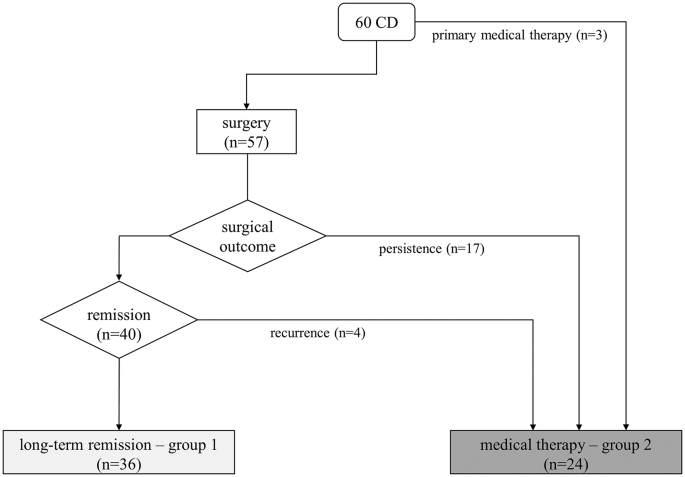
The first normalized UFC is considered as the starting point of observation at follow-up (two or five years). The cohort was divided into two cohorts: group 1 achieved CD remission after surgery, and group 2 achieved long-term eucortisolism during medical therapy. The inclusion criterion was 24-h UFC levels (mean of two collections) below the upper limit of normality during the observational period. Postoperative long-term adrenal insufficiency requiring substitutive glucocorticoid treatment (with hydrocortisone or cortisone acetate tablets) 12 months after surgery or new-onset hypopituitarism were considered exclusion criteria. The group 1 was made of 36 patients (69% female) in remission after successful TSS. The second group consisted of 24 patients (83% female) on long-term medical treatment for CD persistence (n = 17) or relapse (n = 4) after surgery and three patients in primary medical therapy for poor surgical eligibility, as shown in Fig. 1. Within group 2, nine patients underwent previous radiotherapy without efficacy, at least 5 years before reaching adequate biochemical control with medical treatment; none developed hypopituitarism. 14/24 patients (58%) were treated with a monotherapy and 11/24 (46%) with combined therapies during the observation period. Details on medical therapies are shown in Table 1. In particular, 3 patients were treated with metyrapone + pasireotide s.c., 1 with metyrapone + ketoconazole, 2 with ketoconazole and cabergoline, 1 with metyrapone + cabergoline, 1 with metyrapone + ketoconazole + cabergoline, 1 with metyrapone + ketoconazole + pasireotide s.c., 1 with metyrapone + ketoconazole + pasireotide s.c. + cabergoline. Metyrapone and ketoconazole were administered two/three times a day, pasireotide s.c. twice daily and cabergoline once daily in the evening.

Fig. 1
figure 1

Treatment and outcome of the described cohort. Light gray box indicates those patients in group 1 (surgical remission, n = 36), dark gray box indicates the patients in group 2 that achieved normalization of UFC with medical therapy (n = 24, either primary or after surgical failure)

Table 1 Cortisol-lowering drugs, dose, and time in treatment of subjects treated with a single and combined lines of therapy

All 60 patients completed at least 2 years of follow-up; a long-term 5-years evaluation was available in 43 patients of the original cohort (32 after surgery and 11 with medical therapy). Baseline characteristics of the two cohorts are reported in Table 2.

Table 2 Baseline characteristics of the two groups and previous treatment modalities

Data collection and study design

Two researchers retrieved clinical and biochemical data independently from the local digital medical records. We considered as baseline visit the clinical and endocrine evaluation performed with active hypercortisolism. Therefore, the baseline visit consists in the pre-surgical evaluation in group 1, and in the post-surgical confirmation of active hypercortisolism in those in medical treatment (or diagnosis in case of primary treatment, group 2).

We considered clinical and biochemical outcomes during routine follow-up at two- and five-years in each group, starting from surgical remission or the beginning of a stable normalization of UFC under medical therapy. CD diagnosis was based on at least two parameters among 24-h UFC above the upper normal limit (ULN, at least two collections), unsuppressed cortisol levels (> 50 nmol/L) after 1 mg overnight dexamethasone test (1 mg-DST) or late-night salivary cortisol (LNSC) > ULN (at least two samples). In all subjects, CD diagnosis was considered in case of normal-high ACTH levels, positive response to dynamic tests (corticotropin-releasing hormone or desmopressin test, high-dose dexamethasone test), and, two cases, with petrosal sinus sampling (BIPSS) [11]. Long-term remission after TSS was defined through normal UFC, combined with serum cortisol levels < 50 nmol/L in the first month after surgery and need of glucocorticoid replacement therapy. A relapse of CD was defined as the reappearance of the typical signs and symptoms of CD associated with the alteration of at least two first-line screening tests. Presence/absence of clinical signs of CD (round face, facial rubor, buffalo hump, bruising, cutaneous red striae, acne, hirsutism and oligo/amenorrhea in females) were evaluated during outpatient visits by expert endocrinologists. The presence of hirsutism in females was measured according to the Ferriman–Gallwey score > 8 (extent of hair growth in 9 locations was rated 0–4). Proximal muscle strength was diagnosed if patients were not able to stand up from a low seated position with anteriorly extended arms. Bodyweight, body mass index (BMI), waist and hip circumference, systolic (SBP), and diastolic blood pressure (DBP) were assessed with calibrated tools. Overweight was diagnosed in patients with BMI 25–30 kg/m2, obesity with BMI > 30 kg/m2. Visceral obesity was diagnosed as waist circumference ≥ 94 cm in men and ≥ 80 cm in women, or with a waist/hip ratio (WHR) ≥ 1 according to International Diabetes Federation criteria. Arterial hypertension was diagnosed for SBP above 140 mm Hg and/or DBP above 90 mm Hg and/or in patients on antihypertensive drugs. Diabetes mellitus (DM) was diagnosed according to American Diabetes Association criteria or when patients were taking antidiabetic medication. Dyslipidemia was diagnosed when low-density lipoprotein (LDL) calculated cholesterol was ≥ 100 mg/dL and hypertriglyceridemia when triglycerides were ≥ 150 mg/dL or when patients were on lipid-lowering medication. The presence of carotid vascular disease (CVD) has been assessed by supra-aortic vessels duplex ultrasound. Cushing’s cardiomyopathy (CCM) was diagnosed by doppler echocardiography with evidence of impaired relaxation and left ventricular filling pattern. The medical history was checked for cardiovascular disease (acute coronary syndrome, ACS) in all cases. A shortened activated partial thromboplastin time (aPTT < 29 s) defined pro-thrombotic status.

Assays

All biochemical analyses were carried out in an ISO15189:2012-accredited clinical laboratory [12], cortisol levels have been measured in urine or saliva with a mass-spectrometry home-made validated method. UFC was determined by a home-brew liquid chromatography-mass spectrometry (LC-MS/MS) method (intra-assay/interassay coefficient of variation [CV] < 6%/< 8%) since 2011 [13], previously by a radio-immunometric assay (Radim, intra-assay/interassay CV < 3%/< 9%). The patients were instructed to discard the first morning urine void and to collect all urine for the next 24 h, so that the morning urine void on the second day was the final collection. The sample was kept refrigerated from collection time until it was analyzed: normal range for UFC is 16–168 nmol/24 h.

Salivary cortisol was measured by a radio-immunometric assay (Radim, intra-assay/interassay CV < 3%/< 9%) until 2014 [14], after then by LC-MS/MS method (intra-assay/interassay CV < 6%/< 8% [15]). In order to prevent food or blood contamination, samples were collected at least 30 min after subjects had eaten, brushed their teeth, smoked or assumed liquorice; undertaken using Salivette® devices containing a cotton swab with or without citric acid (Sarstedt, Nümbrecht, Germany). The sample was stored at − 80 °C, before analyses [15].

The 1-mg DST test was performed orally assuming 1 mg of dexamethasone between 11 P.M. and midnight, sampling serum cortisol the next morning at 8 A.M. Serum dexamethasone levels, routinely evaluated since 2017, were adequate in all cases [16]. Serum cortisol (RRID: AB_2810257) and ACTH (RRID: AB_2783635) were determined by immune-chemiluminescence assay (Immulite 2000, Siemens Healthcare). Dynamic second-line tests and BIPSS were performed according to international standards.

Statistical analysis

Data were analyzed using SPSS Software for Windows, version 24.0 (SPSS Inc). Data are reported as medians and interquartile range or as percentages. The comparison between continuous variables was performed by non-parametric Wilcoxon test or Mann–Whitney test, as appropriate. The comparison between categorical variables was performed by the χ2 test. The correlation between continuous variables was performed by linear regression analysis. The level of significance for the overall difference between the groups was tested with one-way ANOVA. A p value < 0.05 was considered statistically significant.

Results

Endocrine evaluation

At baseline the two groups were similar for morning serum/salivary cortisol, LNSC, cortisol after 1 mg DST and morning ACTH levels (Table 3); UFC levels were higher in the surgical cohort (p < 0.001). Endocrine parameters were not influenced by sex and BMI. At baseline, all patients had impaired salivary cortisol rhythm with increased LNSC and inadequate cortisol suppression after 1-mg DST. At two years the recovery of salivary cortisol rhythm was observed in 97% of patients after surgery and 50% of patients during medical therapy. The only patient who did not show recovery of cortisol rhythm in the surgical cohort had LNSC of 5.4 nmol/L (range 0.5–2.6 nmol/L), with adequate cortisol suppression after 1-mg DST and sustained normal UFC: it was considered a false-positive due to residual minor depression state.

Table 3 Biochemical pattern at baseline and during the follow-up

Adequate cortisol suppression after 1-mg DST (both with normal UFC and LNSC) was observed in 34 out of 36 patients (94%) in the surgical cohort; the two patients who did not show complete cortisol suppression after 1-mg DST had cortisol levels of 60 and 119 nmol/l, respectively. On the contrary, as per selection criteria, none of the patients in group 2 presented suppressed cortisol after 1-mg DST.

At 5 years follow-up, all cases in the surgical cohort had suppressed cortisol after 1-mg DST and normal salivary cortisol rhythm, whereas in group 2 9% had suppressed cortisol after 1-mg DST and 36% recovered salivary cortisol rhythm. At 5 years, UFC and salivary cortisol levels (either morning or late night) were similar in the two groups, while the median value of serum cortisol after 1-mg DST remained not adequately suppressed (median 75 nmol/L, from 18 to 257 nmol/L) during medical therapy (See Table 3). In group 2, patients on combined therapy had higher UFC (102 vs. 76 nmol/24h p = 0.03) and LNSC (2.4 vs. 1.9 p = 0.05) at 5 years, compared to patients on monotherapy.

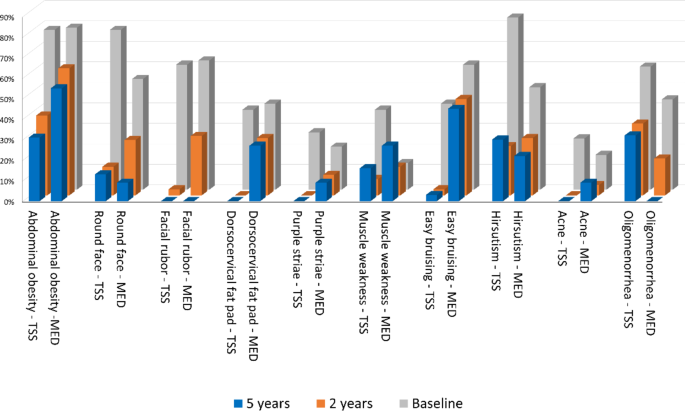
Hirsutism, abdominal obesity, round face and facial rubor were prevalent in group 1 at baseline. On the contrary, the abdominal obesity, facial rubor and easy bruising were most commonly found in the medical cohort. The prevalence of facial rubor, buffalo hump and bruisability was higher after medical than surgical remission after 2 years of eucortisolism; at 5 years the prevalence of buffalo hump and bruisability was higher in patients under drug therapy as well (Table 4; Fig. 2). Higher levels of UFC at baseline were observed in all patients with proximal myopathy (p < 0.001).

Table 4 Two- and five-years changes in clinical phenotype from baseline in group 1 and group 2
Fig. 2

figure 2

Signs and symptoms of hypercortisolism at baseline (grey bars), two-years (orange bars) and five-years (blue bars) follow up after surgical (TSS) or medical remission (MED)

Arterial hypertension

Arterial hypertension (AH) was the most frequent comorbidity in both groups at baseline, with similar distribution in the two groups (Table 5). The prevalence of AH decreased after two years in both groups, especially in the surgical cohort (64% vs. 44% in group 2, p < 0.001; 75% vs. 71% p = 0.003), with no further improvement after five years. Overall, hypertensive patients were older at diagnosis (45yrs vs. 31y; p < 0.001) and with larger BMI (29 vs. 25 kg/m2p = 0.03). Median UFC, morning salivary cortisol and LNSC, and 1-mg DST were not different in patients with/without AH at baseline and at 2 years. SBP and DBP values were similar in the two cohorts and were not correlated to UFC, LNSC or 1-mg DST throughout the follow-up. At 2 years, hypertensive patients had higher levels of morning salivary cortisol and LNSC with impaired rhythm (respectively 10.4 vs. 6 nmol/L, p = 0.01 and 3.2 vs. 1 nmol/l, p = 0.007). SBP and DBP values did not change during the five-years observation time in both groups; however, the number of anti-hypertensive drugs was higher in group 2 than in group 1 (p = 0.007). Overall patients treated with metyrapone showed higher values of DBP at 2 years (mean 89.4 vs. 81.7 mmHg, p = 0.01), the prevalence of AH did not differ from patients with other medical treatments.

Table 5 Two- and five-years changes in cardio-metabolic cortisol-related comorbidities of CD from baseline in group 1 and group 2

Glucose metabolism

DM prevalence at baseline did not show a correlation with BMI and age at CD diagnosis. DM prevalence was similar in group 1 and 2 after two and five years of follow-up. The follow-up analysis of DM was performed excluding patients in pasireotide, since its known impact in glucose metabolism. In both groups, median UFC, morning salivary and LNSC, and 1-mg DST were similar in patients with/without DM at baseline. At 5 years, patients with diabetes had higher levels of morning salivary cortisol and LNSC with impaired cortisol rhythm (respectively 15 vs. 7 nmol/L, p < 0.001 and 5.4 vs. 1.5 nmol/l, p < 0.001). None of the explored hormonal parameters was correlated with HbA1c levels in both groups at any time point considered. The number of antidiabetic drugs was higher after medical than surgical remission (Table 5).

As expected, patients treated with pasireotide had higher incidence of newly onset DM at 2- and 5 years (p = 0.02 and p = 0.05 respectively) and required more antidiabetic drugs at 2- and 5 years (p = 0.002, p = 0.05) or insulin units at 5 years (p = 0.03). HbA1c levels during pasireotide were higher than patients treated with other drugs (55.6 vs. 38 nmol/l, p = 0.002), requiring a higher number of antidiabetic drugs (p = 0.008). Patients on combined therapy with pasireotide had higher rates of DM at 2- and 5 years (p < 0.001 and p = 0.01) and used more antidiabetic drugs at 2- and 5 years (p = 0.004, p = 0.01) than those on monotherapy.

Lipid metabolism

The prevalence of dyslipidemia was similar in the two groups at baseline and after two years, and higher in the medical remission cohort after five years (p = 0.01). Overall, dyslipidemic patients were older at diagnosis (46y vs. 36y; p = 0.006) and had higher BMI (30 vs. 25 kg/m2p < 0.001). There was no correlation between hormone parameters and LDL or triglycerides levels. Lipid profile was similar between patients treated with different drugs.

Vascular disease and coagulative profile

There was no difference between the two groups, at baseline, in the prevalence of carotid vascular disease, history of ACS, and CCM; at 5 years, in both groups, no patient had a worsening of a previously diagnosed stenosis, or novel diagnosis of CVD, ACS and CCM.

The median aPTT value at baseline was in the pro-thrombotic range in both groups (25s), without sex and BMI differences. No correlation was observed between aPTT and UFC, LNSC and 1-mg DST levels. Patients who manifested easy bruising, had shorter aPTT at 2- and 5 years (median 24 vs. 27s, p = 0.03). aPTT does not increase within both groups at 2- and 5-years and aPTT was shorter during medical therapy compared to surgical remission both after 2 and 5 years (22.5s vs. 27s, p = 0.02 at 2y and 23.5s vs. 27.9s, p = 0.02 at 5y).

Discussion

The impact of CD remission on clinical picture and hypercortisolism-related comorbidities is still controversial. The current knowledge suggests that long-term CD surgical remission is associated with increased metabolic and vascular damage, not only if compared to active disease, but also even after long-term normalization of cortisol secretion [17]. If CD recurs after successful TSS, or if surgery fails/is not feasible, cortisol excess can be treated with medical therapy. Likewise, long-term studies (> 2 years) on the clinical effects of medical therapy on CD are lacking. Some prospective registry studies have been published [1], only one retrospective study on long-term use of ketoconazole described a multicentric cohort of CD patients without a control group [18].

In our study, we enrolled 60 patients with CD diagnosed and treated in a single tertiary care center, with sustained and long-term (2 and 5 years) UFC normalization after surgery or during medical therapy. As expected, UFC levels at baseline were different in the two groups, due to the distinct starting point of medical history: a patient with persistent-recurrent CD after pituitary surgery presents with lower UFC than the new diagnosis. After surgical remission, patients achieved the recovery of salivary cortisol rhythm and the complete suppression of cortisol after 1-mg DST (investigated after substitutive glucocorticoid treatment discontinuation) in almost all cases. On the contrary, if eucortisolism is achieved with long-term medical therapy the recovery of salivary cortisol rhythm was observed only in half of patients and only few of them showed cortisol suppression after 1-mg DST within the 5 years observation time. Patients who were more resistant to the recovery of cortisol rhythm were more likely to receive combined treatment, even if no treatment is superior to others in normalizing salivary cortisol rhythm, in line with previous reports [11819].

Within 2 years, patients in the surgical remission group showed a marked improvement of all phenotypic traits common at CD diagnosis compared to those in medical therapy. As observed also in other series of CD patients in remission [20], abdominal obesity persisted more than other clinical features over time, leading to an impaired body composition especially in the medically treated group [21]. Considering hyperandrogenism, acne improvement was more relevant at 2 and 5-years of follow up, probably due to a differential effect of ACTH-dependent adrenal androgens compared to hirsutism.

The impaired cortisol rhythm was a predictor of the long-lasting of most CD phenotypic features, as round face, buffalo hump, facial rubor, abdominal obesity, proximal myopathy and bruisability. A more severe clinical phenotype at baseline can explain a reduced control of hypercortisolism in monotherapy, requiring drug combination, and signs or symptoms are likely to persist despite the normalization of UFC [22]. In this study, no medication outperformed the others in terms of recovery from the CD phenotype.

The aetiology of hypertension and dyslipidemia is known to be heterogeneous, since both are influenced also by age at diagnosis and BMI, causing low rates of remission after UFC normalization [2324]. Arterial hypertension showed a decreasing trend with the best response within 2 years after UFC normalization only after surgical remission. Patients with disrupted salivary cortisol rhythm were more likely to remain hypertensive during the 5 years follow-up. Likewise, DM persistence during follow up correlates to impaired salivary cortisol rhythm and not with UFC. This finding is in contrast with the observations of Schernthaner-Reiter et al. [25]. on CD remission, and, on the contrary, supports data described by Guarnotta et al. [22]. Newell-Price et al.. recently found that when UFC and LSNC are both normal in patients treated with pasireotide, the rise in HbA1c levels is less evident than in patients with normal UFC but uncontrolled LNSC [26]. This observation underlines the importance of the impaired cortisol rhythm in the glucose impairment pathogenesis in CD. During the 5 years observation time, a worsening of previously diagnosed cardiovascular conditions, or novel acute vascular events, was not observed in both groups. This finding suggested that normalized UFC and intensive treatment of cardio-metabolic CD comorbidities play a fundamental role in reducing cardiovascular mortality [27]. A minor impact of CD therapy was observed in dyslipidemia, which persisted in both groups, with minimal improvement over time (−22% in surgical and − 6% in medical cohort). The criterion of 100 mg/dL LDL cut-off identifies a moderate CV risk reflecting the main focus of the study: the assessment of cardiometabolic complication after CD remission, assuming that they present a lower cardiovascular risk compared to patients with overt hypercortisolism.

Plasma hypercoagulability, with shortened aPTT, was found in all patients with active hypercortisolism. In the 5 years observation time, this parameter showed latency in increasing in both groups and in none achieved normality (> 28s). As previously observed in other studies, no correlation is observed between aPTT and any of the explored hormonal parameters [2228]. At 2- and 5 years, instead, shorter aPTT was observed during medical treatment than after surgical remission cohort. In both groups a shorter aPTT was associated with bruisability, which is related to impaired LNSC, strengthening the role of the impaired cortisol rhythm as a major driver of hypercoagulability. Also, Ferrante et al.. observed the long latency of plasma hypercoagulability, persisting for years after biochemical remission of CD: in that series thrombophilia appeared to be reversible within 5 years [29], while in our cohort the recovery takes longer.

Additionally, sexual differences characterize patients with patients with Cushing’s syndrome and hypogonadism in hypercortisolism is known to further increase the cardiovascular risk [3031]. However, it was not an interfering factor in our study population since hypopituitarism was considered an exclusion criterion, no case of new-onset hypogonadism was reported (even in male patients treated with ketoconazole), and the menopause transition in six women during the observation was not considered relevant.

The limits of the present study are its retrospective design, the variability of concomitant treatments, the heterogenous combinations of medical therapy used in clinical practice, the presence of treatment-specific adverse events that mimic the effects of hypercortisolism (such as pasireotide-induced DM and hypertension with metyrapone), the unpredictable effect of previous treatments, including radiotherapy. We considered UFC and LNSC as markers of hypercortisolism remission; nonetheless we acknowledge that both of them present some limitations, especially during medical treatment. The former considers the whole cortisol secretion during the day, and albeit UFC normalization is the main outcome of all trials for medical treatment [3233] it does not detect mild hypercortisolism. On the other hand, a normal LNSC does not fully reflect a normal circadian rhythm: only high cortisol levels in the morning with a decline in the night are able to restore clock-related activities [34].

Its strengths are the complete patient characterization in a single tertiary care center, the comparative study design, and the standardized protocols for diagnosis and long-term follow-up. In particular, samples have been processed within a single laboratory with accurate methods (LC-MS for urinary and salivary steroids), and all endocrine aspects of hypercortisolism were considered (overall daily cortisol production by UFC, circadian cortisol rhythm, and the recovery of the hypothalamic-pituitary axis by 1-mg DST overnight test).

To conclude, despite UFC normalization in both groups during follow-up, surgical remission results in more rapid and relevant improvements in CD phenotype and comorbidities. During medical therapy the UFC levels can be higher than after surgery, although in the normal range, and the normalization of LNSC is not always achieved: both conditions suggests that stricter criteria should be considered to define eucortisolism in patients with CD under medical treatment. Conditions such as obesity, hypertension, dyslipidemia, and hypercoagulability are not completely reversible in a 5-year observation time even in the surgical remission group. This observation underlines that all the comorbidities, independently of the normalization of UFC, must be intensively treated. Moreover, UFC normalization should not be considered the only biochemical goal to be reached, since the persistence of comorbidities seems to be more related to an impaired cortisol rhythm rather than to the cortisol secretory burden.

References

  1. Fleseriu M et al (2021) Consensus on diagnosis and management of Cushing’s disease: a guideline update, Dec. 01, Elsevier Ltd. https://doi.org/10.1016/S2213-8587(21)00235-7

  2. Gadelha M, Gatto F, Wildemberg LE, Fleseriu M Cushing’s syndrome. Dec 09 2023 Elsevier B V https://doi.org/10.1016/S0140-6736(23)01961-X

  3. Ceccato F et al (2024) Clinical and biochemical data for the diagnosis of endogenous hypercortisolism: the ‘cushingomic’ approach. J Clin Endocrinol Metab Jul. https://doi.org/10.1210/clinem/dgae517

    Article Google Scholar

  4. Pivonello R, Isidori AM, De Martino MC, Newell-Price J, Biller BMK, Colao A (2016) Complications of Cushing’s syndrome: state of the Art. Lancet Publishing Group. https://doi.org/10.1016/S2213-8587(16)00086-3

    Article Google Scholar

  5. Clayton RN et al (2016) Mortality in patients with Cushing’s disease more than 10 years after remission: A multicentre, multinational, retrospective cohort study. Lancet Diabetes Endocrinol 4(7):569–576. https://doi.org/10.1016/S2213-8587(16)30005-5

    Article PubMed Google Scholar

  6. Pivonello R, De Leo M, Cozzolino A, Colao A (2015) The treatment of Cushing’s disease. Endocr Soc. https://doi.org/10.1210/er.2013-1048

    Article Google Scholar

  7. Petersenn S et al (2015) Outcomes in patients with Cushing’s disease undergoing transsphenoidal surgery: Systematic review assessing criteria used to define remission and recurrence. BioScientifica Ltd. https://doi.org/10.1530/EJE-14-0883

    Article Google Scholar

  8. Broersen LHA, Jha M, Biermasz NR, Pereira AM, Dekkers OM (2018) Effectiveness of medical treatment for Cushing’s syndrome: a systematic review and meta-analysis. Pituitary 21(6):631–641. https://doi.org/10.1007/s11102-018-0897-z

    Article CAS PubMed PubMed Central Google Scholar

  9. von Elm E, Altman DG, Egger M, Pocock SJ, Gøtzsche PC, Vandenbroucke JP (2008) The Strengthening the Reporting of Observational Studies in Epidemiology (STROBE) statement: guidelines for reporting observational studies. J Clin Epidemiol 61(4): 344–349. https://doi.org/10.1016/j.jclinepi.2007.11.008

  10. Ceccato F (2024) The burden Of Cushing’s disease cardiometabolic comorbidities: comparison between surgical remission and long-term eucortisolism with medical treatment. Repository of the University of Padova. https://doi.org/10.25430/researchdata.cab.unipd.it.00001350

  11. Barbot M et al (2016) Second-line tests in the differential diagnosis of ACTH-dependent Cushing’s syndrome. Pituitary 19(5):488–495. https://doi.org/10.1007/s11102-016-0729-y

    Article CAS PubMed Google Scholar

  12. ISO 15189:2012 Medical laboratories — Requirements for quality and competence. Published 2022. Accessed October 10 (2023) https://www.iso.org/standard/56115.html

  13. Ceccato F et al (2014) The diagnostic performance of urinary free cortisol is better than the cortisol: cortisone ratio in detecting de Novo Cushing’s syndrome: the use of a LC-MS/MS method in routine clinical practice. Eur J Endocrinol 171(1):1–7. https://doi.org/10.1530/EJE-14-0061

    Article CAS PubMed Google Scholar

  14. Ceccato F et al (2012) Assessment of glucocorticoid therapy with salivary cortisol in secondary adrenal insufficiency. Eur J Endocrinol 167(6):769–776. https://doi.org/10.1530/EJE-12-0534

    Article CAS PubMed Google Scholar

  15. Antonelli G, Ceccato F, Artusi C, Marinova M, Plebani M (2015) Salivary cortisol and cortisone by LC-MS/MS: Validation, reference intervals and diagnostic accuracy in Cushing’s syndrome. Clinica Chimica Acta 451:247–251. https://doi.org/10.1016/j.cca.2015.10.004

    Article CAS Google Scholar

  16. Ceccato F et al (2020) Dexamethasone measurement during low-dose suppression test for suspected hypercortisolism: threshold development with and validation. J Endocrinol Invest 43(8):1105–1113. https://doi.org/10.1007/s40618-020-01197-6

    Article CAS PubMed Google Scholar

  17. Pivonello R, Faggiano A, Lombardi G, Colao A (2005) The metabolic syndrome and cardiovascular risk in Cushing’s syndrome. W.B. Saunders. https://doi.org/10.1016/j.ecl.2005.01.010

    Book Google Scholar

  18. Castinetti F et al (2014) Ketoconazole in Cushing’s disease: is it worth a try. J Clin Endocrinol Metab 99(5):1623–1630. https://doi.org/10.1210/jc.2013-3628

    Article CAS PubMed Google Scholar

  19. Barbot M et al (2014) Combination therapy for Cushing’s disease: Effectiveness of two schedules of treatment. Should we start with cabergoline or ketoconazole? Pituitary 17(2):109–117. https://doi.org/10.1007/s11102-013-0475-3

    Article CAS PubMed Google Scholar

  20. Colao A et al (1999) Persistence of Increased Cardiovascular Risk in Patients with Cushing’s Disease after Five Years of Successful Cure,., [Online]. Available: https://academic.oup.com/jcem/article/84/8/2664/2864186

  21. Ceccato F et al (2017) Sep., Body Composition is Different after Surgical or Pharmacological Remission of Cushing’s Syndrome: A Prospective DXA Study, Hormone and Metabolic Research, vol. 49, no. 9, pp. 660–666. https://doi.org/10.1055/s-0043-115008

  22. Guarnotta V et al (2017) The degree of urinary hypercortisolism is not correlated with the severity of cushing’s syndrome. Endocrine 55(2):564–572. https://doi.org/10.1007/s12020-016-0914-9

    Article CAS PubMed Google Scholar

  23. Giordano R et al (2011) Metabolic and cardiovascular outcomes in patients with Cushing’s syndrome of different aetiologies during active disease and 1 year after remission. Clin Endocrinol (Oxf) 75(3):354–360. https://doi.org/10.1111/j.1365-2265.2011.04055.x

    Article CAS PubMed Google Scholar

  24. Jha S, Sinaii N, McGlotten RN, Nieman LK (2020) Remission of hypertension after surgical cure of Cushing’s syndrome. Clin Endocrinol (Oxf), 92(20): 124–130. https://doi.org/10.1111/cen.14129

  25. Schernthaner-Reiter MH et al (2019) Factors predicting long-term comorbidities in patients with Cushing’s syndrome in remission. Endocrine 64(1):157–168. https://doi.org/10.1007/s12020-018-1819-6

    Article CAS PubMed Google Scholar

  26. Newell-Price J et al (2020) Use of late-night salivary cortisol to monitor response to medical treatment in Cushing’s disease. Eur J Endocrinol 182(2):207–217. https://doi.org/10.1530/EJE-19-0695

    Article CAS PubMed Google Scholar

  27. Mondin A et al (2023) Complications and mortality of Cushing’s disease: report on data collected over a 20-year period at a referral centre. Pituitary 26(5):551–560. https://doi.org/10.1007/s11102-023-01343-2

    Article PubMed PubMed Central Google Scholar

  28. Barbot M et al (2018) Effects of pasireotide treatment on coagulative profile: a prospective study in patients with Cushing’s disease. Endocrine 62(1):207–214. https://doi.org/10.1007/s12020-018-1669-2

    Article CAS PubMed Google Scholar

  29. Ferrante E et al (2022) Evaluation of procoagulant imbalance in Cushing’s syndrome after short- and long-term remission of disease. J Endocrinol Invest 45(1):9–16. https://doi.org/10.1007/s40618-021-01605-5

    Article CAS PubMed Google Scholar

  30. Zilio M, Barbot M, Ceccato F, Camozzi V, Bilora F, Casonato A, Frigo AC, Albiger N, Daidone V, Mazzai L, Mantero F, Scaroni C (2014) Diagnosis and complications of Cushing’s disease: gender-related differences. Clin Endocrinol (Oxf) 80(3):403–410. https://doi.org/10.1111/cen.12299

    Article CAS PubMed Google Scholar

  31. Detomas M, Deutschbein T, Tamburello M, Chifu I, Kimpel O, Sbiera S, Kroiss M, Fassnacht M, Altieri B (2024) Erythropoiesis in Cushing syndrome: sex-related and subtype-specific differences. Results from a monocentric study. J Endocrinol Invest 47(1):101–113. https://doi.org/10.1007/s40618-023-02128-x

    Article CAS PubMed Google Scholar

  32. Fleseriu M et al (2019) Long-term efficacy and safety of once-monthly pasireotide in Cushing’s disease: A Phase III extension study. Clin Endocrinol (Oxf) 91(6):776–785. https://doi.org/10.1111/cen.14081

    Article CAS PubMed Google Scholar

  33. Ceccato F et al (2018) Metyrapone treatment in Cushing’s syndrome: a real-life study. Endocrine 62(3):701–711. https://doi.org/10.1007/s12020-018-1675-4

    Article CAS PubMed Google Scholar

  34. Minnetti M, Hasenmajer V, Pofi R, Venneri MA, Alexandraki KI, Isidori AM (2020) Fixing the broken clock in adrenal disorders: Focus on glucocorticoids and chronotherapy. BioScientifica Ltd. https://doi.org/10.1530/JOE-20-0066

    Article Google Scholar

Download references

Funding

Open access funding provided by Università degli Studi di Padova within the CRUI-CARE Agreement.

All authors certify that they have no affiliations with or involvement in any organization or entity with any financial interest or non-financial interest in the subject matter or materials discussed in this manuscript.

Author information

Authors and Affiliations

  1. Department of Medicine-DIMED, University of Padova, Padova, Italy

    Irene Tizianel, Laura Lizzul, Alessandro Mondin, Giacomo Voltan, Pierluigi Mazzeo, Carla Scaroni, Mattia Barbot & Filippo Ceccato

  2. Endocrinology Unit, Department of Medicine DIMED, University Hospital of Padova, Via Ospedale Civile, 105, Padova, 35128, Italy

    Irene Tizianel, Laura Lizzul, Alessandro Mondin, Giacomo Voltan, Pierluigi Mazzeo, Carla Scaroni, Mattia Barbot & Filippo Ceccato

Corresponding author

Correspondence to Filippo Ceccato.

Ethics declarations

Conflict of interest

The authors declare that they have no conflict of interest.

Ethical approval

All procedures performed in studies involving human participants were in accordance with the ethical standards of the institutional and/or national research committee and with the 1964 Helsinki Declaration and its later amendments or comparable ethical standards.

Informed consent

Informed consent was obtained from all individual participants involved in the study.

Additional information

Publisher’s note

Springer Nature remains neutral with regard to jurisdictional claims in published maps and institutional affiliations.

Cite this article

Tizianel, I., Lizzul, L., Mondin, A. et al. Cardiometabolic complications after Cushing’s disease remission. J Endocrinol Invest (2025). https://doi.org/10.1007/s40618-025-02572-x

Download citation

Share this article

Anyone you share the following link with will be able to read this content:

Get shareable linkProvided by the Springer Nature SharedIt content-sharing initiative

Keywords

From https://link.springer.com/article/10.1007/s40618-025-02572-x

High Recovery Rate of Adrenal Function After Successful Surgical Treatment of Cushing’s Syndrome

Abstract

Context

Successful first-line treatment of Cushing’s syndrome by resection of the underlying tumor is usually followed by adrenal insufficiency.

Purpose

The aims of this study were to determine the recovery rate and time to recovery of adrenal function after treatment for different forms of endogenous Cushing’s syndrome and to identify factors associated with recovery.

Methods

In this retrospective study of 174 consecutive patients with Cushing’s syndrome, the recovery rate and time to recovery of adrenal function after surgery were assessed.

Results

The 1-year, 2-year and 5-year recovery rates of patients with Cushing’s disease were 37.8, 70.1 and 81.1%, respectively. For patients with adrenal Cushing’s syndrome, the 1-year, 2-year and 5-year recovery rates were higher: 49.3, 86.9 and 91.3%, respectively. Median time to recovery for patients with Cushing’s disease and adrenal Cushing’s syndrome was 13.9 and 12.1 months, respectively. The median time to recovery of adrenal function in patients with Cushing’s disease with and without recurrence was 9.9 versus 14.4 months, respectively. Higher age was associated with a lower probability of recovery of adrenal function: HR 0.83 per decade of age (95% CI 0.70–0.98).

Conclusion

The recovery rate of adrenal function after successful surgery as first-line treatment in patients with Cushing’s syndrome is high. However, it may take several months to years before recovery of adrenal function occurs. In case of early recovery of adrenal function, clinicians should be aware of a possible recurrence of Cushing’s disease.

Introduction

Cushing’s syndrome (CS) is characterized by chronic exposure to an excess of glucocorticosteroids (1). Endogenous hypercortisolism is a rare disorder with an estimated incidence of 0.2–5 patients per million per year (1). CS can cause severe, disabling signs and symptoms and is associated with significantly increased morbidity and mortality. In approximately 70% cases, endogenous CS is caused by an ACTH-producing pituitary adenoma, also known as Cushing’s disease (CD). In 15–25% cases, an ACTH-independent form of CS is caused by a unilateral adrenal adenoma, adrenal carcinoma or bilateral micro- or macronodular hyperplasia (adrenal CS). An ACTH-producing ectopic tumor is a rare cause of CS. First-line treatment of CS is surgical removal of the pituitary, adrenal or ectopic tumor (12).

Successful first-line treatment by resection of the underlying tumor is usually followed by adrenal insufficiency (AI) due to suppression of the hypothalamic–pituitary–adrenal axis after prolonged exposure to high concentrations of cortisol (345). Theoretically, one would expect that the hypothalamic–pituitary–adrenal axis recovers over time and that the substitution of glucocorticosteroids can slowly be reduced and stopped as long as there is no irreversible damage to the remaining adrenal or pituitary tissue. However, in clinical practice, AI is not always transient. In a subset of patients, this is caused by permanent AI due to perioperative damage to the pituitary gland or irreversible atrophy of the contralateral adrenal gland. In other cases, tapering the dosage of glucocorticosteroids is not possible because this causes worsening of symptoms. Despite the glucocorticoid replacement therapy, patients often experience symptoms resembling AI, such as fatigue, myalgia, arthralgia, depression, anxiety and decreased quality of life, also known as glucocorticoid withdrawal syndrome (GWS) (6). GWS is caused by dependence on supraphysiologic glucocorticoid concentrations after chronic exposure to high concentrations of glucocorticoids, which can complicate and delay the withdrawal of exogenous steroids. As a result, patients and physicians often struggle with a dilemma: on the one hand, lowering the cortisol substitution is necessary to enable functional recovery of the hypothalamic–pituitary–adrenal axis. On the other hand, lowering the substitution therapy often causes worsening of symptoms. In clinical practice, it is not always possible to completely taper the substitution of steroids due to GWS, even in spite of intensive guidance and support by the treating physician, specialized nurse and other healthcare professionals. Moreover, in patients remaining on glucocorticoid replacement, it is not always clear whether the failure to recover from AI is caused by the irreversible damage of the remaining pituitary or adrenal tissue or the failure to overcome the GWS. The time after which adrenal function recovers and substitution therapy can be tapered off varies largely between patients but may take several years (7).

A recent survey among patients with CS highlighted the need of patients for better information about the difficult post-surgical course (8). However, scientific data about this post-operative period, particularly regarding the recovery rate and time to recovery from AI are scarce (91011121314151617181920). Because of the rarity of CS, most studies are hampered by a limited number of patients. The reported recovery rates of adrenal function after first-line treatment for CS vary widely, between 37 and 93% for CD (910111213) and between 38 and 93% for overt adrenal CS (101214151617).

The reported duration to recovery of the hypothalamic–pituitary–adrenal axis after CD and adrenal CS also varies widely, between 13 and 25 months after CD (910111319) and between 11 and 30 months in overt adrenal CS (101415161820).

Factors which influence the recovery rate and the duration to recovery of adrenal function are not entirely clear. A few studies reported a lower chance of recovery and a longer duration to recovery of adrenal function in patients who are younger, have more severe hypercortisolism, and longer duration of symptoms before diagnosis, whereas other studies could not confirm these findings (101321). By contrast, other studies reported a higher chance of recovery in younger patients (21). Identification of these factors may help provide patients with more information about the expected post-surgical course.

Therefore, the aims of the present study were to assess the recovery rate and time to recovery of adrenal function after successful first-line treatment in the different subtypes of CS in a large series of consecutive patients treated at a tertiary referral center and to identify factors associated with recovery.

Methods

Patients

The medical records of adult and pediatric patients treated for CS at Radboud University Medical Center, Nijmegen, between 1968 and 2022 were examined retrospectively. This is a tertiary referral hospital where practically all cases of CS from the large surrounding geographic area are managed. All patients with CD, adrenal CS and ectopic CS who were in remission and developed AI after first-line surgical treatment were included. Exclusion criteria were bilateral adrenalectomy as first-line treatment, adrenocortical carcinoma, radiotherapy of the pituitary gland before surgery, pituitary carcinoma and the therapeutic use of corticosteroids for conditions other than AI. Data were collected on age, sex, body mass index (BMI), duration of CS symptoms, comorbidities, the use of medication, biochemical results at diagnosis and during follow-up, preoperative imaging, surgical treatment and histology.

The study was assessed by the Committee for Research with Humans, Arnhem/Nijmegen Region and the need for written approval by individual patients was waived since this study did not fall within the remit of the Medical Research Involving Human Subjects Act (WMO). The study has been reviewed by the ethics committee on the basis of the Dutch Code of conduct for health research, the Dutch Code of conduct for responsible use, the Dutch Personal Data Protection Act and the Medical Treatment Agreement Act. The ethics committee has passed a positive judgment on the study. The procedures were conducted according to the principles of the Declaration of Helsinki.

Diagnostics and definitions

Patients were diagnosed with CS according to the guidelines available at the time, i.e., the presence of signs and symptoms of hypercortisolism in combination with confirmatory biochemical tests, including the 1 mg dexamethasone suppression test (DST), 24-h urine free cortisol (UFC), late-night salivary cortisol concentrations and/or hair cortisol. The cutoff value for adequate cortisol suppression after the DST was <50 nmol/L (22). For UFC, the times upper limit of normal was calculated because several assays with different reference values were used over time.

First-line treatment consisted of pituitary surgery in patients with CD and unilateral adrenalectomy in patients with ACS. In patients with bilateral macronodular hyperplasia, adrenalectomy of the largest adrenal was performed after carefully outweighing the risks and benefits of surgery together with the patient, taking into account factors such as age, severity of symptoms, comorbidities associated with hypercortisolism (e.g., diabetes mellitus type 2, cardiovascular disease, osteoporosis) and the severity of the hypercortisolism (2).

Peri- and postoperatively, all patients received glucocorticoid stress dosing, which was tapered off within a few days after surgery. Adrenal function was initially evaluated with a postoperative morning fasting cortisol concentration, measured at least 24 h after the last dose of hydrocortisone or cortisone acetate, within 7 days after surgery. If the postoperative morning fasting cortisol was <200 nmol/L, the patient was considered to have AI and glucocorticoid replacement therapy was continued. The starting dose was usually hydrocortisone 30 mg once daily (or an equivalent dose of cortisone acetate in the early years). For children, the dose was weight-based. Afterwards, the dose was slowly tapered off according to the symptoms/well-being of the patient and fasting cortisol values. During follow-up, the dose was usually divided into two or three doses a day.

Remission of CS after treatment was defined as either a morning cortisol of ≤50 nmol/L, adequate cortisol suppression after DST or a late-night salivary cortisol concentration within the reference range. Duration of AI was defined as the time between surgery and discontinuation of glucocorticoid replacement therapy. Complete recovery of adrenal function was assessed by spontaneous fasting cortisol concentration, an insulin tolerance test or a 250 μg ACTH stimulation test after discontinuation of glucocorticoid replacement therapy. In cases where fasting morning cortisol ≥520 nmol/L, adrenal function was considered as completely recovered. For the dynamic tests, assay-dependent cutoff values were used according to the guidelines available at the time. The dynamic tests were not performed routinely in all patients until 1999. In patients for whom no dynamic tests (results) were available, complete recovery of AI was defined as complete discontinuation of replacement therapy. Recurrence of CS was defined as the presence of signs and symptoms of hypercortisolism in combination with confirmatory biochemical tests, including the 1 mg DST, 24-h UFC, late-night salivary cortisol concentrations and/or hair cortisol.

Statistical analysis

Continuous data were expressed as mean ± SD or median + interquartile range (IQR), and categorical data were presented as frequency (n) and percentage (%). We produced Kaplan–Meier curves to determine the unadjusted probability of recovery of adrenal function over time. Patients that tapered off and completely stopped the glucocorticoid replacement therapy were assigned in the survival analyses as having an event (=recovery of adrenal function). The date of the last follow-up visit was assigned in the survival analyses as the last date and patients that were lost to follow-up or developed a recurrence before stopping the glucocorticoid replacement therapy were censored. In order to identify factors associated with recovery of adrenal function, we compared Kaplan Meier curves between several subgroups of patients: CD versus adrenal CS versus ectopic CS, age (at diagnosis) groups of ≤35 versus 36–55 versus ≥56 years old, patients with or without postoperative pituitary deficiencies, patients with or without recurrence of CS during follow-up, patients with or without preoperative medical treatment (PMT), patients operated before versus after 2010 and patients with a low versus slightly higher post-operative morning cortisol (<100 nmol/L versus 100–200 nmol/L), measured within 7 days after surgery. The Kaplan–Meier curves of the subgroups were compared using the two-sided log-rank test. The P-value ≤0.05 was considered statistically significant. The Kaplan–Meier curves provided the 1-year, 2-year and 5-year recovery rates and the median time to recovery of the adrenal gland. We used Cox proportional hazards models to calculate hazard ratios (HRs) with a 95% confidence interval (CI) of the probability of recovery of adrenal function over time in order to identify factors associated with recovery of adrenal function (univariate analyses). Cox proportional hazards models with multivariate analyses were performed to calculate the adjusted HRs with 95% CI. The model of multivariate analysis for the whole group included the variables: etiology of CS, age, sex, BMI, duration of symptoms before diagnosis, UFC and postoperative cortisol 0.10–0.20 versus <0.10 mcmol/L. The model of multivariate analysis for the patients with CD only included the variables: etiology of CD, age, sex, BMI, duration of symptoms before diagnosis, UFC, post-operative cortisol 0.10–0.20 versus <0.10 mcmol/L, PMT, hormonal deficiencies of the anterior pituitary gland other than AI and micro/macroadenoma. A 95% CI not including 1 was considered statistically significant.

All statistical analyses were performed using STATA version 11 (StataCorp, USA).

Results

In total, 174 patients were included in the analysis. The assessment of eligibility, the number of patients excluded from this study and the reasons for exclusion are shown in Fig. 1. The baseline characteristics are described in Table 1. The median follow-up was 6.8 years (IQR: 2.2–12.6). In 69.6% (94/135) of all patients who discontinued their glucocorticoid replacement therapy, the recovery of adrenal function was confirmed with a dynamic test or a morning cortisol concentration ≥520 nmol/L.

Figure 1View Full Size
Figure 1
Flowchart showing the assessment for eligibility, the number of patients excluded from the study and the reasons for exclusion.

Citation: Endocrine Connections 14, 5; 10.1530/EC-24-0612

Table 1Baseline characteristics.

Variable All patients CD Adrenal CS
Participants (n) 174 135 35
Female (%) 135/174 (77.6%) 102/135 (75.6%) 32/35 (91.4%)
Median age at diagnosis (y) 44 (35–55) 43 (32–55) 47 (36–54)
Median BMI at diagnosis (kg/m2) 28.3 (24.7–32.4) 28.6 (24.7–32.9) 28.0 (26.0–31.8)
Median duration of symptoms before diagnosis of CS (years) 3.0 (1.0–5.6) 3.0 (1.0–6.0) 3.5 (1.5–5.6)
Median times upper limit of normal UFC at diagnosis 3.7 (1.9–5.8) 3.9 (2.0–6.4) 2.4 (1.4–4.1)
Median cortisol after DST (nmol/L) 480 (320–630) 460 (290–620) 550 (330–710)
Median salivary cortisol at diagnosis (nmol/L) 8.6 (5.4–15.4) 10.1 (5.9–18.0) 6.1 (4.0–8.9)
Median follow up (years) 6.8 (2.2–12.6) 8.4 (3.0–13.5) 2.2 (1.2–4.7)
Preoperative medical therapy* (n) 120/174 (69%) 106/135 (78.5%) 10/35 (28.6%)
Pituitary microadenoma/macroadenoma/no adenoma detected on MRI scan (n) 64/27/28**
Bilateral disease (n) 7/35 (20.0%)

CD, Cushing’s disease; CS, Cushing’s syndrome; BMI, body mass index; UFC, 24-h urine free cortisol; DST, 1 mg dexamethasone suppression test. Continuous data are summarized as median and interquartile ranges. Categorical data are presented as frequencies and percentages.

*Cortisol-lowering medication, either metyrapone or ketoconazole.

**Missing data on MRI in 16 patients.

Recovery rates and recovery times of adrenal function

The probability of recovery of AI for CD, adrenal CS and ectopic CS are depicted in Fig. 2. The 1-year, 2-year and 5-year recovery rates of adrenal function for the entire cohort were 40.1, 73.4 and 83.3%, respectively. The median time to recovery of adrenal function was 13.9 months. The 1-year, 2-year and 5-year recovery rates of patients with CD were 37.8, 70.1 and 81.1%, respectively. The median recovery time was 13.9 months for patients with CD. For patients with adrenal CS, the 1-year, 2-year and 5-year recovery rates were higher: 49.3, 86.9 and 91.3%, respectively (two-sided log-rank test: P = 0.14). The median recovery time for patients with adrenal CS was 12.1 months. Seven out of the 35 patients with adrenal Cushing had bilateral disease. The median time to recovery in patients with bilateral disease was 17.5 versus 11.0 months in patients with unilateral disease.

Figure 2View Full Size
Figure 2
Cumulative probability of recovery of adrenal function in CD (n = 135), adrenal CS (n = 35) and ectopic Cushing (n = 4).

Citation: Endocrine Connections 14, 5; 10.1530/EC-24-0612

Of the 15 evaluated patients with ectopic CS, only four patients underwent successful resection of the ectopic tumor and were included in our study. All four patients had a neuroendocrine tumor of the lung and recovered from AI. The time to recovery of adrenal function was known in three patients: 5.7, 7.9 and 14.5 months.

Factors associated with recovery of adrenal function

Age at diagnosis

Figure 3 shows the Kaplan–Meier curves of three different age groups (group 1: 0–35 years old, group 2: 36–55 years old and group 3: 56–100 years old). The 1-year recovery rates of patients aged between 0–35, 36–55 and 56–100 years old were 54.6, 37.2 and 31.4%, respectively. The 2-year recovery rates were 79.3, 72.6 and 68.4%, respectively and the 5-years recovery rates were 89.6, 83.8 and 75.1%, respectively. The median times to recovery of adrenal function of patients aged between 0–35, 36–55 and 56–100 years old were 11.2, 13.4 and 17.6 months, respectively. The probability of recovery of AI was higher in young patients (0–35 years old) (two-sided log-rank test: P = 0.05).

Figure 3View Full Size
Figure 3
Cumulative probability of recovery of adrenal function by age groups.

Citation: Endocrine Connections 14, 5; 10.1530/EC-24-0612

Recurrence after primary treatment

In total, 17.8% patients with CD (24/135) had developed a recurrence during follow-up. Figure 4 shows the Kaplan–Meier curves with the probability of recovery of AI of the groups with and without recurrence during follow-up in patients with CD. The probability of recovery of AI was higher in patients with a recurrence (two-sided log-rank test: P-value = 0.02). In patients with a recurrence, the 1-, 2- and 5-year recovery rates of AI were 60.9, 78.3 and 87.0%, respectively. In patients without a recurrence, the 1-, 2- and 5-years recovery rates of AI were 32.6, 68.3 and 79.7%, respectively. The median time to recovery of adrenal function in patients with CD with and without recurrence was 9.9 versus 14.4 months, respectively.

Figure 4View Full Size
Figure 4
Cumulative probability of recovery of adrenal function by recurrence during follow-up in patients with CD.

Citation: Endocrine Connections 14, 5; 10.1530/EC-24-0612

There was only one patient with adrenal CS with a recurrence. This was a patient with bilateral macronodular hyperplasia. During the first surgery, the largest adrenal was removed. However, 3 years later, the contralateral adrenal was also removed because of the recurrence of CS.

Hypopituitarism after pituitary surgery

In patients with CD, we performed a sub-analysis based on the presence of anterior pituitary deficiencies after pituitary surgery for CD, besides AI. Antidiuretic hormone (ADH) deficiency was not included in this analysis. As expected after pituitary surgery and in line with the literature, temporary ADH deficiency occurred in a substantial part of the patients after surgery (23). Therefore, only central hypothyroidism, hypogonadotropic hypogonadism and growth hormone deficiency were taken into account (Fig. 5). The probability of recovery of AI was lower in patients with one or more pituitary deficiencies versus patients with intact pituitary function after surgery (two-sided log-rank test: P-value = 0.05). In patients with anterior pituitary deficiencies, the 1-, 2- and 5-years recovery rates of AI were 35.6, 60.4 and 67.6%, respectively. In patients without anterior pituitary deficiencies, the 1-, 2- and 5-years recovery rates of AI were 39.2, 76.0 and 89.1%, respectively. The median time to recovery of adrenal function in patients with CD with and without anterior pituitary deficiencies was 15.9 versus 13.4 months, respectively. Figure 6 shows the Kaplan–Meier curves by the number of hormonal deficiencies of the anterior pituitary gland, other than AI. Although statistical significance was not reached, there is a trend showing that the more postoperative hormonal deficiencies present, the lower the probability of recovery of AI is (two-sided log-rank test: P-value = 0.15).

Figure 5View Full Size
Figure 5
Kaplan–Meier curve by the presence/absence of hormonal deficiencies of the anterior pituitary gland (other than AI) after surgery in patients with CD.

Citation: Endocrine Connections 14, 5; 10.1530/EC-24-0612

Figure 6View Full Size
Figure 6
Kaplan–Meier curve by the number of hormonal deficiencies of the anterior pituitary gland after surgery in patients with CD.

Citation: Endocrine Connections 14, 5; 10.1530/EC-24-0612

Preoperative cortisol-lowering medical therapy, year of surgery and fasting cortisol concentration at the initial postoperative evaluation

Sub-analyses regarding patients who received PMT versus patients without PMT did not show any difference in the probability of recovery. In patients without PMT, the 1-, 2- and 5-years recovery rates of AI were 42.6, 77.6 and 85.2%, respectively. In patients with PMT, the 1-, 2- and 5-years recovery rates of AI were 41.6, 73.7 and 82.3%, respectively. The median time to recovery of adrenal function in patients without PMT and with PMT was 14.1 versus 13.5 months, respectively.

Sub-analyses regarding patients operated on before versus after 2010, regarding the results of the 1 mg dexamethasone suppression test at diagnosis and regarding patients with a low versus slightly higher postoperative morning cortisol within 7 days after surgery (<100 versus 100–200 nmol/L) also did not show any difference in the probability of recovery of adrenal function.

Table 2 shows HRs of univariate and multivariate Cox regression analyses. Adrenal CS and ectopic CS were associated with a higher probability of recovery of AI in comparison with patients with CS. Higher age was associated with a lower probability of recovery of AI.

Table 2Uni- and multivariate Cox regression analyses.

Variable Univariate Cox regression Multivariate Cox regression
HR 95% CI P value HR 95% CI P value
Etiology of CS (CD/adrenal CS/ectopic) 1.44 1.00–2.08 0.05 1.76 1.11–2.80 0.02
Etiology of CS (CD/adrenal CS) 1.42 0.91–2.22 0.12
Age (decades) 0.81 0.71–0.93 0.002 0.83 0.70–0.98 0.03
Sex (male/female) 1.02 0.68–1.55 0.92 0.74 0.46–1.20 0.22
BMI (kg/m2) 1.00 0.97–1.02 0.81 1.01 0.97–1.05 0.61
Duration of symptoms before diagnosis (years) 0.95 0.90–1.01 0.08 0.95 0.89–1.01 0.09
UFC (ULN) 1.03 0.99–1.07 0.15 1.01 0.97–1.05 0.57
Post-operative cortisol 0.10–0.20 versus <0.10 mcmol/L 0.92 0.56–1.50 0.73 1.16 0.58–2.30 0.67
In patients with CD only
PMT (no/yes) 1.23 0.75–2.02 0.40 1.26 0.53–3.02 0.60
Hormonal deficiencies of the anterior pituitary gland, other than AI (no/yes) 0.65 0.43–0.99 0.05 0.67 0.40–1.11 0.12
Micro/macroadenoma 1.13 0.70–1.83 0.62 1.42 0.79–2.52 0.24

PMT, preoperative medical treatment; HR, hazard ratio; CI, confidence interval; CS, Cushing’s syndrome; CD, Cushing’s disease; BMI, body mass index; UFC (ULN), times upper limit 24-h urine free cortisol; AI, adrenal insufficiency. The model of multivariate analysis for the whole group included the variables: etiology of CD, age, sex, BMI, duration of symptoms before diagnosis, UFC and postoperative cortisol 0.10–0.20 versus <0.10 mcmol/L. The model of multivariate analysis for the patients with CD only included the variables: etiology of CD, age, sex, BMI, duration of symptoms before diagnosis, UFC, postoperative cortisol 0.10–0.20 versus <0.10 mcmol/L, preoperative medical treatment, hormonal deficiencies of the anterior pituitary gland other than AI and micro/macroadenoma.

Discussion

In this study, we investigated the recovery rate of adrenal function and time to recovery after first-line treatment in patients with CS. The main finding is that the recovery rates of adrenal function are high. However, it may take several months to years before recovery of adrenal function occurs.

Patients with adrenal CS had higher recovery rates than patients with CD. This can be explained by the fact that the cortisol excess is generally less severe in adrenal CS and the fact that one adrenal gland remains completely intact after unilateral adrenalectomy. By contrast, patients who undergo pituitary surgery are at risk of developing new pituitary hormone deficiencies, including corticotrope deficiency, due to permanent structural damage to the pituitary gland. Our finding that patients with additional pituitary deficiencies after surgery for CD had lower recovery rates of adrenal function supports this hypothesis.

The recovery rates of adrenal function in CD, as well as in adrenal CS, are higher than what was reported in some previous studies (101112), but are similar to other reports (13151718). As shown in Table 3, it is difficult to compare previous studies because they all differ in design, study population and inclusion and exclusion criteria. For example, Berr et al. and Klose et al. used a different cutoff value of postoperative cortisol (<100 nmol/L) than we did (<200 nmol/L) to define initial AI shortly after surgery. However, only 25 patients in our cohort had a postoperative morning cortisol between 100 and 200 nmol/L and sub-analysis of patients with a morning cortisol <100 nmol/L versus patients with a morning cortisol between 100 and 200 nmol/L did not show any difference in recovery rate or time. Another difference between studies is the strategy for tapering off and stopping glucocorticoids in the postoperative period. In our study, patients started with 30 mg hydrocortisone per day after surgery. One might expect that a higher dose of hydrocortisone leads to a longer time to recovery of adrenal function. However, there are no data or evidence-based guidelines regarding the best strategy for tapering off and stopping glucocorticoids in the postoperative period.

Table 3Overview of previous studies regarding recovery of adrenal function after surgery in patients with CS.

Author n, etiology Recovery rate AI Time to recovery, years Follow up years Definition of AI/remission Substitution therapy (start doses) Recurrence rate (CD)
Alexandraki, 2013 (8) 131 CD 49/81 (60.5%) during follow up Median 1.5 years Minimum 6 years, mean 15.9 ± 6 years Postoperative cortisol ≤50 nmol/L Prednisolone 5 + 2 mg or HC 20 mg in divided doses 22.7% (microadenoma) 33.3% macroadenoma
Berr, 2015 (9) 5-year: Median: Mean 8.2 years Morning cortisol ≤100 nmol/L HC 40–50 mg/day
54 CD CD: 58% CD: 1.4 years CD: 7.0 years
26 ACS ACS: 38% ACS: 2.5 years ACS: 8.5 years
11 ECS ECS: 82% ECS: 0.6 years ECS: 13.5 years
Serban, 2019 (12) 61 CD 5-year: Median 1.6 years Minimum 3 years, median 6 years Morning cortisol ❤ μg/dL or cortisol after 250 μg synacthen test <18 μg/dL Cortisone acetate 25 mg, divided in 2–3 doses 16.4%
Persistent remission: 55.8% 2.1 years
Recurrence: 100% 1.0 years
Ciric 2012 (10) 86 CD 59.3% during follow up Mean 1.1 years Minimum 0.5 years, mean 5.7 years Drop in immediate postoperative cortisol, range <0.5–5.3 µg/dL and symptoms No specific unified algorithm 9.7%
Klose, 2004 (11) 2-year: Median: Post-operative cortisol <100 nmol/L and/or UFC <50 nmoL/24h Hydrocortisone 20–30 mg/day
18 CD CD: 67% CD: 2 years CD: 22.2%
14 ACS ACS: 79% ACS: 2 years ACS: 0%
Prete, 2017 (18) Median: Minimum 2 years Postoperative morning serum cortisol <5 μg/dL/138 nmol/L Hydrocortisone 20–30 mg/day in divided in 2–3 doses Patients with recurrence were excluded
15 CD CD: 1.3 years CD: median 5.8 years
31 ACS ACS: 0.8 years ACS: Median 4.0 years
 14 overt ACS Overt ACS: 1.5 years
 17 subclinical ACS Subclinical ACS: 0.5 years
Hurtado, 2018 (14) 81 ACS 87.8% during follow up Median ACS: 0.4 years Median ACS: 1.2 years Postoperative morning (day 1) serum cortisol <10 μg/dL/276 nmol/L or hemodynamic instability or received perioperative GC due to anticipated AI after unilateral adrenalectomy Prednisone or hydrocortisone, median hydrocortisone-equivalent dose 40 mg/day
 27 severe CS Severe: 1.0 years Severe: 1.0 years
 24 moderate CS Moderate: 0.2 years Moderate: 1.0 years
 30 MACE MACE: 0.2 years MACE: 1.5 years
Dalmazi, 2014 review on adrenal function after adrenalectomy for subclinical CS, 28 studies (17) ACS: 376 overt ACS 141 subclinical ACS Overt ACS: 93.4% subclinical ACS: 97.9% Mean overt ACS: 0.9 years subclinical ACS 0.5 years

CD, Cushing’s disease; ACS, adrenal Cushing’s syndrome; ECS, ectopic Cushing’s syndrome; AI, adrenal insufficiency; Subclin: subclinical; MACE, mild autonomous cortisol excess.

One might also hypothesize that the studies reporting high recurrence rates are related to higher recovery rates in CD patients. In our study, the recurrence rate was 17.8%, which is in line with previous studies (91324). The establishment of recovery of adrenal function in patients with a recurrence later on is a difficult matter: despite the exclusion of patients with immediate obvious persistent disease in our study, recovery of glucocorticoid secretion in patients who developed a recurrence later on could be an early manifestation of recurrence instead of true recovery of physiological adrenal function. A striking finding in this study, in line with the aforementioned hypothesis, was the considerably higher 1-year recovery rate and the shorter time to recovery of patients with a recurrence in comparison to patients without a recurrence. Recovery of adrenal function is more rapid in patients with recurrences (1325). These findings imply that in case of an early recovery of adrenal function, clinicians should be aware of a possible recurrence of CD.

Another difference between studies is the inclusion or exclusion of patients with mild autonomous cortisol secretion (MACS), formerly known as subclinical CS. Previous studies have shown that patients with subclinical CS have a higher probability of recovery and a shorter duration of AI (14151618). In our study, only two patients were diagnosed with subclinical CS (in this study characterized as inadequate suppression after DST in combination with values of UFC within the reference range) and therefore subgroup analysis was not possible.

In the present study, a rather high number of patients received PMT in comparison to other studies. In our institution, it was common practice to start PMT 3 months before pituitary surgery in patients with CD with the aim to improve hemostasis and other Cushing-related comorbidities, although the benefit of PMT has not yet been well established by randomized controlled trials. At the liberty of the treating physician, the dose of ketoconazole or metyrapone was titrated with the aim to normalize the 24-h UFC excretion. The doses needed to achieve normal 24-h UFC and the time to normalization of 24-h UFC varied between patients.

One could hypothesize that lowering cortisol levels during the weeks to months before surgery may result in a faster recovery of adrenal function. However, this was not the case in this study.

Overall, the present study shows a high recovery rate of adrenal function after treatment for CS. The time until recovery is partly dependent on the strategy and success of tapering off of glucocorticoids replacement and therefore may be very long because of GWS. These are meaningful findings. Tapering glucocorticoid substitution in parallel with the recovery of cortisol secretion after surgery for CS is often a challenging and lengthy trajectory for both patients and physicians. The lack of standardization of the follow-up and of the tapering protocols, the need for constant shared decision-making and personalized support for patients, particularly of those who are also confronted with severe associated comorbidities and unpredictable withdrawal symptoms, may discourage patients and physicians from proceeding in this endeavor. Given the rarity of the disease, knowledge on this topic is scarce. Previous, mainly smaller studies reported a wide range of recovery rates of adrenal function after first-line treatment for CS (varying between 37 and 93% for CD, and for overt adrenal CS between 38 and 93%) (10111213151718). The rather low percentages of recovery of adrenal function in some of these previous studies could discourage patients and physicians to persevere the attempt to taper off hydrocortisone. Our findings in a large cohort of patients with CS, including a sizable subgroup of patients with CD, allow us to deepen the multivariate analysis to uncover factors that are associated with a better chance of recovery. The data indicate that in this real-life setting, despite the long time to achieve recovery, the recovery rates are high and while this occurs for most of the patients within 1–2 years after treatment, recovery is still possible even after a longer follow-up. Moreover, this study showed that the recovery rate is higher in patients with adrenal CS versus CD, in younger patients and in patients with CD with preserved pituitary function after pituitary surgery. These findings are very important for clinical practice. They highlight the importance of continuing to taper off the glucocorticoids, if necessary slowly and steadily, in the years after surgery. They also help us better inform the patients beforehand and to improve the management and the expectations of both patients and physicians to motivate them to persevere in tapering of the glucocorticosteroids while considering the factors such as those identified to influence the chance of recovery during their personalized counseling and guidance of the patients in this often very difficult and lengthy period.

In our institution, it is common practice to counsel and provide guidance intensively to patients in this difficult period, both by the treating physician and a specialized nurse, as we consider this coordinated guidance of utmost importance. Moreover, all patients are provided with contact details so that they can reach to us for advice 24 h a day, either by phone or by secure email throughout this process. When indicated, patients are referred to other healthcare professionals such as psychologists, physical therapists, social workers and other specialists.

One important strength of our study is the large size of our single-center cohort, considering the rarity of the disease. This has also allowed us to do subgroup analyses and assess factors associated with recovery from postoperative AI. The limitations include the retrospective character of this study and the fact that patients were included over a long period of time (1968 to 2022) during which diagnostic tools and management protocols for CS have somewhat changed over this period of time. We have tried to mitigate the limitations that are inevitable with a retrospective study by being thorough and extensive in the quality and amount of data that we were able to collect. In addition to that, the diagnostic assessment and the treatment of the patients followed very strict and uniform protocols in conformity with the internationally recognized clinical guidelines available at the time. On the other hand, the fact that this represents a real-life study renders the results more relatable for clinical practitioners and strengthens its impact.

We collected data from medical records regarding the duration of CS-related signs and symptoms before diagnosis, as mentioned by the patient during history taking. We are well aware that these data are rather subjective and dependent on the accuracy of the recollection of the patient. However, this is the only way to assess the duration of symptoms before diagnosis. In our opinion, these data still could be very valuable.

In conclusion, our study shows that the large majority of patients with CS recover their adrenal function after first-line surgical treatment, even though the time to recovery may take several months to years. Informing patients beforehand and providing support, encouragement and guidance in this process is therefore paramount. Herewith, one could consider factors such as the age of the patient, the etiology of CS and the presence of additional pituitary deficiencies after pituitary surgery. In case of an early recovery of adrenal function, clinicians should be aware of a possible recurrence of CD. Future studies should establish the optimal postoperative management for CS to improve the chance for success of recovery of adrenal function.

Declaration of interest

The authors declare that there is no conflict of interest that could be perceived as prejudicing the impartiality of the work reported.

Funding

This research did not receive any specific grant from any funding agency in the public, commercial or not-for-profit sector.

References

Efficacy and Safety of Pasireotide in Patients With Cushing’s Disease

Abstract

Purpose

Pasireotide is the first pituitary-directed approved therapy for Cushing’s disease (CD), effective in reducing 24 h urine free cortisol (UFC) > 50% in more than half of patients, with beneficial effects and with a relatively high incidence of hyperglycemia. The aim of this study was to evaluate efficacy and safety of long-term treatment with pasireotide (PAS) in CD patients, also according to gender.

Methods

We retrospectively evaluated 19 consecutive CD patients (13F; age at diagnosis: 34.9 ± 11.7 yrs) treated with PAS, referred to and followed-up at the Endocrine Unit of the University Hospital of Messina, from 2013 to 2023. We evaluated and compared, in the whole cohort and after gender stratification, anthropometric, clinical, neuroradiological, hormonal and metabolic parameters, along with CD-related comorbidities, before PAS treatment and at last follow-up visit. Side-effects and adverse events related to treatment were also assessed.

Results

Under PAS treatment: overall, 52.6% of patients achieved a normalization of UFCxULN from baseline without any difference in terms of UFC reduction and/or response to treatment according to gender; two females out of the 19 patients experienced tumor shrinkage. In the whole cohort, at last follow-up visit as compared to baseline: body weight, BMI, total cholesterol, LDL-cholesterol were significantly improved, while HbA1c significantly increased. Prevalence of CD-related comorbidities did not change significantly, while the number of patients with IGF-1 SDS below the sex/age adjusted normal range significantly increased. Stratifying patients by sex, at last follow-up visit vs. baseline, we observed lower total and LDL-cholesterol in men and lower waist circumference in women. Most common adverse events were related to hyperglycemia which led to treatment withdrawal in 3 cases, without any gender difference. Response to PAS correlated with younger age at diagnosis, longer duration of disease, lower Hb1Ac levels and absence of diabetes at baseline. Conclusion: PAS is effective in a significant number of patients with CD, regardless of gender, having a positive impact on lipid profile and on anthropometric parameters. Major adverse events are related to hyperglycemia which is more frequently associated with a worse baseline glycometabolic and lipid profile in both sexes.

 This is a preview of subscription content, log in via an institution  to check access.

Avascular Necrosis in Patients With Cushing Syndrome

Abstract

Cushing syndrome (CS) results from prolonged exposure to excess glucocorticoids, leading to a range of clinical manifestations including avascular necrosis (AVN), a rare complication of CS. Although AVN is often associated with exogenous glucocorticoid treatment, it can occur in endogenous CS but may be unrecognized because of its rarity and possibly from a subclinical presentation. We describe a case of a 71-year-old male with florid Cushing disease who initially presented with bilateral hip AVN and later developed bilateral shoulder AVN despite achieving biochemical remission following transsphenoidal surgery and adjuvant stereotactic photon radiosurgery. AVN in endogenous CS is underreported, and guidance on routine screening is lacking. Our case underscores the importance of considering AVN in patients with CS, especially in those with persistent or recurrent joint symptoms and markedly elevated cortisol levels. Early detection of AVN is crucial as it can lead to irreversible joint damage and disability if untreated. Screening strategies should be explored to identify high-risk patients who are diagnosed with CS for timely intervention, thereby preventing long-term morbidity associated with AVN.

Introduction

Cushing syndrome (CS) results from prolonged exposure to excess glucocorticoids, either from exogenous glucocorticoids or endogenous sources. In endogenous CS, hypercortisolism may be due to an ACTH-dependent process, most often from a corticotroph adenoma in Cushing disease (CD) or from ectopic ACTH secretion from neuroendocrine tumors or other solid tumors such as small cell lung carcinoma. On the other hand, ACTH-independent CS is mainly driven from adrenal pathology including adrenal adenomas, adrenocortical carcinomas, adrenal hyperplasia, and primary pigmented micronodular disease [1]. The presenting symptoms and signs of CS include hypertension, diabetes mellitus, weight gain, facial plethora, dorsocervical fat pads, muscle weakness, and osteoporosis, most of which may be detected on physical examination or diagnosed biochemically. A less common symptom is avascular necrosis (AVN) of bone tissue [12], which can present with pain or point tenderness of the hip or other joints as well as present subclinically [3].

AVN of the hip results from compromised blood supply to the bone tissue and usually impacts the hips and shoulders. This leads to necrosis of hematopoietic cells, adipocytes, and osteocytes. Subsequently, bone repair processes are activated, with differentiation of mesenchymal cells into osteoblasts to build new bone and hematopoietic stem cells into osteoclasts to remove necrotic tissue. However, because of impaired bone resorption and formation, subchondral fractures eventually occur [4]. Exogenous glucocorticoid treatment is 1 of the most common causes of AVN and may account for up to 38% of atraumatic AVN and is dose dependent [5]. Glucocorticoid treatment is theorized to cause AVN through increased systemic lipids, leading to compromised perfusion to the femoral head resulting from fat emboli or external lipocyte compression, as well as alterations in the inflammatory cytokines resulting in osteoclast activation and osteoblast apoptosis [46]. Compared to exogenous glucocorticoid treatment, AVN caused by endogenous hypercortisolism is not frequently reported nor is it screened for on diagnosis of CS.

We describe a patient who presented with bilateral hip AVN in the context of florid CD. We aim to highlight this presenting feature to heighten awareness for screening for this progressive condition, which can potentially lead to joint damage, loss of mobility, and long-term disability.

Case Presentation

A 71-year-old male with medical history of active tobacco use and obstructive sleep apnea was diagnosed with new-onset hypertension during an annual health visit. He was started on antihypertensive medications (losartan, hydrochlorothiazide, and spironolactone) by his primary care doctor, but the hypertension remained uncontrolled. Over the course of 2 months, the patient developed progressive lower extremity edema and was started on furosemide, which led to hypokalemia and was subsequently discontinued. He clinically deteriorated, with progressive anasarca and dyspnea, and then developed acute left eye ptosis and diplopia and was admitted to the hospital. The patient also endorsed irritability, mood swings, easy bruising, low libido, increased appetite, 30-lb weight gain, and bilateral hip pain.

Diagnostic Assessment

Physical examination was significant for oral candidiasis, dorsocervical fat pad, facial plethora, proximal muscle weakness, and bilateral hip tenderness. Testing confirmed ACTH-dependent CS with elevated 24-hour urine free cortisol of 1116 μg/24 hours (30788.21 nmol/24 hours) and 1171.9 μg/24 hours (32330.38 nmol/24 hours) (normal reference range, 3.5-45 μg/24 hours; 96.56-1241.46 nmol/24 hours) and ACTH of 173 pg/mL (38.06 pmol/L) and 112 pg/mL (24.64 pmol/L) (normal reference range, 7.2-63 pg/mL; 1.58-13.86 pmol/L) on 2 separate occasions. He had hypogonadotropic hypogonadism with total testosterone levels of 41 ng/dL (1.42 nmol/L) (normal reference range, 250-1100 ng/dL; 8.68-38.17 nmol/mL) and suppressed LH and FSH at <0.2 mIU/mL (<0.2 IU/L) (normal reference range, 0.6-12.1; 0.6-12/1.1 IU/L) and 0.2 mIU/mL (<0.2 IU/L) (normal reference range, 1.0-12.0 2 mIU/mL; 1.0-12.0 2 IU/L) respectively, whereas the remaining pituitary hormones were normal, although IGF-1 was low normal at 66 ng/mL (8.65 nmol/L) (normal reference range, 7.2-63 pg/mL; 1.58-13.86 pmol/L). He also had new-onset diabetes mellitus with glycated hemoglobin of 8% (<5.7%) (Table 1). Imaging of the lungs showed a 15-mm solid noncalcified nodule in the posterior right upper lobe concerning for neoplasm. Pituitary magnetic resonance imaging (MRI) revealed a 16 × 20 × 16 mm macroadenoma invading the left cavernous sinus (Fig. 1). Additionally, pelvis computed tomography (CT) scan demonstrated bilateral avascular necrosis of the capital femoral epiphysis without evidence of fracture or subchondral collapse (Fig. 2A and 2B).

Pituitary magnetic resonance imaging (MRI) with gadolinium, using T1-weighted, turbo spin-echo revealed sequence revealed a 16 × 20 × 16 mm macroadenoma invading the left cavernous sinus (white arrow).

Figure 1.

Pituitary magnetic resonance imaging (MRI) with gadolinium, using T1-weighted, turbo spin-echo revealed sequence revealed a 16 × 20 × 16 mm macroadenoma invading the left cavernous sinus (white arrow).

Coronal inversion recovery image bilateral hips demonstrates geographic lesions bilateral femoral heads with serpentine borders consistent with bilateral femoral head bone infarcts. No subchondral collapse or arthritic changes identified (A). Axial proton density with fat saturation image bilateral hips demonstrates geographic lesions bilateral femoral heads with serpentine borders consistent with bilateral femoral head bone infarcts. No subchondral collapse or arthritic changes identified (B). Coronal T1 image of the right shoulder demonstrates geographic lesion medial humeral head with serpentine border consistent with bone infarct. No subchondral collapse or arthritic changes identified (C). Coronal T1 image of the left shoulder demonstrates geographic lesion medial humeral head with serpentine border consistent with bone infarct. No subchondral collapse or arthritic changes identified (D) (white arrows).

Figure 2.

Coronal inversion recovery image bilateral hips demonstrates geographic lesions bilateral femoral heads with serpentine borders consistent with bilateral femoral head bone infarcts. No subchondral collapse or arthritic changes identified (A). Axial proton density with fat saturation image bilateral hips demonstrates geographic lesions bilateral femoral heads with serpentine borders consistent with bilateral femoral head bone infarcts. No subchondral collapse or arthritic changes identified (B). Coronal T1 image of the right shoulder demonstrates geographic lesion medial humeral head with serpentine border consistent with bone infarct. No subchondral collapse or arthritic changes identified (C). Coronal T1 image of the left shoulder demonstrates geographic lesion medial humeral head with serpentine border consistent with bone infarct. No subchondral collapse or arthritic changes identified (D) (white arrows).

Table 1.

Laboratory evaluation of the patient at presentation

Lab Value Reference Range
Conventional units (Système International units)
ACTH 173 pg/mL (38.06 pmol/L) 7.2-63 pg/mL (1.58-13.86 pmol/L)
24-h urine free cortisol 1116 μg/24 h (30,788.21 nmol/24 h) 4.0-55.0 μg/24 h (110.35-1517.34 nmol/24 h)
Total testosterone 41 ng/mL (1.42 nmol/L) 250-1100 ng/mL (8.68-38.17 nmol/L)
Free testosterone 12.3 pg/mL (0.07 nmol/L) 30.0-135.0 pg/mL (0.17-0.79 nmol/L)
LH <0.2 mIU/mL (<0.2 IU/L) 0.6-12.1 mIU/mL (0.6-12.1 IU/L)
FSH 0.2 mIU/mL (0.2 IU/L) 1-12 mIU/mL (1-12 IU/L)
Prolactin 9.6 ng/mL (9.6 μg/L) 3.5-19.4 ng/mL (3.5-19.4 μg/L)
TSH 0.746 mIU/L 0.450-5.330 mIU/L
Free T4 0.66 ng/dL (8.49 pmol/L) 0.61-1.60 ng/dL (7.85-20.59 pmol/L
IGF-1
Z score
66 ng/mL (8.65 nmol/L)
−0.9
34-245 ng/mL (4.45-32.09 nmol/L)
−2.0 to +2.0
HbA1c 8.2% <5.7%

Abbreviations: Hb A1c, hemoglobin A1C.

Treatment

Prophylactic treatment was started with subcutaneous heparin for anticoagulation and trimethoprim-sulfamethoxazole for opportunistic infections. Orthopedic evaluation did not recommend acute intervention for the hip AVN. Given the pituitary macroadenoma on imaging and left cranial nerve VI palsy, it was determined that the patient likely had CD, so he underwent transsphenoidal surgery. Surgical pathology confirmed the adenoma was ACTH positive, sparsely granulated, with Ki-67 index of 4%, and without increased mitotic activity (Fig. 3).

Hematoxylin and eosin (A) and adrenocorticotropic hormone (B) stained sections show oval nuclei with “salt and pepper” chromatin and granular, ACTH-positive cytoplasm. Original magnification 250×.

Figure 3.

Hematoxylin and eosin (A) and adrenocorticotropic hormone (B) stained sections show oval nuclei with “salt and pepper” chromatin and granular, ACTH-positive cytoplasm. Original magnification 250×.

Outcome and Follow-up

Due to ongoing hypercortisolism (Table 2) and residual tumor in the left cavernous sinus, the patient underwent adjuvant treatment with stereotactic photon radiosurgery at a dose of 13 Gy targeted to the left cavernous sinus and was started on osilodrostat, an oral, reversible inhibitor of 11β-hydroxylase that drives the final step of cortisol synthesis and aldosterone synthase, which converts 11-deoxycorticosterone to aldosterone [7]. The starting dose of osilodrostat was 2 mg twice per day. As the patient developed nausea, lack of appetite, and malaise with decreasing cortisol levels, osilodrostat was reduced to 1 mg daily, and he was started on hydrocortisone replacement therapy on week 11 postoperatively (Table 3). Ultimately, both osilodrostat and hydrocortisone were discontinued following normalization of cortisol levels. Regarding the rest of the hormonal deficiencies, his total testosterone and IGF-1 levels improved to levels of 483 ng/dL (16.76 nmol/L) and 99 (12.97 nmol/L), respectively, and he did not require hormone replacement therapy. Clinically, the patient improved with resolution of his hypertension and diabetes and achieved a 38-lb weight loss. Additionally, his diplopia improved and his hip pain resolved without any restriction in mobility. However, 1 year postoperatively, the patient developed bilateral shoulder pain. MRI of the shoulders demonstrated subchondral changes in the right humeral head (Fig. 2C) and a linear area of subchondral change involving the left humeral head (Fig. 2D) consistent with AVN, as well as a bilateral high-grade supraspinatus tear and acromioclavicular joint osteoarthritis. He was treated with an intraarticular methylprednisolone 40-mg injection to both shoulders, with subsequent improvement of the pain and joint mobility. He also underwent a coronary artery bypass graft surgery for 3-vessel disease. The patient has otherwise maintained normal urine and salivary cortisol levels off osilodrostat or hydrocortisone, and 1 year after surgery, the ACTH (cosyntropin) stimulation test was normal. The pulmonary nodule has remained stable on serial imaging.

Table 2.

Postoperative cortisol and ACTH levels

Postoperative day
Lab Reference Range Conventional units (Système International units) 1 2 2 3 4 5
Morning cortisol 3.7-19.4 μg/dL (102.08- 535.21 nmol/L) 26 μg/dL (717.29 nmol/L) 21.5 μg/dL (593.14 nmol/L) 6 μg/dL (165.53 nmol/L) 8.1 μg/dL (223.46 nmol/L) 16.4 μg/dL (452.44 nmol/L) 21.5 μg/dL (593.14 nmol/L)
ACTH 7.2-63.3 pg/mL (1.58- 13.93 pmol/L) 72 pg/mL (15.84 pmol/L) 62 pg/mL (13.64 pmol/L)

Table 3.

Titration of osilodrostat treatment based on cortisol levels

Postoperative week
Lab Reference range Conventional units (Système International units) 8 9 11 13 15 18 22 24
ACTH 7.2-63.3 pg/mL (1.58-13.93 pmol/L) 95.6 pg/mL (21.03 pmol/L) 131 pg/mL (28.82 pmol/L) 58.8 pg/mL (12.94 pmol/L) 79.3 pg/mL (17.45 pmol/L) 79.9 pg/mL (17.58 pmol/L) 73.4 pg/mL (16.15 pmol/L) 62 pg/mL (13.64 pmol/L) 71.5 pg/mL (15.73 pmol/L)
Morning cortisol 3.7-19.4 μg/dL (102.08-535.21 nmol/L) 23.9 μg/dL (659.35 nmol/L) 18.8 μg/dL (518.65 nmol/L) 6.6 μg/dL (182.08 nmol/L) 4.5 μg/dL (124.15 nmol/L) 3.3 μg/dL (91.04 nmol/L) 2.4 μg/dL (66.21) nmol/L 8.2 μg/dL (226.22. nmol/L) 4.1 μg/dL (113.11 nmol/L)
LNSC <0.010-0.090 μg/dL (0.28-2.48 nmol/L) 0.615 μg/dL (16.97 nmol/L) 0.058 μg/dL (1.60 nmol/L) 0.041 μg/dL (1.13 nmol/L) 0.041 μg/dL (1.13 nmol/L)
UFC, 24-h 5-64 μg/24 h (137.94-1765.63 nmol/24 h) 246 μg/24 h (6786.65 nmol/24 h) 226 μg/24 h (6234.89 nmol/24 h) 2 μg/24 h (55.18. nmol/24 h)
Osilodrostat dose 2 mg BID 2 mg BID 2 mg AM
3 mg PM
2 mg BID 2 mg AM
1 mg PM
1 mg BID 1 mg daily Oslidrostat discontinued

Abbreviations: BID, twice per day; LNSC, late night salivary cortisol; UFC, urine free cortisol.

Discussion

Our patient exhibited pronounced hypercortisolism secondary to CD, with bilateral hip AVN as 1 of the presenting symptoms. Despite achieving biochemical remission of the disease and resolution of other associated symptoms, the patient was later diagnosed with bilateral shoulder AVN.

AVN caused by endogenous hypercortisolism is seldom documented, and routine screening for it is not typically conducted during the diagnosis of CS. However, AVN has been reported to be a presenting symptom in several case reports or may manifest years after the initial diagnosis [8]. Reported causes of AVN in endogenous CS include pituitary adenomas, adrenal adenomas or carcinomas, adrenal hyperplasia, or neuroendocrine tumors [8‐23] (Table 4), with some cases of AVN associated with severe hypercortisolism [1015]. Other risk factors associated with AVN include hip trauma, femoral fractures, hip dislocation, systemic lupus erythematosus in the setting of concomitant corticosteroid treatments, or vasculitis, sickle cell disease, hypercoagulability, Gaucher disease, hyperlipidemia or hypertriglyceridemia, hyperuricemia, hematological malignancies, antiretroviral medications, alcohol use, and exogenous steroid treatment [4]. Our patient had no history of hip trauma or other aforementioned comorbidities. Furthermore, during presentation, his lipid levels were normal, with low-density lipoprotein cholesterol of 89 mg/dL (<130 mg/dL) and triglycerides of 97 mg/dL (<150 mg/dL). Therefore, it is likely that his bilateral hip and shoulder AVN was caused by severe endogenous hypercortisolism.

Table 4.

Published cases of avascular necrosis in patients with endogenous hypercortisolism

First author, year Age (y)/sex Time of diagnosis in relation to CS diagnosis AVN related symptoms Imaging modality Imaging description Diagnosis Treatment
Salazar D, 2021 [15] 38 F 3 y prior to diagnosis Right hip pain MRI
  • Right hip joint effusion and synovitis
  • Flattening of the femoral head-Subcortical edema
Adrenal adenoma Right hip arthroplasty
Madell SH, 1964 [16] 41 F 1 month before diagnosis Right shoulder pain X-ray
  • Increased density of the right humeral head with spotty areas of radiolucency
  • Early flattening and beginning of fragmentation
Adrenal adenoma Osteotomy
Anand A, 2022 [21] 47 M Bilateral hip pain MRI
  • Necrosis of bilateral femur heads
adrenocortical carcinoma
Belmahi N, 2018 [9] 28 F Progressive limping and right hip pain MRI
  • Right femoral head AVN
Pituitary adenoma Right total hip replacement
Wicks I, 1987 [10] 39 M 18 months before diagnosis Progressive hip pain and stiffens X-ray
Bone scan
  • Lucent and sclerotic regions within flattened femoral heads
  • Some loss of articular cartilage
Pituitary adenoma Conservative management
Koch C, 1999 [11] 30 F Sudden onset of severe left hip pain MRI
  • Abnormal high intensity signal changes in the bone marrow of the left femoral head
  • Joint effusion
  • Stage 2 AVN
Pituitary adenoma Immediate core decompression surgery with decongestion of the left femoral head
Premkumar M, 2013 [12] 26 F 2 y after pituitary surgery for Cushing, while on replacement steroid therapy Progressive bilateral hip pain resulting in difficulty in walking MRI
  • Bilateral multiple bony infarcts in the proximal femur and distal femur
  • Femoral head collapse fractures -Stage 2 avascular necrosis
Pituitary adenoma
Bauddh N, 2022 [13] 24 M 2 y prior to diagnosis Progressive left hip pain and difficulty in walking X-ray
MRI
  • Left femoral head AVN
Pituitary adenoma Planned for surgery of hip AVN
Joseph A, 2022 [14] 21 F 1 y prior to diagnosis Bilateral hip joint pain X-ray
MRI
  • Ill-defined mixed sclerotic and lytic pattern of the femoral heads
  • Cortical disruption of the round contour
  • Low signal intensity in the subchondral region of the femoral necks on T1-weighted images
Pituitary adenoma Planned for total hip replacement.
Bisphosphonates.
Pazderska A, 2016 [19] 36 F Right leg pain MRI
  • Bilateral AVN of the femoral heads
  • Left femoral head with early bone fragmentation
Bilateral primary pigmented micronodular adrenal disease Spontaneous healing of AVN after adrenalectomy.
Papadakis G, 2017 [22] 55 F MRI
PET/CT 68Ga-DOTATATE
  • Bilateral AVN
  • Bone marrow edema extending to the intertrochanteric area
  • Mild subchondral femoral head collapse of the left hip
  • Increased activity in bilateral femoral heads and in the bone marrow consistent with edema
  • Mild left femoral head collapse
Ectopic ACTH- secreting tumor
Phillips K, 1986 [8] 24 F 4.5 y after diagnosis Right femoral AVN X-ray
  • Flattening and sclerosis of femoral head
Cushing disease
25 F 4 y after diagnosis Right femoral AVN
  • Subchondral lucency
43 F 8 mo after diagnosis Right humeral AVN
  • Sclerosis and flattening of articular surface of humeral head
61 F 11 y after diagnosis Left femoral AVN and bilateral humeral heads
  • Cortical indistinctness and subchondral lucency
  • Left humeral head flattening and sclerosis
Cerletty J, 1973 [20] 54 M 3 mo before diagnosis Right femoral head fracture X-ray
  • Bilateral subchondral sclerosis of the femoral heads
  • Some narrowing of the joint space on the left
  • Infraction of the margin of the right femoral head
  • Femoral neck fracture.
Bilateral adrenal cortical hyperplasia Total hip joint arthroplasty
Ha J-S, 2019 [18] 36 F 2 y before diagnosis 2 mo left hip restricted range of motion X-ray
MRI
  • Right femoral head with areas of hyperlucency and surrounding sclerosis
  • Subtle changes in the shape of the articular surface
  • Bilateral femoral head osteonecrosis -Increased amount of joint fluid and bone marrow edema in the left hip
  • Right femoral head necrosis
Adrenal cortical adenoma Total hip replacement
Takada, J, 2004 [17] 55 F Intense right hip pain and a limp MRI
  • Low-intensity band on T1-weighted images
  • Stage 2 AVN.
Adrenal adenoma Total hip arthroplasty
Modlinger RS, 1972 [23] 69 F Increased pain of right shoulder X-ray
  • Bilateral shoulders with aseptic necrosis of the humeral heads
Ectopic ACTH secretion NET form pancreatic tumor

Abbreviations: AVN, avascular necrosis; F, female; M, male; MRI, magnetic resonance imaging; NET, neuroendocrine tumor.

AVN can result in irreversible femoral head collapse, leading to severe limitation in movement, reduced joint functionality, and decreased quality of life [24]. Initially, patients may be asymptomatic or endorse nonspecific pain when presenting with AVN and may not be diagnosed until an advanced stage when they develop more severe pain and disability [25]. In a meta-analysis assessing the prevalence of AVN in patients with systemic lupus erythematosus, including those who received corticosteroid treatment, asymptomatic AVN was detected in 29% of patients and symptomatic disease was noted in 9% [26]. AVN can diagnosed with MRI or CT imaging. Although noncontrast MRI has higher sensitivity and specificity in detecting early stages of the disease, CT is comparable to MRI in more advanced stages. Ancillary imaging modalities include plain radiography, positron emission tomography, and bone scan [27].

Staging of AVN relies on radiologic features and size of lesions. In earlier stages, imaging can be normal (stage 0) or with subtle abnormalities on MRI or bone scan and normal radiography (stage 1). As the disease progresses, structural changes, including cystic and sclerotic changes (stage 2), subchondral collapse (stage 3), flattening of the femoral head (stage 4), joint narrowing and acetabular changes (stage 5), and, finally, advanced degenerative changes (stage 6) can be detected on most imaging modalities.

Management of early stages of AVN includes observation or conservative weight-bearing management, medical therapy with bisphosphonates, anticoagulation therapy, statins, and vasodilators. Invasive procedures such as mesenchymal stem cells implantation, osteotomy, surgical joint decompression, and total hip replacement are reserved for more advanced stages [28]. Indeed, AVN accounts for approximately 10% of total hip replacements in the United States [29]. Staging has prognostic implications for treatment options and disease outcomes. Early-stage disease, when diagnosed and treated, can often regress, and be cured. Conservative measures, medical treatment, biophysical stimulation, extracorporeal shockwave therapy, or core decompression, can prevent femoral head collapse and further hip arthroplasty. On the other hand, late-stage disease, characterized by joint collapse, is irreversible and often requires joint replacement [30].

Although actual prevalence rates of AVN in endogenous CS is unknown, one should consider screening for AVN in this high-risk population, particularly in patients showing markedly elevated cortisol levels, as in our case. Such an approach would facilitate the early identification of individuals who would benefit from earlier medical or surgical interventions, thereby preventing permanent joint destruction and chronic disability.

Learning Points

  • AVN can be a complication of endogenous hypercortisolism.
  • AVN may present asymptomatically or with nonspecific symptoms such as joint pain.
  • AVN can affect multiple joints, including hips and shoulders, and its early diagnosis relies on MRI or CT imaging.
  • Early detection and intervention for AVN are crucial to prevent irreversible joint damage and disability.
  • Screening for AVN in patients with CS should be considered to enable timely intervention and prevent long-term complications, particularly in patients with hip or shoulder pain and severe hypercortisolism.

Contributors

All authors made individual contributions to authorship. N.T. and O.C. were involved in the diagnosis and management of the patient and manuscript submission. S.B. was involved in the histopathology section and preparation of histology images. T.L. was involved in the interpretation and preparation of the radiology images. A.N.M. was responsible for the patient’s surgery and treatment plan. All authors reviewed and approved the final draft.

Funding

No public or commercial funding.

Disclosures

Dr. Odelia Cooper is an Editorial Board member for JCEM Case Reports and played no role in the journal’s evaluation of the manuscript. There are no other disclosures to declare.

Informed Patient Consent for Publication

Signed informed consent obtained directly from patient.

Data Availability Statement

Data sharing is not applicable to this article as no datasets were generated or analyzed during the current study.

Abbreviations

  • AVN

    avascular necrosis

  • CD

    Cushing disease

  • CS

    Cushing syndrome

  • CT

    computed tomography

  • MRI

    magnetic resonance imaging

© The Author(s) 2025. Published by Oxford University Press on behalf of the Endocrine Society.
This is an Open Access article distributed under the terms of the Creative Commons Attribution License (https://creativecommons.org/licenses/by/4.0/), which permits unrestricted reuse, distribution, and reproduction in any medium, provided the original work is properly cited. See the journal About page for additional terms.