High-resolution Contrast-enhanced MRI With Three-Dimensional Fast Spin Echo Improved the Diagnostic Performance for Identifying Pituitary Microadenomas In Cushing’s Syndrome

Abstract

Objectives

To assess the diagnostic performance of high-resolution contrast-enhanced MRI (hrMRI) with three-dimensional (3D) fast spin echo (FSE) sequence by comparison with conventional contrast-enhanced MRI (cMRI) and dynamic contrast-enhanced MRI (dMRI) with 2D FSE sequence for identifying pituitary microadenomas.

Methods

This single-institutional retrospective study included 69 consecutive patients with Cushing’s syndrome who underwent preoperative pituitary MRI, including cMRI, dMRI, and hrMRI, between January 2016 to December 2020. Reference standards were established by using all available imaging, clinical, surgical, and pathological resources. The diagnostic performance of cMRI, dMRI, and hrMRI for identifying pituitary microadenomas was independently evaluated by two experienced neuroradiologists. The area under the receiver operating characteristics curves (AUCs) were compared between protocols for each reader by using the DeLong test to assess the diagnostic performance for identifying pituitary microadenomas. The inter-observer agreement was assessed by using the κ analysis.

Results

The diagnostic performance of hrMRI (AUC, 0.95–0.97) was higher than cMRI (AUC, 0.74–0.75; p ≤ .002) and dMRI (AUC, 0.59–0.68; p ≤ .001) for identifying pituitary microadenomas. The sensitivity and specificity of hrMRI were 90–93% and 100%, respectively. There were 78% (18/23) to 82% (14/17) of the patients, who were misdiagnosed on cMRI and dMRI and correctly diagnosed on hrMRI. The inter-observer agreement for identifying pituitary microadenomas was moderate on cMRI (κ = 0.50), moderate on dMRI (κ = 0.57), and almost perfect on hrMRI (κ = 0.91), respectively.

Conclusions

The hrMRI showed higher diagnostic performance than cMRI and dMRI for identifying pituitary microadenomas in patients with Cushing’s syndrome.

Key Points

• The diagnostic performance of hrMRI was higher than cMRI and dMRI for identifying pituitary microadenomas in Cushing’s syndrome.

• About 80% of patients, who were misdiagnosed on cMRI and dMRI, were correctly diagnosed on hrMRI.

• The inter-observer agreement for identifying pituitary microadenomas was almost perfect on hrMRI.

Introduction

Cushing’s syndrome, caused by excessive exposure to glucocorticoids, is associated with considerable morbidity and increased mortality [1]. Cushing’s syndrome has diverse manifestations, including central obesity, moon facies, purple striae, and hypertension [2]. Cushing’s disease, due to adrenocorticotropic hormone (ACTH) hypersecretion from pituitary adenomas, is the most common etiology of ACTH-dependent Cushing’s syndrome [12]. According to the Endocrine Society Clinical Practice Guideline, transsphenoidal surgery is the first-line treatment for Cushing’s disease [3]. The identification of pituitary adenomas on preoperative MRI can significantly increase the postoperative remission rate from 50 to 98% [4]. Therefore, it is critical to identify pituitary adenomas on MRI before surgery.

However, there are considerable challenges in identifying ACTH-secreting pituitary adenomas. This is because about 90% of the tumors are microadenomas (less than 10 mm in size) and the median diameter at surgery is about 5 mm [56]. Conventional contrast-enhanced MRI (cMRI) using a two-dimensional (2D) fast spin echo (FSE) sequence has been routinely used to acquire images with 2- to 3-mm slice thickness, but some microadenomas are difficult to be identified on cMRI, resulting in false negatives reported in up to 50% of patients with Cushing’s disease [7]. Dynamic contrast-enhanced MRI (dMRI) increases the sensitivity of identifying pituitary adenomas to 66% [8], but it also increases false positives at the same time [910]. The 3D spoiled gradient recalled (SPGR) sequence has been introduced in high-resolution contrast-enhanced MRI (hrMRI) to acquire images with 1- to 1.2-mm slice thickness. It is reported that the 3D SPGR sequence is superior to the 2D FSE sequence in the identification of pituitary adenomas with a sensitivity of up to 80% [11,12,13], but it cannot satisfy the clinical needs that about 20% of the lesions are still missed. Therefore, techniques are needed that can help better identify pituitary adenomas, particularly microadenomas. Previously, the 3D FSE sequence was recommended in patients with hyperprolactinemia [14]. Recently, the 3D FSE sequence has developed rapidly and can provide superior image quality with diminished artifacts [15]. Sartoretti et al demonstrated in a very effective fashion that the 3D FSE sequence is a reliable alternative for pituitary imaging in terms of image quality [16]. However, to our knowledge, few studies have investigated the diagnostic performance of 3D FSE sequences for identifying ACTH-secreting pituitary adenomas, particularly microadenomas.

The aim of our study was to assess the diagnostic performance of hrMRI with 3D FSE sequence by comparison with cMRI and dMRI with 2D FSE sequence for identifying ACTH-secreting pituitary microadenomas in patients with Cushing’s syndrome.

Materials and methods

This single-institutional retrospective study was approved by the Institutional Review Board of our hospital. The study was conducted in accordance with the Helsinki Declaration. The informed consent was waived due to the retrospective nature of the study.

Study participants

We retrospectively reviewed the medical records and imaging studies of 186 consecutive patients with ACTH-dependent Cushing’s syndrome, who underwent a combined protocol of cMRI, dMRI, and hrMRI from January 2016 to December 2020. Postoperative patients with Cushing’s disease (n = 97), patients with ectopic ACTH syndrome who underwent pituitary exploration (n = 2), and patients with macroadenomas (n = 5) or lack of pathology (n = 13) were excluded from the study. Finally, 69 patients with ACTH-dependent Cushing’s syndrome were included in the current study (Fig. 1) and the patients included were all surgically confirmed.
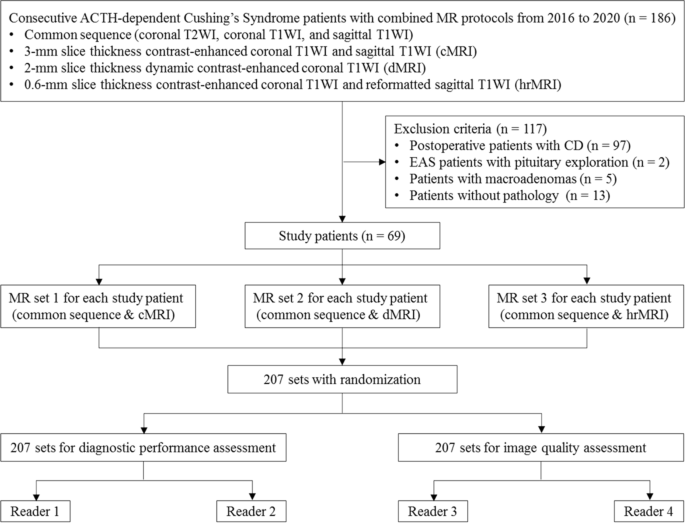
Fig. 1
figure 1

Flowchart of patient inclusion/exclusion process and image analysis. ACTH adrenocorticotropic hormone, CD Cushing’s disease, EAS ectopic ACTH syndrome, T1WI T1-weighted imaging, T2WI T2-weighted imaging

MRI protocol

All the patients were imaged on a 3.0 Tesla MR scanner (Discovery MR750w, GE Healthcare) using an 8-channel head coil. The MRI protocol included coronal T2-weighted imaging, coronal T1-weighted imaging, and sagittal T1-weighted imaging before contrast injection. After contrast injection of gadopentetate dimeglumine (Gd-DTPA) at 0.05 mmol/kg (0.1 mL/kg) with a flow rate of 2 mL/s followed by a 10-mL saline solution flush, dMRI and cMRI with 2D FSE sequence were obtained first, and hrMRI with 3D FSE sequence using variable flip angle technique was performed immediately afterward. Detailed acquisition parameters are presented in Table S1.

Image analysis: diagnostic performance

Image interpretation was independently conducted by two experienced neuroradiologists (F.F. and H.Y. with 25 and 16 years of experience in neuroradiology, respectively), who were blinded to patient information. The evaluation order of cMRI, dMRI, and hrMRI sequences was randomized. The identification of pituitary microadenomas on images was scored based on a three-point scale (0 = poor; 1 = fair; 2 = excellent). Scores of 1 or 2 represented the identification of the lesion. Reference standards were established by using all available imaging, clinical, surgical, and pathological resources, with a multidisciplinary team approach.

Image analysis: image quality

Two readers (Z.L. and B.H. with 4 years of experience in radiology, respectively) were asked to assess the image quality of cMRI, dMRI, and hrMRI. Before exposure to images used in the current study, these readers underwent a training session to make sure that they were comparable to the experienced neuroradiologists in terms of image quality assessment. Images were presented in a random order. Image quality was assessed by using a 5-point Likert scale [17], including overall image quality (1 = non-diagnostic; 2 = poor; 3 = fair; 4 = good; 5 = excellent), sharpness (1 = non-diagnostic; 2 = not sharp; 3 = a little sharp; 4 = moderately sharp; 5 = satisfyingly sharp), and structural conspicuity (1 = non-diagnostic; 2 = poor; 3 = fair; 4 = good; 5 = excellent). An example of image quality assessment is shown in Table S2. Final decision was made through a consensus agreement.

The mean signal intensity of pituitary microadenomas, pituitary gland, and noise on cMRI, dMRI, and hrMRI was measured using an operator-defined region of interest. For noise, a 10-mm2 region of interest was placed in the background, and noise was defined as the standard deviation of the signal intensity of the background [17]. For pituitary microadenomas and pituitary gland, the region of interest should include a representative portion of the structure. The mean signal intensity of the pituitary microadenoma was replaced with that of the pituitary gland when no microadenoma was identified. A signal-to-noise ratio (SNR) was defined as the mean signal intensity of the pituitary microadenoma divided by noise. A contrast-to-noise ratio (CNR) was defined as the absolute difference of the mean signal intensity between the normal pituitary gland and pituitary microadenomas divided by noise [17]. Supplementary Fig. 1 shows how to measure the SNR and CNR with the region of interest in a contrast-enhanced pituitary MRI. Supplementary Fig. 2 shows the selection of images for the SNR and CNR calculation.

Statistical analysis

The κ analysis was conducted to assess the inter-observer agreement for identifying pituitary microadenomas. The κ value was interpreted as follows: below 0.20, slight agreement; 0.21–0.40, fair agreement; 0.41–0.60, moderate agreement; 0.61–0.80, substantial agreement; greater than 0.80, almost perfect agreement.

To assess the diagnostic performance of cMRI, dMRI, and hrMRI for identifying pituitary microadenomas, the receiver operating characteristic curves were plotted and the area under curves (AUCs) were compared between MR protocols for each reader by using the DeLong test. Sensitivity, specificity, positive predictive value, and negative predictive value were calculated. The Mann–Whitney U test was used to evaluate the difference in image quality scores and the Wilcoxon signed-rank test was used to evaluate SNR and CNR measurements between MR protocols. A p value of less than 0.05 was considered statistically significant. Statistical analysis was performed using MedCalc Statistical Software (version 20.0.15; MedCalc Software) and SPSS Statistics (version 22.0; IBM).

Results

Clinical characteristics

A total of 69 patients (median age, 39 years; interquartile range [IQR], 29–54 years; 38 women [55%]) with ACTH-dependent Cushing’s syndrome were included in the study and their clinical characteristics are shown in Table 1. Among the 69 patients, 60 (87%) patients were diagnosed with Cushing’s disease and 9 (13%) were ectopic ACTH syndrome. The median disease course was 36 months (IQR, 12–78 months). The median serum cortisol, ACTH, and 24-h urine free cortisol level before surgery were 33.0 μg/dL (IQR, 25.1–40.1 μg/dL; normal range 4.0–22.3 μg/dL), 77.2 ng/L (IQR, 55.0–124.0 ng/L; normal range 0–46 ng/L), and 422.0 μg (IQR, 325.8–984.6 μg; normal range 12.3–103.5 μg), respectively. The median serum cortisol and 24-h urine free cortisol level after surgery were 3.0 μg/dL (IQR, 1.8–18.4 μg/dL) and 195.6 μg (IQR, 63.5–1240.3 μg), respectively. The median diameter of pituitary microadenomas was 5 mm (IQR, 4–5 mm), ranging from 3 to 9 mm.

Table 1 Clinical characteristics of the patients

Diagnostic performance of cMRI, dMRI, and hrMRI for identifying pituitary microadenomas

The inter-observer agreement for identifying pituitary microadenomas by κ statistic between two readers was moderate on cMRI (κ = 0.50), moderate on dMRI (κ = 0.57), and almost perfect on hrMRI (κ = 0.91), respectively.

The diagnostic performance for identifying pituitary microadenomas on cMRI, dMRI, hrMRI, and combined cMRI and dMRI is summarized in Table 2. For reader 1, the diagnostic performance of hrMRI (AUC, 0.95; 95%CI: 0.87, 0.99) was higher than that of cMRI (AUC, 0.75; 95%CI: 0.63, 0.85; p = 0.002), dMRI (AUC, 0.59; 95%CI: 0.47, 0.71; p < 0.001), and combined cMRI and dMRI (AUC, 0.65; 95%CI: 0.53, 0.76; p = 0.001). For reader 2, the diagnostic performance of hrMRI (AUC, 0.97; 95%CI: 0.89, 1.00) was higher than that of cMRI (AUC, 0.74; 95%CI: 0.63, 0.84; p = 0.001), dMRI (AUC, 0.68; 95%CI: 0.56, 0.79; p = 0.001), and combined cMRI and dMRI (AUC, 0.70; 95%CI: 0.58, 0.80; p = 0.003).

Table 2 Diagnostic performance of cMRI, dMRI, and hrMRI for identifying pituitary microadenomas

For reader 1, 23 of the 69 patients (33%) were misdiagnosed on both cMRI and dMRI, but 18 of the 23 misdiagnosed patients (78%) were correctly diagnosed on hrMRI. For reader 2, 17 of the 69 patients (25%) were misdiagnosed on both cMRI and dMRI, but 14 of the 17 misdiagnosed patients (82%) were correctly diagnosed on hrMRI.

Figure 2 shows that a 5-mm pituitary microadenoma was identified on preoperative pituitary MRI. The margin of the lesion was fully delineated on hrMRI, but not on cMRI and dMRI. Figure 3 shows that a 3-mm pituitary microadenoma was missed on cMRI, but identified on dMRI and hrMRI. Figure 4 shows that a 5-mm pituitary microadenoma was correctly diagnosed on hrMRI, but missed on cMRI or dMRI. Figure 5 shows that a 4-mm pituitary microadenoma was evident on coronal images as well as reconstructed axial and reconstructed sagittal images on hrMRI.
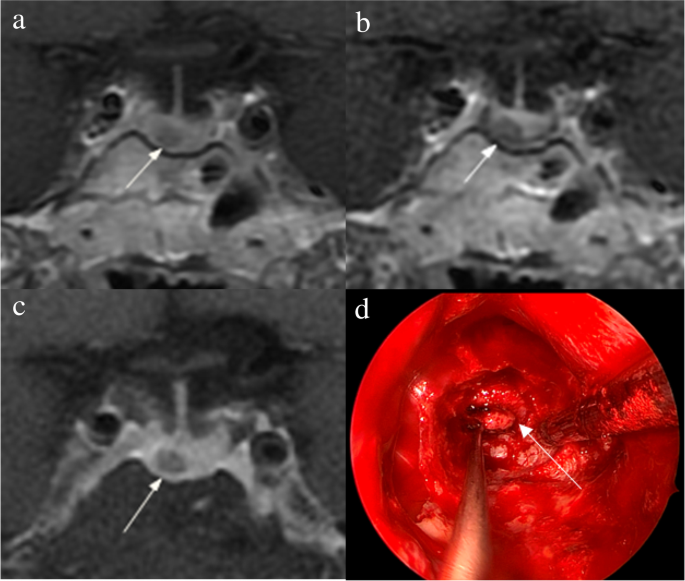
Fig. 2

figure 2

Images in a 56-year-old man with Cushing’s disease. The 5-mm pituitary microadenoma (arrow) can be identified on (a) coronal contrast-enhanced T1-weighted image and (b) coronal dynamic contrast-enhanced T1-weighted image obtained with two-dimensional (2D) fast spin echo (FSE) sequence, but the margin is not fully delineated. The lesion (arrow) is well delineated on (c) coronal contrast-enhanced T1-weighted image on high-resolution MRI obtained with 3D FSE sequence. d Intraoperative endoscopic photograph during transsphenoidal surgery after exposure of the sellar floor shows a round pituitary microadenoma (arrow)
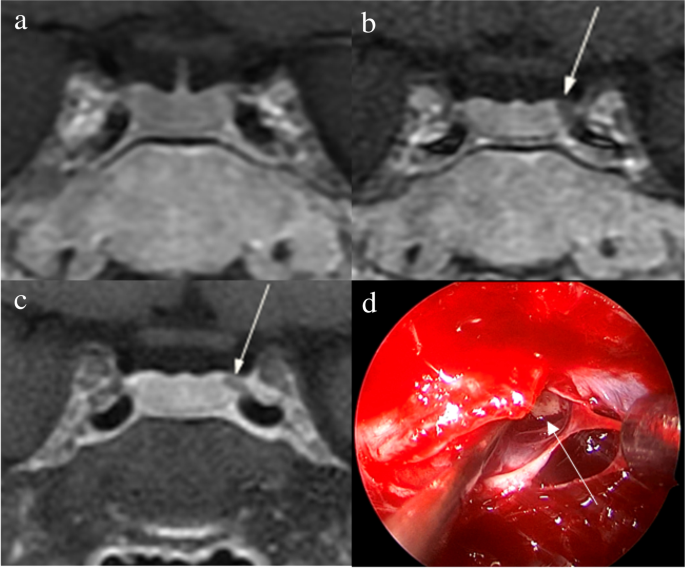
Fig. 3

figure 3

Images in a 34-year-old woman with Cushing’s disease. No tumor is identified on (a) coronal contrast-enhanced T1-weighted image obtained with two-dimensional (2D) fast spin echo (FSE) sequence. The 3-mm pituitary microadenoma (arrow) with delayed enhancement is identified on the left side of the pituitary gland on (b) coronal dynamic contrast-enhanced T1-weighted image obtained with 2D FSE sequence and (c) coronal contrast-enhanced T1-weighted image on high-resolution MRI obtained with 3D FSE sequence. d Intraoperative endoscopic photograph during transsphenoidal surgery shows a 3-mm pituitary microadenoma (arrow)
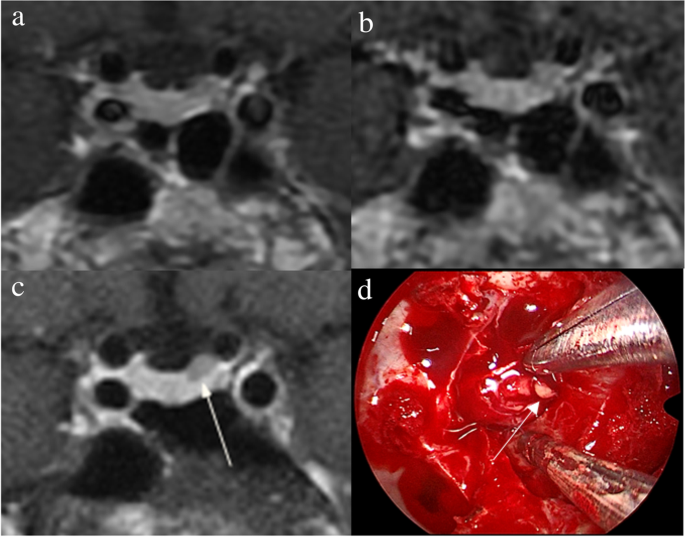
Fig. 4

figure 4

Images in a 43-year-old man with Cushing’s disease. The lesion is missed on (a) coronal contrast-enhanced T1-weighted image and (b) coronal dynamic contrast-enhanced T1-weighted image obtained with two-dimensional (2D) fast spin echo (FSE) sequence. c Coronal contrast-enhanced T1-weighted image on high-resolution MRI obtained with 3D FSE sequence shows a round pituitary microadenoma (arrow) measuring approximately 5 mm with delayed enhancement on the left side of the pituitary gland. d Intraoperative endoscopic photograph for microsurgical resection of the 5-mm pituitary microadenoma (arrow)
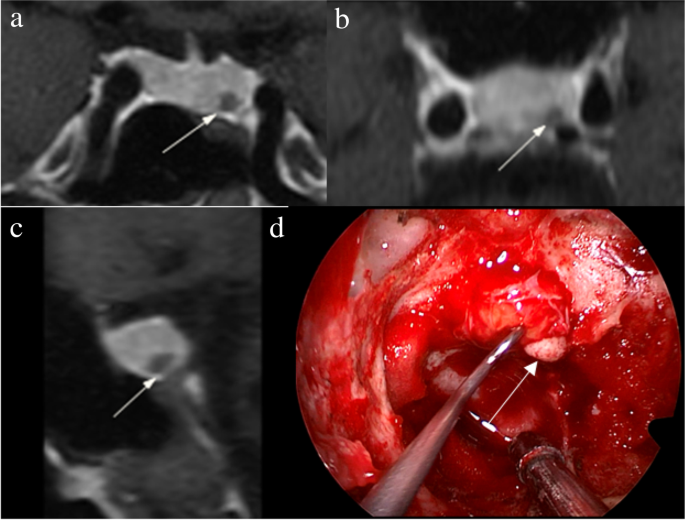
Fig. 5

figure 5

Images in a 48-year-old woman with Cushing’s disease. Preoperative high-resolution contrast-enhanced MRI using three-dimensional fast spin echo sequence shows a 4-mm pituitary microadenoma (arrow) with delayed enhancement is well delineated on the left side of the pituitary gland on (a) coronal, (b) reconstructed axial, and (c) reconstructed sagittal contrast-enhanced T1-weighted images. d Intraoperative endoscopic photograph during transsphenoidal surgery after exposure of the sellar floor shows a round pituitary microadenoma (arrow)

Image quality of cMRI, dMRI, and hrMRI

Image quality scores of cMRI, dMRI, and hrMRI are presented in Table 3. Scores for overall image quality, sharpness, and structural conspicuity on hrMRI (overall image quality, 5.0 [IQR, 5.0–5.0]; sharpness, 5.0 [IQR, 4.5–5.0]; structural conspicuity, 5.0 [IQR, 5.0–5.0]) were higher than those on cMRI (overall image quality, 4.0 [IQR, 3.5–4.0]; sharpness, 4.0 [IQR, 3.0–4.0]; structural conspicuity, 4.0 [IQR, 4.0–4.0]; p < 0.001 for all) and dMRI (overall image quality, 4.0 [IQR, 4.0–4.0]; sharpness, 4.0 [IQR, 4.0–4.0]; structural conspicuity, 4.0 [IQR, 4.0–4.5]; p < 0.001 for all).

Table 3 Image quality scores on cMRI, dMRI, and hrMRI

The SNR and CNR measurements are shown in Table 4. The SNR of the pituitary microadenomas on hrMRI (67.5 [IQR, 51.2–92.1]) was lower than that on cMRI (82.3 [IQR, 61.8–127.2], p < 0.001), but higher than that on dMRI (53.9 [IQR, 35.2–72.6], p = 0.001). The CNR on hrMRI (26.2 [IQR, 15.1–41.0]) was higher than that on cMRI (10.6 [IQR, 0–42.6], p = 0.023) and dMRI (11.2 [IQR, 0–29.8], p < 0.001).

Table 4 SNR and CNR on cMRI, dMRI, and hrMRI

Discussion

The identification of pituitary microadenomas is considerably challenging but critical in patients with ACTH-dependent Cushing’s syndrome. Our study demonstrated that hrMRI with 3D FSE sequence had higher diagnostic performance (AUC, 0.95–0.97) than cMRI (AUC, 0.74–0.75; p ≤ 0.002) and dMRI (AUC, 0.59–0.68; p ≤ 0.001) for identifying pituitary microadenomas. To our knowledge, there are no previous studies specifically evaluating the identification of pituitary microadenomas on hrMRI with 3D FSE sequence by comparison with cMRI and dMRI in patients with ACTH-dependent Cushing’s syndrome, and this is the largest study conducted in ACTH-secreting microadenomas with a sensitivity of more than 90%.

Recently, techniques for pituitary evaluation have developed rapidly. Because of false negatives and false positives on cMRI and dMRI using 2D FSE sequence [7910], a 3D SPGR sequence was introduced for identifying pituitary adenomas. Previous studies demonstrated that the 3D SPGR sequence performed better than the 2D FSE sequence in the identification of pituitary adenomas with a sensitivity of up to 80% [11,12,13]. In patients with hyperprolactinemia, the 3D FSE sequence was recommended [14] and the 3D FSE sequence has rapidly developed recently with superior image quality [1516], suggesting that the 3D FSE sequence may be a reliable alternative for identifying pituitary adenomas. However, to our knowledge, few studies have investigated the diagnostic performance of the 3D FSE sequence for identifying ACTH-secreting pituitary adenomas. To fill the gaps, we conducted the current study and revealed that images obtained with the 3D FSE sequence had higher sensitivity (90–93%) in identifying pituitary microadenomas, than that in previous studies using the 3D SPGR sequence [811,12,13].

There is a trade-off between spatial resolution and image noise. The reduced slice thickness can overcome the partial volume averaging effect, but it is associated with increased image noise [17]. Strikingly, our study showed that hrMRI had higher image quality scores than cMRI and dMRI, in terms of overall image quality, sharpness, and structural conspicuity. The SNR of the pituitary microadenomas on cMRI was slightly higher than that on hrMRI in our study. This is because the SNR was calculated as the mean signal intensity of the pituitary gland (instead of the pituitary microadenoma) divided by noise when no microadenoma was identified, and the mean signal intensity of the pituitary gland is higher than that of the pituitary microadenoma. About 40% of pituitary microadenomas were missed on cMRI, whereas less than 10% of pituitary microadenomas were missed on hrMRI. Given the situation mentioned above, the SNR on hrMRI was lower than that on cMRI. However, the CNR on hrMRI was significantly higher than that on cMRI and dMRI. Therefore, hrMRI in our study can dramatically improve the spatial resolution with high CNR, enabling the better identification of pituitary microadenomas.

The identification of pituitary adenomas on preoperative MRI in patients with ACTH-dependent Cushing’s syndrome could help the differential diagnosis of Cushing’s syndrome and aids surgical resection of lesions. It should be noted that most of the pituitary adenomas in patients with Cushing’s disease are microadenomas [56]. In our study, all the tumors are microadenomas with a median diameter of 5 mm (IQR, 4–5 mm), making the diagnosis more challenging. The sensitivity of identifying pituitary adenomas decreased from 80 to 72% after excluding macroadenomas in a previous study [12], whereas the sensitivity of identifying pituitary microadenomas in our study was 90–93% on hrMRI. In the current study, hrMRI performed better than cMRI, dMRI, and combined cMRI and dMRI, with high AUC (0.95–0.97), high sensitivity (90–93%), and high specificity (100%), superior to previous studies [811,12,13]. The high sensitivity of hrMRI for identifying pituitary adenomas will help surgeons improve the postoperative remission rate [4]. The high specificity of hrMRI will assist clinicians to consider ectopic ACTH syndrome, and then perform imaging to identify ectopic tumors. Besides, the inter-observer agreement for identifying pituitary microadenomas was almost perfect on hrMRI (κ = 0.91), which was moderate on cMRI (κ = 0.50) and dMRI (κ = 0.57). Therefore, hrMRI using the 3D FSE sequence is a potential alternative that can significantly improve the identification of pituitary microadenomas.

Limitations of the study included its retrospective nature and the relatively small sample size in patients with ectopic ACTH syndrome as negative controls. The bias may be introduced in the patient inclusion process. Only those patients who underwent all the cMRI, dMRI, and hrMRI scans were included. In fact, some patients will bypass hrMRI when obvious pituitary adenomas were detected on cMRI and dMRI. These patients were not included in the current study because of lack of hrMRI findings. Given the situation, the sensitivity of identifying pituitary adenomas will be higher with the enrollment of these patients. Besides, the timing of the sequence acquisition after contrast injection is essential [16] and bias may be introduced due to the postcontrast enhancement curve of both the pituitary gland and the microadenoma [14]. In the future, a prospective study with different sequence acquisition orders is needed to minimize possible interference caused by the postcontrast enhancement curve. Moreover, a larger sample size is also needed to verify the diagnostic performance of hrMRI using 3D FSE sequence for identifying pituitary microadenomas and to determine whether it can replace 2D FSE or 3D SPGR sequences for routinely evaluating the pituitary gland.

In conclusion, hrMRI with 3D FSE sequence showed higher diagnostic performance than cMRI and dMRI for identifying pituitary microadenomas in patients with Cushing’s syndrome.

Abbreviations

ACTH:
Adrenocorticotropic hormone
AUC:
Area under the receiver operating characteristics curve
cMRI:
Conventional contrast-enhanced MRI
CNR:
Contrast-to-noise ratio
dMRI:
Dynamic contrast-enhanced MRI
FSE:
Fast spin echo
hrMRI:
High-resolution contrast-enhanced MRI
IQR:
Interquartile range
SNR:
Signal-to-noise ratio
SPGR:
Spoiled gradient re

called

References

  1. Lacroix A, Feelders RA, Stratakis CA, Nieman LK (2015) Cushing’s syndrome. Lancet 386:913–927

    Article CAS PubMed Google Scholar

  2. Loriaux DL (2017) Diagnosis and differential diagnosis of Cushing’s syndrome. N Engl J Med 376:1451–1459

    Article CAS PubMed Google Scholar

  3. Nieman LK, Biller BM, Findling JW et al (2015) Treatment of Cushing’s syndrome: an Endocrine Society clinical practice guideline. J Clin Endocrinol Metab 100:2807–2831

    Article CAS PubMed PubMed Central Google Scholar

  4. Yamada S, Fukuhara N, Nishioka H et al (2012) Surgical management and outcomes in patients with Cushing disease with negative pituitary magnetic resonance imaging. World Neurosurg 77:525–532

    Article PubMed Google Scholar

  5. Vitale G, Tortora F, Baldelli R et al (2017) Pituitary magnetic resonance imaging in Cushing’s disease. Endocrine 55:691–696

    Article CAS PubMed Google Scholar

  6. Jagannathan J, Smith R, DeVroom HL et al (2009) Outcome of using the histological pseudocapsule as a surgical capsule in Cushing disease. J Neurosurg 111:531–539

    Article PubMed PubMed Central Google Scholar

  7. Boscaro M, Arnaldi G (2009) Approach to the patient with possible Cushing’s syndrome. J Clin Endocrinol Metab 94:3121–3131

    Article CAS PubMed Google Scholar

  8. Kasaliwal R, Sankhe SS, Lila AR et al (2013) Volume interpolated 3D-spoiled gradient echo sequence is better than dynamic contrast spin echo sequence for MRI detection of corticotropin secreting pituitary microadenomas. Clin Endocrinol (Oxf) 78:825–830

    Article CAS PubMed Google Scholar

  9. Lonser RR, Nieman L, Oldfield EH (2017) Cushing’s disease: pathobiology, diagnosis, and management. J Neurosurg 126:404–417

    Article PubMed Google Scholar

  10. Potts MB, Shah JK, Molinaro AM et al (2014) Cavernous and inferior petrosal sinus sampling and dynamic magnetic resonance imaging in the preoperative evaluation of Cushing’s disease. J Neurooncol 116:593–600

    Article PubMed Google Scholar

  11. Grober Y, Grober H, Wintermark M, Jane JA, Oldfield EH (2018) Comparison of MRI techniques for detecting microadenomas in Cushing’s disease. J Neurosurg 128:1051–1057

    Article PubMed Google Scholar

  12. Fukuhara N, Inoshita N, Yamaguchi-Okada M et al (2019) Outcomes of three-Tesla magnetic resonance imaging for the identification of pituitary adenoma in patients with Cushing’s disease. Endocr J 66:259–264

    Article PubMed Google Scholar

  13. Patronas N, Bulakbasi N, Stratakis CA et al (2003) Spoiled gradient recalled acquisition in the steady state technique is superior to conventional postcontrast spin echo technique for magnetic resonance imaging detection of adrenocorticotropin-secreting pituitary tumors. J Clin Endocrinol Metab 88:1565–1569

    Article CAS PubMed Google Scholar

  14. Magnaldi S, Frezza F, Longo R, Ukmar M, Razavi IS, Pozzi-Mucelli RS (1997) Assessment of pituitary microadenomas: comparison between 2D and 3D MR sequences. Magn Reson Imaging 15:21–27

    Article CAS PubMed Google Scholar

  15. Lien RJ, Corcuera-Solano I, Pawha PS, Naidich TP, Tanenbaum LN (2015) Three-Tesla imaging of the pituitary and parasellar region: T1-weighted 3-dimensional fast spin echo cube outperforms conventional 2-dimensional magnetic resonance imaging. J Comput Assist Tomogr 39:329–333

    PubMed Google Scholar

  16. Sartoretti T, Sartoretti E, Wyss M et al (2019) Compressed SENSE accelerated 3D T1w black blood turbo spin echo versus 2D T1w turbo spin echo sequence in pituitary magnetic resonance imaging. Eur J Radiol 120:108667

    Article PubMed Google Scholar

  17. Kim M, Kim HS, Kim HJ et al (2021) Thin-slice pituitary MRI with deep learning-based reconstruction: diagnostic performance in a postoperative setting. Radiology 298:114–122

    Article PubMed Google Scholar

Download references

Acknowledgements

We thank Dr. Kai Sun, Medical Research Center, Peking Union Medical College Hospital, for his guidance on the statistical analysis in this study.

Funding

This study has received funding from the National Natural Science Foundation of China (grant 82071899), the National Key Research and Development Program of China (grants 2016YFC1305901, 2020YFA0804500), the Chinese Academy of Medical Sciences Innovation Fund for Medical Sciences (grants 2017-I2M-3–008, 2021-I2M-1–025), the Beijing Natural Science Foundation (grant L182067) and National High Level Hospital Clinical Research Funding (2022-PUMCH-B-067, 2022-PUMCH-B-114).

Author information

Author notes

  1. Zeyu Liu and Bo Hou contributed equally to this work and share first authorship
  2. Hui You and Feng Feng contributed equally to this work and share corresponding authorship

Authors and Affiliations

  1. Department of Radiology, Peking Union Medical College Hospital, Chinese Academy of Medical Sciences and Peking Union Medical College, No. 1 Shuaifuyuan Wangfujing Dongcheng Distinct, Beijing, 100730, China

    Zeyu Liu, Bo Hou, Hui You, Mingli Li & Feng Feng

  2. Department of Endocrinology, Peking Union Medical College Hospital, Chinese Academy of Medical Sciences and Peking Union Medical College, No. 1 Shuaifuyuan Wangfujing Dongcheng Distinct, Beijing, 100730, China

    Lin Lu, Lian Duan & Huijuan Zhu

  3. Department of Neurosurgery, Peking Union Medical College Hospital, Chinese Academy of Medical Sciences and Peking Union Medical College, No. 1 Shuaifuyuan Wangfujing Dongcheng Distinct, Beijing, 100730, China

    Kan Deng & Yong Yao

  4. State Key Laboratory of Complex Severe and Rare Disease, Peking Union Medical College Hospital, Chinese Academy of Medical Sciences and Peking Union Medical College, No. 1 Shuaifuyuan Wangfujing Dongcheng Distinct, Beijing, 100730, China

    Yong Yao, Huijuan Zhu & Feng Feng

Corresponding authors

Correspondence to Hui You or Feng Feng.

Ethics declarations

Guarantor

The scientific guarantor of this publication is Feng Feng.

Conflict of interest

The authors of this manuscript declare no conflict of interest.

Statistics and biometry

No complex statistical methods were necessary for this paper.

Informed consent

Written informed consent was waived by the Institutional Review Board.

Ethical approval

Institutional Review Board approval was obtained.

Methodology

• retrospective

• diagnostic or prognostic study

• performed at one institution

Additional information

Publisher’s note

Springer Nature remains neutral with regard to jurisdictional claims in published maps and institutional affiliations.

Supplementary Information

Below is the link to the electronic supplementary material.

Minimizing the Number of False Positives in Dexamethasone Suppression Testing for the Diagnosis of Cushing’s Syndrome

In this application note, Tecan presents a method for diagnosing Cushing’s syndrome efficiently and accurately. The approach involves simultaneous the measurement of cortisol and dexamethasone levels using LC-MS/MS, which reduces false positives in dexamethasone suppression test (DSTs). The described LC-MS/MS method enables the tracking of multiple analytes, including cortisol, cortisone, and dexamethasone, in serum or plasma. Implementing this analytical approach offers clinical laboratories a straightforward means of performing DSTs, and the availability of a commercially available kit ensures reliable and reproducible results.


CRH Stimulation Test Boosts Cushing Disease Diagnosis

The study covered in this summary was published on Research Square as a preprint and has not yet been peer reviewed.

Key Takeaways

  • Adding a corticotropin-releasing hormone (CRH) stimulation test immediately following a 2-day low-dose dexamethasone suppression test (LDDST) ― what’s known as a Dex-CRH test and was first introduced in 1993 ― identified Cushing disease in 5 of 65 people (7.7%) with a confirmed diagnosis but who had previously shown normal cortisol levels on a conventional LDDST.
  • However, the Dex-CRH test also resulted in one (2.5%) false positive case compared with an LDDST alone.
  • Measuring serum dexamethasone levels further improved the diagnostic accuracy of the Dex-CRH test.

Why This Matters

  • It can be challenging to diagnose Cushing syndrome and to differentiate Cushing disease from nonneoplastic physiologic hypercortisolism caused by conditions that can present with Cushing syndrome–like clinical features, such as diabetes and obesity.
  • The Dex-CRH test, first described in 1993, initially appeared superior to an LDDST alone for ruling out nonneoplastic hypercortisolism, with a report of 100% sensitivity, specificity, and diagnostic accuracy. However, subsequent studies that used different protocols and in which dexamethasone was not measured had results that called into question the accuracy, sensitivity, and specificity of the Dex-CRH test.
  • This study reports the accuracy, sensitivity, and specificity of the Dex-CRH test for diagnosing Cushing disease, performed as first described, in 107 patients, including 74 for whom dexamethasone was also measured.

Study Design

  • The researchers analyzed data from 107 patients with suspected Cushing disease who underwent a Dex-CRH test during 2002–2014 at the Cleveland Clinic.

Key Results

  • Sixty-five people received a confirmed diagnosis of Cushing disease and underwent follow-up for a median of 66 months. Cushing disease was not confirmed in 42 patients who were followed for a median of 52 months.
  • The median age of the 107 patients was 40 years, and 82% to 88% were women. The median body mass index for these patients was 34–37 kg/m2.
  • Among the 65 patients with confirmed Cushing disease, five patients (7.7%) had a suppressed cortisol level no greater than 1.4 μg/dL after the LDDST but were appropriately classified as having Cushing disease with a cortisol level that surpassed 1.4 μg/dL by 15 minutes after CRH stimulation.
  • In contrast, 3 of 42 patients (7.1%) in the group without confirmed Cushing disease had an abnormal Dex-CRH test result. For one of these three patients, the LDDST result was borderline normal, with a cortisol level post-DEX of 1.4 μg/dL that increased to 3.1 μg/dL by 15 minutes after CRH stimulation, which resulted in this patient receiving a false positive diagnosis.
  • A cortisol threshold value of more than 1.4 μg/dL during the Dex-CRH test was diagnostic of Cushing disease with sensitivity of 100%, specificity of 93%, and diagnostic accuracy of 97%.
  • Among the 74 patients with dexamethasone measurements, the sensitivity of the Dex-CRH test was unchanged, but the specificity and diagnostic accuracy increased to 97% and 99%, respectively.

Limitations

  • The study was retrospective.
  • Not all patients underwent measurement of dexamethasone level.
  • No uniform protocol existed for the diagnostic work-up and follow-up of patients suspected of having Cushing disease.

Disclosures

  • The study did not receive commercial funding.
  • The authors had no financial disclosures.

This is a summary of a preprint research study , “The Addition of Corticotropin-Releasing Hormone to 2-Day Low Dose Dexamethasone,” written by researchers primarily from the Cleveland Clinic and Johns Hopkins University School of Medicine, published on Research Square, and provided to you by Medscape. This study has not yet been peer reviewed. The full text of the study can be found on research square.com.

From https://www.medscape.com/viewarticle/985984

‘Benign’ Adrenal Gland Tumors Might Cause Harm to Millions

Millions of people are at increased risk of type 2 diabetes and high blood pressure and don’t even know it, due to a hidden hormone problem in their bodies.

As many as 1 in 10 people have a non-cancerous tumor on one or both of their adrenal glands that could cause the gland to produce excess amounts of the stress hormone cortisol.

Up to now, doctors have thought that these tumors had little impact on your health.

But a new study out of Britain has found that up to half of people with these adrenal tumors are secreting enough excess cortisol to raise their risk of diabetes and high blood pressure.

Nearly 1.3 million adults in the United Kingdom alone could suffer from this disorder, which is called Mild Autonomous Cortisol Secretion (MACS), the researchers said.

Anyone found with one of these adrenal tumors should be screened to see if their health is at risk, said senior researcher Dr. Wiebke Arlt, director of the University of Birmingham Institute of Metabolism and Systems Research in England.

“People who are found to have an adrenal tumor should undergo assessment for cortisol excess and if they are found to suffer from cortisol overproduction they should be regularly screened for type 2 diabetes and hypertension and receive treatment if appropriate,” Arlt said.

These tumors are usually discovered during imaging scans of the abdomen to treat other illnesses, said Dr. André Lacroix, an endocrinologist at the University of Montreal Hospital Center, who wrote an editorial accompanying the study. Both were published Jan. 4 in the Annals of Internal Medicine.

Adrenal glands primarily produce the hormone adrenaline, but they are also responsible for the production of a number of other hormones, including cortisol, Lacroix said.

Cortisol is called the “fight-or-flight” hormone, and can cause blood sugar levels to rise and blood pressure to surge — usually in response to some perceived bodily threat.

Previous studies had indicated that about 1 in 3 adrenal tumors secrete excess cortisol, and an even lower number caused cortisol levels to rise so high that they affected health, researchers said in background notes.

But this new study of more than 1,300 people with adrenal tumors found that previous estimates were wrong.

About half of these patients had excess cortisol due to their adrenal tumors. Further, more than 15% had levels high enough to impact their health, compared to those with truly benign tumors.

MACS patients were more likely to be diagnosed with high blood pressure, and were as much as twice as likely to be on three or more blood pressure medications.

They also were more likely to have type 2 diabetes, and were twice as likely to require insulin to manage their blood sugar, the study found.

“This study clearly shows that mild cortisol production is more frequent than we thought before, and that the more cortisol you produce, the more likely to you are to have consequences such as diabetes and hypertension,” Lacroix said.

About 70% of people with MACS were women, and most were of postmenopausal age, the researchers said.

“Adrenal tumor-related cortisol excess is an important previously overlooked health issue that particularly affects women after the menopause,” Arlt said.

Lacroix agreed that guidelines should be changed so that people with adrenal tumors are regularly screened.

“Everybody who is found to have an adrenal nodule larger than 1 centimeter needs to be screened to see if they’re producing excess hormone or not,” he said. “That’s very clear.”

A number of medications can reduce cortisol overproduction or block cortisol action, if an adrenal tumor is found to be causing an excess of hormone.

People with severe cortisol excess can even have one of their two adrenal glands removed if necessary, Lacroix said.

“It is quite possible to live completely normally with one adrenal gland,” he said.

More information

The Cleveland Clinic has more about adrenal tumors.

SOURCES: Wiebke Arlt, MD, DSc, director, Institute of Metabolism and Systems Research, University of Birmingham, U.K.; André Lacroix, MD, endocrinologist, University of Montreal Hospital Center; Annals of Internal Medicine, Jan. 4, 2022

From https://consumer.healthday.com/1-4-benign-adrenal-gland-tumors-might-cause-harm-to-millions-2656172346.html

Desmopressin Stimulation Test in a Pregnant Patient with Cushing’s Disease

https://doi.org/10.1016/j.aace.2021.11.005Get rights and content
Under a Creative Commons license
open access

Highlights

Due to the physiologic rise of ACTH during pregnancy, unstimulated ACTH levels may not be an accurate marker to differentiate between adrenal and ACTH-independent Cushing’s syndrome.

The desmopressin stimulation test can be done during pregnancy to investigate the etiology of Cushing’s syndrome.

Non-gadolinium enhanced pituitary imaging may not detect pituitary adenoma, which is the most common cause of Cushing’s disease. Contrast-enhanced pituitary magnetic resonance imaging should be considered in pregnant women with ACTH-dependent Cushing’s syndrome.

Due to increase maternal and fetal morbidities in active Cushing’s syndrome, prompt diagnosis and appropriate treatment are essential. The treatment of choice is transsphenoidal surgery during the second trimester, preferably at a high-volume pituitary center.

There were significantly lower rates of fetal complications in women with active Cushing’s syndrome than a cured disease, including low birth weight.

Abstract

Objective

The hypothalamic-pituitary-adrenal axis stimulation during pregnancy complicates the investigation of Cushing’s syndrome. Our objective is to present a pregnant patient with Cushing syndrome caused by pituitary tumor in which the desmopressin stimulation test helped in the diagnosis and led to appropriate management.

Case report

A 27-year-old woman with 9-week gestation presented with proximal myopathy for 2 months. She had high blood pressure, wide abdominal purplish striae, and proximal myopathy. Her past medical history revealed hypertension and dysglycemia for 1 year. The 8 AM cortisol was 32.4 μg/dL (5-18), late-night salivary cortisol at 11 PM was 0.7 μg/dL (<0.4), and the mean 24-hour urinary free cortisol was 237.6 μg/day (21.0-143.0). The mean ACTH concentrations at 8 AM were 44.0 pg/mL (0-46.0). Non-gadolinium enhanced pituitary magnetic resonance imaging (MRI) reported no obvious lesion. The desmopressin stimulation test showed a 70% increase in ACTH levels from baseline after desmopressin administration. The pituitary MRI with gadolinium showed an 8x8x7-mm pituitary adenoma. Transsphenoidal surgery with tumor removal was done, which showed ACTH-positive tumor cells. After the surgery, the patient carried on the pregnancy uneventfully.

Discussion

During pregnancy, the ACTH level may not be an accurate marker to help in the differential diagnosis of Cushing’s syndrome. Moreover, non-gadolinium pituitary imaging may not detect small pituitary lesions.

Conclusion

In the present Case, the desmopressin stimulation test suggested the diagnosis of Cushing’s disease, which subsequently led to successful treatment. This suggested that the desmopressin test may serve as a useful test to diagnose Cushing’s disease in pregnant individuals.

Keywords

Cushing’s disease
Cushing’s syndrome
desmopressin stimulation test
pregnancy

Introduction

Pregnancy rarely occurs during the course of Cushing’s syndrome (CS).1,2 Given the increase in maternal and fetal morbidities in women with active CS, early diagnosis and treatment of CS are essential.2

The diagnosis of CS using the usual diagnostic tests is challenging due to stimulation of the hypothalamic-pituitary-adrenal axis during pregnancy. The physiologic rise of ACTH from the 7th week of pregnancy also complicates the investigation for the etiology of CS.1 The concern of gadolinium use during pregnancy can affect the sensitivity in detecting small pituitary lesions in ACTH-dependent CS if using non-gadolinium pituitary imaging. Desmopressin is a vasopressin analog selective for V2 receptors. The desmopressin stimulation test has been proposed as a useful procedure for the differential diagnosis of CS.3 Desmopressin stimulates the increase in ACTH and cortisol in patients with CS caused by pituitary tumor or Cushing’s disease (CD) but not in the majority of normal, obese subjects and patients with adrenal CS or ectopic ACTH syndrome.3,4 However, there were limited data on the desmopressin stimulation test during pregnancy.

Here we present the 27-year-old woman with CS in which the desmopressin stimulation test helped in the diagnosis of CD and led to successful treatment.

Case presentation

A 27-year-old woman with 9-week gestation was referred from the orthopedic department to evaluate CS. She presented with proximal myopathy for 2 months. On physical examination, she had Cushingoid appearance, wide purplish striae, bruising, and proximal muscle weakness. Her blood pressure was 160/100 mmHg, and her body mass index was 32.2 kg/m2. Her past medical history revealed that she had hypertension, dyslipidemia, and impaired fasting glucose for 1 year without taking any medication. She also gained 20 kg in the past 2 years. The 8 AM cortisol (chemiluminescent immunometric assay, Immulite/Siemens) was 32.4 μg/dL (normal , 5.0-18.0), late-night salivary cortisol at 11 PM (electrochemiluminescence immunoassay, Roche Cobas) was 0.7 μg/dL (normal, <0.4), and the mean 24-hour urinary free cortisol (UFC) (radioimmunoassay, Immulite/Siemens) was 237.6 μg/day (normal, 21.0-143.0). ACTH concentrations at 8 AM (chemiluminescent immunometric assay, Immulite/Siemens) were 48.4 and 39.6 pg/mL (normal, 0-46.0) (Table 1). At 12 weeks of gestation, non-gadolinium enhanced pituitary magnetic resonance imaging (MRI) reported a mild bulging contour of the right lateral aspect of the pituitary gland without an obvious abnormal lesion (Figure 2A). The desmopressin stimulation test was then carried out at 14 weeks of gestation. Serial blood samples for ACTH and cortisol were obtained basally (at 8 AM) and at 15, 30, 45, and 60 minutes after the intravenous administration of 10 μg of desmopressin. The results were shown in Table 2. Compared with baseline, ACTH levels increased from 34.7 to 58.9 pg/mL (70%) at 15 minutes after desmopressin administration (a ≥35% increase in ACTH levels was considered an indication of CD in non-pregnant individuals)3 (Figure 1). The pituitary MRI with gadolinium revealed an 8x8x7-mm circumscribed lesion with heterogeneous iso- to hyperintensity on T2W in the right inferolateral aspect of the anterior pituitary lobe. The lesion had a delayed enhancement compared to normal pituitary tissue (Figure 2B). Non-contrast MRI adrenal glands showed bilateral normal adrenal glands without mass or nodule. Other abdominal organs were unremarkable. Regarding comorbidities, she had hypertension and gestational diabetes mellitus (GDM). The HbA1c level was 5.7% (39 mmol/mol). Using a two-step strategy, GDM was diagnosed at 12 weeks of gestation. Hypertension and GDM were controlled with 750 mg of methyldopa and 50 units of insulin per day, respectively.

Table 1. Laboratory investigations of the present Case

Variable At 9 weeks of gestation
8 AM cortisol, μg/dL (5.0-18.0) 32.4
Salivary cortisol (11 PM , <0.4 μg/dL) 0.7
UFC (21.0-143.0 μg/day) 183.5 and 291.6
ACTH, pg/mL (8 AM, 0-46.0) 48.4 and 39.6
DHEAS (8 AM, 35.0-430.0 μg/dL) 378.0
PAC (upright position, 8 AM), ng/dL 5.2
PRA (upright position, 8 AM), ng/mL/hr 2.1
Potassium, mmol/L 3.6

UFC, urinary free cortisol; ACTH, adrenocorticotrophic hormone; DHEAS, dehydroepiandrosterone sulphate; PAC, plasma aldosterone concentration; PRA, plasma renin activity.

Figure 2Pituitary imaging of the present Case. (A) A non-gadolinium MRI of the pituitary gland at 12 weeks of gestation showing a mild bulging contour of the right lateral aspect of the pituitary gland without an obvious abnormal lesion (B) An MRI of the pituitary gland with gadolinium at 14 weeks of gestation showing an 8x8x7-mm circumscribed lesion with heterogeneous iso- to hyperintensity on T2W in the right inferolateral aspect of the anterior pituitary lobe. The lesion had a delayed enhancement compared to normal pituitary tissue.

Table 2. Desmopressin stimulation test results performing at 14 weeks of gestation

Time 0 min 15 min 30 min 45 min 60 min
ACTH (pg/mL) 34.7 58.9 57.4 49.9 38.2
Cortisol (μg/dL) 30.6 30.2 29.7 29.6 31.0

ACTH, adrenocorticotrophic hormone

Figure 1. Percentage of ACTH increase after desmopressin administration (time 0 min).

Transsphenoidal surgery with tumor removal was performed at 18 weeks of gestation. Pathological findings showed a 1.3×1.0x0.3 cm of tissue with segments of the pituitary gland and tumor. There were monomorphous round nuclei, stippled chromatin, indistinct nucleoli, and pale eosinophilic cytoplasm cells. These cells were reactive with ACTH and showed loss of reticulin framework, unlike the normal pituitary gland. The next day after the surgery, her 8 AM cortisol was 6.0 μg/dL. Hydrocortisone supplement was started and continued throughout pregnancy. Antihypertensives were discontinued, and the insulin dosages decreased to less than 20 units per day. At 38 weeks of gestation, she gave birth to a 2300-gm male newborn (small for gestational age). Dysglycemia and hypertension resolved after the delivery. One year after the first child’s delivery, the patient had a spontaneous pregnancy without GDM or hypertension. The 8 AM cortisol was 3.9 μg/dL, and hydrocortisone replacement was continued. The patient successfully delivered a term 3300-gm male infant without fetal or maternal complications. Two years after the first transsphenoidal surgery, a 1-μg cosyntropin stimulation test was performed, the basal cortisol was 11.7 μg/dL, and the peak serum cortisol was 23.8 μg/dL. Steroid replacement was withdrawn.

Discussion

Herein we present a 27-year-old woman who was evaluated during her first pregnancy for clinical and laboratory features suggestive of CD. Her morning serum and late-night salivary cortisol concentrations were elevated in addition to non-suppressed ACTH, but a definitive diagnosis was not obtained by a non-gadolinium pituitary MRI. The diagnosis of CD was suggested, however, by the results of a desmopressin stimulation test. The pituitary MRI with gadolinium was proceeded and revealed a pituitary lesion greater than 6 mm.

The prevalence of pregnancy is low due to reduced fertility in CS. To date, there have been less than 300 pregnant patients with CS reported in the literature.2 In pregnancy, the most frequent etiology of CS is adrenal CS (60%), followed by ACTH-producing pituitary adenomas or CD (35%), and very rarely ectopic ACTH (<5%).1 In contrast, CD is the most common cause of CS in non-pregnant people (approximately 70 percent). The clinical diagnosis of CS during pregnancy may be missed due to overlapping features between pregnancy and CS. However, wide purplish cutaneous striae and proximal myopathy are signs with high discrimination index when CS is suspected.5 These signs are not present in normal pregnancy.

In this present Case, CS was diagnosed with apparent clinical features of CS in addition to an elevated UFC and late-night salivary cortisol. The patient denied taking any supplements and her 8 AM cortisol was not suppressed and therefore did not suggest an etiology of exogenous steroid use. Pregnant women without CS may have elevated UFC and late-night salivary cortisol due to increased total and free plasma cortisol from the first trimester until the end of pregnancy.6 This results from an elevated concentration of cortisol transport protein and the increase in placental ACTH and CRH. According to the current guideline, UFC is the recommended test when CS is suspected during pregnancy.5 Since UFC increases during the second trimester, it may not be a reliable marker after the first trimester of pregnancy unless the level is clearly increased (up to 2- to 3-fold the upper limit of normal values).1 Late-night salivary cortisol is also one of the useful tests to diagnose CS during pregnancy because the circadian rhythm of cortisol is preserved in normal pregnancy. Furthermore, it is not influenced by the changes in the binding proteins.7 However, the previous study has shown that late-night salivary cortisol increased progressively throughout pregnancy. When compared with non-pregnant women, median values of late-night salivary cortisol in pregnant women were 1.1, 1.4, and 2.1 times higher in the first, second, and third trimesters respectively. The cutoff values for late-night salivary cortisol on each gestational trimester were: first trimester 0.255 μg/dL, second trimester 0.260 μg/dL, and third trimester 0.285 μg/dL. The respective sensitivities and specificities in each trimester were: first trimester 92 and 100%, second trimester 84 and 98%, and third trimester 80 and 93%.8

Given the non-suppressed ACTH levels after the 7th week of gestation, we were not able to summarize whether the etiology was adrenal CS or ACTH-dependent CS which could be either CD or ectopic ACTH syndrome. In non-pregnant individuals, ACTH suppression usually identifies adrenal CS. However, in pregnancy, ACTH levels were non-suppressed in half of those with adrenal CS due to continued stimulation of maternal hypothalamic-pituitary-adrenal axis by placental CRH.1 Therefore, using the ACTH thresholds in general populations can lead to misdiagnosis when investigating the etiology of CS in pregnant individuals. The hypothalamic-pituitary-adrenal axis response to exogenous glucocorticoids is blunted in pregnant women. Following an overnight dexamethasone administration, pregnant women without CS may have non-suppressed plasma cortisol and UFC.6 In non-pregnant individuals with CS, the high-dose dexamethasone suppression test identify CD with a sensitivity of 82% and a specificity of 50%.4 During pregnancy, the high-dose dexamethasone suppression test failed to identify almost half of the patients with CD.1 Inferior petrosal sinus sampling is usually avoided due to the risk of excessive radiation exposure. Since the non-gadolinium MRI also showed no obvious pituitary lesion in the present Case, in addition to the limitation of the high-dose dexamethasone suppression test and inferior petrosal sinus sampling in pregnancy, we used desmopressin stimulation to help in the investigation of CD since desmopressin can stimulate an ACTH response in a considerable proportion of patients with CD but not in most patients with adrenal CS or ectopic ACTH syndrome.3,4

Desmopressin has been assigned to pregnancy category B by the US Food and Drug Administration (FDA). In the most recent guideline update on the diagnosis and management of CD, the desmopressin stimulation test can be used to differentiate ectopic CS and CD in patients with normal or high ACTH and have no adenoma or equivocal results of pituitary MRI. However, the guideline did not mention the use of this test in pregnant individuals.9 The literature regarding the use of desmopressin stimulation tests in pregnancy is limited. We were able to identify one study in a pregnant patient with active CS, who was surgically confirmed as CD, in which the desmopressin stimulation test was performed at 10 weeks of gestation and after the delivery. Compared with age-matched healthy non-pregnant women, there were different responses of cortisol and ACTH after desmopressin administration in a pregnant patient with active CS.10 The ACTH peaks after the administration of desmopressin were higher in the pregnant patient. CRH stimulation test was also performed in the pregnant patient with CD. Desmopressin stimulated ACTH values during pregnancy and after the delivery were not significantly different, while the CRH stimulated ACTH values were significantly higher when the test was performed after the delivery. The authors did not mention optimal cutoff values for these diagnostic tests.10 In non-pregnant individuals, the ACTH increase of more than 35% at 15 minutes after the desmopressin administration gave the sensitivity of 84% and the specificity of 43% in the diagnosis of CD.3 Another recent study in ACTH-dependent CS showed that the threshold increase in the ACTH level after desmopressin stimulation of 45% identified CD with a sensitivity of 91% and a specificity of 75%.4 Using the non-pregnant cutoff values for the desmopressin stimulation test, the diagnosis of CD was made in our patient who was later surgically confirmed as CD.

Pituitary microadenomas were the cause of CD in almost 90% of non-pregnant individuals.11 In pregnant women with CD, pituitary microadenomas were also reported to be more common than macroadenomas.1,12 Almost 40% of pituitary microadenomas in CD were invisible or poorly visible in non-contrast MRI, in which contrast-enhanced MRI detected them.13 In the Case series from Lindsay et al., the non-contrast MRI could not correctly identify pituitary adenomas in 38% of pregnant patients with available data.1 The same case series reported a pregnant patient having normal pituitary MRI and was later surgically confirmed as having CD from a 3×3 adenoma with positive staining for ACTH. In the present case, a mild bulging contour of the pituitary gland, although without an obvious abnormal lesion, in addition to desmopressin test results, suggested the need for contrast-enhanced pituitary MRI. Gadolinium contrast is FDA pregnancy category C since it is water-soluble and can cross the placenta into the fetus and amniotic fluid.14 However, since a non-gadolinium MRI may not detect pituitary microadenoma even in patients with normal imaging results,1,15 we suggested physicians consider pituitary MRI with gadolinium as initial imaging in pregnant patients with clinical suspicion of CD.

Prompt diagnosis and treatment of CS are essential due to a higher rate of fetal loss in active CS patients without treatment than those who received either medical or surgical treatment. There are significantly lower rates of various fetal complications, including low birth weight, in women with active CS than in cured CS.2 Although medical and surgical treatment were not compared as prognostic factors for complications, experts recommend transsphenoidal surgery in the second trimester as the treatment of choice for CD in pregnancy.1,15 Medical treatment should be the second choice when surgery cannot be carried out or late diagnosis is made.

Conclusion

In the present Case, the results from the desmopressin stimulation test and the pituitary MRI with gadolinium suggested the diagnosis of CD, which subsequently led to successful treatment. This suggested that the desmopressin test may serve as a useful test to diagnose CD even in the context of pregnancy.

Conflicts of Interest

None of the authors have any potential conflicts of interest associated with this research.

References

Funding Statement

This research did not receive any specific grant from funding agencies in the public, commercial, or not-for-profit sectors.

Acknowledgements

The authors would like to thank you all the colleagues in the Division of Endocrinology and Metabolism, Department of Medicine, Faculty of medicine, Chulalongkorn University for all the support.