Cushing’s Awareness Day, 2013

awareness2013


Today, April 8th, is Cushing’s Awareness Day. Please wear your Cushing’s ribbons, t-shirts, awareness bracelets or Cushing’s colors (blue and yellow) and hand out Robin’s wonderful Awareness Cards to get a discussion going with anyone who will listen.

And don’t just raise awareness on April 8.  Any day is a good day to raise awareness.


What Can *YOU* Do to help?

Check out these ideas

1) status of the Cushing’s Awareness Day legislation… who has signed, who do we need to get? I have contacts to the US congressfolks from Houston, and I wanted to get them to sign if they have not. Can we get someone to testify before Congress? Can we get any federal funding? Can we rally with other rare disease groups to get in front of that mic on CSPAN?

2) can we do a fund drive for the month prior to April 8th in order to fund all of our projects and this site? can we keep track of how much each board member raises with little thermometers that show how much is collected, in order to get people excited about how much money is being generated?

3) can those who have had surgery in the past year right up there story to be published on April 8th for awareness day? I hope that planning this far in advance will allow us to get more articles published. Perhaps those who already had surgery can ask the paper to re-run their story with an update and reminder about awareness day.

4) can someone can write a press release to the news channels to get coverage for awareness day

5) we get someone to create a very nice postcard that we all can print from our home at our expense on card stock. Then we each pay for the postage to send the cards to all of our friends and families. Perhaps we can ask our family and friends to donate money to us that we can then donate to this board…

6) I need a Cushing’s bumper sticker! I know there are some for sale on the store site, but I was wondering if we can get some heads on this project to get something really catchy. I would put one on my card if we could get a really cool design going… any graphic artists wanna take this up?

7) I love the radio blog shows. I think they are so great. Perhaps we can add that icon to all of our Myspace, Facebook, and personal websites. Do we have an icon that we can post to get people to this site?

8) Have people set up care pages to keep friends and family informed about all the tests, doctors appts and then following us through surgery and post op. I have over 65 people subscribing to my care page, and I am confident that those 65 people didn’t know anything about Cushing’s until I told them about it. If we inform little circles of 50 all around the US and world, then we will be doing a great job increasing awareness. It is free, and I love mine. I control the tone of the site, and no one talks back to me there!

9). What can we do in the medical community? I’d like to see us patients doing more to lead the doctors down the proper path. —– Do we get a booth at a national endocrinologist conference and pass out information we want them to know, with Cushies staffing the booth? —– Do we develop a pamphlet specifically for doctors? —– Do we start a partnership with the national association of endocrinologists (not sure if this really exists, but you know what I mean) and work together to get more research done on Cyclic Cushing’s by offering ourselves up as research participants?

10) Perhaps we contact every Women’s health magazine on the market and submit some articles in February for consideration of their April magazine.

11) Perhaps we buy the google ads based on key words that appears in email. The links pop up on the right side bar while people read their gmail or other online email. If the person says ponch, fat, or other key words, then the side bar will give a link to this site.

12) We can distribute DVDs of Kate’s show and the two mystery diagnosis shows (Sam and Sharmyn) to doctors and endos? To new Cushies? This will take some money for DVDs and postage, but if we focus on raising some money, then we can allocated funds to these worthwhile expenses. Now, I am not sure if we need permission from Mystery Diagnosis or Nat Geo for that, but someone can take this project and get all the details.


I’d like to see us set up a goal-driven campaign for Cushing’s Awareness Day. This will really help motivate us into seeing how much interest and good we are generating as a group.

# of newspaper articles submitted
# of newspaper articles publised
# of magazine articles submitted
# of magazine articles published
# of dollars raised
# of dollars allocated to outreach (keyword ads in gmail and others, etc)
# of carepages set up
# of care page followers (in friends and family.. I have 65 already) etc.

If we each decide to lead a project to get all of this taken care of, we could be in a very good position to launch a really big Cushing’s Day Awareness in April. I am really looking forward to seeing all the creativity that exists of the minds of my brilliant Cushie friends!

This year, Novatis has made 2 TV commercials that will air this month to help with Cushing’s Awareness.

View them in advance here:

And

Also, a bit late for Cushing’s Awareness Day this year but a big hope for the future is the upcoming Congressional Caucus on Rare Diseases:

April 16th Rare Disease Congressional Caucus Briefing


RDCC-Horizontal-CMYK

Rare Disease Legislative Advocates and Novartis, in coordination with Rare Disease Caucus Co-Chairs Representatives Leonard Lance (R-NJ) and Joe Crowley (D-NY)  will host a briefing on “Medical Innovation for Rare Diseases: Challenges that Our Country Must Address.”  Tuesday, April 16, 2013 from 12:00 PM – 1:00 PM in Rayburn B-318


Discussion:

  • Advancements and new developments in the treatment of rare diseases
  • Advances in the rare pituitary disease space
  • Opportunities and challenges for those living with a rare disease
  • Opportunities to discover new treatment options

Speakers  include:   

  • Robert Knutzen – Pituitary Network Association; Chairman and CEO
  • Louis Pace – Cushing’s Support and Research Foundation; President
  • Dr. Vijay Iyengar – Novartis Rare Disease Franchise; Vice President

Food and Refreshments will be served.

General Public may RSVP by clicking here

Staffers may RSVP by contacting Helen Dwight in the office of Rep. Leonard Lance (202-225-5361) or Nicole Cohen in the office of Rep. Joe Crowley (202-225-3965).

Cushing’s Awareness Challenge, Day 1: Rare Disease Congressional Caucus Briefing

Cushing's Awareness Challenge 2013

Cushing’s Awareness Challenge 2013

The Challenge is back!

This year, I’m doing something w-a-y outside my comfort zone for Cushing’s Awareness.

A while ago, I got this email:

Rare Disease Congressional Caucus Briefing

Good morning Mary:

I hope everything is well.

I would like to invite you to join us at the Rare Disease Congressional Caucus briefing scheduled for April 2013. The final date is still being discussed but we are looking into two possible dates of either April 16th or April 18th. The meeting will take place in Washington, D.C. and will be attended by members of the Rare Disease Caucus including co-chairs Rep. Joseph Crowley and Rep. Leonard Lance.

As you may know Rare Disease Congressional Caucus is a forum for members of Congress to voice constituent concerns, share ideas, and build support for legislation that will improve the lives of people with rare diseases. The goal of the meeting in April is to educate the members of the Caucus about rare pituitary disorders, including Cushing’s Disease – area that has received little to no recognition among legislators. The meeting will serve as an opportunity to raise legislators’ awareness about multiple issues that patients with rare pituitary diseases, such as Cushing’s disease and Acromegaly, face in their everyday lives.

In preparation for the meeting we drafted a Resolution that addresses some of the key challenges for the patient community including long diagnostic delays, limited treatment options, difficulty finding physicians or treatment centers with expertise in their disease and as a result – a  diminished quality of life for patients. Would you be willing to have a look at the draft in the attachment and provide your feedback? Your opinion as a leader of the patient community and expert in Cushing’s disease would be highly appreciated.

I sincerely hope that you will be able to join us at the meeting to share your perspective and talk about the work that you are doing to help patient afflicted by Cushing’s disease live happier and healthier lives.

Please feel free to call or email anytime if you have questions or if you would like to discuss this further. I look forward to hearing back from you soon.

Regards,

Even though I’m absolutely terrified of speaking in front of groups (or singles!) I’m going to do this. What a fantastic opportunity to get the word out there for Cushing’s!

Turns out this will be April 16 – wish me luck!

maryo colorful zebra

A Quarter of a Century

I had my one, and only, pituitary surgery on this date in 1987.  Of course, I was trying to get a diagnosis for several years before that.

I know it’s hard to get a diagnosis now – imagine how hard it was over 30 years ago – before the Internet, Facebook, Twitter, message boards, chatrooms.  No online support – no support anywhere.

Finding any information possible at the Public Library.  Days that you feel like death warmed over, heading out to the library to Xerox medical articles you don’t understand, poring over them at home, trying to find any kernel of hope for what you have.  Then trying to convince doctors when your family doesn’t even believe you.

Finally, a doctor believes you…but he’s the wrong kind of doctor so he sends you away.  Another year goes by.  The endo recommends surgery but there are only 3 possibilities anywhere.  NIH – close by and free, Montreal – they speak French – and San Francisco.

After a diagnosis, 6 weeks of inpatient testing at the NIH.

From my bio at http://www.cushings-help.com/maryos_story.htm

There were about 12 of us there and it was nice not to be alone with this mystery disease. Many of these Cushies (mostly women) were getting bald, couldn’t walk, having strokes, had diabetes. One was blind, one had a heart attack while I was there. Towards the end of my testing period, I was looking forward to the surgery just to get this whole mess over with. While I was at NIH, I was gaining about a pound a day!

The MRI still showed nothing, so they did a Petrosal Sinus Sampling Test. That scared me more than the prospect of surgery. (This test carries the risk of stroke and uncontrollable bleeding from the incision points.) Catheters were fed from my groin area to my pituitary gland and dye was injected. I could watch the whole procedure on monitors. I could not move during this test or for several hours afterwards to prevent uncontrolable bleeding from a major artery. The test did show where the tumor probably was located. Also done were more sophisticated dexamethasone suppression tests where drugs were administered by IV and blood was drawn every hour (they put a heplock in my arm so they don’t have to keep sticking me). I got to go home for a weekend and then went back for the surgery – the Transsphenoidal Resection. I fully expected to die during surgery (and didn’t care if I did) so I signed my will and wrote last letters to those I wanted to say goodbye to. During the time I was home just before surgery, a college classmate of mine (I didn’t know her) did die at NIH of a Cushing’s-related problem. I’m so glad I didn’t find out until a couple months later!

November 3, 1987, the surgeon, Dr. Ed Oldfield, cut the gum above my front teeth under my upper lip so there is no scar. He used tiny tools and microscopes. My tumor was removed successfully. In some cases (not mine) the surgeon uses a plug of fat from the abdomen to help seal the cut. Afterwards, I was in intensive care overnight and went to a neurology ward for a few days until I could walk without being dizzy. I had some major headaches for a day or two but they gave me drugs (morphine) for those. Also, I had cotton plugs in my nostrils. It was a big day when they came out. I had diabetes insipidus (DI) for a little while, but that went away by itself – thank goodness!

I had to use a foam product called “Toothies” to brush my teeth without hitting the incision. Before they let me go home, I had to learn to give myself an injection in my thigh. They sent me home with a supply of injectible cortisone in case my level ever fell too low (it didn’t). I was weaned gradually off cortisone pills (scary). I now take no medications. I had to get a Medic Alert bracelet. I will always need to tell medical staff when I have any kind of procedure – the effects of my excess cortisone will remain forever.

I went back to the NIH for several follow-up visits of a week each where they did all the blood and urine testing again. After a few years NIH set me free. Now I go to my “outside” endocrinologist every year for the dexamethasone suppression test, 24-hour urine and regular blood testing.

As I get further away from my surgery, I have less and less chance that my tumor will grow back. I have never lost all the weight I gained and I still have the hair on my chin but most of my other symptoms are gone. I am still and always tired and need a nap most days. I do not, however, still need to take whole days off just to sleep.

I consider myself very lucky that I was treated before I got as bad as some of the others on my floor at NIH but think it is crazy that these symptoms are not taken seriously by doctors.

$200 PAID Marketing Research Opportunity

Advanced Focus is a national marketing research firm based in New York.

We are currently working on a study nationwide for women, ages 25-45 years, diagnosed and being treated for Cushing’s Disease.  This study will be held entirely online at the beginning of August.  All participants will receive $200 for their time.

Thank you for your time,

Cathy

Executive Medical Recruiter

212-696-4455

Ext. 2048

www.advancedfocus.com

Day Nine, Cushing’s Awareness Challenge

UVA 2004
Cushing’s Conventions have always been special times for me – we learn a lot, get to meet other Cushies, even get referrals to endos!

As early as 2001 (or before) my pituitary function was dropping.  My former endo tested annually but did nothing to help me with the symptoms.

In the fall of 2002 my endo refused to discuss my fatigue or anything at all with me until I lost 10 pounds. He said I wasn’t worth treating in my overweight condition and that I was setting myself up for a heart attack. He gave me 3 months to lose this weight. Those 3 months included Thanksgiving, Christmas and New Years.  Needless to say, I left his office in tears, again.

Fast forward 2 years to 2004.  I had tried for awhile to get my records from this endo. He wouldn’t send them, even at doctors’ or my requests.

I wanted to go see Dr. Vance at UVa but I had no records so she would’t see me until I could get them.

Finally, my husband went to the former endo’s office and threatened him with a court order, The office manager managed to come up with about 13 pages of records. For going to him from 1986 to 2001 including weeks and weeks at NIH and pituitary surgery, that didn’t seem like enough records to me.

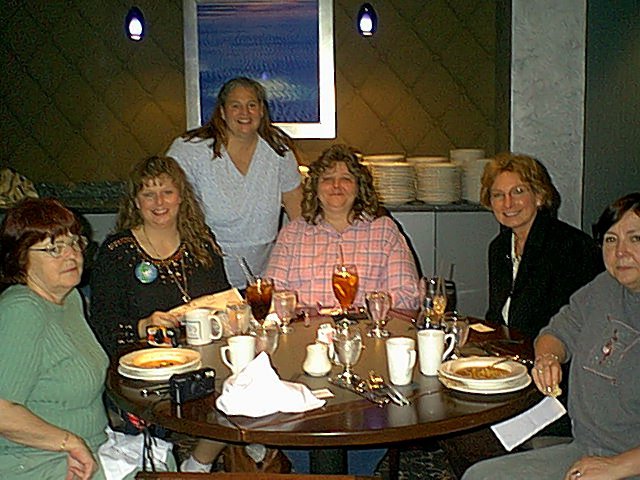
In April of 2004, many of us from the message boards went to the UVa Pituitary Days Convention. That’s where the picture above comes in.  Other pictures from that convention are here.

By chance, we met a wonderful woman named Barbara Craven. She sat at our table for lunch on the last day and, after we learned that she was a dietitian who had had Cushing’s, one of us jokingly asked her if she’d do a guest chat for us. I didn’t follow through on this until she emailed me later. In the email, she asked how I was doing. Usually I say “fine” or “ok” but for some reason, I told her exactly how awful I was feeling.

Barbara emailed me back and said I should see a doctor at Johns Hopkins. I said I didn’t think I could get a recommendation to there, so SHE referred me. The doctor got right back to me, set up an appointment. Between his vacation and mine, that first appointment turned out to be Tuesday, Sept 14, 2004.

Just getting through the maze at Johns Hopkins was amazing. They have the whole system down to a science, moving from one place to another to sign in, then go here, then window 6, then… But it was very efficient.

My new doctor was wonderful. Understanding, knowledgeable. He never once said that I was “too fat” or “depressed” or that all this was my own fault. I feel so validated, finally.

He looked through my records, especially at my 2 previous Insulin Tolerance Tests. From those, he determined that my growth hormone has been low since at least August 2001 and I’ve been adrenal insufficient since at least Fall, 1999 – possibly as much as 10 years! I was amazed to hear all this, and astounded that my former endo not only didn’t tell me any of this, he did nothing. He had known both of these things – they were in the past records that I took with me. Perhaps that was why he had been so reluctant to share copies of those records. He had given me Cortef in the fall of 1999 to take just in case I had “stress” and that was it.

The new endo took a lot of blood (no urine!) for cortisol and thyroid stuff. I went back on Sept. 28, 2004 for arginine, cortrosyn and IGF testing.

He said that I would end up on daily cortisone – a “sprinkling” – and some form of GH, based on the testing the 28th.

For those who are interested, my new endo is Roberto Salvatori, M.D.
Assistant Professor of Medicine at Johns Hopkins

Medical School: Catholic University School of Medicine, Rome, Italy
Residency: Montefiore Medical Center
Fellowship: Cornell University, Johns Hopkins University
Board Certification: Endocrinology and Metabolism, Internal Medicine

Clinical Interests: Neuroendocrinology, pituitary disorders, adrenal disorders

Research Interests: Control of growth hormone secretion, genetic causes of growth hormone deficiency, consequences of growth hormone deficiency.

Although I have this wonderful doctor, a specialist in growth hormone deficiency at Johns Hopkins, in November, 2004, my insurance company saw fit to over-ride his opinions and his test results based on my past pharmaceutical history! Hello??? How could I have a history of taking GH when I’ve never taken it before?

Of course, I found out late on a Friday afternoon. By then it was too late to call my case worker at the drug company, so we had to appeal on Monday. My local insurance person also worked on an appeal, but the whole thing was  just another long ordeal of finding paperwork, calling people, FedExing stuff, too much work when I just wanted to start feeling better by Thanksgiving.

As it turned out the insurance company rejected the brand of hGH that was prescribed for me. They gave me the ok for a growth hormone was just FDA-approved for adults on 11/4/04. The day this medication was approved for adults was the day after my insurance said that’s what is preferred for me. In the past, this form of hGH was only approved for children with height issues. Was I going to be a ginuea pig again?

The new GH company assigned a rep for me, submitted info to pharmacy, and waited for insurance approval, again.

I finally started the Growth Hormone December 7, 2004.

Was the hassle and 3 year wait worth it?

Stay tuned for Day 12, April 12, 2012 when all will be revealed.


Read Dr. Barbara Craven’s Guest Chat, October 27, 2004

Thanks for reading 🙂


MaryO