Official Rare Disease Day 2015 Video

world-rare-disease-2015

Bring People Living with a Rare Disease out of the Shadows and into the Spotlight:

Watch and Share the Official Rare Disease Day 2015 Video!

Following the Rare Disease Day theme Living with a Rare Disease, the 2015 video poignantly recognises the millions of families, friends and carers whose daily lives are impacted by rare diseases.

A big round of applause goes out to the many individuals involved in the creation of the video. Special thanks to video participants RitaPietro and Beatrice who are each living with a rare disease, as well as their family members who accompanied them to the filming of the video. Thanks also to UNIAMO, the Italian national rare disease alliance, for making the video production possible and to director Carlo Hintermann, animators Lulu Cancrini and Marco Varriale and all of their team for their in-kind contribution of the creation and production of the video.

The cooperation between all those involved in this year’s video is symbolic of the unity and solidarity that families, professionals, policy makers, researchers and industry are demonstrating by living day-by-day, hand-in-hand with rare disease patients. Get involved today!

Be a part of the Rare Disease Day momentum – share the Rare Disease Day 2015 video and show the world how to live in solidarity day-by-day, hand-in-hand.

The video has been translated in 20 languages:

Englishfrançaisdeutschespañolitalianoportuguês – čeština – dansk – العربيةmagyarsuomalainenromân polskiTürkslovaški中国的 – CroatianUkrainian – Bulgarian – Dutch


Hypothalamus-Pituitary- Adrenal Axis

I am a huge fan of Coursera.  This lecture is on the HPA Axis.

You may have to sign up/log in to view this video but Coursera is free – and you might find other courses of interest!

https://www.coursera.org/learn/physiology/lecture/DceZ9/hypothalamus-pituitary-adrenal-axis

#1 ~ Cushing’s Myths and Facts

Myth: “Cushing’s is RARE”, “No one has Cushing’s!”, “It is literally impossible for you to have Cushing’s Disease!”

myth-busted

Fact: We have all been guilty of referring to Cushing’s as a “Rare” disease. I*, myself, say this all the time. In fact, the statistics state that only about 2 in every million people are afflicted with this disease. However, these are documented cases.

In reality, Cushing’s is not as rare as we once thought. The fact is that Cushing’s is just rarely diagnosed! Non experts tend to not test accurately and adequately for Cushing’s.

With an inappropriate protocol for testing, the prevalence of accurate diagnoses decreases. Cushing’s experts DO understand how extensive and difficult the diagnostic process is, so they tend to be more deliberate and thorough when exploring possible Cushing’s in their patients. Cushing’s patients who cycle also have to be more persistent in asking for adequate testing so that they are appropriately diagnosed.

The following video is an accurate portrayal of what many patients experience when trying to get help for their symptoms:

Please review the following links:
http://home.comcast.net/~staticnrg/Cushings/LimitationsSC_UFC_dex_mildCS.pdf
http://survivethejourney.blogspot.com/2008/11/new-research-has-shown-cushings.html

* Dr. Karen Ternier Thames

Today in Lab History

Jokichi Takamine was a Japanese-American biochemist and industrialist, born Nov. 3, 1854, who isolated the hormone produced in the adrenal gland that causes the body to respond to emergencies. This chemical was adrenalin — now called epinephrine — from the suprarenal gland. It was the first pure hormone to be isolated from natural sources.

He applied for and received a U.S. patent on the substance, and went on to make a fortune with his marketing of Adrenalin. In fact, the product that he marketed was not pure epinephrine, but a mixture of the hormone and its sibling compound, norepinephrine, or noradrenaline. It is now made synthetically. He also found takadastase, and played a key role in the introduction of phosphate fertilizer along with various other manufacturing and chemical industries to Japan.

~~~~~

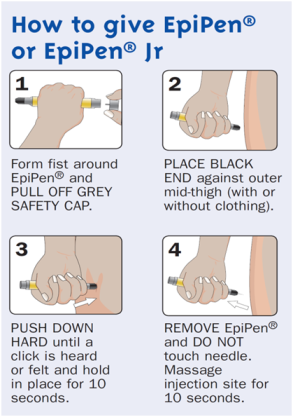
How_to_give_EpiPen

Epinephrine, an EpiPen or Auvi-Q/Allerject injection, should be given in the mid-anterior lateral thigh (not the outer thigh). We call this the EpiCenter of the thigh, and this video segment from the EpiCenter Medical (http://www.epicentermedical.com) online anaphylaxis first aid course has a thigh location graphic to help you pinpoint the most effective location for the injection.

Dr Friedman: Meeting on Thyroid and Hormonal Problems

friedman

Dr. Theodore Friedman will host a free meeting on thyroid and hormonal problems on Sunday February 16 from 7-8 PM PST at Anshe Emes synagogue-1490 S. Robertson Blvd., Los Angeles, CA 90035.

The meeting will be videoconferenced to those who cannot make it in person.

To sign up for the videoconference, email mail@goodhormonehealth.com by February 14.