Resolution of pituitary microadenoma after coronavirus disease 2019: a case report

This article was originally published here

J Med Case Rep. 2021 Nov 1;15(1):544. doi: 10.1186/s13256-021-03127-3.

ABSTRACT

BACKGROUND: This report describes the case of a patient whose pituitary microadenoma resolved after he contracted coronavirus disease 2019. To our knowledge, this is one of the first reported cases of pituitary tumor resolution due to viral illness. We present this case to further investigate the relationship between inflammatory response and tumor remission.

CASE PRESENTATION: A 32-year-old man in Yemen presented to the hospital with fever, low blood oxygen saturation, and shortness of breath. The patient was diagnosed with coronavirus disease 2019. Past medical history included pituitary microadenoma that was diagnosed using magnetic resonance imaging and secondary adrenal insufficiency, which was treated with steroids. Due to the severity of coronavirus disease 2019, he was treated with steroids and supportive care. Three months after his initial presentation to the hospital, brain magnetic resonance imaging was performed and compared with past scans. Magnetic resonance imaging revealed changes in the microadenoma, including the disappearance of the hypointense lesion and hyperintense enhancement observed on the previous scan.

CONCLUSIONS: Pituitary adenomas rarely undergo spontaneous resolution. Therefore, we hypothesized that tumor resolution was secondary to an immune response to coronavirus disease 2019.

PMID:34724974 | DOI:10.1186/s13256-021-03127-3

Sparrow Pharmaceuticals Hopes To Change The Future Of Endocrinology

By Ed Miseta, Chief Editor, Clinical Leader
Follow Me On Twitter @EdClinical

Go ahead and continuously improvement iStock-1295289697

Sparrow Pharmaceuticals is an emerging biopharma company on a mission to help patients suffering from an excess of corticosteroids, with a focus on Cushing’s syndrome, autonomous cortisol secretion (ACS), and polymyalgia rheumatica (PMR).

Cushing’s and ACS are both caused by an excess of cortisol produced by tumors. Patients with Cushing’s can present physically with a fatty hump between their shoulders, a rounded face, and pink or purple stretch marks on their skin. Cushing’s syndrome and ACS can both result in high blood pressure, bone loss, type 2 diabetes, weight gain, and mood, cognition, and sleep disorders. Any of those symptoms may be side effects for patients with conditions such as PMR who rely on long-term treatment with corticosteroid medications such as prednisone.

“Cushing’s syndrome impacts around 20,000 patients in the U.S. alone,” says David Katz, Chief Scientific Officer for Sparrow. “Approximately 50% of those patients can be cured by surgery, but some will develop another tumor years later. ACS is an under-recognized condition, but it may affect up to 3 million patients in the U.S. There are also around 2 million people in the U.S. who rely on long-term use of corticosteroid medications to control autoimmune diseases and other conditions.”

The treatments being developed by Sparrow are based on recognition that cortisol and corticosteroid medications are activated in certain tissues such as the liver, bone, fat, and brain, where in excess they act to cause toxicity. The company’s investigational drugs inhibit HSD-1, the enzyme responsible for that activation.

Sparrow is about to launch a Phase 2 trial for Cushing’s syndrome. In early 2022 the company will also begin two additional Phase 2 trials for ACS and PMR, a common autoimmune disease in elderly patients. PMR is an arthritic syndrome characterized by a phenomenon known as claudication, which means the more you use a limb, the more it hurts and the harder it is to use. “For example, the more a PMR patient walks, the more painful and stiff their legs will become,” says Katz. “If they’re trying to do anything with their arms, the arms will get stiffer and more painful. The disease is pretty debilitating in terms of physical function. The only approved treatment for PMR is steroids, which have side effects such as diabetes, hypertension, osteoporosis, and fractures.”

Unknown Clinical Challenges

Katz is excited about the clinical trials for ACS and PMR because no sizable interventional trials have been reported in either of those conditions.

“We’re going into a completely new area, and we don’t know what we’re going to encounter in terms of patient recruitment and retention,” says Katz. “There is also no strong precedent for how to get approval for a drug in these conditions. The only treatment indicated for PMR is steroids, and that came without any efficacy clinical trials. There are no drugs approved for ACS. It’s hard to anticipate the challenges we will face when we are in an area that is very new.”

Patient centricity is a topic that is very important to Katz, and he spends a lot of time thinking about how to make trials a more pleasant experience for patients by limiting the burden placed on them. He notes that can sometimes be a difficult trade-off because of the procedures that must be performed to meet regulatory standards.

“In Cushing’s syndrome clinical care and clinical trials, the standard way for someone’s cortisol level to be measured is a 24-hour urine collection,” states Katz. “That involves looking at the amount of cortisol in the urine over a 24-hour period. That collection is inconvenient and burdensome, and the patient must then carry it somewhere to be analyzed.”

Sparrow hopes to shift that collection to a spot urine sample, like what patients would experience during a physical. The patient would urinate into a cup and hand it off to a clinic employee for analysis. The process would be much simpler and less burdensome for the patient. Sparrow will first need to prove that in a clinical trial the spot sample will work as well or better than the 24-hour collection. Subjects in the initial clinical trials will have to contribute the 24-hour collections so that Sparrow can demonstrate that future patients will not need to do so.

The Future of Endocrinology

Katz has a positive outlook on the future of endocrinology. Sparrow’s leading drug candidate, SPI-62, is an oral, small-molecule HSD-1 inhibitor. In four clinical trials, it demonstrated potent targeting of HSD-1 in both the brain and liver, and significantly lowered cortisol levels in the liver. The studies also showed a favorable safety and tolerability profile.

“If we are successful at developing SPI-62, I believe it will change the field of endocrinology,” says Katz. “We aim to shift the focus in Cushing’s syndrome to intracellular cortisol as the main driver of symptoms. What I mean by that is if we find that SPI-62 substantially reduces symptoms and that the degree of inhibition of our target HSD-1 correlates well with clinical improvement, then we can get to a new standard of care. We can potentially get rid of the 24-hour urine collections, which will be a big relief to patients. Additionally, many of today’s drugs have a side effect called adrenal insufficiency, which results when the drugs either reduce cortisol too much or completely block activity. Many of today’s drugs also require frequent monitoring and dose titration to prevent adrenal insufficiency. We believe that with HSD-1 inhibition we might avoid adrenal insufficiency as well.”

Katz is hopeful patients treated with SPI-62 will not require monitoring and dose titration. That proof will take years and lots of clinical trials. Sparrow may also produce the first targeted therapy for ACS. That could improve the recognition of ACS as a prevalent form of hypercortisolism and a substantial cause of morbidity and mortality.

“ACS is probably the most under-recognized condition in endocrinology based on recent epidemiological studies,” adds Katz. “It’s possible that as few as 3% of patients who have ACS actually have a diagnosis.  That is shocking for a condition that is associated with a lot of cardiometabolic and bone morbidity, negative effects on mood and cognition, sleep, and muscle strength, and is associated with excess mortality. We want to bring attention to this condition by bringing out a targeted therapy to treat a spectrum of symptoms by getting to the root cause of them.”

From https://www.clinicalleader.com/doc/sparrow-pharmaceuticals-hopes-to-change-the-future-of-endocrinology-0001

A Case of Cushing’s Disease Presenting with Isolated Suicidal Attempt

Cushing’s disease is an abnormal secretion of ACTH from the pituitary that causes an increase in cortisol production from the adrenal glands. Resultant manifestations from this excess in cortisol include multiple metabolic as well as psychiatric disturbances which can lead to significant morbidity and mortality. In this report, 23-year-old woman presented to mental health facility with history of severe depression and suicidal ideations. During evaluation, she found to have Cushing’s disease, which is unusual presentation. She had significant improvement in her symptoms with reduction of antidepressant medications after achieving eucortisolism. Cushing syndrome can present with wide range of neuropsychiatric manifestations including major depression. Although presentation with suicidal depression is unusual. Early diagnosis and prompt management of hypercortisolsim may aid in preventing or lessening of psychiatric symptoms The psychiatric and neurocognitive disorders improve after disease remission (the normalization of cortisol secretion), but some studies showed that these disorders can partially improve, persist, or exacerbate, even long-term after the resolution of hypercortisolism. The variable response of neuropsychiatric disorders after Cushing syndrome remission necessitate long term follow up.

Endogenous Cushing syndrome is a complex disorder caused by chronic exposure to excess circulating glucocorticoids. It has a wide range of clinical signs and symptoms as a result of the multisystem effects caused by excess cortisol.1

The hypercortisolism results in several complications that include glucose intolerance, diabetes, hypertension, dyslipidemia, thromboembolism, osteoporosis, impaired immunity with increased susceptibility to infection as well as neuropsychiatric disorders.2,3

Cushing syndrome presents with a wide variety of neuro-psychiatric manifestations like anxiety, major depression, mania, impairments of memory, sleep disturbance, and rarely, suicide attempt as seen in this case.2,4

The mechanism of neuropsychiatric symptoms in Cushing’s syndrome is not fully understood, but multiple proposed theories have been reported, one of which is the direct brain damage secondary to excess of glucocorticoids.5

A 23-year-old female presented to Al-Amal complex of mental health in Riyadh, Saudi Arabia with history of suicidal tendencies and 1 episode of suicidal attempt which was aborted because of religious reasons. She reported history of low mood, having disturbed sleep, loss of interest, and persistent feeling of sadness for 4 months. She also reported history of weight gain, facial swelling, hirsutism, and irregular menstrual cycle with amenorrhea for 3 months. She was prescribed fluoxetine 40 mg and quetiapine 100 mg. She was referred to endocrinology clinic at King Fahad Medical City, Riyadh for evaluation and management of possible Cushing syndrome as the cause of her abnormal mental health.

She was seen in the endocrinology clinic where she reported symptoms as mentioned above in addition to headache, acne, and proximal muscle weakness.

On examination her vital signs were normal. She had depressed affect, rounded face with acne and hirsutism, striae in the upper limb, and abdomen with proximal muscle weakness (4/5).

Initial investigations showed that 24 hour urinary free cortisol was more than 633 µg which is more than 3 times upper limit of normal (this result was confirmed on second sample with level more than 633 µg/24 hour), cortisol level of 469 nmol/L after low dose 1 mg-dexamethasone suppression test and ACTH level of 9.8 pmol/L. Levels of other anterior pituitary hormones tested were within normal range. She also had prediabetes with HbA1c of 6.1 and dyslipidemia. Serum electrolytes, renal function and thyroid function tests were normal.

MRI pituitary showed left anterior microadenoma with a size of 6 mm × 5 mm.

MRI pituitary (Figure 1).


                        figure

Figure 1. (A-1) Coronal T2, (B-1) post contrast coronal T1 demonstrate small iso intense T1, heterogeneous mixed high, and low T2 signal intensity lesion in the left side of anterior pituitary gland which showed micro adenoma with a size of 6 mm × 5 mm. (A-2) Post-operative coronal T2 and (B-2) post-operative coronal T1. Demonstrates interval resection of the pituitary micro adenoma with no recurrence or residual lesion and minimal post-operative changes. There is no abnormal signal intensity or abnormal enhancing lesion seen.

No further hormonal work up or inferior petrosal sinus sampling were done as the tumor size is 6 mm and ACTH level consistent with Cushing’s disease (pituitary source). She was referred to neurosurgery and underwent trans-sphenoidal resection of the tumor. Histopathology was consistent with pituitary adenoma and positive for ACTH. Her repeated cortisol level after tumor resection was less than 27 and ACTH 2.2 with indicated excellent response to surgery.

She was started on hydrocortisone until recovery of her hypothalamic pituitary adrenal axis documented by normal morning cortisol 3 months after surgery (Table 1).

Table

Table 1. Labs.

Table 1. Labs.

During follow up with psychiatry her depressive symptoms improved but not resolved and she was able to stop fluoxetine 5 months post-surgery. Currently she is maintained on quetiapine 100 mg with significant improvement in her psychiatric symptoms.

Currently she is in remission from Cushing’s disease based on the normal level of repeated 24 hour urinary free cortisol and with an over-all improvement in her metabolic profile.

Cushing syndrome is a state of chronic hypercortisolism due to either endogenous or exogenous sources. Glucocorticoid overproduction by adrenal gland can be adrenocorticotropic (ACTH) hormone dependent which represent most of the cases and ACTH independent.6 To the best of our knowledge this is the first case documented in Saudi Arabia.

There are multiple theories behind the neuropsychiatric manifestations in Cushing syndrome. These include increased stress response leading to behavioral changes, prolonged cortisol exposure leading to decreased brain volume especially in the hippocampus, reduced dendritic mass, decreased glial development, trans-cellular shift of water and synaptic loss, and excess glucocorticoid levels inhibiting neurogenesis and promoting neuronal tendency to toxic insult.3,7

In this report, the patient presented with severe depression with suicidal attempt. She had significant improvement in her symptoms with reduction of antidepressant medications but her depression persisted despite remission of Cushing disease. A similar case has been reported by Mokta et al,1 about a young male who presented with suicidal depression as initial manifestation of Cushing disease. As opposed to the present case he had complete remission of depression within 1 month of resolution of hypercortisolism.

In general, psychiatric and neurocognitive disorders secondary to Cushing syndrome improves after normalization of cortisol secretion, but some studies showed that these disorders can partially improve, persist, or exacerbate, even long-term after the resolution of hypercortisolism. This may be due to persistence hypercortisolism creating toxic brain effects that occur during active disease.2,8 Similar patients need to be followed up for mental health long after Cushing syndrome has been resolved.

Depression is a primary psychiatric illness, that is, usually not examined for secondary causes. Symptoms of depression and Cushing syndrome overlap, so diagnosis and treatment of Cushing disease can be delayed. Early diagnosis and prompt management of hypercortisolsim may aid in preventing or lessening psychiatric symptoms. The variable neuropsychiatric disorders associated with Cushing syndrome post-remission necessitates long term follow up.

Declaration of Conflicting Interests:
The author(s) declared no potential conflicts of interest with respect to the research, authorship, and/or publication of this article.

Funding:
The author(s) received no financial support for the research, authorship, and/or publication of this article.

Informed Consent
Written informed consent was obtained from the patient for the publication of this case and accompanying images.

ORCID iD
Sultan Dheafallah Al-Harbi  https://orcid.org/0000-0001-9877-9371

1. Mokta, J, Sharma, R, Mokta, K, Ranjan, A, Panda, P, Joshi, I. Cushing’s disease presenting as suicidal depression. J Assoc Physicians India. 2016;64:8283.
Google Scholar | Medline

2. Pivonello, R, Simeoli, C, De Martino, MC, et alNeuropsychiatric disorders in cushing’s syndrome. Front Neurosci. 2015;9:16.
Google Scholar | Crossref | Medline

3. Pereira, AM, Tiemensma, J, Romijn, JA. Neuropsychiatric disorders in Cushing’s syndrome. Neuroendocrinology. 2010;92:6570.
Google Scholar | Crossref | Medline | ISI

4. Tang, A, O’Sullivan, AJ, Diamond, T, Gerard, A, Campbell, P. Psychiatric symptoms as a clinical presentation of Cushing’s syndrome. Ann Gen Psychiatry. 2013;12:1.
Google Scholar | Crossref | Medline

5. Sonino, N, Fava, GA, Raffi, AR, Boscaro, M, Fallo, F. Clinical correlates of major depression in Cushing’s disease. Psychopathology. 1998;31:302306.
Google Scholar | Crossref | Medline

6. Wu, Y, Chen, J, Ma, Y, Chen, Z. Case report of Cushing’s syndrome with an acute psychotic presentation. Shanghai Arch Psychiatry. 2016;28:169172.
Google Scholar | Medline

7. Rasmussen, SA, Rosebush, PI, Smyth, HS, Mazurek, MF. Cushing disease presenting as primary psychiatric illness: a case report and literature review. J Psychiatr Pract. 2015;21:449457.
Google Scholar | Crossref | Medline

8. Sonino, N, Fava, GA. Psychiatric disorders associated with Cushing’s syndrome. Epidemiology, pathophysiology and treatment. CNS Drugs. 2001;15:361373.
Google Scholar | Crossref | Medline

CDC Expands Eligibility for COVID-19 Booster Shots


For Immediate Release: Thursday, October 21, 2021
Contact: Media Relations
(404) 639-3286

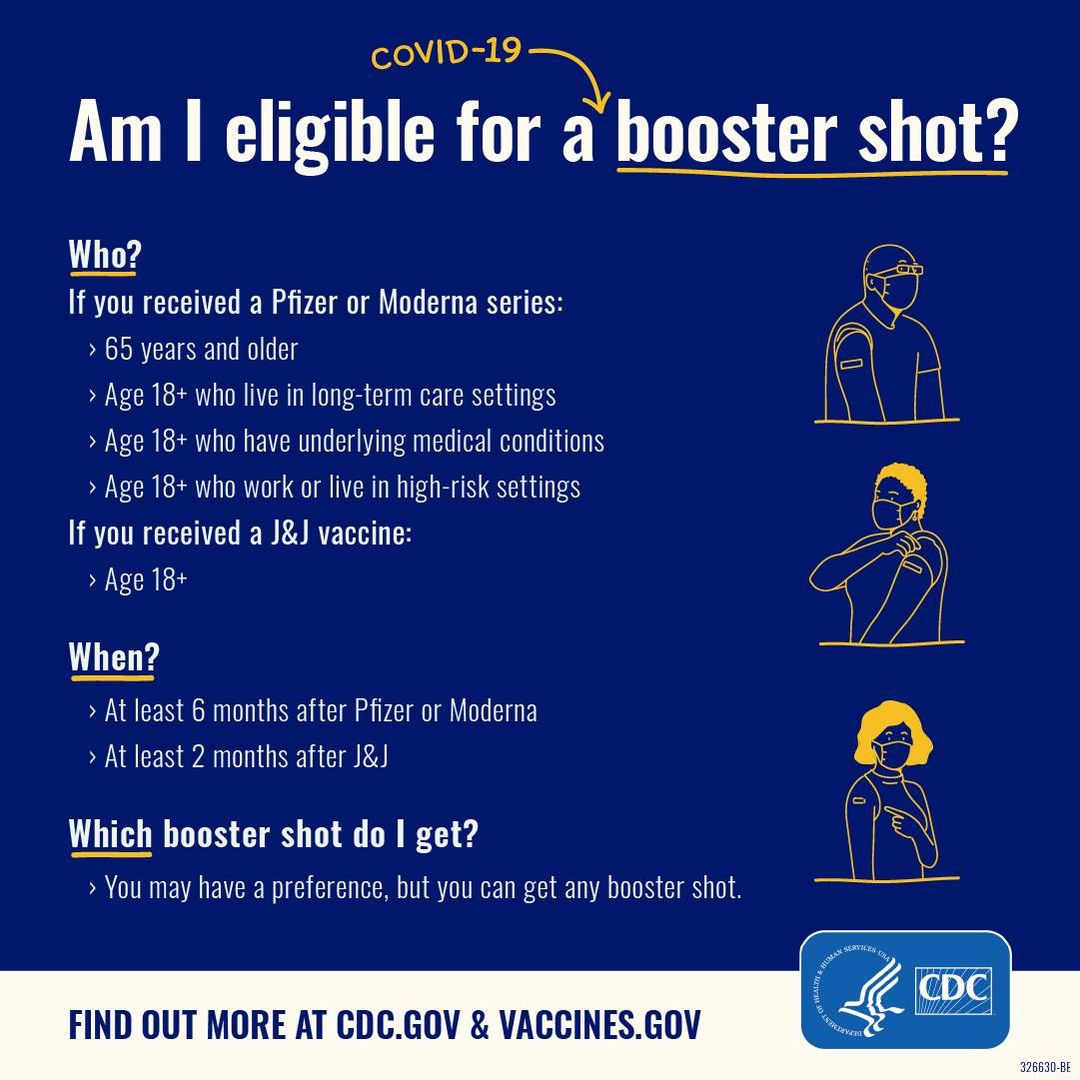
Today, CDC Director Rochelle P. Walensky, M.D., M.P.H., endorsed the CDC Advisory Committee on Immunization Practices’ (ACIP) recommendation for a booster shot of COVID-19 vaccines in certain populations. The Food and Drug Administration’s (FDA) authorization and CDC’s recommendation for use are important steps forward as we work to stay ahead of the virus and keep Americans safe.

For individuals who received a Pfizer-BioNTech or Moderna COVID-19 vaccine, the following groups are eligible for a booster shot at 6 months or more after their initial series:

For the nearly 15 million people who got the Johnson & Johnson COVID-19 vaccine, booster shots are also recommended for those who are 18 and older and who were vaccinated two or more months ago.

There are now booster recommendations for all three available COVID-19 vaccines in the United States. Eligible individuals may choose which vaccine they receive as a booster dose. Some people may have a preference for the vaccine type that they originally received, and others may prefer to get a different booster. CDC’s recommendations now allow for this type of mix and match dosing for booster shots.

Millions of people are newly eligible to receive a booster shot and will benefit from additional protection. However, today’s action should not distract from the critical work of ensuring that unvaccinated people take the first step and get an initial COVID-19 vaccine. More than 65 million Americans remain unvaccinated, leaving themselves – and their children, families, loved ones, and communities– vulnerable.

Available data right now show that all three of the COVID-19 vaccines approved or authorized in the United States continue to be highly effective in reducing risk of severe disease, hospitalization, and death, even against the widely circulating Delta variant. Vaccination remains the best way to protect yourself and reduce the spread of the virus and help prevent new variants from emerging.

The following is attributable to Dr. Walensky:

“These recommendations are another example of our fundamental commitment to protect as many people as possible from COVID-19. The evidence shows that all three COVID-19 vaccines authorized in the United States are safe – as demonstrated by the over 400 million vaccine doses already given. And, they are all highly effective in reducing the risk of severe disease, hospitalization, and death, even in the midst of the widely circulating Delta variant.”

###
U.S. DEPARTMENT OF HEALTH AND HUMAN SERVICESexternal icon

CDC works 24/7 protecting America’s health, safety and security. Whether disease start at home or abroad, are curable or preventable, chronic or acute, or from human activity or deliberate attack, CDC responds to America’s most pressing health threats. CDC is headquartered in Atlanta and has experts located throughout the United States and the world.

Identified: the gene behind an unusual form of Cushing’s Syndrome

A team of scientists in Montreal and Paris has succeeded in identifying the gene responsible for the development of a food-dependent form of Cushing’s Syndrome, a rare disease affecting both adrenal glands.

In their study published in The Lancet Diabetes & EndocrinologyDr. Isabelle Bourdeau and Dr. Peter Kamenicky identify in the gene KDM1A the mutations responsible for the development of this unusual form of the disease.

The scientists also show, for the first time, that the disease is genetically transmitted.

Bourdeau is a researcher and a Université de Montréal medical professor practising at the CHUM Research Centre (CRCHUM), while Kamenicky works at the Hôpital de Bicêtre, part of the Assistance publique-hôpitaux de Paris network in France.

Cushing’s Syndrome is caused by the overproduction of cortisol, a steroid hormone, by the two adrenal glands located above the kidneys.

“When the tissues of the human body are exposed to this excess of cortisol, the effects for those with the disease are serious: weight gain, high blood pressure, depression, osteoporosis, and heart complications, for example,” said Bourdeau, co-lead author of the study with Dr. Fanny Chasseloup, a colleague from the French team.

This discovery comes nearly 30 years after food-induced Cushing’s Syndrome was first described in 1992 by a research group led by Dr. André Lacroix at the CRCHUM and his colleagues Drs. Johanne Tremblay and Pavel Hamet.

The form of the disease being studied by Bourdeau and her colleagues is caused specifically by the abnormal expression of the receptors of a hormone named GIP (glucose-dependent insulinotropic peptide), in both adrenal glands of patients. This hormone is produced by the small intestine in response to food intake. For people with the disease, cortisol concentrations increase abnormally every time they ingest food.

The discovery of the genetic mechanism by the French and Quebec teams was made possible through the use of recent cutting-edge genetic techniques on tissues of patients including those investigated by Dr Lacroix at CHUM. Bourdeau was aided by CRCHUM researcher Martine Tétreault during the computer analyses related to the research project.

Earlier diagnosis thanks to genetic analysis

“In general, rare diseases are generally underdiagnosed in clinics,” said Bourdeau, the medical director of the adrenal tumors multidisciplinary team at the CHUM.

“By identifying this new gene, we now have a way of diagnosing our patients and their families earlier and thus offer more personalized medicine. At the CHUM, genetic analysis is already offered in our Genetic Medicine Division.”

In a remarkable demonstration of scientific cooperation, the Quebec and French teams were able to collect and study tissue specimens available in local and international biobanks in Canada, France, Italy, Greece, Belgium and the Netherlands.

Blood and adrenal gland tissue samples of 17 patients—mostly women—diagnosed with GIP-dependent Cushing’s Syndrome were compared genetically with those of 29 others with non-GIP-dependent bilateral adrenal Cushing’s Syndrome.

This was quite an accomplishment, given the rarity of the disease in the general population. It allowed the researchers to identify the genetic mutations of the KDM1A gene and to determine that the disease is genetically transmitted.

Since 2009, the CHUM has been designated as the adrenal tumors quaternary care centre of the Quebec Cancer Program.

About this study

Loss of KDM1A in GIP-dependent primary bilateral macronodular adrenal hyperplasia with Cushing’s syndrome: a multicenter retrospective cohort study,” by Drs. Fanny Chasseloup, Isabelle Bourdeau and their colleagues, was published Oct. 13, 2021, in The Lancet Diabetes & Endocrinology. Funding was provided by the Agence nationale de la recherche, the Fondation du Grand défi Pierre Lavoie, the Institut national du cancer, the Fonds de recherche du Québec-Santé, INSERM and Assistance publique-hôpitaux de Paris.

About the CRCHUM

The University of Montreal Hospital Research Centre (CRCHUM) is one of North America’s leading hospital research centres. It strives to improve adult health through a research continuum covering such disciplines as the fundamental sciences, clinical research and public health. Over 1,850 people work at the CRCHUM, including more than 550 researchers and more than 460 graduate students

Media contact

  • Jeff HeinrichUniversité de MontréalTel: 514 343-7593
  • Lucie DufresneCentre hospitalier de l’Université de MontréalTel: 514 890-8000 p. 15380

From https://nouvelles.umontreal.ca/en/article/2021/10/15/identified-the-gene-behind-an-unusual-form-of-cushing-s-syndrome/