Day Fourteen, Cushing’s Awareness Challenge 2015

In Day 9 on April 9, 2015, I wrote about how we got the Cushing’s colors of blue and yellow.  This post is going to be about the first Cushing’s ribbons.
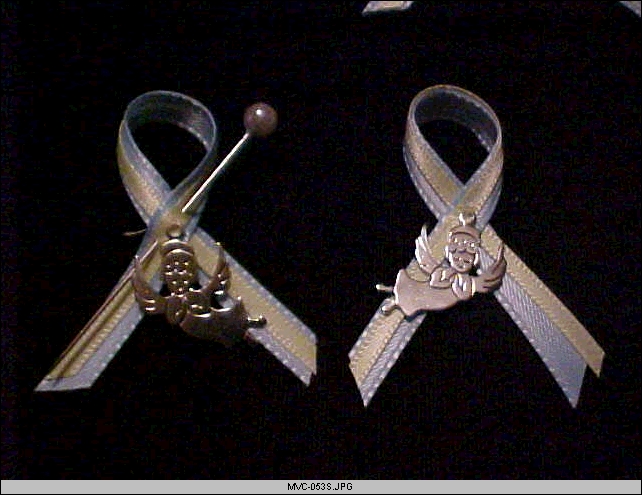
 

I was on vacation  in September, 2001 when SuziQ called me to let me know that we had had our first Cushie casualty (that we knew about).

On the message boards, Lorrie wrote: Our dear friend, Janice died this past Tuesday, September 4, 2001. I received an IM from her best friend Janine, tonight. Janine had been reading the boards, as Janice had told her about this site, and she came upon my name and decided to IM me. I am grateful that she did. She said that she knew that Janice would want all of us to know that she didn’t just stop posting.

For all of the newcomers to the board that did not know Janice, she was a very caring individual. She always had something positive to say. Janice was 36 years old, was married and had no children. She had a miscarriage in December and began to have symptoms of Cushing’s during that pregnancy. After the pregnancy, she continued to have symptoms. When discussing this with her doctor, she was told that her symptoms were just related to her D&C. She did not buy this and continued until she received the accurate diagnosis of Cushing’s Syndrome (adrenal) in March of 2001. Tragically, Janice’s tumor was cancerous, a very rare form of Cushing’s.

Janice then had her tumor and adrenal gland removed by open adrenalectomy, a few months ago. She then began chemotherapy. She was very brave through this even though she experienced severe side effects, including weakness and dizziness. She continued to post on this board at times and even though she was going through so much, she continued with a positive attitude. She even gave me a referral to a doctor a few weeks ago. She was my inspiration. Whenever I thought I had it bad, I thought of what she was dealing with, and I gained more perspective.

Janice was having difficulty with low potassium levels and difficulty breathing. She was admitted to the hospital, a CT scan was done and showed tumor metastasis to the lungs. She then was begun on a more aggressive regimen of chemo. She was discharged and apparently seemed to be doing well.

The potassium then began to drop again, she spiked a temp and she was again admitted to the hospital. She improved and was set to be discharged and then she threw a blood clot into her lungs. She was required to be put on a ventilator. She apparently was at high risk for a heart attack. Her husband did not want her to suffer anymore and did not want her to suffer the pain of a heart attack and so chose for the doctors to discontinue the ventilator on Tuesday. She died shortly thereafter.

Janice was our friend. She was a Cushie sister. I will always remember her. Janine asked me to let her know when we get the Cushing’s ribbons made as she and the rest of Janice’s family would like to wear them in her memory. She said that Janice would want to do anything she could to make others more aware of Cushing’s.

The image at the top of the page shows the first blue and yellow ribbon which were worn at Janice’s funeral.  When we had our “official ribbons” made, we sent several to Janice’s family.

Janice was the first of us to die but there have been more, way too many more, over the years.  I’ll write a bit more about that on Day 21.


PRKACA mutations in cortisol-producing adenomas and adrenal hyperplasia

Eur J Endocrinol. 2015 Mar 6. pii: EJE-14-1113. [Epub ahead of print]

PRKACA mutations in cortisol-producing adenomas and adrenal hyperplasia – a single-center study of 60 cases.

Abstract

Objective: Cortisol excess due to adrenal adenomas or hyperplasia causes Cushing’s syndrome. Recent genetic studies have identified a somatic PRKACAL206R mutation as a cause of cortisol-producing adenomas.

We aimed to compare the clinical features of lesions with PRKACA mutations to those with CTNNB1 mutations and to search for similar mutations in unilateral hyperplasia or tumors co-secreting aldosterone.

Design, patients and methods: 60 patients with cortisol excess who had adrenalectomies at our institution between 1992 and 2013 were assessed, and somatic mutations were determined by Sanger sequencing. 36 patients had overt Cushing’s syndrome, the remainder were subclinical. 59 cases were adenomas (three bilateral), one was classified as hyperplasia. Four tumors had proven co-secretion of aldosterone.

Results: Among cortisol-secreting unilateral lesions without evidence of co-secretion (n=52), we identified somatic mutations in PRKACA (L206R) in 23.1%, CTNNB1 (S45P, S45F) in 23.1%, GNAS (R201C) in 5.8% and CTNNB1 plus GNAS (S45P, R201H) in 1.9%. PRKACA and GNAS mutations were mutually exclusive. Of the co-secreting tumors, two (50%) had mutations in KCNJ5 (G151R and L168R). The hyperplastic gland showed a PRKACAL206R mutation, while patients with bilateral adenomas did not have known somatic mutations. PRKACA-mutant lesions were associated with younger age, overt Cushing’s syndrome and higher cortisol levels versus non-PRKACA-mutant or CTNNB1-mutant lesions. CTNNB1 mutations were more significantly associated with right than left lesions.

Conclusions: PRKACAL206R is present not only in adenomas, but also in unilateral hyperplasia and is associated with more severe autonomous cortisol secretion. Bilateral adenomas may be caused by yet-unknown germline mutations.

PMID:
25750087
[PubMed – as supplied by publisher]

From http://www.ncbi.nlm.nih.gov/pubmed/25750087

Myth: “All types of Cushing’s are the same”

Myth: “All types of Cushing’s are the same”

myth-busted

Fact: In the words of our dear friend and advocate, Robin Ess, “There are many genetic varieties with quite a few discovered in the past couple of years. Plus, there are several types such as adrenal, ectopic, and pituitary. And so on”….Amazingly, some doctors do not realize that there are different varieties of Cushing’s and that the symptoms can come from a different source.

For instance, a doctor might rule out a pituitary tumor and completely dismiss the patient, even with biochemical evidence of Cushing’s. That doctor, instead of dismissing the patient, should thoroughly look for other potential sources, such as an adrenal tumor, or yet another source. Did you know that tumors on one’s lungs can even cause Cushing’s? Most people don’t know that.

For more information about the different types of Cushing’s, please read: http://www.mayoclinic.org/diseases-conditions/cushing-syndrome/basics/causes/con-20032115

Another great article regarding ectopic Cushing’s can be found here: http://www.nejm.org/doi/full/10.1056/NEJM199809243391304#.VH-80v5f2s8.facebook

MaryONote: Folks might be interested in listening to this podcast episode with Jayne, a Cushing’s patient who had pituitary surgeries and a bilateral adrenalectomy before finding the true source of her ectopic Cushing’s – lung tumors.

http://www.blogtalkradio.com/cushingshelp/2008/01/31/tentative-date-an-interview-with-jayne-cyclical-cushings-patient

Subclinical Cushing’s syndrome and cardiovascular disease

Guido Di Dalmazi and colleagues1 reported that in patients with adrenal incidentalomas and either stable mild hypercortisolism or worsening of cortisol hypersecretion, all-cause and cardiovascular disease-specific mortality was higher compared with in those with adrenal incidentalomas that did not secrete cortisol, after a mean follow-up of 7·5 years. Moreover, cortisol concentrations measured after dexamethasone-suppression test were associated with all-cause mortality independent of the presence of traditional cardiovascular disease risk factors.
Subclinical Cushing’s syndrome is the most common hormonal abnormality in patients with adrenal incidentalomas (prevalence 1—29%).2 The proportion of adrenal incidentalomas that progress to subclinical Cushing’s syndrome is low (1·7%) and most are lesions of 3 cm or larger.2 Progression to overt Cushing’s syndrome is controversial (because both spontaneous normalisation of hypersecretion and stable disease have been reported during follow-up) and spontaneous normalisation of hypersecretion has been reported in 50% of cases.2 Results of the study by Di Dalmazi and co-workers1 are important because they show, for the first time, that patients with subclinical Cushing’s syndrome are at increased risk of cardiovascular disease and all-cause mortality (mainly attributable to cardiovascular disease). The association of cortisol with all-cause mortality might also be attributable to its potential role in the pathogenesis of metabolic syndrome.3
Findings of previous studies have shown an increased prevalence of cardiovascular disease risk factors in patients with subclinical Cushing’s syndrome, but data for optimum management are conflicting. Some criteria—such as large (>4—6 cm) adrenal incidentalomas, features suggestive of malignancy (eg, heterogeneity, irregular shape, calcification or necrosis, invasion to adjacent tissues), or potentially lethal hormonal hypersecretion (ie, pheochromocytomas)—support the need for adrenalectomy. However, universal surgical management of patients with subclinical Cushing’s syndrome has not been accepted.24 Uncertainty about the most effective management strategy for subclinical Cushing’s syndrome is attributable to the variable definitions used, and the small sample size and retrospective nature of most studies.4 Only one prospective study has been published so far showing that laparoscopic adrenalectomy is more beneficial than is conservative management for the normalisation or improvement of cardiovascular disease risk factors, such as diabetes, dyslipidaemia, hypertension, and obesity.5
Prospective studies and registries are needed to document the effect of different approaches on the incidence of cardiovascular disease events and mortality in patients with adrenal incidentalomas and subclinical Cushing’s syndrome. Until then, individualised treatment seems prudent. Surgical management of subclinical Cushing’s syndrome can be suggested in young patients (age <50 years) and in those with cardiovascular disease risk factors or bone disease associated with hypercortisolism that are of recent onset, difficult to control with drugs, or show progression over time.4
Another message from Di Dalmazi’s study1 is that hormonal deterioration might develop even after 4—5 years, which most studies reported as a reasonable and safe follow-up.2 This possibility should be kept in mind for the management of patients with adrenal incidentalomas, especially if clinical signs of Cushing’s syndrome develop or if cardiovascular disease risk factors become evident or increase in severity (ie, hormonal hypersecretion).
We declare that we have no competing interests.

References

1 Di Dalmazi GVicennati VGarelli S, et alCardiovascular events and mortality in patients with adrenal incidentalomas that are either non-secreting or associated with intermediate phenotype or subclinical Cushing’s syndrome: a 15-year retrospective studyLancet Diabetes Endocrinol 2014published online Jan 29 http://dx.doi.org/10.1016/S2213-8587(13)70211-0.
2 Anagnostis PKaragiannis ATziomalos KKakafika AIAthyros VGMikhailidis DPAdrenal incidentaloma: a diagnostic challengeHormones (Athens) 20098163-184PubMed
3 Anagnostis PAthyros VGTziomalos KKaragiannis AMikhailidis DPClinical review: The pathogenetic role of cortisol in the metabolic syndrome: a hypothesisJ Clin Endocrinol Metab 200994:2692-2701PubMed
4 Terzolo MPia AReimondo GSubclinical Cushing’s syndrome: definition and managementClin Endocrinol (Oxf) 20127612-18PubMed
5 Toniato AMerante-Boschin IOpocher GPelizzo MRSchiavi FBallotta ESurgical versus conservative management for subclinical Cushing syndrome in adrenal incidentalomas: a prospective randomized studyAnn Surg 2009249388-391PubMed
a Division of Endocrinology, Police Medical Centre, Thessaloniki, 54 640, Greece
b Department of Endocrinology and Metabolism, Agios Pavlos General Hospital, Thessaloniki, Greece
c Second Propedeutic Department of Internal Medicine, Medical School, Aristotle University of Thessaloniki, Hippokration Hospital, Thessaloniki, Greece
d Department of Clinical Biochemistry (Vascular Prevention Clinic) Royal Free Hospital Campus, University College London Medical School, University College London, London, UK

The Role of Adrenal Scintigraphy in the Diagnosis of Subclinical Cushing’s Syndrome and the Prediction of Post-surgical Hypoadrenalism

World J Surg. 2014 Mar 11. [Epub ahead of print]

Abstract

BACKGROUND:

Management of subclinical Cushing’s syndrome (SCS) remains controversial; it is not possible to predict which patients would benefit from adrenalectomy. In the present study we aimed to evaluate the role of adrenocortical scintigraphy (ACS) in the management of patients with SCS.

METHODS:

The medical records of 33 consecutive patients with adrenal “incidentaloma” and proven or suspected SCS who underwent 131I-19-iodocholesterol ACS between 2004 and 2010 were reviewed. Sixteen underwent laparoscopic adrenalectomy (surgical group-S-group) and 17 were medically managed (medical group-M-group). Follow-up evaluation was obtained by outpatient consultation.

RESULTS:

Overall 25 patients (15 in the S-group and 10 in the M-group) had concordant unilateral uptake at ACS (ACS+). In the S-group, the mean follow-up duration was 30.9 ± 16.1 months and, irrespective of the presence of hormonal diagnosis of SCS, in patients who were ACS+ adrenalectomy resulted in a significant increase in HDL cholesterol and decreases in body mass index, glycemia, and blood pressure (BP). One patient reduced antihypertensive medication and three others were able to discontinue it altogether. Prolonged postoperative hypoadrenalism (PH) occurred in 14 patients in the S-group. The overall accuracy in predicting PH was 93.7 % for ACS and 68.7 % for laboratory findings. In the M-group, the mean follow-up duration was 31.5 ± 26.3 months and no patient developed overt Cushing’s syndrome, although ACS+ patients experienced a worsening in glycemia and diastolic BP.

CONCLUSIONS:

Adrenal scintigraphy seems the most accurate diagnostic test for SCS. It is able to predict the metabolic outcome and the occurrence of PH, identifying the patients who could benefit from adrenalectomy irrespective of hormonal diagnosis.

PMID:
24615601
[PubMed – as supplied by publisher]

From http://www.ncbi.nlm.nih.gov/pubmed/24615601