Delirium Induced by Rapid Titration of Osilodrostat in a Patient With Cushing’s Disease

Abstract

Cushing’s disease frequently presents with psychiatric symptoms such as depression, anxiety, and cognitive impairment. Osilodrostat, an 11β-hydroxylase inhibitor, is used for persistent or recurrent cases, but rapid titration may precipitate adrenal insufficiency and psychiatric complications.

We report a woman in her early 40s with a history of major depressive disorder treated with clomipramine. After transsphenoidal surgery for Cushing’s disease, she remained hypercortisolemic, and hydrocortisone replacement was continued postoperatively for safety due to unstable cortisol secretion. Cortisol secretion was unstable, with day-to-day fluctuations. Osilodrostat was initiated at 2 mg/day. Shortly thereafter, urinary free cortisol (UFC) increased, and between days 3 and 5, she developed depressive symptoms, depersonalization, and suicidal ideation. These were judged to be related to cortisol elevation, and osilodrostat was rapidly titrated, reaching 40 mg/day by day 9. Depressive symptoms improved as UFC decreased. However, from day 9, she developed delirium with fluctuating consciousness, disorientation, purposeless hyperactivity, and stereotyped speech, peaking on days 10-12. During this period, blood pressure decreased, accompanied by tachycardia and fever. Infection and metabolic abnormalities were clinically excluded. Symptoms resolved spontaneously by day 14, with amnesia for the episode, and she was discharged on day 20 without recurrence.

This case illustrates a rare clinical course where depressive symptoms during cortisol elevation and delirium during cortisol reduction occurred sequentially in the same patient following rapid osilodrostat titration. The episode suggests that abrupt cortisol fluctuations may induce psychiatric symptoms even under hydrocortisone supplementation. Clinicians should avoid rapid titration and ensure close collaboration between endocrinology and psychiatry when psychiatric symptoms arise during treatment.

Introduction

Cushing’s disease is caused by an adrenocorticotropic hormone (ACTH) secreting pituitary adenoma, leading to chronic hypercortisolism. In addition to physical features such as central obesity, moon face, and hypertension, psychiatric symptoms including depression, anxiety, and cognitive impairment are frequently observed [1-3]. Depression occurs in 40-60% of patients and is associated with increased suicide risk. Anxiety and cognitive impairment are also common, and psychiatric symptoms may even precede the physical manifestations. Thus, psychiatrists may encounter such patients at an early stage, and it is clinically important to consider underlying endocrine disorders [1,3]. The first-line treatment is transsphenoidal surgery, but remission is not always achieved [4].

Osilodrostat, an oral 11β-hydroxylase inhibitor, is primarily used for the treatment of persistent or recurrent Cushing’s disease. By inhibiting cortisol synthesis, it effectively lowers circulating cortisol levels, thereby improving the clinical manifestations of hypercortisolism. The phase III LINC 3 trial demonstrated its efficacy [5], but adverse events such as adrenal insufficiency and psychiatric symptoms have been reported [6-8]. Acute adrenal insufficiency can present with hypotension, tachycardia, fever, and gastrointestinal symptoms, and in severe cases with impaired consciousness or delirium [9]. To minimize these risks, gradual titration in 2-mg increments at intervals of at least two weeks is recommended [6].

For monitoring treatment efficacy, urinary free cortisol (UFC) is widely used as a reliable marker reflecting total cortisol secretion over 24 hours and serves as a standard index of disease activity and treatment response [1,2].

Case Presentation

The patient was a 43-year-old woman with a history of major depressive disorder since her early twenties, treated mainly with clomipramine. Although she experienced recurrent episodes, she was able to continue working as a clinical psychologist, with occasional sick leave. Her past history included papillary thyroid carcinoma treated surgically, followed by hypothyroidism managed with levothyroxine 75 µg/day.

In her thirties, she developed treatment-resistant hypertension. In March 2024, inferior petrosal sinus sampling confirmed Cushing’s disease. In April 2024, she underwent transsphenoidal surgery and started hydrocortisone replacement at 30 mg/day. However, hypercortisolism and elevated ACTH persisted. Cortisol levels showed marked day-to-day fluctuations rather than being consistently elevated, and replacement therapy was continued for safety.

In June 2024, she was admitted to our endocrinology department because of persistent disease activity. Psychiatry was consulted due to her psychiatric history. At admission, she was alert, cooperative, and exhibited neither depressive nor psychotic symptoms. Clomipramine was continued. Physical examination revealed a BMI of 27.5, central obesity, moon face, and violaceous striae. Blood pressure was 155/105 mmHg. Routine chemistry and thyroid function were within normal limits. Endocrinological work-up confirmed persistent hypercortisolism: the 24-hour UFC was markedly elevated (409.2 µg/day; normal < 50 µg/day), midnight serum cortisol was inappropriately high (14.3 µg/dL; normally suppressed at night), and dexamethasone suppression testing failed to suppress morning cortisol (9.7 µg/dL after 0.5 mg dexamethasone). Corticotropin-releasing hormone stimulation testing demonstrated an exaggerated ACTH response (63.6 → 105.0 pg/mL), consistent with pituitary-dependent Cushing’s disease. Postoperative brain MRI showed only expected surgical changes without new lesions.

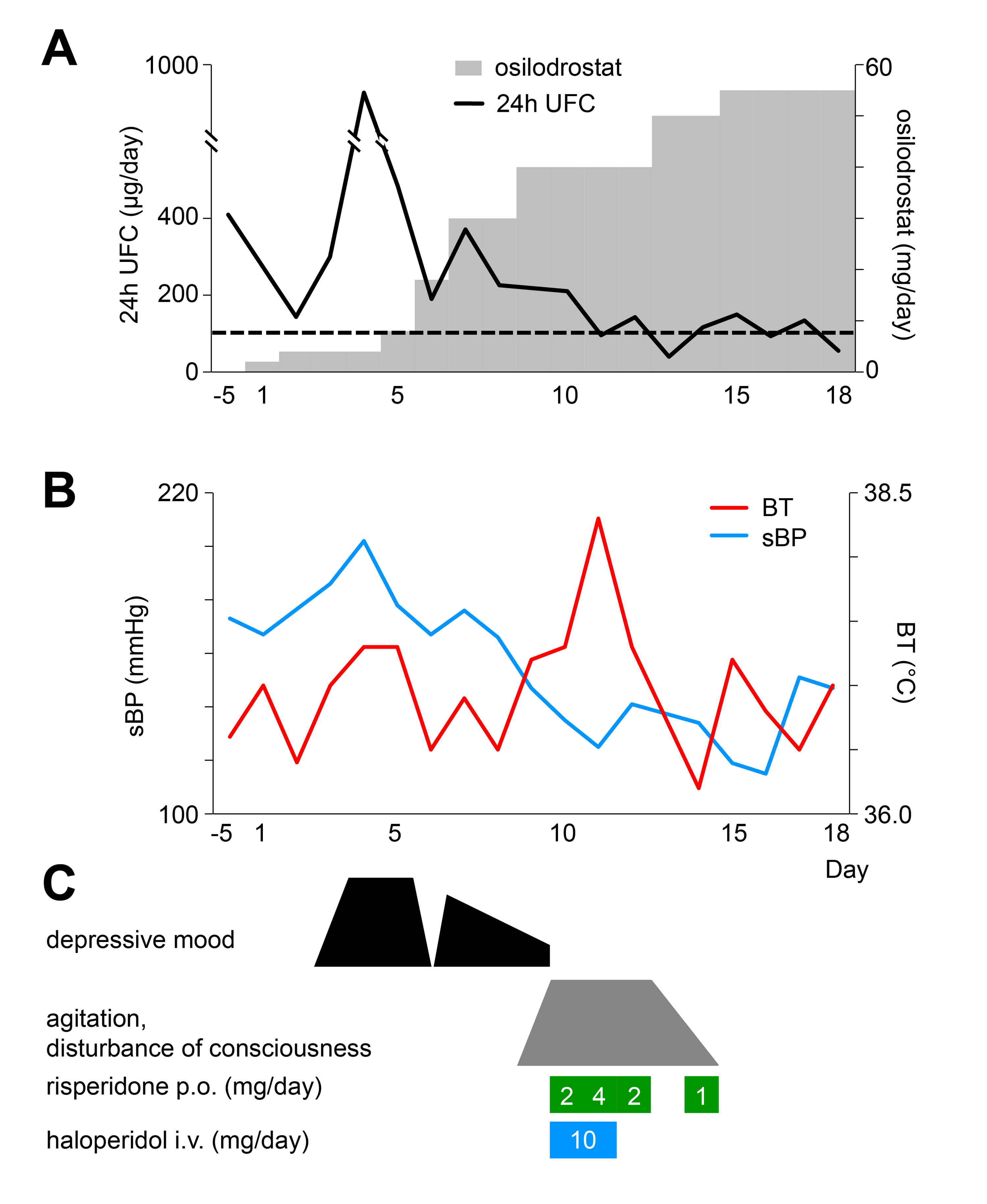
Figure 1 illustrates the clinical course in this case. Osilodrostat was initiated at 2 mg/day on day 1. UFC unexpectedly rose thereafter, and between days 3 and 5, she developed depressed mood, depersonalization, and suicidal ideation. These psychiatric symptoms were judged to be associated with increased cortisol secretion. Antidepressant adjustment was not attempted. Instead, priority was given to endocrine control, and osilodrostat was rapidly up-titrated. Although the risk of adrenal insufficiency was considered, treatment was deemed safe under hydrocortisone supplementation. By day 9, the dose of osilodrostat reached 40 mg/day, UFC decreased, and depressive symptoms improved.
Timeline-of-clinical-events-and-interventions-in-the-present-case.
Figure 1: Timeline of clinical events and interventions in the present case.

Panel (A) shows the osilodrostat dosage and 24-hour urinary free cortisol (UFC) levels; panel (B) depicts vital signs (sBP, systolic blood pressure; BT, body temperature); and panel (C) illustrates psychiatric symptoms and the dosages of antipsychotic medications, all plotted against treatment days.

However, from day 9 onward, delirium and psychomotor agitation emerged, peaking on days 10-12. She displayed fluctuating consciousness, global disorientation, impaired attention, purposeless hyperactivity, stereotyped behaviors, and repetitive utterances of meaningless numbers. She wandered barefoot and occasionally shouted fragmented phrases such as “Say you love me.” Anxiety and insomnia were prominent, but hallucinations and self-disturbances were absent.

At that time, her vital signs showed a decline in blood pressure from 155/105 mmHg to 125/59 mmHg, a pulse rate of 110/min, and a temperature of 38.3°C. Electrolytes and glucose were normal, and no inflammatory response or other signs of infection were detected. Because of marked psychomotor agitation, imaging and EEG were not performed. Risperidone and haloperidol were given but were ineffective.

At onset, the delirium was interpreted as a manifestation of hypercortisolism, partly because it occurred during a holiday when comprehensive evaluation was not feasible. Osilodrostat was therefore not reduced. As her symptoms improved spontaneously and she remained stable under hydrocortisone supplementation, the dose was maintained. Since the delirium resolved completely and did not recur, additional imaging or EEG was not performed.

By day 14, delirium had resolved, and the patient reported amnesia for the episode. No recurrence occurred, and she was discharged on day 20 at her and her family’s request. Outpatient follow-up confirmed stable status without recurrence of delirium.

Discussion

This case illustrates an unusual clinical course in which qualitatively distinct psychiatric symptoms appeared sequentially during rapid titration of osilodrostat. The initial depressive phase coincided with a transient rise in UFC and may have been related to unstable cortisol secretion that had already been observed prior to admission. Although not sufficient for a formal diagnosis, such variability is reminiscent of cyclical Cushing’s disease [10], which has also been associated with mood fluctuations [1,3]. Previous studies have demonstrated the link between hypercortisolism and depression [1,3], and our case is consistent with these findings during the early phase of treatment.

In contrast, the subsequent delirium phase was accompanied by hypotension, tachycardia, and fever, resembling adrenal insufficiency. Similar neuropsychiatric manifestations, including delirium and psychosis, have been described in previous reports of adrenal insufficiency [8,9]. However, unlike those cases, where symptoms typically emerged after drug withdrawal, delirium in our patient developed rapidly following dose escalation. This temporal pattern suggests that even transient cortisol reductions may precipitate acute neuropsychiatric symptoms.

Taken together, these observations both align with and extend prior findings linking cortisol dysregulation to psychiatric manifestations. Our case supports previous evidence that hypercortisolism is associated with depressive symptoms [1,3], whereas hypocortisolism predisposes to delirium or psychosis [8,9]. Importantly, it also highlights a dynamic aspect of this relationship: abrupt cortisol fluctuations themselves, regardless of direction, may transiently disrupt neuroendocrine homeostasis and trigger psychiatric symptoms. This interpretation is consistent with reports of cyclical Cushing’s disease showing alternating mood states [10], but it differs in that the fluctuation here was iatrogenic and temporally linked to rapid pharmacologic titration.

Pharmacological factors may have further amplified these effects. Clomipramine and antipsychotics such as haloperidol and risperidone are known to cause confusion or agitation, particularly under hormonal stress. It is therefore plausible that psychotropic drug interactions and cortisol fluctuations acted synergistically to produce the observed neuropsychiatric manifestations.

This report has several limitations. The onset of delirium occurred during a holiday, and severe agitation precluded blood sampling for serum cortisol, ACTH testing, or therapeutic steroid administration. Thus, strict diagnostic criteria for adrenal insufficiency could not be fulfilled. Nonetheless, the clinical presentation, with hypotension, tachycardia, fever, and altered consciousness, was consistent with an adrenal insufficiency-like state. Electrolytes, glucose, and inflammatory markers remained within normal limits, making infection or metabolic causes unlikely. However, structural or neurological contributors could not be completely excluded because imaging and EEG were not performed. Although the clinical picture resembled adrenal insufficiency, true adrenal crisis was unlikely given the normal electrolyte levels, spontaneous recovery, and maintained oral intake. Therefore, this episode may be better characterized as a state of functional adrenal dysregulation rather than frank adrenal insufficiency.

Conclusions

This case highlights a rare course in which depressive symptoms during cortisol elevation and delirium during cortisol reduction occurred sequentially in the same patient following rapid titration of osilodrostat. The episode suggests that even under hydrocortisone supplementation, abrupt cortisol fluctuations can induce psychiatric symptoms. However, because some observations were paradoxical and certain assessments could not be performed during the acute phase, these interpretations should be made with caution. The episode may represent a state of functional adrenal dysregulation rather than distinct phases of hyper- or hypocortisolism.

This case offers two clinical lessons. First, osilodrostat should be titrated gradually according to established guidelines. Second, if psychiatric symptoms arise during treatment, they are best managed through close collaboration between endocrinology and psychiatry.

References

  1. Pivonello R, Simeoli C, De Martino MC, et al.: Neuropsychiatric disorders in Cushing’s syndrome. Front Neurosci. 2015, 9:129. 10.3389/fnins.2015.00129
  2. Sharma ST, Nieman LK, Feelders RA: Cushing’s syndrome: epidemiology and developments in disease management. Clin Epidemiol. 2015, 7:281-93. 10.2147/CLEP.S44336
  3. Sonino N, Fava GA, Raffi AR, Boscaro M, Fallo F: Clinical correlates of major depression in Cushing’s disease. Psychopathology. 1998, 31:302-6. 10.1159/000029054
  4. Fleseriu M, Auchus R, Bancos I, et al.: Consensus on diagnosis and management of Cushing’s disease: a guideline update. Lancet Diabetes Endocrinol. 2021, 9:847-75. 10.1016/S2213-8587(21)00235-7
  5. Pivonello R, Fleseriy M, Newell-Price J, et al.: Efficacy and safety of osilodrostat in patients with Cushing’s disease (LINC 3): a multicentre phase 3 study with a double-blind, randomised withdrawal phase. Lancet Diabetes Endocrinol. 2020, 8:748-61. 10.1016/S2213-8587(20)30240-0
  6. U.S. Food and Drug Administration. Osilodrostat prescribing information. (2020). Accessed: October 18, 2025: https://www.accessdata.fda.gov/drugsatfda_docs/label/2020/212801s000lbl.pdf.
  7. Gadelha M, Bex M, Feelders RA, et al.: Randomized trial of osilodrostat for the treatment of Cushing disease. J Clin Endocrinol Metab. 2022, 107:e2882-95. 10.1210/clinem/dgac178
  8. Ekladios C, Khoury J, Mehr S, Feghali K: Osilodrostat-induced adrenal insufficiency in a patient with Cushing’s disease. Clin Case Rep. 2022, 10:e6607. 10.1002/ccr3.6607
  9. Arlt W: Society for Endocrinology endocrine emergency guidance: Emergency management of acute adrenal insufficiency (adrenal crisis) in adult patients. Endocr Connect. 2016, 5:G1-3. 10.1530/EC-16-0054
  10. Meinardi JR, Wolffenbuttel BH, Dullaart RP: Cyclic Cushing’s syndrome: a clinical challenge. Eur J Endocrinol. 2007, 157:245-54. 10.1530/EJE-07-0262

Prospective Assessment of Mood and Quality of Life in Cushing Syndrome before and after Biochemical Control

Abstract

Context

Cushing syndrome (CS) impairs quality of life (QoL) and mood. Prospective real-life data on post-treatment recovery and predictors of improvement are limited.

Objectives

Evaluate changes in QoL, depression, and anxiety in patients with CS, before and after biochemical control, and identify predictors of clinically meaningful improvement.

Design and Setting

Prospective observational study at a tertiary center.

Patients

67 patients with endogenous CS (60 pituitary, 7 adrenal) were assessed with active disease and again after achieving biochemical control through surgery and/or medication.

Outcomes

Patient-reported outcomes included CushingQoL, Beck Depression Inventory-II (BDI-II), and State-Trait Anxiety Inventory (STAI).

Results

Mean and longest follow-up was 2.3 and 11.5 years, respectively. Treatment led to improvements in mean scores across all domains (QoL: +18.2±20.9, BDI: –6.8±8.6, STAI-State: –9.6±12.5, STAI-Trait: –8.6±12.6; all p < 0.001). However, minimal important difference was achieved in 64.6% for QoL, 67.9% for BDI, 53.2% and 52.8% for STAI subscales. After multivariable analysis, QoL improvements were predicted by lower baseline BMI, pre-treatment symptoms ❤ years, post-operative hydrocortisone replacement >6 months, and normal follow-up late-night salivary cortisol (LNSC). Depression improvements were predicted by symptoms ❤ years, normal follow-up LNSC, and surgical treatment. Anxiety improvements were predicted by younger age and >6 months post-operative hydrocortisone. Depression improved more gradually than QoL and anxiety.

Conclusions

Although effective treatment improves mood and QoL in CS, clinically meaningful recovery is variable and incomplete for some patients. Our findings highlight the need to limit diagnostic delay and provide comprehensive post-treatment care that includes normalization of cortisol circadian rhythm.

Accepted manuscripts
Accepted manuscripts are PDF versions of the author’s final manuscript, as accepted for publication by the journal but prior to copyediting or typesetting. They can be cited using the author(s), article title, journal title, year of online publication, and DOI. They will be replaced by the final typeset articles, which may therefore contain changes. The DOI will remain the same throughout.

This content is only available as a PDF.

© The Author(s) 2025. Published by Oxford University Press on behalf of the Endocrine Society.
This is an Open Access article distributed under the terms of the Creative Commons Attribution-NonCommercial-NoDerivs licence (https://creativecommons.org/licenses/by-nc-nd/4.0/), which permits non-commercial reproduction and distribution of the work, in any medium, provided the original work is not altered or transformed in any way, and that the work is properly cited. For commercial re-use, please contact reprints@oup.com for reprints and translation rights for reprints. All other permissions can be obtained through our RightsLink service via the Permissions link on the article page on our site—for further information please contact journals.permissions@oup.com. See the journal About page for additional terms.

Severe Psychosis Due to Cushing Syndrome

Cushing syndrome (CS) is a rare clinical condition resulting in excess cortisol production. Neuropsychiatric disturbances are prevalent, in addition to the well-known metabolic effects. Depression and anxiety are the most common manifestations, while mania and psychosis are rare.1,2 We report the case of a patient who presented with severe psychosis due to adrenocorticotropic hormone (ACTH)–dependent CS due to a pituitary adenoma (PA).

Case Report

A 47-year-old woman was brought to the hospital after she was found wandering on someone’s property 2 days after her parents had filed a missing person report. She was disoriented, had difficulty recalling events, and reported intrusive thoughts. She had a history of hypertension, hyperlipidemia, prediabetes, and schizoaffective disorder diagnosed 10 years ago when she had an episode of acute psychosis. She was noncompliant with her medications.

On presentation, her blood pressure was 160/111 mm Hg, pulse rate was 111 bpm, and body mass index was 24.14 kg/m2. The psychiatric examination revealed disorientation, thought disorganization, subdued mood, blunted affect, and impaired memory and attention. She had central adiposity and coarse terminal hair growth on her chin; the rest of the physical examination was unremarkable. She was started on olanzapine but developed catatonia after 10 days. Olanzapine was discontinued after 4 weeks as her catatonia worsened. Due to the worsening of hypertension, her random cortisol level was checked and found to be elevated at 51.8 μg/dL (2.9–19.4 μg/dL). Further workup was deferred due to testing difficulty in the setting of acute psychosis. A trial of aripiprazole was initiated but was discontinued after 10 days due to the persistence of catatonia. She then received electroconvulsive therapy on alternate days for 11 sessions, with improvement in her symptoms.

The workup of CS was initiated due to the difficulty in managing her symptoms, weight gain, worsening of hypertension, and pedal edema. Laboratory investigations showed potassium of 2.7 mEq/dL (3.5–5.5 mEq/dL), elevated serum cortisol of 39.3 μg/dL (2.9–19.4 μg/dL), and ACTH of 100.2 pg/dL (7.2–63.3 pg/dL). Her 24-hour urinary free cortisol level was 2,340 and 1,180 (≤45 μg/dL) on 2 separate occasions, thyroid-stimulating hormone was 0.02 (0.4–4.0 mIU/L), and free thyroxine was 0.6 (0.7–1.9 ng/dL). The dexamethasone suppression test was also abnormal. Given that her ACTH level was elevated, there was a high concern for a PA. A magnetic resonance imaging scan revealed a 9.3 x9.6–mm nonenhancing focus on the posterior aspect of the pituitary, which confirmed the diagnosis of ACTH-dependent CS. Central hypothyroidism was attributed to the mass effect of the PA. Transsphenoidal PA resection was performed with subsequent improvement in her symptoms.

Discussion

Acute psychosis may be the initial manifestation of CS. This can easily be overlooked, especially in patients with preexisting psychiatric conditions. CS can be indolent, with clinical and neuropsychiatric features often beginning years before diagnosis. In this case, the initial presentation a decade ago could also be attributed to CS. Many antipsychotic drugs can result in metabolic syndrome, which can be hard to differentiate from manifestations of CS.3 Individuals with neuropsychiatric disorders can have elevation in their cortisol levels due to activation of the hypothalamic-pituitary axis, especially in the evening, without the presence of any pituitary or adrenal adenomas (these result in pathological hypercortisolism).4 This is known as pseudo-CS or physiological hypercortisolism.5 Based on clinical features alone, physiological and pathological hypercortisolism can be hard to distinguish. A high index of clinical suspicion is needed, with repeat testing often required, as there are no specific cutoffs to distinguish between these conditions.6,7

In patients with severe neuropsychiatric illness and features of metabolic syndrome, a diagnosis of CS should be strongly considered, especially in those not responding to conventional treatment strategies. Early recognition and treatment can lead to improved outcomes, though complete recovery of psychiatric symptoms may not be seen in some patients.8,9

AnchorArticle Information

Published Online: August 21, 2025. https://doi.org/10.4088/PCC.25cr03957
© 2025 Physicians Postgraduate Press, Inc.
Prim Care Companion CNS Disord 2025;27(4):25cr03957
Submitted: March 6, 2025; accepted April 30, 2025.
To Cite: Dhaliwal G, MD; Kaur JK, Batra J, et al. Severe psychosis due to Cushing syndrome. Prim Care Companion CNS Disord 2025;27(4):25cr03957.
Author Affiliations: Department of Endocrinology, Diabetes and Metabolism, HealthPartners Institute, Minneapolis, Minnesota (Dhaliwal, JK Kaur, J Kaur); Department of Endocrinology, University of Nebraska, Omaha, Nebraska (Batra).
Corresponding Author: Jasleen Kaur, MD, Department of Endocrinology, Diabetes and Metabolism, HealthPartners Institute, 401 Phalen Blvd, St Paul, MN 55130 (jasleen.x.kaur@healthpartners.com).
Relevant Financial Relationships: None.
Funding/Support: None.
Patient Consent: Consent was received from the patient to publish the case report, and information has been de-identified to protect patient anonymity.
ORCID: Jasleen Kaur: https://orcid.org/0000-0002-0584-4638

From https://www.psychiatrist.com/pcc/severe-psychosis-due-cushing-syndrome/

First-Episode Psychosis and Cushing Syndrome

Cushing syndrome, a state of hypercortisolism, has multiple etiologies, including ectopic adrenocorticotropic hormone (ACTH) syndrome (EAS). EAS is a frequently severe emergency related to the degree of hypercortisolism. Neuropsychiatric symptoms of Cushing syndrome are well documented, including irritability, anxiety, depressed mood, and cognitive impairment.1 A few prior case reports have described first episode psychosis associated with Cushing syndrome,2 sometimes leading to delayed or misdiagnosis of Cushing syndrome.

Here, we report a case of a 72-year old man diagnosed with EAS caused by excessive ACTH secretion by a metastatic neuroendocrine tumor. Our report aims to add to the body of evidence indicating that Cushing associated psychosis can cause acutely severe paranoia and delusions that significantly impact management.

Case Report

Mr A, a 72-year-old retired physician with no prior psychiatric history, was diagnosed with new-onset psychosis in the setting of hypercortisolism. He initially presented with weakness secondary to hypokalemia and was found to have Cushing syndrome. On psychiatric evaluation, he demonstrated paranoia and delusions as well as illogical, concrete, and limited thought content. Laboratory workup, neurocognitive examination, and collateral history ruled out delirium or dementias. His morning cortisol levels were up to 162 μg/dL, and ACTH levels were greater than 2,000 pg/mL.

Mr A’s cortisol levels were not suppressed with a high-dose dexamethasone test, supporting ectopic ACTH production. He was found to have a metastatic ACTH secreting large cell neuroendocrine tumor, responsible for his hypercortisolism. Magnetic resonance imaging of his brain demonstrated a pituitary mass, and a bilateral adrenalectomy revealed a small focus of neuroendocrine carcinoma on his left adrenal gland.

Mr A was treated with haloperidol for hallucinations, delusional features, and paranoia; ramelteon for delirium prophylaxis; and suvorexant for sleep initiation. His endocrinology team ultimately started him on osilodrostat (decreases cortisol synthesis via 11 β-hydroxylase inhibition), which led to improvements in his cortisol levels, and his psychotic features subsequently diminished and resolved by the fourth day. All medications for psychiatric symptoms were successfully discontinued without symptom recurrence.

Discussion

Hypothalamic-pituitary-adrenal axis abnormalities, including hypercortisolism, have been well documented in first-episode psychosis cases.3 This includes increased morning cortisol levels in the blood in individuals with first-episode psychosis and increased baseline cortisol levels in the saliva for individuals at a clinical high risk of psychosis.4 There are multiple proposed mechanisms for how excess exposure to cortisol leads to psychosis. Theories include structural and chemical changes such as abnormal regulation of neurotransmitters, impaired neurogenesis, decreased brain volume in the hippocampus, abnormal loss of synapses, and dendritic atrophy. However, these changes are typically in the setting of prolonged exposure to high levels of cortisol.

There are a limited number of case reports regarding Cushing syndrome and acute psychosis.2 Past case reports that have described Cushing syndrome and acute onset of psychosis endorse severely high levels of cortisol, which may be a driving factor, and patients presented with less profound delusional and paranoid content.2 In this case, the patient presented with severe paranoia and delusions in the setting of excess cortisol and metastatic malignancy. Similar cases have been reported and focus on reducing cortisol levels to help manage the psychiatric symptoms.2,5,6 Psychotropic management can assist with symptoms; however, the ultimate treatment remains to address the endocrinologic abnormality. While most cases have reported improvement of neuropsychiatric symptoms with resolution of hypercortisolism, others have described persisting or even exacerbation of psychiatric symptoms even after resolution of the high cortisol levels.5–7 Most importantly, we must recognize Cushing syndrome and its hormonal derangements as a possible underlying etiology of psychosis to guide effective diagnostics and therapeutic management.

Article Information

Published Online: March 25, 2025. https://doi.org/10.4088/PCC.24cr03886
© 2025 Physicians Postgraduate Press, Inc.
Prim Care Companion CNS Disord 2025;27(2):24cr03886
Submitted: November 4, 2024; accepted January 3, 2025.
To Cite: Gunther M, Jiang S. First-episode psychosis and Cushing syndrome. Prim Care Companion CNS Disord 2025;27(2):24cr03886.
Author Affiliations: Department of Psychiatry and Behavioral Sciences, Stanford University School of Medicine, Palo Alto, California (Gunther); Department of Psychiatry, University of Florida, Gainesville, Florida (Jiang).
Corresponding Author: Matthew Gunther, MD, MA, Department of Psychiatry and Behavioral Sciences, Stanford University School of Medicine, 401 Quarry Rd, Palo Alto, CA 94304 (guntherm@stanford.edu).
Relevant Financial Relationships: None.
Funding/Support: None.
Patient Consent: Consent was received from the patient to publish the case report, and information has been de-identified to protect anonymity.

References:

  1. Santos A, Resmini E, Pascual JC, et al. Psychiatric symptoms in patients with Cushing’s syndrome: prevalence, diagnosis and management. Drugs. 2017;77(8):829–842. CrossRef
  2. Okumura T, Takayama S, Nishio S, et al. ACTH producing thymic neuroendocrine tumor initially presenting as psychosis: a case report and literature review. Thorac Cancer. 2019;10(7):1648–1653. CrossRef
  3. Misiak B, Pruessner M, Samochowiec J, et al. A meta-analysis of blood and salivary cortisol levels in first-episode psychosis and high-risk individuals. Front Neuroendocrinol. 2021;62:100930. CrossRef
  4. Chaumette B, Kebir O, Mam-Lam-Fook C, et al. Salivary cortisol in early psychosis: new findings and meta-analysis. Psychoneuroendocrinology. 2016;63:262–270. CrossRef
  5. Al-Harbi SD, Mashi AH, AlJohani NJ. A case of Cushing’s disease presenting with isolated suicidal attempt. Clin Med Insights Case Rep. 2021;14:11795476211027668.
  6. Mokta J, Sharma R, Mokta K, et al. Cushing’s disease presenting as suicidal depression. J Assoc Physicians India. 2016;64(11):82–83.
  7. Pivonello R, Simeoli C, De Martino MC, et al. Neuropsychiatric disorders in Cushing’s syndrome. Front Neurosci. 2015;9:129.

From https://www.psychiatrist.com/pcc/first-episode-psychosis-cushing-syndrome/

Adrenal Insufficiency May Be Misdiagnosed as Anxiety

The hormone cortisol is produced by the adrenal glands, so adrenal insufficiency (also called Addison’s disease) is caused when the adrenal glands do not produce cortisol normally. Low cortisol can actually cause anxiety and depression, so some patients may really have anxiety — though doctors need to do further testing and/or evaluation to see that it is caused by their hormone levels, not a mental illness.

“I have adrenal insufficiency, which can cause depression and anxiety as a sign and symptom of low cortisol. After attempting hospitalization for depression, we found that I’d been living on almost undetectable cortisol for at least a year,” Sarah Reilley said. “Now that I’m on hydrocortisone replacement, my depression and anxiety are nearly gone and serve to warn me when my cortisol is dangerously low! I’m really lucky to be alive.”

Read about other conditions that may be misdiagnosed as anxiety here: https://themighty.com/topic/chronic-illness/misdiagnosed-anxiety-symptoms/