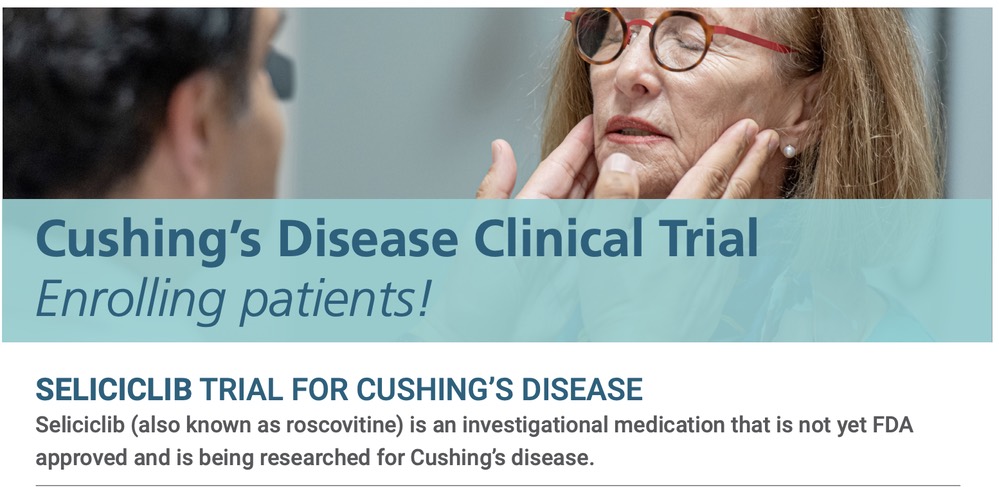
Clinical Trial: Multicenter Study of Seliciclib (R-roscovitine) for Cushing Disease

Sponsor:
Information provided by (Responsible Party):
Shlomo Melmed, MD, Cedars-Sinai Medical Center
Brief Summary:

This phase 2 multicenter, open-label clinical trial will evaluate safety and efficacy of 4 weeks of oral seliciclib in patients with newly diagnosed, persistent, or recurrent Cushing disease.

Funding Source – FDA Office of Orphan Products Development (OOPD)

Condition or disease  Intervention/treatment  Phase 
Cushing Disease Drug: Seliciclib Phase 2
Detailed Description:
This phase 2 multicenter, open-label clinical trial will evaluate safety and efficacy of two of three potential doses/schedules of oral seliciclib in patients with newly diagnosed, persistent, or recurrent Cushing disease. Up to 29 subjects will be treated with up to 800 mg/day oral seliciclib for 4 days each week for 4 weeks and enrolled in sequential cohorts based on efficacy outcomes. The study will also evaluate effects of seliciclib on quality of life and clinical signs and symptoms of Cushing disease.
Ages Eligible for Study: 18 Years and older   (Adult, Older Adult)
Sexes Eligible for Study: All
Accepts Healthy Volunteers: No
Criteria

Inclusion criteria:

  • Male and female patients at least 18 years old
  • Patients with confirmed pituitary origin of excess adrenocorticotropic hormone (ACTH) production:
    • Persistent hypercortisolemia established by two consecutive 24 h UFC levels at least 1.5x the upper limit of normal
    • Normal or elevated ACTH levels
    • Pituitary macroadenoma (>1 cm) on MRI or inferior petrosal sinus sampling (IPSS) central to peripheral ACTH gradient >2 at baseline and >3 after corticotropin-releasing hormone (CRH) stimulation
    • Recurrent or persistent Cushing disease defined as pathologically confirmed resected pituitary ACTH-secreting tumor or IPSS central to peripheral ACTH gradient >2 at baseline and >3 after CRH stimulation, and 24 hour UFC above the upper limit of normal reference range beyond post-surgical week 6
    • Patients on medical treatment for Cushing disease. The following washout periods must be completed before screening assessments are performed:
      • Inhibitors of steroidogenesis (metyrapone, ketoconazole): 2 weeks
      • Somatostatin receptor ligand pasireotide: short-acting, 2 weeks; long-acting, 4 weeks
      • Progesterone receptor antagonist (mifepristone): 2 weeks
      • Dopamine agonists (cabergoline): 4 weeks
      • CYP3A4 strong inducers or inhibitors: varies between drugs; minimum 5-6 times the half-life of drug

Exclusion criteria:

  • Patients with compromised visual fields, and not stable for at least 6 months
  • Patients with abutment or compression of the optic chiasm on MRI and normal visual fields
  • Patients with Cushing’s syndrome due to non-pituitary ACTH secretion
  • Patients with hypercortisolism secondary to adrenal tumors or nodular (primary) bilateral adrenal hyperplasia
  • Patients who have a known inherited syndrome as the cause for hormone over secretion (i.e., Carney Complex, McCune-Albright syndrome, Multiple endocrine neoplasia (MEN) 1
  • Patients with a diagnosis of glucocorticoid-remedial aldosteronism (GRA)
  • Patients with cyclic Cushing’s syndrome defined by any measurement of UFC over the previous 1 months within normal range
  • Patients with pseudo-Cushing’s syndrome, i.e., non-autonomous hypercortisolism due to overactivation of the hypothalamic-pituitary-adrenal (HPA) axis in uncontrolled depression, anxiety, obsessive compulsive disorder, morbid obesity, alcoholism, and uncontrolled diabetes mellitus
  • Patients who have undergone major surgery within 1 month prior to screening
  • Patients with serum K+< 3.5 while on replacement treatment
  • Diabetic patients whose blood glucose is poorly controlled as evidenced by HbA1C >8%
  • Patients who have clinically significant impairment in cardiovascular function or are at risk thereof, as evidenced by congestive heart failure (NYHA Class III or IV), unstable angina, sustained ventricular tachycardia, clinically significant bradycardia, high grade atrioventricular (AV) block, history of acute MI less than one year prior to study entry
  • Patients with liver disease or history of liver disease such as cirrhosis, chronic active hepatitis B and C, or chronic persistent hepatitis, or patients with alanine aminotransferase (ALT) or aspartate aminotransferase (AST) more than 1.5 x ULN, serum total bilirubin more than ULN, serum albumin less than 0.67 x lower limit of normal (LLN) at screening
  • Serum creatinine > 2 x ULN
  • Patients not biochemically euthyroid
  • Patients who have any current or prior medical condition that can interfere with the conduct of the study or the evaluation of its results, such as
    • History of immunocompromise, including a positive HIV test result (ELISA and Western blot). An HIV test will not be required, however, previous medical history will be reviewed
    • Presence of active or suspected acute or chronic uncontrolled infection
    • History of, or current alcohol misuse/abuse in the 12 month period prior to screening
  • Female patients who are pregnant or lactating, or are of childbearing potential and not practicing a medically acceptable method of birth control. If a woman is participating in the trial then one form of contraception is sufficient (pill or diaphragm) and the partner should use a condom. If oral contraception is used in addition to condoms, the patient must have been practicing this method for at least two months prior to screening and must agree to continue the oral contraceptive throughout the course of the study and for 3 months after the study has ended. Male patients who are sexually active are required to use condoms during the study and for three month afterwards as a precautionary measure (available data do not suggest any increased reproductive risk with the study drugs)
  • Patients who have participated in any clinical investigation with an investigational drug within 1 month prior to screening or patients who have previously been treated with seliciclib
  • Patients with any ongoing or likely to require additional concomitant medical treatment to seliciclib for the tumor
  • Patients with concomitant treatment of strong CYP3A4 inducers or inhibitors.
  • Patients who were receiving mitotane and/or long-acting somatostatin receptor ligands octreotide long-acting release (LAR) or lanreotide
  • Patients who have received pituitary irradiation within the last 5 years prior to the baseline visit
  • Patients who have been treated with radionuclide at any time prior to study entry
  • Patients with known hypersensitivity to seliciclib
  • Patients with a history of non-compliance to medical regimens or who are considered potentially unreliable or will be unable to complete the entire study
  • Patients with presence of Hepatitis B surface antigen (HbsAg)
  • Patients with presence of Hepatitis C antibody test (anti-HCV)

Osilodrostat Treatment for Adrenal and Ectopic Cushing Syndrome

Integration of Clinical Studies With Case Presentations

Maria Fleseriu, Richard J Auchus, Irina Bancos, Beverly MK Biller
Journal of the Endocrine Society, Volume 9, Issue 4, April 2025, bvaf027
https://doi.org/10.1210/jendso/bvaf027

Abstract

Although most cases of endogenous Cushing syndrome are caused by a pituitary adenoma (Cushing disease), approximately one-third of patients present with ectopic or adrenal causes.

Surgery is the first-line treatment for most patients with Cushing syndrome; however, medical therapy is an important management option for those who are not eligible for, refuse, or do not respond to surgery.

Clinical experience demonstrating that osilodrostat, an oral 11β-hydroxylase inhibitor, is effective and well tolerated comes predominantly from phase III trials in patients with Cushing disease. Nonetheless, reports of its use in patients with ectopic or adrenal Cushing syndrome are increasing. These data highlight the importance of selecting the most appropriate starting dose and titration frequency while monitoring for adverse events, including those related to hypocortisolism and prolongation of the QT interval, to optimize treatment outcomes. Here we use illustrative case studies to discuss practical considerations for the management of patients with ectopic or adrenal Cushing syndrome and review published data on the use of osilodrostat in these patients.

The case studies show that to achieve the goal of reducing cortisol levels in all etiologies of Cushing syndrome, management should be individualized according to each patient’s disease severity, comorbidities, performance status, and response to treatment. This approach to osilodrostat treatment maximizes the benefits of effective cortisol control, leads to improvements in comorbid conditions, and may ameliorate quality of life for patients across all types and severities of Cushing syndrome.

Read the article


From https://www.endocrine.org/journals/journal-of-the-endocrine-society/osilodrostat-treatment-for-adrenal-and-ectopic-cushing-syndrome

Day 26, Cushing’s Awareness Challenge

So often during the diagnosis phase of Cushing’s I felt lost like this picture – I was walking alone to an unknown place with an unknown future.

My diagnosis was pre-Internet which meant that any information had to be gotten from libraries, bookstores, magazines…or doctors.  In 1983 to 1986 I knew something was terribly wrong but there was no backup from doctors, family or friends.  My first hope was from a magazine (see Day Six)

After I got that first glimmer of hope, it was off to the library to try to understand medical texts.  I would pick out words I did understand – and it was more words each trip.  I made Xerox copies of my findings to read at home and try to digest. (I still have all those old pages!)

All my research led me to Cushing’s.

Unfortunately, the research didn’t lead me to doctors who could help for several years.  That contributed greatly to the loneliness.  If a doctor says you’re not sick, friends and family are going to believe the doctor, not you.  After all, he’s the one trained to know what’s wrong or find out.

I was so grateful when I finally got into a clinical trial at NIH and was so nice not to be alone with this mystery illness.  I was also surprised to learn, awful as I felt, there were Cushies much worse off than I was.

I am so glad that the Internet is here now helping us all know that we’re not alone anymore.

We’re all in this together with help, support, research, just being there.  I love this quote from Catherine at http://wheniwasyou.wordpress.com/2012/03/31/wheniwasyou/

Mary, I am delighted to see you here. Cushings – because of the persistent central obesity caused by (we know now) the lack of growth hormone plus the hypothyroidism I was diagnosed with (but for which treatment was ineffective due to my lack of cortisol) – was one of the things I considered as an explanation for my symptoms. Your site was enormously educational and helpful to me in figuring out what might be happening to me. Those other patient testimonies I referred to? Many of them were the bios you posted. Thank you so much for commenting. I am so grateful for the support and encouragement. I really hope that my experiences will help other undiagnosed hypopituitary patients find their way to a diagnosis. I often used to dream that one day I’d get to say to others what was so often said to me: don’t give up, there will be an answer. I kept believing in myself because people I hadn’t even met believed in me. Now I am finally here and I do hope my story will help others to have faith in their own instincts.

Thanks again. Please do keep in touch.

Catherine

Day 12, Cushing’s Awareness Challenge

In March of 1987, after the endo finally  confirmed that I had Cushing’s, I was sent to a local hospital where they repeated all those same tests for another week and decided that it was not my adrenal gland (Cushing’s Syndrome) creating the problem. The doctors and nurses had no idea what to do with me, so they put me on the brain cancer ward.

When I left this hospital after a week, we didn’t know any more than we had before.

As luck would have it, NIH (National Institutes of Health, Bethesda, Maryland) was doing a clinical trial of Cushing’s. I live in the same area as NIH so it was not too inconvenient but very scary at first to think of being tested there. At that time I only had a choice of NIH, Mayo Clinic and a place in Quebec to do this then-rare pituitary surgery called a Transsphenoidal Resection.

My husband asked my endo if it were his wife, if he would recommend this surgery.  The endo responded that he was divorcing his wife – he didn’t care what happened to her.  Oh, my!

I chose NIH – closest and free. After I was interviewed by the doctors there, I got a letter that I had been accepted into the clinical trial.

The night before I was admitted, I signed my will.  I was sure I was going to die there.  If not during testing, as a result of surgery.

The first time I was there was for 6 weeks as an inpatient. More of the same tests.

There were about 12 of us there and it was nice not to be alone with this mystery disease. Many of these Cushies (mostly women) were getting bald, couldn’t walk, having strokes, had diabetes. One was blind, one had a heart attack while I was there. Several were from Greece.

My first roommate was a nurse.  She spent the entire first night screaming in pain.  I was very glad when they moved me to a new room!

Towards the end of my testing period, I was looking forward to the surgery just to get this whole mess over with – either a cure or dying. While I was at NIH, I was gaining about a pound a day!

During the time I was home the weekend  before surgery, a college classmate of mine (I didn’t know her) DID die at NIH of a Cushing’s-related problem. I’m so glad I didn’t find out until reading the alumnae magazine a couple months later!  She was the same class, same major, same home-town, same disease…

We have a Scottish doctor named James Lind to thank for the clinical trial.  He  conducted the first ever clinical trial in 1747 and developed the theory that citrus fruits cured scurvy.  Lind  compared the effects of various different acidic substances, ranging from vinegar to cider, on groups of afflicted sailors, and found that the group who were given oranges and lemons had largely recovered from scurvy after 6 days.

I’d like to think that I advanced the knowledge of Cushing’s at least a little bit by being a guinea  pig in 1987-1989.

From the NIH: http://endocrine.niddk.nih.gov/pubs/cushings/cushings.aspx

Hope through Research

Several components of the National Institutes of Health (NIH) conduct and support research on Cushing’s syndrome and other disorders of the endocrine system, including the National Institute of Diabetes and Digestive and Kidney Diseases, the National Institute of Child Health and Human Development (NICHD), the National Institute of Neurological Disorders and Stroke, the National Cancer Institute, and the National Center for Research Resources.

NIH-supported scientists are conducting intensive research into the normal and abnormal function of the major endocrine glands and the many hormones of the endocrine system. Researchers continue to study the effects of excess cortisol, including its effect on brain structure and function. To refine the diagnostic process, studies are under way to assess the accuracy of existing screening tests and the effectiveness of new imaging techniques to evaluate patients with ectopic ACTH syndrome. Researchers are also investigating jugular vein sampling as a less invasive alternative to petrosal sinus sampling. Research into treatment options includes study of a new drug to treat the symptoms of Cushing’s syndrome caused by ectopic ACTH secretion.

Studies are under way to understand the causes of benign endocrine tumor formation, such as those that cause most cases of Cushing’s syndrome. In a few pituitary adenomas, specific gene defects have been identified and may provide important clues to understanding tumor formation. Endocrine factors may also play a role. Increasing evidence suggests that tumor formation is a multistep process. Understanding the basis of Cushing’s syndrome will yield new approaches to therapy.

The NIH supports research related to Cushing’s syndrome at medical centers throughout the United States. Scientists are also treating patients with Cushing’s syndrome at the NIH Clinical Center in Bethesda, MD. Physicians who are interested in referring an adult patient may contact Lynnette Nieman, M.D., at NICHD, 10 Center Drive, Room 1-3140, Bethesda, MD 20892-1109, or by phone at 301-496-8935. Physicians interested in referring a child or adolescent may contact Constantine Stratakis, M.D., D.Sc., at NICHD, 10 Center Drive, Room 1-3330, Bethesda, MD 20892-1103, or by phone at 301-402-1998.

Corcept Completes Enrollment in Phase 3 Gradient Trial of Relacorilant in Patients With Adrenal Cushing’s Syndrome

Corcept Therapeutics Incorporated (NASDAQ: CORT), a commercial-stage company engaged in the discovery and development of medications to treat severe endocrinologic, oncologic, metabolic and neurologic disorders by modulating the effects of the hormone cortisol, today announced completion of enrollment in GRADIENT, a Phase 3 trial of its proprietary selective cortisol modulator relacorilant in patients with Cushing’s syndrome (hypercortisolism) caused by an adrenal adenoma or adrenal hyperplasia.

“Hypercortisolism with adrenal etiology affects many patients and is associated with serious cardiometabolic comorbidities, including hypertension and hyperglycemia, and increased risk of premature death,” said Bill Guyer, PharmD, Corcept’s Chief Development Officer. “GRADIENT is the first prospective placebo-controlled study to be conducted exclusively in these patients with Cushing’s syndrome. We expect data from GRADIENT in the fourth quarter of this year.”

GRADIENT is a randomized, double-blind, placebo-controlled trial conducted at sites in the United States, Europe and Israel. One-hundred thirty-seven patients were randomized 1:1 to receive relacorilant or placebo for 22 weeks. Primary endpoints are improvement in glucose metabolism and hypertension.

About Cushing’s Syndrome (Hypercortisolism)
Cushing’s syndrome is caused by excessive activity of the hormone cortisol. Endogenous Cushing’s syndrome is an orphan disease that most often affects adults aged 20-50. Symptoms vary, but most patients experience one or more of the following manifestations: high blood sugar, diabetes, high blood pressure, upper-body obesity, rounded face, increased fat around the neck, thinning arms and legs, severe fatigue and weak muscles. Irritability, anxiety, cognitive disturbances and depression are also common. Cushing’s syndrome can affect every organ system and can be lethal if not treated effectively.

About Relacorilant
Relacorilant is a selective cortisol modulator that binds to the glucocorticoid receptor (GR), but does not bind to the body’s other hormone receptors. Corcept is studying relacorilant in a variety of serious disorders, including ovarian, adrenal and prostate cancer and Cushing’s syndrome. Relacorilant is proprietary to Corcept and is protected by composition of matter, method of use and other patents. Relacorilant has orphan drug designation in the United States and the European Union for the treatment of Cushing’s syndrome.

About Corcept Therapeutics
For over 25 years, Corcept’s focus on cortisol modulation and its potential to treat patients across a wide variety of serious disorders has led to the discovery of more than 1,000 proprietary selective cortisol modulators. Corcept’s advanced clinical trials are being conducted in patients with hypercortisolism, solid tumors, amyotrophic lateral sclerosis (ALS) and liver disease (NASH). In February 2012, the company introduced Korlym, the first medication approved by the U.S. Food and Drug Administration for the treatment of patients with Cushing’s syndrome. Corcept is headquartered in Menlo Park, California. For more information, visit Corcept.com.

Forward-Looking Statements
Statements in this press release, other than statements of historical fact, are forward-looking statements based on our current plans and expectations that are subject to risks and uncertainties that might cause our actual results to differ materially from those such statements express or imply. These risks and uncertainties include, but are not limited to, our ability to operate our business; risks related to the study and development of Korlym as well as relacorilant, miricorilant, dazucorilant and our other product candidates, including their clinical attributes, regulatory approvals, mandates, oversight and other requirements; and the scope and protective power of our intellectual property. These and other risks are set forth in our SEC filings, which are available at our website and the SEC’s website.

In this press release, forward-looking statements include those concerning the development of relacorilant as a treatment for Cushing’s syndrome, and design, timing and expectations regarding our GRADIENT trial. We disclaim any intention or duty to update forward-looking statements made in this press release.

From https://finance.yahoo.com/news/corcept-completes-enrollment-phase-3-120000179.html