Vitamin D Deficiency in Cushing’s Disease: Before and After Its Supplementation

1
Department of Health Promotion, Maternal-Infantile Care, Excellence Internal and Specialist Medicine “G. D’Alessandro” [PROMISE], Section of Endocrine Disease and Nutrition, University of Palermo, 90127 Palermo, Italy
2
Biochemistry Head CQRC Division (Quality Control and Biochemical Risk), Department of Health Promotion, Maternal-Infantile Care, Excellence Internal and Specialist Medicine “G. D’Alessandro” [PROMISE], University of Palermo, 90127 Palermo, Italy
Author to whom correspondence should be addressed.
Academic Editor: Edgard Delvin
Nutrients 202214(5), 973; https://doi.org/10.3390/nu14050973

Abstract

Background: The primary objective of the study was to assess serum 25-hydroxyvitamin D [25(OH)D] values in patients with Cushing’s disease (CD), compared to controls. The secondary objective was to assess the response to a load of 150,000 U of cholecalciferol. Methods: In 50 patients with active CD and 48 controls, we evaluated the anthropometric and biochemical parameters, including insulin sensitivity estimation by the homeostatic model of insulin resistance, Matsuda Index and oral disposition index at baseline and in patients with CD also after 6 weeks of cholecalciferol supplementation. Results: At baseline, patients with CD showed a higher frequency of hypovitaminosis deficiency (p = 0.001) and lower serum 25(OH)D (p < 0.001) than the controls. Six weeks after cholecalciferol treatment, patients with CD had increased serum calcium (p = 0.017), 25(OH)D (p < 0.001), ISI-Matsuda (p = 0.035), oral disposition index (p = 0.045) and decreased serum PTH (p = 0.004) and total cholesterol (p = 0.017) values than at baseline. Multivariate analysis showed that mean urinary free cortisol (mUFC) was independently negatively correlated with serum 25(OH)D in CD. Conclusions: Serum 25(OH)D levels are lower in patients with CD compared to the controls. Vitamin D deficiency is correlated with mUFC and values of mUFC > 240 nmol/24 h are associated with hypovitaminosis D. Cholecalciferol supplementation had a positive impact on insulin sensitivity and lipids.

1. Introduction

Vitamin D is the precursor of a hormone with pleiotropic effects. Its deficiency has been largely investigated and shown to be associated with many complications including diabetes mellitus, adrenal insufficiency, cardiovascular disease, neurological disorders and other endocrinopathies [1,2,3].
Vitamin D, also known as cholecalciferol, is first formed in the skin by the photolysis of 7-dehydrocholesterol and after hydroxylated in the liver to 25-hydroxyvitamin D [25(OH)D]. It is further transformed in the kidney into 1,25-dihydroxyvitamin D3 (1,25(OH)2D3) (calcitriol) that is the active form [4].
Cushing’s disease (CD) is characterized by a cortisol excess due to autonomous pituitary ACTH secretion. Patients with CD show many comorbidities such as cardiovascular disease, metabolic disease, diabetes mellitus, metabolic syndrome, dyslipidemia, obesity, osteoporosis/osteopenia and infections that contribute to increasing the mortality risk for these patients [5,6,7,8,9,10,11]. Indeed, GCs are key regulators of intermediary metabolism promoting hepatic gluconeogenesis and glycogenosis and on lipid metabolism favouring the deposition of fat to the upper trunk and the face [12]. They stimulate water diuresis, glomerular filtration rate and renal plasma flow and these effects result in arterial hypertension and atherosclerosis. GCs reduce bone remodelling, augment urinary calcium excretion and decrease the intestinal calcium absorption. In addition, they act on immune and hematological systems inhibiting the secretion of interleukins and increasing the red blood cell count, respectively [12].
An interesting relationship exists between glucocorticoids (GCs) and vitamin D values [13,14,15,16]. Indeed, exogenous steroid therapy has been reported to be associated with vitamin deficiency [13]. The mechanism by which GCs reduce 25(OH)D levels is not direct, but indirect, regulating vitamin D receptor expression in many tissues and cells [17,18]. Some authors have shown that treatment with dexamethasone in mice was associated with a decrease in 1α-hydroxylase which is involved in the conversion from 25(OH)D3 to the active metabolite 1,25(OH)2D3 and an increase in 24-hydroxylase, able to break down the active form of calcitriol, in inactive, reducing circulating 25(OH)D levels [19]. In a clinical setting, controversial data have been reported on GCs effects on serum 1,25(OH)2D concentrations [20,21,22,23]. A likely reason for these discrepancies might be the marked heterogeneity of the studied groups. Some of these studies were performed in humans [23,24,25,26], and others in animal models [27,28], but only a few studies were conducted in subjects with endogenous hypercortisolism.
Low serum 25(OH)D levels have significant skeletal and extra-skeletal consequences such as myopathy, high risk of fractures and also affect the immune system and metabolism. All of these systems are impaired in patients with hypercortisolism and a vitamin D deficiency may provide a further aggravation of CD comorbidities. Indeed, it may cause a reduced intestinal calcium absorption resulting in secondary hypocalcemia and hyperparathyroidism leading to a bone demineralization. Its deficiency can contribute to obesity and metabolic syndrome due to the lack of antiadipogenic effect of vitamin D and to cardiovascular disease by a deregulation of the renin–angiotensin–aldosterone system, cardiac contractility and increase in cytokine release [29]. In the end, vitamin D deficiency causes impaired insulin sensitivity and immune system [30].
The discrepancies that emerge in the above-mentioned studies suggest a need to investigate the role of 25(OH)D in patients with CD. Therefore, the primary objective of the study was to evaluate serum 25(OH)D levels in patients with CD, compared to a control group matched for age, BMI and gender, and search for a possible correlation with the degree of hypercortisolism. The secondary objective was to evaluate the response to a course of 150,000 U of cholecalciferol on metabolic and hormonal parameters 6 weeks after the administration in patients with CD.

2. Materials and Methods

2.1. Subjects and Study Design

Fifty patients with active CD, 43 of them women (86%) and 7 of them men (20%) (mean age 50.9 ± 17.4 years; mean duration of disease 32.5 ± 22.4 years), followed from January 2016 to December 2020, by the Endocrinology of the University of Palermo, were included in the current study. Clinical practice guidelines and a recent consensus statement were used to diagnose CD [31,32].
We recruited a control group matched for age, BMI and gender in the same temporal period. It was composed of 48 patients, 33 women (82.5%) and 7 men (17.5%) (mean age 48.5 ± 13.4 years) were evaluated by our team for a suspicion not biochemically confirmed of Cushing’s syndrome (CS).
In all patients, we evaluated phenotypic characteristics including moon face, facial rubor, dorsal fat pad or buffalo hump, defined as a fatty tissue deposit between the shoulders, purple striae, defined as wide, reddish-purple streaks, and myopathy defined as muscle weakness at the proximal level.
We also assessed cardiovascular, metabolic and bone comorbidities. The diagnosis of metabolic syndrome was based on National Cholesterol Education Program Adult Treatment Panel (NCEP ATP III) criteria, while the diagnosis of diabetes mellitus and prediabetes were based on the American Diabetes Association (ADA, Arlington, VA, USA) criteria [33,34].
Among patients with diabetes mellitus (18 out of 50), 16 were treated with metformin alone, while 2 were treated with a combination of metformin and GLP-1 agonist receptors. Metformin and GLP-1 agonist receptors were discontinued 24 h and 2 weeks before metabolic evaluations, respectively, to avoid any interference with metabolic parameters. Diabetic patients were on good metabolic control (HbA1c ≤ 7%). Both CD patients and the controls were naïve to cholecalciferol.
In CD and the controls, BMI and waist circumference (WC), fasting serum lipids (total cholesterol (TC), HDL cholesterol, LDL cholesterol and triglycerides (TG), HbA1c, glycaemia, insulinaemia, albumin corrected calcium, phosphorus and parathyroid hormone (PTH) were assessed. To avoid seasonal influences, serum 25(OH)D levels were only assayed between winter and spring seasons (November–April). We evaluated urinary free cortisol (UFC) as the mean of three 24 h urine collections (mUFC), cortisol after a low dose of dexamethasone suppression test and plasma ACTH. We defined patients with mild hypercortisolism when mUFC levels not exceeding twice the upper limit of normal (ULN), moderate hypercortisolism by a level of mUFC more than 2 to 5 times the ULN and severe hypercortisolism by a mUFC level more than 5 times the ULN, as previously reported [35].
As defined by the Endocrine Society guidelines, we considered 25(OH)D deficiency for values < 20 ng/mL (50 nmol/L), insufficiency as levels of 20–30 ng/mL (50–75 nmol/L) and sufficiency for values ≥ 30 ng/mL (≥75 nmol/L) [36]. In addition, severe 25(OH)D deficiency was defined by levels < 10 ng/mL (<25 nmol/L) [37].
As markers of insulin sensitivity, we calculated the homeostatic model of insulin resistance (HOMA2-IR) [38], and in 32 patients with CD and in 40 controls who had no previous diagnosis of diabetes, we also evaluated the Matsuda index of insulin sensitivity (ISI-Matsuda) [39], the oral disposition index (DIo) [40] and the area under the curve for insulin (AUC2h insulinemia) and glucose (AUC2h glycaemia).
At the baseline visit, we assessed patients’ lifestyle habits: physical activity level, balanced diet (consumption of dairy products, meat, coffee, soft drinks), exposure to ultraviolet (UV) radiation, smoking status and alcohol use.
We excluded patients with adrenal-dependent hypercortisolism, pregnancy, taking oral contraceptives, liver or renal disease, cholecalciferol supplementation within 3 months before the study, malabsorption syndrome and exposure to ultraviolet (UV) radiation (solarium and sunscreen usage).
Patients with CD received an oral load dose of cholecalciferol of 150,000 UI [41,42] and biochemical parameters (metabolic and hormonal) were assayed 6 weeks after administration.
The study protocol was approved by the Ethics Committee of the Policlinico Paolo Giaccone hospital. All patients signed a written informed consent.

2.2. Assays

Biochemical parameters were measured by standard methods (Modular P800, Roche, Milan, Italy), as previously reported [9].
Hormonal parameters were measured by electrochemiluminescence immunoassay (ECLIA, Elecsys, Roche, Milan, Italy) following the manufacturer’s instructions, as previously reported [9].
Mean UFC was measured by mass spectrometry, as previously reported [35].
Normal values for hormonal markers were defined as follows: ACTH 2.2–14 pmol/L and UFC 59–378 nmol/24 h.

2.3. Statistical Analysis

We used statistical Packages for Social Science SPSS version 19 (SPSS, Inc., Chicago, IL, USA) for data analysis. The normality of quantitative variables was tested with the Shapiro–Wilk test. We calculated mean ± SD for continuous variables and rates and proportions for categorical variables. The differences between paired continuous variables (CD vs. controls) were analysed using one-way ANOVA. We used univariate Pearson correlation to evaluate the relations with the outcome parameters. For those variables which were significant at univariate correlation, we performed multiple linear regression analysis to identify independent predictors of the dependent variable 25(OH)D. A p-value of 0.05 was considered statistically significant. A receiver operating characteristic (ROC) analysis was performed to investigate the diagnostic ability of significantly associated risk factors to predict 25(OH)D deficiency. The ROC curve is plotted as sensitivity versus 1-specificity. The area under the ROC curve (AUC) was estimated to measure the overall performance of the predictive factors for serum 25(OH)D deficiency.

3. Results

At baseline, patients with CD had a higher frequency of arterial hypertension (p = 0.009), osteoporosis/osteopenia (p = 0.002), hypercholesterolemia (p = 0.002), diabetes mellitus (p = 0.026), myopathy (p < 0.001), facial rubor (p = 0.005), buffalo hump (p = 0.002) and hypovitaminosis deficiency (p = 0.001) than the controls (Table 1).
Table 1. Comorbidities of patients with CD and controls at baseline.
Table
By contrast, the controls had a higher frequency of vitamin D sufficiency (p = 0.004). Patients with CD also had higher WC (p = 0.031), PTH (p = 0.003), glycaemia (p = 0.010), HbA1c (p = 0.004), total cholesterol (p < 0.001), LDL cholesterol (p = 0.002), ACTH (p < 0.001), mUFC (p = 0.001), cortisol after a low dose of dexamethasone suppression test (p = 0.001) and lower 25(OH)D (p < 0.001), ISI-Matsuda (p = 0.007) and DIo (p = 0.003) than the controls (Table 2).
Table 2. Anthropometric and biochemical parameters of patients with CD and controls at baseline.
Table
Six weeks after cholecalciferol treatment, patients with CD showed increased serum calcium (p = 0.017), 25(OH)D (p < 0.001), ISI-Matsuda (p = 0.035), DIo (p = 0.045) and a decrease in PTH (p = 0.004) and total cholesterol (p = 0.017) levels than at baseline (Table 3).
Table 3. Anthropometric and biochemical parameters at baseline and 6 weeks after cholecalciferol supplementation in patients with CD.
Table
Considering the degree of hypercortisolism, in patients with severe hypercortisolism we observed 25(OH)D deficiency in 73.1% of cases (53.8% of them had a severe deficiency), insufficiency in 12.5% of cases and sufficiency in 6.3% of cases. In patients with moderate hypercortisolism, we observed 25(OH)D deficiency in 64.7% of cases (29% of them had a severe deficiency), insufficiency in 23.5% of cases and sufficiency in 11.8% of cases. In patients with mild hypercortisolism, we observed deficiency in 52.9% of cases (20% of them had a severe deficiency), insufficiency in 41.1% of cases and sufficiency in 6% of cases.
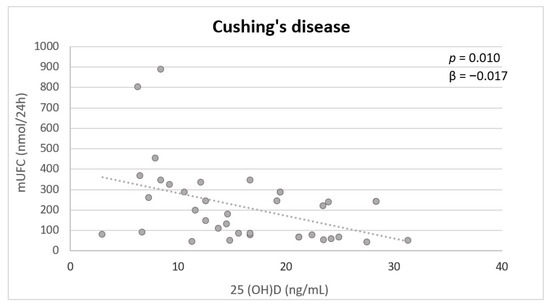
At univariate correlation, in patients with CD at baseline, serum 25(OH)D was inversely correlated with glycaemia (r = −0.385, p = 0.019), HbA1c (r = −0.391, p = 0.017), WC (r = −0.373, p = 0.023), mUFC (r = −0.466, p = 0.033) and cortisol after a low dose of dexamethasone suppression test (r = −0.299, p = 0.049) (Table 4). In the controls, at baseline, 25(OH)D was inversely correlated with WC (r = −0.130, p = 0.042) (Table 4).
Table 4. Correlation of serum 25-hydroxyvitamin D [25(OH)D] levels at baseline in patients with Cushing’s disease and controls.
Table
Multivariate analysis showed that mUFC was independently inversely associated with 25(OH)D (p = 0.010) in patients with CD (Figure 1). In the controls, no significant associations were found.
Nutrients 14 00973 g001 550
Figure 1. Independent variables associated with serum 25(OH)D in patients with active CD at multivariate analysis. mUFC: mean urinary free cortisol.
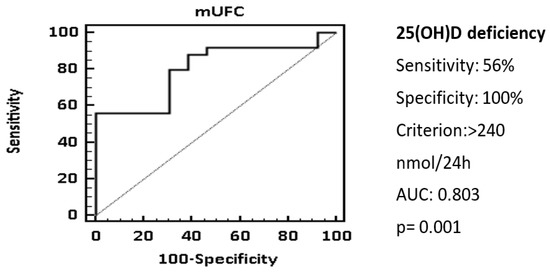
The ROC analysis showed that a cut-off of mUFC > 240 nmol/24 h was associated with 25(OH)D deficiency with a specificity of 100% and a sensitivity of 56.9%, AUC 0.803 (Figure 2).
Nutrients 14 00973 g002 550
Figure 2. 25(OH)D status and mUFC. ROC curve showed that a cut-off of mUFC > 240 nmol/24 h could be associated with 25(OH)D deficiency. Statistical analysis was performed using the chi-square test and receiver operator characteristic (ROC) curve analysis.

4. Discussion

The present study shows that patients with active CD have lower serum 25(OH)D values than the controls and that serum 25(OH)D levels are inversely correlated with mUFC in CD. In addition, a cholecalciferol load is associated after 6 weeks from the administration with an improvement of serum 25(OH)D and glycometabolic and lipid parameters in patients with CD. Furthermore, we found that higher values of mUFC than 240 nmol/24 h are predictive of 25(OH)D deficiency. The degree of hypercortisolism evaluated by UFC levels is a useful parameter to quantify the “amount” of cortisol secretion, even though it is not sufficiently exhaustive to assess the aggressiveness of the disease [35]. Indeed, a combination of several factors, including the degree of hypercortisolism, but also the duration of the disease, age and other individual predisposing factors, contribute to the aggressiveness of the disease.
Long-standing studies were conducted on vitamin D levels in patients with CD. Patients with CD, with and without osteopenia, were compared before and after oral calcium load showing that serum 1,25 (OH)2D3 plasma levels were higher in subjects with osteopenia than in those without it, likely due to a secondary increase in PTH levels as an effect of hypercortisolism [19]. Another study investigated the effect of hypercortisolism and eucortisolism, showing a reduction in serum 25(OH)D levels, but not in 1,25 (OH)2D3 in patients with hypercortisolism. By contrast, two other studies found normal serum 25(OH)D values in patients with CD [23,24]. However, all the above-mentioned studies were conducted on a small sample of patients. Recently, a meta-analysis conducted on the studies that evaluated serum 25(OH)D levels in patients treated with GCs reported lower serum 25(OH)D levels in these patients compared to healthy subjects [16]. A hypothetical reason was that patients with CD had low 24-hydroxylase levels than the controls, causing an alteration of vitamin D catabolism.
An interesting in vitro study in NCI-H295R cells found that treatment with 1,25(OH)2D3 decreased corticosterone secretion without affecting cortisol levels [43].
As expected, in the current study, we showed that treatment with cholecalciferol is associated with an improvement in insulin sensitivity and total cholesterol values in patients with CD. Indeed, cholecalciferol supplementation has been reported to be associated with improved peripheral insulin sensitivity and secretion in patients at high risk of diabetes or with type 2 diabetes [44]. A recent meta-analysis on 41 randomized controlled studies showed a significant improvement in total cholesterol levels after cholecalciferol supplementation. In addition, this improvement was more pronounced in patients with vitamin D deficiency [45,46].
A recent study compared the metabolism of vitamin D in patients with CD and controls after cholecalciferol treatment, showing that patients with CD had a higher 25(OH)D/24,25(OH)2D ratio than healthy controls, likely due to a decrease in 24-hydroxylase activity. The authors concluded that this alteration of vitamin D catabolism might have an influence on the effectiveness of cholecalciferol therapy in CD [47].
There are some limitations in the current study. First, the study is not randomized. Second, the dose of cholecalciferol administered is the same independently of the baseline serum 25(OH)D values. Third, we did not register the intake of milk and dairy products of the patients included in the study.
In conclusion, serum 25(OH)D levels are lower in subjects with active CD compared to controls matched for age, BMI and gender. Vitamin D deficiency is correlated with mUFC and values of mUFC > 240 nmol/24 h are predictive of 25(OH)D deficiency. In addition, cholecalciferol supplementation has a positive impact on insulin sensitivity and lipids and therefore should be considered part of the treatment of patients with CD at diagnosis, in order to improve the comorbidities. However, further studies are needed to evaluate a possible effect of cholecalciferol supplementation on the aggressiveness of CD.

Author Contributions

Conceptualization, V.G. and F.D.G.; methodology, V.G.; software, V.G.; validation, V.G., F.D.G. and C.G.; formal analysis, V.G.; investigation, V.G.; resources, F.D.G.; data curation, V.G.; writing—original draft preparation, V.G.; writing—review and editing, V.G.; visualization, V.G.; supervision, C.G.; project administration, C.G.; funding acquisition, C.G. All authors have read and agreed to the published version of the manuscript.

Funding

This research received no external funding.

Institutional Review Board Statement

The study was conducted in accordance with the Declaration of Helsinki, and was approved by the Institutional Review Board (or Ethics Committee) of Policlinico Paolo Giaccone (number 1, approved on the 17 January 2022).

Informed Consent Statement

Informed consent was obtained from all subjects involved in the study. Written informed consent has been obtained from the patient(s) to publish this paper.

Data Availability Statement

Data are available on demand at corresponding author.

Conflicts of Interest

The authors declare no conflict of interest.

References

  1. Muscogiuri, G.; Altieri, B.; Annweiler, C.; Balercia, G.; Pal, H.B.; Boucher, B.J.; Cannell, J.J.; Foresta, C.; Grübler, M.R.; Kotsa, K.; et al. Vitamin D and chronic diseases: The current state of the art. Arch. Toxicol. 2017, 91, 97–107. [Google Scholar] [CrossRef] [PubMed]
  2. Marino, R.; Misra, M. Extra-skeletal effects of Vitamin D. Nutrients 2019, 11, 1460. [Google Scholar] [CrossRef] [PubMed]
  3. Zendehdel, A.; Arefi, M. Molecular evidence of role of vitamin D deficiency in various extraskeletal diseases. J. Cell. Biochem. 2019, 120, 8829–8840. [Google Scholar] [CrossRef] [PubMed]
  4. Bikle, D.; Christakos, S. New aspects of vitamin D metabolism and action-addressing the skin as source and target. Nat. Rev. Endocrinol. 2020, 16, 234–252. [Google Scholar] [CrossRef]
  5. Pivonello, R.; Isidori, A.; De Martino, M.C.; Newell-Price, J.; Biller, B.M.K.; Colao, A. Complications of Cushing’s syndrome: State of the art. Lancet Diabetes Endocrinol. 2016, 4, 611–629. [Google Scholar] [CrossRef]
  6. Guarnotta, V.; Ferrigno, R.; Martino, M.; Barbot, M.; Isidori, A.M.; Scaroni, C.; Ferrante, A.; Arnaldi, G.; Pivonello, R.; Giordano, C. Glucocorticoid excess and COVID-19 disease. Rev. Endocr. Metab. Disord. 2020, 22, 703–714. [Google Scholar] [CrossRef]
  7. Giordano, C.; Guarnotta, V.; Pivonello, R.; Amato, M.C.; Simeoli, C.; Ciresi, A.; Cozzolino, A.; Colao, A. Is diabetes in Cushing’s syndrome only a consequence of hypercortisolism? Eur. J. Endocrinol. 2014, 170, 311–319. [Google Scholar] [CrossRef]
  8. Drey, M.; Berr, C.M.; Reincke, M.; Fazel, J.; Seissler, J.; Schopohl, J.; Bidlingmaier, M.; Zopp, S.; Reisch, N.; Beuschlein, F.; et al. Cushing′s syndrome: A model for sarcopenic obesity. Endocrine 2017, 57, 481–485. [Google Scholar] [CrossRef]
  9. Guarnotta, V.; Prinzi, A.; Pitrone, M.; Pizzolanti, G.; Giordano, C. Circulating irisin levels as a marker of osteosarcopenic-obesity in Cushing’s disease. Diabetes Metab. Syndr. Obes. 2020, 13, 1565–1574. [Google Scholar] [CrossRef]
  10. Hakami, O.A.; Ahmed, S.; Karavitaki, N. Epidemiology and mortality of Cushing′s syndrome. Best Pr. Res. Clin. Endocrinol. Metab. 2021, 35, 101521. [Google Scholar] [CrossRef]
  11. Javanmard, P.; Duan, D.; Geer, E.B. Mortality in patients with endogenous Cushing′s Syndrome. Endocrinol. Metab. Clin. North Am. 2018, 47, 313–333. [Google Scholar] [CrossRef] [PubMed]
  12. McKay, L.I.; Cidlowski, J.A. Physiologic and pharmacologic effects of corticosteroids. In Holland-Frei Cancer Medicine, 6th ed.; Kufe, D.W., Pollock., R.E., Weichselbaum, R.R., Eds.; BC Decker: Hamilton, ON, Canada, 2003. [Google Scholar]
  13. Tirabassi, G.; Salvio, G.; Altieri, B.; Ronchi, C.L.; Della Casa, S.; Pontecorvi, A.; Balercia, G. Adrenal disorders: Is there any role for Vitamin D? Rev. Endocr. Metab. Disord. 2016, 18, 355–362. [Google Scholar] [CrossRef] [PubMed]
  14. Skversky, A.L.; Kumar, J.; Abramowitz, M.K.; Kaskel, F.J.; Melamed, M.L. Association of glucocorticoid use and low 25-Hydroxyvitamin D levels: Results from the National Health and Nutrition Examination Survey (NHANES): 2001–2006. J. Clin. Endocrinol. Metab. 2011, 96, 3838–3845. [Google Scholar] [CrossRef] [PubMed]
  15. Muscogiuri, G.; Altieri, B.; Penna-Martinez, M.; Badenhoop, K. Focus on Vitamin D and the Adrenal Gland. Horm. Metab. Res. 2015, 47, 239–246. [Google Scholar] [CrossRef]
  16. Davidson, Z.E.; Walker, K.Z.; Truby, H. Clinical review: Do Glucocorticosteroids alter Vitamin D status? A systematic review with meta-analyses of observational studies. J. Clin. Endocrinol. Metab. 2012, 97, 738–744. [Google Scholar] [CrossRef]
  17. Hidalgo, A.A.; Trump, D.L.; Johnson, C.S. Glucocorticoid regulation of the vitamin D receptor. J. Steroid Biochem. Mol. Biol. 2010, 121, 372–375. [Google Scholar] [CrossRef]
  18. Hidalgo, A.A.; Deeb, K.K.; Pike, J.W.; Johnson, C.S.; Trump, D.L. Dexamethasone enhances 1α,25-Dihydroxyvitamin D3 effects by increasing Vitamin D receptor transcription. J. Biol. Chem. 2011, 286, 36228–36237. [Google Scholar] [CrossRef]
  19. Favus, M.J.; Kimberg, D.V.; Millar, G.N.; Gershon, E. Effects of cortisone administration on the metabolism and localization of 25-Hydroxycholecalciferol in the rat. J. Clin. Investig. 1973, 52, 1328–1335. [Google Scholar] [CrossRef]
  20. Kugai, N.; Koide, Y.; Yamashita, K.; Shimauchi, T.; Nagata, N.; Takatani, O. Impaired mineral metabolism in Cushing’s syndrome: Parathyroid function, vitamin D metabolites and osteopenia. Endocrinol. Jpn. 1986, 33, 345–352. [Google Scholar] [CrossRef]
  21. Aloia, J.F.; Roginsky, M.; Ellis, K.; Shukla, K.; Cohn, S. Skeletal metabolism and body composition in Cushing’s Syndrome. J. Clin. Endocrinol. Metab. 1974, 39, 981–985. [Google Scholar] [CrossRef]
  22. Findling, J.W.; Adams, N.D.; Lemann, J., Jr.; Gray, R.W.; Thomas, C.J.; Tyrrell, J.B. Vitamin D metabolites and parathyroid hormone in Cushing’s Syndrome: Relationship to calcium and phosphorus homeostasis. J. Clin. Endocrinol. Metab. 1982, 54, 1039–1044. [Google Scholar] [CrossRef] [PubMed]
  23. Seeman, E.; Kumar, R.; Hunder, G.G.; Scott, M.; Heath, H., 3rd; Riggs, B.L. Production, degradation, and circulating levels of 1,25-dihydroxyvitamin D in health and in chronic glucocorticoid excess. J. Clin. Investig. 1980, 66, 664–669. [Google Scholar] [CrossRef] [PubMed]
  24. Klein, R.G.; Arnaud, S.B.; Gallagher, J.C.; DeLuca, H.F.; Riggs, B.L. Intestinal calcium absorption in exogenous Hypercortisonism. J. Clin. Investig. 1977, 60, 253–259. [Google Scholar] [CrossRef] [PubMed]
  25. Chaiamnuay, S.; Chailurkit, L.-O.; Narongroeknawin, P.; Asavatanabodee, P.; Laohajaroensombat, S.; Chaiamnuay, P. Current daily glucocorticoid use and serum creatinine levels are associated with lower 25(OH) Vitamin D levels in Thai patients with systemic lupus erythematosus. JCR J. Clin. Rheumatol. 2013, 19, 121–125. [Google Scholar] [CrossRef]
  26. Slovik, D.M.; Neer, R.M.; Ohman, J.L.; Lowell, F.C.; Clark, M.B.; Segre, G.V.; Potts, J.T., Jr. Parathyroid hormone and 25-hydroxyvitamin D levels in glucocorticoid-treated patients. Clin. Endocrinol. 1980, 12, 243–248. [Google Scholar] [CrossRef]
  27. Lindgren, J.U.; Merchant, C.R.; DeLuca, H.F. Effect of 1,25-dihydroxyvitamin D3 on osteopenia induced by prednisolone in adult rats. Calcif. Tissue Res. 1982, 34, 253–257. [Google Scholar] [CrossRef]
  28. Corbee, R.; Tryfonidou, M.; Meij, B.; Kooistra, H.; Hazewinkel, H. Vitamin D status before and after hypophysectomy in dogs with pituitary-dependent hypercortisolism. Domest. Anim. Endocrinol. 2012, 42, 43–49. [Google Scholar] [CrossRef]
  29. Park, J.E.; Pichiah, P.T.; Cha, Y.-S. Vitamin D and metabolic diseases: Growing roles of Vitamin D. J. Obes. Metab. Syndr. 2018, 27, 223–232. [Google Scholar] [CrossRef]
  30. Medrano, M.; Carrillo-Cruz, E.; Montero, I.; Perez-Simon, J.A. Vitamin D: Effect on Haematopoiesis and immune system and clinical applications. Int. J. Mol. Sci. 2018, 19, 2663. [Google Scholar] [CrossRef]
  31. Fleseriu, M.; Auchus, R.; Bancos, I.; Ben-Shlomo, A.; Bertherat, J.; Biermasz, N.R.; Boguszewski, C.L.; Bronstein, M.D.; Buchfelder, M.; Carmichael, J.D.; et al. Consensus on diagnosis and management of Cushing’s disease: A guideline update. Lancet Diabetes Endocrinol. 2021, 9, 847–875. [Google Scholar] [CrossRef]
  32. Nieman, L.K.; Biller, B.M.K.; Findling, J.W.; Newell-Price, J.; Savage, M.O.; Stewart, P.M.; Montori, V. The diagnosis of Cushing’s Syndrome: An endocrine society clinical practice guideline. J. Clin. Endocrinol. Metab. 2008, 93, 1526–1540. [Google Scholar] [CrossRef] [PubMed]
  33. Expert Panel on Detection, Evaluation, Treatment of High Blood Cholesterol in Adults. Executive summary of the third report of the National Cholesterol Education Program (NCEP) expert panel on detection, evaluation, and treatment of high blood cholesterol in adults (Adult Treatment Panel III). JAMA 2001, 285, 2486–2497. [Google Scholar] [CrossRef] [PubMed]
  34. American Diabetes Association. Classification and diagnosis of diabetes: Standards of medical care in diabetes—2021. Diabetes Care 2021, 44 (Suppl. S1), S15–S33. [Google Scholar] [CrossRef] [PubMed]
  35. Guarnotta, V.; Amato, M.C.; Pivonello, R.; Arnaldi, G.; Ciresi, A.; Trementino, L.; Citarrella, R.; Iacuaniello, D.; Michetti, G.; Simeoli, C.; et al. The degree of urinary hypercortisolism is not correlated with the severity of cushing’s syndrome. Endocrine 2016, 55, 564–572. [Google Scholar] [CrossRef] [PubMed]
  36. Holick, M.F.; Binkley, N.C.; Bischoff-Ferrari, H.A.; Gordon, C.M.; Hanley, D.A.; Heaney, R.P.; Murad, M.H.; Weaver, C.M. Endocrine Society. Evaluation, treatment, and prevention of Vitamin D deficiency: An endocrine society clinical practice guideline. J. Clin. Endocrinol. Metab. 2011, 96, 1911–1930. [Google Scholar] [CrossRef]
  37. Fiebrich, H.-B.; Berg, G.V.D.; Kema, I.P.; Links, T.P.; Kleibeuker, J.H.; Van Beek, A.P.; Walenkamp, A.M.E.; Sluiter, W.J.; De Vries, E.G.E. Deficiencies in fat-soluble vitamins in long-term users of somatostatin analogue. Aliment. Pharmacol. Ther. 2010, 32, 1398–1404. [Google Scholar] [CrossRef]
  38. Matthews, D.R.; Hosker, J.P.; Rudenski, A.S.; Naylor, B.A.; Treacher, D.F.; Turner, R.C. Homeostasis model assessment: Insulin resistance and β-cell function from fasting plasma glucose and insulin concentrations in man. Diabetologia 1985, 28, 412–419. [Google Scholar] [CrossRef]
  39. Matsuda, M.; DeFronzo, R.A. Insulin sensitivity indices obtained from oral glucose tolerance testing: Comparison with the euglycemic insulin clamp. Diabetes Care 1999, 22, 1462–1470. [Google Scholar] [CrossRef]
  40. Utzschneider, K.M.; Prigeon, R.L.; Faulenbach, M.V.; Tong, J.; Carr, D.B.; Boyko, E.J.; Leonetti, D.L.; McNeely, M.J.; Fujimoto, W.Y.; Kahn, S.E. Oral disposition index predicts the development of future diabetes above and beyond fasting and 2-h glucose levels. Diabetes Care 2009, 32, 335–341. [Google Scholar] [CrossRef]
  41. Glendenning, P.; Zhu, K.; Inderjeeth, C.; Howat, P.; Lewis, J.R.; Prince, R.L. Effects of three-monthly oral 150,000 IU cholecalciferol supplementation on falls, mobility, and muscle strength in older postmenopausal women: A randomized controlled trial. J. Bone Miner. Res. 2011, 27, 170–176. [Google Scholar] [CrossRef]
  42. Kearns, M.D.; Alvarez, J.A.; Tangpricha, V. Large, single-dose, oral Vitamin D supplementation in adult populations: A systematic review. Endocr. Pract. 2014, 20, 341–351. [Google Scholar] [CrossRef] [PubMed]
  43. Lundqvist, J.; Norlin, M.; Wikvall, K. 1α,25-Dihydroxyvitamin D3 affects hormone production and expression of steroidogenic enzymes in human adrenocortical NCI-H295R cells. Biochim. Biophys. Acta 2010, 1801, 1056–1062. [Google Scholar] [CrossRef] [PubMed]
  44. Lemieux, P.; Weisnagel, S.J.; Caron, A.Z.; Julien, A.-S.; Morisset, A.-S.; Carreau, A.-M.; Poirier, J.; Tchernof, A.; Robitaille, J.; Bergeron, J.; et al. Effects of 6-month vitamin D supplementation on insulin sensitivity and secretion: A randomised, placebo-controlled trial. Eur. J. Endocrinol. 2019, 181, 287–299. [Google Scholar] [CrossRef] [PubMed]
  45. Li, Y.; Tong, C.H.; Rowland, C.M.; Radcliff, J.; Bare, L.A.; McPhaul, M.J.; Devlin, J.J. Association of changes in lipid levels with changes in vitamin D levels in a real-world setting. Sci. Rep. 2021, 11, 21536. [Google Scholar] [CrossRef] [PubMed]
  46. Dibaba, D.T. Effect of vitamin D supplementation on serum lipid profiles: A systematic review and meta-analysis. Nutr. Rev. 2019, 77, 890–902. [Google Scholar] [CrossRef] [PubMed]
  47. Povaliaeva, A.; Bogdanov, V.; Pigarova, E.; Zhukov, A.; Dzeranova, L.; Belaya, Z.; Rozhinskaya, L.; Mel’Nichenko, G.; Mokrysheva, N. Assessment of Vitamin D metabolism in patients with Cushing’s disease in response to 150,000 IU cholecalciferol treatment. Nutrients 2021, 13, 4329. [Google Scholar] [CrossRef]
Publisher’s Note: MDPI stays neutral with regard to jurisdictional claims in published maps and institutional affiliations.

Assessment of Vitamin D Metabolism in Patients with Cushing’s Disease

Endocrinology Research Centre, 117292 Moscow, Russia
*
Author to whom correspondence should be addressed.
Academic Editor: Spyridon N. Karras
Nutrients 202113(12), 4329; https://doi.org/10.3390/nu13124329
Received: 12 November 2021 / Revised: 26 November 2021 / Accepted: 27 November 2021 / Published: 30 November 2021

Abstract

In this study we aimed to assess vitamin D metabolism in patients with Cushing’s disease (CD) compared to healthy individuals in the setting of bolus cholecalciferol treatment. The study group included 30 adults with active CD and the control group included 30 apparently healthy adults with similar age, sex and BMI. All participants received a single dose (150,000 IU) of cholecalciferol aqueous solution orally. Laboratory assessments including serum vitamin D metabolites (25(OH)D3, 25(OH)D2, 1,25(OH)2D3, 3-epi-25(OH)D3 and 24,25(OH)2D3), free 25(OH)D, vitamin D-binding protein (DBP) and parathyroid hormone (PTH) as well as serum and urine biochemical parameters were performed before the intake and on Days 1, 3 and 7 after the administration. All data were analyzed with non-parametric statistics. Patients with CD had similar to healthy controls 25(OH)D3 levels (p > 0.05) and higher 25(OH)D3/24,25(OH)2D3 ratios (p < 0.05) throughout the study. They also had lower baseline free 25(OH)D levels (p < 0.05) despite similar DBP levels (p > 0.05) and lower albumin levels (p < 0.05); 24-h urinary free cortisol showed significant correlation with baseline 25(OH)D3/24,25(OH)2D3 ratio (r = 0.36, p < 0.05). The increase in 25(OH)D3 after cholecalciferol intake was similar in obese and non-obese states and lacked correlation with BMI (p > 0.05) among patients with CD, as opposed to the control group. Overall, patients with CD have a consistently higher 25(OH)D3/24,25(OH)2D3 ratio, which is indicative of a decrease in 24-hydroxylase activity. This altered activity of the principal vitamin D catabolism might influence the effectiveness of cholecalciferol treatment. The observed difference in baseline free 25(OH)D levels is not entirely clear and requires further study.

1. Introduction

Cushing’s disease (CD) is one of the disorders associated with endogenous hypercortisolism and is caused by adrenocorticotropic hormone (ACTH) hyperproduction originating from pituitary adenoma [1]. Skeletal fragility is a frequent complication of endogenous hypercortisolism, and fragility fractures may be the presenting clinical feature of disease. The prevalence of osteoporosis in endogenous hypercortisolism as assessed by dual-energy X-ray absorptiometry (DXA) or incidence of fragility fractures has been reported to be up to 50%. Osteoporosis in CD patients has a complex multifactorial pathogenesis, characterized by a low bone turnover and severe suppression of bone formation [2]. Exogenous glucocorticoids are used in the treatment of a wide range of diseases and it is estimated that 1–2% of the population is receiving long-term glucocorticoid therapy. As a consequence, glucocorticoid-induced osteoporosis is the most common secondary cause of osteoporosis [3].
Native vitamin D (in particular D3, or cholecalciferol) and its active metabolites (such as alfacalcidol) are universally considered as the essential components of the osteoporosis management [4,5]. The search for the optimal treatment of bone complications during chronic exposure to glucocorticoid excess provoked the investigation of vitamin D metabolism in this state. Early studies on this topic were focused predominantly on the general vitamin D status (assessed as 25(OH)D level) and on the levels of the active vitamin D metabolite (1,25(OH)2D). These studies showed inconsistent results, reporting that the chronic excess of glucocorticoids decreased [6,7,8,9], increased [10,11,12] or did not change [13,14,15] the levels of 25(OH)D or 1,25(OH)2D. A likely reason for such inconsistency might have been the high heterogeneity of the studied groups. Some of these studies were performed in humans [6,7,9,10,11,12,13,15] and some in animal models [8,14], and only several of them included subjects with specifically endogenous hypercortisolism [10,12,14,15]. Only two studies assessed both the levels of the active (1,25(OH)2D) and the inactive (24,25(OH)2D) vitamin D metabolites in endogenous hypercortisolism. One of them lacked control group and reported low-normal 24,25(OH)2D levels in patients with Cushing’s syndrome [10]. The second study by Corbee et al. reported similar circulating concentrations of 25(OH)D, 1,25(OH)2D and 24,25(OH)2D in studied groups of dogs regardless of either the presence of CD or hypophysectomy status [14].
Several experimental studies were performed to evaluate the impact of glucocorticoid excess on the enzymes involved in vitamin D metabolism. In mouse kidney glucocorticoid treatment increased 24-hydroxylase expression [16] and 24-hydroxylase activity [17]. An increased expression of 24-hydroxylase was also shown in rat osteoblastic and pig renal cell cultures treated with 1,25(OH)2D [18]. Dhawan and Christakos showed that 1,25(OH)2D-induced transcription of 24-hydroxylase was glucocorticoid receptor-dependent [19]. However, some works showed conflicting results. In particular, the steroid and xenobiotic receptor (SXR) which is activated by glucocorticoids [20], repressed 24-hydroxylase expression in human liver and intestine in work by Zhou et al. [21]. Lower 24-hydroxylase expression was observed in the brain and myocardium of glucocorticoid-treated rats [22] as well as in human osteosarcoma cells and human osteoblasts [23].
Nevertheless, based on experimental data, it has been suggested that the acceleration of 25(OH)D catabolism in the presence of glucocorticoid excess may predispose to vitamin D deficiency. Yet, relatively recent meta-analysis of the studies assessing 25(OH)D levels in chronic glucocorticoid users showed that serum 25(OH)D levels in these patients were suboptimal and lower than in healthy controls, but similar to steroid-naive disease controls [24].
Glucocorticoids also affect calcium and phosphorus homeostasis. In particular, they were shown to reduce gastrointestinal absorption by antagonizing vitamin D action (reducing the expression of genes for proteins involved in calcium transport—epithelial Ca channel TRPV6 and calcium-binding protein calbindin-D9K) [25]. Glucocorticoids increased fractional calcium excretion due to mineralocorticoid receptor-mediated action on epithelial sodium channels [26]. Hypercalciuria is highly prevalent in people with CD [27]. These effects might result in a negative calcium balance, although plasma ionized calcium was normal in people and dogs with hypercortisolism compared to control subjects [12,28]. Glucocorticoids also reduced tubular phosphate reabsorption by inhibiting tubular expression of the sodium gradient-dependent phosphate transporter, and induced phosphaturia [29], which was accompanied by phosphate lowering in humans [12].
Overall, current data on vitamin D status in hypercortisolism are conflicting and need clarification. In particular, clinical data on the state of vitamin D metabolism in the state of glucocorticoids excess are quite scarce. Studies were very heterogeneous in design, some lacked a control group, and the absolute majority of the studies were performed before the introduction of vitamin D measurement standardization [30]. Nevertheless, determining the optimal vitamin D treatment regimen in these high-risk patients is fairly relevant.
The aim of this study was to assess vitamin D metabolism in patients with CD compared to healthy individuals particularly in the setting of cholecalciferol treatment.

2. Materials and Methods

2.1. Study Population and Design

The study group included 30 adult patients with CD admitted for inpatient treatment at a tertiary pituitary center. Diagnosis of CD was established in accordance with the federal guidelines [31]. All patients were confirmed to be positive for endogenous hypercortisolism in at least two of the following tests: 24-h urine free cortisol (UFC) greater than the normal range for the assay and/or serum cortisol > 50 nmol/L after the 1-mg overnight dexamethasone suppression test and/or late-night salivary cortisol greater than 9.4 nmol/L). All patients also had morning ACTH ≥ 10 pg/mL and pituitary adenoma ≥ 6 mm identified by magnetic resonance imaging (MRI) or a positive for CD bilateral inferior petrosal sinus sampling (BIPSS). MRI was performed using a GE Optima MR450w 1.5T with Gadolinium (Boston, MA, USA). BIPSS was performed according to the standard procedure described elsewhere [32,33].
The control group included 30 apparently healthy adult individuals recruited from the staff and the faculty of the facility.
Inclusion criteria were age from 18 to 60 for both groups and the presence of the disease activity for the study group (defined as the presence of endogenous hypercortisolism at the time of participation in the study). Exclusion criteria for both groups were: vitamin D supplementation for 3 months prior to the study; severe obesity (body mass index (BMI) ≥ 35 kg/m2); pregnancy; the presence of granulomatous disease, malabsorption syndrome, liver failure; decreased GFR (less than 60 mL/min per 1.73 m2); severe hypercalcemia (total serum calcium > 3.0 mmol/L); allergic reactions to vitamin D medications; 25(OH)D level more than 60 ng/mL (determined by immunochemiluminescence analysis). All patients were recruited in the period from October 2019 to April 2021. The study protocol (ClinicalTrials.gov Identifier: NCT04844164) was approved by the Ethics Committee of Endocrinology Research Centre, Moscow, Russia on 10 April 2019 (abstract of record No. 6), all patients signed informed consent to participate in the study.
All participants received standard therapeutic dose (150,000 IU) of an aqueous solution of cholecalciferol (Aquadetrim®, Medana Pharma S.A., Sieradz, Poland) orally as a single dose [34]. Blood and urine samples were obtained before the intake as well as on days 1, 3 and 7 after administration; time points of sample collection were determined based on the authors’ previous work evaluating changes in 25(OH)D levels after a therapeutic dose of cholecalciferol [35]. The assessment included serum biochemical parameters (total calcium, albumin, phosphorus, creatinine, magnesium), parathyroid hormone (PTH), vitamin D-binding protein (DBP), vitamin D metabolites (25(OH)D3, 25(OH)D2, 1,25(OH)2D3, 3-epi-25(OH)D3 and 24,25(OH)2D3), free 25(OH)D and urine biochemical parameters (calcium- and phosphorus-creatinine ratios in spot urine).

2.2. Socio–Demographic and Anthropometric Data Collection

At the baseline visit, patients underwent a questionnaire aimed to assess their lifestyle: the presence of unhealthy habits, physical activity level, balanced diet (consumption of dairy products, meat, coffee, soft drinks), exposure to ultraviolet (UV) radiation (solarium and sunscreen usage, traveling south and the number of daytime walks in the sunny weather in the 3 months preceding study participation). Smoking status was classified as current smoker, former smoker and non-smoker; current and former smokers were collectively referred to as total smokers. A unit of alcohol was defined as a glass of wine, a bottle of beer or a shot of spirits, approximating 10–12 g ethanol. Serving of dairy products was defined as 100 g of cottage cheese, 200 mL of milk, 125 g of yogurt or 30 g of cheese. Patients’ weight was measured in light indoor clothing with a medical scale to the nearest 100 g, and their height with a wall-mounted stadiometer to the nearest centimeter. BMI was calculated as weight in kilograms divided by height in meters squared.

2.3. Laboratory Measurements

Morning ACTH (reference range 7–66 pg/mL), serum cortisol after a low-dose dexamethasone suppression test (cutoff value for suppression, 50 nmol/L [36]), late-night salivary cortisol (reference range 0.5–9.4 nmol/L [37]) were assayed by electrochemiluminescence assay using a Cobas 6000 Module e601 (Roche, Rotkreuz, Switzerland). The 24-h UFC (reference range 60–413 nmol/24 h) was measured by an immunochemiluminescence assay (extraction with diethyl ether) on a Vitros ECiQ (Ortho Clinical Diagnostics, Raritan, NJ, USA).
Total 25(OH)D levels (25(OH)D2 + 25(OH)D3; reference range 30–100 ng/mL) at the baseline visit were determined by the immunochemiluminescence analysis (Liaison, DiaSorin, Saluggia, Italy). PTH levels were evaluated by the electrochemiluminescence immunoassay (ELECSYS, Roche, Basel, Switzerland; reference range for this and subsequent laboratory parameters are given in the Results section for easier reading). Biochemical parameters of blood serum and urine were assessed by the ARCHITECT c8000 analyzer (Abbott, Chicago, IL, USA) using reagents from the same manufacturer according to the standard methods. Serum DBP and free 25(OH)D levels were measured by enzyme-linked immunosorbent assay (ELISA) using commercial kits. The assay used for free 25(OH)D levels assessment (DIAsource, ImmunoAssays S.A., Ottignies-Louvain-la-Neuve, Belgium) has <6.2% intra- and inter-assay coefficient of variation (CV) at levels 5.8–9.6 pg/mL. The assay used for DBP levels assessment (Assaypro, St Charles, MO, USA) has 6.2% average intra-assay CV and 9.9% average inter-assay CV.
The levels of vitamin D metabolites (25(OH)D3, 25(OH)D2, 1,25(OH)2D3, 3-epi-25(OH)D3 and 24,25(OH)2D3) in serum were determined by ultra-high performance liquid chromatography in combination with tandem mass spectrometry (UPLC-MS/MS) using an in-house developed method, described earlier [38]. With this technique, the laboratory participates in DEQAS quality assurance program (lab code 2388) and the results fall within the target range for the analysis of 25(OH)D and 1,25(OH)2D metabolites in human serum (Supporting Information, Figures S1 and S2). All UPLC-MS/MS measurements were made after the first successful completion (5/5 samples within the target range) of the DEQAS distributions for both analytes simultaneously. Each batch contained control samples (analytes in blank serum) with both high and low analyte concentrations. The samples were barcoded and randomized prior to the measurements to eliminate analyst-related errors.
Serum samples (3 aliquots) collected at each visit were either transferred directly to the laboratory for biochemical analyzes, total 25(OH)D and PTH measurement (1 aliquot) or were stored at −80 °C avoiding repeated freeze-thaw cycles for measurement of DBP, free 25(OH)D and vitamin D metabolites at a later date (2 aliquots).
Albumin-adjusted serum calcium levels were calculated using the formula [39]: total plasma calcium (mmol/L) = measured total plasma calcium (mmol/L) + 0.02 × (40 − measured plasma albumin (g/L)).
Baseline free 25(OH)D levels were also calculated using the formula introduced by Bikle et al. [40,41]. The affinity constant for 25(OH)D and albumin binding (Kalb) used for the calculation was equal 6 × 10⁵ M−1, and affinity constant for 25(OH)D and DBP binding (KDBP) was equal 7 × 10⁸ M−1.

Free 25(OH)D=total 25(OH)D1+Kalbalbumin+KDBPDBP

2.4. Statistical Analysis

Statistical analysis was performed using Statistica version 13.0 (StatSoft, Tulsa, OK, USA). All data were analyzed with non-parametric statistics and expressed as median [interquartile range] unless otherwise specified. Mann-Whitney U-test and Fisher’s exact two-tailed test were used for comparisons between two groups. Friedman ANOVA was performed to evaluate changes in indices throughout the study and pairwise comparisons using Wilcoxon test with adjustment for multiple comparisons (Bonferroni) were also made if the Friedman ANOVA was significant. Spearman rank correlation method was used to obtain correlation coefficients among indices. A p-value of less than 0.05 was considered statistically significant. When adjusting for multiple comparisons, a p-value greater than the significance threshold, but less than 0.05 was considered as a trend towards statistical significance.

3. Results

The groups were similar in terms of age, sex and BMI (p > 0.05). Both groups consisted predominantly of young and middle-aged women and the majority of patients were overweight or moderately obese (Table 1). Patients from the study group presented with lower screening levels of total 25(OH)D (p < 0.05).
Table 1. General characteristics of the patients at the baseline visits. For detailed description of the data format please refer to the Section 2.
The features of the underlying disease course in the study group are listed in Table 2. 15 patients (50%) had diabetes mellitus with an almost compensated state at the time of participation in the study, and 7 patients (23%) reported a history of low-energy fractures.
Table 2. Characteristics of the patients with Cushing’s disease (CD) in terms of the underlying disease.
The groups did not differ significantly in the reported smoking status, the level of daily physical activity, dietary habits and UV exposure (p > 0.05) and although there was a slight difference in alcohol consumption (p < 0.05), the absolute values were minor in both groups (Table 3).
Table 3. Questionnaire results.

3.1. Baseline Laboratory Evaluation

Detailed results of laboratory studies are presented in Table 4 and Table 5.
Table 4. Changes in the levels of the biochemical parameters and parathyroid hormone (PTH) during the study.
Table 5. Changes in the levels of free 25(OH)D, vitamin D-binding protein (DBP) and vitamin D metabolites during the study.
Patients with CD had several alterations in biochemical parameters, in particular, lower baseline serum creatinine and albumin levels, while magnesium levels were higher than in the control group (p < 0.05). They also had higher levels of urine phosphorus-creatinine ratio (p < 0.05). The rest of the studied biochemical parameters did not show significant difference between the groups (p > 0.05). 3 patients (10%) from the study group and 5 patients (17%) from the control group had secondary hyperparathyroidism, one patient with CD (3%) was diagnosed with mild primary hyperparathyroidism.
As for the assessment of vitamin D metabolism, unexpectedly the levels of 25(OH)D3 occurred to be equal in the groups (p > 0.05), with only two patients (7%) from the study group and one patient (3%) from the control group having sufficient vitamin D levels, according to the Endocrine Society and the Russian Association of Endocrinologists guidelines (≥30 ng/mL [34,42]). The levels of the active vitamin D metabolite—1,25(OH)2D3—were equal between the groups as well (p > 0.05), whereas the levels of 3-epi-25(OH)D3 and 24,25(OH)2D3 were lower in CD patients. Further calculation of 25(OH)D3/24,25(OH)2D3 and 25(OH)D3/1,25(OH)2D3 ratios corresponded to the observed levels of metabolites: 25(OH)D3/24,25(OH)2D3 ratio was higher in the study group (p < 0.05) assuming lower 24-hydroxylase activity and 25(OH)D3/1,25(OH)2D3 ratio was equal between the groups (p > 0.05).
Levels of free 25(OH)D were lower in CD patients (p < 0.05) and the levels of DBP did not differ between the groups (p > 0.05). Although calculated free 25(OH)D showed prominent positive correlation with the measured free 25(OH)D in both groups (r = 0.63 in the study group, r = 0.87 in the control group, p < 0.05), the association appeared to be weaker in the study group. In the control group, DBP levels correlated with both measured and calculated 25(OH)D levels (r = −0.48, p < 0.05 and r = −0.69, p < 0.05 respectively), while in patients with CD there was no association with measured free 25(OH)D levels (r = 0.04, p > 0.05 and r = −0.50, p < 0.05 respectively).
Correlation with 24-h UFC in CD patients was observed for serum albumin level (r = −0.37, p < 0.05) and urine calcium-creatinine ratio (r = 0.51, p < 0.05) among assessed biochemical parameters, and only with 25(OH)D3/24,25(OH)2D3 ratio among the parameters of vitamin D metabolism (r = 0.36, p < 0.05).

3.2. Laboratory Evaluation after the Intake of Cholecalciferol

All patients from the study group and 28 patients (93%) from the control group completed the study.
The observed baseline differences in biochemical parameters mostly preserved during the follow-up. In the study group there was an increase in serum phosphorus levels by Day 1 (p = 0.006) and a tendency to an increase in the urine phosphorus-creatinine ratio by Day 7 (p = 0.02). Patients from the control group showed a clinically insignificant increase in serum creatinine levels by Day 1 (p = 0.002) and a non-significant trend towards an increase in serum total and albumin-adjusted calcium (p = 0.01 for both measurements). No change in PTH levels was observed in patients with CD during the follow-up (p > 0.05), while in the control group there was a tendency for PTH to decrease by Day 3 (p = 0.02). There were no new cases of hypercalcemia in both groups during the follow-up. One patient from the study group and one patient from the control group had persistently increased urine calcium-creatinine ratio throughout the study. Four patients from the study group (13%) and none from the control group developed hypercalciuria during the follow-up, however these patients had no clinical manifestations during the observation period.
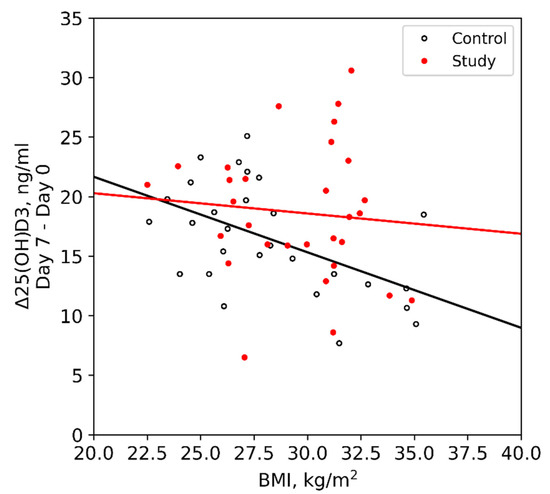
By Day 7, 25 patients (83%) from the study group and 22 patients (79%) reached sufficient 25(OH)D3 levels (≥30 ng/mL). Levels of 25(OH)D3 continued to increase by Day 3 in both groups (p < 0.001), after which tended to decrease in the study group (p = 0.01) and remained stable in the control group (p = 0.65). The increase in 25(OH)D3 after cholecalciferol intake was equal between the groups (18.5 [15.9; 22.5] ng/mL in the study group vs. 16.6 [13.1; 19.8] ng/mL in the control group, p > 0.05). In the presence of obesity, Δ25(OH)D3 was higher in the CD patients than in the control group (18.3 [14.2; 23.0] vs. 12.1 [10.0; 13.1] ng/mL, p < 0.05), while in non-obese patients no difference was observed (p > 0.05).
Obese and non-obese patients with CD had equal Δ25(OH)D3 (18.3 [14.2; 23.0] vs. 19.6 [16.0; 21.5] ng/mL, p > 0.05), while in the control group it was significantly lower in obese patients (12.1 [10.0; 13.1] vs. 18.3 [15.3; 21.4] ng/mL, p < 0.05). BMI showed significant correlation with Δ25(OH)D3 only in the control group (r = −0.47, p < 0.05), while in CD patients there was no such association (r = −0.06, p > 0.05) (Figure 1).
Figure 1. Relationship between Δ25(OH)D3 and BMI in groups.
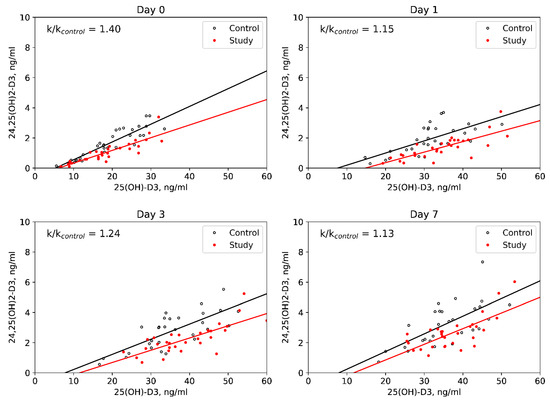
1,25(OH)2D3 levels increased in CD patients by Day 1 and were stable during the follow-up in the control group. The rest of the studied parameters of vitamin D metabolism changed in a similar way between groups: 3-epi-25(OH)D3 levels increased until the Day 3, after which they decreased by the Day 7; 24,25(OH)2D3 levels showed more graduate elevation throughout the follow-up. In both groups 25(OH)D3/24,25(OH)2D3 ratios increased by Day 1, after which they decreased by Day 7, and 25(OH)D3/1,25(OH)2D3 ratios increased by Day 1, after which they remained stable. DBP levels didn’t change and free 25(OH)D levels showed an increase in both groups during the follow-up. The levels of 25(OH)D2 did not exceed 0.5 ng/mL in all examined individuals throughout the study. Among assessed parameters of vitamin D metabolism, higher 25(OH)D3/24,25(OH)2D3 ratios in the study group was the only difference between the groups which remained significant throughout the observation period (p < 0.05) (Figure 2).
Figure 2. Dynamic evaluation of 25(OH)D3/24,25(OH)2D3 ratios in groups.

4. Discussion

The main goal of our study was to evaluate the 25(OH)D3 levels and its response to the therapeutic dose of cholecalciferol in patients with CD as compared to healthy individuals. We observed no difference in baseline 25(OH)D3 assessed by UPLC-MS/MS between groups. Similar to our data were obtained in most studies conducted specifically in the state of endogenous hypercortisolism in humans [12,15] and dogs [14]. The study by Kugai et al. lacked control group and reported plasma levels of 25(OH)D corresponding to the vitamin D deficiency in most of the examined patients [10], while in our study only 2/3 of the patients with CD had 25(OH)D levels below 20 ng/mL. As for exogenous hypercortisolism, the meta-analysis aimed to explore serum 25(OH)D levels in glucocorticoid users showed lower levels than in healthy controls, but similar to steroid-naive disease controls, thus causing concern regarding the influence of the disease status on 25(OH)D levels [24]. Somewhat surprisingly, we obtained significantly discordant results in the study group when screening total 25(OH)D by ELISA and when measuring baseline 25(OH)D3 by UPLC-MS/MS, since the initial difference between the groups revealed by ELISA data with lower total 25(OH)D levels in the study group was not replicated by UPLC-MS/MS. It should be noted that our ELISA method did not participate in an external quality control program at the time of the study unlike UPLC-MS/MS; furthermore, a lower analytical performance was previously described for this technique with tendency for low specificity and lower measurement results [45].
When assessing other parameters of vitamin D metabolism, the most significant finding was the higher 25(OH)D3/24,25(OH)2D3 ratio in CD patients, both initially and during the observation after the intake of the cholecalciferol loading dose, indicating consistently reduced activity of 24-hydroxylase, the main enzyme of vitamin D catabolism. Earlier clinical and experimental studies also suggested altered activity of enzymes of vitamin D metabolism in hypercortisolism. However, these studies were heterogeneous and aimed predominantly at studying the activity of 1α-hydroxylase [7,8,10,11,12,14], which was not altered in patients with CD as compared to healthy individuals in our study. In the setting of the short-term glucocorticoid administration, Lindgren et al. showed transient increase in 24,25(OH)2D3 levels in rats [8], while in the study of Hahn et al. there was no change in 24,25(OH)2D3 levels [11]. Dogs with CD had similar 24,25(OH)2D3 levels before and after hypophysectomy as well as compared to control dogs [14]. The only study of considerably similar design by Kugai et al. reported low-normal 24,25(OH)2D3 in patients with Cushing’s syndrome [10], which is consistent with our result, as well as some experimental works indicative of suppression on CYP24A1 expression by glucocorticoids in human osteoblasts [23], liver and intestine [21] and in rat brain and myocardium [22]. However, in the present work, the activity of 24-hydroxylase in patients with hypercortisolism was for the first time evaluated by calculating the 25(OH)D3/24,25(OH)2D3 ratio, which has recently emerged as a new tool for vitamin D status assessment [46,47]. Given the correlation of this parameter with laboratory marker of the underlying disease activity (24-h UFC), a direct effect of cortisol overproduction on 24-hydroxylase activity might be assumed. Interestingly, it seems that the decreased activity of 24-hydroxylase observed in CD influenced the effectiveness of cholecalciferol treatment, decreasing the negative effect of obesity, as patients with CD had similar increase in 25(OH)D3 in obese and non-obese state and lacked correlation between Δ25(OH)D3 and BMI, as opposed to the control group. Moreover, the increase in 25(OH)D3 in obese patients from the control group was lower not only than in non-obese controls, but also than in obese patients with CD.
Another intriguing finding was lower levels of free 25(OH)D observed in patients with CD despite similar DBP levels and lower albumin levels, which, on the contrary, allows one to expect higher values of free 25(OH)D. Considering the weaker correlation between the measured and calculated free 25(OH)D in patients with CD, as well as the lack of correlation of the measured 25(OH)D with the main transport protein, an altered affinity of DBP might be suspected. One possible explanation is protein glycosylation as a consequence of diabetes mellitus, which was present in half of the patients [38,48,49]. After cholecalciferol intake, which was accompanied by an increase in free 25(OH)D, the differences between the groups were leveled; therefore, another suggested explanation might be competitive binding to the ligand. Since actin binds DBP with high affinity [50] and considering catabolic action of glucocorticoids on muscle tissue [51], actin is a presumable competing ligand candidate. Although this is mostly speculative, as far as the authors are aware, the present work was the first to assess free vitamin D in the glucocorticoid excess, so the described findings require verification of reproducibility and further evaluation.
The obtained discrepancies in the biochemical parameters characterizing calcium and phosphorus metabolism were generally consistent with the data of early studies discussed in the introduction [12,25,26,27,28,29], except for similar to controls serum phosphorus levels and lower prevalence of hypercalciuria. An interesting observation was the complete absence of the PTH decrease in patients with CD after receiving a loading dose of cholecalciferol. The mechanism of this phenomenon is not entirely clear, we tend to agree with the earlier hypothesis that this may be an adaptation to chronic urinary calcium loss [52].
Our research is distinguished by a number of important strengths: a prospective design, substantial sample of patients with CD, accounting for social and behavioral factors affecting vitamin levels D, comprehensive spectrum of vitamin D metabolism parameters investigated and participation in an external quality control program for vitamin D metabolites measurement.
Nevertheless, the study also had several limitations: the amount of dietary vitamin D and phosphorus, as well as possible differences in DBP affinity to vitamin D metabolites due to genetic isoforms of DBP [53] or other possible involved parameters (e.g., fibroblast growth factor-23) were not taken into account. A few patients from both groups received therapy with possible impact on vitamin D and calcium metabolism within 3 months preceding the participation in the study (spironolactone, diuretics, proton pump inhibitors, oral contraceptives, antifungal treatment, antidepressants, barbiturates, antiepileptic drugs). The groups had a trend for differences in sex and BMI (p = 0.07 for both parameters). Also, the study lacked a study group of patients with remission of CD to test the hypotheses put forward, however, this is a promising direction for further research.

5. Conclusions

We report that patients with endogenous ACTH-dependent hypercortisolism of pituitary origin have a consistently higher 25(OH)D3/24,25(OH)2D3 ratio than healthy controls, which is indicative of a decrease in 24-hydroxylase activity. This altered activity of the principal vitamin D catabolism might influence the effectiveness of cholecalciferol treatment. There is also a lack of clarity regarding the lower levels of free 25(OH)D observed in patients with CD, which require further study. To test the proposed hypotheses and to develop specialized clinical guidelines for these patients, longer-term randomized clinical trials are needed.

Supplementary Materials

The following are available online at https://www.mdpi.com/article/10.3390/nu13124329/s1, Method validation against DEQAS, Figure S1: Comparison between DEQAS data for 25(OH)D scheme and our lab results, Figure S2: Comparison between DEQAS data for 1,25(OH)2D scheme and our lab results.

Author Contributions

Conceptualization, L.R., E.P., A.P. and A.Z.; methodology, V.B., Z.B., L.R. and G.M.; formal analysis, A.P.; investigation, A.P., V.B., E.P., L.D. and A.Z.; data curation, A.P. and V.B.; writing—original draft preparation, A.P.; writing—review and editing, V.B., E.P., A.Z., Z.B., L.R.; visualization, V.B.; supervision, L.D., L.R., G.M. and N.M.; project administration, L.R. and N.M.; funding acquisition, L.R. and N.M. All authors have read and agreed to the published version of the manuscript.

Funding

This research was funded by the Russian Science Foundation, grant number 19-15-00243.

Institutional Review Board Statement

This study was performed in line with the principles of the Declaration of Helsinki. Approval was granted by the Ethics Committee of Endocrinology Research Centre, Moscow, Russia on 10 April 2019 (abstract of record No. 6).

Informed Consent Statement

Written informed consent was obtained from all individual participants included in the study.

Data Availability Statement

The datasets generated during and/or analyzed during the current study are available from the corresponding author on reasonable request.

Acknowledgments

We express our deep gratitude to our colleagues: Natalya M. Malysheva, Vitaliy A. Ioutsi, Larisa V. Nikankina for the help with the laboratory research.

Conflicts of Interest

The authors declare no conflict of interest. The funders had no role in the design of the study; in the collection, analyses, or interpretation of data; in the writing of the manuscript, or in the decision to publish the results.

References

  1. Nishioka, H.; Yamada, S. Cushing’s disease. J. Clin. Med. 20198, 1951. [Google Scholar] [CrossRef]
  2. Mazziotti, G.; Frara, S.; Giustina, A. Pituitary Diseases and Bone. Endocr. Rev. 201839, 440–488. [Google Scholar] [CrossRef] [PubMed]
  3. Compston, J. Glucocorticoid-induced osteoporosis: An update. Endocrine 201861, 7–16. [Google Scholar] [CrossRef] [PubMed]
  4. Buckley, L.; Guyatt, G.; Fink, H.A.; Cannon, M.; Grossman, J.; Hansen, K.E.; Humphrey, M.B.; Lane, N.E.; Magrey, M.; Miller, M. 2017 American College of Rheumatology Guideline for the prevention and treatment of glucocorticoid-induced osteoporosis. Arthritis Care Res. 201769, 1095–1110. [Google Scholar] [CrossRef]
  5. Belaya, Z.; Rozhinskaya, L.y.; Grebennikova, T.; Kanis, J.; Pigarova, E.; Rodionova, S.; Toroptsova, N.; Nikitinskaya, O.; Skripnikova, I.; Drapkina, O.; et al. Summary of the Draft Federal Clinical Guidelines for Osteoporosis. Osteoporos. Bone Dis. 202023, 4–21. [Google Scholar] [CrossRef]
  6. Klein, R.G.; Arnaud, S.B.; Gallagher, J.C.; Deluca, H.F.; Riggs, B.L. Intestinal calcium absorption in exogenous hypercortisolism. J. Clin. Investig. 197760, 253–259. [Google Scholar] [CrossRef] [PubMed]
  7. Seeman, E.; Kumar, R.; Hunder, G.G.; Scott, M.; Iii, H.H.; Riggs, B.L. Production, degradation, and circulating levels of 1,25-dihydroxyvitamin D in health and in chronic glucocorticoid excess. J. Clin. Investig. 198066, 664–669. [Google Scholar] [CrossRef]
  8. Lindgren, J.U.; Merchant, C.R.; DeLuca, H.F. Effect of 1,25-dihydroxyvitamin D3 on osteopenia induced by prednisolone in adult rats. Calcif. Tissue Int. 198234, 253–257. [Google Scholar] [CrossRef]
  9. Chaiamnuay, S.; Chailurkit, L.O.; Narongroeknawin, P.; Asavatanabodee, P.; Laohajaroensombat, S.; Chaiamnuay, P. Current daily glucocorticoid use and serum creatinine levels are associated with lower 25(OH) vitamin D levels in thai patients with systemic lupus erythematosus. J. Clin. Rheumatol. 201319, 121–125. [Google Scholar] [CrossRef]
  10. Kugai, N.; Koide, Y.; Yamashita, K.; Shimauchi, T.; Nagata, N.; Takatani, O. Impaired mineral metabolism in Cushing’s syndrome: Parathyroid function, vitamin D metabolites and osteopenia. Endocrinol. Jpn. 198633, 345–352. [Google Scholar] [CrossRef]
  11. Hahn, T.J.; Halstead, L.R.; Baran, D.T. Effects of short term glucocorticoid administration on intestinal calcium absorption and circulating vitamin D metabolite concentrations in man. J. Clin. Endocrinol. Metab. 198152, 111–115. [Google Scholar] [CrossRef]
  12. Findling, J.W.; Adams, N.D.; Lemann, J.; Gray, R.W.; Thomas, C.J.; Tyrrell, J.B. Vitamin D metabolites and parathyroid hormone in Cushing’s syndrome: Relationship to calcium and phosphorus homeostasis. J. Clin. Endocrinol. Metab. 198254, 1039–1044. [Google Scholar] [CrossRef] [PubMed]
  13. Slovik, D.M.; Neer, R.M.; Ohman, J.L.; Lowell, F.C.; Clark, M.B.; Segre, G.V.; Potts, J.T., Jr. Parathyroid hormone and 25-hydroxyvitamin D levels in glucocorticoid-treated patients. Clin. Endocrinol. 198012, 243–248. [Google Scholar] [CrossRef]
  14. Corbee, R.J.; Tryfonidou, M.A.; Meij, B.P.; Kooistra, H.S.; Hazewinkel, H.A.W. Vitamin D status before and after hypophysectomy in dogs with pituitary-dependent hypercortisolism. Domest. Anim. Endocrinol. 201242, 43–49. [Google Scholar] [CrossRef] [PubMed]
  15. Aloia, J.F.; Roginsky, M.; Ellis, K.; Shukla, K.; Cohn, S. Skeletal metabolism and body composition in Cushing’s syndrome. J. Clin. Endocrinol. Metab. 197439, 981–985. [Google Scholar] [CrossRef]
  16. Van Cromphaut, S.J.; Stockmans, I.; Torrekens, S.; Van Herck, E.; Carmeliet, G.; Bouillon, R. Duodenal calcium absorption in dexamethasone-treated mice: Functional and molecular aspects. Arch. Biochem. Biophys. 2007460, 300–305. [Google Scholar] [CrossRef] [PubMed]
  17. Akeno, N.; Matsunuma, A.; Maeda, T.; Kawane, T.; Horiuchi, N. Regulation of vitamin D-1-hydroxylase and -24-hydroxylase expression by dexamethasone in mouse kidney. J. Endocrinol. 2000164, 339–348. [Google Scholar] [CrossRef] [PubMed]
  18. Kurahashi, I.; Matsunuma, A.; Kawane, T.; Abe, M.; Horiuchi, N. Dexamethasone enhances vitamin D-24-hydroxylase expression in osteoblastic (UMR-106) and renal (LLC-PK 1) cells treated with 1a, 25-dihydroxyvitamin D3. Endocrine 200217, 109–118. [Google Scholar] [CrossRef]
  19. Dhawan, P.; Christakos, S. Novel regulation of 25-hydroxyvitamin D3 24-hydroxylase (24(OH)ase) transcription by glucocorticoids: Cooperative effects of the glucocorticoid receptor, C/EBPb, and the vitamin D receptor in 24(OH)ase transcription. J. Cell. Biochem. 2010110, 1314–1323. [Google Scholar] [CrossRef] [PubMed]
  20. Luo, G.; Cunningham, M.; Kim, S.; Burn, T.; Lin, J.; Sinz, M.; Hamilton, G.; Rizzo, C.; Jolley, S.; Gilbert, D.; et al. CYP3A4 induction by drugs: Correlation between a pregnane X receptor reporter gene assay and CYP3A4 expression in human hepatocytes. Drug Metab. Dispos. 200230, 795–804. [Google Scholar] [CrossRef]
  21. Zhou, C.; Assem, M.; Tay, J.C.; Watkins, P.B.; Blumberg, B.; Schuetz, E.G.; Thummel, K.E. Steroid and xenobiotic receptor and vitamin D receptor crosstalk mediates CYP24 expression and drug-induced osteomalacia. J. Clin. Investig. 2006116, 1703–1712. [Google Scholar] [CrossRef] [PubMed]
  22. Jiang, P.; Xue, Y.; Li, H.; Liu, Y. Dysregulation of vitamin D metabolism in the brain and myocardium of rats following prolonged exposure to dexamethasone. Psychopharmacology 2014231, 3445–3451. [Google Scholar] [CrossRef] [PubMed]
  23. Zayny, A.; Almokhtar, M.; Wikvall, K.; Ljunggren, Ö.; Ubhayasekera, K.; Bergquist, J.; Kibar, P.; Norlin, M. Effects of glucocorticoids on vitamin D3-metabolizing 24-hydroxylase (CYP24A1) in Saos-2 cells and primary human osteoblasts. Mol. Cell. Endocrinol. 2019496, 110525. [Google Scholar] [CrossRef] [PubMed]
  24. Davidson, Z.E.; Walker, K.Z.; Truby, H. Do glucocorticosteroids alter vitamin D status? A systematic review with meta-analyses of observational studies. J. Clin. Endocrinol. Metab. 201497, 738–744. [Google Scholar] [CrossRef] [PubMed]
  25. Huybers, S.; Naber, T.H.J.; Bindels, R.J.M.; Hoenderop, J.G.J. Prednisolone-induced Ca2+ malabsorption is caused by diminished expression of the epithelial Ca2+ channel TRPV6. Am. J. Physiol.-Gastrointest. Liver Physiol. 2007292, 92–97. [Google Scholar] [CrossRef] [PubMed]
  26. Ferrari, P.; Bianchetti, M.G.; Sansonnens, A.; Frey, F.J. Modulation of renal calcium handling by 11β-hydroxysteroid dehydrogenase type 2. J. Am. Soc. Nephrol. 200213, 2540–2546. [Google Scholar] [CrossRef]
  27. Faggiano, A.; Pivonello, R.; Melis, D.; Filippella, M.; Di Somma, C.; Petretta, M.; Lombardi, G.; Colao, A. Nephrolithiasis in Cushing’s disease: Prevalence, etiopathogenesis, and modification after disease cure. J. Clin. Endocrinol. Metab. 200388, 2076–2080. [Google Scholar] [CrossRef] [PubMed]
  28. Ramsey, I.K.; Tebb, A.; Harris, E.; Evans, H.; Herrtage, M.E. Hyperparathyroidism in dogs with hyperadrenocorticism. J. Small Anim. Pract. 200546, 531–536. [Google Scholar] [CrossRef]
  29. Freiberg, J.M.; Kinsella, J.; Sacktor, B. Glucocorticoids increase the Na+-H+ exchange and decrease the Na+ gradient-dependent phosphate-uptake systems in renal brush border membrane vesicles. Proc. Natl. Acad. Sci. USA 198279, 4932–4936. [Google Scholar] [CrossRef] [PubMed]
  30. Sempos, C.T.; Heijboer, A.C.; Bikle, D.D.; Bollerslev, J.; Bouillon, R.; Brannon, P.M.; DeLuca, H.F.; Jones, G.; Munns, C.F.; Bilezikian, J.P.; et al. Vitamin D assays and the definition of hypovitaminosis D: Results from the First International Conference on Controversies in Vitamin D. Br. J. Clin. Pharmacol. 201884, 2194–2207. [Google Scholar] [CrossRef]
  31. Melnichenko, G.A.; Dedov, I.I.; Belaya, Z.E.; Rozhinskaya, L.Y.; Vagapova, G.R.; Volkova, N.I.; Grigor’ev, A.Y.; Grineva, E.N.; Marova, E.I.; Mkrtumayn, A.M.; et al. Cushing’s disease: The clinical features, diagnostics, differential diagnostics, and methods of treatment. Probl. Endocrinol. 201561, 55–77. [Google Scholar] [CrossRef]
  32. Machado, M.C.; De Sa, S.V.; Domenice, S.; Fragoso, M.C.B.V.; Puglia, P.; Pereira, M.A.A.; De Mendonça, B.B.; Salgado, L.R. The role of desmopressin in bilateral and simultaneous inferior petrosal sinus sampling for differential diagnosis of ACTH-dependent Cushing’s syndrome. Clin. Endocrinol. 200766, 136–142. [Google Scholar] [CrossRef]
  33. Findling, J.W.; Kehoe, M.E.; Raff, H. Identification of patients with Cushing’s disease with negative pituitary adrenocorticotropin gradients during inferior petrosal sinus sampling: Prolactin as an index of pituitary venous effluent. J. Clin. Endocrinol. Metab. 200489, 6005–6009. [Google Scholar] [CrossRef] [PubMed]
  34. Pigarova, E.A.; Rozhinskaya, L.Y.; Belaya, J.E.; Dzeranova, L.K.; Karonova, T.L.; Ilyin, A.V.; Melnichenko, G.A.; Dedov, I.I. Russian Association of Endocrinologists recommendations for diagnosis, treatment and prevention of vitamin D deficiency in adults. Probl. Endocrinol. 201662, 60–84. [Google Scholar] [CrossRef]
  35. Petrushkina, A.A.; Pigarova, E.A.; Tarasova, T.S.; Rozhinskaya, L.Y. Efficacy and safety of high-dose oral vitamin D supplementation: A pilot study. Osteoporos. Int. 201627, 512–513. [Google Scholar] [CrossRef]
  36. Pivonello, R.; De Martino, M.C.; De Leo, M.; Lombardi, G.; Colao, A. Cushing’s Syndrome. Endocrinol. Metab. Clin. N. Am. 200837, 135–149. [Google Scholar] [CrossRef]
  37. Belaya, Z.E.; Iljin, A.V.; Melnichenko, G.A.; Rozhinskaya, L.Y.; Dragunova, N.V.; Dzeranova, L.K.; Butrova, S.A.; Troshina, E.A.; Dedov, I.I. Diagnostic performance of late-night salivary cortisol measured by automated electrochemiluminescence immunoassay in obese and overweight patients referred to exclude Cushing’s syndrome. Endocrine 201241, 494–500. [Google Scholar] [CrossRef]
  38. Povaliaeva, A.; Pigarova, E.; Zhukov, A.; Bogdanov, V.; Dzeranova, L.; Mel’nikova, O.; Pekareva, E.; Malysheva, N.; Ioutsi, V.; Nikankina, L.; et al. Evaluation of vitamin D metabolism in patients with type 1 diabetes mellitus in the setting of cholecalciferol treatment. Nutrients 202012, 3873. [Google Scholar] [CrossRef] [PubMed]
  39. Thode, J.; Juul-Jørgensen, B.; Bhatia, H.M.; Kjaerulf-Nielsen, M.; Bartels, P.D.; Fogh-Andersen, N.; Siggaard-Andersen, O. Comparison of serum total calcium, albumin-corrected total calcium, and ionized calcium in 1213 patients with suspected calcium disorders. Scand. J. Clin. Lab. Investig. 198949, 217–223. [Google Scholar] [CrossRef]
  40. Bikle, D.D.; Siiteri, P.K.; Ryzen, E.; Haddad, J.G.; Gee, E. Serum protein binding of 1, 25-Dihydroxyvitamin D: A reevaluation by direct measurement of free metabolite levels. J. Clin. Endocrinol. Metab. 198561, 969–975. [Google Scholar] [CrossRef]
  41. Bikle, D.D.; Gee, E.; Halloran, B.; Kowalski, M.A.N.N.; Ryzen, E.; Haddad, J.G. Assessment of the Free Fraction of 25-Hydroxyvitamin D in Serum and Its Regulation by Albumin and the Vitamin D-Binding Protein. J. Clin. Endocrinol. Metab. 198663, 954–959. [Google Scholar] [CrossRef]
  42. Holick, M.F.; Binkley, N.C.; Bischoff-Ferrari, H.A.; Gordon, C.M.; Hanley, D.A.; Heaney, R.P.; Murad, M.H.; Weaver, C.M. Evaluation, treatment, and prevention of vitamin D deficiency: An Endocrine Society clinical practice guideline. J. Clin. Endocrinol. Metab. 201196, 1911–1930. [Google Scholar] [CrossRef] [PubMed]
  43. Dirks, N.F.; Martens, F.; Vanderschueren, D.; Billen, J.; Pauwels, S.; Ackermans, M.T.; Endert, E.; den Heijer, M.; Blankenstein, M.A.; Heijboer, A.C. Determination of human reference values for serum total 1,25-dihydroxyvitamin D using an extensively validated 2D ID-UPLC–MS/MS method. J. Steroid Biochem. Mol. Biol. 2016164, 127–133. [Google Scholar] [CrossRef] [PubMed]
  44. Tang, J.C.Y.; Nicholls, H.; Piec, I.; Washbourne, C.J.; Dutton, J.J.; Jackson, S.; Greeves, J.; Fraser, W.D. Reference intervals for serum 24,25-dihydroxyvitamin D and the ratio with 25-hydroxyvitamin D established using a newly developed LC–MS/MS method. J. Nutr. Biochem. 201746, 21–29. [Google Scholar] [CrossRef]
  45. Máčová, L.; Bičíková, M. Vitamin D: Current challenges between the laboratory and clinical practice. Nutrients 202113, 1758. [Google Scholar] [CrossRef] [PubMed]
  46. Ginsberg, C.; Hoofnagle, A.N.; Katz, R.; Hughes-Austin, J.; Miller, L.M.; Becker, J.O.; Kritchevsky, S.B.; Shlipak, M.G.; Sarnak, M.J.; Ix, J.H. The Vitamin D Metabolite Ratio Is Associated With Changes in Bone Density and Fracture Risk in Older Adults. J. Bone Miner. Res. 2021, 1–8. [Google Scholar] [CrossRef]
  47. Cavalier, E.; Huyghebaert, L.; Rousselle, O.; Bekaert, A.C.; Kovacs, S.; Vranken, L.; Peeters, S.; Le Goff, C.; Ladang, A. Simultaneous measurement of 25(OH)-vitamin D and 24,25(OH)2-vitamin D to define cut-offs for CYP24A1 mutation and vitamin D deficiency in a population of 1200 young subjects. Clin. Chem. Lab. Med. 202058, 197–201. [Google Scholar] [CrossRef]
  48. Rondeau, P.; Bourdon, E. The glycation of albumin: Structural and functional impacts. Biochimie 201193, 645–658. [Google Scholar] [CrossRef]
  49. Soudahome, A.G.; Catan, A.; Giraud, P.; Kouao, S.A.; Guerin-Dubourg, A.; Debussche, X.; Le Moullec, N.; Bourdon, E.; Bravo, S.B.; Paradela-Dobarro, B.; et al. Glycation of human serum albumin impairs binding to the glucagon-like peptide-1 analogue liraglutide. J. Biol. Chem. 2018293, 4778–4791. [Google Scholar] [CrossRef]
  50. McLeod, J.F.; Kowalski, M.A.; Haddad, J.G. Interactions among serum vitamin D binding protein, monomeric actin, profilin, and profilactin. J. Biol. Chem. 1989264, 1260–1267. [Google Scholar] [CrossRef]
  51. Gupta, Y.; Gupta, A. Glucocorticoid-induced myopathy: Pathophysiology, diagnosis, and treatment. Indian J. Endocrinol. Metab. 201317, 913. [Google Scholar] [CrossRef] [PubMed]
  52. Smets, P.; Meyer, E.; Maddens, B.; Daminet, S. Cushing’s syndrome, glucocorticoids and the kidney. Gen. Comp. Endocrinol. 2010169, 1–10. [Google Scholar] [CrossRef] [PubMed]
  53. Arnaud, J.; Constans, J. Affinity differences for vitamin D metabolites associated with the genetic isoforms of the human serum carrier protein (DBP). Hum. Genet. 199392, 183–188. [Google Scholar] [CrossRef] [PubMed]
Publisher’s Note: MDPI stays neutral with regard to jurisdictional claims in published maps and institutional affiliations.

Updated Cushing’s disease guideline highlights new diagnosis, treatment ‘roadmap’

An updated guideline for the treatment of Cushing’s disease focuses on new therapeutic options and an algorithm for screening and diagnosis, along with best practices for managing disease recurrence.

Despite the recent approval of novel therapies, management of Cushing’s disease remains challenging. The disorder is associated with significant comorbidities and has high mortality if left uncontrolled.

Adrenal transparent _Adobe
Source: Adobe Stock

“As the disease is inexorable and chronic, patients often experience recurrence after surgery or are not responsive to medications,” Shlomo Melmed, MB, ChB, MACP, dean, executive vice president and professor of medicine at Cedars-Sinai Medical Center in Los Angeles, and an Endocrine Today Editorial Board Member, told Healio. “These guidelines enable navigation of optimal therapeutic options now available for physicians and patients. Especially helpful are the evidence-based patient flow charts [that] guide the physician along a complex management path, which usually entails years or decades of follow-up.”

Shlomo Melmed

The Pituitary Society convened a consensus workshop with more than 50 academic researchers and clinical experts across five continents to discuss the application of recent evidence to clinical practice. In advance of the virtual meeting, participants reviewed data from January 2015 to April 2021 on screening and diagnosis; surgery, medical and radiation therapy; and disease-related and treatment-related complications of Cushing’s disease, all summarized in recorded lectures. The guideline includes recommendations regarding use of laboratory tests, imaging and treatment options, along with algorithms for diagnosis of Cushing’s syndrome and management of Cushing’s disease.

Updates in laboratory, testing guidance

If Cushing’s syndrome is suspected, any of the available diagnostic tests could be useful, according to the guideline. The authors recommend starting with urinary free cortisol, late-night salivary cortisol, overnight 1 mg dexamethasone suppression, or a combination, depending on local availability.

If an adrenal tumor is suspected, the guideline recommends overnight dexamethasone suppression and using late-night salivary cortisol only if cortisone concentrations can also be reported.

The guideline includes several new recommendations in the diagnosis arena, particularly on the role of salivary cortisol assays, according to Maria Fleseriu, MD, FACE, a Healio | Endocrine Today Co-editor, professor of medicine and neurological surgery and director of the Pituitary Center at Oregon Health & Science University in Portland.

Maria Fleseriu

“Salivary cortisol assays are not available in all countries, thus other screening tests can also be used,” Fleseriu told Healio. “We also highlighted the sequence of testing for recurrence, as many patients’ urinary free cortisol becomes abnormal later in the course, sometimes up to 1 year later.”

The guideline states combined biochemical and imaging for select patients could potentially replace petrosal sinus sampling, a very specialized procedure that cannot be performed in all hospitals, but more data are needed.

“With the corticotropin-releasing hormone stimulation test becoming unavailable in the U.S. and other countries, the focus is now on desmopressin to replace corticotropin-releasing hormone in some of the dynamic testing, both for diagnosis of pseudo-Cushing’s as well as localization of adrenocorticotropic hormone excess,” Fleseriu said.

The guideline also has a new recommendation for anticoagulation for high-risk patients; however, the exact duration and which patients are at higher risk remains unknown.

“We always have to balance risk for clotting with risk for bleeding postop,” Fleseriu said. “Similarly, recommended workups for bone disease and growth hormone deficiency have been further structured based on pitfalls specifically related to hypercortisolemia influencing these complications, as well as improvement after Cushing’s remission in some patients, but not all.”

New treatment options

The guideline authors recommended individualizing medical therapy for all patients with Cushing’s disease based on the clinical scenario, including severity of hypercortisolism. “Regulatory approvals, treatment availability and drug costs vary between countries and often influence treatment selection,” the authors wrote. “However, where possible, it is important to consider balancing cost of treatment with the cost and the adverse consequences of ineffective or insufficient treatment. In patients with severe disease, the primary goal is to treat aggressively to normalize cortisol concentrations.”

Fleseriu said the authors reviewed outcomes data as well as pros and cons of surgery, repeat surgery, medical treatments, radiation and bilateral adrenalectomy, highlighting the importance of individualized treatment in Cushing’s disease.

“As shown over the last few years, recurrence rates are much higher than previously thought and patients need to be followed lifelong,” Fleseriu said. “The role of adjuvant therapy after either failed pituitary surgery or recurrence is becoming more important, but preoperative or even primary medical treatment has been also used more, too, especially in the COVID-19 era.”

The guideline summarized data on all medical treatments available, either approved by regulatory agencies or used off-label, as well as drugs studied in phase 3 clinical trials.

“Based on great discussions at the meeting and subsequent emails to reach consensus, we highlighted and graded recommendations on several practical points,” Fleseriu said. “These include which factors are helpful in selection of a medical therapy, which factors are used in selecting an adrenal steroidogenesis inhibitor, how is tumor growth monitored when using an adrenal steroidogenesis inhibitor or glucocorticoid receptor blocker, and how treatment response is monitored for each therapy. We also outline which factors are considered in deciding whether to use combination therapy or to switch to another therapy and which agents are used for optimal combination therapy.”

Future research needed

The guideline authors noted more research is needed regarding screening and diagnosis of Cushing’s syndrome; researchers must optimize pituitary MRI and PET imaging using improved data acquisition and processing to improve microadenoma detection. New diagnostic algorithms are also needed for the differential diagnosis using invasive vs. noninvasive strategies. Additionally, the researchers said the use of anticoagulant prophylaxis and therapy in different populations and settings must be further studied, as well as determining the clinical benefit of restoring the circadian rhythm, potentially with a higher nighttime medication dose, as well as identifying better markers of disease activity and control.

“Hopefully, our patients will now experience a higher quality of life and fewer comorbidities if their endocrinologist and care teams are equipped with this informative roadmap for integrated management, employing a consolidation of surgery, radiation and medical treatments,” Melmed told Healio.

Cushing Disease Treated Successfully with Metyrapone During Pregnancy

https://doi.org/10.1016/j.aace.2021.10.004Get rights and content
Under a Creative Commons license
open access

Highlights

Cushing’s Disease (CD) in pregnancy is rare, but poses many risks to the mother and fetus

Although surgery is still considered first line, this CASE highlights the successful use of metyrapone throughout pregnancy to manage CD in patients where surgery is considered high risk or low likelihood of cure

The dose of metyrapone can be titrated to a goal urinary free cortisol of < 150 ug/24 hours given the known rise in cortisol during gestation

Though no fetal adverse events have been reported, metyrapone does cross the placenta and long-term effects are unknown.

ABSTRACT

Background

Cushing Disease (CD) in pregnancy is a rare, but serious, disease that adversely impacts maternal and fetal outcomes. As the sole use of metyrapone in the management of CD has been rarely reported, we describe our experience using it to treat a pregnant patient with CD.

Case Report

34-year-old woman with hypertension who was diagnosed with adrenocorticotropic hormone-dependent CD based on a urinary free cortisol (UFC) of 290 μg/24hr (reference 6-42μg/dL) and abnormal dexamethasone suppression test (cortisol 12.4 μg/dL) before becoming pregnant. She conceived naturally 12 weeks post-transsphenoidal surgery, and was subsequently found to have persistent disease with UFC 768μg/dL. Surgery was deemed high risk given the proximity of the tumor to the right carotid artery and high likelihood of residual disease. Instead, she was managed with metyrapone throughout her pregnancy and titrated to goal UFC of <150μg/24hr due to the known physiologic rise in cortisol during gestation. The patient had diet-controlled gestational diabetes, and well-controlled hypertension. She gave birth at 37 weeks gestation to a healthy baby boy, without adrenal insufficiency in the baby or mother.

Discussion

This CASE highlights the successful use of metyrapone throughout pregnancy to manage CD in patients where surgery is considered high risk or low likelihood of cure. While metyrapone is effective, close surveillance is required for worsening hypertension, hypokalemia, and potential adrenal insufficiency. Though no fetal adverse events have been reported, this medication crosses the placenta and long-term effects are unknown.

Conclusion

We describe a CASE of CD during pregnancy that was successfully treated with metyrapone.

Key words

Cushing disease
metyrapone
pregnancy
cortisol

INTRODUCTION

Cushing disease (CD) is caused by endogenous overproduction of glucocorticoids due to hypersecretion of adrenocorticotropic hormone (ACTH) by a pituitary adenoma. CD in pregnancy is very rare, and when it occurs, it is considered a high-risk pregnancy with many potential adverse outcomes for both the mother and fetus.1 Infertility is common in CD due to cortisol and androgen excess leading to hypogonadotropic hypogonadism.1 Due to the rarity of CD in pregnancy, there is little guidance in terms of treatment for this patient population. Similar to non-pregnant patients, the first-line treatment is transsphenoidal pituitary adenoma resection, with medical therapy as a second-line treatment option. This report presents a CASE that highlights the use of metyrapone, a steroidogenesis inhibitor, as a sole therapy in cases where surgery is deemed to be high risk and unlikely curative due to location of the tumor.

CASE REPORT

A 34-year-old woman with a past medical history of hypertension and infertility for six years presented to endocrinology for evaluation. Aside from difficulty conceiving, her only complaints were nausea and easy bruising. On exam she did not have clinical features of CD –abdominal violaceous striae, moon facies or a dorsocervical fat pad were absent. Her laboratory results revealed an elevated prolactin level (50-60ng/mL, reference range 1.4-24), an elevated ACTH level (61 pg/mL, reference range 0-46), and low FSH and LH levels (1.7mIU/mL and 1.76mIU/mL, respectively). Further testing demonstrated an elevated urinary free cortisol level (UFC) (290μg/24 hour, reference range 6-42) and her cortisol failed to suppress on a 1mg dexamethasone suppression test (cortisol 12.4μg/dL). Magnetic resonance imaging (MRI) of the pituitary with and without contrast showed a T2 hyperintense, hypoenhancing lesion within the right side of the sella touching the right cavernous internal carotid artery measuring 8x8x9 mm consistent with a pituitary adenoma (Figure 1).

Figure 1. Caption: T1 weighted post gadolinium coronal image of the pituitary gland with a small hypoenhancing lesion within the right side of the sella.

After the presumed diagnosis of CD was made, she was referred to neurosurgery for transsphenoidal resection of the adenoma, which she underwent a few months later. Intra-operatively, a white friable tumor was found, and otherwise the surgery was uneventful. Three months later, however, she was found to have a persistent 8x8x9mm hypoenhancing lesion extending laterally over the right cavernous carotid artery on MRI. The mass approximated but did not contact the right intracranial optic nerve. The pathology from resected tissue was consistent with normal pituitary tissue with staining for growth hormone (80%), ACTH (30%), prolactin (40%), follicle stimulating hormone (5%), luteinizing hormone (40%) and thyroid stimulating hormone (15%), proving the surgery to have been unsuccessful.

Twelve weeks post-operatively, the patient discovered she was pregnant. At 12 weeks gestation, her UFC was 768μg/24h and two midnight salivary cortisol levels were elevated at 0.175 and 0.625μg/dL (reference <0.010-0.090). She was experiencing easy bruising and taking labetalol 400 mg twice daily for hypertension. She had gained 10 pounds by 12 weeks gestation.

A second transsphenoidal surgery during pregnancy was deemed high risk, with a high likelihood of residual disease due to the proximity of the tumor to the right carotid artery. The decision was made to treat the patient medically with metyrapone which was started at 250 mg twice per day at 12 weeks gestation and was eventually uptitrated based on UFC levels every 3-4 weeks (goal of <150μg /24h) to 1000 mg three times per day by the time of delivery with an eventual UFC level of 120μg/24h (Figure 2) . Morning ACTH and serum cortisol levels were monitored for potential adrenal insufficiency.

Figure 2. Caption: This figure depicts the patient’s 24 hour urinary cortisol levels over time as well as the titration of metyrapone dosage in mg/day.

Her hypertension was well controlled throughout pregnancy on labetalol with the addition of nifedipine XL 30mg daily in the second trimester. She remained normokalemic with potassium ranging from 3.8-4.1mEq/L. She was diagnosed with gestational diabetes at 24 weeks by an abnormal two-step oral glucose tolerance test, which was diet-controlled. The patient was induced at 37 weeks gestation due to cervical insufficiency with cerclage in place, and was given stress dose steroids along with metyrapone. She delivered a healthy baby boy vaginally without complications. His Apgar scores were 9 and 9 and he weighed 6 pounds and 5 ounces. At the time of delivery and one week later, the baby’s cortisol levels were normal (6 μg/dL, normal 4-20), without evidence of adrenal insufficiency.

The patient’s metyrapone dose was reduced to 500mg three times a day after pregnancy and her 2 month postpartum 24 hour UFC was 42μg/24hr. The patient stopped the metyrapone on her own four months later and her UFC was found to be elevated at 272ug/24hr (normal 6-42μg/24hr). An MRI one year postpartum revealed a 10x10x9 mm adenoma in the right sella with some suprasellar extension without compression of the optic chiasm, but with abutment of the right carotid artery. Due to the persistently elevated cortisol, large size of the tumor, and potential for cure, especially if followed by radiation therapy, a second transsphenoidal surgery was recommended. However, due to the COVID-19 pandemic the patient underwent a delayed surgery 1.5 years postpartum. The pathology was consistent with a pituitary adenoma that stained strongly and diffusely for ACTH and synaptophysin, only. Her postoperative day 2 cortisol was 1.1μg/dL (reference range 6.7-22.6) and hydrocortisone 20mg in the morning and 10mg in the afternoon was started. She remains on hydrocortisone replacement and went on to conceive again, one month after her second surgery.

DISCUSSION

We describe a patient with pre-existing CD who became pregnant and was managed successfully with metyrapone throughout her pregnancy.

Although CD is rare in pregnancy, it can occur, and poses risks to both the mother and fetus.1,2 Potential maternal complications include hypertension, preeclampsia, diabetes, fractures and more uncommonly, cardiac failure, psychiatric disorders, infection and maternal death.1,2 There is also increased fetal morbidity including prematurity, intrauterine growth retardation and less commonly CD can lead to stillbirth, spontaneous abortion, intrauterine death and hypoadrenalism.1,2

It is, therefore, imperative that these patients receive prompt care to control cortisol levels. The treatment of CD in pregnancy is challenging as there are no large research trials studying the efficacy and safety of medications in CD during pregnancy. Pituitary surgery is first-line recommendation and should be done late in the first trimester or in the second trimester to prevent spontaneous pregnancy loss.3 In this CASE, however, it was felt that a second surgery would be high-risk given the proximity of the tumor to the right carotid artery and possibly not curative, and thus surgery was not a feasible option. She was therefore successfully managed with medical therapy with metyrapone alone throughout her pregnancy.

Metyrapone use in pregnancy has been previously reported in the literature and has been shown to be effective in reducing cortisol levels.4,5,6 Although not approved for use in pregnancy, this steroidogenesis inhibitor is the most commonly used medication to treat Cushing’s syndrome in pregnant women.3,5 Due to metyrapone’s inhibition of 11-beta-hydroxylase, there is a buildup of steroidogenesis precursors such as 11-deoxycorticosterone, which can worsen hypertension, increase frequency of preeclampsia, and cause hypokalemia.3 Metyrapone also leads to elevation of adrenal androgens, which in conjunction with accumulation of 11-deoxycorticosterone, can cause hirsutism and virilization. 8

Though the use of Cabergoline has been reported in cases with Cushing disease during pregnancy, no long term safety data is available regarding it effects on pregnancy as well as the fetus. Moreover, studies assessing the effect of cabergoline in persistent or recurrent CD show a response rate of 20-30% only in cases with mild hypercortisolism. 9

There is no consensus on how to medically treat patients with CD during pregnancy. We chose a goal UFC of <150μg/24 hours because of the physiological rise of cortisol to two to three times the upper limit of normal during pregnancy.3,7 During pregnancy, there is an increase in corticotropin-releasing hormone from the placenta, which is identical in structure to the hypothalamic form.7 This leads to increased levels of ACTH which stimulates the maternal adrenal glands to become slightly hypertrophic and accounts for the rise in serum cortisol levels in pregnancy.7 Corticosteroid-binding globulin also increases in pregnancy, along with serum free cortisol, leading to urinary free cortisol increasing to 3-fold the normal range.7 We therefore aimed to keep our patient’s urinary free cortisol approximately 3 times the upper limit of normal on our assay, to maintain normal cortisol levels for pregnancy.

Close surveillance of patients is required for worsening hypertension, hypokalemia, and potential adrenal insufficiency.3 Although no fetal adverse events from metyrapone have been reported, the medication does cross the placenta, leading to the potential for fetal adrenal insufficiency, and long-term effects are unknown.3

CONCLUSION

This CASE demonstrates the successful use of metyrapone alone to treat CD throughout pregnancy resulting in the birth of a healthy baby without adrenal insufficiency. These cases are particularly challenging given the lack of FDA-approved therapies and the lack of consensus on directing titration of medications and the duration of therapy.

Uncited reference

4.6..

REFERENCES:

Clinical Relevance: Cushing’s Disease (CD) in pregnancy is a rare, but serious, disease that has potential adverse effects on maternal and fetal health. Surgery is considered first line therapy, and there is little consensus on medical treatment of CD in pregnancy. This CASE demonstrates the successful use and titration of metyrapone throughout pregnancy.

From https://www.sciencedirect.com/science/article/pii/S2376060521001164

Acute severe Cushing’s disease presenting as a hypercoagulable state

This article was originally published here

Proc (Bayl Univ Med Cent). 2021 Jul 29;34(6):715-717. doi: 10.1080/08998280.2021.1953950. eCollection 2021.

ABSTRACT

Cushing’s disease (CD) is the most common cause of endogenous cortisol excess. We discuss the case of a 60-year-old woman with recurrent venous thromboembolism, refractory hypokalemia, and lumbar vertebrae compression fractures with a rapidly progressive disease course.

Ectopic hypercortisolism was suspected given the patient’s age and rapid onset of disease. Investigations revealed cortisol excess from a pituitary microadenoma.

This case demonstrates that CD can present with severe findings and highlights the increased risk of venous thromboembolism in hypercortisolism, especially in CD.

PMID:34732999 | PMC:PMC8545141 | DOI:10.1080/08998280.2021.1953950