Cushing’s, Cancer and Other Serious Diseases

I was drawn to this blog post because the author mentioned that she had both Cushing’s and cancer, a kind of unusual combination.

1974 to Today: Seal it up
By Experience
I still haven’t heard what the consensus is on my aftercare: Cushing’s and Cancer. I don’t know what I will be expecting to feel like after surgery. My endocrinologist said that I should get sick after the surgery and need some kind of
1974 to Today – http://1974totoday.blogspot.com/

I don’t usually comment on blog posts but I did on this one because we seem to share so much, disease-wise.

I said

Hi, I was drawn to your blog post because I have a blog with the same name, Cushings & Cancer.

I had my Cushing’s long ago and my cancer (kidney aka renal cell carcinoma) was 3 years ago but I sure know where you’re coming for.

My surgeon contacted my endo for the amounts of steroids during surgery (they came through the IV) then post-op, they kept cutting my dose in half until I was back down to normal.
Generally, you stress-dose after surgery if you feel like you have a flu coming on. Has your endo given you Cortef or another steroid to take for emergencies like this? Sometimes, they will give you an injectible to be faster acting.

Best of luck with the cancer surgery AND your Cushing’s.
MaryO

I sure hope that this isn’t a trend, Cushies getting cancer although I know of a couple others on the boards getting cancer.

I suppose Cushing’s doesn’t make us any more immune to other diseases but it seems like it should.

Haven’t we already “done our time”?

OTOH, I have a friend with a serious cancer (aren’t they all?)  who recently learned that she has a second, unrelated, cancer.  Makes you wonder sometimes.

What other diseases have you had in addition to your Cushing’s?

Münchausen By Media

The Internet makes it so easy to develop weird and unusual diseases.  Just plop a symptom into Google and suddenly you find yourself with stomach cancer, Cushing’s or other dread diseases.

Even on TV, the ads for lawyers almost convince people they might have mesothelioma and other rare illnesses that might bring you – and them! – bundles of money if you just sue someone.

Magazine ads implore you to “ask your doctor about…” this drug or that you might or might not need.  Your doctor might just give it to you to keep you from asking.  And there’s a needless medication that brings profit to the drug company and side effects to you.

TV shows like House and Mystery Diagnosis will show you diseases you never dreamed about.

There’s a great topic on the Power Surge message boards, What’s the worst “disease or ailment” you’ve had, where the women discuss the diseases they thought that they had, based on symptoms, what they’ve seen online, in the news but not based on reality.

I’ve done it myself.  About the only time I was right was with my Cushing’s diagnosis. That one was a good call. But my thoughts of kidney cancer metastasis haven’t come true (yet, anyway!).

There’s been information online lately about Münchausen Syndrome.  Wikipedia says:

“…the affected person exaggerates or creates symptoms of illnesses in themselves or their child/children in order to gain investigation, treatment, attention, sympathy, and comfort from medical personnel. In some extremes, people suffering from Münchausen’s Syndrome are highly knowledgeable about the practice of medicine, and are able to produce symptoms that result in multiple unnecessary operations. For example, they may inject a vein with infected material, causing widespread infection of unknown origin, and as a result cause lengthy and costly medical analysis and prolonged hospital stay. The role of “patient” is a familiar and comforting one, and it fills a psychological need in people with Münchausen’s. It is distinct from hypochondriasis in that patients with Münchausen syndrome are aware that they are exaggerating, whereas sufferers of hypochondriasis believe they actually have a disease.”

I think we’ve all see this, especially online.  It’s so easy to sit in the comfort of ones home and add “just a little” to the symptoms, making it more impressive for the readers.

From A Strange Case of Münchausen By Internet:

“…When I first got online, I “met” a young woman who claimed to be a vet, and offered me all kinds of advice about my cat and my tropical fish. She got cancer, slowly declined, then died. We wanted to send flowers, and maybe attend the funeral, and got her ISP to contact her family for us. To our shock, her parents said there was no funeral. She wasn’t dead, she wasn’t even sick. At least not physically. She’d pulled this kind of “pretend death” several times before, and was in therapy, but every time life got stressful, she’d do it again.

And the Internet is the ideal place for a Munchausen sufferer. With the click of a button, you can find out all kinds of information, to help you pose as anyone you want. People don’t expect to see you in person or even talk to you except by e-mail, making deception easier. And often, mailing lists, message boards, etc., will give unqualified support to their members…”

And Media Makes Me Sick:

“…The Internet is hands-down the worst thing to ever happen to the medical world. With Web sites like WebMD, any paranoid hypochondriac like me can jump online, look for symptoms and immediately convince himself he has cancer or Cushing’s disease or non-Hodgkin’s lymphoma or any other of a million things.

WebMD allows you to find one symptom and then “helps” you by listing 15,000 things it could mean.

Oh my God. I do have a slight ache! That’s it. I must have a brain tumor. I’m not kidding, I recently scared myself into thinking I had cancer. It took a specialist, a CT scan and an ultra-sound to convince me otherwise…”

Karen found this older article at http://www.villagevoice.com/2001-06-26/news/cybersickness/1

“…Over nearly three years, from 1998 to 2000, a woman—let’s call her Anna—posted to an online support group for people with mental illness. To the larger circle of readers, she acted mostly as friendly counselor. But to a select few, she e-mailed stories of escalating catastrophes. Her husband and two children had perished in a plane crash, she wrote. As a kid, her father had molested her, and she had suffered multiple personality disorder. Finally, she told her trusted—and trusting—confidants that she had just been diagnosed with leukemia.

Gwen Grabb, a psychotherapy intern and mother of three in Los Angeles, says the group believed Anna because she took on the role of helping others, revealing her own difficulties much later, and to an intimate audience. “She was very bright,” recalls Grabb. “She was very supportive and kind. One day, she started telling me about `the crash,’ what they found in the black box, how you could hear her daughter screaming. I had known her a year. I believed her.”

But as the tales became more elaborate and grotesque, Grabb grew suspicious. Along with another group member—Pam Cohen, a bereavement counselor in the Mid-Atlantic region—she did some research and discovered Anna was making it up. It was a shock to all, but worse than that to Cohen. “It is like an emotional rape,” she says. People may have been upset over the online life and fatal cancer of the fictional Kaycee, whose creator admitted last month she’d invented the high school character for expressive purposes. But that was geared to a general audience, however easily suckered. Pretenders like Anna hurt a much more vulnerable group—folks who may be seriously ill and are seeking help…”

So – use caution and remember that not everything you read will happen to you!

Cancer risk elevated for adults after Cushing’s syndrome diagnosis

I certainly know this to be true :(  I’m an 18 year survivor of yet another disease that I shouldn’t have gotten:  kidney cancer.


Key takeaways:

  • Adults with Cushing’s syndrome have a 78% higher risk for any cancer compared with controls.
  • Cushing’s syndrome is tied to a higher risk for genitourinary cancers, thyroid cancer and adrenocortical carcinoma.

Adults diagnosed with endogenous Cushing’s syndrome have a higher risk for developing cancer compared with controls without the condition, according to data published in the European Journal of Endocrinology.

In a retrospective analysis of data from the Clalit Health Services’ electronic health record database in Israel, 19% of adults with endogenous Cushing’s syndrome were diagnosed with cancer during a median follow-up of 14.7 years compared with 11.1% of adults without Cushing’s syndrome (HR = 1.78; 95% CI, 1.44-2.2).

Adults with Cushing's syndrome have an increased risk for any type of cancer vs. controls. Data were derived from Rudman Y, et al. Eur J Endocrinol. 2024;doi:10.1093/ejendo/lvae098.

Adults diagnosed with Cushing’s syndrome also had a greater risk for genitourinary cancers (HR = 1.63; 95% CI, 1.02-2.61), thyroid cancer (HR = 3.68; 95% CI, 1.68-8.01) and adrenocortical carcinoma (HR = 24.72; 95% CI, 2.89-211.56) than controls.

Amit Akirov

“Our study is the first to demonstrate an elevated cancer risk in patients with Cushing’s syndrome, highlighting the importance of raising awareness and the need to establish guideline recommendations for cancer screening in this population, especially for genitourinary, thyroid and gynecological cancers,” Amit Akirov, MD, associate professor in the faculty of medicine at Tel Aviv University and in the Endocrine Institute at Rabin Medical Center in Petach-Tikva, Israel, told Healio.

Akirov and colleagues obtained health record data for 609 adults diagnosed with Cushing’s syndrome from 2000 to June 2023 (mean age at diagnosis, 48.1 years; 65% women; 41.2% with Cushing’s disease, 32.8% with adrenal Cushing’s syndrome; 25.9% with undetermined etiology). Those with Cushing’s syndrome were matched, 1:5, by age, sex, socioeconomic status and BMI with a control group of 3,018 adults who were never tested for hypercortisolism. The outcome of interest was the first diagnosis of any malignant cancer after Cushing’s syndrome diagnosis with the except of nonmelanoma skin cancer.

The increased risk for cancer among those with Cushing’s syndrome was observed both among adults younger than 60 years (HR = 2.15; 95% CI, 1.63-2.84) and those aged 60 years and older (HR = 1.42; 95% CI, 1.02-1.98). Adults with obesity and Cushing’s syndrome had a higher risk for cancer than those with obesity and no hypercortisolism (HR = 2.21; 95% CI, 1.44-3.4). No difference in cancer risk was seen among adults without obesity.

Akirov told Healio that the researchers suspected the presence of Cushing’s syndrome could increase cancer risk prior to conducting the study.

“While some studies suggest that excess growth hormone or prolactin may be linked to an increased cancer risk, this association had not been previously examined in patients with Cushing’s syndrome,” Akirov said in an interview. “However, we hypothesized that elevated cortisol levels could provide a foundation for tumor development.”

Adults with Cushing’s disease had a higher risk for any cancer (HR = 1.65; 95% CI, 1.15-2.36) and gynecological cancers (HR = 3.65; 95% CI, 1.16-11.52) than matched controls. Those with adrenal Cushing’s syndrome had an increased risk for any malignancy (HR = 2.36; 95% CI, 1.7-3.29), lung cancer (HR = 3.06; 95% CI, 1.11-8.42), genitourinary cancers (HR = 2.42; 95% CI, 1.22-4.82), thyroid cancer (HR = 4.97; 95% CI, 1.24-19.87) and adrenocortical carcinoma diagnosed more than 5 years after Cushing’s syndrome diagnosis (HR = 19.73; 95% CI, 2.21-176.5) than controls.

More research is needed to confirm the findings, further assess which cancers adults with Cushing’s syndrome are at the greatest risk for being diagnosed with and whether there are any predictors for cancer in Cushing’s syndrome, according to Akirov.

For more information:

Amit Akirov, MD, can be reached at amit.akirov@gmail.com.

Published by:endocrine today logo
Sources/Disclosures

Disclosures: Akirov reports receiving occasional scientific fees for consulting and serving on advisory board for CTS Pharma, Medison and Neopharm. Please see the study for all other authors’ relevant financial disclosures.


Day 22, Cushing’s Awareness Challenge

This is a tough one.  Sometimes I’m in “why me” mode.  Why Cushing’s?  Why cancer?  Unfortunately, there’s not a thing I can do about either.  Cushing’s, who knows the risk factors?  For kidney cancer I found out the risk factors and nearly none apply to me. So why? But why not?  No particular reason why I should be exempt from anything.

Since there’s nothing to be done with the exception of trying to do things that could harm my remaining kidney, I have to try to make the best of things.  This is my life.  It could be better but it could be way worse.

One of the Challenge topics was to write about “My Dream Day” so here’s mine…

I’d wake up on my own – no snooze alarms – at about 8 am, sun streaming through the window.  I’d we well rested and not have had any nightmares the night before.  I remember my son is home for a visit but I let him sleep in for a while.

I’d get out for a bike ride or a brisk walk, come home, head for the hot tub then shower.  I’d practice the piano for a bit, then go out to lunch with friends, taking Michael with me.  While we’re out, the maid will come in and clean the house.

After lunch, maybe a little technology shopping/buying.  Then the group of us go to one of our homes for piano duets, trios, 2-piano music.

When we get home, it’s immaculately clean and I find that the Prize Patrol has visited and left a substantial check.

I had wisely left something for dinner in the Ninja so dinner is ready.  After dinner, I check online and find no urgent email, no work that needs to be done, no bills that need to be paid, no blog challenge posts to write…

I wake up from My Dream Day and realize that this is so far from real life, so I re-read The Best Day of My Life  and am happy that I’m not dealing with anything worse.

Day 20, Cushing’s Awareness Challenge

And today, we talk about pink jeeps and ziplines…

How in the world did we get here in a Cushing’s Challenge?  I’m sliding these in because earlier I linked (possibly!) my growth hormone use as a cause of my cancer – and I took the GH due to Cushing’s issues.  Clear?  LOL

I had found out that I had my kidney cancer on Friday, April 28, 2006 and my surgery on May 9, 2006.  I was supposed to go on a Cushie Cruise to Bermuda on May 14, 2006.  My surgeon said that there was no way I could go on that cruise and I could not postpone my surgery until after that cruise.

I got out of the hospital on the day that the other Cushies left for the cruise and realized that I wouldn’t have been much (ANY!) fun and I wouldn’t have had any.

An especially amusing thread from that cruise is The Adventures of Penelopee Cruise (on the Cushing’s Help message boards).  Someone had brought a UFC jug and  decorated her and had her pose around the ship.

The beginning text reads:

Penelopee had a lovely time on Explorer of the Seas which was a five day cruise to Bermuda. She needed something to cheer her up since her brother, Tom, went off the deep end, but that’s another story!

Penelopee wanted to take in all of the sights and sounds of this lovely vessel. Every day she needed to do at least one special thing. Being a Cushie, she didn’t have enough spoons to do too much every day.

On the first day, she went sunning on the Libido deck……she didn’t last too long, only about 10 minutes. Goodness, look at her color! Do you think maybe her ACTH is too high?

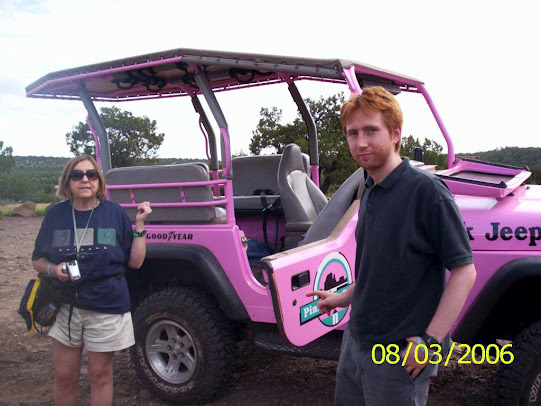
Although I missed this trip, I was feeling well enough to go to Sedona, Arizona in August, 2006.  I convinced everyone that I was well enough to go off-road in a pink jeep,  DH wanted to report me to my surgeon but I survived without to much pain and posed for the header image.

In 2009, I figured I have “extra years” since I survived the cancer and I wanted to do something kinda scary, yet fun. So, somehow, I decided on ziplining. Tom wouldn’t go with me but Michael would so I set this up almost as soon as we booked a Caribbean cruise to replace the Cushie Cruise to Bermuda.

Each person had a harness around their legs with attached pulleys and carabiners. Women had them on their chests as well. In addition, we had leather construction gloves and hard hats.

We climbed to the top of the first platform and were given brief instructions and off we went. Because of the heavy gloves, I couldn’t get any pictures. I had thought that they would take some of us on the hardest line to sell to us later but they didn’t. They also didn’t have cave pictures or T-Shirts. What a missed opportunity!

This was so cool, so much fun. I thought I might be afraid at first but I wasn’t. I just followed instructions and went.

Sometimes they told us to break. We did that with the right hand, which was always on the upper cable.

After the second line, I must have braked too soon because I stopped before I got to the platform. Michael was headed toward me. The guide on the end of the platform wanted me to do some hand over hand maneuver but I couldn’t figure out what he was saying so he came and got me by wrapping his legs around me and pulling me to the platform.

After that, no more problems with braking!

The next platform was very high – over 70 feet in the air – and the climb up was difficult. It was very hot and the rocks were very uneven. I don’t know that I would have gotten to the next platform if Michael hadn’t cheered me on all the way.

We zipped down the next six lines up to 250-feet between platforms and 85-feet high in the trees, at canopy level. It seemed like it was all over too soon.

But, I did it! No fear, just fun.

Enough of adventures – fun ones like these, and scary ones like transsphenoidal surgery and radical nephrectomy!