Sleep Impairment Similar in Cushing Syndrome, Mild Autonomous Cortisol Secretion

Patients with mild autonomous cortisol secretion (MACS) have similar sleep disturbances as patients with Cushing syndrome, according to results of a study published in the Journal of Clinical Endocrinology & Metabolism.

In both Cushing syndrome and MACS, varying degrees of hypercortisolism can affect circadian cortisol secretion and sleep.

Patients diagnosed with MACS (n=194) or Cushing syndrome (n=154) at the Mayo Clinic in the United States between 2019 and 2025 and healthy control individuals (n=89) recruited between 2019 and 2023 were evaluated for sleep outcomes using the Pittsburgh Sleep Quality Index (PSQI).

The MACS, Cushing syndrome, and control cohorts, of whom 73%, 89%, and 67% were women and 92%, 89%, and 91% were White, respectively, had median ages of 60, 48, and 56 years and a median BMI of 32, 34, and 28 kg/m2, respectively.

For sleep outcomes, all PSQI outcomes were worse among patients with MACS than control individuals (all P <.001). Among patients, more with Cushing syndrome vs MACS had:

  • Bad sleep quality (75% vs 58%; P <.001);
  • Sleep duration of less than 5 hours (24% vs 15%; P =.031);
  • At least 3 days of dysfunction due to daytime sleepiness (70% vs 56%; P =.011); and,
  • Higher total PSQI scores (mean, 12 vs 11; P =.005).

All outcomes of the Short Form 36 (SF-36) were significantly worse among patients with MACS than control individuals (all P <.001) and worse among patients with Cushing syndrome than MACS (all P £.004), except for the emotional limitation score (P =.002).

Similarly, patients with Cushing syndrome had lower Cushing Quality of Life (CushingQoL) scores than patients with MACS for physical (mean, 23.4 vs 44.9; P <.001), psychosocial (mean, 29.8 vs 46.7; P <.001), and overall (mean, 28.2 vs 46.2; P <.001) scores, respectively.

In Cushing syndrome and MACS, the researchers observed significant correlations between PSQI total scores and SF36 mental (r range, -0.50 to -0.40; both P <.001) and physical (r range, -0.35 to -0.28; both P <.001) component scores and CushingQoL overall (r range, -0.56 to -0.43; both P <.001), physical (r range, -0.57 to -0.38; both P <.001), and psychosocial (r range, -0.49 to -0.38; both P <.001) scores. In only MACS, PSQI was correlated with clinical severity (r, 0.17; P =.020). Among control individuals, PSQI total scores were correlated with SF36 mental (r, -0.29; P =.008) and physical (r, -0.45; P <.001) component scores.

Worse sleep was associated with every 1-kg/m2 increase in BMI among control individuals (b, 0.21; P =.005), inversely related with every 1-year increase in age among patients with Cushing syndrome (b, -0.12; P <.001), and inversely related with every 1-year increase in age (b, -0.08; P =.009) and positively related with every 1-point increase in clinical severity (b, 0.14; P =.044) and with female gender (b, 2.35; P =.002) among patients with MACS.

The major limitation of this study was the lack of objectively measured sleep outcomes.

The study authors concluded, “[W]e found that patients with MACS and [Cushing syndrome] demonstrate similar sleep impairment. Younger age, female sex and higher clinical severity score were associated with worse sleep in patients with MACS, while younger age was the only factor associated with poor sleep in patients with [Cushing syndrome].”

Disclosure: Multiple study authors declared affiliations with biotech, pharmaceutical, and/or device companies. Please see the original reference for a full list of authors’ disclosures.

https://www.endocrinologyadvisor.com/news/sleep-impairment-similar-in-cushing-syndrome-mild-autonomous-cortisol-secretion/

Sleep Disturbances in Patients With Cushing Syndrome and Mild Autonomous Cortisol Secretion

The Journal of Clinical Endocrinology & Metabolism, dgaf553, https://doi.org/10.1210/clinem/dgaf553

Abstract

Context

The impact of active hypercortisolism on sleep is incompletely characterized. Studies report impaired sleep in patients with Cushing syndrome (CS). Patients with mild autonomous cortisol secretion (MACS) demonstrate mild nocturnal hypercortisolism that could impact sleep.

Objectives

To characterize sleep abnormalities in patients with CS and MACS using the Pittsburgh Sleep Quality Index (PSQI), identify factors associated with poor sleep, and compare sleep abnormalities in patients with MACS versus referent subjects.

Methods

We conducted a single-center cross-sectional study of adults with active CS and MACS. Clinical and biochemical severity scores for hypercortisolism were calculated. Parallelly, we enrolled referent subjects. Quality of life was assessed using 1) Short Form-36 in all participants, and 2) Cushing QoL in patients with active hypercortisolism. Sleep quality was assessed using PSQI.

Results

PSQI was assessed in 154 patients with CS (mean 12, SD ±4.5), 194 patients with MACS (mean 11, SD 4.6), and 89 referents (mean 5, SD ±3.4). Patients with MACS exhibited shorter sleep duration, longer sleep latency, more severe daytime dysfunction, lower sleep efficiency, and a higher sleep medication use compared to referent subjects (P = <0.001 for all). Age-, sex, and BMI adjusted analysis demonstrated no differences in PSQI or its subcomponents between patients with CS and MACS (P >0.05 for all). In a multivariable analysis of patients with MACS, younger age, female sex and higher clinical hypercortisolism severity score were associated with impaired sleep. In patients with CS, only younger age was associated with poor sleep.

Conclusions

Patients with MACS demonstrate sleep impairment that is similar to patients with CS. Younger women with higher clinical severity of MACS are more likely to have impaired sleep.

Millennial Woman Hasn’t Slept the Night in 19 Months—Viewers Shocked Why

“I haven’t had a proper night’s sleep in 19 months,” Aleksa Diaz told Newsweek. “Even if I’m physically exhausted, I can’t fall asleep. I wake up more than ten times a night—fully conscious. I only get about two to four hours of broken sleep.”

The 30-year-old from Austin, Texas, has shared her experience on TikTok (@aleksaheals) earning 94,000 views. During the video, she points out that she has not “crashed” once and wonders how her body is continuing to function.

Diaz says that her insomnia began in January 2024 and is linked to a benign tumor in her pituitary gland—a small, hormone-producing gland at the base of the brain—known as a pituitary adenoma.

According to the American Brain Tumor Association (ABTA), about 13,770 pituitary tumors are diagnosed each year in the U.S., accounting for roughly 17 percent of all primary tumors in the central nervous system (CNS).

Symptoms of Pituitary Tumors

Pituitary tumors and cysts typically arise from two main causes: pressure on the gland and surrounding structures, or overproduction of hormones. The severity and type of symptoms depend on the tumor’s size and the specific hormones involved.

The ABTA notes that when the tumor presses on the pituitary gland or nearby structures, it can lead to:

  • Headaches
  • Visual loss
  • Hair loss
  • Diminished libido
  • Weight fluctuations
  • Skin changes
  • Fatigue or low energy

Symptoms Caused by Excess Hormone Production

Approximately 70 percent of pituitary tumors are “secreting,” meaning they release excess hormones. These include:

  • Growth hormone: Overproduction can cause localized excess growth (‘acromegaly’) in adults and gigantism in children.
  • Prolactin: Leads to menstrual changes and abnormal milk production.
  • Sex hormones: Can cause menstrual irregularities and sexual dysfunction.
  • Thyroid hormones: Can trigger hyperthyroidism, with symptoms such as weight loss, heart rhythm changes, anxiety, bowel changes, fatigue, thinning skin and sleep problems.
  • Adrenal hormones: Excess can lead to Cushing’s disease, characterized by a moon-shaped face, excess body hair, easy bruising, menstrual irregularities and high blood pressure.

A Long Road to Diagnosis

Diaz told Newsweek that she has experienced many of these symptoms, beginning with severe hair loss at just 18.

“I started to feel off and suddenly began losing hair,” she recalled. “I was shedding over 300 hairs a day—just brushing my hair or running my fingers through it.”

Initially, doctors diagnosed her with polycystic ovary syndrome (PCOS). “I didn’t have any other symptoms, but I just thought it must be what they said,” Diaz explained.

By the time she turned 22, the hair loss was severe and unrelenting.

“It wasn’t stopping,” she said. “I went to a dermatologist and had a brain MRI—then they found a 5mm tumor on my pituitary gland.”

Around the same time, Diaz began gaining weight that wouldn’t budge despite dieting and regular exercise.

“I developed depression and always had a puffy, inflamed face,” she said. “The hair loss was causing me a lot of self-esteem issues.”

Over the years, Diaz’s symptoms multiplied—dry skin, dry eyes, low libido, anxiety, twitching legs and hip pain after exercise. She estimates she has consulted around 40 doctors and spent 500–600 hours researching her condition.

In 2018, she was formally diagnosed with a pituitary adenoma and prescribed metformin to lower hormone levels. “They told me to wait and see,” she said. When her insomnia worsened, Diaz suspected the tumor was causing multiple hormone-related conditions, but doctors did not confirm it.

By January 2024, she noticed new symptoms: vaginal dryness, hip pain and worsening sleep. Tests revealed her estrogen was abnormally low for her age.

“I take medication for that now and progesterone too,” she said. After years of trying everything—dermatologists, supplements and expensive hair treatments—she finally saw some hair regrowth.

Still, Diaz’s diagnosis of hypopituitarism means her pituitary gland underproduces several critical hormones.

The ABTA notes that doctors often recommend monitoring small tumors, since they typically grow slowly and cause no symptoms. But Diaz, whose tumor is 5 mm, disagrees.

She said: “Doctors believe that because the tumor is under 1 cm it can’t possibly be causing enough symptoms to risk doing surgery. The main risk is developing another hormone deficiency post-op.

“However, surgeons who do this surgery say it’s routine and not super risky, so it’s confusing as a patient.

“Cases like mine of mild hypopituitarism are often ignored, leading to a slow progression of hormone deficiencies—the very thing that is a risk of surgery.”

When she was 29, Diaz started taking hormone replacement therapy (HRT)—a treatment that replaces female hormones, mainly estrogen and progesterone, which fall to low levels during menopause.

She told Newsweek: “Doctors don’t understand why I’m basically in menopause. We don’t know the risks of long-term HRT. The medications make me feel better, but it’s not safe as a long-term solution.”

Living with the Emotional Toll

Alongside her physical symptoms, Diaz has developed severe depression and feels “literally running on empty.”

“I feel like I have hope for the future only when I manage a decent night’s sleep,” she said. “I don’t want to see anyone or socialize. I haven’t gone out in six months. It’s affected my job—I was almost fired in March.

“I’ve become very forgetful, I miss meetings and tasks and I sometimes can’t remember what I did yesterday. It’s like I have severe ADHD, but it’s not.”

A Call for Change in Treatment

Now financially and emotionally exhausted, Diaz fears what will happen if she continues to be denied further testing or surgical treatment.

“I’m worried something will happen to me,” she said. “I’ve reached my limit financially. My physical and mental health are exhausted.”

Diaz believes her struggle is far from unique. “From the time you have symptoms to when you get a diagnosis it can take 10 years,” she said.

“A lot of women have expressed they don’t feel like they are being taken seriously—and that has been my experience. Being young is a disadvantage. I’m on six medications now to manage my hormones. I’ve lost weight and my hair is growing back, so doctors think I must be fine. But they don’t see what’s really going on.”

Do you have a tip on a health story that Newsweek should be covering? Do you have a question about pituitary tumors? Let us know via health@newsweek.com.

https://www.newsweek.com/millennial-woman-sleep-insomnia-pituitary-tumor-10821739

Day 3: Cushing’s Awareness Challenge

me-tired

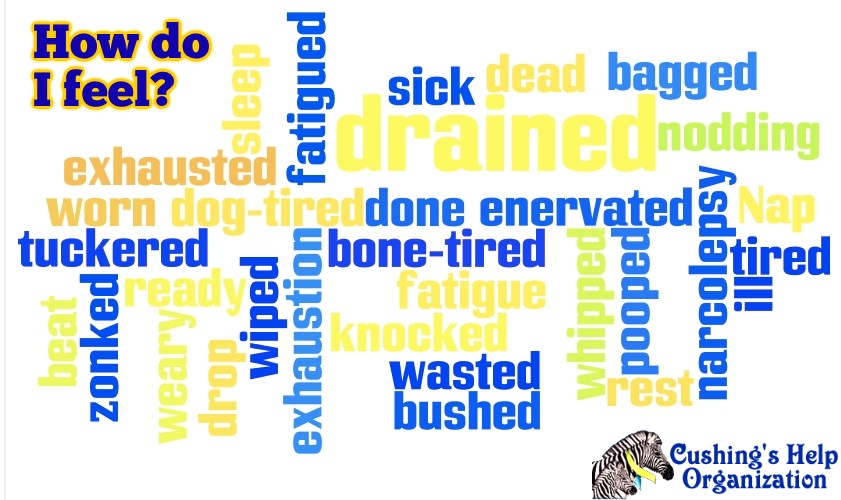
Sleep.  Naps.  Fatigue, Exhaustion.  I still have them all.  I wrote on my bio in 1987 after my pituitary surgery “I am still and always tired and need a nap most days. I do not, however, still need to take whole days off just to sleep.

That seems to be changing back, at least on the weekends.  A recent weekend, both days, I took 7-hour naps each day and I still woke up tired. That’s awfully close to taking a whole day off to sleep again.

In 2006, I flew to Chicago, IL for a Cushing’s weekend in Rockford.  Someone else drove us to Lake Geneva, Wisconsin for the day.  Too much travel, too Cushie, whatever, I was too tired to stay awake.  I actually had put my head down on the dining room table and fallen asleep but our hostess suggested the sofa instead.  Amazing that I traveled that whole distance – and missed the main event 😦

This sleeping thing really impacts my life.  Between piano lessons, I take a nap.  I sleep as late as possible in the mornings and afternoons are pretty much taken up by naps.  I nod off at night during TV. One time I came home between church services and missed the third service because I fell asleep.

I only TiVo old tv shows that I can watch and fall asleep to since I already know the ending.

Since  mid-February, I have been doing physical therapy twice a week for 2 hours at a time for a knee injury (read more about that in Bees Knees).  I come home from that exhausted – and in more pain than I went.  I know it’s working and my knee is getting better, but it’s such a time and energy sapper.  Neither of which I can really spare.

Maybe now that I’m nearly 10  years out from my kidney cancer (May 9, 2006) I could theoretically go back on Growth Hormone again.  My surgeon says he “thinks” it’s ok.  I’m sort of afraid to ask my endo about it, though.  I want to feel better and get the benefits of the GH again but I don’t want any type of cancer again and I certainly can’t afford to lose another kidney.

I’ll probably just muddle through without it.  I always laugh when I see that commercial online for something called Serovital.  I saw it in Costco the other day and it mentions pituitary right on the package.  I wish I could take the people buying this, sit them down and tell them not to mess with their pituitary glands.  But I won’t.  I’ll take a nap instead because I’m feeling so old and weary today, and yesterday.

And tomorrow…

Day 1: Cushing’s Awareness Challenge

April is always Cushing’s Awareness Challenge month because Dr. Harvey Cushing was born on April 8th, 1869.

30-posts

Thanks to Robin for this wonderful past logo!  I’ve participated in these 30 days for Cushing’s Awareness several times so I’m not quite sure what is left to say this year but I always want to get the word out when I can.

As I see it, there have been some strides the diagnosis or treatment of Cushing’s since last year.  More drug companies are getting involved, more doctors seem to be willing to test, a bit more awareness, maybe.


April Fool's Day

How fitting that this challenge should begin on April Fool’s Day.  So much of Cushing’s  Syndrome/Disease makes us Cushies seem like we’re the April Fool.  Maybe, just maybe, it’s the doctors who are the April Fools…

Doctors tell us Cushing’s is too rare – you couldn’t possibly have it.  April Fools!

All you have to do is exercise and diet.  You’ll feel better.  April Fools!

Those bruises on your legs?  You’re just clumsy. April Fools!

Sorry you’re growing all that hair on your chin.  That happens as you age, you know.  April Fools!

Did you say you sleep all day?  You’re just lazy.  If you exercised more, you’d have more energy. April Fools!

You don’t have stretch marks.  April Fools!

You have stretch marks but they are the wrong [color/length/direction] April Fools!

The hump on the back of your neck is from your poor posture. April Fools!

Your MRI didn’t show a tumor.  You couldn’t have Cushing’s. April Fools!

This is all in your mind.  Take this prescription for antidepressants and go home.  April Fools!

If you have this one surgery, your life will get back to normal within a few months. April Fools!

What?  You had transsphenoidal surgery for Cushing’s?  You wasted your time and money. April Fools!

I am the doctor.  I know everything.  Do not try to find out any information online. You could not have Cushing’s.  It’s too rare…  April FOOL!

All this reminds me of a wonderful video a message board member posted a while ago:

So now – who is the April Fool?  It wasn’t me.  Don’t let it be you, either!