Webinar: Endoscopic Endonasal Surgery for the Treatment of Cushing’s Disease

Mon, Jun 13, 2016 11:00 AM – 12:00 PM EDT


Presented by:
Dr. Maria Koutourousiou
Webinar DescriptionAn update on the diagnosis and treatment options of Cushing’s disease. Description of the endoscopic endonasal approach for the management of CD. Surgical videos demonstration and comparison with the microscopic transsphenoidal approach. Surgical outcomes and adjuvant treatment.

Presenter Bio

Dr. Mary Koutourousiou is an attending Neurosurgeon and Assistant Professor at the University of Louisville. She is the Director of the Pituitary and Skull Base Program. Dr. Koutourousiou received her M.D. from the Aristotle University of Thessaloniki, Greece and completed her neurosurgical residency at the General Hospital of Athens “G. Gennimatas”, in Greece. She underwent subspecialty fellowship training in Endoscopic Pituitary Surgery and Minimally Invasive Neurosurgery at the UMC St. Radboud, Nijmegen, in the Netherlands. She moved to the United States in 2010 and completed four years of research and a clinical fellowship in Endoscopic and Open Skull Base Surgery at UPMC Presbyterian in Pittsburgh, Pennsylvania.

Dr. Koutourousiou has published extensively in the field of endoscopic skull base surgery. Her studies have been presented in national and international neurosurgical meetings. Dr. Koutourousiou’s work in skull base surgery has been recognized by the European Skull Base Society and the World Federation of Skull Base Societies.

Register here: https://attendee.gotowebinar.com/register/4982773766837282305?utm_source=newsletter_199&utm_medium=email&utm_campaign=webinar-announcement-endoscopic-endonasal-surgery-for-the-treatment-of-cushing-s-disease

A Team Effort to Treat a Pea-Sized Gland

HYANNIS – Endoscopic surgery for pituitary tumors involves the use of small instruments, but neurosurgeon Nicholas Coppa, MD, FAANS, is quick to say it takes a big team to make the surgeries a success.

“It’s very much a collaborative effort among endocrinology, neurosurgery and otolaryngology specialties,” he said.

Dr. Coppa frequently works with endocrinologist Catalina Norman, MD, PhD, and ear, nose and throat surgeon Ross Johnston, MD.

The pituitary gland sits at the base of the brain. It makes important hormones that control several different systems in the body and help maintain normal body function.

“The overwhelming majority of patients with big tumors present with visual problems,” said Dr. Coppa. “They get tunnel vision from a tumor putting pressure on the vision nerves.

Many patients’ pituitary problems are detected incidentally while the physician is trying to diagnose a set of symptoms, most commonly headaches, he added. A variety of asymptomatic tumors are detected this way.

A subset of pituitary tumors secrete excess hormones, which create syndromes characterized by whatever hormone is being secreted in excess, Dr. Coppa added. Oftentimes these problems are diagnosed by an endocrinologist.

Before coming to Neurosurgeons of Cape Cod – now known as Cape Cod Healthcare Neurosurgery – in 2013, Dr. Coppa was professor of skull base surgery at Oregon Health and Science University’s Northwest Pituitary Center. He has performed more than 200 endoscopic surgeries for pituitary tumors, sinonasal malignancies and anterior skull base encephaloceles. The procedure is fairly new on Cape Cod, he said.

The pituitary gland is about the size of a pea, so operating on it is a tricky and delicate procedure.

The surgeon commonly works with an endoscope inserted through one nostril, and microsurgical instruments through the other nostril. This allows him to maneuver to the surgical area.

According to the Northwest Pituitary Center’s web site, “The tube is connected to a TV monitor that helps your doctor see the surgical area even more clearly than with a microscope. Your doctor can also use intraoperative neuro-navigation to perform image-guided surgery, based on a pre-operative CT scan or MRI. This helps the doctor see exactly where the tumor is and avoid damaging healthy brain tissue that is nearby.”

Nasal endoscopy for the neurosurgeon has really taken off in the last 10 years, according to Dr. Coppa. The main reason for the increase is because the technique allows better visualization of the anatomy, he said.

“We find that it allows, at least in my experience, more maneuverability of your micro-surgical instruments. That’s been very satisfying for patients. The nasal morbidity [adverse effects] is lower compared to historic ways of doing it.”

Ear, nose and throat doctors use trans-nasal surgery to treat many sinus conditions, said Dr. Coppa. But the procedure is predominantly used by neurosurgeons for pituitary tumors, other tumors of the skull base and malignancies of the sinus cavity that often invade the brain.

After endoscopic pituitary surgery, patients are typically in the hospital for several days and resume day-to-day activities within that first week.

By BILL O’NEILL, OneCape Health News


From http://www.capecod.com/newscenter/a-team-effort-to-treat-a-pea-sized-gland/

‘Adrenal Fatigue’ Not Always Used Accurately

Dear Dr. Roach: I had apoplexy, a ruptured pituitary tumor, developed panhypopituitarism, then adrenal insufficiency. I am doing fairly well with cortisol replacement, thyroid supplement and oral diabetic medicine.

My problem is exhaustion that comes on very easily. I have other ailments to blame, too — chronic pain from fibromyalgia and tendinitis. I am 67. I am still able to work. Is adrenal fatigue a real issue, and if so, what can be done about it? — S.M.

Answer: The term “adrenal fatigue” is increasingly used, and not always correctly — or, at least, it is used in cases where it’s not clear if that is actually the case. But let me start by discussing what has happened to you. Pituitary apoplexy is bleeding into the pituitary gland, usually into a pituitary tumor, as in your case. This may cause severe headaches and vision changes, and often it prevents the pituitary from making the many important hormones that control the endocrine glands and regulate the body.

For example, without TSH from the pituitary gland, the thyroid won’t release thyroid hormone, and importantly, the adrenal gland can’t make cortisol without the influence of ACTH from the pituitary.

Rather than trying to replace TSH, ACTH and the other pituitary hormones, it is easier to directly replace the hormones made by the adrenal, thyroid and gonads. That’s why you are taking cortisol and thyroid hormone, and why younger women take estrogen and men testosterone. Although there is nothing wrong with your thyroid and adrenal glands, they simply won’t work unless stimulated.

Inadequate adrenal function from any cause leads to profound fatigue, and in the presence of severe stress, such as surgery or major infection, the body’s need for cortisol increases dramatically. Unless enough adrenal hormone is given in response, the result can be an immediate life-threatening condition called an Addisonian crisis.

Readers may email questions to ToYourGoodHealth@med.cornell.edu.

From http://www.vnews.com/To-Your-Good-Health–Adrenal-Fatigue–not-Always-Used-Accurately-1802516

Day 28, Cushing’s Awareness Challenge 2016

Over the years, we went on several Windjammer Barefoot Cruises.  We liked them because they were small, casual and were fairly easy on the wallet.

They sailed around the Caribbean to a variety of islands, although they sometimes changed itineraries depending on weather, crew, whatever.  One trip we were supposed to go to Saba but couldn’t make port.  A lot of people got off at the next port and flew home.

The captains were prone to “Bedtime Stories” which were often more fiction than true but they added to the appeal of the trip.  We didn’t care if we missed islands or not – we were just there to sail over the waves and enjoy the ride.

The last trip we took with them was about two years before I started having Cushing’s problems.  (You wondered how I was going to tie this together, right?)

The cuise was uneventful, other than the usual mishaps like hitting docks, missing islands and so on.  Until it was a particularly rough sea one day.  I was walking somewhere on deck and suddenly a wave came up over the deck making it very slippery.  I fell and cracked the back of my head on the curved edge of a table in the dining area.  I had the next-to-the-worse headache I have ever had, the worst being after my pituitary surgery. At least after the surgery I got some morphine.

We asked several doctors later if that hit could have contributed to my Cushing’s but doctors didn’t want to get involved in that at all.

The Windjammer folks didn’t fare much better, either. In October 1998, Hurricane Mitch was responsible for the loss of the s/v Fantome (the last one we were on).

All 31 crew members aboard perished; passengers and other crew members had earlier been offloaded in Belize.

The story was recorded in the book The Ship and the Storm: Hurricane Mitch and the Loss of the Fantome  by Jim Carrier.  The ship, which was sailing in the center of the hurricane, experienced up to 50-foot (15 m) waves and over 100 mph (160 km/h) winds, causing the Fantome to founder off the coast of Honduras.

This event was similar to the Perfect Storm in that the weather people were more interested in watching the hurricane change directions than they were in people who were dealing with its effects.

I read this book and I was really moved by the plight of those crew members.

I’ll never know if that hit on my head contributed to my Cushing’s but I have seen several people mention on the message boards that they had a traumatic head injury of some type in their earlier lives.

Day 17, Cushing’s Awareness Challenge 2016


Because it’s a Sunday again, this is a semi-religious post…

After I was finished with the Cushing’s long diagnostic process, surgery and several post-op visits to NIH, I was asked to give the scripture reading at my church. The man who preached the sermon that week was the survivor of a horrific accident where he and his family were hit by a van while waiting at an airport.

I thought I had written down the scripture reading carefully. I practiced and practiced. I don’t like speaking in front of a crowd but I said I would. When I got to church, the reading was different from what I had practiced. Maybe I wrote it down wrong, maybe someone changed it. Whatever.

The real scripture turned out to be Psalm 116. I got very emotional while reading this and started crying when I got to verse 8 “For you, O LORD, have delivered my soul from death“.  Others in the congregation who knew part of my story were very moved, too.

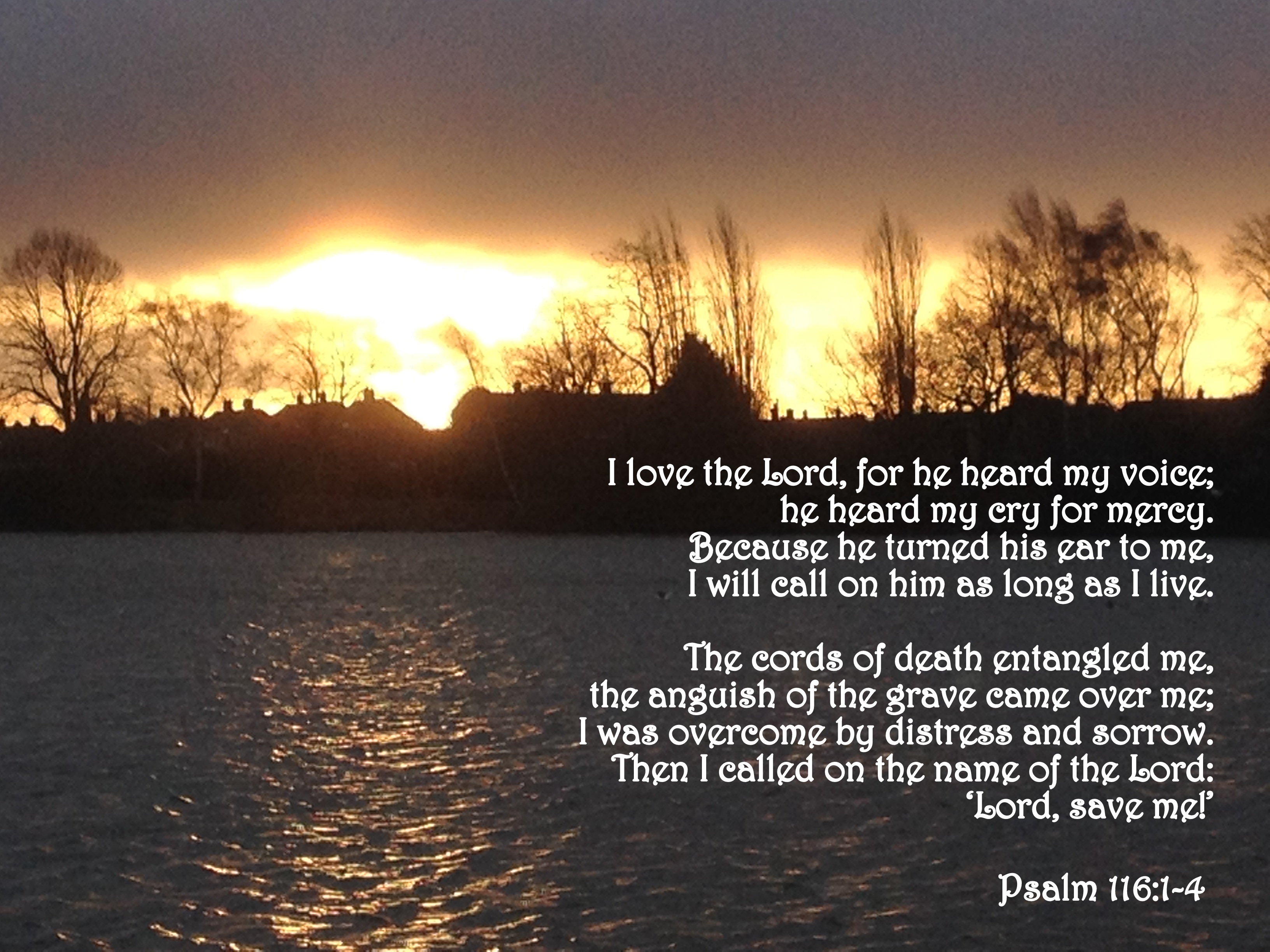
psalm-116-1-4

Psalm 116 (New International Version)

1 I love the LORD, for he heard my voice;
he heard my cry for mercy.

2 Because he turned his ear to me,
I will call on him as long as I live.

3 The cords of death entangled me,
the anguish of the grave came upon me;
I was overcome by trouble and sorrow.

4 Then I called on the name of the LORD:
“O LORD, save me!”

5 The LORD is gracious and righteous;
our God is full of compassion.

6 The LORD protects the simplehearted;
when I was in great need, he saved me.

7 Be at rest once more, O my soul,
for the LORD has been good to you.

8 For you, O LORD, have delivered my soul from death,
my eyes from tears,
my feet from stumbling,

9 that I may walk before the LORD
in the land of the living.

10 I believed; therefore I said,
“I am greatly afflicted.”

11 And in my dismay I said,
“All men are liars.”

12 How can I repay the LORD
for all his goodness to me?

13 I will lift up the cup of salvation
and call on the name of the LORD.

14 I will fulfill my vows to the LORD
in the presence of all his people.

15 Precious in the sight of the LORD
is the death of his saints.

16 O LORD, truly I am your servant;
I am your servant, the son of your maidservant;
you have freed me from my chains.

17 I will sacrifice a thank offering to you
and call on the name of the LORD.

18 I will fulfill my vows to the LORD
in the presence of all his people,

19 in the courts of the house of the LORD—
in your midst, O Jerusalem.
Praise the LORD.

This Psalm has come to have so much meaning in my life. When I saw at a book called A Musician’s Book of Psalms each day had a different psalm. “My” psalm  was listed as the reading for my birthday, so I had to buy this book!  For a while, it was the license plate on my car.

I used to carry a print out of this everywhere I go because I find it very soothing. “when I was in great need, he saved me.” This print out is in a plastic page saver but now I have this info on my phone and iPad.

On the other side there is an article I found after my kidney cancer.  You can read that article in yesterday’s post.