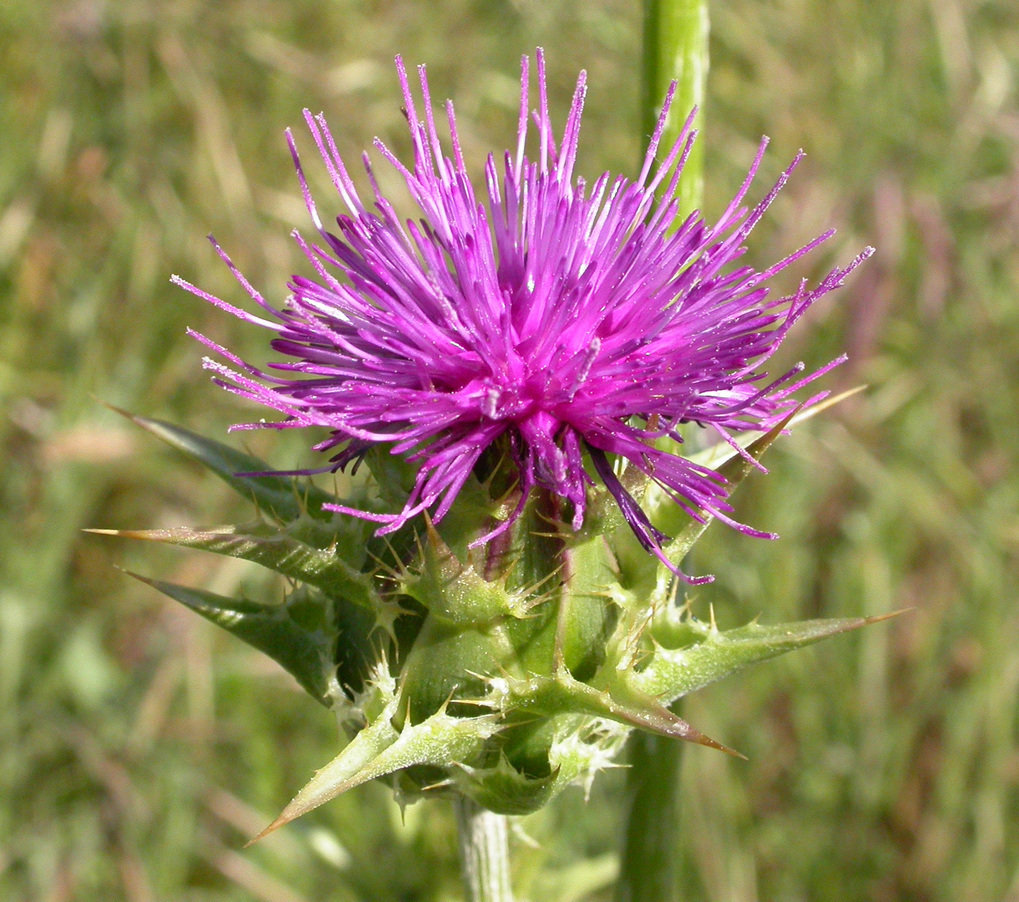
Silibinin from milk thistle seeds as novel, non-invasive treatment strategy for Cushing Disease

Silibinin has an outstanding safety profile in humans and is currently used for the treatment of liver disease and poisoning. Scientists at the Max Planck Institute of Psychiatry in Munich discovered in collaboration with scientists from the Helmholtz Zentrum München in cell cultures, animal models and human tumor tissue that silibinin can be applied to treat Cushing Disease, a rare hormone condition caused by a tumor in the pituitary gland in the brain. The researchers have filed a patent and now plan clinical trials using silibinin as a non-invasive treatment strategy. Thus, in future, patients might not have to undergo brain surgery anymore.
Treatment with silibinin, a constituent of milk thistle seeds, alleviated symptoms of Cushing Disease in cell cultures, animal models and human tumor tissue. In future, patients might not have to undergo brain surgery anymore.

Cushing Disease, not to be confused with Cushing’s Syndrome, is caused by a tumor in the pituitary gland in the brain. The tumor secrets increased amounts of the stress hormone adrenocorticotropin (ACTH) followed by cortisol release from the adrenal glands leading to rapid weight gain, elevated blood pressure and muscular weakness. Patients are prone to osteoporosis and infections and may show cognitive dysfunction or even depression. In 80 to 85 % of the patients, the tumor can be removed by uncomfortable brain surgery. For inoperable cases, there is currently only one targeted therapy approved, which unfortunately causes intense side effects such as hyperglycemia in more than 20 % of the patients.

Scientists around Günter Stalla, endocrinologist at the Max Planck Institute of Psychiatry in Munich, have now discovered in cell cultures, animal models and human tumor tissue that a harmless plant extract can be applied to treat Cushing Disease. “Silibinin is the major active constituent of milk thistle seeds. It has an outstanding safety profile in humans and is already used for the treatment of liver disease and poisoning,” explains Marcelo Paez-Pereda, leading scientist of the current study published in the renowned scientific journal Nature Medicine. After silibinin treatment, tumor cells resumed normal ACTH production, tumor growth slowed down and symptoms of Cushing Disease disappeared in mice.

In 2013, the Max Planck scientists filed a patent on a broad family of chemical and natural compounds, including silibinin, to treat pituitary tumors. Compared to humans, where only 5.5 in 100,000 people worldwide develop Cushing Disease, this condition is very common in several pets. For example, 4 % of dogs and even 7 % of horses suffer from Cushing Disease. Thus, the researchers now plan to test special formulations with a very pure substance and slow release of the active component silibinin in clinical trials.

Silibinin: Mode of action

“We knew that Cushing Disease is caused by the release of too much ACTH. So we asked ourselves what causes this over production and how to stop it,” says Paez-Pereda. In their first experiments, the researchers found tremendously high amounts of the heat shock protein 90 (HSP90) in tumor tissue from patients with Cushing Disease. In normal amounts, HSP90 helps to correctly fold another protein, the glucocorticoid receptor, which in turn inhibits the production of ACTH. “As there are too many HSP90 molecules in the tumor tissue, they stick to the glucocorticoid receptor,” explains Paez-Pereda. “We found that silibinin binds to HSP90 thus allowing glucocorticoid receptor molecules to dissolve from HSP90. With silibinin, we might have discovered a non-invasive treatment strategy not only for the rare Cushing Disease but also for other conditions with the involvement of glucocorticoid receptors, such as lung tumors, acute lymphoblastic leukemia or multiple myeloma,” concludes Paez-Pereda.

From http://www.psych.mpg.de/2034377/PM1507

Mortality in cured Cushing’s disease

In patients diagnosed with Cushing’s disease, mortality is high compared to the general population However, it is not yet known if this mortality remains high even after initial therapy.

Therefore van Haalen et al., performed a systematic review and meta-analysis of follow-up studies in patients cured from Cushing’s disease after initial treatment. They found that mortality remained high in patients with Cushing’s disease even after initial biochemical cure remission, suggesting that cure does not directly reverse the metabolic consequences of long-term overexposure to cortisol.

Read full article by van Haalan et al., titled ‘Mortality remains increased in Cushing’s disease despite biochemical remission: a systematic review and meta-analysis’, European Journal of Endocrinology 172, R143-R149.

DOI: 10.1530/EJE-14-0556

From http://www.ese-hormones.org/news/article.aspx?articleid=9083

Day Twenty-seven, Cushing’s Awareness Challenge 2015

So often during the diagnosis phase of Cushing’s I felt like this picture – I was walking alone to an unknown place with an unknown future.

My diagnosis was pre-Internet which meant that any information had to be gotten from libraries, bookstores, magazines…or doctors.  In 1983 to 1986 I knew something was terribly wrong but there was no backup from doctors, family or friends.  My first hope was from a magazine (see Day Six)

After I got that first glimmer of hope, it was off to the library to try to understand medical texts.  I would pick out words I did understand – and it was more words each trip.  All my research led me to Cushing’s.

Unfortunately, the research didn’t lead me to doctors who could help for several years.  That contributed greatly to the loneliness.  If a Doctor says you’re not sick, friends and family are going to believe the doctor, not you.  After all, he’s the one trained to know what’s wrong, or find out.

I was so grateful when I finally got into a clinical trial at NIH and was so nice not to be alone with this mystery illness.  I was also surprised to learn, awful as I felt, there were Cushies much worse off than I was.

I am so glad that the Internet is here now helping us all know that we’re not alone anymore.


We’re all in this together with help, support, research, just being there.  I love this quote from Catherine at http://wheniwasyou.wordpress.com/2012/03/31/wheniwasyou/

Mary, I am delighted to see you here. Cushings – because of the persistent central obesity caused by (we know now) the lack of growth hormone plus the hypothyroidism I was diagnosed with (but for which treatment was ineffective due to my lack of cortisol) – was one of the things I considered as an explanation for my symptoms. Your site was enormously educational and helpful to me in figuring out what might be happening to me. Those other patient testimonies I referred to? Many of them were the bios you posted. Thank you so much for commenting. I am so grateful for the support and encouragement. I really hope that my experiences will help other undiagnosed hypopituitary patients find their way to a diagnosis. I often used to dream that one day I’d get to say to others what was so often said to me: don’t give up, there will be an answer. I kept believing in myself because people I hadn’t even met believed in me. Now I am finally here and I do hope my story will help others to have faith in their own instincts.

Thanks again. Please do keep in touch.

Catherine


Day Ten, Cushing’s Awareness Challenge 2015

In March of 1987, after the endo finally  confirmed that I had Cushing’s, I was sent to a local hospital where they repeated all those same tests for another week and decided that it was not my adrenal gland (Cushing’s Syndrome) creating the problem. The doctors and nurses had no idea what to do with me, so they put me on the brain cancer ward.

When I left this hospital after a week, we didn’t know any more than we had before.

As luck would have it, NIH (National Institutes of Health, Bethesda, Maryland) was doing a clinical trial of Cushing’s. I live in the same area as NIH so it was not too inconvenient but very scary at first to think of being tested there. At that time I only had a choice of NIH, Mayo Clinic and a place in Quebec to do this then-rare pituitary surgery called a Transsphenoidal Resection.

My husband asked my endo if it were his wife, if he would recommend this surgery.  The endo responded that he was divorcing his wife – he didn’t care what happened to her.  Oh, my!

I chose NIH – closest and free. After I was interviewed by the doctors there, I got a letter that I had been accepted into the clinical trial.

The night before I was admitted, I signed my will.  I was sure I was going to die there.  If not during testing, as a result of surgery.

The first time I was there was for 6 weeks as an inpatient. More of the same tests.

There were about 12 of us there and it was nice not to be alone with this mystery disease. Many of these Cushies (mostly women) were getting bald, couldn’t walk, having strokes, had diabetes. One was blind, one had a heart attack while I was there. Several were from Greece.

My first roommate was a nurse.  She spent the entire first night screaming in pain.  I was very glad when they moved me to a new room!

Towards the end of my testing period, I was looking forward to the surgery just to get this whole mess over with – either a cure or dying. While I was at NIH, I was gaining about a pound a day!

During the time I was home the weekend  before surgery, a college classmate of mine (I didn’t know her) DID die at NIH of a Cushing’s-related problem. I’m so glad I didn’t find out until reading the alumnae magazine a couple months later!  She was the same class, same major, same home-town, same disease…

We have a Scottish doctor named James Lind to thank for the clinical trial.  He  conducted the first ever clinical trial in 1747 and developed the theory that citrus fruits cured scurvy.  Lind  compared the effects of various different acidic substances, ranging from vinegar to cider, on groups of afflicted sailors, and found that the group who were given oranges and lemons had largely recovered from scurvy after 6 days.

I’d like to think that I advanced the knowledge of Cushing’s at least a little bit by being a guinea  pig in 1987-1989.

From the NIH: http://endocrine.niddk.nih.gov/pubs/cushings/cushings.aspx

Hope through Research

Several components of the National Institutes of Health (NIH) conduct and support research on Cushing’s syndrome and other disorders of the endocrine system, including the National Institute of Diabetes and Digestive and Kidney Diseases, the National Institute of Child Health and Human Development (NICHD), the National Institute of Neurological Disorders and Stroke, the National Cancer Institute, and the National Center for Research Resources.

NIH-supported scientists are conducting intensive research into the normal and abnormal function of the major endocrine glands and the many hormones of the endocrine system. Researchers continue to study the effects of excess cortisol, including its effect on brain structure and function. To refine the diagnostic process, studies are under way to assess the accuracy of existing screening tests and the effectiveness of new imaging techniques to evaluate patients with ectopic ACTH syndrome. Researchers are also investigating jugular vein sampling as a less invasive alternative to petrosal sinus sampling. Research into treatment options includes study of a new drug to treat the symptoms of Cushing’s syndrome caused by ectopic ACTH secretion.

Studies are under way to understand the causes of benign endocrine tumor formation, such as those that cause most cases of Cushing’s syndrome. In a few pituitary adenomas, specific gene defects have been identified and may provide important clues to understanding tumor formation. Endocrine factors may also play a role. Increasing evidence suggests that tumor formation is a multistep process. Understanding the basis of Cushing’s syndrome will yield new approaches to therapy.

The NIH supports research related to Cushing’s syndrome at medical centers throughout the United States. Scientists are also treating patients with Cushing’s syndrome at the NIH Clinical Center in Bethesda, MD. Physicians who are interested in referring an adult patient may contact Lynnette Nieman, M.D., at NICHD, 10 Center Drive, Room 1-3140, Bethesda, MD 20892-1109, or by phone at 301-496-8935. Physicians interested in referring a child or adolescent may contact Constantine Stratakis, M.D., D.Sc., at NICHD, 10 Center Drive, Room 1-3330, Bethesda, MD 20892-1103, or by phone at 301-402-1998.

PRKACA mutations in cortisol-producing adenomas and adrenal hyperplasia

Eur J Endocrinol. 2015 Mar 6. pii: EJE-14-1113. [Epub ahead of print]

PRKACA mutations in cortisol-producing adenomas and adrenal hyperplasia – a single-center study of 60 cases.

Abstract

Objective: Cortisol excess due to adrenal adenomas or hyperplasia causes Cushing’s syndrome. Recent genetic studies have identified a somatic PRKACAL206R mutation as a cause of cortisol-producing adenomas.

We aimed to compare the clinical features of lesions with PRKACA mutations to those with CTNNB1 mutations and to search for similar mutations in unilateral hyperplasia or tumors co-secreting aldosterone.

Design, patients and methods: 60 patients with cortisol excess who had adrenalectomies at our institution between 1992 and 2013 were assessed, and somatic mutations were determined by Sanger sequencing. 36 patients had overt Cushing’s syndrome, the remainder were subclinical. 59 cases were adenomas (three bilateral), one was classified as hyperplasia. Four tumors had proven co-secretion of aldosterone.

Results: Among cortisol-secreting unilateral lesions without evidence of co-secretion (n=52), we identified somatic mutations in PRKACA (L206R) in 23.1%, CTNNB1 (S45P, S45F) in 23.1%, GNAS (R201C) in 5.8% and CTNNB1 plus GNAS (S45P, R201H) in 1.9%. PRKACA and GNAS mutations were mutually exclusive. Of the co-secreting tumors, two (50%) had mutations in KCNJ5 (G151R and L168R). The hyperplastic gland showed a PRKACAL206R mutation, while patients with bilateral adenomas did not have known somatic mutations. PRKACA-mutant lesions were associated with younger age, overt Cushing’s syndrome and higher cortisol levels versus non-PRKACA-mutant or CTNNB1-mutant lesions. CTNNB1 mutations were more significantly associated with right than left lesions.

Conclusions: PRKACAL206R is present not only in adenomas, but also in unilateral hyperplasia and is associated with more severe autonomous cortisol secretion. Bilateral adenomas may be caused by yet-unknown germline mutations.

PMID:
25750087
[PubMed – as supplied by publisher]

From http://www.ncbi.nlm.nih.gov/pubmed/25750087