Baa Baa Black Sheep and Easter

When I was driving, I noticed that I don’t even notice some of the pain that is becoming my norm. In many ways, it is nice. For those of you wondering if it is worth it, YES! This is what you go through treatment in order to experience. Fight!

via Baa Baa Black Sheep and Easter.

Day 6: Cushing’s Awareness Challenge 2015

People sometimes ask me how I found out I had Cushing’s Disease.  Theoretically, it was easy.  In practice, it was very difficult.

Ladies Home Journal, 1983In 1983 I came across a little article in the Ladies Home Journal which said “If you have these symptoms…”

I found the row with my symptoms and the answer read “…ask your doctor about Cushing’s”.

After that article, I started reading everything I could on Cushing’s, I bought books that mentioned Cushing’s. I asked and asked my doctors for many years and all of them said that I couldn’t have it.  It was too rare.  I was rejected each time.


Due to all my reading at the library, I was sure I had Cushing’s but no one would believe me. My doctors would say that Cushing’s Disease is too rare, that I was making this up and that I couldn’t have it.

In med school, student doctors are told “When you hear hoofbeats, think horses, not zebras“.

According to Wikipedia: “Zebra is a medical slang term for a surprising diagnosis. Although rare diseases are, in general, surprising when they are encountered, other diseases can be surprising in a particular person and time, and so “zebra” is the broader concept.

The term derives from the aphorism “When you hear hoofbeats behind you, don’t expect to see a zebra”, which was coined in a slightly modified form in the late 1940s by Dr. Theodore Woodward, a former professor at the University of Maryland School of Medicine in Baltimore.  Since horses are the most commonly encountered hoofed animal and zebras are very rare, logically you could confidently guess that the animal making the hoofbeats is probably a horse. By 1960, the aphorism was widely known in medical circles.”

So doctors typically go for the easily diagnosed, common diseases.  Just because something is rare doesn’t mean that no one gets it.  We shouldn’t be dismissed because we’re too hard to diagnose.

When I was finally diagnosed in 1987, 4 years later, it was only because I started bleeding under the skin. My husband made circles around the outside perimeter each hour with a marker so my leg looked like a cut log with rings.

When I went to my Internist the next day he was shocked at the size of the rings. He now thought I had a blood disorder so he sent me to a Hematologist/Oncologist.

Fortunately, he ran a twenty-four hour urine test and really looked at me and listened to me.  Both he and his partner recognized that I had Cushing’s but, of course, couldn’t do anything further with me.  They packed me off to an endo where the process started again.

My final diagnosis was in October, 1987.  Quite a long time to simply  “…ask your doctor about Cushing’s”.

Looking back, I can see Cushing’s symptoms much earlier than 1983.  But, that ‘s for a different post.


Closing the door on Plan C

attot's avatara tale of two tumors

I had a follow-up appointment with Plan C today – a local oncologist specializing in NETs (which includes carcinoids).  Since my labs all came back negative and the Octreoscan was read as negative, she is sending me back to my PCP and won’t be scheduling a follow-up with me.  She knows something is wrong – I was flushing profusely when I was in her office today – but she has looked into this as far as she is able to here and is going to leave it at that.

I do still have the somatostatin test pending and she did order two more tests – Chromogranin A, which is another marker for carcinoids, and calcitonin which can be elevated with medullary thryoid cancer (another disease that can also cause flushing).  She also recommends I see an allergist to perhaps further rule out a mast cell disorder, although she did run…

View original post 260 more words

Karma is not a four letter word

“I am not a big believer in, well, anything but science. But I do believe karma kicked me in the ass the last couple of years. And the reason I call it karma is because I know I had it coming….”

attot's avatara tale of two tumors

Screen Shot 2015-04-03 at 10.37.19 AM

I am not a big believer in, well, anything but science.  But I do believe karma kicked me in the ass the last couple of years.  And the reason I call it karma is because I know I had it coming.

You see, I used to be pretty judgmental about overweight people.  Until the last few years, I was one of those skinny, smug, healthy people that would cringe when I discovered I would be sitting next to an overweight person on a plane.  I would silently judge when I saw an overweight person buying junk food at the grocery store.  I would exchange knowing glances with my skinny, smug, healthy friends if I would see an overweight person struggle up the escalator while we took the stairs.

That was me.  I am not proud of it, but I know it was me.   Until karma came to pay me…

View original post 435 more words

Day 5: Cushing’s Awareness Challenge 2015

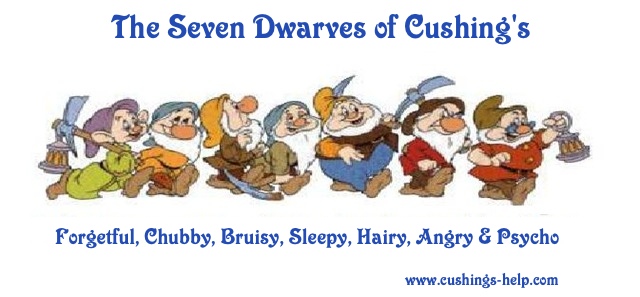
The Seven Dwarves of Cushing's

So, these are only seven of the many, many symptoms of Cushing’s.  I had those above – and I often felt like I looked like one of those little bearded dwarves.

Cushing’s affects every part of the body.  It’s not like when I had kidney cancer and only the kidney was affected.

Here are some of the many areas affected.

  • Progressive obesity and skin changes
  • Weight gain and fatty tissue deposits, particularly around the midsection and upper back, in the face (moon face) and between the shoulders (buffalo hump). Some symptoms such as sudden weight gain, are caused by excess cortisol. The excess cortisol in the body does not increase protein and carbohydrate metabolism. It slows or nearly disables metabolism function, which can cause weight gain (fat accumulation) in the buttocks, abdomen, cheeks, neck, or upper back.
  • Loss of muscle mass. Some areas of the body, such as the arms and legs, will remain thin.
  • Pink or purple stretch marks (striae) on the skin of the abdomen, thighs, breasts and arms
  • Thinning, fragile skin that bruises easily
  • Slow healing of cuts, insect bites and infections
  • Acne

Women with Cushing’s syndrome may experience:

  • Thicker or more visible body and facial hair (hirsutism)
  • Irregular or absent menstrual periods

Men with Cushing’s syndrome may experience:

  • Decreased libido
  • Decreased fertility
  • Erectile dysfunction

Other signs and symptoms include:

  • Fatigue
  • Muscle weakness
  • Depression, anxiety and irritability
  • Loss of emotional control
  • Cognitive difficulties
  • New or worsened high blood pressure
  • Glucose intolerance that may lead to diabetes
  • Headache
  • Bone loss, leading to fractures over time
  • Hyperlipidemia (elevated lipids – cholesterol – in the blood stream)
  • Recurrent opportunistic or bacterial infections
Think you have Cushing’s?  Get to a doctor and don’t give up!

MaryO
         MaryO