Endoscopic Pituitary Surgery – Remission Rates and Gland Preservation – Daniel F. Kelly, MD

2015 California Pituitary Conference

Dr. Daniel Kelly discusses the outcomes of endoscopic pituitary surgery with regards to endocrine function. He analyzes the current literature and the Pacific Brain Tumor Center’s experience with remission rates of hormone secreting tumors. He also evaluates the rate of pituitary dysfunction following pituitary tumor surgery.

If One Partner Has Cushing’s Syndrome, Can The Couple Still Get Pregnant?

Cushing’s syndrome can affect fertility in both men and women.

Women

The high levels of cortisol in Cushing’s syndrome disrupt a woman’s ovaries. Her menstrual periods may stop completely or become irregular. As a result, women with Cushing’s syndrome almost always have difficulty becoming pregnant.5,6,7 For those who do become pregnant, the risk of miscarriage is high.5,6,7

In rare cases, usually when a woman’s Cushing’s syndrome is caused by a benign adrenal tumor, pregnancy can occur, but it brings high risk for the mother and fetus.5,6,7

After a woman is treated for Cushing’s syndrome, her ovaries often recover from the effects of too much cortisol. Her regular menstrual cycles will return, and she can become pregnant.8

In some women, regular periods do not return after they are treated for Cushing’s syndrome. This occurs if surgery removes the part of the pituitary gland involved in reproduction.4 An infertility specialist can prescribe hormone therapy to bring back regular periods, ovulation, and fertility.8

Men

A man diagnosed with Cushing’s syndrome may have a decline in sperm production and could have reduced fertility.9 He also might experience a lowered sex drive as well as impotence (pronounced IM-puh-tuhns). In addition, some medications used to treat Cushing’s syndrome can reduce fertility.10 However, fertility usually recovers after Cushing’s syndrome is cured and treatment has stopped.9

Does Cushing’s syndrome affect pregnancy?

Cushing’s syndrome can cause serious and potentially life-threatening effects for the mother and the fetus during pregnancy.11,12 For example, Cushing’s syndrome raises a woman’s risk of developing pregnancy-related high blood pressure (called preeclampsia, pronounced pree-i-KLAMP-see-uh, or eclampsia) and/or pregnancy diabetes, which also is called gestational (pronounced je-STEY-shuhn-ul) diabetes). Infection and slow healing of any wounds are more likely, as is heart failure. When the syndrome is caused by a tumor, it will be surgically removed as early as possible to reduce any threat.13


  1. Margulies, P. (n.d.). Adrenal diseases—Cushing’s syndrome: The facts you need to know. Retrieved May 21, 2012, from National Adrenal Diseases Foundation website http://www.nadf.us/adrenal-diseases/cushings-syndrome/ External Web Site Policy
  2. Nieman, L. K., & Ilias, I. (2005). Evaluation and treatment of Cushing’s syndrome. Journal of American Medicine, 118(12), 1340-1346. PMID 16378774.
  3. American Cancer Society. (n.d.). Fact sheet on pituitary tumors. Retrieved May 19, 2012, fromhttp://documents.cancer.org/acs/groups/cid/documents/webcontent/003133-pdf.pdf (PDF – 171 KB). External Web Site Policy
  4. Biddie, S. C., Conway-Campbell, B. L, & Lightman, S. L. (2012). Dynamic regulation of glucocorticoid signalling in health and disease. Rheumatology, 51(3), 4034-4112. Retrieved May 19, 2012, from PMID: 3281495.
  5. Abraham, M. R., & Smith, C. V. (n.d.). Adrenal disease and pregnancy.Retrieved April 8, 2012, fromhttp://emedicine.medscape.com/article/127772-overview – aw2aab6b6. External Web Site Policy
  6. Pickard, J., Jochen, A. L., Sadur, C. N., & Hofeldt, F. D. (1990). Cushing’s syndrome in pregnancy. Obstetrical & Gynecological Survey, 45(2), 87-93.PMID 2405312.
  7. Lindsay, J. R., Jonklaas, J., Oldfield, E. H., & Nieman, L. K. (2005). Cushing’s syndrome during pregnancy: Personal experience and review of the literature. Journal of Clinical Endocrinology and Metabolism, 90(5), 3077.PMID 15705919.
  8. Klibansky, A. (n.d.). Pregnancy after cure of Cushing’s disease. Retrieved April 27, 2012, fromhttp://03342db.netsolhost.com/page/pregnancy_after_cure_of_cushings_disease.php. External Web Site Policy
  9. Jequier, A.M. Endocrine infertility. In Male infertility: A clinical guide (2nd ed.). Cambridge University Press, 2011: chap 20, pages 187-188. Retrieved May 19, 2012, from http://books.google.com/books?id=DQL0YC79uCMC&pg=PA188&lpg=PA188&dq=male+infertility+causes+and+treatment+Cushing&source=bl&ots=k1Ah5tVJC7&sig=WJR4N0wUawlh0Rant31QMPq6ufs&hl=en&sa=X&ei=hGe5T-LrHYSX6AHgrvmzCw&ved=0CGoQ6AEwAQ#v=onepage&q=male%20infertility%20causes%20and%20treatment%20Cushing&f=false. External Web Site Policy
  10. Stewart, P. M., & Krone, N. P. (2011). The adrenal cortex. In Kronenberg, H. M., Shlomo, M., Polonsky, K. S., Larsen P. R. (Eds.). Williams textbook of endocrinology (12th ed.). (chap. 15). Philadelphia, PA: Saunders Elsevier.
  11. Abraham, M. R., & Smith, C. V. Adrenal disease and pregnancy. Retrieved April 8, 2012, from http://emedicine.medscape.com/article/127772-overview – aw2aab6b6. External Web Site Policy
  12. Buescher, M. A. (1996). Cushing’s syndrome in pregnancy. Endocrinologist, 6, 357-361.
  13. Ezzat, S., Asa, S. L., Couldwell, W. T., Barr, C. E., Dodge, W. E., Vance M. L., et al. (2004). The prevalence of pituitary adenomas: A systematic review.Cancer, 101(3), 613-619. PMID 15274075.

From https://www.nichd.nih.gov/health/topics/cushing/conditioninfo/pages/faqs.aspx

Day Twenty, Cushing’s Awareness Challenge 2015

And today, we talk about pink jeeps and ziplines…

How in the world did we get here in a Cushing’s Challenge?  I’m sliding these in because earlier I linked (possibly!) my growth hormone use as a cause of my cancer – and I took the GH due to Cushing’s issues.  Clear?  LOL


I had found out that I had my kidney cancer on Friday, April 28, 2006 and my surgery on May 9, 2006.  I was supposed to go on a Cushie Cruise to Bermuda on May 14, 2006.  My surgeon said that there was no way I could go on that cruise and I could not postpone my surgery until after that cruise.


I got out of the hospital on the day that they left for the cruise and realized that I wouldn’t have been much (ANY!) fun and I wouldn’t have had any.

An especially amusing thread from that cruise is The Adventures of Penelopee Cruise.  Someone had brought a UFC jug and  decorated her and had her pose around the ship.  The beginning text reads:

Penelopee had a lovely time on Explorer of the Seas which was a five day cruise to Bermuda. She needed something to cheer her up since her brother, Tom, went off the deep end, but that’s another story!

Penelopee wanted to take in all of the sights and sounds of this lovely vessel. Every day she needed to do at least one special thing. Being a Cushie, she didn’t have enough spoons to do too much every day.

On the first day, she went sunning on the Libido deck……she didn’t last too long, only about 10 minutes. Goodness, look at her color! Do you think maybe her ACTH is too high?

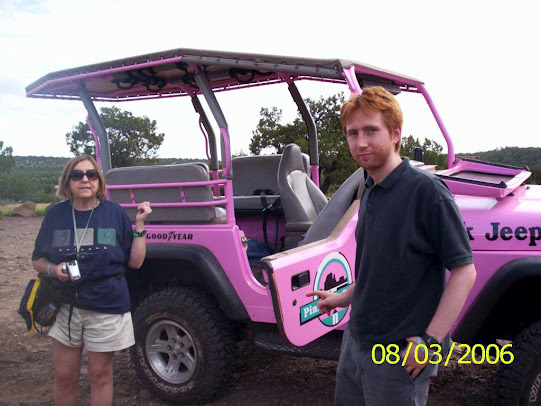
Although I missed this trip, I was feeling well enough to go to Sedona, Arizona in August, 2006.  I convinced everyone that I was well enough to go off-road in a pink jeep,  DH wanted to report me to my surgeon but I survived without to much pain and posed for the header image.

In 2009, I figured I have “extra years” since I survived the cancer and I wanted to do something kinda scary, yet fun. So, somehow, I decided on ziplining. Tom wouldn’t go with me but Michael would so I set this up almost as soon as we booked a Caribbean cruise to replace the Cushie Cruise to Bermuda.

Each person had a harness around their legs with attached pulleys and carabiners. Women had them on their chests as well. In addition, we had leather construction gloves and hard hats.

We climbed to the top of the first platform and were given brief instructions and off we went. Because of the heavy gloves, I couldn’t get any pictures. I had thought that they would take some of us on the hardest line to sell to us later but they didn’t. They also didn’t have cave pictures or T-Shirts. What a missed opportunity!

This was so cool, so much fun. I thought I might be afraid at first but I wasn’t. I just followed instructions and went.

Sometimes they told us to break. We did that with the right hand, which was always on the upper cable.

After the second line, I must have braked too soon because I stopped before I got to the platform. Michael was headed toward me. The guide on the end of the platform wanted me to do some hand over hand maneuver but I couldn’t figure out what he was saying so he came and got me by wrapping his legs around me and pulling me to the platform.

After that, no more problems with breaking!

The next platform was very high – over 70 feet in the air – and the climb up was difficult. It was very hot and the rocks were very uneven. I don’t know that I would have gotten to the next platform if Michael hadn’t cheered me on all the way.

We zipped down the next six lines up to 250-feet between platforms and 85-feet high in the trees, at canopy level. It seemed like it was all over too soon.

But, I did it! No fear, just fun.

Enough of adventures – fun ones like these, and scary ones like transsphenoidal surgery and radical nephrectomy!


Day Twelve, Cushing’s Awareness Challenge 2015

Today’s Cushing’s Awareness Challenge post is about kidney cancer (renal cell carcinoma). You might wonder how in the world this is related to Cushing’s. I think it is, either directly or indirectly.

I alluded to this yesterday when I said:

I finally started the Growth Hormone December 7, 2004.
Was the hassle and 3 year wait worth it?
Stay tuned for tomorrow, April 12, 2015 when all will be revealed.

So, as I said, I started Growth Hormone for my panhypopituitarism on December 7, 2004.  I took it for a while but never really felt any better, no more energy, no weight loss.  Sigh.

April 14 2006 I went back to the endo and found out that the argenine test that was done in 2004 was done incorrectly. The directions were written unclearly and the test run incorrectly, not just for me but for everyone who had this test done there for a couple years. My endo discovered this when he was writing up a research paper and went to the lab to check on something.

So, I went off GH again for 2 weeks, then was retested. The “good news” was that the argenine test is only 90 minutes now instead of 3 hours.

Wow, what a nightmare my argenine retest started! I went back for that Thursday, April 27, 2006. Although the test was shorter, I got back to my hotel and just slept and slept. I was so glad that I hadn’t decided to go home after the test.

Friday I felt fine and drove back home, no problem. I picked up my husband for a biopsy and took him to an outpatient surgical center. While I was there waiting for the biopsy to be completed, I started noticing blood in my urine and major abdominal cramps.

There were signs all over that no cellphones were allowed so I sat in the restroom (I had to be in there a lot, anyway!) and I left messages for several of my doctors on what I should do. It was Friday afternoon and most of them were gone 😦  I finally decided to see my PCP after I got my husband home.

When Tom was done with his testing, his doctor took one look at me and asked if I wanted an ambulance. I said no, that I thought I could make it to the emergency room ok – Tom couldn’t drive because of the anaesthetic they had given him. I barely made it to the ER and left the car with Tom to park. Tom’s doctor followed us to the ER and instantly became my new doctor.

They took me in pretty fast since I was in so much pain, and had the blood in my urine. At first, they thought it was a kidney stone. After a CT scan, my new doctor said that, yes, I had a kidney stone but it wasn’t the worst of my problems, that I had kidney cancer. Wow, what a surprise that was! I was admitted to that hospital, had more CT scans, MRIs, bone scans, they looked everywhere.

My new “instant doctor” felt that he wasn’t up to the challenge of my surgery, so he called in someone else.  My next new “instant doctor” came to see me in the ER in the middle of the night.  He patted my hand, like a loving grandfather might and said “At least you won’t have to do chemotherapy”.  And I felt so reassured.

It wasn’t until later, much after my surgery, that I found out that there was no chemo yet that worked for my cancer.  I was so thankful for the way he told me.  I would have really freaked out if he’d said that nothing they had was strong enough!

My open radical nephrectomy was May 9, 2006 in another hospital from the one where the initial diagnosis was made. My surgeon felt that he needed a specialist from that hospital because he believed preop that my tumor had invaded into the vena cava because of its appearance on the various scans. Luckily, that was not the case.

My entire left kidney and the encapsulated cancer (10 pounds worth!) were removed, along with my left adrenal gland and some lymph nodes. Although the cancer (renal cell carcinoma AKA RCC) was very close to hemorrhaging, the surgeon believed he got it all.

He said I was so lucky. If the surgery had been delayed any longer, the outcome would have been much different. I will be repeating the CT scans every 3 months, just to be sure that there is no cancer hiding anywhere. As it turns out, I can never say I’m cured, just NED (no evidence of disease). This thing can recur at any time, anywhere in my body.

I credit the argenine re-test with somehow aggravating my kidneys and revealing this cancer. Before the test, I had no clue that there was any problem. The argenine test showed that my IGF is still low but due to the kidney cancer I couldn’t take my growth hormone for another 5 years – so the test was useless anyway, except to hasten this newest diagnosis.

So… either Growth Hormone helped my cancer grow or testing for it revealed a cancer I might not have learned about until later.

My five years are up now.  My kidney surgeon *thinks* it would be ok to try the growth hormone again.  I’m still a little leery about this, especially where I didn’t notice that much improvement.


What to do?


Day Eleven, Cushing’s Awareness Challenge 2015

UVA 2004
Cushing’s Conventions have always been special times for me – we learn a lot, get to meet other Cushies, even get referrals to endos!

As early as 2001 (or before) my pituitary function was dropping.  My former endo tested annually but did nothing to help me with the symptoms.

In the fall of 2002 my endo refused to discuss my fatigue or anything at all with me until I lost 10 pounds. He said I wasn’t worth treating in my overweight condition and that I was setting myself up for a heart attack. He gave me 3 months to lose this weight. Those 3 months included Thanksgiving, Christmas and New Years.  Needless to say, I left his office in tears, again.

Fast forward 2 years to 2004.  I had tried for awhile to get my records from this endo. He wouldn’t send them, even at doctors’ or my requests.

I wanted to go see Dr. Vance at UVa but I had no records so she would’t see me until I could get them.

Finally, my husband went to the former endo’s office and threatened him with a court order. The office manager managed to come up with about 13 pages of records. For going to him from 1986 to 2001 including weeks and weeks at NIH and pituitary surgery, that didn’t seem like enough records to me.

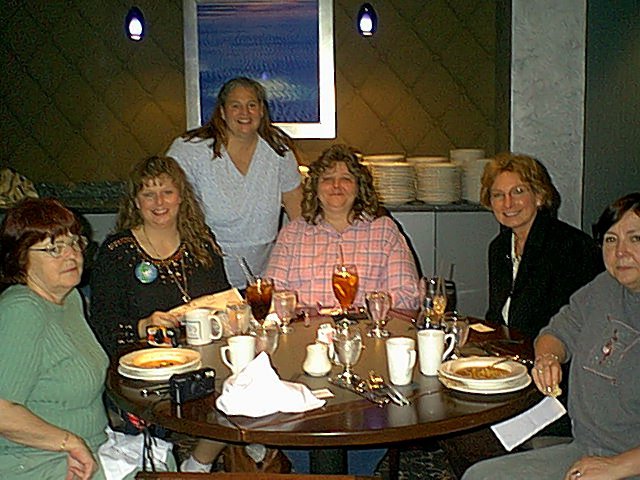
In April of 2004, many of us from the message boards went to the UVa Pituitary Days Convention. That’s where the picture above comes in.  Other pictures from that convention are here.

By chance, we met a wonderful woman named

Read Barbara Craven. She sat at our table for lunch on the last day and, after we learned that she was a dietitian who had had Cushing’s, one of us jokingly asked her if she’d do a guest chat for us. I didn’t follow through on this until she emailed me later. In the email, she asked how I was doing. Usually I say “fine” or “ok” but for some reason, I told her exactly how awful I was feeling.

Barbara emailed me back and said I should see a doctor at Johns Hopkins. I said I didn’t think I could get a recommendation to there, so SHE referred me. The doctor got right back to me, set up an appointment. Between his vacation and mine, that first appointment turned out to be Tuesday, Sept 14, 2004.

Just getting through the maze at Johns Hopkins was amazing. They have the whole system down to a science, moving from one place to another to sign in, then go here, then window 6, then… But it was very efficient.

My new doctor was wonderful. Understanding, knowledgeable. He never once said that I was “too fat” or “depressed” or that all this was my own fault. I feel so validated, finally.

He looked through my records, especially at my 2 previous Insulin Tolerance Tests. From those, he determined that my growth hormone has been low since at least August 2001 and I’ve been adrenal insufficient since at least Fall, 1999 – possibly as much as 10 years! I was amazed to hear all this, and astounded that my former endo not only didn’t tell me any of this, he did nothing. He had known both of these things – they were in the past records that I took with me. Perhaps that was why he had been so reluctant to share copies of those records. He had given me Cortef in the fall of 1999 to take just in case I had “stress” and that was it.

The new endo took a lot of blood (no urine!) for cortisol and thyroid stuff. I went back on Sept. 28, 2004 for arginine, cortrosyn and IGF testing.

He said that I would end up on daily cortisone – a “sprinkling” – and some form of GH, based on the testing the 28th.

For those who are interested, my new endo is Roberto Salvatori, M.D.
Assistant Professor of Medicine at Johns Hopkins

Medical School: Catholic University School of Medicine, Rome, Italy
Residency: Montefiore Medical Center
Fellowship: Cornell University, Johns Hopkins University
Board Certification: Endocrinology and Metabolism, Internal Medicine

Clinical Interests: Neuroendocrinology, pituitary disorders, adrenal disorders

Research Interests: Control of growth hormone secretion, genetic causes of growth hormone deficiency, consequences of growth hormone deficiency.

Although I have this wonderful doctor, a specialist in growth hormone deficiency at Johns Hopkins, in November, 2004, my insurance company saw fit to over-ride his opinions and his test results based on my past pharmaceutical history! Hello??? How could I have a history of taking GH when I’ve never taken it before?

Of course, I found out late on a Friday afternoon. By then it was too late to call my case worker at the drug company, so we had to appeal on Monday. My local insurance person also worked on an appeal, but the whole thing was  just another long ordeal of finding paperwork, calling people, FedExing stuff, too much work when I just wanted to start feeling better by Thanksgiving.

As it turned out the insurance company rejected the brand of hGH that was prescribed for me. They gave me the ok for a growth hormone was just FDA-approved for adults on 11/4/04. The day this medication was approved for adults was the day after my insurance said that’s what is preferred for me. In the past, this form of hGH was only approved for children with height issues. Was I going to be a ginuea pig again?

The new GH company assigned a rep for me, submitted info to pharmacy, and waited for insurance approval, again.

I finally started the Growth Hormone December 7, 2004.

Was the hassle and 3 year wait worth it?

Stay tuned for tomorrow, April 12, 2015 when all will be revealed.

Read

Read Dr. Barbara Craven’s Guest Chat, October 27, 2004

Thanks for reading 🙂

MaryO