Myth: “Vitamins and Natural Remedies can cure/heal Cushing’s”

myth-busted


More from Dr. Karen Thames:

Myth: “Vitamins and Natural Remedies can cure/heal Cushing’s”

Fact: Do you know how many people have told me that if I just “juice”, I will be cured from Cushing’s or Adrenal Insufficiency?! I appreciate the sentiment, but the sad reality is that no amount of juicing and no vitamin will cure Cushing’s. Some Cushing’s patients do take vitamins, some do eat raw food or paleo diets, and some even juice. However, this is just a lifestyle choice and not an attempt to cure Cushing’s. I must admit that when you have such a dreadful disease, you do sometimes take desperate measures to heal yourself. Perhaps, doing acupuncture or some other form of natural healing technique seems attractive at times. Take it from a person who has had acupuncture, seen many natural doctors, juiced, took vitamins, ate a raw food diet, and yes, I EVEN did a series of colonics! If you have ever had colonics, you know that it brings new meaning to the phrase, “no pain, no gain!”

Seriously, this is all before I knew I had Cushing’s. I watched as every person who administered the different kinds of treatment scratched their heads as I continued to gain weight, eventually at a rate of 5 pounds per week! They couldn’t believe that I was actually still gaining weight. Their natural and not surprising response, of course, was to project blame onto me. “Karen, there is NO way you are following protocol! You MUST be lying on your food log!” What we all didn’t realize is that I was suffering from a life-threatening illness called Cushing’s Disease that caused morbid obesity in me and that none of those “remedies” would EVER work!

Now, I have already been in Twitter wars over this topic. Someone tried to tell me that a raw food diet will “cure Cushing’s” and then she told me that I am “ignorant and in denial”! She proceeded to tell me that her daughter, though she had surgery to treat Cushing’s, was REALLY cured because of changing her diet. She also told me that the daughter, who had her Adrenal Glands removed, didn’t need steroids. Listen folks, this is VERY dangerous! I have no adrenal glands and I NEED steroids! Cortisol is life sustaining and you will die without it! I fully expect that someone will argue this point until the cows come home. It doesn’t matter. It won’t change the facts. Cushing’s is caused by excess cortisol in the body. The ONLY treatment is to target the source of the excess cortisol (i.e.brain tumor, adrenal tumor, ectopic tumor, or prolonged steroid use for another disease). Targeting the source is the first line of treatment. Cushing’s Syndrome/Disease will lead to death if not treated properly! #BattlegroundDiagnosis

Disclaimer: I am not a medical doctor. Please seek the advice of a medical professional if you have questions or need further assistance.

If you want to follow our documentary, please go to http://www.Facebook.com/Hug.A.Cushie

Myth: Even Though You Are Chronically Ill, You Should Have The Same Amount Of Energy Every Day,,,

myth-busted


Myth: Even though you are chronically ill, you should have the same amount of energy every day. “You look SO good and you went to that party last month! Why can’t you come to MY party?!” When you say you are not well enough to do something, you are just making excuses. You could do it, just like you did that other thing; you are just choosing not to!


Fact: You may have heard me talk about “The Spoon Theory”. It was created by someone named Christine Miserandino, to explain the experience of someone with chronic illness in terms of using energy to live and to complete tasks every day. Though the myth assumes that one should have the same amount of energy all the time; the fact is that energy levels fluctuate and people who are chronically ill must make conscious decisions about what they can spend their energy on.

Christine Miserandino (2010) uses the spoon theory to answer the question, “What does it feel like to be sick?” The spoons serve as a symbol for resources available and energy spent to get through every moment of every day. Miserandino states that “The difference in being sick and being healthy is having to make choices or to consciously think about things when the rest of the world doesn’t have to”. Most people who get sick feel a loss of a life they once knew. When you are healthy, you expect to have a never ending supply of spoons. But, when you are not well, you need to count your spoons to keep track and you can never forget about it or take it for granted. Each task costs a spoon and each spoon is not to be taken for granted. Miserandino (2010) asks, “Do you know how many spoons people waste every day?”

Patients use the metaphor of a banking system. In this system, patients must make a withdrawal of a spoon every time they complete a task. Cushing’s and Adrenal Insufficiency patients talk about the “Cortisol Bank” metaphor. The concept is the same and the idea is that certain stressors and/or tasks cause one’s body to make a cortisol withdrawal from the body. Bad things happen when there is a cortisol deficit, meaning that there is not enough cortisol in the body for one to live everyday because of the amount of cortisol that has already been used up. If a person continues to draw from the bank on an account that is already negative, the situation can become worse and worse as each day passes.

Something needs to happen in order to start making appropriate deposits. This can include, taking more medication (stress dosing or an emergency shot), resting, getting adequate physical and emotional support and help, and saying “NO!”. Even when in a deficit, many patients have a difficult time saying “no” to an invitation to an event, completing a task, or engaging someone in a way that will use up more energy because of their fear of their loved one’s reactions. Much of the time, this fear is warranted because of the actual reactions they have received. Ever heard, “But you volunteered for the bake sale last week! You must be better! Why can’t you come to church this week?!”. You may have heard something similar.

It is important for loved ones to understand the amount of “spoons” it takes for a chronically ill person just to get through every single day. EVERYTHING costs spoons! The amount of spoons paid by each person varies from person to person. It all depends on that individual’s situation, body, level of illness, etc. What is common for all, though, is that spoons must be used and eventually those spoons run out. In order to avoid becoming sick or to recuperate from getting sick, the chronically ill patient must evaluate how he/she will use spoons and what tasks can be feasibly completed that day or week. Please understand that when the chronically ill patient says, “YES” to you; he/she is making a conscious choice to use up spoons to meet your need, request, or demand. Talking on the phone, going out to lunch, making dinner, coming to your event all required a sacrifice of another task that day or week. Your friend may have come to lunch with you but that required that she skipped washing the dishes that day or washing her hair, or is even giving up doing something important the next day. Instead of being angry at your friend, please consider why the request is denied at times.

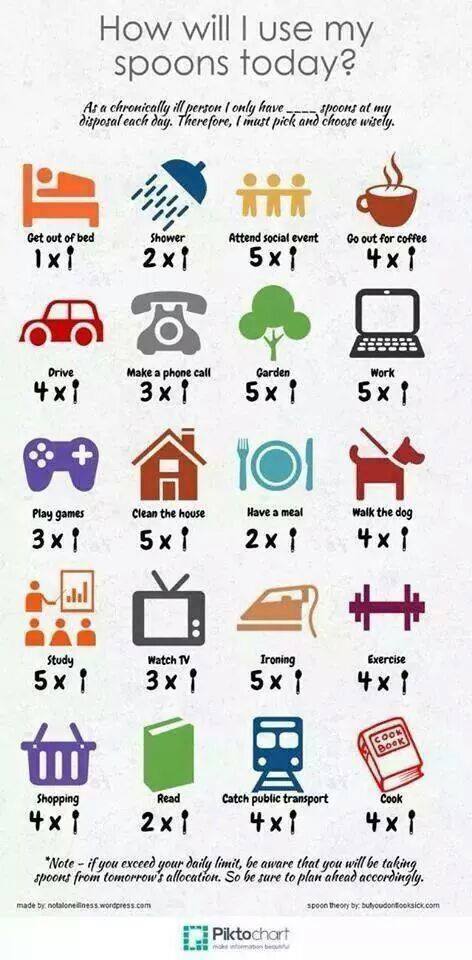
spoons-mythsRefer to the attached picture. This is not an exact science but gives some idea of the spoon bank. If you have time, try doing this exercise: Lay out 8-12 physical spoons. As you complete certain tasks throughout the day, use this chart to subtract spoons from your pile.

Each and every thing requires a spoon. Taking a shower, washing your hair, cooking, cleaning, watching a movie, going out to lunch, working, writing this post (Ha)! When you are done with your day, notice how many spoons you have left. Observe your feelings after this exercise. You can even do it for a week. Lay out a certain amount of spoons for every day for seven days. If you go into a deficit, borrow spoons from the following day. However, if you do borrow spoons; you must take away a task that you WERE planning to originally do that day. Notice what happens and notice how you feel at the end of the week.

You can view “The Spoon Theory” in its entirety at: http://www.butyoudontlooksick.com/articles/written-by-christine/the-spoon-theory/

Can you think of any other tasks that are not on this chart? Help our friends who are doing the activity. List those tasks and assign how many spoons each task will require.
Spoon Bank
Get out of bed- 1 Spoon
Shower- 2 Spoons
Attend Special Event- 5 Spoons
Go out for Coffee- 4 Spoons
Drive- 4 Spoons
Make a Phone Call- 3 Spoons
Work- 5 spoons
Play Games-3 Spoons
Clean the House- 5 Spoons
Have a Meal- 2 Spoons
Walk the Dog- 4 Spoons
Study- 5 Spoons
Watch TV- 3 Spoons
Ironing- 5 Spoons
Exercise- 4 Spoons
Shopping- 4 Spoons
Read- 2 Spoons
Catch Public Transport- 4 Spoons
Cook- 4 Spoons

HOME | Sitemap | Adrenal Crisis! | Abbreviations | Glossary | Forums | Donate | Bios | Add Your Bio

Myth: “All Cushing’s patients have the exact same symptoms

Myth: “All Cushing’s patients have the exact same symptoms and the level of illness is the same for everyone. If you do not have ALL of the classic symptoms of Cushing’s, then you must NOT have Cushing’s Syndrome/Disease!”

myth-busted

Fact: Everyone does NOT have the exact same symptoms. Not all Cushing’s patients are exactly the same. This is one mistake that non experts tend to make in terms of categorizing patients by whether they meet the exact same classic symptoms or not. Experts have come to learn that each patient should be treated individually. Though there are symptoms that are more prominent in the Cushing’s population, not every patient has to meet every single symptom in order to meet criteria for Cushing’s.

For instance, not all Cushing’s patients become overweight. Everyone does not gain the same amount of weight. There are various theories as to why. One issue is that different patients are diagnosed at different stages of the illness. We know that patients tend not to be diagnosed at the onset of the illness because of doctors’ misconception that Cushing’s patients must be extremely obese to have the disease. So, patients who have not gained as much weight may not be listened to until after the weight has gotten out of control. However, there ARE patients who are diagnosed early enough where there has not been a tremendous amount of weight gain.

I (Karen Ternier Thames), for one, started trying to get help after gaining my first 30 pounds because I KNEW that something was wrong with my body. Had I received an appropriate diagnosis, I probably would not have gained the 150 pounds I ended up gaining in 5 years.

Regardless of the reason, it is a myth that all Cushing’s patients gain the same amount of weight. The following are other additional reasons that an endocrinologist gave me for supposedly not meeting the criteria for Cushing’s when I was misdiagnosed: “1. Your stretch marks are not purple enough”, 2. “Your buffalo hump is not large enough”, 3. “You are not THAT fat!”, 4. “Cushing’s patients do NOT have children”, and 5. ” your face does not look like a classic moon face”. These are some of the reasons why, 2 years earlier, this same doctor dismissed apparently high cortisol levels, and didn’t even tell me, leading to several more years of suffering!

So, not all Cushing’s patients are obese, not all Cushing’s patients gain the same weight at the same rate, not all Cushing’s patients have the same size buffalo hump or the same round moon face. There are variations in these symptoms. IF you are experiencing extreme changes in your body regardless of diet and exercise and its not influenced by external factors, then it is time to speak up!

It is important to raise concern with your doctor if you do have ANY Cushing’s symptoms. Please do not be inhibited if you do not show every single symptom!

Myth: “Men1 and Men2 are the only genetic causes of Cushing’s”

Myth: “Men1 and Men2 are the only genetic causes of Cushing’s”

myth-busted

FACT: This is a Myth. More current research has explored multiple etiologies of Cushing’s. It was once thought that heredity had no influence on the development of Cushing’s Syndrome/Disease and our knowledge was once limited in this sense. Researchers have done more work in terms of exploring genetic factors in the onset of this disease. *~Robin Ess (Cushing’s educator and advocate)

The following causes for Cushing’s have all been explored:

1. Men 1

2. Men2

3. FIPA

4. CAH/BAH

5. PRKAR1A(protein kinase,cAMP-dependent, regulatory, type I, ? gene)

http://www.medscape.org/viewarticle/564106_2

6.(PDE11A)

http://www.medscape.org/viewarticle/564106_4

http://www.medscape.org/viewarticle/564106_6

7.PRKACA

http://www.nature.com/nrendo/journal/v10/n8/pdf/nrendo.2014.89.pdf?WT.ec_id=NRENDO-201408

http://www.ncbi.nlm.nih.gov/pubmed/24700472

http://www.nature.com/ng/journal/v46/n6/full/ng.2956.html

https://www.genomeweb.com/sequencing/exome-sequencing-study-narrows-new-cushings-syndrome-gene-culprit

8.ARMC5

http://www.sciencedaily.com/releases/2014/10/141013090455.htm

http://www.nejm.org/doi/full/10.1056/NEJMoa1304603

Myth: UFC’s are the Gold Standard for Cushing’s testing

Myth: UFC’s are the Gold Standard for Cushing’s testing

myth-busted

Fact: UFC stands for Urinary Free Cortisol. In layman’s terms this test assesses cortisol by collecting urine for 24 hours. It was once thought that this was the gold standard and the end all and be all in terms of assessing Cushing’s in a patient. What we now know is that this is not necessarily true. Though this test is helpful in assessing for Cushing’s in some patients, not all patients have positive labs with this test, even if they DO, in fact, have Cushing’s.

There are various theories as to why. Cyclical Cushing’s patients also tend to report having a lower prevalence of positive UFCs in their test batteries.

Cushing’s experts understand that the most effective way to test for Cushing’s, especially in cases where it is suspected that the patient is cycling, is to administer multiple test measures across an extended period of time.

The following links may be helpful:

http://www.ncbi.nlm.nih.gov/pmc/articles/PMC2978784/

Click to access LimitationsSC_UFC_dex_mildCS.pdf

http://survivethejourney.blogspot.com/2008/08/when-gold-standard-becomes-tarnished.html