Risk Comparison and Assessment Model of Deep Vein Thrombosis in Patients with Pituitary Adenomas After Surgery

Abstract

Background

Deep vein thrombosis (DVT), a major component of venous thromboembolism (VTE), is a common postoperative complication. Its occurrence after pituitary adenoma surgery is influenced by multiple factors.

Methods

This retrospective study analyzed 1440 pituitary adenoma cases treated at Beijing Tiantan Hospital (2018–2023). The incidence of postoperative DVT was recorded, and logistic regression was used to identify associated risk factors. Differences across pituitary adenoma subtypes were compared. Additionally, Regression and machine learning models were developed to predict DVT.

Results

Among 397 patients who underwent postoperative lower limb ultrasound, 104 (7.2 %) developed DVT. Significant risk factors included advanced age, higher body mass index (BMI), intravenous cannulation, prolonged hospital stay, shorter preoperative activated partial thromboplastin time (APTT), longer thrombin time (TT), elevated platelet count, and higher postoperative D-dimer levels. Patients with Cushing’s disease exhibited a significantly higher DVT incidence, potentially related to decreased pre- and postoperative APTT and PT/INR values. Conversely, patients with prolactin-secreting adenomas had a lower DVT incidence, possibly due to younger age and higher postoperative PT values. A support vector machine (SVM) model showed strong predictive performance (AUC: 0.82; accuracy: 86.08 %; specificity: 96.72 %).

Conclusion

DVT incidence varies by pituitary adenoma subtype. Machine learning enhances predictive models for postoperative DVT in pituitary adenoma patients.

Introduction

Venous thromboembolism (VTE), encompassing both deep vein thrombosis (DVT) and pulmonary embolism, is a common cardiovascular disorder. It typically presents with clinical symptoms such as lower limb swelling, chest pain, tachypnea, and, in severe cases, may result in fatal outcomes [1]. The development of VTE is influenced by three factors known as the Virchow triad: altered venous blood flow, endothelial or vessel wall damage, and hypercoagulability [2]. Surgical procedures can increase the risk of VTE, particularly DVT in the lower extremities, due to intraoperative injuries and postoperative hemodynamic changes [[3], [4], [5]]. In the absence of anticoagulant prophylaxis, the incidence of VTE following brain tumor surgery ranges from 3 % to 30 % [[6], [7], [8]]. Although pituitary adenomas are commonly considered benign cranial tumors, emerging evidence suggests that patients undergoing resection of pituitary adenomas may have a higher risk of postoperative VTE compared to those with other sellar or parasellar tumors such as craniopharyngiomas, meningiomas, or chordomas [9].
This disparity may be attributed to the unique hormone secretion functions of pituitary adenomas, as well as dysregulation of water and electrolyte balance—following surgery. Despite this, the risk factors contributing to the development of postoperative VTE in pituitary adenomas have not been extensively explored. Limited studies have identified a particularly elevated VTE risk in patients with Cushing’s disease, a hormone-secreting subtype of pituitary adenoma [10]. Given the relatively high incidence of postoperative DVT in this population, the present study aims to systematically investigate risk factors associated with lower extremity DVT after pituitary adenoma surgery. Furthermore, we seek to compare thrombotic risk across different clinical subtypes of pituitary adenomas and to construct a tailored risk prediction model to guide perioperative thromboprophylaxis in affected patients.

A Preliminary Model to Tailor Osilodrostat In Patients With Adrenocorticotropic Hormone (ACTH)-Dependent Cushing’s syndrome

Abstract

Over the past 10 years, osilodrostat has become one of the most commonly used steroidogenesis inhibitors in patients with Cushing’s syndrome. The starting dose is usually determined based on the product characteristics, the prescriber’s experience, and cortisol levels. However, no study has attempted to determine whether there was a dose–response relationship between osilodrostat and cortisol reduction. In this study, we developed a preliminary kinetic–pharmacodynamic model to tailor osilodrostat in patients with Adrenocorticotropin hormone (ACTH)-dependent Cushing’s syndrome. We first analyzed the decrease in cortisol 48 hours after initiation or dose change of osilodrostat in 18 patients. Simulations were then performed for different doses of osilodrostat to evaluate the variation in cortisol concentrations. Our results report the first dose–response relationship between osilodrostat dose and cortisol levels, which should be helpful in identifying the optimal dosing regimen in patients with Cushing’s syndrome and in individualizing treatment to approximate a nychthemeral rhythm.

Significance

The current preliminary study is a first step in trying to better understand the effect of osilodrostat on cortisol, which should help determine the optimal dose for each patient.

Introduction

Cushing’s syndrome is a rare condition in which increased cortisol levels lead to a wide range of comorbidities and increased mortality. Surgery is usually regarded as the first-line and most effective treatment.1 In some cases, cortisol-lowering drugs are necessary, mainly after failed surgery.2,3 Among several steroidogenesis inhibitors such as ketoconazole and metyrapone,4,5 osilodrostat, which acts through inhibition of 11β-hydroxylase, is now being considered an effective drug in controlling cortisol hypersecretion. Initially designed as a CYP11B2 inhibitor, the study by Ménard et al.6 involving both animal models and healthy human subjects showed that osilodrostat reduced cortisol levels from a dose of 1 mg/day, while lower doses exerted an anti-aldosterone effect. Since then, several clinical trials and retrospective studies emphasized its efficacy in all etiologies of Cushing’s syndrome.7-9 While the usual recommended starting dose is 2 mg twice a day, precise studies on the short-term effect of osilodrostat on plasma cortisol are lacking. These data could, however, be of interest to tailor the treatment. Moreover, baseline urinary free cortisol (UFC) level is not able to predict response to osilodrostat.10 Taking advantage of serial cortisol measurements performed in inpatient clinics in our center at the time osilodrostat became available, we developed a pharmacokinetic (PK)/pharmacodynamic model of plasma cortisol variation as a function of osilodrostat dose in patients with Adrenocorticotropin-hormone (ACTH)-dependent Cushing’s syndrome.

Patients and methods

Clinical data and hormonal measurements

We retrospectively included patients with ACTH-dependent Cushing’s syndrome, who had serial measurements of plasma cortisol (every 4 hours for 24 hours) before and after the first osilodrostat dose between 2019 and 2024. These measurements were part of our standard of care approach when osilodrostat became available in our tertiary expert center as a thorough evaluation of the efficacy and tolerance of a new drug. The initial dose ranged from 2 to 15 mg/day, depending on the severity of hypercortisolism. Subsequently, osilodrostat dose was gradually adjusted based on the successive cortisol measurements described above. Sex, age at diagnosis, and etiologies were recorded, as well as plasma cortisol measurements 48 hours after the initiation or any change in the osilodrostat dose and time elapsed since change of dose and last administration were recorded. All plasma cortisol measurements were performed with the same Elecsys II Cortisol, Cobas (Roche Diagnostics) assay in the hormonal laboratory of our center; cross-reactivity with 11-deoxycortisol is 4.9%. According to our institutional policy, this retrospective study did not require specific signed informed consent from patients as the data collected were anonymized. It was thus approved by the Ethics Committee of Assistance Publique—Hopitaux de Marseille (RGPD PADS reference RUXXX2). The current study complies with the Declaration of Helsinki.

Pharmacokinetics and statistical analysis

The pharmacodynamic parameters of osilodrostat on cortisol concentrations were analyzed using a kinetic–pharmacodynamic (PD) model in the software Nonlinear Mixed Effects Modeling version 7.4 (NONMEM Icon Development Solutions, Ellicott City, MD, United States). PK analysis from a previously published study6 was used to predict plasma concentration in our patients. The PK parameters were described in the article, and mean concentration values were obtained by digitizing the graph of osilodrostat vs time using the software WebPlotDigitizer version 4.2.11 With these data, a one-compartment population PK model was used to predict osilodrostat concentrations for different dosing regimens. Direct and indirect relationship between osilodrostat-predicted concentration and variation of cortisol concentrations were evaluated to consider a delay. The variation of cortisol concentrations was calculated with reference to a session without treatment. Several functions were tested to describe the relationship such as linear and sigmoidal. Model selection and evaluation were done by the likelihood ratio test (objective function), goodness-of-fit plots (observed vs predicted variation of cortisol concentrations, observed vs individual predictions, normalized prediction distribution errors vs time and variation of cortisol predictions), bootstrap, and visual predictive checks. Graphical analysis was performed with the R software version 4.4.012 using the ggplot2 package.13 Simulations were performed for different doses of osilodrostat to evaluate the variation on cortisol concentrations using the package rxode2.14

Results

Of the patients who were prescribed osilodrostat at least once between 2019 and 2024, 18 were presenting ACTH-dependent Cushing’s syndrome, 12 women (66.6%) and 6 men (33.3%). Mean age was 53.2 ± 15 years. The cause of Cushing’s syndrome was Cushing’s disease in 16 patients (88.9%), ectopic ACTH secretion in 1 patient (5.6%), and ACTH-dependent hypercortisolism of uncertain diagnosis in 1 patient (5.6%). Clinical characteristics are presented in Table 1. It should be noted that none of the patients included were Asian.


Table 1.

Clinical characteristics of patients with all included patients and differentiated according to gender.

All patientsa Women Men
Age at diagnosis 53.2 ± 15 54 ± 17.2 51.5 ± 10.5
Weight 81.7 ± 13.7 79.5 ± 12.7 86.2 ± 15.6
% of CD 88.9 83.3 100
ULN of 24 hour UFC 4.4 ± 8.3 5.5 ± 10.3 2.5 ± 1.8
Osilodrostat starting dose 3.3 ± 2.2 3.7 ± 2.4 2.5 ± 1.4
Cortisol before osilodrostat intake 422.9 ± 159.2 414.7 ± 176.6 439.4 ± 130.7
Cortisol 4 hour after osilodrostat 404 ± 165.6 408.2 ± 200.1 395.5 ± 70.8


Abbreviations: CD, Cushing’s disease; ULN, upper limit range; UFC, urinary free cortisol.

aOf note, none of the included patients were Asian.

In their article, Ménard et al.6 showed that the dose–exposure relationship was not strictly proportional. A one-compartment model was enhanced by increasing the relative bioavailability with the dose and was estimated that the dose resulting in a 50% increase in bioavailability was 1.06 mg. The PK parameters derived from Ménard et al.6 were fixed and used to predict osilodrostat concentration in our patients. A direct relationship between the predicted osilodrostat concentrations and variation of cortisol concentrations (%) gave a better fit than an indirect model. The drug effect was modeled with the following sigmoidal function (Eq. 1);

(1)

where Imax is the maximal inhibition and IC50 is the apparent half-maximal inhibitory concentration.

The estimated PD parameters were IC50 and Imax. Their values as well as the relative standard errors (RSE%) and the corresponding bootstrap IC50 are shown in Table 2. Final parameters were used to simulate n = 500 profiles following a single dose of osilodrostat.


Table 2.

Pharmacodynamic parameters of osilodrostat’s effects on the variation of cortisol concentrations.

Parameters Unit Estimation RSE% Bootstrap
0.025 0.975
KA (fixed)a 1/hour 4.03
CL/F (fixed)a L/hour 18.3
V/F (fixed)a L 125
Imax % 44.5 18.7 12.51 90.9
IC50 mg/L 0.011 37.4 0.0001 0.10
Interindividual variability (ω)
 Imax 0.40 30.9 0.003 1.86
 IC50 3.78 41.0 0.003 9.22
Residual unexplained variability (σ)
 Additive % 23.8 12.2 18.2 29.9


Abbreviations: CL/F, apparent clearance; IC50, osilodrostat concentration associated with half the maximal inhibition of the cortisol variation; Imax, maximum inhibitory effect of osilodrostat on the variation of cortisol; KA, first-order absorption rate constant; RSE, relative standard error; V/F, apparent volume of distribution.


aAdapted from Ménard et al.6

The effects on plasma cortisol variation are depicted in Figure 1. Cortisol concentration declines during the first hour after taking osilodrostat, from 24% for a 1 mg dose to over 42% for a 20 mg dose. Thereafter, from the first hour onward, cortisol increases progressively, with loss of treatment efficacy occurring around the 10th-15th hour for 1 and 2 mg, while for doses above 5 mg, a moderate effect persists over the following hours. Figure 2 shows the variation in cortisol concentration for a 2 mg dose, with median decrease in cortisol variation of 31%, ranging from 0% to 67.5%, with, as mentioned above, a maximum effect 1 hour after osilodrostat intake, and a progressive increase in cortisol levels, mainly during the 12 hours following treatment. The same analysis for 10 mg revealed a median reduction in cortisol of 38%, ranging from 5% to 80%. Figure 3 describes the relationship between osilodrostat concentration and cortisol variation, showing that the maximum effect corresponds to the maximum concentration and that a decrease in osilodrostat concentration results in an increase in cortisol level.

Relationship between time since last administration of osilodrostat and cortisol concentrations.

Figure 1.

Relationship between time since last administration of osilodrostat and cortisol concentrations.

Visual predictive variation on cortisol concentrations following 2 or 10 mg osilodrostat administration.

Figure 2.

Visual predictive variation on cortisol concentrations following 2 or 10 mg osilodrostat administration.

Relation between osilodrostat concentration and cortisol variation.

Figure 3.

Relation between osilodrostat concentration and cortisol variation.

Discussion

To the best of our knowledge, this is the first study that attempts to define a dose/efficacy relationship between osilodrostat dose and the variation of plasma cortisol. First, our results suggest that the effect of osilodrostat appears immediately after the peak of concentration, 1 hour after treatment intake, which highlights the parallel evolution of osilodrostat and cortisol concentrations. This is unusual, as typically effect peak takes few hours, following concentration peak.15 The relationship between osilodrostat concentration and the effect on cortisol is not linear but sigmoidal with a rapid increase in concentrations producing a rapid significant effect, leading to a maximal effect. Because elimination is a slower process than absorption, the effect’s decline will also be slower: this means that efficiency remains stable during the first 5 hours, with a further progressive increase of cortisol and a loss of efficiency around 10-15 hours after intake. This confirms the need for two intakes per day, with one early in the morning and the other 12 hours later in the evening. In addition, even if our simulation suggests a wide interindividual variability, we were able to determine the impact of different doses of osilodrostat on the percent decrease in plasma cortisol levels. For instance, 20 mg osilodrostat leads to an estimated 42% decrease in cortisol concentration. Interestingly, Ferrari et al.16 recently showed that patients controlled with two doses of osilodrostat for at least 1 month had the same efficacy with a single intake (combing both doses) at 4 or 7 Pm. This is quite surprising and will need to be evaluated in future studies: our preliminary model could give more precise information on this point.

Cushing’s syndrome is also characterized by a loss of circadian rhythm leading to increased comorbidities such as diabetes, hypertension, and cardiovascular disease.17,18 This is why 24 hour UFC can only be considered an imperfect marker of glucocorticoid overexposure even though it is an easy-to-use marker, as exemplified by its use in all the clinical trials performed on cortisol-lowering drugs.7,8,10,19 Predicting the efficacy of osilodrostat on plasma cortisol might be helpful to tailor the treatment as a titrating approach. Of note, some studies suggested that there might be an inpatient variability of cortisol secretion in Cushing’s syndrome,20 and this might account for a bias in our results. However, none of our patients had cyclical Cushing’s syndrome. Moreover, 12 patients in our cohort had at least two cortisol cycles (every 4 hours during the day) before starting treatment. A comparison of these two cycles using Student’s t-test showed no significant difference (P = .7), indicating no obvious spontaneous variability. Our preliminary report gives interesting insights into the maximal efficacy expected for a single dose of osilodrostat, thus defining the initial dosage needed to rapidly control hypercortisolism, as opposed to the dose currently recommended by the manufacturer (2 mg twice daily). Thus, our results could help define an optimal dose in the morning, but also in the evening, with the aim of re-establishing a circadian profile. This will, however, have to be confirmed on an interventional study focusing on comorbidities, quality of life and their potential improvements while using this PK model.

The main limitation of this proof-of-concept study is the large CI. This may be due to the relatively low number of patients and the fact that cortisol was measured every 4 hours instead of every hour, but also to the large variability in efficacy between subjects. Due to the number of patients included in the analysis, it was not possible to investigate further if a covariate, such as the gender, may explain these differences between individuals. It is important to highlight that although our model predicts cortisol levels 1 hour post intake as the most reliable predictor of future efficacy, cortisol measurements were taken every 4 hours. Thus, this finding should be confirmed in prospective studies with more frequent cortisol measurements, particularly 1 hour after osilodrostat administration. While the kinetic–pharmacodynamic approach used in this study can present with some inherent limitations, this type of approach is regularly used to define the modalities of use for a medication in a new indication. A nonlinear mixed-effects modeling allows the use of data from the routine clinical follow-up of patients. This method is thus effective and particularly well-suited for sparse data. Finally, a larger study could include closer measurements of cortisol. Liquid chromatography coupled to tandem mass spectrometry (LC-MS/MS) is the best method for avoiding cross-reactivity with steroid precursors and could be used for these measurements. However, we used the Elecsys Cortisol II Immunoassay, which shows <5% cross-reactivity with 11-deoxycortisol; thus, our results are credible.

In conclusion, we designed a kinetic–pharmacodynamic model to adapt osilodrostat in patients with ACTH-dependent Cushing’s syndrome. Our model shows that cortisol level 1 hour after treatment is the best indicator of future efficacy. Moreover, depending on the initial cortisol level and the goal to be achieved, different doses should be prescribed. Despite wide inter-patient variability, we believe our model provides insight into the minimal dose necessary to decrease cortisol levels and the maximal efficacy expected for a given dose. Thus, it should help physicians tailor the treatment to reach maximal efficacy in the shortest possible time. The next step will be to analyze whether this percent decrease remains stable on a long-term basis or becomes more important with time, as suggested by some clinical cases showing delayed adrenal insufficiency on stable doses of osilodrostat.21

Authors’ contributions

Cecilia Piazzola (Conceptualization [equal], Formal analysis [equal], Writing—original draft [equal]), Frederic Castinetti (Conceptualization [equal], Formal analysis [equal], Writing—review & editing [equal]), Katharina von Fabeck (Conceptualization [equal], Writing—review & editing [equal]), and Nicolas Simon (Conceptualization [equal], Methodology [equal], Supervision [equal], Validation [equal], Writing—original draft [equal], Writing—review & editing [equal])

Funding

This work received an unrestricted educational grant from Recordati Rare Diseases.

To see the references and the original article, please go here: https://academic.oup.com/ejendo/article/193/4/K11/8255719?login=false


Changing face of Cushing’s Disease Over Three Decades in Pituitary Center

Abstract

Objective

Cushing Disease (CD) presents with typical clinical findings, even though, there is a wide spectrum of manifestations. Over the years, the sings and symptoms of Cushing’s syndrome (CS) have become more subtle and atypical forms of CS have emerged. In this study, we aimed to investigate the changes in the clinical presentation of CD in recent years.

Materials and methods

In this study, CD patients followed by our center were examined. A total of 258 patients with CD were included in the study. The clinical findings at the time of presentation, laboratory and imaging findings, treatment modalities and remission status in the first year after treatment were evaluated.

Results

The mean age of the patients included in the study was 41.3 ±13.28 years. CD patients diagnosed between 2013 and 2023 were older than those diagnosed between 1990 and 2012 (p < 0.001). There was no difference between the groups in terms of gender. Moon face, purple striae, hirsutism, and menstrual irregularities were statistically significantly less frequent in the last 10 years than in previous years (p < 0.001; p = 0.004; p < 0.001; p < 0.001, respectively). In addition, patients who applied after 2013 had lower baseline cortisol and adrenocorticotropic hormone (ACTH) levels, and a smaller median size of the pituitary adenoma. Limitations of the study include its retrospective design and the subjectivity of clinical data.

Conclusion

As the clinical presentation of Cushing’s disease changes over time, waiting for the typical Cushing’s clinic can delay diagnosis. It is important that clinicians take this into account when they suspect CD.

 This is a preview of subscription content, log in via an institution  to check access.

The Neurosurgical Outcome of Pediatric Cushing’s Disease in a Single Center From China: A 20-Year Experience

Objective: Pediatric Cushing’s disease (CD) is exceptionally rare and poses significant diagnostic and therapeutic challenges. This study aimed to review the diagnostic features and to evaluate the long-term surgical outcomes of transsphenoidal surgery (TSS) in Pediatric CD patients at a single tertiary center in China over two decades.

Methods: A retrospective analysis included 22 pediatric CD patients (10 male, 12 female; mean age 15.8 ± 2.5 years) who underwent TSS between 2002 and 2022. Diagnosis was established through a multidisciplinary protocol involving standardized biochemical testing (LDDST, HDDST), bilateral inferior petrosal sinus sampling (BIPSS) with desmopressin stimulation (n=19), and high-resolution pituitary MRI. Microscopic TSS (MTSS) was performed before 2016 (n=11) and endoscopic TSS (ETSS) thereafter (n=11). Surgical strategy was guided by MRI and BIPSS findings. Immediate remission was defined as a postoperative serum cortisol nadir <5 μg/dL or normal 24-h urinary free cortisol (UFC). Recurrence was defined as the reappearance of hypercortisolism after remission. Mean follow-up was 29.4 months (range 2-129).

Results: MRI identified the adenoma in 18/22 patients (81.8%; 16 microadenomas, 2 macroadenomas). BIPSS indicated lateralization in 14/19 patients (73.7%), with concordance between BIPSS and MRI lateralization in 57.9% (11/19) of cases. Immediate postoperative remission was achieved in 20 patients (90.9%). The two non-remitters (one macroadenoma, one MRI- and pathology-negative) received additional therapies. Among the 20 patients with initial remission, 2 (10.0%) developed recurrence (one microadenoma, one MRI-negative) during follow-up. The sustained long-term remission rate was 81.8% (18/22).

Conclusion: Transsphenoidal surgery represents a highly effective first-line treatment for pediatric CD, achieving high rates of immediate (90.9%) and long-term remission (81.8%) in a specialized center. A meticulous diagnostic approach incorporating BIPSS is crucial, particularly for MRI-negative cases. While recurrence occurred in a minority of patients, primarily those with microadenomas, durable disease control is attainable for the majority with appropriate surgical management. The transition to endoscopic techniques was feasible and effective.

Introduction

Cushing’s disease (CD), caused by excessive ACTH secretion from a pituitary corticotroph adenoma, is a rare disorder with an estimated prevalence of approximately 10 cases per 100,000. Its incidence is even lower in children, representing about 5% of adult cases (1). CD accounts for 75-80% of Cushing’s syndrome in pediatric patients (23). Clinical manifestations include weight gain, facial rounding (“moon facies”), hypertension, fatigue, and pubertal arrest. If untreated, pediatric CD can severely impair quality of life and lead to significant morbidity and mortality.

Diagnosis of pediatric CD is frequently delayed due to atypical symptoms and remains significantly challenging for pediatricians and pediatric endocrinologists (4). It relies on standardized biochemical evaluation and neuroimaging. Transsphenoidal pituitary surgery (TSS), encompassing both microscopic and endoscopic approaches, remains the preferred treatment for pediatric CD. However, as the majority of pituitary adenomas in pediatric CD are microadenomas or radiologically occult, TSS poses significant technical challenges for neurosurgeons (5).

Here, we present a review of the diagnostic features and surgical outcomes of 22 pediatric CD patients treated at a single center in China over a 20-year period.

Patients and methods

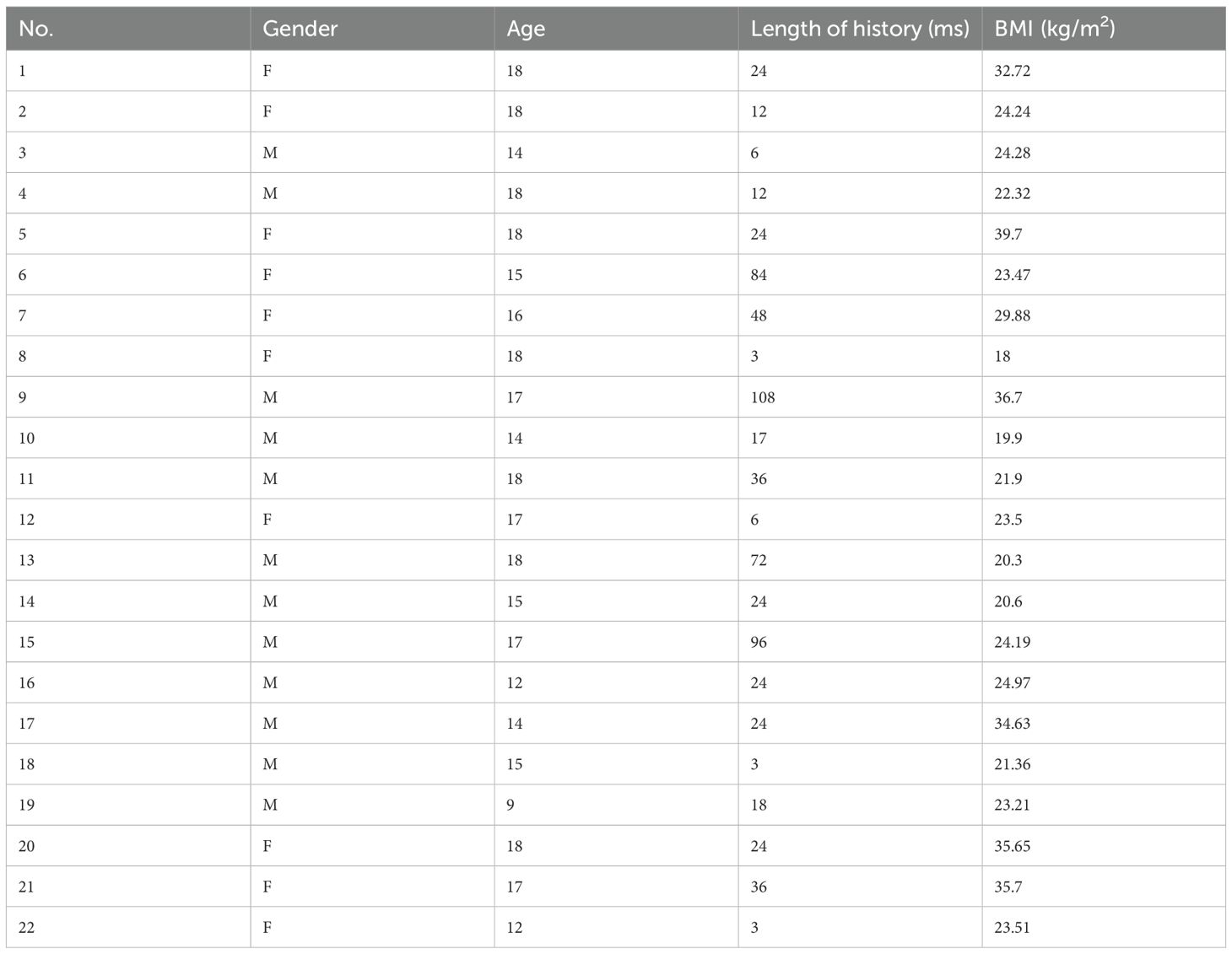
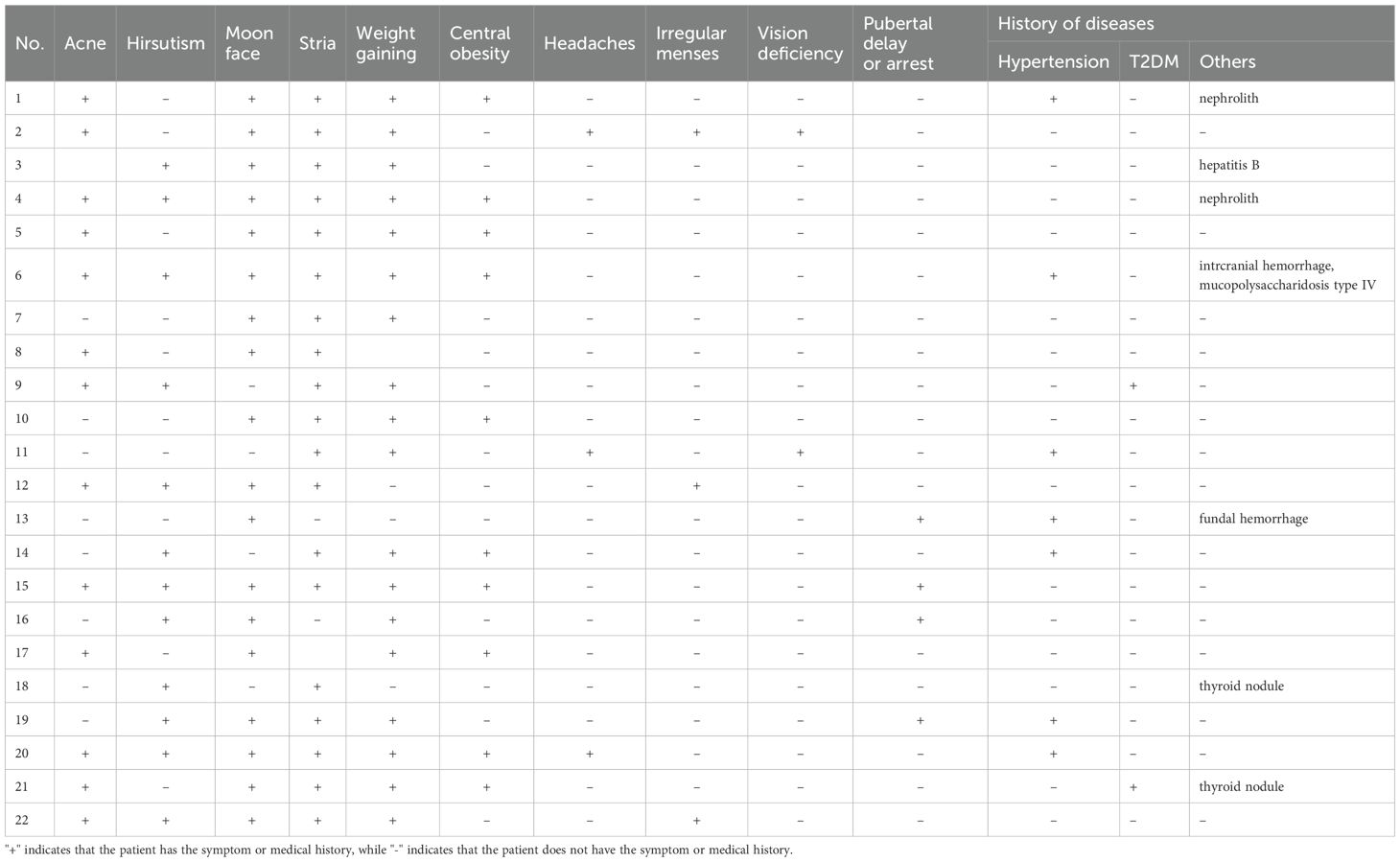
Between 2002 and 2022, 519 patients underwent TSS for CD performed by a single neurosurgical team in the Department of Neurosurgery, Ruijin Hospital. Twenty-six patients aged 18 years or younger were initially identified as pediatric; four were excluded due to incomplete data or insufficient follow-up. Clinical features of the remaining 22 pediatric patients (10 male, 12 female) were retrospectively reviewed. Mean age at surgery was 15.8 ± 2.5 years (range 9-18), and mean symptom duration prior to diagnosis was 32.0 ± 30.8 months (range 3-108). Mean BMI was 26.4 ± 6.4 (range 18.0-39.7) (Table 1). Presenting symptoms included weight gain (18/22), acne (13/22), hirsutism (12/22), moon facies (18/22), striae (19/22), central obesity (10/22), pubertal delay or arrest (4/22), irregular menses (3/12 females), headaches (3/22), visual deficits (2/22), hypertension (7/22), and type 2 diabetes mellitus (2/22) (Table 2).

Table 1
www.frontiersin.org

Table 1. The demographic information of 22 patients at diagnosis of CD.

Table 2
www.frontiersin.org

Table 2. Clinical signs and symptoms of 22 patients at diagnosis of CD.

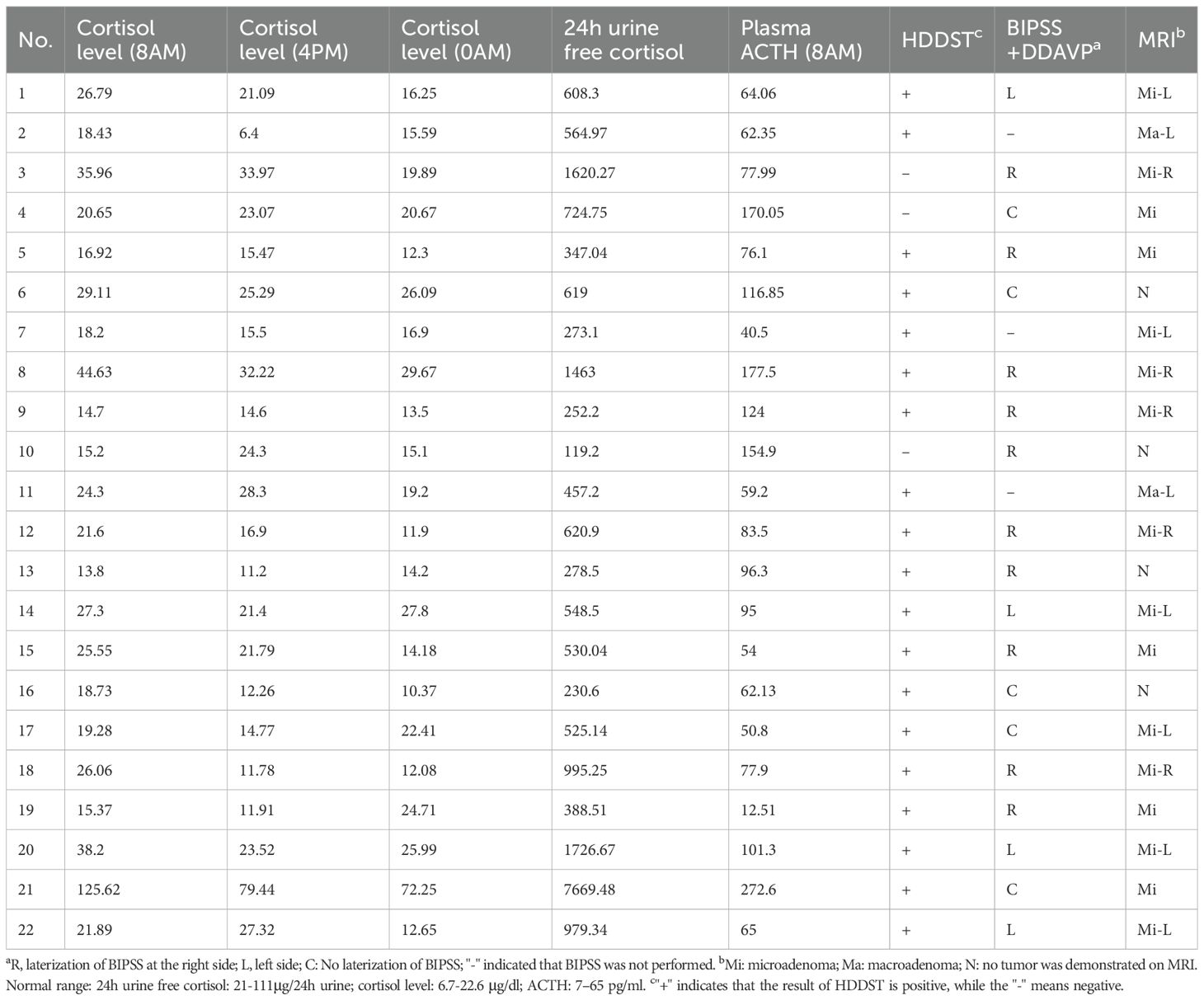
Diagnosis of CD was confirmed by a multidisciplinary team comprising radiologists, endocrinologists, interventional radiologists, pediatricians, and neurosurgeons. Clinical manifestations, plasma cortisol circadian rhythm, low-dose dexamethasone suppression test (LDDST, 2 mg dexamethasone), and high-dose dexamethasone suppression test (HDDST, 8 mg dexamethasone) were assessed by pediatricians or endocrinologists. Following the 2mg LDDST, the 48-hour serum cortisol level exceeded 1.8 μg/dL, indicating inadequate suppression. In contrast, after the 8mg HDDST, the 48-hour cortisol level was suppressed to <50% of baseline, demonstrating significant suppression. Bilateral inferior petrosal sinus sampling (BIPSS) with or without desmopressin (DDAVP) stimulation was performed by experienced interventional radiologists. Samples were immediately placed on ice after collection. All biochemical analyses were conducted in a College of American Pathologists-accredited laboratory (No. 7217913).

Preoperative pituitary magnetic resonance imaging (MRI) was performed at 1.5 T or 3.0 T in all patients. T1-weighted and T2-weighted spin-echo images were obtained in coronal and sagittal planes (2-mm slice thickness) before and after gadolinium injection. A dynamic coronal sequence was also acquired within 2 minutes post-injection (Table 3).

Table 3
www.frontiersin.org

Table 3. Preoperative endocrinological evaluation and neuroimaging results of 22 patients at diagnosis of CD.

The same surgical team performed TSS on all patients using a mononostril approach. Microscopic TSS (MTSS) was utilized in 11 patients treated before 2016, while endoscopic TSS (ETSS) was employed in the subsequent 11 patients. For patients with concordant MRI-identified adenomas and BIPSS lateralization, exploration focused on the imaging-identified region, and a rim of pituitary tissue surrounding the tumor cavity was resected. If the tumor involved the cavernous sinus (CS), the inner CS wall was also inspected/explored. If BIPSS lateralization conflicted with MRI findings, the pituitary side indicated by BIPSS was explored first. For MRI-negative tumors, exploration commenced on the side with higher ACTH levels on BIPSS (when available) and proceeded to complete gland inspection. If no adenoma was identified intraoperatively, approximately half of the gland was resected, guided by BIPSS results.

Immediate remission was defined as a postoperative serum cortisol nadir <5 μg/dL or normal 24-hour UFC. Recurrent hypercortisolism was defined as the reappearance of biochemical hypercortisolism after a period of hypocortisolism or clinical adrenal insufficiency. The concordance of BIPSS lateralization with MRI localization refers to whether the tumor side indicated by BIPSS corresponds to the tumor side identified on MRI.

Patients were followed in the outpatient clinic at regular intervals. If endocrine evaluations were performed at local hospitals, results were communicated to the authors via WeChat. Mean follow-up duration was 29.4 months (range 2–129 months).

Results

Preoperative plasma cortisol levels measured at three time points were: mean 28.10 μg/dL at 8:00 AM (range 14.70-125.62 μg/dL), 22.39 μg/dL at 4:00 PM (range 6.4-79.44 μg/dL), and 20.62 μg/dL at midnight (range 11.9-72.25 μg/dL). Mean preoperative plasma ACTH level at 8:00 AM was 95.21 pg/mL (range 12.51-272.6 pg/mL), and mean 24-hour UFC was 979.18 μg/24h (range 119.20-7669.48 μg/24h). HDDST was positive in 19/22 patients. BIPSS with DDAVP was performed in 19 patients, demonstrating lateralization in 14 patients (4/14 left, 10/14 right).

MRI localized an adenoma in 18/22 patients (81.8%), comprising 16 microadenomas and 2 macroadenomas. Tumor location on MRI was: right sellar (n=5), left sellar (n=8), and central sellar (n=5). Concordance between BIPSS lateralization and MRI localization was 57.89% (11/19).

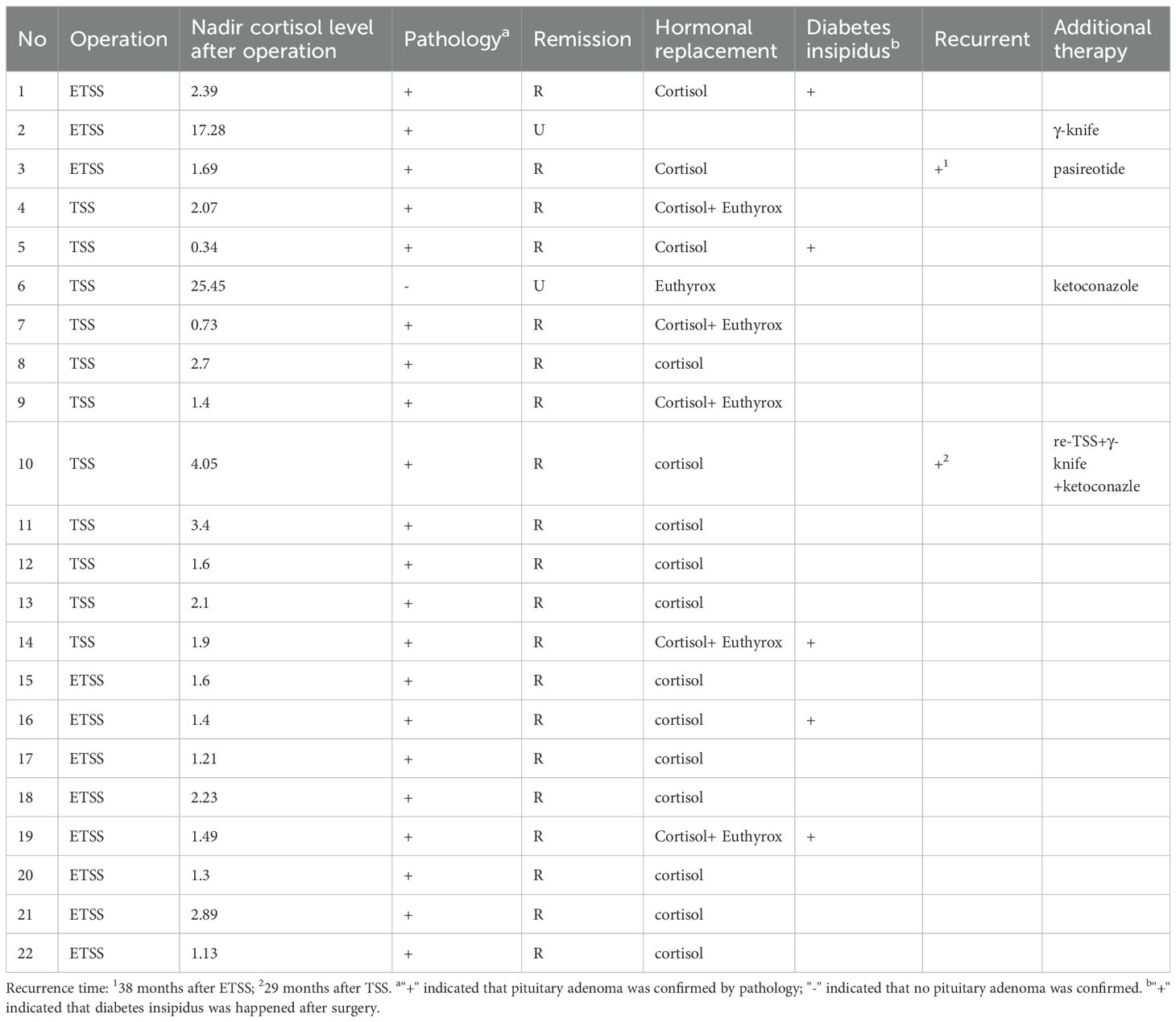
Immediate postoperative remission was achieved in 20 patients (90.9%). The two patients without immediate remission (Case 2: macroadenoma; Case 6: MRI- and pathology-negative) received additional treatments (Case2: gamma knife radiosurgery; Case 6: ketoconazole). Among the 20 patients with initial remission, 2 (10.0%) experienced recurrence (Case 3: microadenoma; Case 10: MRI-negative). Case3 received pasireotide after recurrence; Case 10 underwent repeat TSS, which did not achieve remission. Subsequent gamma knife treatment also ultimately failed. Ketoconazole therapy was then initiated. The sustained long-term remission rate for the cohort was 81.8% (18/22).

In these cases, intraoperative bleeding was controlled in all cases, and no patient required transfusion. Case 10 experienced a CSF leak following repeat transsphenoidal surgery (TSS). All patients who achieved postoperative remission were administered cortisone replacement therapy. The requirement for levothyroxine replacement differed between groups: one child in the ETSS group (1/11) versus five patients in the MTSS group (5/11). For diabetes insipidus, oral desmopressin was administered to three patients in the ETSS group and two in the MTSS group (Table 4).

Table 4
www.frontiersin.org

Table 4. The neurosurgical outcome and follow-up results of 22 patients of CD.

Discussion

This 20-year single-center experience represents one of the largest reported cohorts of surgically managed pediatric Cushing’s disease patients. Our findings demonstrate that transsphenoidal surgery (TSS), whether microscopic (MTSS) or endoscopic (ETSS), is a highly effective first-line treatment for pediatric CD, achieving an immediate remission rate of 90.9% and a sustained long-term remission rate of 81.8%.

The diagnostic complexity of pediatric CD is highlighted by the significant diagnostic delay observed (mean 32.0 months) and the occurrence of MRI-negative cases (4/22, 18.2%). This aligns with established literature emphasizing the challenges of pediatric CD diagnosis stemming from its rarity, atypical presentation, and the high proportion of microadenomas or radiologically occult tumors (3468). Our adherence to a rigorous multidisciplinary diagnostic protocol, incorporating standardized biochemical testing (LDDST, HDDST), BIPSS with DDAVP stimulation (performed in 19/22), and high-resolution dynamic pituitary MRI, reflects current best practices for confirming ACTH-dependent Cushing’s syndrome and tumor localization. The moderate concordance rate (57.89%) between BIPSS lateralization and MRI localization underscores their complementary roles, particularly in cases with equivocal imaging. BIPSS remains critical for guiding surgical exploration in MRI-negative or discordant cases, as evidenced by its use in our decision-making algorithm (910).

Our immediate remission rate (90.9%) compares favorably with contemporary pediatric CD surgical series, which typically report rates between 70% and 98% (1381113). The two immediate surgical failures occurred in patients with a macroadenoma (Case 2) or an MRI- and pathology-negative diagnosis (Case 6), profiles consistently associated with lower remission rates. The long-term remission rate of 81.8% (18/22) is robust, although the recurrence rate of 10% (2/20 initially remitted patients) merits attention. Both recurrences arose in patients with microadenomas, one of whom was MRI-negative (Case 10). This recurrence rate falls within the reported range (5-30%) for pediatric CD and reinforces the need for lifelong endocrine surveillance (11415). The relatively short mean follow-up (29.4 months) suggests that the true recurrence rate might be higher with extended observation, representing a limitation of this study.

Our experience reflects the evolution of surgical technique, with a transition from MTSS to ETSS after 2016. While the cohort size and follow-up duration preclude definitive conclusions regarding the comparative efficacy of MTSS versus ETSS in this specific pediatric population, both techniques yielded high success rates. In our group, no significant differences exist in remission or recurrence rates. However, regarding complications, ETSS demonstrates a lower incidence of hypopituitarism compared to MTSS, while the incidence of diabetes insipidus is similar. It should be noted, however, that this comparison remains limited by the small number of reported cases. The endoscopic approach offers theoretical advantages, such as wider panoramic visualization potentially aiding in the identification of small or laterally extending microadenomas, which are common in children. Larger, prospective studies with longer follow-up are warranted to directly compare outcomes between these surgical modalities in pediatric CD.

The spectrum of clinical manifestations observed (e.g., weight gain, moon facies, striae, hypertension, pubertal arrest/delay) demonstrates the profound multisystem impact of hypercortisolism in children. The notable prevalence of metabolic complications like hypertension (7/22) and type 2 diabetes mellitus (2/22), even in this young cohort, highlights the urgency of timely diagnosis and effective intervention to mitigate long-term morbidity (51618).

Limitations

This study shares the limitations inherent to retrospective, single-center designs. The modest sample size, though substantial for this rare condition, limits statistical power for subgroup analyses, such as rigorous comparison of MTSS vs. ETSS outcomes or identification of specific predictors of failure/recurrence. The mean follow-up period is relatively short for a disease with potential for late recurrence, long-term remission rates may be lower than reported, and the study could not capture long-term complications of TSS, particularly those affecting growth and development in pediatric patients. Detailed data on specific postoperative complications (e.g., diabetes insipidus, hypopituitarism) and pituitary function during follow-up would provide a more comprehensive assessment of treatment sequelae but were not the primary focus of this outcome report.

Conclusion

Despite the inherent diagnostic and therapeutic challenges of pediatric Cushing’s disease, transsphenoidal surgery performed in a specialized center achieves high rates of immediate and sustained remission. Our results support the efficacy of TSS as the primary treatment modality. A meticulous multidisciplinary diagnostic approach, including BIPSS when indicated, is crucial for success, particularly in MRI-negative cases. While recurrence remains a concern necessitating vigilant long-term follow-up, the majority of children with CD can attain durable disease control with appropriate surgical management. The transition to endoscopic techniques proved safe and effective, warranting further investigation in larger pediatric cohorts with extended follow-up.

Data availability statement

The original contributions presented in the study are included in the article/supplementary material. Further inquiries can be directed to the corresponding authors.

Ethics statement

The studies involving humans were approved by The ethics committee of Ruijin hospital. The studies were conducted in accordance with the local legislation and institutional requirements. The participants provided their written informed consent to participate in this study. Written informed consent was obtained from the individual(s), and minor(s)’ legal guardian/next of kin, for the publication of any potentially identifiable images or data included in this article.

Author contributions

BW: Methodology, Writing – original draft. HZ: Conceptualization, Data curation, Formal Analysis, Writing – original draft. TS: Methodology, Project administration, Writing – review & editing. JR: Data curation, Formal Analysis, Writing – original draft. QS: Resources, Supervision, Writing – review & editing. YS: Supervision, Writing – review & editing. LB: Supervision, Writing – review & editing.

Funding

The author(s) declare that no financial support was received for the research and/or publication of this article.

Conflict of interest

The authors declare that the research was conducted in the absence of any commercial or financial relationships that could be construed as a potential conflict of interest.

Generative AI statement

The author(s) declare that no Generative AI was used in the creation of this manuscript.

Any alternative text (alt text) provided alongside figures in this article has been generated by Frontiers with the support of artificial intelligence and reasonable efforts have been made to ensure accuracy, including review by the authors wherever possible. If you identify any issues, please contact us.

Publisher’s note

All claims expressed in this article are solely those of the authors and do not necessarily represent those of their affiliated organizations, or those of the publisher, the editors and the reviewers. Any product that may be evaluated in this article, or claim that may be made by its manufacturer, is not guaranteed or endorsed by the publisher.

References

1. Savage MO and Ferrigno R. Paediatric Cushing’s disease: long-term outcome and predictors of recurrence. Front Endocrinol (Lausanne). (2024) 15:1345174. doi: 10.3389/fendo.2024.1345174

PubMed Abstract | Crossref Full Text | Google Scholar

2. Tarcin G, Catli G, Cetinkaya S, Eren E, Kardelen AD, Akinci A, et al. Clinical features, diagnosis and treatment outcomes of Cushing’s disease in children: A multicenter study. Clin Endocrinol (Oxf). (2024) 100:19–28. doi: 10.1111/cen.14980

PubMed Abstract | Crossref Full Text | Google Scholar

3. Zheng X, Wang H, Zhang W, Feng S, Liu Y, Li S, et al. Diagnosis, manifestations, laboratory investigations, and prognosis in pediatric and adult cushing’s disease in a large center in China. Front Endocrinol (Lausanne). (2021) 12:749246. doi: 10.3389/fendo.2021.749246

PubMed Abstract | Crossref Full Text | Google Scholar

4. Joshi K, Taliou A, and Stratakis CA. Diagnostic and management challenges in paediatric Cushing’s syndrome. Clin Endocrinol (Oxf). (2024) 101:631–9. doi: 10.1111/cen.15096

PubMed Abstract | Crossref Full Text | Google Scholar

5. Ferrigno R, Hasenmajer V, Caiulo S, Minnetti M, Mazzotta P, Storr HL, et al. Paediatric Cushing’s disease: Epidemiology, pathogenesis, clinical management and outcome. Rev Endocr Metab Disord. (2021) 22:817–35. doi: 10.1007/s11154-021-09626-4

PubMed Abstract | Crossref Full Text | Google Scholar

6. Yanar EA, Makazan NV, Kareva MA, Vorontsov AV, Vladimirova VP, Bezlepkina OB, et al. Course of Cushing;s disease and treatment outcomes in correlation with pituitary MRI in children. Probl Endokrinol (Mosk). (2022) 68:93–104. doi: 10.14341/probl12854

PubMed Abstract | Crossref Full Text | Google Scholar

7. Maiter D, Chanson P, Constantinescu SM, and Linglart A. Diagnosis and management of pituitary adenomas in children and adolescents. Eur J Endocrinol. (2024) 191:R55–r69. doi: 10.1093/ejendo/lvae120

PubMed Abstract | Crossref Full Text | Google Scholar

8. Crock PA, Ludecke DK, Knappe UJ, and Saeger W. A personal series of 100 children operated for Cushing’s disease (CD): optimizing minimally invasive diagnosis and transnasal surgery to achieve nearly 100% remission including reoperations. J Pediatr Endocrinol Metab. (2018) 31:1023–31. doi: 10.1515/jpem-2018-0262

PubMed Abstract | Crossref Full Text | Google Scholar

9. Turan H, Catli G, Kardelen AD, Bober E, Akinci A, Cetinkaya S, et al. Diagnostic value of bilateral petrosal sinus sampling in children with cushing disease: A multi-center study. J Clin Res Pediatr Endocrinol. (2022) 14:29–36. doi: 10.4274/jcrpe.galenos.2021.2021.0152

PubMed Abstract | Crossref Full Text | Google Scholar

10. Chen S, Chen K, Lu L, Zhang X, Tong A, Pan H, et al. The effects of sampling lateralization on bilateral inferior petrosal sinus sampling and desmopressin stimulation test for pediatric Cushing’s disease. Endocrine. (2019) 63:582–91. doi: 10.1007/s12020-018-1779-x

PubMed Abstract | Crossref Full Text | Google Scholar

11. Lonser RR, Wind JJ, Nieman LK, Weil RJ, DeVroom HL, and Oldfield EH. Outcome of surgical treatment of 200 children with Cushing’s disease. J Clin Endocrinol Metab. (2013) 98:892–901. doi: 10.1210/jc.2012-3604

PubMed Abstract | Crossref Full Text | Google Scholar

12. Joshi SM, Hewitt RJ, Storr HL, Rezajooi K, Ellamushi H, Grossman AB, et al. Cushing’s disease in children and adolescents: 20 years of experience in a single neurosurgical center. Neurosurgery. (2005) 57:281–5. doi: 10.1227/01.NEU.0000166580.94215.53

PubMed Abstract | Crossref Full Text | Google Scholar

13. Kanter AS, Diallo AO, Jane JA Jr., Sheehan JP, Asthagiri AR, Oskouian RJ, et al. Single-center experience with pediatric Cushing’s disease. J Neurosurg. (2005) 103:413–20. doi: 10.3171/ped.2005.103.5.0413

PubMed Abstract | Crossref Full Text | Google Scholar

14. Pasternak-Pietrzak K, Moszczynska E, and Szalecki M. Treatment challenges in pediatric Cushing’s disease: Review of the literature with particular emphasis on predictive factors for the disease recurrence. Endocrine. (2019) 66:125–36. doi: 10.1007/s12020-019-02036-2

PubMed Abstract | Crossref Full Text | Google Scholar

15. Yordanova G, Martin L, Afshar F, Sabin I, Alusi G, Plowman NP, et al. Long-term outcomes of children treated for Cushing’s disease: a single center experience. Pituitary. (2016) 19:612–24. doi: 10.1007/s11102-016-0756-8

PubMed Abstract | Crossref Full Text | Google Scholar

16. Pasternak-Pietrzak K, Moszczyńska E, Jurkiewicz E, and Szalecki M. Paediatric Cushing’s disease – a literature review of epidemiology, pathogenesis, clinical symptoms, and diagnostics. Endokrynol Pol. (2020) 71:87–95. doi: 10.5603/EP.a2019.0040

PubMed Abstract | Crossref Full Text | Google Scholar

17. Storr HL and Savage MO. Management of endocrine disease: Paediatric Cushing’s disease. Eur J Endocrinol. (2015) 173:R35–45. doi: 10.1530/EJE-15-0013

PubMed Abstract | Crossref Full Text | Google Scholar

18. Tatsi C, Kamilaris C, Keil M, Saidkhodjaeva L, Faucz FR, Chittiboina P, et al. Paediatric Cushing syndrome: a prospective, multisite, observational cohort study. Lancet Child Adolesc Health. (2024) 8:51–62. doi: 10.1016/S2352-4642(23)00264-X

PubMed Abstract | Crossref Full Text | Google Scholar

Keywords: Cushing’s disease, pediatric, transsphenoidal surgery, surgical outcome, surgical strategy

Citation: Wang B, Zhang H, Su T, Ren J, Sun Q, Sun Y and Bian L (2025) The neurosurgical outcome of pediatric Cushing’s disease in a single center from China: a 20-year experience. Front. Endocrinol. 16:1663624. doi: 10.3389/fendo.2025.1663624

Received: 10 July 2025; Accepted: 22 August 2025;
Published: 03 September 2025.

Edited by:

Sadishkumar Kamalanathan, Jawaharlal Institute of Postgraduate Medical Education and Research (JIPMER), India

Reviewed by:

Aleksandra Zdrojowy-Wełna, Wroclaw Medical University, Poland
Medha Bhardwaj, Mahatma Gandhi University of Medical Sciences Technology, India

Copyright © 2025 Wang, Zhang, Su, Ren, Sun, Sun and Bian. This is an open-access article distributed under the terms of the Creative Commons Attribution License (CC BY). The use, distribution or reproduction in other forums is permitted, provided the original author(s) and the copyright owner(s) are credited and that the original publication in this journal is cited, in accordance with accepted academic practice. No use, distribution or reproduction is permitted which does not comply with these terms.

*Correspondence: Yuhao Sun, syh11897@rjh.com.cn; Liuguan Bian, Blg11118@rjh.com.cn

These authors have contributed equally to this work

Disclaimer: All claims expressed in this article are solely those of the authors and do not necessarily represent those of their affiliated organizations, or those of the publisher, the editors and the reviewers. Any product that may be evaluated in this article or claim that may be made by its manufacturer is not guaranteed or endorsed by the publisher.

Relacorilant and Cardiometabolic Outcomes

New data on relacorilant (Corcept Therapeutics), a selective glucocorticoid receptor modulator, revealed several cardiometabolic benefits for patients with hypercortisolism.

Researchers presented results from the GRACE and GRADIENT trials, which assessed relacorilant in adults with hypercortisolism. GRACE was an open-label trial that enrolled adults with endogenous hypercortisolism, whereas GRADIENT included those with adrenal hypercortisolism and randomly assigned participants to relacorilant or placebo.

Both trials demonstrated similar reductions in body weight. The relacorilant group in GRADIENT had a 3.6 kg reduction in body weight, and adults in GRACE reduced their body weight by 3.3 kg at 22 weeks.

“Relacorilant may improve many of the common features of hypercortisolism, which may provide a holistic benefit to our patients,” Oksana Hamidi, DO, MSCS, study investigator and associate professor in the division of endocrinology at UT Southwestern Medical Center, told Healio | Endocrine Today. “An interesting observation was that relacorilant can lead to weight loss, and that weight loss is mostly fat mass, with lean mass being preserved or even increasing. The ability to maintain muscle is particularly important for our patients.”

In a cardiometabolic analysis, adults with hypertension receiving relacorilant had greater reductions in both systolic and diastolic blood pressure compared with placebo. For adults with hyperglycemia at baseline, the relacorilant group had greater declines in fasting glucose and glucose area under the curve.

Corin Badiu, MD, study investigator, professor of endocrinology and head of the department of endocrinology IV in the National Institute of Endocrinology and “C.Davila” University of Medicine and Pharmacy in Bucharest, Romania, and fellow of the Romanian Academy of Medical Sciences, said the benefits of relacorilant may extend into additional areas that could be studied in the future.

“Apart from metabolic and cardiovascular improvements, we expect long-term improvements in bone mass, liver steatosis, mood, sleep and other behavioral aspects [that] are disturbed in hypercortisolism,” Badiu told Healio | Endocrine Today.

Irina Bancos, MD, MSc, professor of medicine in the division of endocrinology, metabolism and nutrition at Mayo Clinic, said relacorilant could provide benefits similar to mifepristone (Korlym, Corcept Therapeutics) for patients with hypercortisolism, but with fewer adverse events related to progesterone health. Bancos was not involved with the trial.

“Why is there a need for another medication in the same class by the same company? The major reason is to achieve the same metabolic impact as far as weight loss and improvement of hyperglycemia … but also to decrease the side effects,” Bancos told Healio | Endocrine Today.

From https://www.healio.com/news/endocrinology/20250912/promising-new-data-could-change-treatment-landscape-for-some-rare-diseases?utm_source=selligent&utm_medium=email&utm_campaign=20250920ENDO&utm_content=20250920ENDO