Nominations Now Open for RareVoice Awards

rare-voice

Rare Disease Legislative Advocates is pleased to open nominations for the 5th Annual RareVoice Awards, a celebration to honor advocates who give rare disease patients a voice on Capitol Hill and in state government.

Wednesday, November 16, 2016
Arena Stage in Washington, DC

If you know of someone who has been a “Voice” for the rare disease community and should be honored for their work, please click here to submit your nomination.

RareVoice Award nominations are open to the public.  We encourage the community to nominate individuals and organizations who have gone above and beyond to become rare disease policy leaders and political advocates in their state and our nation. We have nominations open for the following categories: Congressional Staff, Patient Advocate or Patient Organization (at the state or federal level), and Government Agency Staff.

Deadline to submit nominations is July 31, 2016.

Pituitary Patient Support Group Meeting

pituitary-meeting

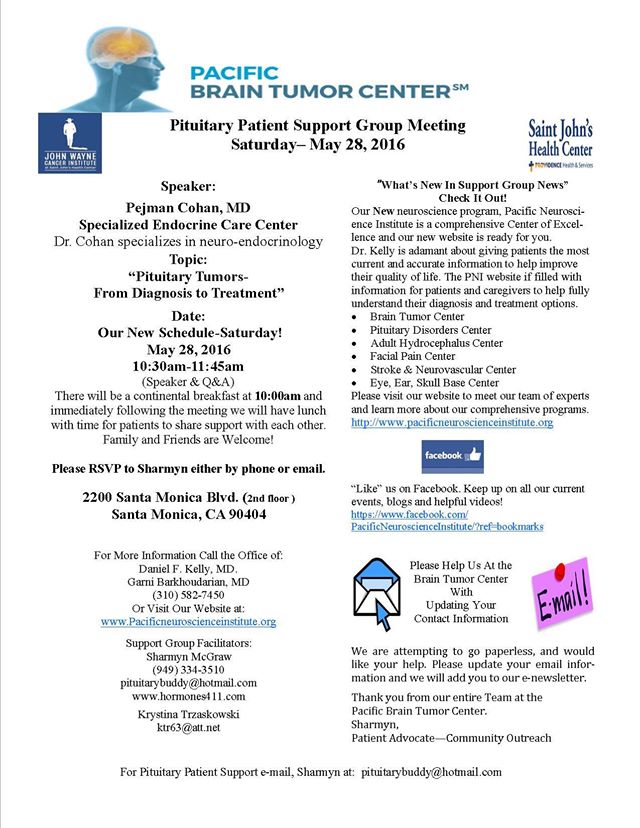
Pituitary Patient Support Group Meeting, Saturday May 28, 2016.

Neuro Endocrine expert Dr. Pejman Cohan will be speaking. “From Diagnosis to Treatments”

There will be time for Q&A and lunch served after the meeting.

Meeting 10:30am-11:45am Lunch 11:45am-1:00pm

Location: John Wayne Cancer Institute- 2nd floor conference room, 2200 Santa Monica Blvd. Santa Monica, CA 90404

Free parking with validation, behind building in the JWCI parking lot.

Please RSVP to Sharmyn at  pituitarybuddy@hotmail.com

Download flyer here.

Registration Open for Regional Legislative Conferences and In-District Lobby Days

Rare Disease Legislative Advocates will host In-District Lobby Days to facilitate meetings for rare advocates across the country with their elected federal officials during the summer Congressional recess (July 18th through September 5th).

Registration is open through July 1st.

Federal elected officials need to hear regularly from constituents affected by rare disease.  Meeting with your Representative and Senators throughout the year is critical to building a relationship.  These meetings are an opportunity to invite them to join the Rare Disease Congressional Caucus and to highlight legislation that could be beneficial to the rare disease community.

To help advocates prepare, we are holding regional Legislative Conferences in Boston on June 28th and in both Chicago and Seattle on June 30th. These half-day conferences will feature remarks from federal elected officials, academics, patient advocates and other rare disease stakeholders.  Lunch will be provided. Registration will be available here through June 22nd. Don’t miss the opportunity to learn and network with other local advocates!

We will also hold two preparatory webinars.  The first, to be held on June 16th at 2pm ET/11am PT, will provide an overview of the regional Legislative Conferences and In-District Lobby Days. The second, to be held on July 13th at 2pm ET/11am PT, will cover In-District Lobby Days in more detail including legislative issues which advocates may want to raise in their meetings.

RDLA’s May Legislative In-Person Meeting

RDLA Congressional Caucus


Rare Disease Legislative Advocates in coordination with Rare Disease Congressional Caucus Co-Chairs: Representative Leonard Lance (R-NJ), Representative Joe Crowley (D-NY), Senator Orrin Hatch (R-UT), and Senator Amy Klobuchar (D-MN); and the Office of Senator Mark Kirk (R-IL) will host a briefing on:

 The NIH and FDA: Vital Agencies in the Fight Against Rare Diseases

Wednesday, May 18th, 2016

2:00 pm – 3:00 pm

Senate Capitol Visitors Center Room 201, Washington, D.C., 20004

   REGISTER   

Moderator:  Ellie Dehoney, Vice President of Policy and Advocacy, Research!America

  • The Undiagnosed Disease Program at the NIH
    • William Gahl, M.D., Ph.D, Clinical Director, National Human Genome Research Institute (invited)
  • Precision Medicine – The White House & the NIH
    • Matthew Might, Strategist, Executive Office of the President, The White House, Associate Professor, University of Utah, Associate Professor, Visiting, Harvard Medical School, Founder, NGLY1.org (invited)
  • The Value of Patients to Clinical Innovation at the NIH
    • Kayla Martinez & Dorelia Rivera, NOMID Patient
  • The Role of NIH Funding in Kickstarting Biomedical Innovation
    • Christopher C. Gibson, Ph.D, Co-Founder & CEO, Recursion Pharmaceuticals

Come and enjoy an array of refreshments  or have coffee and snack break while learning about the role of our health agencies.

Why Was This Woman Gaining Weight Despite Her Diet?

“I just can’t seem to lose weight,” the 59-year-old woman said quietly. She had tried everything, she told the young doctor, who was training to be an endocrinologist at Mount Sinai Hospital in New York City. Weight Watchers. Exercise. She ate more vegetables, less fat, then fewer carbs. But still she was gaining weight, 30 pounds during the past seven months, including 12 in the past two weeks. She had never been skinny, she continued, but shapely. In her mid-40s, she started gaining weight, slowly at first, then rapidly. She was considering bariatric surgery, but she wanted to make sure she wasn’t missing something obvious. She had low thyroid hormones and had to take medication. Could her thyroid be off again?

The doctor asked her about symptoms associated with a low thyroid-hormone level. Fatigue? Yes, she was always tired. Changes in her hair or skin? No. Constipation? No. Do you get cold easier? Never. Indeed, these days she usually felt hot and sweaty.

It was probably not the thyroid, the doctor said. She asked if the woman had any other medical problems. She had high blood pressure and high cholesterol — both well controlled with medications. She also had obstructive sleep apnea, a disorder in which the soft tissue at the back of the throat collapse during sleep, cutting off air flow and waking the person many times throughout the night. She had a machine that helped keep her airway open, and she used it every night. She also had back pain, knee pain and carpal-tunnel syndrome. The pain was so bad that she had to retire from her job years before she was ready.

Big, Bigger, Biggest

The doctor examined her, then went to get Dr. Donald Smith, an endocrinologist and director of lipids and metabolism at Mount Sinai’s cardiovascular institute. After hearing a summary of the case, Smith asked the patient if she had anything to add. She did: She didn’t understand why she was getting so much bigger. Her legs were huge. She used to have nice ankles, but now you could hardly see them. Her doctor had given her a diuretic, but it hadn’t done a thing. Everything was large — her feet, her hands, even her face seemed somehow bigger. She hardly recognized the woman in the mirror. Her doctors just encouraged her to keep trying to lose weight.

Worth a Thousand Words

“Let me show you a picture,” she said suddenly and reached over to her purse. The patient’s sister had made a comment recently that led the patient to wonder whether the changes she saw in the mirror were more than simple aging. The patient pulled out a photograph of an attractive middle-aged woman and handed it to Smith. That was me eight years ago, she told him. Looking at the two faces, it was hard to believe they belonged to the same woman. Smith suspected this was something more than the extra pounds.

Two possibilities came to mind. Each was a disease of hormonal excess; each caused rapid weight gain. The first was Cushing’s disease, caused by overproduction of one of the fight-or-flight hormones, cortisol. The doctor looked at the patient, seeking clues. On her upper back, just below her neck, the woman had a subtle area of enlargement. This discrete accumulation of fat, called a buffalo hump, can occur with normal weight gain but is frequently seen in patients with Cushing’s. Do you bruise more easily these days? he asked. Cushing’s makes the skin fragile. No, she said. Did she have stretch marks on her stomach from the weight gain? The rapid expansion of the abdomen can cause the fragile skin to develop dark purple stretch lines. No. So maybe it wasn’t Cushing’s.

Find out the answer at http://www.nytimes.com/interactive/2016/04/17/magazine/17mag-diagnosis.html#/#7