Classifying hypertension

HYPERTENSION is classified into two categories according to its cause: essential and secondary.

The vast majority of patients have essential or primary hypertension, while only about 5-10% of patients have secondary hypertension, which are mainly caused by kidney and hormonal conditions like renal artery stenosis, hyperthyroidism, Cushing’s syndrome, and even pregnancy, among others.

The exact cause of essential hypertension is still unknown, although it is certainly the result of a combination of factors, including increasing age, having relatives with high blood pressure (ie family history), a sedentary lifestyle, a poor diet with too much salt, drinking too much alcohol, smoking and too much stress.

Says Malaysian Society of Hypertension president and Universiti Malaya Department of Primary Care Medicine senior consultant Prof Datin Dr Chia Yook Chin: “Each factor increases blood pressure by just a little, but when you add them all together little by little, it raises it by quite a lot.”

Despite not knowing the root cause of hypertension, it has been established that there is overstimulation of the sympathetic nerves in people with this condition.

This in turn increases the secretion of certain hormones involved in the regulation of sodium and fluids in the body, called renin, angiotensin, and aldosterone.

The amount of salt and water in our body affects our blood pressure – the more salt and water present, the higher our blood pressure.

These two elements are regulated by our kidneys through the three hormones mentioned above, which are produced by the adrenal glands located on top of the kidneys.

The overstimulation of the sympathetic nerves also results in increased vascular tone, which causes our arteries to become constricted, thus, also raising blood pressure.

From The Star

Texas Medical Center Announces Brain, Spine And Pituitary Tumor Center

Aerial of the Texas Medical Center, an area in...

Aerial of the Texas Medical Center, an area in the Southeast Houston district. (Photo credit: Wikipedia)

The Texas Medical Center announced that a brain and pituitary tumor treatment center will be established at the Methodist Hospital.

According to a press release from the medical center, “Brain, spine and pituitary tumor patients will soon have access to a new clinic at The Methodist Hospital, thanks to a $10 million gift from a Houston oil executive. The Kenneth R. Peak Brain and Pituitary Tumor Treatment Center will offer treatments customized to each patient. Researchers will study each tumor and tailor treatments to fit the tumors genetic profile using a relatively new approach to medicine called personalized medicine.”

The Texas Medical Center is located at 2450 Holcombe Blvd.

For more information, call 713-791-6161 or email or visitwww.texasmedicalcenter.org/.

The Deadline is Friday for Helping Grow the Rare Disease Congressional Caucus

caucus1

Friday, May 17 at 8PM eastern is the deadline for this.

We want to have Caucus Members from all 50 States.

We have 28 to go: AL, AK, AZ, CO, CT, DE, HI, ID, KS, KY, LA, ME, MD, MS, MO, MT, NV, NH, NM, ND, OK, RI, SC, SD, UT, VT, WI, & WY If you live in one of these states or know someone who does – Please take ACTION today!


http://bit.ly/RareAlert

Original post:

Help us strengthen the rare disease community’s voice on Capitol Hill!  Please take 3 minutes to ask your Member of Congress to join the Rare Disease Caucus at http://bit.ly/RareAlert.
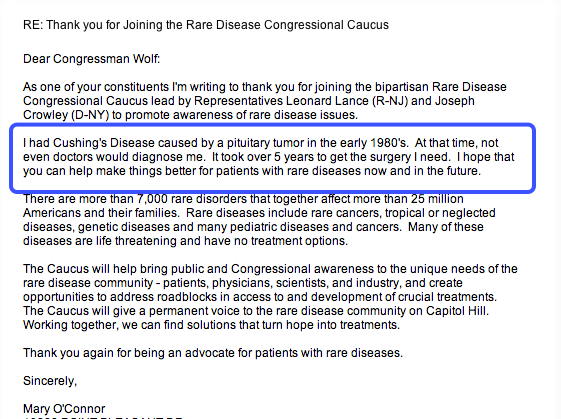
It’s easy – the Action Center has a draft letter that will automatically be sent to your Member of Congress – just put in your name and address & click send.  We also encourage you to personalize the letter to share information about your specific disease.  If your Congress Member is already on the Caucus, the letter will automatically populate as a thank you letter instead – these are just as important to send!
It can take up to 10 letters from constituents for a Member to respond so please share this Action Alert with your friends, family & colleagues.  Join our Facebook event & invite your friends:   http://on.fb.me/17Mlpjg
The Rare Disease Congressional Caucus will help bring public and Congressional awareness to the unique needs of the rare disease community – patients, physicians, scientists, and industry, and create opportunities to address roadblocks in access to and development of crucial treatments.  The Caucus will give a permanent voice to the rare disease community on Capitol Hill.  Working together, we can find solutions that turn hope into treatments.

Hyperthyroidism due to thyroid stimulating hormone secretion after surgery for Cushing’s syndrome: A novel cause of the syndrome of inappropriate secretion of thyroid stimulating hormone

Overview of the thyroid system (See Wikipedia:...

Overview of the thyroid system (See Wikipedia:Thyroid). To discuss image, please see Talk:Human body diagrams (Photo credit: Wikipedia)

  1. Daisuke Tamada, MD1,
  2. Toshiharu Onodera, MD1,
  3. Tetsuhiro Kitamura, MD, PhD1,
  4. Yuichi Yamamoto, MD1,
  5. Yoshitaka Hayashi, MD, PhD2,
  6. Yoshiharu Murata, MD, PhD2,
  7. Michio Otsuki, MD, PhD1 and
  8. Iichiro Shimomura, MD, PhD1

Author Affiliations


  1. 1Department of Metabolic Medicine, Osaka University Graduate School of Medicine, Osaka, Japan

  2. 2Department of Genetics, Research Institute of Environmental Medicine, Nagoya University, Nagoya, Japan
  1. Address all correspondence and requests for reprints to: Michio Otsuki, MD, PhD, Department of Metabolic Medicine, Osaka University Graduate School of Medicine, 2–2 Yamada-oka, Suita, Osaka 565-0871, Japan, Telephone: +81-6-6879-3732. Fax: +81-6-6879-3739, E-mail: otsuki@endmet.med.osaka-u.ac.jp.

Abstract

Context: Hyperthyroidism with the syndrome of inappropriate secretion of thyroid stimulating hormone (TSH) (SITSH) occurred by a decrease in hydrocortisone dose after surgery for Cushing’s syndrome. This is a novel cause of SITSH.

Objective: The aim of this study was to describe and discuss the two cases of SITSH patients who were found after surgery for Cushing’s syndrome. We also checked whether SITSH occurred in the consecutive 7 patients with Cushing’s syndrome after surgery.

Patients and Methods: A 45-year-old Japanese woman with adrenocorticotropin (ACTH)-independent Cushing’s syndrome and a 37-year-old Japanese man with ACTH-dependent Cushing’s syndrome presented SITSH caused by insufficient replacement of hydrocortisone for postoperative adrenal insufficiency. When the dose of hydrocortisone was reduced to less than 20 mg/day within 18 days after operation, SITSH occurred in both cases. We examined whether the change of the hydrocortisone dose induced the secretion of TSH. Free T3 and TSH were normalized by the hydrocortisone dose increase of 30 mg/day and these were elevated by the dose decrease of 10 mg/day. We also checked TSH and thyroid hormone the consecutive 7 patients with Cushing’s syndrome after surgery. Six (66.6 %) of nine patients showed SITSH.

Conclusions: This is the first report that insufficient replacement of hydrocortisone after the surgery of Cushing’s syndrome caused SITSH. Hyperthyroidism by SITSH as well as adrenal insufficiency can contribute to withdrawal symptoms of hydrocortisone replacement. So we need to consider the possibility of SITSH for the pathological evaluation of withdrawal syndrome of hydrocortisone replacement.

  • Received May 4, 2013.
  • Accepted May 8, 2013.

Help Grow the Rare Disease Congressional Caucus

Take Action . Rare Disease Legislative Advocates at 10.56.06 AM

The Rare Disease Congressional Caucus will help bring public and Congressional awareness to the unique needs of the rare disease community – patients, physicians, scientists, and industry, and create opportunities to address roadblocks in access to and development of crucial treatments.  The Caucus will give a permanent voice to the rare disease community on Capitol Hill.  Working together, we can find solutions that turn hope into treatments.

The screen shot above shows what happens when you fill in the little text box with information about your disease.  The rest is automatically generated.

Please take 3 minutes to ask your Member of Congress to join the Rare Disease Caucus at http://bit.ly/RareAlert.

English: Capitol Hill

English: Capitol Hill (Photo credit: Wikipedia)

It’s easy – the Action Center has a draft letter that will automatically be sent to your Member of Congress – just put in your name and address & click send.  We also encourage you to personalize the letter to share information about your specific disease.  If your Congress Member is already on the Caucus, the letter will automatically populate as a thank you letter instead – these are just as important to send!

It can take up to 10 letters from constituents for a Member to respond so please share this Action Alert with your friends, family, facebook groups, Twitter, blogs & colleagues.

Join our Facebook event & invite your friends:   http://on.fb.me/17Mlpj