Cushing’s, Cancer and Other Serious Diseases

I was drawn to this blog post because the author mentioned that she had both Cushing’s and cancer, a kind of unusual combination.

1974 to Today: Seal it up
By Experience
I still haven’t heard what the consensus is on my aftercare: Cushing’s and Cancer. I don’t know what I will be expecting to feel like after surgery. My endocrinologist said that I should get sick after the surgery and need some kind of
1974 to Today – http://1974totoday.blogspot.com/

I don’t usually comment on blog posts but I did on this one because we seem to share so much, disease-wise.

I said

Hi, I was drawn to your blog post because I have a blog with the same name, Cushings & Cancer.

I had my Cushing’s long ago and my cancer (kidney aka renal cell carcinoma) was 3 years ago but I sure know where you’re coming for.

My surgeon contacted my endo for the amounts of steroids during surgery (they came through the IV) then post-op, they kept cutting my dose in half until I was back down to normal.
Generally, you stress-dose after surgery if you feel like you have a flu coming on. Has your endo given you Cortef or another steroid to take for emergencies like this? Sometimes, they will give you an injectible to be faster acting.

Best of luck with the cancer surgery AND your Cushing’s.
MaryO

I sure hope that this isn’t a trend, Cushies getting cancer although I know of a couple others on the boards getting cancer.

I suppose Cushing’s doesn’t make us any more immune to other diseases but it seems like it should.

Haven’t we already “done our time”?

OTOH, I have a friend with a serious cancer (aren’t they all?)  who recently learned that she has a second, unrelated, cancer.  Makes you wonder sometimes.

What other diseases have you had in addition to your Cushing’s?

Co-Occurrence of Endogenous and Exogenous Cushing’s Syndromes: Does “Double Cushing Syndrome” Really Exist? A Case Report

ABSTRACT

Double Cushing syndrome exists: exogenous steroid use can mask concurrent adrenal hypercortisolism. When symptoms persist and cortisol remains high after tapering or stopping prescribed glucocorticoids, an endogenous source is likely. Early recognition with ACTH testing, dexamethasone suppression, and adrenal imaging reduces misdiagnosis, favors timely surgery, and supports safe tapering.

1 Introduction

Cushing syndrome (CS) is a non-physiological increase in plasma glucocorticoids [1]. In most cases, the source of increased plasma glucocorticoids is caused by exogenous steroid administration, which is quite common, and about 1% of the world population is on long-term (more than 3 months) oral glucocorticoids [12]. On the contrary, endogenous overproduction of glucocorticoids is rare, and annually, only two to eight per million people are diagnosed with endogenous CS [3]. The simultaneous occurrence of endogenous and exogenous CS is an exceptionally uncommon phenomenon. This dual manifestation has been reported in a few case reports, highlighting its rarity and the complex diagnostic and therapeutic challenges it poses [45]. Therefore, in this study, we discuss a patient who presented with cushingoid features and was simultaneously diagnosed with both endogenous and exogenous CS or, as it is called, double CS.

2 Case Presentation

The patient was a 46-year-old male with a history of new-onset hypertension and recurrent deep vein thrombosis (DVT) who was referred to our endocrinology clinic with a chief complaint of hip pain and weakness of the lower limbs. In the past 3 years, the patient had been receiving 50 mg/day of oral prednisolone and inhalation powder of Umeclidinium and Vilanterol (62.5/25 μg/dose) because of respiratory complications that started after Coronavirus Disease 2019 (COVID-19) vaccination. After 3 months of corticosteroid treatment, he experienced DVT for the first time when he was started on rivaroxaban. However, while he was on treatment, the second DVT occurred 1 month before his referral, and therefore, rivaroxaban was changed to warfarin 5 mg/day.

The patient also mentioned weight gain with his body mass index (BMI) rising from 26 to 31 kg/m2, progressive weakness of proximal muscles, easy bruising, decreased libido, mood changes with mostly euphoric mood, and irritability during the last 2 years. Moreover, multiple osteoporotic fractures of ribs, clavicle, sternum, and lumbar vertebrae were added to his symptoms in the past 5 months. At that time, he underwent bone densitometry, which revealed osteopenia of the left hip with a Z-score of −1.3 and severe osteoporosis of total lumbar spine with a T-score of −3.9. He started taking calcium and vitamin D3 supplements and received a single injection of 750 μg/3 mL teriparatide 30 days before his referral to our center.

Two months ago, the patient gradually reduced the dosage of prednisolone by tapering the dose to 12.5 mg/day. However, a month later, the hip pain and muscle weakness worsened to such an extent that the patient was unable to walk. Due to his signs and symptoms, the patient was referred to our center for further evaluation of CS. The patient also mentioned a history of nephrolithiasis, new-onset hypertension, and lower limb edema, for which he was started on eplerenone 25 mg and furosemide 20 mg tablets once daily. In his family history, the patient’s mother had type 2 diabetes mellitus, and his two sisters had a history of nephrolithiasis. The patient did not mention any history of allergies to medications or foods. He was addicted to opium and had 15 pack-years of smoking, but he did not mention alcohol consumption.

Upon admission, the patient presented with a blood pressure of 150/83 mmHg, heart rate of 74 bpm, respiratory rate of 20/min, temperature of 36.5°C, oxygen saturation of 93%, and BMI of 31 kg/m2. He was sitting in a wheelchair due to weakness and severe pain in the hip. On physical examination, the patient showed the features of CS, including moon face, buffalo hump, central obesity, facial plethora, thin and brittle skin, acne, and purple stretch marks (striae) on the flanks (Figure 1). Proximal muscle weakness in the lower limbs with a muscle force grade of 4/5 and 3+ edema was also observed. Laboratory investigations are shown in Table 1.

Details are in the caption following the image

De-identified clinical photographs illustrating the Cushingoid phenotype. (A) Overall habitus with marked central (truncal) adiposity. (B) Rounded plethoric face (“moon facies”). (C) Relatively slender distal extremities compared with truncal obesity. (D) Dorsocervical fat pad (“buffalo hump”). (E) Upper thoracic/supraclavicular fat accumulation. (F) Protuberant abdomen with wide violaceous striae.
TABLE 1. Laboratory findings of case report.
Laboratory test Patient value (in-hospital) Patient value (follow-up) Reference range
On admission
Hemoglobin (g/dL) 16.6 13.6 13.5–17.5
Hematocrit (%) 49.5 42.1 42–52
WBC (white blood cells; 103/μL) 11.8 7.1 4.0–11.0
PLT (platelet count; 103/μL) 286 294 150–450
BUN (blood urea nitrogen; mg/dL) 10 11 7–18
Cr (creatinine; mg/dL) 0.9 0.9 0.7–1.3
ALP (alkaline phosphatase; IU/L) 1016 129 44–147
AST (aspartate aminotransferase; IU/L) 48 30 < 31
ALT (alanine transaminase; IU/L) 88 21 < 31
CRP (C-reactive protein; mg/dL) 31 3 < 5
ESR (erythrocyte sedimentation rate; mm/h) 63 24 < 15
Sodium (mEq/L) 148 141 136–145
Potassium (mEq/L) 4.8 4.3 3.5–5
FBS (fasting blood glucose; mg/dL) 97 89 80–100
TC (total cholesterol; mg/dL) 267 182 < 200
TG (triglyceride; mg/dL) 148 104 < 200
LDL (low-density lipoprotein; mg/dL) 138 98 < 130
HDL (high-density lipoprotein; mg/dL) 64 55 30–70
In hospital
Cortisol 8 a.m. fasting (μg/dL) 20.2 14.1 4.3–24.9
ACTH (adrenocorticotropic hormone; pg/mL) < 1 7.2–63.3
1 mg Overnight dexamethasone suppression test (μg/dL) 16.5 < 1.8

3 Methods (Differential Diagnosis, Investigations, and Treatment)

Initially suspected of having exogenous-induced CS, the patient’s prednisolone was on hold for 3 days. Cortisol 8 a.m. fasting level, measured with Electrochemiluminescence (ECL) and adrenocorticotropic hormone (ACTH) test, was 20.2 μg/dL (585.4 nmol/L) and < 1 pg/mL, respectively. Due to the lack of suppression of serum cortisol despite not using oral glucocorticoids, the absence of adrenal insufficiency symptoms, and the fact that the patient’s symptoms remained unchanged during this period, co-occurrence of endogenous CS was suspected.

A 1 mg overnight dexamethasone suppression test was performed to confirm endogenous CS diagnosis, and the results were reported as 16.5 μg/dL (normal range < 1.8 μg/dL). Considering the possibility of an ACTH-independent CS, the patient underwent an abdominopelvic multidetector computed tomography (MDCT) of abdominopelvic with adrenal protocol, which revealed a well-defined lesion with an approximate size of 32.8 × 38.6 mm in the left adrenal gland with a radiodensity of 90 Hounsfield units and a normal right adrenal gland (Figure 2). Moreover, evidence of previous old fractures as multiple callus formation was seen involving the clavicles, sternum, bilateral ribs, ischium, and pelvic bones. Multilevel old stable compression fractures of thoracic and lumbar vertebral bodies were also present. The differential diagnoses were glucocorticoid secretory adrenal tumors, including adrenal cell carcinoma and lipid-poor adenoma. In order to rule out pheochromocytoma, 24-h urine catecholamines were measured, and the results were negative.

Details are in the caption following the image

Abdominopelvic multidetector computed tomography (MDCT) with adrenal protocol showing a well-defined lesion with an approximate size of 32.8 × 38.6 mm in the left adrenal gland; radiodensity 90 HU. (A) Transverse plane. (B) Coronal plane. (C) Sagittal plane.

Finally, the patient underwent left adrenalectomy and corticosteroid replacement therapy due to the suppression of the other adrenal gland. According to the post-operative pathological investigations, immunohistochemistry markers reported as negative chromogranin, positive melan-A and inhibin, less than 3% Ki-67 marker, and lipid-poor adrenal cortical adenoma without invasions were diagnosed (Figure 3).

Details are in the caption following the image

Immunohistochemistry of the adrenal lesion (all panels acquired with a 100× oil-immersion objective; 10× eyepiece; original magnification ×1000). (A) Positive inhibin, (B) Positive Melan-A, (C) Less than 3% Ki-67 marker, and (D) Negative chromogranin.

4 Results (Outcome and Follow-Up)

Within 3 months after the operation, the patient’s corticosteroid was tapered and then discontinued due to the normalization of the cortisone serum test (14.1 μg/dL). Proximal limb weakness and hip pain, which had deprived the patient of the ability to move, gradually improved so that he could walk easily and perform daily activities. The signs and symptoms related to CS, including the patient’s mood, skin signs, and general appearance, returned to normal. The patient has been followed up for 6 months after the surgery. The patient’s BMI decreased to 24 kg/m2, and he stopped his anti-hypertensive medications with a blood pressure of 100/60 mmHg without previously prescribed drugs. So far, the laboratory tests have been within the normal range, and he has no complaints (Table 1).

5 Discussion

The described case was diagnosed with a cortisol-producing adrenocortical adenoma accompanied by exogenous CS. CS is an uncommon clinical condition caused by prolonged exposure to increased cortisol levels, which can be due to endogenous or exogenous factors [6]. Endogenous CS is infrequent and is classified as ACTH-dependent (80% of cases) or ACTH-independent (20% of cases) [7]. In the ACTH-independent category, adrenal adenoma accounts for 60% of cases and only 12% of cases of endogenous CS [78]. Exogenous CS mainly occurs due to prolonged administration of glucocorticoids, which are used to manage a broad spectrum of diseases such as inflammatory, autoimmune, or neoplastic disorders and are the most common cause of CS worldwide [9]. Multiple factors, including formulation, duration of administration, pharmacokinetics, affinity, and potency of exogenous glucocorticoids, affect the probability of exogenous CS, but all forms of glucocorticoids can induce CS [10].

In the setting of cushingoid clinical features with chronic administration of high-dose glucocorticoids, especially oral prednisolone, the probability of exogenous CS is remarkably high; therefore, CS diagnostic approaches suggest that the first step after confirmation of cortisol excess is ruling out exogenous glucocorticoid administration [7810]. Therefore, the possibility of co-occurrence of endogenous CS with iatrogenic CS is extremely low, and the diagnosis requires high clinical suspicion [4].

Differentiating endogenous and exogenous CS based on clinical features can be challenging and far-fetched. However, a few points can help physicians distinguish between these two. First, exogenous CS symptoms tend to be more striking, while endogenous CS appears more gradually. Second, hypertension, hypokalemia, and features of androgen excess, such as acne and hirsutism, are more common in endogenous CS [410]. In addition, endogenous CS should be suspected if the patient’s symptoms continue after corticosteroid discontinuation or if the serum cortisol level is high despite corticosteroid cessation. In our case, the patient had a high cortisol level despite stopping prednisolone for 3 days, and he did not have any symptoms of adrenal insufficiency despite stopping prednisolone suddenly. Consequently, it was suspected that glucocorticoids might come from an endogenous source. Because ACTH was suppressed concurrently with elevated cortisol, non-ACTH-dependent CS was suspected, and MDCT of abdominopelvic confirmed it.

So far, few similar cases of simultaneous endogenous and exogenous CS have been reported. The first case was a 23-year-old woman with juvenile idiopathic arthritis who was administered high doses of triamcinolone for 16 years [4]. The development of cushingoid features that favored endogenous CS, such as hirsutism and acne, strengthened the suspicion of endogenous CS, and a CT scan revealed hypercortisolism with a bulky and nodular left adrenal gland, and a double CS was confirmed [4]. The second case was a 66-year-old woman diagnosed with exogenous CS after consumption of Traditional Chinese medicine (TCM) for a year [5]. The cessation of TCM did not significantly improve her cushingoid features, and she developed additional CS complications, including hypertension, diabetes mellitus, and osteoporotic fractures over the next 8 years. CS workup revealed a right-sided adrenal adenoma, and after the adrenalectomy, her clinical cushingoid features markedly improved [5]. These cases suggest that exogenous and endogenous CS can exist simultaneously in the same person. Although it is very rare, it should be considered in a person who still complains of CS symptoms after corticosteroid cessation. We suggest clinicians evaluate the patients for the disappearance of exogenous CS symptoms after tapering and stopping glucocorticoids. If the symptoms remain, they should be evaluated for endogenous CS.

6 Conclusion

The co-occurrence of an endogenous CS in the setting of an exogenous CS is curious. The diagnosis is based on a high clinical suspicion. Clinicians should evaluate patients for symptom resolution after tapering and discontinuing corticosteroids. Clinical cushingoid features that do not resolve after discontinuing exogenous glucocorticoids and high cortisol levels despite discontinuing corticosteroids should raise clinicians’ suspicion of the co-occurrence of exogenous and endogenous CS.

Author Contributions

Reza Amani-Beni: investigation, methodology, writing – original draft, writing – review and editing. Atiyeh Karimi Shervedani: methodology, writing – original draft. Bahar Darouei: conceptualization, validation, writing – review and editing. Matin Noroozi: methodology, writing – original draft. Maryam Heidarpour: conceptualization, supervision, validation, writing – review and editing.

Acknowledgments

The authors have nothing to report.

Consent

Written informed consent was obtained from the patient to publish this report, including de-identified clinical photographs, in accordance with the journal’s patient consent policy.

Conflicts of Interest

The authors declare no conflicts of interest.

Data Availability Statement

The data that supports the findings of this study are available on request of the corresponding author. The data are not publicly available due to privacy restrictions.

https://onlinelibrary.wiley.com/doi/10.1002/ccr3.71419

AACE Issues New Medical Guidelines For Proper And Ethical Use Of Growth Hormone

The American Association of Clinical Endocrinologists (AACE) released new medical guidelines for the accurate diagnosis and effective ethical treatment of growth hormone deficiency in affected patients.


Growth hormone replacement therapy has proven useful for children and adults with scientifically proven growth hormone deficiency. In recent years, however, growth hormone use for anti-aging and athletic enhancement has increased to the point that this use currently accounts for approximately 30 percent of growth hormone prescriptions in the United States (1). A number of professional athletes have now admitted or have been alleged to have used HGH to speed recovery from injury or to enhance performance. Anti-aging centers tout benefits of HGH to slow the aging process.


"Although there is not a wealth of medical data published concerning HGH as a recovery tool for injured athletes, it’s certainly not an approved indication for use," Dr. David Cook, Interim Division Chief of Endocrinology at the Oregon Health & Science University, and co-author of the new medical guidelines said.


In addition to addressing the increasing misuse of growth hormone in anti-aging and sports, the AACE guidelines more importantly address the accurate diagnosis and effective therapy for growth hormone deficient patients, as well as new cut points or benchmarks for growth hormone testing.


"These guidelines are the result of recent advancements in our understanding of the benefits of growth hormone replacement for patients," Dr. Cook said.


Responsiveness to growth hormone therapy is often determined by many variables, such as age, sex, adiposity, and concurrent medications. However, even after accounting for these variables, there remain highly individual differences in the response to growth hormone.


"Controlled trials, using strict dosing regimes and measuring clinical end points, such as body composition and insulin sensitivity, have shown us that growth hormone dosing should be individualized, with close attention to avoiding side effects," Dr. Cook said.


The AACE guidelines also outline new cut points for stimulation testing of growth hormone deficiency. Stimulation testing measures normal secretion or low growth hormone secretion, making them an accurate barometer to gauge growth hormone deficiency.


"If the cut point is five and the highest response is four, then the patient is growth hormone deficient," Dr. Cook said. "Some tests also depend upon body mass index such as the Arginine + growth hormone releasing hormone stimulation test."


Despite a growing body of evidence on the benefits of growth hormone therapy, there is still considerable inconsistency in the United States in the clinical practice of growth hormone replacement for adults.


"There are multiple factors accounting for this," Dr. Cook said. "Such as the high cost of growth hormone therapy, the need for daily injections, the lack of awareness regarding its indications, diagnosis, long-term surveillance, and concerns about whether there are long-term risks involved."

Consequences of untreated growth hormone deficiency include cardiovascular complications, metabolic complications, osteopenia/osteoporosis, and diminished quality of life.


About AACE

AACE is a professional medical organization with more than 6,000 members in the United States and 92 other countries. Founded in 1991, AACE is dedicated to the optimal care of patients with endocrine problems. AACE initiatives inform the public about endocrine disorders. AACE also conducts continuing education programs for clinical endocrinologists, physicians whose advanced, specialized training enables them to be experts in the care of endocrine disease, such as diabetes, thyroid disorders, growth hormone deficiency, osteoporosis, cholesterol disorders, hypertension and obesity.


About the American College of Endocrinology (ACE)

The American College of Endocrinology (ACE) is the educational and scientific arm of the American Association of Clinical Endocrinologists (AACE). ACE is a scientific and charitable medical organization dedicated to promoting the art and science of clinical endocrinology for the improvement of patient care and public health. The American College of Endocrinology is the leader in advancing the care and prevention of endocrine and metabolic disorders by: providing professional education and reliable public health information; recognizing excellence in education, research and service; promoting clinical research; and defining the future of clinical endocrinology.


About Endocrine Practice

Endocrine Practice is the official scientific publication of the ACE and the AACE. It publishes the latest information in the treatment of diabetes, thyroid disease, obesity, growth hormone deficiency, sexual dysfunction, and osteoporosis, among others. The journal contains original articles, case reports, review articles, AACE Medical Guidelines for Clinical Practice, commentaries, editorials, and visual images. The total circulation of Endocrine Practice exceeds 5,300. Of these readers, 94 percent are physicians who treat endocrine-related disorders. Readership includes subscriptions in 84 countries, as well as many medical schools and research facilities.

(1) Lyle WG. Human growth hormone and anti-aging. Plast Reconstr Surg. 2002;110:1585-1589.


Source: American Association of Clinical Endocrinologists


Article URL: http://www.medicalnewstoday.com/articles/169743.php

Main News Category: Endocrinology

Real-World Osilodrostat Effectiveness and Safety in Non-Pituitary Cushing Syndrome

Abstract

Context

Osilodrostat’s clinical development program mostly enrolled Cushing disease patients. Data in non-pituitary Cushing syndrome (CS) are limited.

Objective

Evaluate osilodrostat effectiveness and safety in non-pituitary CS in real-world practice in France.

Design

Retrospective, observational study (LINC 7; NCT05633953). Data for patients who initiated osilodrostat under the French Autorisation Temporaire d’Utilisation scheme or, once approved, in routine clinical practice were extracted retrospectively for ≤36 months (2019–2022).

Setting

Multicenter institutional practice.

Patients or Other Participants

103 adult non-pituitary CS patients: ectopic adrenocorticotropic hormone secretion (EAS), n=53; adrenocortical carcinoma (ACC), n=19; adrenal adenoma (AA), n=17; bilateral adrenal nodular disease (BND), n=14. 43 remained on osilodrostat throughout the observation period.

Intervention

Median (min–max) osilodrostat exposure and baseline dose: 177 days (1–1178), 5.0 mg/day (1–60).

Main Outcome Measure

Proportion with mean urinary free cortisol (mUFC) ≤ upper limit of normal (ULN) at week (W) 12 (modified intention-to-treat [mITT] population: all enrolled patients with ≥12W follow-up, excluding patients without W12 mUFC for non-safety reasons).

Results

Osilodrostat was initiated and titrated based on investigator judgment. Cortisol decreased by W4, remaining stable thereafter. 23/52 patients (mITT; 44.2%, 95% CI 30.5–58.7) had mUFC ≤ULN at W12 (missing values input as non-responders). 45/52 had W12 mUFC available; proportion with mUFC ≤ULN by etiology: EAS, n=12/29 (41%); ACC, n=4/6; AA, n=1/3; BND, n=6/7. Most common (≥15%) TEAEs: adrenal insufficiency (28%) and hypokalemia (18%). 29 patients (EAS, n=24; ACC, n=5) died from AEs (n=1 assessed as osilodrostat related by investigator), mostly neoplasm progression (n=11).

Conclusions

Osilodrostat is a suitable treatment for endogenous Cushing syndrome of various non-pituitary etiologies.

InformationAccepted manuscripts
Accepted manuscripts are PDF versions of the author’s final manuscript, as accepted for publication by the journal but prior to copyediting or typesetting. They can be cited using the author(s), article title, journal title, year of online publication, and DOI. They will be replaced by the final typeset articles, which may therefore contain changes. The DOI will remain the same throughout.
Helping others learn more about Cushing’s/Acromegaly

I found this article especially interesting.  This question was asked of a group of endos at an NIH conference a few years ago – if you saw someone on the street who looked like they had symptoms of fill-in-the disease, would you suggest that they see a doctor.  The general answer was no.  No surprise there.

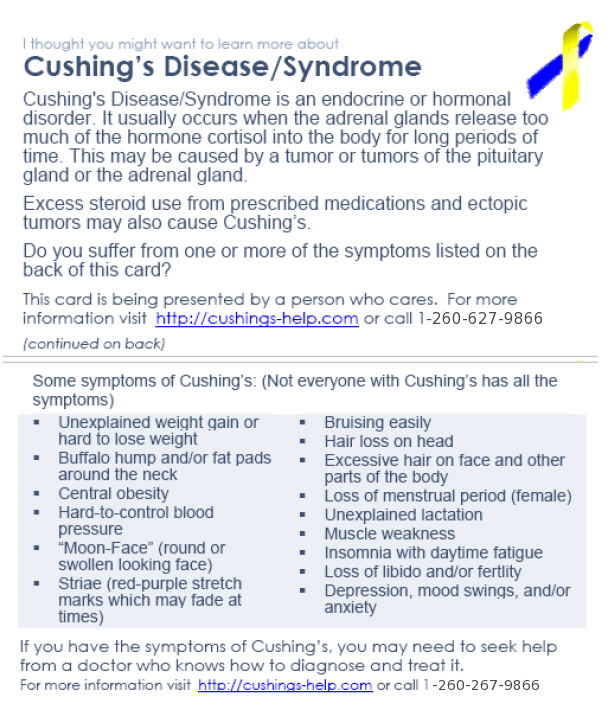
Patients, if you see someone who looks like s/he has Cushing’s, give them a discrete card.

Spread The Word! Cushing’s Pocket Reference

Robin Writes:

This has been a concern of mine for some time. Your post spurred me on to do something I’ve been meaning to do. I’ve designed something you can print that will fit on the business cards you can buy just about anywhere (Wal-mart included). You can also print on stiff paper and cut with a paper cutter or scissors. I’ve done a front and a back.

Cushing's Pocket Reference

Here are the links:

Front: This card is being presented by a person who cares.
Back (The same for everyone)

This Topic on the Message Boards

~~~~~~~~~~~~~~~~~~

And now, the article from http://www.guardian.co.uk/lifeandstyle/2009/nov/03/doctor-diagnosis-stranger:

Are doctors ever really off duty?

Which potentially serious symptoms would prompt them to stop and advise a stranger on a bus?

By Lucy Atkins

Bus

Passengers on a London bus. Photograph: David Levene

A Spanish woman of 55, Montse Ventura, recently met the woman she refers to as her “guardian angel” on a bus in Barcelona. The stranger – an endocrinologist – urged Ventura to have tests for acromegaly, a rare disorder involving an excesss of growth hormone, caused by a pituitary gland tumour. How had the doctor made this unsolicited diagnosis on public transport? Apparently the unusual, spade-like shape of Ventura’s hands was a dead giveaway.

But how many off-duty doctors would feel compelled to alert strangers to symptoms they spot? “If I was sitting next to someone on a bus with a melanoma, I’d say something or I wouldn’t sleep at night,” says GP Mary McCullins. “We all have a different threshold for interfering and you don’t want to terrify people, but this is the one thing I’d urge a total stranger to see a doctor about.” So what other symptoms might prompt a doctor to approach someone on the street?

Moon face

Cushing’s syndrome is another rare hormone disorder which can be caused by a non-cancerous tumour in the pituitary gland. “A puffy, rounded ‘moon face’ is one of the classic signs of Cushing’s,” says Dr Steve Field, chair of the Royal College of GPs. “In a social situation, I wouldn’t just say, ‘You’re dangerously ill’ but I’d try to elicit information and encourage them to see a doctor.”

Different-sized pupils

When one pupil is smaller than the other, perhaps with a drooping eyelid, it could be Horner’s syndrome, a condition caused when a lung tumour begins eating into the nerves in the neck. This can be the first obvious sign of the cancer. “I’d encourage someone to get this checked out,” says Dr Simon Smith, consultant in emergency medicine at the Oxford Radcliffe Hospitals Trust. “People often have an inkling that something’s wrong, and you might spur them to get help sooner.”

Clubbing fingers

Some people are born with club-shaped fingers, but if, over time, they become “drumstick-like”, this could signify serious problems such as lung tumours, chronic lung infections or congenital heart disease. “Because it happens gradually, some people disregard clubbing,” says Smith. “But I’d say something because it can be an important symptom in many serious illnesses.”

Lumpy eyelids

Whitish yellowy lumps around the eyelids can be a sign of high cholesterol, a major factor in heart disease. Sometimes you also get a yellow circle around the iris. “I would suggest they got a cholesterol test with these symptoms,” says Smith. “They can do something about it that could save their life.”

Suntan in unlikely places

A person with Addison’s disease, a rare but chronic condition brought about by the failure of the adrenal glands, may develop what looks like a deep tan, even in non sun-exposed areas such as the palms. Other symptoms (tiredness, dizziness) can be non-specific so the condition is often advanced by the time it is diagnosed. Addison’s is treatable with lifelong steroid replacement therapy. “If someone was saying they hadn’t been in the sun but had developed a tan, alarm bells would ring and I’d probably ask how they were feeling,” says McCullins.

Trench mouth

Putrid smelling breath – even if the teeth look perfect – can be a sign of acute necrotising periodontitis. “I’d be able to tell when someone walks through the door,” says dentist Laurie Powell. “But people become accustomed to it and don’t notice.” Untreated, the condition damages the bones and connective tissue in the jaw. It can also be a sign of other diseases such as diabetes or Aids.