Explaining Cushing’s to Others

Kate on the Cushing’s support board (Cushing’s Help and Support) wrote this letter after having pituitary surgery…

Dear friends and family:

I am writing this letter to share with you some basic facts about Cushing’s Disease/Syndrome and the recovery process so that you will have sufficient information to form realistic expectations about me and my ability to engage in certain activities in light of this disease and its aftermath.

As you know, Cushing’s is a rarely diagnosed endocrine disorder characterized by hypercortisolism. Cortisol is a hormone produced by the adrenal glands and is vital to regulate the body’s cardivoascular functions and metabolism, to boost the immune system and to fight inflammation. But its most important job is to help the body to respond to stress.

The adrenal glands release cortisol in response to stress, so atheletes, women experiencing pregnancy, and those suffering from alcoholism, panic disorders and malnutrition naturally have higher-than-normal levels of cortisol.

People with Cushing’s Syndrome live life with too much cortisol for their bodies as a result of a hormone-secreting tumor. Mine is located in the pituitary gland. Endogenous hypercortisolism leaves the body in a constant state of “fight or flight,” which ravages the body and tears down the body’s major systems including cardivascular, musculo-skeletal, endocrine, etc.

Symptoms vary, but the most common symptoms include rapid, unexplained weight gain in the upper body with increased fat around the neck and face (“moon facies”); buffalo hump; facial flushing/plethora; muscle wasting in the arms and legs; purplish striae (stretch marks) on the abdomen, thighs, buttocks, arms and breasts; poor wound healing and bruising; severe fatigue; depression, anxiety disorders and emotional lability; cognitive difficulties; sleep disorders due to abnormally high nighttime cortisol production; high blood pressure and high blood sugar/diabetes; edema; vision problems; premature osteoperosis; and, in women, signs of hyperandrogenism such as menstrual irregularities, infertility, hirsutism, male-patterned balding and steroid-induced acne.

Attached, you will find a sketch of a typical Cushing’s patient. As you can see, the effects of the disease on the body are dramatic.Worse, the psychological and emotional effects of having a chronic, debilitating and disfiguring disease range from distressing to demoralizing.Imagine that, in the space of a year, you became unrecognizable to those around you and to yourself. You look in the mirror, but the person staring back a tyou is a stranger. You endure the stares and looks of pity from those who knew you before Cushing’s, fully aware that they believe you have “let yourself go” or otherwise allowed this to happen to your body. Nothing you can say or do will persuade them otherwise, so at some point, you stop trying and resolve to live your life in a stranger’s body.

You feel increasingly sick, but when you explain your array of symptoms to your doctor, you are dismissed as a depressed hypochondriac who needs to diet and exercise more. Worse, your family members think the same thing — and are often quick to tell you how you need to “change your lifestyle” to overcome the effects of what you eventually will discover, once properly diagnosed, is a serious and rare disease.

If only it were so simple! No one would choose to have Cushing’s. Those of us who have it would not wish it even on our worst enemy.

Most people with Cushing’s long for the ability to do simple things, like walk a flight of stairs without having to sit for half an hour afterwards, or vacuum the house or even unload a dishwasher.

One of the worst parts about this disease is the crushing fatigue and muscle wasting/weakness, which accompanies hypercortisolism. Not only do we become socially isolated because of the virilzing effects of an endocrine tumor, which drastically alters our appearance, but we no longer feel like ourselves with regard to energy. We would love to take a long bike ride, run three miles or go shopping like we used to — activities, which we took for granted before the disease struck. Those activities are sadly impossible at times for those with advanced stages of the disease.

Sometimes, as with any serious illness, performing even basic tasks of daily care such as showering and dressing can exhaust the limited reserves of energy available to a Cushing’s patient.

How do we explain to you what it’s like to watch our lives slip away? What response is sufficient to express the grief and frustration over losing so much of ourselves? It is often difficult to find the strength to explain how your well-meaning words of prompting and encouragement (to diet or exercise) only serve to leave us more isolated and feeling alone.

Though we wouldn’t want it, we wish our disease were as well-understood as cancer so that those who love us would have a frame of reference for what we go through. With Cushing’s, there is such limited public awareness that we are left to describe the effects of the disease from a void, often with limited understanding from those who love us most, which is disheartening.

The most frustrating misconception about this disease is that we somehow are “doing this to ourselves,” or delaying recovery because we need to continue steroid replacement or lack the energy to excercise often, which is sadly false. Trust me that we would love to have that much control over such a terrible disease.

Fortunately, there is a good likelihood of remission from Cushing’s in the hands of a skilled pituitary surgeon. Unfortunately, the long-term remission rate is only 56%, meaning that 44% of people with Cushing’s will require a second (sometimes third) pituitary surgery, radiation or bilateraly adrenalectomy to resolve the hypercortisolism. Without successful treatment, Cushing’s leads to death. Even with successful treatment, I will have to be monitored for possible recurrence for the rest of my life.

After surgery or other treatment, the recovery period can last months or even years. Because the tumor takes over control of the body’s production of cortisol, the adrenal glands, which had lain dormant prior to surgery, require time to start functioning properly again.

Until this happens, we must take synthetic steroids or else risk adrenal insufficiency or adrenal crisis, which can be quickly life-threatening. Careful monitoring of our cortisol levels is critical during the weaning period. It is a rare but sad fact that some people’s adrenal glands never return to normal, and those people must continue to take hydrocortisone or prednisone — sometimes for life — simply in order for the body to perform correctly its basic systemic functions.

The physical recovery from surgery can be quick, but the withdrawal from hydrocortisone can be a lengthy and extremely painful process. As I described above, Cushing’s causes a tearing-down of muscles and bone. While there is an over-abundance of cortisol in our bodies (as a result of the tumor), we often can’t feel the effects of the muscle-wasting and bone deterioration because of the anti-inflammatory action of cortisol. Upon weaning, however, these become painfully (literally!) evident.

The physical pain experienced while weaning from cortisol has been described as worse than weaning from heroin. When cortisol levels are low, one experiences the symptoms akin to a really bad flu, including severe fatigue (”like a wet cement blanket laid on top of me”); weakness and exhaustion; nausea; headache; vomiting; mental confusion. It is imperative for people who are on replacement steroids after Cushing’s surgery to carry extra Cortef (or injectable Solu-Cortef) with them at all times in addition to wearing a medic alert bracelet so that medical professionals will be alerted to the possiblity of adrenal insufficiency in the event of an adrenal crisis.

People who have struggled with Cushing’s Syndrome all hope to return to “normal” at some point. Though none of us want to have Cushing’s, it is often a relief finally to have a correct diagnosis and treatment plan. For many, there is a gradual resolution of many Cushing’s symptoms within a few years of surgery or other successful treatment, and a good quality of life can be achieved.

But regrettably, this is not possible in every case. Depending on the severity of the disease and the length of time before diagnosis and treatment, the prognosis can be poor and lead to shortened life expectancy and diminished quality of life. This is not a choice or something we can control, but it is the reality for some people who have suffered the consequences of long-term hypercortisolism.

The best support you can give someone who is suffering from Cushing’s or its aftermath is to BELIEVE them and to understand that they are not manufacturing their illness or prolonging recovery. Ask them what they are able (and not able) to do, and then be prepared to help them in ways that matter — whether that be to bring them a meal or help them to run errands, pick up prescriptions from the pharmacy or clean their house.

Because it’s these little everyday tasks, which can fall by the wayside when someone has (or has had) Cushing’s, and these are the things we miss the most: doing for ourselves.

Ask us questions about the disease, and then actively listen to what we say. We know you don’t know much about Cushing’s — even our doctors sometimes lack information about this rare disease. But know we appreciate the interest and will tell you everything you want to know, because those of us who have it necessarily become experts in it just in order to survive.

Thank you for caring about me and for hearing what I am saying in this letter. I know you love me and are concerned about me, and I appreciate that so much. Thank you also for taking the time to read this letter. I look forward to discussing further any questions you might have.

In the meantime, I am attaching a brief article written by a woman who recently was diagnosed with Cushing’s. I hope hearing another person’s experiences will help you to understand what I’m going through so that when we talk, we will be coming from a similar starting place.


Endocrinologists (doctors who specialize in Cushing’s Syndrome and its related issues) realize the medical aspect and know the damaging effects that Cushing’s has on the body. Family and friends see their Cushie suffering and know they are hurting physically and often times mentally and emotionally. However, understanding the debilitation of Cushing’s and how it can affect every aspect of a person’s life can only be truly realized by those who have experienced the syndrome.

Cushings Help Organization, Inc., a non-profit family of websites maintained by MaryO, a pituitary Cushing’s survivor, provides this letter for patients to provide to their family and friends in hopes of providing a better understanding Cushing’s and it’s many aspects.

We’re sorry to hear that your family member or friend has Cushing’s Syndrome or suspected Cushing’s. A person may feel better at times then at other times. It’s common for a Cushing’s patient to have burst of energy and then all of a sudden they become lethargic and don’t feel like moving a muscle. There are many symptoms that are associated with Cushing’s. They include weight gain, fatigue, muscle weakness, shortness of breath, feeling achy all over, headaches, blurred vision, mood swings, high blood pressure, stretch marks (straie), buffalo hump, diabetes, edema and the list goes on. Hormones affect every area of the body.

It is important to note that not all patients have every symptom. Even some hallmark symptoms, such as straie or the “buffalo hump”, may not be noticable on every patient. Not everyone who has Cushing’s will experience the same symptoms, treatment, or recovery. Because not all “Cushies” have these symptoms, it makes diagnosis even more difficult.

Cushing’s can cause the physical appearance change due to weight gain, hair loss, rosacea, acne, etc. This can be very disturbing when looking in the mirror. Changes in appearance can often cause the Cushing’s patient to withdraw from family and friends making it a very lonely illness. Patients often feel alone or withdrawn because few others understand.

Cushing’s can affect affect anyone of any age although it is more commen in women.

Cushing’s patients need to be able to take one day at time and learn to listen to their bodies. There will most likely be times when naps are needed during the day and often times may not be able to sleep at night due to surges of cortisol. Your Cushie doesn’t expect you to understand Cushing’s Syndrome completely. They do need you to be there for them and try to understand to the best of your ability what they feel and not give up on them.

Often a Cushing’s patient may be moody and say things that they don’t mean. If this should happen with your Cushie try not to take it personally and know that it’s most likely caused by the elevated cortisol and disturbances in other hormone levels caused by the Cushing’s and not from the heart or true feelings of your Cushie.

It can be very depressing and frustrating having so many limitations and experience things in life being taken from you. Cushing’s patients are sick, not lazy, not hypochondriacs or even the newer term “Cyberchondriacs”. If a Cushing’s patient says they don’t feel like doing something or they express how bad they feel let them know that you believe them. One of the most frustrating things to someone who is sick is to have those you love not believe you or support you. Telling a Cushie to think positive thoughts will not make him/her well and will just be aggrivating.

Testing procedures can be lengthy and this can become frustrating for the patient and family. Often, it takes a while for results to come back and this can be stressful. Don’t look to far ahead just take one day at a time and deal with the situation that is at hand at the present time.

After a diagnosis is made then it’s time for treatment. Surgery is usually the best treatment option for Cushing’s that is caused by tumors. Don’t be surprised if the surgeon’s facility wants to run even more tests or redo some of those that have already been done. Your Cushie may have to travel a ways to find a surgeon who is trained in these delicate surgeries and who has performed many of them.

Once the diagnosis has been made and treatment has finished then it’s time for the recovery process. Not all patients who have surgery are cured and they have to make a choice along with the advice of their doctor as to what their next treatment option will be.

The recovery from the surgery itself is similar to any other surgery and will take a while to recover. The recovery process obtained from getting a cure from Cushing’s is quiet different from other surgeries. A Cushing’s patients body has been exposed to excess cortisol, usually for quite a long time, and has become accustomed it. When the tumor is removed that has been responsible for the excessive cortisol and the body is no longer getting it this causes the body to have withdrawal symptoms. Withdrawal can be very hard causing an array of symptoms muscle aches, weakness, bone and joint pain, emotional disturbances etc.

Thank you for reading this and we hope it will help you to understand a little more about Cushing’s and the dibilating affect it can have on a person. Thank you for being there and supporting your Cushie during this time in their life. We realize that when a family member has Cushing’s it not only affects the individual but other family members and those around them as well. Showing your love and support will encourage a speedy recovery for your Cushie.


‘The ugly disease’

By Toby Hatchett

When Fedela Vincent, 68, of Rye, was diagnosed with Cushing’s disease, she was relieved, almost happy. After more than three years, she knew what was wrong with her.

Vincent had spent years trying to figure out what was wrong with her, what was happening to her and her body. A petite woman, of 5 feet, she had always been trim and fit. She ate right, worked out at the gym and led a healthy lifestyle.

But, for no apparent reason, she began to gain weight. Lots of weight, primarily in the upper body.

“I looked like an apple, with a moon face,” Fedela says. “Cushing’s is not called ?the ugly disease’ for nothing.”

Cushing’s disease victims don’t share the same symptoms, but many of the symptoms are physically noticeable: the extreme weight gain in the upper body, the moon face, a buffalo hump on the back, hair loss and blotchy, red skin with breakouts.

“Feeling constantly cruddy” is the polite description of being a Cushie,” Fedela says.

Then there are the other symptoms, those not visible on the outside. Fedela says the worst for her was the insomnia, the anxiety, the fear of abandonment and pain. The joints hurt, the muscles lose their mass and walking is difficult.

When Fedela was at her worst, she couldn’t walk up the stairs, let alone cook or shop. She was as weak as a kitten, she says.

Her doctors at this time urged her to lose weight, giving medications that often made her sick in an effort to solve the problem.

Bob Vincent, her husband of 48 years, never left her side during this difficult time. Cushing’s disease is such a traumatic disease that it is estimated more than half of husbands leave their wives. The mood swings can be dramatic.

“When Bob would bring me coffee,” says Fedela, “he never knew what to expect.”

Then Fedela decided to try a different kind of doctor. She went to Dr. Jennifer Warren, in Hampton, who specializes in weight control. In Warren, she found someone who listened to her and paid attention. Warren was the first doctor to suggest Cushing’s disease might be the cause of Fedela’s weight gain.

From that moment on, things began to happen. Fedela went to Dr. Daniel Nadeau who put her on a diabetes-related medication for weight loss. This didn’t work and after a month, she was given a simple urinalysis test. Within 24 hours, she had her diagnosis.

Nadeau referred Fedela to the Lahey Clinic, in Burlington, Mass. There she met the doctor she now calls her “savior,” Dr. Nicholas Tritos. This clinic is world-renowned for its work in pituitary malfunctions.

What is Cushing’s disease? It is the body reacting to a constant overdose of steroids being released by the adrenal glands. The pituitary gland over-stimulates the adrenal glands, which in turn send crisis-level chemical messages to all the other endocrine glands.

“The body reacts to the hyper-stimulation by constantly being in a state of fight or flight,” says Fedela. “It’s 24/7 with no relief.”

Cushing’s disease affects an estimated 10 to 15 out of every million people. The fact that it is relatively rare in numbers is one cause of the lack of public knowledge and awareness of this disease.

Non-diagnosed, Cushing’s disease can lead to uncontrollable diabetes, and eventually, death. The symptoms can be so varied and mimic so many other conditions, that Cushing’s disease is often not diagnosed or misdiagnosed.

“The not knowing what is wrong with you is awful,” Fedela says, “and the way people look at you when you’re not what society calls “normal.’”

“People would tell me ?you are what you eat’ and suggest I try Weight Watchers, things like that.”

But Fedela was carefully watching what she ate, often eating less than her doctors prescribed. Even when her energy level was almost non-existent, she and her husband would go to the gym.

“Bob wouldn’t let me stay inside. We kept going out, for drives, to Market Square and lunch with friends.”

After the initial diagnosis, Fedela spent six months undergoing various tests.

Then, on Mother’s Day of this year, during the New Hampshire floods, she was operated on. Fifty percent of one side of the pituitary was removed and 25 percent of the other side to remove the offending tumorous tissues.

Fedela spent five days recovering at the Lahey Clinic.

“The whole staff was just wonderful. The nurses would pop in to see what a Cushie looked like. They never left me alone.”

When she came out of the surgery, Bob was there beside her, along with a very special teddy bear.

“The teddy bear was hugged by members of South Church, including the children Fedela taught in her kindergarten class,” he said.

The blessing of this disease, as Fedela describes it, is in learning how to receive. Having long been a giver herself, this was not an easy lesson to learn. South Church, in Portsmouth, put together a Fedela Vincent Support Group, with people from Portsmouth, Rye, Salem, Mass., and Greenland, to provide moral support, company and meals. For six weeks, day and night, someone was there.

“South Church is an amazing institution,” Bob says. “The support group was invaluable. Fedela received over 250 cards from all over the country.”

This support group is still there for Vincent as she continues to recover and regain her health. She still has problems, but she can now lead a more normal life. “I can shop!” she says with a grin.

“I wanted to do this interview as a call to the medical community to be alert to the symptoms of Cushing’s disease and to really listen to their patients.”

Fedela also hopes that by sharing her story, others may learn that diet alone is not always the cause of weight gain. America’s obsession with skinny bodies and the resulting negative judgmental views on those who do not fit this picture is something she hopes people may think twice about before making judgments.

Lastly, Fedela wants to publicly thank her husband, family, friends and physicians who have stood by her during this difficult struggle. She still has a long way to go, but she is on the mend now and knows what was wrong with her.

“The not knowing what was happening to me was the worst of all.”

“If by telling my story, I can help even one person not go through what I did, then it’s worth it.”

Tritos, a leading endocrinologist at the Lahey Clinic, says it is common for Cushing’s disease to not be immediately diagnosed.

“It is common because the condition itself is uncommon. The symptoms are subtle and can be attributed to other causes.”

“In Fedela’s case, her own body was producing an overload of steroids.”

There is a peculiar type of weight gain, in the face, neck and upper torso. Unfortunately, it can take awhile to be diagnosed.

“Most patients go from one doctor to another before Cushing’s disease is diagnosed.”

Also, Tritos says, sometimes the tests are inconclusive.

But once on the appropriate path, most patients can be helped.

Tritos also notes the value of a good support system, which Fedela had in place.

“The support of family and friends is very important. By telling her story, Mrs. Vincent will increase the public’s awareness of Cushing’s disease.”

Helping others learn more about Cushing’s/Acromegaly

I found this article especially interesting.  This question was asked of a group of endos at an NIH conference a few years ago – if you saw someone on the street who looked like they had symptoms of fill-in-the disease, would you suggest that they see a doctor.  The general answer was no.  No surprise there.

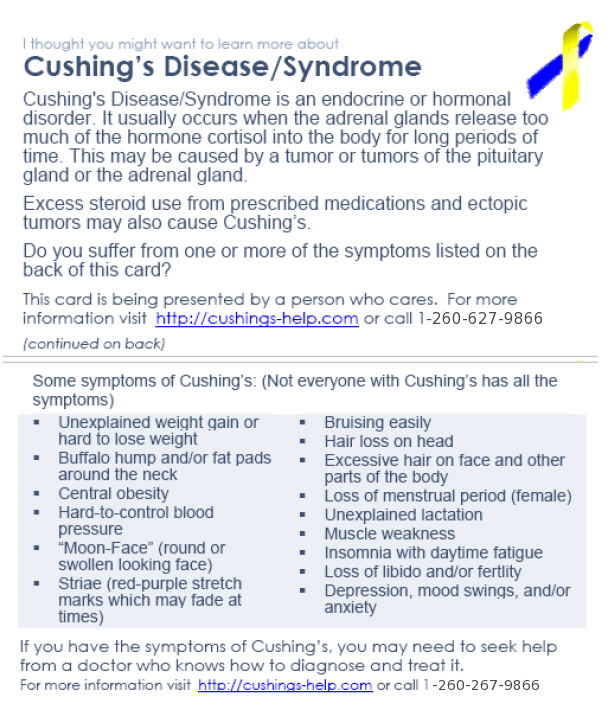
Patients, if you see someone who looks like s/he has Cushing’s, give them a discrete card.

Spread The Word! Cushing’s Pocket Reference

Robin Writes:

This has been a concern of mine for some time. Your post spurred me on to do something I’ve been meaning to do. I’ve designed something you can print that will fit on the business cards you can buy just about anywhere (Wal-mart included). You can also print on stiff paper and cut with a paper cutter or scissors. I’ve done a front and a back.

Cushing's Pocket Reference

Here are the links:

Front: This card is being presented by a person who cares.
Back (The same for everyone)

This Topic on the Message Boards

~~~~~~~~~~~~~~~~~~

And now, the article from http://www.guardian.co.uk/lifeandstyle/2009/nov/03/doctor-diagnosis-stranger:

Are doctors ever really off duty?

Which potentially serious symptoms would prompt them to stop and advise a stranger on a bus?

By Lucy Atkins

Bus

Passengers on a London bus. Photograph: David Levene

A Spanish woman of 55, Montse Ventura, recently met the woman she refers to as her “guardian angel” on a bus in Barcelona. The stranger – an endocrinologist – urged Ventura to have tests for acromegaly, a rare disorder involving an excesss of growth hormone, caused by a pituitary gland tumour. How had the doctor made this unsolicited diagnosis on public transport? Apparently the unusual, spade-like shape of Ventura’s hands was a dead giveaway.

But how many off-duty doctors would feel compelled to alert strangers to symptoms they spot? “If I was sitting next to someone on a bus with a melanoma, I’d say something or I wouldn’t sleep at night,” says GP Mary McCullins. “We all have a different threshold for interfering and you don’t want to terrify people, but this is the one thing I’d urge a total stranger to see a doctor about.” So what other symptoms might prompt a doctor to approach someone on the street?

Moon face

Cushing’s syndrome is another rare hormone disorder which can be caused by a non-cancerous tumour in the pituitary gland. “A puffy, rounded ‘moon face’ is one of the classic signs of Cushing’s,” says Dr Steve Field, chair of the Royal College of GPs. “In a social situation, I wouldn’t just say, ‘You’re dangerously ill’ but I’d try to elicit information and encourage them to see a doctor.”

Different-sized pupils

When one pupil is smaller than the other, perhaps with a drooping eyelid, it could be Horner’s syndrome, a condition caused when a lung tumour begins eating into the nerves in the neck. This can be the first obvious sign of the cancer. “I’d encourage someone to get this checked out,” says Dr Simon Smith, consultant in emergency medicine at the Oxford Radcliffe Hospitals Trust. “People often have an inkling that something’s wrong, and you might spur them to get help sooner.”

Clubbing fingers

Some people are born with club-shaped fingers, but if, over time, they become “drumstick-like”, this could signify serious problems such as lung tumours, chronic lung infections or congenital heart disease. “Because it happens gradually, some people disregard clubbing,” says Smith. “But I’d say something because it can be an important symptom in many serious illnesses.”

Lumpy eyelids

Whitish yellowy lumps around the eyelids can be a sign of high cholesterol, a major factor in heart disease. Sometimes you also get a yellow circle around the iris. “I would suggest they got a cholesterol test with these symptoms,” says Smith. “They can do something about it that could save their life.”

Suntan in unlikely places

A person with Addison’s disease, a rare but chronic condition brought about by the failure of the adrenal glands, may develop what looks like a deep tan, even in non sun-exposed areas such as the palms. Other symptoms (tiredness, dizziness) can be non-specific so the condition is often advanced by the time it is diagnosed. Addison’s is treatable with lifelong steroid replacement therapy. “If someone was saying they hadn’t been in the sun but had developed a tan, alarm bells would ring and I’d probably ask how they were feeling,” says McCullins.

Trench mouth

Putrid smelling breath – even if the teeth look perfect – can be a sign of acute necrotising periodontitis. “I’d be able to tell when someone walks through the door,” says dentist Laurie Powell. “But people become accustomed to it and don’t notice.” Untreated, the condition damages the bones and connective tissue in the jaw. It can also be a sign of other diseases such as diabetes or Aids.

Ectopic Adrenocorticotropic Hormone-Secreting Pituitary Adenoma in the Clivus Region: A Case Report

Yan Zhang, Danrong Wu, Ruoqiu Wang, Min Luo, Dong Wang, Kaiyue Wang, Yi Ai, Li Zheng, Qiao Zhang, Lixin Shi

Department of Endocrinology and Metabolism, Guiqian International General Hospital, Guiyang, People’s Republic of China

Correspondence: Qiao Zhang; Lixin Shi, Department of Endocrinology and Metabolism, Guiqian International General Hospital, Guiyang, People’s Republic of China, Tel/Fax +86 851-86277666, Email endocrine_zq@126.com; slx1962@medmail.com.cn

Abstract: Ectopic pituitary adenoma (EPA) is a pituitary adenoma unrelated to the intrasellar component and is an extremely rare disease. EPA resembles typical pituitary adenomas in morphology, immunohistochemistry, and hormonal activity, and it may present with specific or non-specific endocrine manifestations. Here, we report a rare case of ectopic adrenocorticotropic hormone (ACTH)-secreting pituitary adenoma in the clival region. Only three patients with ACTH-secreting pituitary adenomas occurring in the clivus have been previously reported, and the present case was diagnosed as a clivus-ectopic ACTH-secreting pituitary macroadenoma. Thus, in addition to the more common organs, such as the lung, thymus, and pancreas, in the diagnosis of ectopic ACTH syndrome, special attention should be paid to the extremely rare ectopic ACTH-secreting pituitary adenoma of the clivus region.

Keywords: ectopic pituitary adenoma, Cushing’s syndrome, clivus, adrenocorticotropic hormone, endocrine

Introduction

The diagnosis of Cushing’s syndrome (CS), particularly its localization diagnosis, has always been a challenge in clinical practice.1,2 Endogenous CS can be divided into adrenocorticotropic hormone (ACTH)-dependent and non-ACTH dependent with the former accounting for 70% of CS cases. Ectopic ACTH syndrome accounts for 5–10% of CS cases, and its lesions are mainly located in the lungs, thymus, pancreas, and the thyroid gland.3 Finding such lesions in non-pituitary intracranial regions is extremely rare, and ectopic ACTH in the clivus region is even rarer. To date, less than 60 cases of ectopic ACTH-secreting pituitary adenomas have been reported,4 and determining their localization is a formidable challenge in CS diagnosis. It is difficult to make an accurate and prompt diagnosis of ectopic ACTH-secreting pituitary adenoma caused by hypercortisolism based on its clinical manifestation, routine laboratory tests, and radiologic examinations.1,4 Ectopic pituitary adenomas (EPAs) are mainly concentrated in the sphenoid sinus, suprasellar region, and cavernous sinus, and rare regions include the clivus, ethmoid sinus, and nasal cavity.5 A literature review showed that only three cases of primary EPA in the clivus region have been reported worldwide.6–8 Recently, we diagnosed a patient with ectopic ACTH-secreting pituitary macroadenoma in the clivus region that was confirmed by surgery and immunohistochemistry.

Case Presentation

A 53-year-old female patient sought medical attention at our hospital for hypertension, headache, and dizziness with a blood pressure as high as 180/100 mmHg. Her medical history showed that she had developed similar symptoms 2 years ago. At that time, she had hypertension (180/100 mmHg), headache, and dizziness, and she was treated with amlodipine (5 mg per day), benazepril hydrochloride (10 mg per day), and metoprolol tartrate (50 mg per day). The patient was not hospitalized for treatment and did not undergo systemic examination. Three months before admission, the patient had a thoracic vertebrae fracture caused by moving heavy objects. One month before admission, she had a bilateral rib fracture due to falling on flat ground. Her physical examination results were as follows: blood pressure, 160/85 mmHg; height, 147 cm; weight, 55.2 kg; and body mass index (BMI), 25.54 kg/m2. In the physical examination, moon facies, buffalo hump, concentric obesity, facial plethora, and large patches of ecchymosis at the blood sampling site were observed. Purple striae were absent below the axilla, abdomen, and limbs. Her hematological examination results were as follows: cortisol (COR) rhythm with 33.52 µg/dL (reference range: 4.26–24.85) at 8:00 AM, 34.3 µg/dL at 4:00 PM, and 33.14 µg/dL at 12:00 AM; 1 mg dexamethasone overnight suppression test indicated 22.21 µg/dL COR at 8:00 AM; 24 h urine COR was 962.16 µg/24 h (reference range: 50–437 µg/24 h); 8:00 AM ACTH at two different times was 74 pg/mL and 90.8 pg/mL (reference range: <46); high-dose dexamethasone suppression test (HDDST) was 21.44 µg/dL COR (serum COR level was not suppressed by more than 50%); serum potassium was 3.38 mmol/L (reference range: 3.5–5.5); insulin-like growth factor-1 (IGF-1) was 106.6 ng/mL (reference range: 84–236); serum luteinizing hormone (LH) was <0.07 IU/L (reference range: 1.9–12.5); serum follicle stimulating hormone (FSH) was 0.37 IU/L (reference range: 2.5–10.2); prolactin (PRL), testosterone, progesterone, and estradiol test results were normal; FT4 was 8.25 pmol/L (reference range: 10.44–24.38); TSH was 1.116 mIU/L (reference range: 0.55–4.78); oral glucose tolerance test (OGTT) indicated that fasting blood glucose was 6.3 mmol/L and 2-h blood glucose was 18.72 mmol/L; and glycated hemoglobin (HbA1c) was 7.1%. A bone mineral density test suggested osteoporosis (dual energy X-rays: L1-L4 T values were −3.4).

Magnetic resonance (MR) scans were performed using a SIGNA Pioneer 3.0T (GE Healthcare, Waukesha, WI, USA), and computed tomography (CT) scans were performed using a 256 slice CT scanner (Revolution CT; GE Healthcare, Waukesha, WI, USA). The enhanced MR scan of the sellar lesion showed a soft tissue mass with abnormal signals in the occipital bone clivus. T1WI showed an isointense signal, and T2WI showed an isointense/slightly hyperintense signal in a large area of approximately 30 mm × 46 mm. The lesion extended anteriorly to completely fill the entire sphenoidal sinus, and it was in a close proximity to the right internal carotid arteries. Significant invasion, liquefaction, and necrosis were not observed in the bilateral cavernous sinuses. Pituitary gland morphology was normal with a superoinferior diameter of 3.14 mm, and the pituitary gland was located in the center. An occipital bone clival space-occupying lesion was considered with a tendency of low malignancy and a possibility of chordoma (Figure 1A–C). Non-enhanced high-resolution CT scans of the nasal sinuses showed osteolytic destruction, and a soft tissue mass was observed in the occipital bone clivus. The mass had a large area of 20 mm × 30 mm × 46 mm (Figure 1D). Enhanced CT of the adrenals showed bilateral adrenal gland hyperplasia.

Figure 1 (A) MR T1+T2 scan (transverse view). MR T1 scan (left) shows the soft tissue mass of the occipital clivus (white arrow), and MR T2 scan (right) shows that the right internal carotid artery, cavernous sinus, and tumor are within close proximity to each other (white arrow). (B) MR T1 enhanced scan (sagittal view) shows clear demarcation between normal pituitary gland and mass (white arrow). (C) MR T2 scan (sagittal view) shows that the pituitary fossa is normally present (white arrow). (D) CT (sagittal view) shows bony destruction of dorsum sellae, clivus, and sphenoid sinus by mass (white arrow).

Bilateral inferior petrosal sinus sampling (IPSS) combined with a desmopressin stimulation test had the following results: baseline ACTH at left inferior petrosal sinus/periphery (IPS/P), 5.4; post-stimulation IPS/P, 3.42; stimulation corrected (ACTHPRL) IPS/P, 2.8; right baseline IPS/P, 1.64; post-stimulation IPS/P, 9.34; and stimulation corrected IPS/P, 6.92. The left inferior petrosal sinus was the dominant side (Table 1).

Table 1 Bilateral Inferior Petrosal Sinus Sampling Combined with Desmopressin Stimulation Test

The patient underwent endoscopic transsphenoidal clival lesion resection surgery, and the postoperative pathology test results showed EPA (Figure 2). The immunohistochemistry staining results were as follows: CK (+), SYN (+), CgA (+), ACTH (+), growth hormone (GH) (−), LH (−), TSH (−), PRL (−), FSH (−), and Ki-67 (<1% +). The COR level at 10 days after surgery was 15.87 µg/dL, and the ACTH level was 31.37 pg/mL (Table 2).

Table 2 Changes in COR and ACTH Levels During Course of Treatment
Figure 2 Pathological diagnosis of (clivus) ectopic pituitary adenoma. (A) Pituitary adenoma revealing a trabecular and nested structure revealing vascular invasion (hematoxylin and eosin (HE) stain, 200x) composed of two distinct types of cells. (B) ACTH expression in the EPA (200x, ACTH-antibody, Dako).

After admission, her blood and urine COR levels were significantly elevated, and a qualitative diagnosis of CS was obtained. Etiological examination found that ACTH was also significantly elevated, suggesting that the CS was ACTH dependent. The HDDST results showed that the serum COR level was not suppressed by more than 50% and was accompanied by hypokalemia, suggesting that the ACTH-dependent CS may be ectopic ACTH syndrome. Ectopic ACTH syndrome is relatively rare, and the lesions are caused by non-pituitary tumors. No lesions were identified in the lung, thymus, pancreas, and thyroid of our patient. Regarding the IPSS examination, the IPS/P ratio was greater than 2, which suggested that the ectopic ACTH was located intracranially and not at the periphery. Radiologic testing suggested that the pituitary structure was normal and that a space-occupying lesion in the clivus region was present. Therefore, ectopic ACTH-secreting adenoma in the clivus region was considered, and postoperative pathological biopsy was used to confirm the diagnosis.

Discussion

EPA is an extremely rare disease that occurs outside of the sella turcica, and it is not linked to the intrasellar pituitary. The morphology, immunohistochemistry, and hormone activity of EPAs are similar to typical pituitary adenomas. EPAs can manifest as specific or non-specific endocrine disorders, and they account for 0.48% of all pituitary adenomas.9 The pathogenesis of EPA is still currently unknown. It is generally considered that during the development of the anterior pituitary lobe, the incompletely degraded Rathke cleft cyst remnants of the Rathke pouch lead to the formation of EPAs in the nasopharynx, sphenoid, and clivus.10,11 EPA is rare in China. Zhu et al5 recorded 14,357 pituitary gland patients in the last 20 years; of these patients, only 14 were diagnosed with EPA (0.098% of all cases), but none of the lesions originated from the clivus region. Previous literature reviews4,5 revealed that non-functioning EPAs in the clivus region are the most common (50%); the most common hormone-secreting functional adenomas are PRL adenomas and GH adenomas, which account for 25.0% and 21.4% of EPAs, respectively, whereas ACTH-secreting EPAs are extremely rare and only account for 3.6% of cases.

The postoperative pathological and immunohistochemical results of the tumor tissue in the patient demonstrated that it was an ectopic ACTH-secreting pituitary macroadenoma in the clivus region. Most EPAs are microadenomas (diameter <1 cm), except those in the clivus region, which are macroadenomas.5 Adenoma size generally does not affect the patient’s clinical and biochemical characteristics, and it may be related to tumor location or extension.12 Encasement of the internal carotid artery is a characteristic feature of EPA invasion into surrounding tissues.5 Encasement of the right internal carotid artery by the tumor was also observed in our patient. Therefore, surgery cannot completely remove the tumor and may ultimately affect surgical outcomes, and radiotherapy may even be required in the future. The serum COR and ACTH levels of our patient were evaluated 10 days after surgery. Although the levels were significantly lower than those before the surgery, the COR level was still significantly higher than the cutoff value of 1 µg/dL,13,14 suggesting that the patient may not have complete remission due to the incomplete tumor resection in the area adjacent to the carotid artery during surgery. Another feature that was observed in our patient was bone invasion. Because the clivus is composed of abundant cancellous bone that is connected to surrounding bone structures, EPAs or other tumors may cause bone destruction and affect the sphenoidal sinus and cavernous sinus, which is also consistent with literature reports.15,16

Due to the low incidence of EPAs, most EPA cases are reported as case reports in the literature. We performed an English literature search using the PubMed and Web of Science Core Collection databases with the following predetermined terms: “Cushing’s syndrome”, “pituitary adenomas”, “clivus”, “ectopic pituitary adenoma”, and “adrenocorticotropic”. The literature was included if it met the following criteria: (i) the confirmed diagnosis of CS or ectopic ACTH syndrome was described in the literature; (ii) the diagnosis of EPA was confirmed by postoperative inspection; and (iii) EPA occurred in the clivus. After excluding cases of clival invasion from other sites, we found only three reports of ectopic ACTH-secreting adenoma in the clivus region,6–8 and they were all female patients. Ortiz-Suarez and Erickson6 employed transfrontal craniotomy to demonstrate that the ectopic ACTH-secreting adenoma was an extension of extrasellar lesion to the clivus. In a case report by Pluta et al,7 the patient was found to have cavernous sinus and clival ACTH-positive tumors through transphenoidal surgery. In a case report by Aftab et al,8 the patient only presented a space-occupying lesion with unilateral vision loss; the patient was initially diagnosed with clival chordoma, but the postoperative results supported the diagnosis of EPA. Based on preoperative imaging, the possibility of chordoma was also considered to be high in our patient. We combined the clinical manifestation and laboratory test results of the patient and considered the etiology of CS to conclude that the patient had clival ectopic ACTH-secreting adenoma instead of chordoma.

Hormone tests in our patient suggested secondary pituitary-gonadal axis and decreased pituitary-thyroid axis function. These changes in endocrine function may be due to pituitary suppression by hypercortisolism. After surgery, the corresponding markers recovered, indicating that the suppression was transient. The patient has a history of fracture and a bone mineral density suggestive of osteoporosis, which may also be associated with CS hypercortisolemia.

Treatment modalities for EPA include adenoma resection surgery, radiotherapy, and drugs. The first-line recommended treatment is surgical resection. Craniotomy is considered the surgical procedure of choice for EPA, and endoscopic transsphenoidal surgery (TSS) is considered a feasible method for preserving pituitary function while simultaneously treating EPA. However, due to limitations with the surgical operation space, there are still concerns whether sufficient exploration and effective tumor resection can be achieved.17 Because there are few case reports of such patients, the long-term outcomes of these two surgical procedures require further validation. Due to differences in EPA sites and functions, the efficacy of surgery also differs. Zhu et al5 reported that compared to the radical resection rate of sphenoidal sinus and cavernous sinus EPA (72.3% and 73.3%, respectively), the radical resection rate of clival EPA is only 45.0%, and this difference is statistically significant.

The three clival EPA patients described in the three relevant publications6–8 all showed significant improvements in postoperative signs, symptoms, and hormone levels after complete surgical removal of the lesions or combined with radiation therapy. In our patient, however, radical resection of the tumor could not be achieved due to the close proximity of the tumor mass to the right internal carotid artery, and surgery could not be used to achieve complete remission, which is similar to the case reported by Zhu et al.5 For such patients, radiotherapy can be considered as a second-line treatment for EPA. To control hormone levels, drugs and bilateral adrenalectomy are also treatment options.5,18,19

Conclusion

EPA is a rare disease, and clival EPA is even rarer. From the entire diagnosis and treatment course, this unique and rare EPA case was preliminarily diagnosed through a comprehensive hormone panel and IPSS, and it was confirmed by pathology and immunohistochemistry after surgery. In the diagnosis of ectopic ACTH syndrome, attention should also be paid to extremely rare pituitary ectopic sites, such as the sphenoid sinuses, parasellar region, and the clivus, in addition to common sites, such as the lungs, thymus, pancreas, and thyroid.

Data Sharing Statement

The raw data supporting the conclusions of this article will be made available by the authors without undue reservation.

Informed Consent Statement

Prior written permission was obtained from the patient for treatment as well as for the preparation of this manuscript and for publication. Our institution approved the publication of the case details.

Acknowledgments

We would like to thank the patient and her family.

Author Contributions

All authors made a significant contribution to the work reported, whether that is in the conception, study design, execution, acquisition of data, analysis and interpretation, or in all these areas; took part in drafting, revising or critically reviewing the article; gave final approval of the version to be published; have agreed on the journal to which the article has been submitted; and agree to be accountable for all aspects of the work.

Funding

There is no funding to report.

Disclosure

The authors report no conflicts of interest in this work.

References

1. Senanayake R, Gillett D, MacFarlane J, et al. New types of localization methods for adrenocorticotropic hormone-dependent Cushing’s syndrome. Best Pract Res Clin Endocrinol Metab. 2021;35:101513. doi:10.1016/j.beem.2021.101513

2. Young J, Haissaguerre M, Viera-Pinto O, et al. Management of Endocrine Disease: cushing’s syndrome due to ectopic ACTH secretion: an expert operational opinion. Eur J Endocrinol. 2020;182:R29–r58. doi:10.1530/EJE-19-0877

3. Hayes AR, Grossman AB. The ectopic adrenocorticotropic hormone syndrome: rarely easy, always challenging. Endocrinol Metab Clin North Am. 2018;47:409–425. doi:10.1016/j.ecl.2018.01.005

4. Zhu J, Lu L, Yao Y, et al. Long-term follow-up for ectopic ACTH-secreting pituitary adenoma in a single tertiary medical center and a literature review. Pituitary. 2020;23:149–159. doi:10.1007/s11102-019-01017-y

5. Zhu J, Wang Z, Zhang Y, et al. Ectopic pituitary adenomas: clinical features, diagnostic challenges and management. Pituitary. 2020;23:648–664. doi:10.1007/s11102-020-01071-x

6. Ortiz-Suarez H, Erickson DL. Pituitary adenomas of adolescents. J Neurosurg. 1975;43:437–439. doi:10.3171/jns.1975.43.4.0437

7. Pluta RM, Nieman L, Doppman JL, et al. Extrapituitary parasellar microadenoma in Cushing’s disease. J Clin Endocrinol Metab. 1999;84:2912–2923. doi:10.1210/jcem.84.8.5890

8. Aftab HB, Gunay C, Dermesropian R, et al. “An Unexpected Pit” – ectopic pituitary adenoma. J Endocr Soc. 2021;5:A557–A558. doi:10.1210/jendso/bvab048.1137

9. Li X, Zhao B, Hou B, et al. Case report and literature review: ectopic thyrotropin-secreting pituitary adenoma in the suprasellar region. Front Endocrinol. 2021;12:619161. doi:10.3389/fendo.2021.619161

10. Agely A, Okromelidze L, Vilanilam GK, et al. Ectopic pituitary adenomas: common presentations of a rare entity. Pituitary. 2019;22:339–343. doi:10.1007/s11102-019-00954-y

11. Tajudeen BA, Kuan EC, Adappa ND, et al. Ectopic pituitary adenomas presenting as sphenoid or clival lesions: case series and management recommendations. J Neurol Surg B Skull Base. 2017;78:120–124. doi:10.1055/s-0036-1592081

12. Akirov A, Shimon I, Fleseriu M, et al. Clinical study and systematic review of pituitary microadenomas vs. macroadenomas in cushing’s disease: does size matter? J Clin Med. 2022;11:1558. doi:10.3390/jcm11061558

13. Badiu C. Williams textbook of endocrinology. Acta Endocrinologica. 2019;15:416. doi:10.4183/aeb.2019.416

14. Rollin GA, Ferreira NP, Junges M, et al. Dynamics of serum cortisol levels after transsphenoidal surgery in a cohort of patients with Cushing’s disease. J Clin Endocrinol Metab. 2004;89:1131–1139. doi:10.1210/jc.2003-031170

15. Hu S, Cheng S, Wu Y, et al. A large cavernous sinus giant cell tumor invading clivus and sphenoid sinus masquerading as meningioma: a case report and literature review. Front Surg. 2022;9:861739. doi:10.3389/fsurg.2022.861739

16. Wu X, Ding H, Yang L, et al. Invasive corridor of clivus extension in pituitary adenoma: bony anatomic consideration, surgical outcome and technical nuances. Front Oncol. 2021;11:689943. doi:10.3389/fonc.2021.689943

17. Sun X, Lu L, Feng M, et al. Cushing syndrome caused by ectopic adrenocorticotropic hormone-secreting pituitary adenomas: case report and literature review. World Neurosurg. 2020;142:75–86. doi:10.1016/j.wneu.2020.06.138

18. Szabo Yamashita T, Sada A, Bancos I, et al. Differences in outcomes of bilateral adrenalectomy in patients with ectopic ACTH producing tumor of known and unknown origin. Am J Surg. 2021;221:460–464. doi:10.1016/j.amjsurg.2020.08.047

19. Szabo Yamashita T, Sada A, Bancos I, et al. Bilateral adrenalectomy: differences between cushing disease and Ectopic ACTH-producing tumors. Ann Surg Oncol. 2020;27:3851–3857. doi:10.1245/s10434-020-08451-4

Creative Commons License This work is published and licensed by Dove Medical Press Limited. The full terms of this license are available at https://www.dovepress.com/terms.php and incorporate the Creative Commons Attribution – Non Commercial (unported, v3.0) License. By accessing the work you hereby accept the Terms. Non-commercial uses of the work are permitted without any further permission from Dove Medical Press Limited, provided the work is properly attributed. For permission for commercial use of this work, please see paragraphs 4.2 and 5 of our Terms.


Psoriatic arthritis patients face more endocrine comorbidities


AT 2016 GRAPPA ANNUAL MEETING


VITALS

Key clinical point:Patients with psoriatic disease had a significantly higher prevalence of diabetes mellitus and some other endocrine comorbidities.

Major finding: In a univariate analysis, the risk for Cushing’s disease was notably higher among psoriatic arthritis patients, compared with controls (odds ratio, 5.31).

Data source: Retrospective, cross-sectional comparison of 3,161 patients with psoriatic arthritis and 31,610 matched controls.

Disclosures: Dr. Haddad, Dr. Coates, and Dr. Kavanaugh reported having no relevant financial disclosures.

The large, population-based cohort is a strength of the study. “We are now going back to see how many of these patients were seen by rheumatologists,” Dr. Haddad said. A lack of association with disease burden is a potential limitation, he added.

Thirty percent of patients were treated with biologics and about 67% with steroids. “That number treated with steroids seems high,” a meeting attendee commented. Dr. Haddad explained that it is the percentage ever treated with steroids, not necessarily currently on steroids.

In a separate session at the GRAPPA meeting addressing psoriatic disease treatment recommendations, an attendee asked about specific recommendations for comorbidities. For now, GRAPPA plans to include comorbidities within its overall recommendations, as it did in its most recent update, released in January 2016. A limited amount of data is a primary reason.

“As the evidence on comorbidities gets better, we may someday have separate recommendations for comorbidities,” said Laura Coates, MD, a clinical lecturer in rheumatology at the University of Leeds (England).

“The comorbidities are very important,” said Arthur F. Kavanaugh, MD, professor of medicine at the University of California, San Diego. “That’s trickier and deals with the international nature of GRAPPA. It’s hard to say, ‘Go see this specialist,’ because that might not be standard of care in that country.”

Dr. Haddad, Dr. Coates, and Dr. Kavanaugh reported having no relevant financial disclosures.

 From http://www.clinicalendocrinologynews.com/specialty-focus/diabetes/single-article-page/psoriatic-arthritis-patients-face-more-endocrine-comorbidities/f8700c8ffde9fc2534295458feb8eba3.html?utm_source=News_CEN_eNL_072616&utm_medium=email&utm_content=Psoriatic+arthritis+patients+face+more+endocrine+comorbidities

Pituitary Gland: Normal Function and Assessment

Abstract

This computer-based, interactive module introduces preclinical medical students to normal pituitary function and outlines its assessment. Solid understanding of these topics is requisite to learning clinical disorders of the pituitary.

Existing resources largely target learners at earlier or later stages of training; thus, we created this resource to address needs of medical students during a first- or second-year endocrine course. A module format was selected to promote interactive, independent learning.

Two cohorts of medical students completed the 40-minute module: 172 second-year students who had completed a year of basic sciences in the traditional curriculum and 180 foundation-phase students in a three-semester combined basic and clinical sciences curriculum (due to a change in the medical school curriculum at our institution). In both instances, the module was completed before start of clinical pituitary content. A static set of PowerPoint slides accompanied the module to facilitate note taking.

Test Your Knowledge slides were inserted to ensure grasp of key terms/concepts before moving to subsequent slides. A short question-and-answer session was held following module completion to clarify points of confusion. Students rated effectiveness of the module as 4.6 out of 5, commenting on its clarity, organization, high-yield nature, and utility in preparing for clinical material.

Faculty noted greater understanding of foundational pituitary principles and more engaging discussions. The percentage of pituitary-related questions answered correctly on the midterm exam increased.

Finally, success of the pituitary module prompted development of adrenal, thyroid, and parathyroid modules that now comprise the Endocrine Organs Introduction Series in our curriculum.

Citation

Kirk D, Smith KW. Pituitary gland: normal function and assessment. MedEdPORTAL Publications. 2016;12:10430. http://dx.doi.org/10.15766/mep_2374-8265.10430

Educational Objectives

After completing this module, the learner will be able to:

  1. Describe the normal function and regulation of the pituitary gland, including names and actions of the anterior and posterior pituitary hormones.
  2. Understand the basic approach to laboratory assessment of the pituitary.
  3. Differentiate between anterior and posterior pituitary origin, function, and regulation.
  4. List the hormones produced by the pituitary gland.
  5. Discuss for each pituitary hormone: hypothalamic stimulating/inhibiting factors and their clinical uses, basic physiologic function, and regulation (feedback loop).
  6. Describe factors that affect growth hormone levels.
  7. Understand the tests for growth hormone excess and deficiency.
  8. Define a primary versus secondary endocrine disorder.

Keywords

  • Endocrine, Endocrinology, Pituitary, Module, Preclinical Medical Education

More information at https://www.mededportal.org/publication/10430