Interview with Stephanie – PCOS, Possibly Cushing’s Patient

interview

The next interview on BlogTalk Radio will be Wednesday, April 22 at 6:00 PM eastern.  The Call-In number for questions or comments is (657) 383-0416.

Steph has a bio posted here: http://cushingsbios.com/2015/04/16/stephanie-steph-undiagnosed-bio/

The archived interview will be available after 7:00 PM Eastern through iTunes Podcasts (Cushie Chats) or BlogTalkRadio.  While you’re waiting, there are currently 82 other past interviews to listen to!

In her bio, Steph writes:

Hi. My name Steph, and this has been a long journey for me so far, and I see a long road ahead. Hopefully their will be a rainbow once all these clouds have melted away.

I just turned 33 years old (this month) and have been dealing with symptoms of Cushing’s since I was a pre-teen without even knowing it. I was diagnosed (or possibly mis-diagnosed) with PCOS when I was about 11. That’s when the irregular (to almost non-existent) menstrual cycles, hirutism (chin, upper lip, upper and lower thighs, fingers, toes, basically everywhere) and weight problems began. I was immediately put on birth control to regulate my periods, which only made my life a living nightmare. They forced on a fake (non-ovulating) period and made my moods a disaster. I went on to be on birth control until from the age of 11 until about 3 years ago when I just couldn’t take it anymore, and took myself off. I’ve been using herbal supplements for menstrual regulalation since then, and feel MUCH better.

Over the years I’ve always felt like there was something “more than PCOS” wrong with me. From the extreme inability to lose weight normally, and the ease to gain it, to the weak legs, vitamen d insuffeciency, high cholesterol, high blood pressure, extreme irritability, now non-existent cycle, shortness of breath (just from walking up 1 flight of stairs), slow healing, hoarse voice, high testosterone, male pattern baldness, blurry vision, EXTREME brain fog etc….. It has been very, very, very tough and emotional over the years. It has taken a toll on my personality, emotions, and those around me….

The way that I found out about cushing’s is rather unique. I was on a popular PCOS message board site called “soul cysters”, and I have always been EXTREMELY self conscience of my round puffy face, and was wondering if it could be a side effect of PCOS. So I searched Puffy face on the message board to see if others on the board had experienced it, and sure enough Cushing’s came up, and a suprising number of women either had both (cushing’s and PCOS) or had been mis-diagnosed, which apparently is very common with cushing’s. it was like a gigantic light bulb went off in my head when I started googling cushings symptoms. All these things that I have been experiencing almost my entire life started coming together. I’m really not crazy!! Everything is possibly related. Im almost 100% sure that this is it!!! I don’t know if this is a good or bad thing, as I see that cushing’s is curable in most cases, but it is also scary, and diagnosing it seems like hell!!

I have began my -already slow- journey to diagnosis. And, the the Dr.’s don’t seem to be all that well informed. However, I am DETERMINED. I am excited at the thought of possibly being able to get my life back through surgery or meds. I went to a well respected Endo in my area, and she is gonna test all of my hormones, including my cortisol level. Though she didn’t seem to be too informed on Cushing’s when I brought it up, along with my “dead ringer” symptoms. I’m going to a pulmonologist on the 29th as suggested by my GP (who also thinks I have cushings, but admits he’s not well informed enough or equipped to diagnose). I’m also going to an OBGYN soon (tried going to one today, and had to walk out because it was such a bad experience). But I am determined to get 2nd, 3rd, and however many opinions are needed until I am satisfied.

Also, on a side note, possibly having cushing’s, along with having PCOS, has made me look at the doctors and the medical profession as a whole in a different light. I feel like if you find a genuinely good doctor who listens, cares, takes you seriously, and is willing to test you without question, and work with you, your levels, and your symptoms, you are blessed!! I have had so many doctors try to push meds down my throat (for their own pockets/greed obviously) when it wasn’t needed or necessary without hesitation or question. And, then when I tell them that the medicine is affecting me adversely, they just tell me to keep taking it! It’s sad and ridiculous. I’ve had to learn to do my own research, know my own body well, and trust my own judgement…..

I will be praying for myself and everyone on this message board who has had to deal with this horrific symptoms over the years.

Updates coming…..

HOME | Sitemap | Adrenal Crisis! | Abbreviations | Glossary | Forums |Donate | Bios | Add Your Bio

Day Eleven, Cushing’s Awareness Challenge 2015

UVA 2004
Cushing’s Conventions have always been special times for me – we learn a lot, get to meet other Cushies, even get referrals to endos!

As early as 2001 (or before) my pituitary function was dropping.  My former endo tested annually but did nothing to help me with the symptoms.

In the fall of 2002 my endo refused to discuss my fatigue or anything at all with me until I lost 10 pounds. He said I wasn’t worth treating in my overweight condition and that I was setting myself up for a heart attack. He gave me 3 months to lose this weight. Those 3 months included Thanksgiving, Christmas and New Years.  Needless to say, I left his office in tears, again.

Fast forward 2 years to 2004.  I had tried for awhile to get my records from this endo. He wouldn’t send them, even at doctors’ or my requests.

I wanted to go see Dr. Vance at UVa but I had no records so she would’t see me until I could get them.

Finally, my husband went to the former endo’s office and threatened him with a court order. The office manager managed to come up with about 13 pages of records. For going to him from 1986 to 2001 including weeks and weeks at NIH and pituitary surgery, that didn’t seem like enough records to me.

In April of 2004, many of us from the message boards went to the UVa Pituitary Days Convention. That’s where the picture above comes in.  Other pictures from that convention are here.

By chance, we met a wonderful woman named

Read Barbara Craven. She sat at our table for lunch on the last day and, after we learned that she was a dietitian who had had Cushing’s, one of us jokingly asked her if she’d do a guest chat for us. I didn’t follow through on this until she emailed me later. In the email, she asked how I was doing. Usually I say “fine” or “ok” but for some reason, I told her exactly how awful I was feeling.

Barbara emailed me back and said I should see a doctor at Johns Hopkins. I said I didn’t think I could get a recommendation to there, so SHE referred me. The doctor got right back to me, set up an appointment. Between his vacation and mine, that first appointment turned out to be Tuesday, Sept 14, 2004.

Just getting through the maze at Johns Hopkins was amazing. They have the whole system down to a science, moving from one place to another to sign in, then go here, then window 6, then… But it was very efficient.

My new doctor was wonderful. Understanding, knowledgeable. He never once said that I was “too fat” or “depressed” or that all this was my own fault. I feel so validated, finally.

He looked through my records, especially at my 2 previous Insulin Tolerance Tests. From those, he determined that my growth hormone has been low since at least August 2001 and I’ve been adrenal insufficient since at least Fall, 1999 – possibly as much as 10 years! I was amazed to hear all this, and astounded that my former endo not only didn’t tell me any of this, he did nothing. He had known both of these things – they were in the past records that I took with me. Perhaps that was why he had been so reluctant to share copies of those records. He had given me Cortef in the fall of 1999 to take just in case I had “stress” and that was it.

The new endo took a lot of blood (no urine!) for cortisol and thyroid stuff. I went back on Sept. 28, 2004 for arginine, cortrosyn and IGF testing.

He said that I would end up on daily cortisone – a “sprinkling” – and some form of GH, based on the testing the 28th.

For those who are interested, my new endo is Roberto Salvatori, M.D.
Assistant Professor of Medicine at Johns Hopkins

Medical School: Catholic University School of Medicine, Rome, Italy
Residency: Montefiore Medical Center
Fellowship: Cornell University, Johns Hopkins University
Board Certification: Endocrinology and Metabolism, Internal Medicine

Clinical Interests: Neuroendocrinology, pituitary disorders, adrenal disorders

Research Interests: Control of growth hormone secretion, genetic causes of growth hormone deficiency, consequences of growth hormone deficiency.

Although I have this wonderful doctor, a specialist in growth hormone deficiency at Johns Hopkins, in November, 2004, my insurance company saw fit to over-ride his opinions and his test results based on my past pharmaceutical history! Hello??? How could I have a history of taking GH when I’ve never taken it before?

Of course, I found out late on a Friday afternoon. By then it was too late to call my case worker at the drug company, so we had to appeal on Monday. My local insurance person also worked on an appeal, but the whole thing was  just another long ordeal of finding paperwork, calling people, FedExing stuff, too much work when I just wanted to start feeling better by Thanksgiving.

As it turned out the insurance company rejected the brand of hGH that was prescribed for me. They gave me the ok for a growth hormone was just FDA-approved for adults on 11/4/04. The day this medication was approved for adults was the day after my insurance said that’s what is preferred for me. In the past, this form of hGH was only approved for children with height issues. Was I going to be a ginuea pig again?

The new GH company assigned a rep for me, submitted info to pharmacy, and waited for insurance approval, again.

I finally started the Growth Hormone December 7, 2004.

Was the hassle and 3 year wait worth it?

Stay tuned for tomorrow, April 12, 2015 when all will be revealed.

Read

Read Dr. Barbara Craven’s Guest Chat, October 27, 2004

Thanks for reading 🙂

MaryO

Day Ten, Cushing’s Awareness Challenge 2015

In March of 1987, after the endo finally  confirmed that I had Cushing’s, I was sent to a local hospital where they repeated all those same tests for another week and decided that it was not my adrenal gland (Cushing’s Syndrome) creating the problem. The doctors and nurses had no idea what to do with me, so they put me on the brain cancer ward.

When I left this hospital after a week, we didn’t know any more than we had before.

As luck would have it, NIH (National Institutes of Health, Bethesda, Maryland) was doing a clinical trial of Cushing’s. I live in the same area as NIH so it was not too inconvenient but very scary at first to think of being tested there. At that time I only had a choice of NIH, Mayo Clinic and a place in Quebec to do this then-rare pituitary surgery called a Transsphenoidal Resection.

My husband asked my endo if it were his wife, if he would recommend this surgery.  The endo responded that he was divorcing his wife – he didn’t care what happened to her.  Oh, my!

I chose NIH – closest and free. After I was interviewed by the doctors there, I got a letter that I had been accepted into the clinical trial.

The night before I was admitted, I signed my will.  I was sure I was going to die there.  If not during testing, as a result of surgery.

The first time I was there was for 6 weeks as an inpatient. More of the same tests.

There were about 12 of us there and it was nice not to be alone with this mystery disease. Many of these Cushies (mostly women) were getting bald, couldn’t walk, having strokes, had diabetes. One was blind, one had a heart attack while I was there. Several were from Greece.

My first roommate was a nurse.  She spent the entire first night screaming in pain.  I was very glad when they moved me to a new room!

Towards the end of my testing period, I was looking forward to the surgery just to get this whole mess over with – either a cure or dying. While I was at NIH, I was gaining about a pound a day!

During the time I was home the weekend  before surgery, a college classmate of mine (I didn’t know her) DID die at NIH of a Cushing’s-related problem. I’m so glad I didn’t find out until reading the alumnae magazine a couple months later!  She was the same class, same major, same home-town, same disease…

We have a Scottish doctor named James Lind to thank for the clinical trial.  He  conducted the first ever clinical trial in 1747 and developed the theory that citrus fruits cured scurvy.  Lind  compared the effects of various different acidic substances, ranging from vinegar to cider, on groups of afflicted sailors, and found that the group who were given oranges and lemons had largely recovered from scurvy after 6 days.

I’d like to think that I advanced the knowledge of Cushing’s at least a little bit by being a guinea  pig in 1987-1989.

From the NIH: http://endocrine.niddk.nih.gov/pubs/cushings/cushings.aspx

Hope through Research

Several components of the National Institutes of Health (NIH) conduct and support research on Cushing’s syndrome and other disorders of the endocrine system, including the National Institute of Diabetes and Digestive and Kidney Diseases, the National Institute of Child Health and Human Development (NICHD), the National Institute of Neurological Disorders and Stroke, the National Cancer Institute, and the National Center for Research Resources.

NIH-supported scientists are conducting intensive research into the normal and abnormal function of the major endocrine glands and the many hormones of the endocrine system. Researchers continue to study the effects of excess cortisol, including its effect on brain structure and function. To refine the diagnostic process, studies are under way to assess the accuracy of existing screening tests and the effectiveness of new imaging techniques to evaluate patients with ectopic ACTH syndrome. Researchers are also investigating jugular vein sampling as a less invasive alternative to petrosal sinus sampling. Research into treatment options includes study of a new drug to treat the symptoms of Cushing’s syndrome caused by ectopic ACTH secretion.

Studies are under way to understand the causes of benign endocrine tumor formation, such as those that cause most cases of Cushing’s syndrome. In a few pituitary adenomas, specific gene defects have been identified and may provide important clues to understanding tumor formation. Endocrine factors may also play a role. Increasing evidence suggests that tumor formation is a multistep process. Understanding the basis of Cushing’s syndrome will yield new approaches to therapy.

The NIH supports research related to Cushing’s syndrome at medical centers throughout the United States. Scientists are also treating patients with Cushing’s syndrome at the NIH Clinical Center in Bethesda, MD. Physicians who are interested in referring an adult patient may contact Lynnette Nieman, M.D., at NICHD, 10 Center Drive, Room 1-3140, Bethesda, MD 20892-1109, or by phone at 301-496-8935. Physicians interested in referring a child or adolescent may contact Constantine Stratakis, M.D., D.Sc., at NICHD, 10 Center Drive, Room 1-3330, Bethesda, MD 20892-1103, or by phone at 301-402-1998.

Higher Cortisol Levels Found in Hair of Patients With Adrenal Insufficiency Using Hydrocortisone

Patients on hydrocortisone replacement for adrenal insufficiency appear to have elevated cortisol concentrations in their scalp hair, according to recent findings.

In the cross-sectional study, Nienke R. Biermasz, MD, PhD, of Leiden University Medical Center in the Netherlands, and colleagues evaluated patients treated at the outpatient clinical of the medical center between July 2012 and January 2014. Participants included 132 adults with primary or secondary adrenal insufficiency being treated with hydrocortisone (group 1) and 42 controls with a pituitary disease receiving hydrocortisone (group 2). A third group of 195 healthy controls were also included in the analysis.

The researchers collected locks of roughly 150 hairs cut as close to the scalp as possible. The most proximal 3 cm of hair were used in the analysis to correlate with the most recent 3 months. The researchers extracted cortisol from the hair and used ELISA to measure cortisol concentration.

The researchers found that compared with healthy controls and group 2, group 1 had a higher hair cortisol concentration (P < .001) and hair cortisol concentration was associated with hydrocortisone dose (P = .04).

Male participants in group 1 had higher hair cortisol concentrations compared with women in the group (P < .001).

Compared with healthy controls, group 1 had a higher mean BMI (P < .001) and BMI was associated with hair cortisol concentration in the overall sample. The association between hair cortisol concentration and BMI was especially strong in men.

According to the researchers, further studies are needed to better understand the sex-specific associations between hair cortisol concentrations and hydrocortisone use in this population.

“Intriguingly, this gender effect seems to be specific for hydrocortisone use, since it is not present in controls with an intact [hyptothalamic-pituitary-adrenal axis],” the researchers wrote. “In female patients, higher self-reported hydrocortisone intake was associated with higher [hair cortisol concentration], whereas this association was not found in male patients who demonstrated on average higher [hair cortisol concentration] even in the lower dose range.” – by Jennifer Byrne

Disclosure: The researchers report no relevant financial disclosures.

From http://www.healio.com/endocrinology/adrenal/news/online/%7B1d2660eb-3f68-4302-94b2-321f73a4ee89%7D/higher-cortisol-levels-found-in-hair-of-patients-with-adrenal-insufficiency-using-hydrocortisone

Day 5: Cushing’s Awareness Challenge 2015

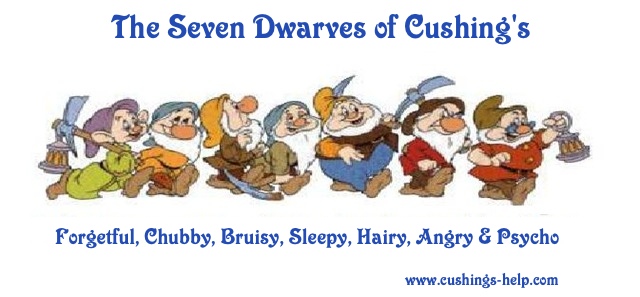
The Seven Dwarves of Cushing's

So, these are only seven of the many, many symptoms of Cushing’s.  I had those above – and I often felt like I looked like one of those little bearded dwarves.

Cushing’s affects every part of the body.  It’s not like when I had kidney cancer and only the kidney was affected.

Here are some of the many areas affected.

  • Progressive obesity and skin changes
  • Weight gain and fatty tissue deposits, particularly around the midsection and upper back, in the face (moon face) and between the shoulders (buffalo hump). Some symptoms such as sudden weight gain, are caused by excess cortisol. The excess cortisol in the body does not increase protein and carbohydrate metabolism. It slows or nearly disables metabolism function, which can cause weight gain (fat accumulation) in the buttocks, abdomen, cheeks, neck, or upper back.
  • Loss of muscle mass. Some areas of the body, such as the arms and legs, will remain thin.
  • Pink or purple stretch marks (striae) on the skin of the abdomen, thighs, breasts and arms
  • Thinning, fragile skin that bruises easily
  • Slow healing of cuts, insect bites and infections
  • Acne

Women with Cushing’s syndrome may experience:

  • Thicker or more visible body and facial hair (hirsutism)
  • Irregular or absent menstrual periods

Men with Cushing’s syndrome may experience:

  • Decreased libido
  • Decreased fertility
  • Erectile dysfunction

Other signs and symptoms include:

  • Fatigue
  • Muscle weakness
  • Depression, anxiety and irritability
  • Loss of emotional control
  • Cognitive difficulties
  • New or worsened high blood pressure
  • Glucose intolerance that may lead to diabetes
  • Headache
  • Bone loss, leading to fractures over time
  • Hyperlipidemia (elevated lipids – cholesterol – in the blood stream)
  • Recurrent opportunistic or bacterial infections
Think you have Cushing’s?  Get to a doctor and don’t give up!

MaryO
         MaryO