Subclinical Cushing’s syndrome and cardiovascular disease

Guido Di Dalmazi and colleagues1 reported that in patients with adrenal incidentalomas and either stable mild hypercortisolism or worsening of cortisol hypersecretion, all-cause and cardiovascular disease-specific mortality was higher compared with in those with adrenal incidentalomas that did not secrete cortisol, after a mean follow-up of 7·5 years. Moreover, cortisol concentrations measured after dexamethasone-suppression test were associated with all-cause mortality independent of the presence of traditional cardiovascular disease risk factors.
Subclinical Cushing’s syndrome is the most common hormonal abnormality in patients with adrenal incidentalomas (prevalence 1—29%).2 The proportion of adrenal incidentalomas that progress to subclinical Cushing’s syndrome is low (1·7%) and most are lesions of 3 cm or larger.2 Progression to overt Cushing’s syndrome is controversial (because both spontaneous normalisation of hypersecretion and stable disease have been reported during follow-up) and spontaneous normalisation of hypersecretion has been reported in 50% of cases.2 Results of the study by Di Dalmazi and co-workers1 are important because they show, for the first time, that patients with subclinical Cushing’s syndrome are at increased risk of cardiovascular disease and all-cause mortality (mainly attributable to cardiovascular disease). The association of cortisol with all-cause mortality might also be attributable to its potential role in the pathogenesis of metabolic syndrome.3
Findings of previous studies have shown an increased prevalence of cardiovascular disease risk factors in patients with subclinical Cushing’s syndrome, but data for optimum management are conflicting. Some criteria—such as large (>4—6 cm) adrenal incidentalomas, features suggestive of malignancy (eg, heterogeneity, irregular shape, calcification or necrosis, invasion to adjacent tissues), or potentially lethal hormonal hypersecretion (ie, pheochromocytomas)—support the need for adrenalectomy. However, universal surgical management of patients with subclinical Cushing’s syndrome has not been accepted.24 Uncertainty about the most effective management strategy for subclinical Cushing’s syndrome is attributable to the variable definitions used, and the small sample size and retrospective nature of most studies.4 Only one prospective study has been published so far showing that laparoscopic adrenalectomy is more beneficial than is conservative management for the normalisation or improvement of cardiovascular disease risk factors, such as diabetes, dyslipidaemia, hypertension, and obesity.5
Prospective studies and registries are needed to document the effect of different approaches on the incidence of cardiovascular disease events and mortality in patients with adrenal incidentalomas and subclinical Cushing’s syndrome. Until then, individualised treatment seems prudent. Surgical management of subclinical Cushing’s syndrome can be suggested in young patients (age <50 years) and in those with cardiovascular disease risk factors or bone disease associated with hypercortisolism that are of recent onset, difficult to control with drugs, or show progression over time.4
Another message from Di Dalmazi’s study1 is that hormonal deterioration might develop even after 4—5 years, which most studies reported as a reasonable and safe follow-up.2 This possibility should be kept in mind for the management of patients with adrenal incidentalomas, especially if clinical signs of Cushing’s syndrome develop or if cardiovascular disease risk factors become evident or increase in severity (ie, hormonal hypersecretion).
We declare that we have no competing interests.

References

1 Di Dalmazi GVicennati VGarelli S, et alCardiovascular events and mortality in patients with adrenal incidentalomas that are either non-secreting or associated with intermediate phenotype or subclinical Cushing’s syndrome: a 15-year retrospective studyLancet Diabetes Endocrinol 2014published online Jan 29 http://dx.doi.org/10.1016/S2213-8587(13)70211-0.
2 Anagnostis PKaragiannis ATziomalos KKakafika AIAthyros VGMikhailidis DPAdrenal incidentaloma: a diagnostic challengeHormones (Athens) 20098163-184PubMed
3 Anagnostis PAthyros VGTziomalos KKaragiannis AMikhailidis DPClinical review: The pathogenetic role of cortisol in the metabolic syndrome: a hypothesisJ Clin Endocrinol Metab 200994:2692-2701PubMed
4 Terzolo MPia AReimondo GSubclinical Cushing’s syndrome: definition and managementClin Endocrinol (Oxf) 20127612-18PubMed
5 Toniato AMerante-Boschin IOpocher GPelizzo MRSchiavi FBallotta ESurgical versus conservative management for subclinical Cushing syndrome in adrenal incidentalomas: a prospective randomized studyAnn Surg 2009249388-391PubMed
a Division of Endocrinology, Police Medical Centre, Thessaloniki, 54 640, Greece
b Department of Endocrinology and Metabolism, Agios Pavlos General Hospital, Thessaloniki, Greece
c Second Propedeutic Department of Internal Medicine, Medical School, Aristotle University of Thessaloniki, Hippokration Hospital, Thessaloniki, Greece
d Department of Clinical Biochemistry (Vascular Prevention Clinic) Royal Free Hospital Campus, University College London Medical School, University College London, London, UK

Cushing’s Awareness Challenge 17

robin-causes

Another of Robin’s wonderful images.

A similar image from the CushieWiki

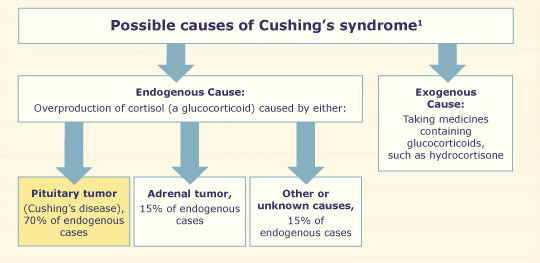
cushings-causes

No wonder Cushing’s is so hard to diagnose!

maryo colorful zebra

Cushing’s Awareness Challenge, Day 4

Another idea I borrowed from Robin – using a Wordle as inspiration for today’s post.
Even though I’m “in remission” since 1987, I’m still way too fatigued, napping every afternoon for several hours.  People think I should be normal since my pituitary surgery was so long ago.  Well, no.
me-tired
Just a few days ago, I posted this abstract on Severe fatigue in patients with adrenal insufficiency.  I don’t think that they needed to do this study at all.  Just ask any Cushie!

Abstract

BACKGROUND:

Fatigue is a frequently experienced complaint in patients with adrenal insufficiency (AI) and may be influenced by cortisol levels.

AIM:

The objective of this study was to determine the prevalence of severe fatigue in adrenal insufficiency (AI) patients, to assess which dimensions contribute to fatigue severity and to determine the association between salivary cortisol levels and momentary fatigue.

SUBJECTS AND METHODS:

We performed a cross-sectional study in the outpatient department of a university hospital. Included were 27 patients with congenital adrenal hyperplasia (CAH), 26 patients with primary AI (PAI), 24 patients with secondary AI (SAI) and 31 patients with adrenal insufficiency after treatment for Cushing’s syndrome (Cush-AI). Measurements included computerised questionnaires to determine fatigue severity and physical and psychosocial contributors. Patients took four saliva samples at home, in which cortisol levels were measured.

RESULTS:

Severe fatigue was experienced by 41 % of the CAH patients, 42 % of the PAI patients, 50 % of the SAI patients and 42 % of the Cush-AI patients. Psychological distress, functional impairment, sleep disturbance, physical activity, concentration problems and social functioning contributed to the subjective experience of fatigue. Salivary cortisol levels were not correlated with momentary fatigue.

CONCLUSIONS:

A considerable proportion of AI patients experience severe fatigue. Salivary cortisol level is not a significant predictor for momentary fatigue in AI patients.

PMID:
24615365
[PubMed – in process]

From http://www.ncbi.nlm.nih.gov/pubmed/24615365


Back to my nap now…

maryo colorful zebra

Severe fatigue in patients with adrenal insufficiency: physical, psychosocial and endocrine determinants

Abstract

BACKGROUND:

Fatigue is a frequently experienced complaint in patients with adrenal insufficiency (AI) and may be influenced by cortisol levels.

AIM:

The objective of this study was to determine the prevalence of severe fatigue in adrenal insufficiency (AI) patients, to assess which dimensions contribute to fatigue severity and to determine the association between salivary cortisol levels and momentary fatigue.

SUBJECTS AND METHODS:

We performed a cross-sectional study in the outpatient department of a university hospital. Included were 27 patients with congenital adrenal hyperplasia (CAH), 26 patients with primary AI (PAI), 24 patients with secondary AI (SAI) and 31 patients with adrenal insufficiency after treatment for Cushing’s syndrome (Cush-AI). Measurements included computerised questionnaires to determine fatigue severity and physical and psychosocial contributors. Patients took four saliva samples at home, in which cortisol levels were measured.

RESULTS:

Severe fatigue was experienced by 41 % of the CAH patients, 42 % of the PAI patients, 50 % of the SAI patients and 42 % of the Cush-AI patients. Psychological distress, functional impairment, sleep disturbance, physical activity, concentration problems and social functioning contributed to the subjective experience of fatigue. Salivary cortisol levels were not correlated with momentary fatigue.

CONCLUSIONS:

A considerable proportion of AI patients experience severe fatigue. Salivary cortisol level is not a significant predictor for momentary fatigue in AI patients.

PMID:
24615365
[PubMed – in process]

From http://www.ncbi.nlm.nih.gov/pubmed/24615365

Genetic variations associated with hyperplasias, adenomas of adrenal cortex

Beuschlein F. N Engl J Med. 2014;doi:10.1056/NEJMoa1310359.

Genetic variations of the catalytic subunit of cyclic protein kinase A, or PKA, were linked to the development of bilateral adrenal hyperplasias and unilateral cortisol-producing adrenal adenomas. These effects may activate corticotropin-independent Cushing’s syndrome, according to data published in The New England Journal of Medicine.

“The current study suggests that more than one-third of cortisol-producing adenomas associated with overt Cushing’s syndrome have unique somatic mutations in PRKACA (which encodes the main catalytic subunit of PKA), resulting in constitutive PKA activation,” Felix Beuschlein, MD, of the University of Munich, and colleagues wrote.

The researchers performed an exome sequencing of tumor-tissue specimens from 10 patients with cortisol-producing adrenal adenomas and evaluated their recurrent mutations in candidate genes in 171 additional patients with adrenocortical tumors, according to data.

Somatic mutations in PRKACA were discovered in eight of 10 adenomas. These somatic mutations also were identified in 22 of 59 unilateral adenomas (37%) from patients with overt Cushing’s syndrome; mutations were not detectable in 40 patients with subclinical hypercortisolism or in 82 patients with other adrenal tumors, according to data.

Five of the 35 patients with cortisol-producing hyperplasias appeared to be carriers of the germline duplication of the genomic region on chromosome 19 that includes PRKACA, researchers wrote.

In vitro study data indicated that PKA catalytic subunit genetic mutations impaired inhibition by the PKA regulatory subunit, and cells from patients with germline chromosomal gains appeared to increase the protein levels of the subunit.

“Because PRKACA mediates most of the effects of inactivating PRKAR1A mutations and because mutations of PRKAR1 are associated with a variety of tumors in humans and mice, we would speculate that somatic PRKACA defects might also play a role in other forms of endocrine and nonendocrine tumors,” researchers wrote.

Disclosure: Beuschlein reports financial ties with the European Community, HRA Pharma, Novartis, Viropharma, and Wilhelm-Sander Stiftung.

From http://www.healio.com/endocrinology/adrenal/news/online/%7B22954d9a-0fc9-4e80-b80a-d74bbdfea1a9%7D/genetic-variations-associated-with-hyperplasias-adenomas-of-adrenal-cortex