CDC Expands Eligibility for COVID-19 Booster Shots


For Immediate Release: Thursday, October 21, 2021
Contact: Media Relations
(404) 639-3286

Today, CDC Director Rochelle P. Walensky, M.D., M.P.H., endorsed the CDC Advisory Committee on Immunization Practices’ (ACIP) recommendation for a booster shot of COVID-19 vaccines in certain populations. The Food and Drug Administration’s (FDA) authorization and CDC’s recommendation for use are important steps forward as we work to stay ahead of the virus and keep Americans safe.

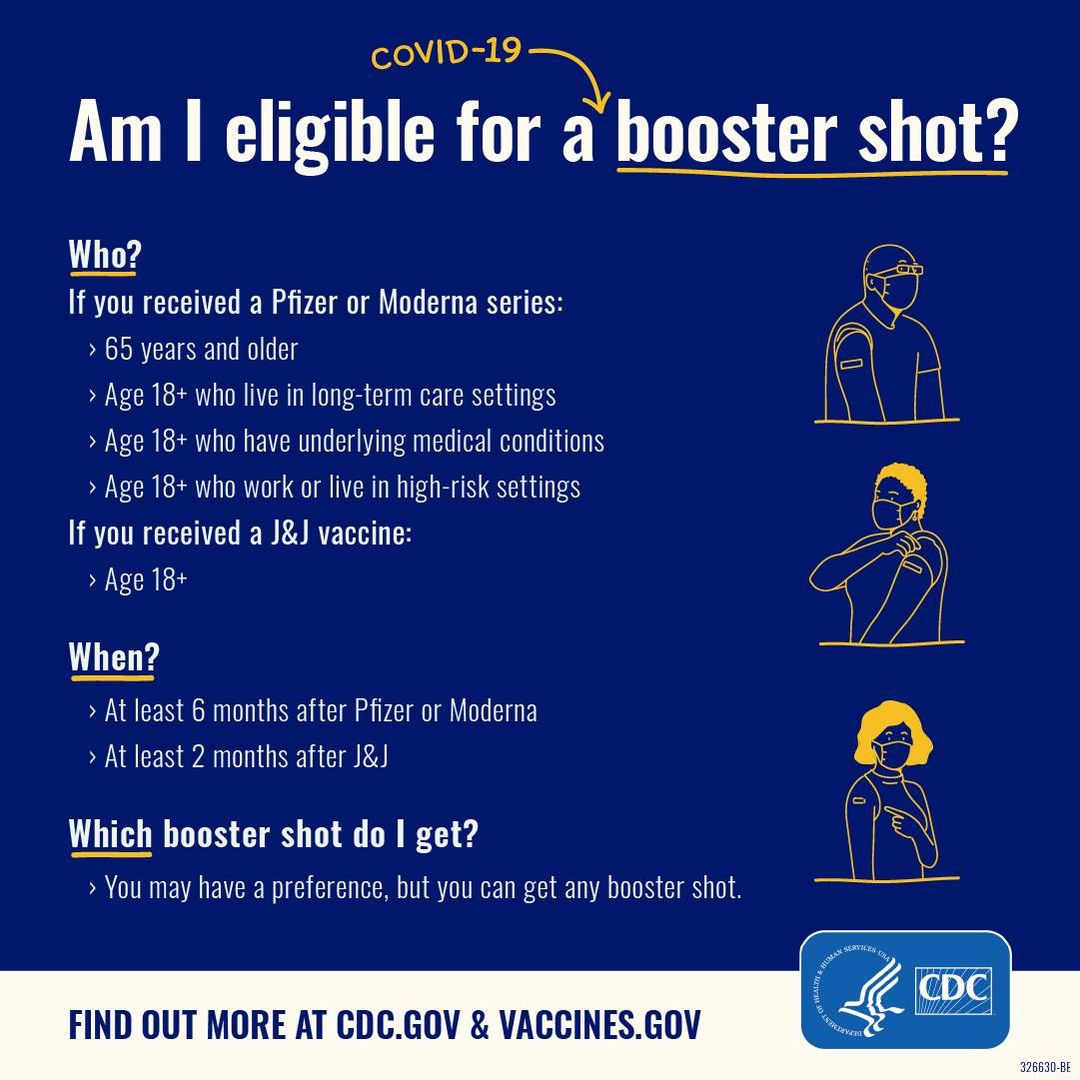
For individuals who received a Pfizer-BioNTech or Moderna COVID-19 vaccine, the following groups are eligible for a booster shot at 6 months or more after their initial series:

For the nearly 15 million people who got the Johnson & Johnson COVID-19 vaccine, booster shots are also recommended for those who are 18 and older and who were vaccinated two or more months ago.

There are now booster recommendations for all three available COVID-19 vaccines in the United States. Eligible individuals may choose which vaccine they receive as a booster dose. Some people may have a preference for the vaccine type that they originally received, and others may prefer to get a different booster. CDC’s recommendations now allow for this type of mix and match dosing for booster shots.

Millions of people are newly eligible to receive a booster shot and will benefit from additional protection. However, today’s action should not distract from the critical work of ensuring that unvaccinated people take the first step and get an initial COVID-19 vaccine. More than 65 million Americans remain unvaccinated, leaving themselves – and their children, families, loved ones, and communities– vulnerable.

Available data right now show that all three of the COVID-19 vaccines approved or authorized in the United States continue to be highly effective in reducing risk of severe disease, hospitalization, and death, even against the widely circulating Delta variant. Vaccination remains the best way to protect yourself and reduce the spread of the virus and help prevent new variants from emerging.

The following is attributable to Dr. Walensky:

“These recommendations are another example of our fundamental commitment to protect as many people as possible from COVID-19. The evidence shows that all three COVID-19 vaccines authorized in the United States are safe – as demonstrated by the over 400 million vaccine doses already given. And, they are all highly effective in reducing the risk of severe disease, hospitalization, and death, even in the midst of the widely circulating Delta variant.”

###
U.S. DEPARTMENT OF HEALTH AND HUMAN SERVICESexternal icon

CDC works 24/7 protecting America’s health, safety and security. Whether disease start at home or abroad, are curable or preventable, chronic or acute, or from human activity or deliberate attack, CDC responds to America’s most pressing health threats. CDC is headquartered in Atlanta and has experts located throughout the United States and the world.

Hypopituitarism and COVID-19 – exploring a possible bidirectional relationship?

As of September 1, 2021, the severe acute respiratory syndrome coronavirus 2 (SARS-CoV-2), which is the virus responsible for the coronavirus disease 2019 (COVID-19), has infected over 219 million and caused the deaths of over 4.5 million worldwide. Although COVID-19 has been traditionally associated with its ability to cause varied symptoms resembling acute respiratory distress syndrome (ARDS), emerging scientific evidence has demonstrated that SARS-CoV-2 causes much more damage beyond its effects on the upper respiratory tract.

To this end, in a recent study published in Reviews in Endocrine and Metabolic Disorders, the researchers discuss the extra-pulmonary manifestations of COVID-19.

Risk factors for severe COVID-19

It is now a well-known fact that the likelihood of people falling severely ill or dying from COVID-19 is increases if these individuals are obese, or have certain comorbidities like diabetes mellitus (DM), vitamin D deficiency, and vertebral fractures (VFs).

Any abnormality in the pituitary gland may lead to metabolic disorders, impaired immunity, and a host of other conditions that also make the body susceptible to infections. Since such conditions are common in patients with COVID-19 as well, it has been hypothesized that there might be a relationship between COVID-19 and pituitary gland disorders.

On the other hand, researchers have also observed that COVID-19 causes increased severity of pituitary-related disorders, and even pituitary apoplexy, which is a condition defined as internal bleeding or impaired blood supply in the pituitary gland. A group of Italian researchers has reviewed this bidirectional relationship between the pituitary gland abnormalities and COVID-19 in their study recently published in Reviews in Endocrine and Metabolic Disorders.

The link between pituitary gland abnormalities and COVID19

The pituitary gland releases hormones that regulate and control some of the most important functions of the body like growth, metabolism, energy levels, bone health, mood swings, vision, reproduction, and immunity, to name a few. The inability of the pituitary gland to release one or more of these hormones is known as ‘hypopituitarism.’  Factors responsible for hypopituitarism include traumatic brain injury, pituitary adenomas (tumors), genetic mutations, as well as infiltrative and infectious diseases.

Hypopituitarism can lead to severe cases of DM, growth hormone deficiency (GHD), abnormal lipid profile, obesity, arterial hypertension, and immune dysfunctions. Interestingly, similar consequences of COVID-19 have also been reported.

SARS-CoV-2 infects the human body by binding to a special class of receptors known as the angiotensin-converting enzyme 2 (ACE2) receptors. These receptors are located in the endothelial linings of most organs like the brain, heart, lungs, kidneys, intestine, liver, and pancreas, among others. The main function of the ACE2 receptors is binding to specific target molecules to maintain the renin-angiotensin system that is crucial for regulating dilation of blood vessels, as well as maintain blood glucose levels, the immune system, and homeostasis.

Therefore, SARS-CoV-2 binding to these ACE2 receptors facilitates the entry of this virus into all the organs that have these receptors, thus leading to the ability of SARS-CoV-2 to cause widespread damage in the body. Upon entry into the pancreas, for example, SARS-CoV-2 can inhibit ß-cells function, which worsens hyperglycemia and increases the risk for acute diabetic complications.

Similarly, the presence of ACE2 receptors in brain tissues may cause invasion into the pituitary gland and lead to pituitary apoplexy. The entry of SARS-CoV-2 into the brain can also cause neurological damage in infected patients, which may account for some of the common neurological complaints of COVID-19 including headaches, confusion, dysgeusia, anosmia, nausea, and vomiting.

Study findings

Hypopituitarism leading to metabolic syndrome has been scientifically linked to higher mortality in COVID-19 patients. In fact, the presence of a single metabolic syndrome component has been observed to double the risk of death by COVID-19. This risk was even higher among patients with DM and hypertension.

There was also an increased incidence of VFs in COVID-19 patients with hypopituitarism. Hence, patients with DM, obesity, hypertension, and chronic inflammatory disease, are all at an increased risk of poor outcomes and death in COVID-19.

Arterial hypertension is a common finding in adults with GHD, which is another consequence of hypopituitarism. Hypopituitarism also causes adrenal insufficiency, a condition that is primarily managed with glucocorticoids and hormonal replacement therapies.

Notably, patients with COVID-19 are often treated for prolonged periods with high-dose exogenous glucocorticoids, which is a class of steroids that suppress some activities of the immune system. This treatment approach may result in suppression of the hypothalamic-pituitary–adrenal axis that can lead to adrenal insufficiency.

Hypogonadism is another aspect of pituitary insufficiency that predisposes patients, especially males, to COVID-19. Evidence shows that males with hypogonadism were more frequently affected by metabolic syndrome.

Pituitary apoplexy, albeit rare, has also been linked to COVID-19, especially in patients with pituitary adenomas and those who are being treated with anticoagulant therapy. This may be because the pituitary gland becomes overstimulated during an infectious disease, which may increase pituitary blood demand and lead to sudden infarction precipitating acute apoplexy.

This phenomenon has also been shown in patients suffering from infectious diseases that cause hemorrhagic fevers. Taken together, pituitary apoplexy complicates treatment and management procedures in COVID-19 patients.

Despite the use of steroids in COVID-19 patients, there have been no contraindications for vaccination in such patients. However, those on extensive hormonal therapies need constant monitoring for best results.

Implications

The pituitary gland acts like a double-edged sword for COVID-19. On one end, hypopituitarism predisposes patients to metabolic disorders like DM, obesity, and VFs, all of which are known risk factors for COVID-19.

On the other hand, COVID-19 may cause direct or indirect damage to the pituitary glands by entering the brain and inducing unfavorable vascular events – though evidence on this remains lesser in comparison to that of hypopituitarism. Ultimately, the researchers of the current study conclude that managing patients with hormonal insufficiencies optimally with steroids is likely to improve outcomes in severe COVID-19.

Journal reference:

Primary Adrenal Insufficiency Due to Bilateral Adrenal Infarction in COVID-19

This article was originally published here

J Clin Endocrinol Metab. 2021 Jul 29:dgab557. doi: 10.1210/clinem/dgab557. Online ahead of print.

ABSTRACT

CONTEXT: Coronavirus disease 2019 (COVID-19) is a proinflammatory and prothrombotic condition, but its impact on adrenal function has not been adequately evaluated.

CASE REPORT: A 46-year-old woman presented with abdominal pain, hypotension, and skin hyperpigmentation after COVID-19 infection. The patient had hyponatremia, serum cortisol <1.0 µg/dL, adrenocorticotropin (ACTH) of 807 pg/mL, and aldosterone ❤ ng/dL. Computed tomography (CT) findings of adrenal enlargement with no parenchymal and minimal peripheral capsular enhancement after contrast were consistent with bilateral adrenal infarction. The patient had autoimmune hepatitis and positive antiphospholipid antibodies, but no previous thrombotic events. The patient was treated with intravenous hydrocortisone, followed by oral hydrocortisone and fludrocortisone.

DISCUSSION: We identified 9 articles, including case reports, of new-onset adrenal insufficiency and/or adrenal hemorrhage/infarction on CT in COVID-19. Adrenal insufficiency was hormonally diagnosed in 5 cases, but ACTH levels were measured in only 3 cases (high in 1 case and normal/low in other 2 cases). Bilateral adrenal nonhemorrhagic or hemorrhagic infarction was identified in 5 reports (2 had adrenal insufficiency, 2 had normal cortisol levels, and 1 case had no data). Interestingly, the only case with well-characterized new-onset acute primary adrenal insufficiency after COVID-19 had a previous diagnosis of antiphospholipid syndrome. In our case, antiphospholipid syndrome diagnosis was established only after the adrenal infarction triggered by COVID-19.

CONCLUSION: Our findings support the association between bilateral adrenal infarction and antiphospholipid syndrome triggered by COVID-19. Therefore, patients with positive antiphospholipid antibodies should be closely monitored for symptoms or signs of acute adrenal insufficiency during COVID-19.

PMID:34463766 | DOI:10.1210/clinem/dgab557

Rapid Control Of Ectopic Cushing’s Syndrome During The Covid-19 Pandemic in a Patient With Chronic Hypokalaemia

This article was originally published here

Endocrinol Diabetes Metab Case Rep. 2021 May 1;2021:EDM210038. doi: 10.1530/EDM-21-0038. Online ahead of print.

ABSTRACT

SUMMARY: In this case report, we describe the management of a patient who was admitted with an ectopic ACTH syndrome during the COVID pandemic with new-onset type 2 diabetes, neutrophilia and unexplained hypokalaemia. These three findings when combined should alert physicians to the potential presence of Cushing’s syndrome (CS). On admission, a quick diagnosis of CS was made based on clinical and biochemical features and the patient was treated urgently using high dose oral metyrapone thus allowing delays in surgery and rapidly improving the patient’s clinical condition. This resulted in the treatment of hyperglycaemia, hypokalaemia and hypertension reducing cardiovascular risk and likely risk for infection. Observing COVID-19 pandemic international guidelines to treat patients with CS has shown to be effective and offers endocrinologists an option to manage these patients adequately in difficult times.

LEARNING POINTS: This case report highlights the importance of having a low threshold for suspicion and investigation for Cushing’s syndrome in a patient with neutrophilia and hypokalaemia, recently diagnosed with type 2 diabetes especially in someone with catabolic features of the disease irrespective of losing weight. It also supports the use of alternative methods of approaching the diagnosis and treatment of Cushing’s syndrome during a pandemic as indicated by international protocols designed specifically for managing this condition during Covid-19.

PMID:34013889 | DOI:10.1530/EDM-21-0038

From https://www.docwirenews.com/abstracts/rapid-control-of-ectopic-cushings-syndrome-during-the-covid-19-pandemic-in-a-patient-with-chronic-hypokalaemia/

How does COVID-19 impact the adrenal gland?

This month marks a little over one year since the first surge of COVID-19 across the United States. April is also Adrenal Insufficiency Awareness month, a good time to review the data on how COVID-19 infection can impact the adrenal glands.

The adrenal glands make hormones to help regulate blood pressure and the ability to respond to stress. The hormones include steroids such as glucocorticoid (cortisol), mineralocorticoid (aldosterone), and forms of adrenaline known as catecholamines (norepinephrine, epinephrine, and dopamine). The activity of the adrenal gland is controlled through its relationship with the pituitary gland (the master regulator of hormones in the body).

Some common adrenal diseases include the following:

  • Addison’s Disease (where the body attacks the adrenal glands making them dysfunctional)
  • Hyperaldosteronism
  • Cushing’s Syndrome
  • Pheochromocytoma
  • Adrenal Nodules/Masses (termed incidentaloma)
  • Congenital adrenal hyperplasia

COVID-19 was found in the adrenal and pituitary glands of some patients who succumbed to the illness, suggesting that these organs might be among the targets for infection.  One of the first highly effective therapies for COVID-19 infection was the use of IV steroid (dexamethasone) supplementation in hospitalized patients in patients requiring oxygen.

A focused search of COVID-19-related health literature shows 85 peer-reviewed papers that have been published in medical literature specifically on the adrenal gland and COVID-19. This literature focuses on three phases of COVID infection that may impact the adrenal gland: the acute active infection phase, the immediate post-infection phase, and the long-term recovery phase.

Medical research has identified that during the acute active infection, the adrenal system is one of the most heavily affected organ systems in the body in patients who have COVID-19 infection requiring hospitalization. In these cases, supplementation with the steroid dexamethasone serves as one of the most powerful lifesaving treatments.

Concern has also been raised regarding the period of time just after the acute infection phase – particularly, the development of adrenal insufficiency following cases of COVID-19 hospitalizations. Additionally, some professional societies recommend that for patients who have adrenal insufficiency and are on adrenal replacement therapy, they be monitored closely post-COVID-19 vaccine for the development of stress-induced adrenal insufficiency.

In mild-to-moderate COVID-19 cases, there does not seem to be an effect on adrenaline-related hormones (norepinephrine, epinephrine, dopamine). However, in cases of severe COVID-19 infection triggering the development of shock, patients will need supplementation with an infusion of catecholamines and a hormone called vasopressin to maintain their blood pressure.

Finally, some studies have addressed the concern of adrenal insufficiency during the long-term recovery phase. Dr Sara Bedrose, adrenal endocrine specialist at  Baylor College of Medicine, indicates that studies which included adrenal function in COVID survivors showed a large percentage of patients with suboptimal cortisol secretion during what is called ACTH stimulation testing.

Results indicated that most of those cases had central adrenal insufficiency. It was concluded that adrenal insufficiency might be among the long-term consequences of COVID-19 and it seemed to be secondary to pituitary gland inflammation (called hypophysitis) or due to direct hypothalamic damage. Long-term follow-up of COVID 19 survivors will be necessary to exclude a gradual and late-onset adrenal insufficiency.

Some patients who have COVID-19 will experience prolonged symptoms. To understand what is happening to them, patients may question whether or not they have a phenomenon called adrenal fatigue. This is a natural question to ask, especially after having such a severe health condition. A tremendous amount of resources are being developed to investigate the source and treatment of the symptoms, and this work has only just begun.

However, adrenal fatigue is not a real medical diagnosis. It’s a term to describe a group of signs and symptoms that arise due to underactive adrenal glands. Current scientific data indicate that adrenal fatigue is not in and of itself a medical disease – although a variety of over-the-counter supplements and compounded medications may be advocated for in treatment by alternative medicine/naturopathic practitioners.

My takeaway is that we have learned a great deal about the effects COVID-19 infection has on the adrenal glands. Long-term COVID-19 remains an area to be explored –  especially in regards to how it may affect the adrenal glands.

-By Dr. James Suliburk, associate professor of surgery in the Division of Surgical Oncology and section chief of endocrine surgery for the Thyroid and Parathyroid Center at Baylor College of Medicine

From https://blogs.bcm.edu/2021/04/22/how-does-covid-19-impact-the-adrenal-gland/