Day Thirteen, Cushing’s Awareness Challenge

This is one of the suggestions from the Cushing’s Awareness Challenge post:

“Give yourself, your condition, or your health focus a mascot. Is it a real person? Fictional? Mythical being? Describe them. Bonus points if you provide a visual!”

The “Official mascot” is the zebra.  I wrote about the zebra in this series, Day Six

In med school, student doctors are told “When you hear hoofbeats, think horses, not zebras“.  According to Wikipedia: “Zebra is a medical slang term for a surprising diagnosis. Although rare diseases are, in general, surprising when they are encountered, other diseases can be surprising in a particular person and time, and so “zebra” is the broader concept.

The term derives from the aphorism ”When you hear hoofbeats behind you, don’t expect to see a zebra”, which was coined in a slightly modified form in the late 1940s by Dr. Theodore Woodward, a former professor at the University of Maryland School of Medicine in Baltimore.  Since horses are the most commonly encountered hoofed animal and zebras are very rare, logically you could confidently guess that the animal making the hoofbeats is probably a horse. By 1960, the aphorism was widely known in medical circles.”

Although one of my signature images has a zebra, many have rainbows or butterflies in them so I guess that I consider those my own personal mascots.

I posted this in 2010 in 40 Days of Thankfulness: Days Twenty-Two through Thirty

I have a special affinity for rainbows. To me, a rainbow is a sign that things are going to be ok.

Years ago, our little family was in Florida. I felt guilty about going because my dad was terminally ill with his second bout of colon cancer. I was worried about him and said a little prayer for him.

I was lying on the beach while DH and our son were in the ocean and I looked up and saw a rainbow. It was a perfectly clear, sunny afternoon. I even called the people out of the water, in case it was something I wanted to see that didn’t really exist. They saw it, too.

Where in the world did that rainbow come from, if it wasn’t a sign that everything would be ok?

Butterflies are something else again.  I like them because I would like to think that my life has evolved like a butterfly’s, from something ugly and unattractive to something a big easier on the eye.

My Cushie self was the caterpillar, post-op is more butterfly-ish, if not in looks, in good deeds.

From July, 2008

For as long as I can remember, I’ve loved butterflies for their beauty and what they stood for. I’ve always wanted to shed my cocoon and become someone else, someone beautiful, graceful.

One of my first memories as a kid was knocking on the back door of my house and when my mom answered, I’d pretend to somehow be an orphan, looking for some kind person to take me in. And I would try to be that different child, with new habits, in the hopes that my parents would somehow think better of me, love me more as this poor homeless kid than they did as their own.

The butterfly was trying to emerge but it never got too far. Somehow, I would slip into my original self and be a bother to my parents.

Hope springs eternal, though!


Day Ten, Cushing’s Awareness Challenge

Blue and Yellow – we have those colors on ribbons, websites, tshirts, Cushing’s Awareness Challenge logos and even cars.

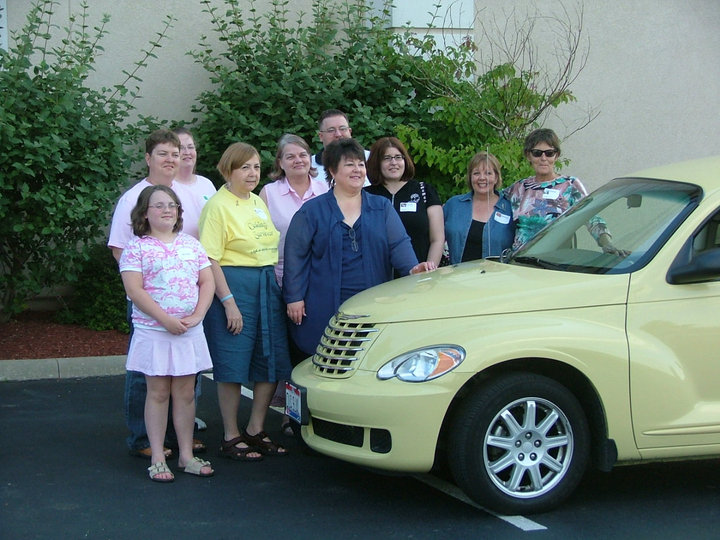
This is the yellow PT cruiser I had rented for the Columbus, OH meeting in 2007. It was when we all met at Hoggy’s for dinner although some of us travellers stayed at this hotel.

I’m the one in yellow and blue.


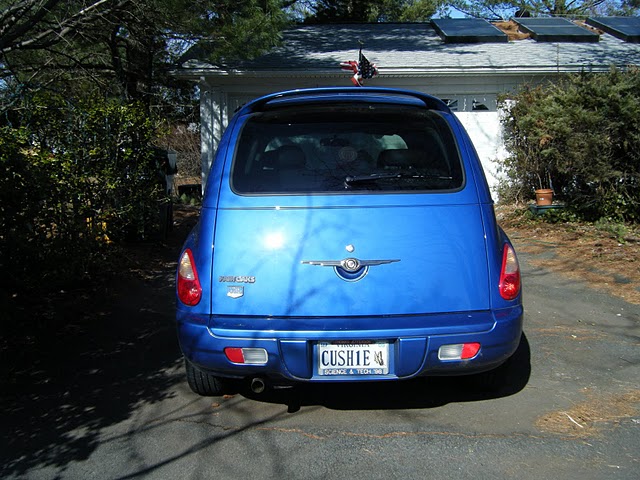
Later in 2007, I bought my own truly Cushie Car.  I even managed to get a butterfly on the tags.


So, where did all this blue and yellow come from, anyway?  The answer is so easy and without any thought that it will amaze you!

In July of 2000, I was talking with my dear friend Alice, who runs a wonderful menopause site, Power Surge, wondering why there weren’t many support groups online (OR off!) for Cushing’s and I wondered if I could start one myself and we decided that I could. This website (http://www.cushings-help.com) first went “live” July 21, 2000.  It was a one-page bit of information about Cushing’s.  Nothing fancy.

I didn’t know much about HTML (yet!) but I knew a little from what Alice had taught me and I used on my music studio site.  I didn’t want to put as much work <COUGH!> into the Cushing’s site as I had on the music studio site so I used a WYSIWYG web editor called Microsoft FrontPage.

One of their standard templates was – you guessed it! – blue and yellow.

TaDa!  Instant Cushie color scheme forever.  Turns out that the HTML that this software churned out was really awful and had to be entirely redone as the site grew.  But the colors stuck.

Day Eight, Cushing’s Awareness Challenge

It’s Here!


Dr. Cushing was born in Cleveland Ohio. The fourth generation in his family to become a physician, he showed great promise at Harvard Medical School and in his residency at Johns Hopkins Hospital (1896 to 1900), where he learned cerebral surgery under William S. Halsted

After studying a year in Europe, he introduced the blood pressure sphygmomanometer to the U.S.A. He began a surgical practice in Baltimore while teaching at Johns Hopkins Hospital (1901 to 1911), and gained a national reputation for operations such as the removal of brain tumors. From 1912 until 1932 he was a professor of surgery at Harvard Medical School and surgeon in chief at Peter Bent Brigham Hospital in Boston, with time off during World War I to perform surgery for the U.S. forces in France; out of this experience came his major paper on wartime brain injuries (1918). In addition to his pioneering work in performing and teaching brain surgery, he was the reigning expert on the pituitary gland since his 1912 publication on the subject; later he discovered the condition of the pituitary now known as “Cushing’s disease“.

Read more about Dr. Cushing

Today, April 8th, is Cushing’s Awareness Day. Please wear your Cushing’s ribbons, t-shirts, awareness bracelets or Cushing’s colors (blue and yellow) and hand out Robin’s wonderful Awareness Cards to get a discussion going with anyone who will listen.

And don’t just raise awareness on April 8.  Any day is a good day to raise awareness.


MaryO

Day Six, Cushing’s Awareness Challenge

People sometimes ask me how I found out I have Cushing’s.  Theoretically, it was easy.  In practice, it was very difficult.

Ladies Home Journal, 1983In 1983 I came across a little article in the Ladies Home Journal which said “If you have these symptoms…”

I found the row with my symptoms and the answer read “…ask your doctor about Cushing’s”.

After that article, I started reading everything I could on Cushing’s, I bought books that mentioned Cushing’s. I asked and asked my doctors and all of them said was rejected each time.


Due to all my reading at the library, I was sure I had Cushing’s but no one would believe me. My doctors would say that Cushing’s Disease is too rare, that I was making this up and that I couldn’t have it.

In med school, student doctors are told “When you hear hoofbeats, think horses, not zebras“.  According to Wikipedia: “Zebra is a medical slang term for a surprising diagnosis. Although rare diseases are, in general, surprising when they are encountered, other diseases can be surprising in a particular person and time, and so “zebra” is the broader concept.

The term derives from the aphorism “When you hear hoofbeats behind you, don’t expect to see a zebra”, which was coined in a slightly modified form in the late 1940s by Dr. Theodore Woodward, a former professor at the University of Maryland School of Medicine in Baltimore.  Since horses are the most commonly encountered hoofed animal and zebras are very rare, logically you could confidently guess that the animal making the hoofbeats is probably a horse. By 1960, the aphorism was widely known in medical circles.”

So doctors typically go for the easily diagnosed, common diseases.  Just because something is rare doesn’t mean that no one gets it.  We shouldn’t be dismissed because we’re too hard to diagnose.

When I was finally diagnosed in 1987, 4 years later, it was only because I started bleeding under the skin. My husband made circles around the outside perimeter each hour with a marker so my leg looked like a cut log with rings.

When I went to my Internist the next day he was shocked at the size. He now thought I had a blood disorder so he sent me to a Hematologist/Oncologist. Fortunately, he ran a twenty-four hour urine test and really looked at me and listened to me.  Both he and his partner recognized that I had Cushing’s but, of course, couldn’t do anything further with me.  They packed me off to an endo where the process started again.

My final diagnosis was in October, 1987.  Quite a long time to simply  “…ask your doctor about Cushing’s”.

Looking back, I can see Cushing’s symptoms much earlier than 1983.  But, that ‘s for a different post.


Day Five, Cushing’s Awareness Challenge


The above is the official Cushing’s path to a diagnosis but here’s how it seems to be in real life:


Egads!  I remember the naive, simple days when I thought I’d give them a tube or two of blood and they’d tell me I had Cushing’s for sure.

Who knew that diagnosing Cushing’s would be years of testing, weeks of collecting every drop of urine, countless blood tests, many CT and MRI scans…

Then going to NIH, repeating all the above over 6 weeks inpatient plus an IPSS test, an apheresis (this was experimental at NIH) and specialty blood tests…

The path to a Cushing’s diagnosis is a long and arduous one but you have to stick with it if you believe you have this Syndrome.