Clinical Trial for levoketoconazole

This trial is testing the safety and effectiveness of a new investigational drug for the treatment of Cushing’s Syndrome. Under the supervision of qualified physicians, cortisol levels and symptoms of Cushing’s Syndrome will be closely followed along with any signs of side effects.

The investigational drug (levoketoconazole) is administered by mouth in the form of tablets.

This is a phase 3 trial.

There will be up to 90 participants worldwide in this trial. This page lists U.S. sites only.

Eligibility criteria

Participants must:

be at least 18 years old
have been diagnosed with endogenous Cushing’s Syndrome by a medical professional (endogenous means that it is caused by your body producing more cortisol than it needs, not caused by the use of steroid medications)
Participants must not:

have been treated with radiation for their endogenous Cushing’s syndrome in the past 4 years
be currently using weight loss medication
have a history of drug or alcohol abuse
have been diagnosed with uncontrolled hypertension, some forms of cancer, adrenal carcinoma, Hepatitis B / C, or HIV
Note: The study doctor will ultimately determine your eligibility
Study details

The length of this study and the number of study visits will vary from patient to patient. It has approximately 13 to 27 visits to the study site spread out over one to one and a half years. This study will enroll approximately 90 participants.

A placebo isn’t being used for this trial. All study participants will receive the investigational drug.

The sponsor of this trial is Cortendo AB.

The results of this trial are intended to be published. Individual patient information will not be included.

Reasonable travel expenses may be reimbursed.

This is a global study which will be conducted in multiple countries, with several sites in the US.

This information is intended for US audiences only.

Find out if you’re eligible here.

Pituitary ACTH Hypersecretion (Cushing’s Disease)

Browse Complete Report with TOC:

http://www.reportbazzar.com/product/pituitary-acth-hypersecretion-cushings-disease-pipeline-review-h1-2015/

Summary

This report provides comprehensive information on the therapeutic development for Pituitary ACTH Hypersecretion (Cushing’s Disease), complete with comparative analysis at various stages, therapeutics assessment by drug target, mechanism of action (MoA), route of administration (RoA) and molecule type, along with latest updates, and featured news and press releases. It also reviews key players involved in the therapeutic development for Pituitary ACTH Hypersecretion (Cushing’s Disease) and special features on late-stage and discontinued projects.

Report features investigational drugs from across globe covering over 20 therapy areas and nearly 3,000 indications. The report is built using data and information sourced from proprietary databases, Company/University websites, SEC filings, investor presentations and featured press releases from company/university sites and industry-specific third party sources, put together by team. Drug profiles/records featured in the report undergoes periodic updation following a stringent set of processes that ensures that all the profiles are updated with the latest set of information. Additionally, processes including live news & deals tracking, browser based alert-box and clinical trials registries tracking ensure that the most recent developments are captured on a real time basis.

The report enhances decision making capabilities and help to create effective counter strategies to gain competitive advantage. It strengthens R&D pipelines by identifying new targets and MOAs to produce first-in-class and best-in-class products.

Request Sample Report:  Pituitary ACTH Hypersecretion (Cushing’s Disease) – Pipeline Review, H1 2015

Scope

– The report provides a snapshot of the global therapeutic landscape of Pituitary ACTH Hypersecretion (Cushing’s Disease)

– The report reviews key pipeline products under drug profile section which includes, product description, MoA and R&D brief, licensing and collaboration details & other developmental activities

– The report reviews key players involved in the therapeutics development for Pituitary ACTH Hypersecretion (Cushing’s Disease) and enlists all their major and minor projects

– The report summarizes all the dormant and discontinued pipeline projects

– A review of the Pituitary ACTH Hypersecretion (Cushing’s Disease) products under development by companies and universities/research institutes based on information derived from company and industry-specific sources

– Pipeline products coverage based on various stages of development ranging from pre-registration till discovery and undisclosed stages

– A detailed assessment of monotherapy and combination therapy pipeline projects

– Coverage of the Pituitary ACTH Hypersecretion (Cushing’s Disease) pipeline on the basis of target, MoA, route of administration and molecule type

– Latest news and deals relating related to pipeline products

Reasons to buy

– Provides strategically significant competitor information, analysis, and insights to formulate effective R&D development strategies

– Identify emerging players with potentially strong product portfolio and create effective counter-strategies to gain competitive advantage

– Develop strategic initiatives by understanding the focus areas of leading companies

– Identify and understand important and diverse types of therapeutics under development for Pituitary ACTH Hypersecretion (Cushing’s Disease)

– Plan mergers and acquisitions effectively by identifying key players of the most promising pipeline

– Devise corrective measures for pipeline projects by understanding Pituitary ACTH Hypersecretion (Cushing’s Disease) pipeline depth and focus of Indication therapeutics

– Develop and design in-licensing and out-licensing strategies by identifying prospective partners with the most attractive projects to enhance and expand business potential and scope

– Modify the therapeutic portfolio by identifying discontinued projects and understanding the factors that drove them from pipeline”


From http://www.medgadget.com/2015/10/pituitary-acth-hypersecretion-cushings-disease-pipeline-review-h1-2015-by-reportbazzar.html

NIH: An Open-Label Study of The Safety, Pharmacokinetics and Pharmacodynamics of Mifepristone in Children With Refractory Cushing’s Disease

This study is currently recruiting participants.

Summary

Number 13-CH-0170
Sponsoring Institute National Institute of Child Health and Human Development (NICHD)
Recruitment Detail Type: Participants currently recruited/enrolled
Gender: Male & Female
Min Age: 6
Max Age: 17
Referral Letter Required No
Population Exclusion(s) None
Special Instructions Currently Not Provided
Keywords Child;
Cushing Syndrome;
Metabolism;
Mifepristone;
Pharmacokinetic-Pharmacodynamic
Recruitment Keyword(s) None
Condition(s) Cushing’s Syndrome;
Cushing Syndrome
Investigational Drug(s) Mifepristone
Investigational Device(s) None
Intervention(s) Drug: mifepristone
Supporting Site National Institute of Child Health and Human Development

Background:

– There are currently no approved therapies for children with Cushing’s disease who are not cured by surgery alone. A drug called mifepristone has been approved to treat adults with Cushing’s syndrome and elevated blood glucose caused by Cushing’s. The drug is marketed under the name Korlym(Registered Trademark). The study drug may have a different effect on a child’s body than an adult’s, so researchers want to know how much of the drug to give children and what effect it will have. They want to learn if mifepristone improves Cushing’s disease in children as it does in adults. They also want to know about the drug’s side effects in children.

Objectives:

– To study the effect of a medication called mifepristone in children with Cushing’s disease that has not been helped by pituitary surgery.

Eligibility:

– Children ages 6 to 17 with active Cushing’s disease following pituitary surgery and who have a body weight higher than expected for their height and age.

Design:

– Participants will be screened for up to 8 weeks with a physical exam, medical history, and medical tests including blood tests and X-rays.

– Participants will take tablets of the study drug each day for 12 weeks.

– Participants will stay at the clinic for 4 nights at the beginning of the study. They will have three 1-day visits during the study. They will stay at the clinic the last 3 days of the study.

– At these visits, participants will be given several tests. In one test, a small wire is inserted under the skin of the belly and a small monitor is attached taped to the belly. In another, the participant drinks a liquid and blood samples are taken.

– Follow-up visits will occur 4 weeks and 12 weeks after the study ends.

–Back to Top–

Eligibility

INCLUSION CRITERIAPatients who are eligible for enrollment must meet the following eligibility criteria:

– Males and females 6-17 years at informed consent

– Active Cushing’s disease as demonstrated by the following:

–24 hour Urinary Free Cortisol greater than the upper limit of normal for age on two urine collections during screening and

— midnight serum cortisol > 4.4 mcg/dL (mean of two determinations on a single day at 2330 and 2400 during screening)

– Previous trans-sphenoidal surgery (TSS) for ACTH secreting pituitary tumor at least 3 months prior to screening

– Increased body weight defined by BMI Z-score of 1.5 or above

– Able to provide consent/assent

– Able to swallow study drug tablets (not crushed or split)

– Willing to use non-hormonal method of contraception in patients of reproductive potential

– Primary health care provider in home location

EXCLUSION CRITERIA:

– Hypercortisolism not due to Cushing’s disease.

– Type 1 diabetes mellitus

– HbA1c geater than or equal to 9.5% at Screening

– Body weight < 25 kg

– Use of certain medications that are CYP3A substrates with narrow therapeutic ranges, such as simvastatin, lovastatin, cyclosporine, dihydroergotamine, ergotamine, fentanyl, pimozide, quinidine, sirolimus, and tacrolimus during the 4 weeks prior to starting study drug. Use of these medications is also prohibited until 2 weeks after end of dosing.

– Use of certain medications that are strong CYP3A inhibitors such as itraconazole, nefazodone, ritonavir, nelfinavir, indinavir, atazanavir, amprenavir, fosamprenavir, boceprevir, clarithromycin, conivaptan, lopinavir, mibefradil, posaconazole, saquinavir, telaprevir, telithromycin, and voriconazole during the 2 weeks prior to starting study drug.

Use of these medications is also prohibited until 2 weeks after end of dosing. Grapefruit and grapefruit juice are prohibited during this time frame.

– Use of certain medications that are strong inducers on CYP3A such as rifampin, rifabutin, rifapentin, phenobarbital, phenytoin, carbamazepine, St. John’s wort during the 2 weeks prior to starting study drug. Use of these medications is also prohibited until 2 weeks after end of dosing.

– Use of medications used to treat hypercortisolism from the duration indicated below prior to Day 1. Use of the medications is also prohibited until after the end of study 4 week follow up visit.

–steroidogenesis inhibitors such as ketoconazole, metyrapone: 4 weeks

–cabergoline, bromocriptine, somatostatin analogs such as octreotide, lanreotide, pasireotide long acting formulations: 8 weeks (immediate release formulations: 2 weeks)

–mitotane: 8 weeks

– Use of systemic glucocorticoid medications beginning 1 month prior to screening or anticipated use of these medications except for the treatment of adrenal insufficiency. Use of glucocorticoid medications is prohibited during the study until after the end of study 4 week study visit.

– Inflammatory, rheumatological, proliferative or other disorder(s) that would be anticipated to worsen with glucocorticoid blockade (e.g. inflammatory bowel disease, rheumatoid arthritis, psoriasis, etc.).

– Uncontrolled hypo- or hyperthyroidism.

– Uncorrected hypokalemia (< 3.5 mEq/L). The screening period may be used to correct hypokalemia prior to starting study drug. Use of potassium and/or mineralocorticoid antagonists is permitted during the study.

– QTc geater than or equal to 450 msec on Screening electrocardiogram

– Unexplained vaginal bleeding in females and/or any history of endometrial pathology.

– Positive pregnancy test in females.

From http://clinicalstudies.info.nih.gov/cgi/detail.cgi?A_2013-CH-0170.html

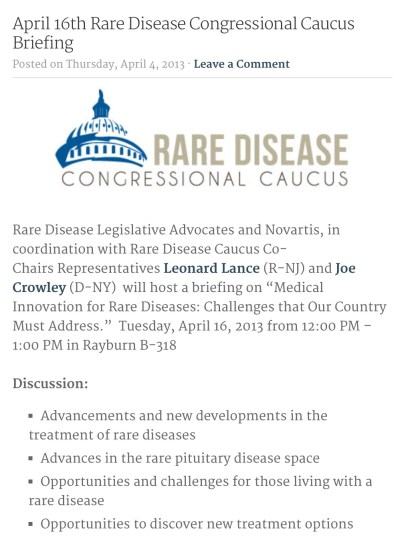
Cushing’s on Capitol Hill: Cushing’s Awareness Challenge

Earlier this year, I got this email:

Good morning Mary:

I hope everything is well.

I would like to invite you to join us at the Rare Disease Congressional Caucus briefing scheduled for April 2013. The final date is still being discussed but we are looking into two possible dates of either April 16th or April 18th. The meeting will take place in Washington, D.C. and will be attended by members of the Rare Disease Caucus including co-chairs Rep. Joseph Crowley and Rep. Leonard Lance.

As you may know Rare Disease Congressional Caucus is a forum for members of Congress to voice constituent concerns, share ideas, and build support for legislation that will improve the lives of people with rare diseases. The goal of the meeting in April is to educate the members of the Caucus about rare pituitary disorders, including Cushing’s Disease – area that has received little to no recognition among legislators. The meeting will serve as an opportunity to raise legislators’ awareness about multiple issues that patients with rare pituitary diseases, such as Cushing’s disease and Acromegaly, face in their everyday lives.

In preparation for the meeting we drafted a Resolution that addresses some of the key challenges for the patient community including long diagnostic delays, limited treatment options, difficulty finding physicians or treatment centers with expertise in their disease and as a result – a  diminished quality of life for patients. Would you be willing to have a look at the draft in the attachment and provide your feedback? Your opinion as a leader of the patient community and expert in Cushing’s disease would be highly appreciated.

I sincerely hope that you will be able to join us at the meeting to share your perspective and talk about the work that you are doing to help patient afflicted by Cushing’s disease live happier and healthier lives.

Please feel free to call or email anytime if you have questions or if you would like to discuss this further. I look forward to hearing back from you soon.

Attached to the email was the House of Congress Resolution.  Read it here.

I got back quite quickly and said that I would love to attend.  If it was on the 16th, I could go, no problem.  If it was the 18th, probably not because I had plane tickets that day to attend the Magic Foundation Conference in Las Vegas.

In late March, I needed to make my final decision on Las Vegas.  I had been waffling about that trip for a while since my husband had surprise triple bypass surgery in late January.  When I made the decision not to go, he still couldn’t drive or walk the dog – and I was just afraid to leave him alone for 5 days.

caucus1

caucus2

As it turned out, the date was a non-issue since the Congressional Caucus would be on the 16th.

April 15 was a terrible day as news of the Boston Marathon came in.  Security was stepped up in several cities, including Washington, DC.

I looked online to see if the Caucus would be cancelled and found out that the 16th was Emancipation Day in DC – and the main route that I would take to get there would be closed for a parade.

I was already getting very nervous about the whole thing and not knowing how to get there added to the stress levels.

I had my talk printed out with 3 different places to stop, depending on the time.

We left about 10AM for a noon meeting.  I’d decided to park at the train station and take a taxi to the Rayburn House Office Building.

When we got to the Rayburn Building, there was a long line of folks waiting to get in.  I don’t know if they only open the front door at certain times but when the line started to move, it went fairly quickly.  They took 5 at a time through security then we were on our own to find out where to go.

It turned out that our meeting room – 318 – is the room usually used for the Ways and Means Committee.  We got there just about 11:30.  Robert Knutzen from the Pituitary Network Association was already there as was Alexey from Novartis.  Alexey said “Mary?” and I said “Alexey?” and we introduced ourselves.  I already knew Bob from several past meetings so the four of us just chatted a bit while others started arriving.

I had brought quite a few Cushing’s brochures with me and had planned to hand them out to people but Julia from the RDLA (Rare Disease Legislative Advocates) showed me a table where I could leave them for folks to take on their own – and quite a few did.  If they read them, that’s another story!

Right around noontime, lots of people came in.  Some were staffers gathering information to take back to their offices, many others were from rare disease organizations, a few were legislators.  It was standing room only and we estimated there were maybe 120-140 people there.  Only two were known pituitary patients:  Bob with Acromegaly and me with Cushing’s.  Bob mentioned the statistic again “1 in 5” so at least 24 others in that room should have had a pituitary tumor…

Representative Leonard Lance (NJ) spoke a bit about the need to recognize rare diseases in this country.  He mentioned that there were 7,000 rare diseases and it was important to focus on getting awareness for patients with them.  This Caucus focused on the pituitary, although only 2 pituitary diseases were represented.

Vijay Iyengar, Vice President the Rare Disease Franchise of Novartis oncology talked about their two drugs to either cure disease or improve quality of life through a  3-pronged approach:

  • Targeted research
  • Open collaboration
  • Patient inspired solutions

Novartis created the Rare Disease Franchise was recently created as a means of strengthening their involvement and has two drugs with FDA approvals, one for Cushing’s and one for Acromegaly. Their Acromegaly drug is 25 years old and their newest, Signifor, was approved on the anniversary of the discovery of Cushing’s Disease (December 2012) and three new applications are in the approval pipeline.

These diseases are rare because not many people have them and not much knowledge is available about them.

He also said he needs collaborative partners, particularly with Cushing’s.  He would like to have Clinical Trial centers.  However, usually enough patients are near one or two centers.  With Cushing’s, there would need to be 40 or more centers.  We talked to Vijay after the Caucus about this and connecting his company with Cushing’s patients.

Emily Acland, although not a Cushing’s patient, summed up some of the symptoms based on her contacts with patients through the Patient Access Network.

Alexey Salamakha, Manager of Rare Disorders for Novartis/Public Affairs and Communications,  read some thoughts on the need for disability benefits from Donna of John’s Foundation for Cushing’s Awareness.  This included the the fact that veterinarians are more knowledgeable about Cushing’s than endocrinologists. He talked about patient advocacy.

Alexey specifically mentioned me and thanked me for my work.

Bob Knutzen was not diagnosed until the age of 52.  He is currently 75.  He expressed his desire to have Centers of Excellence for Hormonal Health with the funds coming from NIH’s budget.

Pituitary disease isn’t rare, just the diagnosis. He also pointed out that pituitary patients generally die 10 years early.  Without treatment, pituitary patients can’t have children.

If I didn’t know what acromegaly was before this meeting, I wouldn’t have known when I left, either.

Sean O’Neil, Vice President at Novartis made comments about his company and what was being done to help patients.

Other topics during this Caucus were:

  • The issues of Cortisol withdrawal
  • Congressmen Snyder and Runyon proposed H con resolution 31 “Supporting Rare Pituitary Disease Awareness”.  Track this resolution through the Committee, House and Senate
  • The need for awareness of pituitary gland diseases
  • There are lifetime changes – people may be cured/in remission but they’re never the same
  • The possibility of a dipstick for cortisol similar to ones diabetics use
  • Faster diagnosis

My contribution to all this was speed of diagnosis.  I told a bit of my story, diagnosing myself in the pre-Internet 1980’s and how today, 26 years later, people are still having issues with diagnosis and wasting on average 6-20 years just getting to surgery.  I mentioned that I knew a few people who went for 20 years before getting diagnosed.

After the Caucus was over, there was a lot of discussion, and I talked with several people who had questions about my experiences, Cushing’s Help, what could be done to raise awareness…

Will anything come of it?  I don’t know but maybe some folks will start thinking a bit more.

From Tom, on Facebook:

Mary did a great job presenting the Cushings story at the April 16 hearing of the Congressional Caucus on Rare Diseases – Challenges our Country Must Address. Co- chairs Congressman Joe Crowley (D-NY) and Congressman Leonard Lance (R-NJ) both attended and endorsed the good work being done in this effort. Mary spoke with many of the sponsors and others both before and after the hearing discussing her personal experience. Mary has created multiple websites to get the message out on rare diseases especially Cushing’s Syndrome. That effort now extends to more than 40 countries and more than 10,000 participants. We will be doing follow ups with the Congressional Caucus on Rare Diseases and with Novartis, RDLA, EveryLife, Patient Access Network, the Pituitary Network Association and others to build on the gains.

And another email:

Dear Mary,

It was a pleasure to meet you and Tom today. Thank you for attending the Rare Disease Congressional Briefing. I think you did an excellent job by sharing your unique perspective on what a life with Cushing’s disease is like. I want to thank you for supporting our mission and educating general public about pituitary disorders. We at Novartis strongly believe that patient advocacy organizations such as Cushing’s Help and Support and passionate advocates like you are the future and the hope of the Cushing’s community.

As a follow up to our conversation I have reached out to my contacts at NORD and asked if they can help with filing for a 501(c)(3) status. I will keep you posted. Please stay in touch.

Novartis drug Signifor approved in the EU as the first medication to treat patients with Cushing’s disease

* Reuters is not responsible for the content in this press release.

Wed Apr 25, 2012

Novartis International AG / Novartis drug SigniforR approved in the EU as the first medication to treat patients with Cushing’s disease . Processed and transmitted by Thomson Reuters ONE. The issuer is solely responsible for the content of this announcement.

Signifor is first targeted approach for Cushing’s disease,

  • a debilitating endocrine disorder caused by an underlying pituitary tumor that triggers excess cortisol[1],[2],[3]
  • Majority of patients in the Phase III clinical trial experienced a rapid and sustained decrease in mean cortisol levels with a subset of patients achieving normalization
  • With reduced cortisol levels, key clinical manifestations of the disease improved, including reductions in blood pressure, cholesterol, weight and body mass index[1]

Basel, April 25, 2012 – Novartis announced today that the European Commission has approved SigniforR (pasireotide) for the treatment of adult patients with Cushing’s disease for whom surgery is not an option or for whom surgery has failed[1]. Signifor is the first medicine to be approved in the European Union (EU) targeting Cushing’s disease.

The approval is based on data from the largest randomized Phase III study to evaluate a medical therapy in patients with Cushing’s disease, a disorder caused by excess cortisol in the body due to the presence of a non-cancerous pituitary tumor[1],[2],[3]. In the study, mean urinary-free cortisol (UFC) levels were normalized in 26.3% and 14.6% of the 162 patients randomized to receive Signifor 900µg and 600µg subcutaneous (sc) injection twice daily, respectively, at month six. The primary endpoint, the proportion of patients who achieved normalization of UFC after six months without dose up-titration relative to randomized dose, was met in patients treated with 900µg twice daily[4].

In addition, the study showed the majority of the patients remaining on the study at month six (91 out of 103 patients; 88%) had any reduction in their mean UFC[5]. The median reduction in mean UFC was 47.9% in both dose groups. Reductions in UFC were rapid and sustained through the end of the study, with the majority of patients experiencing a decrease within the first two months[4].

Overall reductions in the clinical manifestations of Cushing’s disease, including blood pressure, total cholesterol, weight and body mass index, were observed at months six and twelve in patients with both full and partial mean UFC control, with the greatest reductions observed in patients with normalized UFC levels[1],[4].

“As the first therapeutic option to specifically target Cushing’s disease, Signifor has the potential to redefine treatment of this debilitating disease,” said Hervé Hoppenot, President, Novartis Oncology. “By focusing research efforts on our understanding of this rare disease where there is significant unmet need, we have been able to successfully bring a novel treatment option to patients in the European Union.”

Cushing’s disease most commonly affects adults as young as 20 to 50 years and affects women three times more often than men. It may present with weight gain, central obesity, a round, red and full face, severe fatigue and weakness, striae (purple stretch marks), high blood pressure, depression and anxiety[2],[3],[6],[7].

“Patients with Cushing’s disease often struggle with a variety of debilitating health issues associated with the overproduction of cortisol and previously were faced with a treatment approach limited to surgery,” said Ellen van Veldhuizen, board member of the Dutch Adrenal Society. “The approval of pasireotide as a new treatment option that may help patients with Cushing’s disease is welcome news.”

The decision follows the positive opinion the Committee for Medicinal Products for Human Use (CHMP) adopted for Signifor in January 2012 for the treatment of Cushing’s disease and applies to all 27 EU member states, plus Iceland and Norway. Signifor has orphan drug designation for Cushing’s disease, a condition which affects no more than five in 10,000 people in the EU, the threshold for orphan designation[8],[9]. Additional regulatory submissions for pasireotide for the treatment of Cushing’s disease are under way worldwide.

About Cushing’s disease
Cushing’s syndrome is an endocrine disorder caused by excessive cortisol, a vital hormone that regulates metabolism, maintains cardiovascular function and helps the body respond to stress. Cushing’s disease is a form of Cushing’s syndrome, in which excess cortisol production is triggered by an adrenocorticotropic hormone (ACTH)-secreting pituitary adenoma. It is a rare but serious disease that affects approximately one to two patients per million per year. The first line and most common treatment approach for Cushing’s disease is surgical removal of the tumor[2],[3],[10].

About PASPORT-CUSHINGS
PASPORT-CUSHINGS (PASireotide clinical trial PORTfolio – CUSHING’S disease) is a prospective, randomized, double-blind, Phase III study conducted at 68 sites in 18 countries. The study evaluated the efficacy and safety of Signifor in 162 adult patients with persistent or recurrent Cushing’s disease and UFC levels greater than 1.5 times the upper limit of normal (ULN), as well as in patients with newly diagnosed Cushing’s disease who were not candidates for surgery[4].

Patients with primarily moderate to severe hypercortisolism were randomized to receive Signifor sc injection in doses of 900µg (n=80) or 600µg (n=82) twice daily. The primary endpoint was the proportion of patients who achieved normalization of UFC after six months without dose up-titration relative to randomized dose, which was met in patients treated with 900µg twice daily[4].

About Signifor (pasireotide)
Signifor (pasireotide) is approved in the European Union (EU) for the treatment of adult patients with Cushing’s disease for whom surgery is not an option or for whom surgery has failed. For the treatment of Cushing’s disease, Signifor has been studied as a twice-daily subcutaneous (sc) injection and is currently being evaluated as a long-acting release (LAR), once-monthly intramuscular (IM) injection as part of a global Phase III program. Signifor is a multireceptor targeting somatostatin analog (SSA) that binds with high affinity to four of the five somatostatin receptor subtypes (sst 1, 2, 3 and 5)[1],[3],[11].

Information about Novartis clinical trials for pasireotide can be obtained by healthcare professionals at www.pasporttrials.com.

Important Safety Information about Signifor
Signifor is contraindicated in patients with hypersensitivity to the active substances in Signifor or to any of the excipients and in patients with severe liver impairment.

Alterations in blood glucose levels have been frequently reported in healthy volunteers and patients treated with Signifor. Glycemic status should be assessed prior to starting treatment with Signifor. Patients need to be monitored for hyperglycemia; if hyperglycemia develops, the initiation or adjustment of antidiabetic treatment is recommended. Dose reduction or treatment discontinuation should be considered if uncontrolled hyperglycemia persists. After treatment discontinuation, glycemic monitoring (e.g. FPG or HbA1c) should be done according to clinical practice.

Monitoring of liver function is recommended prior to starting treatment with Signifor and after one, two, four, eight and twelve weeks during treatment and thereafter as clinically indicated. Therapy should be discontinued if the patient develops jaundice, other clinical signs of significant liver dysfunctions, sustained AST (aminotransferases) or ALT (alanine aminotransferase) increase five times the upper limit of normal (ULN) or greater, or if ALT or AST increase three times ULN with concurrent bilirubin elevation greater than two times ULN.

Patients with cardiac disease and/or risk factors for bradycardia need to be closely monitored. Caution is to be exercised in patients who have or may develop QT prolongation. Hypokalemia or hypomagnesemia must be corrected prior to initiating therapy and monitored thereafter. Electrocardiography should be performed prior to the start of Signifor therapy and as clinically indicated thereafter.

Treatment with Signifor leads to rapid suppression of adrenocorticotropic hormone (ACTH) secretion in Cushing’s disease patients. Patients need to be monitored and instructed how to monitor for signs and symptoms of hypocortisolism. Temporary exogenous steroid (glucocorticoid) replacement therapy and/or dose reduction or interruption of Signifor therapy may be necessary.

Monitoring of gallbladder and pituitary hormones is recommended prior to initiating treatment and periodically thereafter.

Signifor should not be used during pregnancy unless clearly necessary. Breast feeding should be discontinued during treatment with Signifor.

Signifor may affect the way other medicines work, and other medicines can affect how Signifor works. Caution is to be exercised with the concomitant use of drugs with low therapeutic index mainly metabolized by CYP3A4, bromocriptine, cyclosporine, anti-arrhythmic medicines or drugs that may lead to QT prolongation.

The most frequently reported adverse events (AE) (>10%) by investigators for Signifor were diarrhea, nausea, hyperglycemia, cholelithiasis, abdominal pain, diabetes mellitus, injection site reactions, fatigue and increased glycosylated hemoglobin (HbA1c), with most events being Grade 1-2. The tolerability profile of Signifor was similar to that of other somatostatin analogs with the exception of the greater degree of hyperglycemia[1].

Disclaimer
The foregoing release contains forward-looking statements that can be identified by terminology such as “potential,” “under way,” or similar expressions, or by express or implied discussions regarding potential future marketing approvals for Signifor or regarding potential future revenues from Signifor. You should not place undue reliance on these statements. Such forward-looking statements reflect the current views of management regarding future events, and involve known and unknown risks, uncertainties and other factors that may cause actual results with Signifor to be materially different from any future results, performance or achievements expressed or implied by such statements. There can be no guarantee that Signifor, or its LAR version, will be approved for sale, or for any additional indications, in any market, or at any particular time. Nor can there be any guarantee that Signifor will achieve any particular levels of revenue in the future. In particular, management’s expectations regarding Signifor could be affected by, among other things, unexpected regulatory actions or delays or government regulation generally; unexpected clinical trial results, including unexpected new clinical data and unexpected additional analysis of existing clinical data; government, industry and general public pricing pressures; the company’s ability to obtain or maintain patent or other proprietary intellectual property protection; competition in general; unexpected manufacturing issues; the impact that the foregoing factors could have on the values attributed to the Novartis Group’s assets and liabilities as recorded in the Group’s consolidated balance sheet, and other risks and factors referred to in Novartis AG’s current Form 20-F on file with the US Securities and Exchange Commission. Should one or more of these risks or uncertainties materialize, or should underlying assumptions prove incorrect, actual results may vary materially from those anticipated, believed, estimated or expected. Novartis is providing the information in this press release as of this date and does not undertake any obligation to update any forward-looking statements contained in this press release as a result of new information, future events or otherwise.

About Novartis
Novartis provides innovative healthcare solutions that address the evolving needs of patients and societies. Headquartered in Basel, Switzerland, Novartis offers a diversified portfolio to best meet these needs: innovative medicines, eye care, cost-saving generic pharmaceuticals, preventive vaccines and diagnostic tools, over-the-counter and animal health products. Novartis is the only global company with leading positions in these areas. In 2011, the Group’s continuing operations achieved net sales of USD 58.6 billion, while approximately USD 9.6 billion (USD 9.2 billion excluding impairment and amortization charges) was invested in R&D throughout the Group. Novartis Group companies employ approximately 124,000 full-time-equivalent associates and operate in more than 140 countries around the world. For more information, please visit http://www.novartis.com.

Novartis is on Twitter. Sign up to follow @Novartis at http://twitter.com/novartis.

References
[1] SigniforR (pasireotide) Summary of Product Characteristics. Basel, Switzerland: Novartis; April 2012.
[2] National Endocrine and Metabolic Diseases Information Service. US National Institutes of Health. Cushing’s Syndrome. Available at:http://endocrine.niddk.nih.gov/pubs/cushings/Cushings_Syndrome_FS.pdf. Accessed March 2012.
[3] Pedroncelli, A. Medical Treatment of Cushing’s Disease: Somatostatin Analogues and Pasireotide. Neuroendocrinology. 2010;92(suppl1):120-124.
[4] Colao, A. A 12-Month Phase III Study of Pasireotide in Cushing’s Disease. New Engl J Med. 2012; 366:32-42.
[5] Tritos N., Biller, B. Advances in Medical Therapies for Cushing’s Syndrome. Discovery Medicine. 2012:13(69):171-179.
[6] Newell-Price, J., et al. The Diagnosis and Differential Diagnosis of Cushing’s Syndrome and Pseudo-Cushing’s States. Endocrine Reviews.1998;19(5):647-672.
[7] Bertanga, X., et al. Cushing’s Disease. Best Practice & Research Clinical Endocrinology & Metabolism. 2009;23:607-623.
[8] European Commission. The Centralised Procedure. Available at:http://ec.europa.eu/health/authorisation-procedures-centralised_en.htm. Accessed March 2012.
[9] European Medicines Agency. Committee for Orphan Medicinal Products. Public Summary of Positive Opinion for Orphan Designation of Pasireotide for the treatment of Cushing’s Disease. Available at:http://www.ema.europa.eu/docs/en_GB/document_library/
Orphan_designation/2009/10/WC500006176.pdf
. Accessed March 2012.
[10] Lindholm, J., et al. Incidence and Late Prognosis of Cushing’s Syndrome: A Population-Based Study. J Clin Endocrinol Metab. 2001;86(1):117-23.
[11] US National Institutes of Health. Efficacy and Safety of Pasireotide Administered Monthly in Patients With Cushing’s Disease. Available at: http://clinicaltrials.gov/ct2/show/NCT01374906. Accessed March 2012.

# # #

Novartis Media Relations


Central media line : +41 61 324 2200
Eric Althoff
Novartis Global Media Relations
+41 61 324 7999 (direct)
+41 79 593 4202 (mobile)
eric.althoff@novartis.com
Nicole Riley
Novartis Oncology ‘
+1 862 778 3110 (direct)
+1 862 926 9040 (mobile)
nicole.riley@novartis.com

e-mail: media.relations@novartis.com

For Novartis multimedia content, please visit www.thenewsmarket.com/Novartis
For questions about the site or required registration, please contact: journalisthelp@thenewsmarket.com.

Novartis Investor Relations

Central phone: +41 61 324 7944
Susanne Schaffert +41 61 324 7944 North America:
Pierre-Michel Bringer +41 61 324 1065 Helen Boudreau +1 212 830 2404
Thomas Hungerbuehler +41 61 324 8425 Jill Pozarek +1 212 830 2445
Isabella Zinck +41 61 324 7188 Edwin Valeriano +1 212 830 2456
e-mail: investor.relations@novartis.com e-mail: investor.relations@novartis.com

Media release (PDF)

From http://www.reuters.com/article/2012/04/25/idUS52612+25-Apr-2012+HUG20120425