Cushing’s Syndrome – Epidemiology Forecast to 2023

It’s NOT as rare as they thought…

Epidemiologists forecast an increase in the diagnosed prevalent cases of CS in the 6MM, from 32,634 diagnosed prevalent cases in 2013 to 34,573 diagnosed prevalent cases in 2023, with an annual growth rate of 0.59% in the forecast period. In 2023, the US will have the highest number of diagnosed prevalent cases of CS, with 17,162 diagnosed prevalent cases.

For this analysis, The publisher epidemiologists used data available from Orphanet to construct the 10-year epidemiological forecast for the diagnosed prevalent cases of CS, Cushing’s disease, ectopic ACTH CS, adrenal adenoma CS, and adrenal carcinoma CS in the 6MM. The forecast provides the age- and sex-specific diagnosed prevalent cases of CS subtypes in the six markets, providing a comprehensive view of CS. In addition, this analysis provided detailed, clinically relevant segmentations for Cushing’s disease in order to improve the management of the disease.

Scope

  • The Cushing’s syndrome (CS) EpiCast Report provides an overview of the risk factors, comorbidities, and the global and historical epidemiological trends for CS in the six major markets (6MM) (US, France, Germany, Italy, Spain, and UK). The report also includes a 10-year epidemiological forecast for the diagnosed prevalent cases of CS, Cushing’s disease, ectopic- adrenocorticotropic hormone (ACTH) CS, adrenal adenoma CS, and adrenal carcinoma CS segmented by age (18 to =85 years) and sex in these markets.
  • The CS epidemiology report is written and developed by Masters- and PhD-level epidemiologists.
  • The EpiCast Report is in-depth, high-quality, transparent and market-driven, providing expert analysis of disease trends in the 6MM.

Read the article here: http://www.businesswire.com/news/home/20141103006612/en/Research-Markets-EpiCast-Report-Cushings-Syndrome–#.VFgvl5PF9HA

Rare neuroendocrine tumours may be misdiagnosed as Cushing’s disease

By Eleanor McDermid, Senior medwireNews Reporter

Ectopic tumours secreting corticotropin-releasing hormone (CRH) and adrenocorticotropic hormone (ACTH) are very rare in children and can result in a misdiagnosis of Cushing’s disease (CD), say researchers.

Three of the patients in the reported case series had pituitary hyperplasia and underwent transsphenoidal surgery for apparent CD before the tumour that was actually causing their symptoms was located. The hyperplasia was probably caused by release of CRH from the ectopic tumour, which stimulated the pituitary gland, giving the impression of an ACTH-secreting pituitary adenoma, explain Maya Lodish (National Institutes of Health, Bethesda, Maryland, USA) and study co-authors.

These three patients were part of a series of seven, which Lodish et al describe as “a relatively large number of patients, considering the infrequency of this disease.”

The patients were aged between 1.8 and 21.3 years. Three had neuroendocrine tumours located in the pancreas ranging in size from 1.4 to 7.0 cm, two had thymic carcinoids ranging from 6.0 mm to 11.5 cm, one patient had a 12.0 cm tumour in the liver and one had a 1.3 cm bronchogenic carcinoid tumour of the right pulmonary lobe.

Four of the patients had metastatic disease and, during up to 57 months of follow-up, three died of metastatic disease or associated complications and two patients had recurrent disease.

“Our series demonstrates that these are aggressive tumors with a high mortality rate,” write the researchers in the Journal of Clinical Endocrinology & Metabolism. “It is important to follow the appropriate work up, regarding both biochemical and imaging tests, which can lead to the correct diagnosis and to the most beneficial therapeutic approach.”

The team found the CRH stimulation test to be helpful, noting, for example, that none of the patients had a rise in cortisol that was consistent with CD, with all patients showing smaller responses ranging from 2% to 15%. Likewise, just one patient had an ACTH rise higher than 35% on CRH administration, and four patients had a “flat” response, which has previously been associated with ectopic neuroendocrine tumours.

Of note, six patients had normal or high plasma CRH levels, despite all having high cortisol levels, which would be expected to result in undetectable plasma CRH due to negative feedback, implying another source of CRH production. Five patients had blunted diurnal variation of both cortisol and ACTH levels consistent with Cushing’s syndrome.

The patients also underwent a variety of imaging procedures to identify the source of ACTH/CRH production, some of which, such as octreotide scans, are specialist and not available in most hospitals, the researchers note, potentially contributing to inappropriate diagnosis and management.

From http://www.news-medical.net/news/20141030/Rare-neuroendocrine-tumours-may-be-misdiagnosed-as-Cushinge28099s-disease.aspx

Utility of measurement of dexamethasone levels in the diagnostic testing for Cushing’s syndrome

From Day 1 of the 16th International Congress of Endocrinology and the Endocrine Society’s 96th Annual Meeting and Expo »

Chicago, IL – June 21, 2014

ST Sharma, JA Yanovski, SB Abraham, LK Nieman

Summary: Dexamethasone (dex) suppression tests (DST) are used for screening and differential diagnosis of Cushing’s syndrome (CS). The 1 mg overnight (LD) DST is used to diagnose CS, the dex-suppressed CRH stimulation (Dex-CRH) test to differentiate CS from pseudocushings (PCS) while the 8 mg overnight (HD) DST is used to differentiate Cushing’s disease (CD) from ectopic ACTH syndrome (EAS). Researchers assessed the utility of dex levels in improving the diagnostic accuracy of these tests and they found that low dex and high CBG levels can account for false positive (FP) DST and Dex-CRH test results. Use of a higher dex dose in pts with low dex levels can help decrease FP results.

Methods:

  • This is a retrospective study of patients (pts) with CS, PCS and normal volunteers (NV) who had a dex level measured as part of LDDST, HDDST or Dex-CRH test.
  • A post-dex cortisol (F) level ≥1.8 mcg/dl in the LDDST and a 15 min post-CRH F level ≥1.4 mcg/dl in the Dex-CRH test suggested CS.
  • A ≥69% suppression of F levels in HDDST indicated CD.
  • Dex levels

Results:

  • LDDST (n=77): Post-dex F was abnormal in 44 pts, 37 of these did not have CS on follow-up.
  • Proportion of pts with low dex levels was similar in those with incorrect or correct LDDST results (P=0.7).
  • Three of 5 pts with an abnormal result and low dex levels (44-117 ng/dl) had suppressed post-dex F levels after a 2 mg overnight DST. HDDST (N=56): Results were not consistent with the final diagnosis (CD or EAS) in 13 (23%) pts.
  • Of these, 5 had low dex levels (400-1220 ng/dl).
  • Proportion of pts with low dex levels was similar between those with correct and incorrect HDDST results (P=0.5).
  • HDDST in 1 pt with ACTH-dependent CS suggested EAS (28% suppression) with low dex level.
  • IPSS indicated CD.
  • After a doubled dex dose (16 mg), F levels suppressed by 76%, changing the HDDST result to CD.
  • Dex-CRH (n=139): Results were consistent with the final diagnosis in 133 pts (74 CS, 20 NV, 39 PCS).
  • Six pts with an abnormal result had dex levels
  • Of these, repeat testing with doubled dex dose (1 mg every 6 hours) in 2 pts led to higher dex levels (610, 757 ng/dl) and normal F level in one.
  • Two pts with abnormal result were on OCPs, 1 with a known high cortisol binding globulin (CBG) level.
  • None had CS on follow-up.
  • There was no correlation between dex and post-dex F levels in LDDST, 15 min post-CRH F levels in Dex-CRH test and % suppression of F post-dex in HDDST (P=NS).

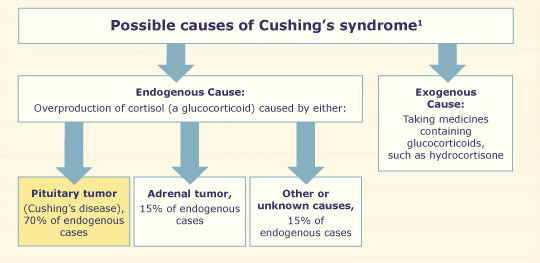
Cushing’s Awareness Challenge 17

robin-causes

Another of Robin’s wonderful images.

A similar image from the CushieWiki

cushings-causes

No wonder Cushing’s is so hard to diagnose!

maryo colorful zebra

Outcome of Bilateral Adrenalectomy in Cushing’s Syndrome: A Systematic Review

  1. Katrin Ritzel,
  2. Felix Beuschlein,
  3. Anne Mickisch,
  4. Andrea Osswald,
  5. Harald J. Schneider,
  6. Jochen Schopohl and
  7. Martin Reincke

Author Affiliations


  1. Medizinische Klinik und Poliklinik IV, Klinikum der Universität München, D-80336 München, Germany
  1. Address all correspondence and requests for reprints to: Martin Reincke, M.D., Medizinische Klinik und Poliklinik IV, Klinikum der Universität München, Ziemssenstrasse 1, D-80336 München, Germany. E-mail:Martin.Reincke@med.uni-muenchen.de.

Abstract

Background: The outcome of bilateral adrenalectomy (BADx) in patients with Cushing’s syndrome (CS) is not well characterized.

Methods: A literature search was performed with the search terms “bilateral adrenalectomy” or “total adrenalectomy” and “Cushing’s” or “Cushing.” Immediate and long-term outcomes after BADx in CS were analyzed using descriptive statistics (median [range]).

Results: From 549 screened publications, 37 studies met inclusion criteria (1320 patients, 82% having Cushing’s disease [CD], 13% having ectopic CS, and 5% having primary adrenal hyperplasia).

Surgical morbidity and mortality of BADx (23 studies, 739 patients) were 18% (6–31) and 3% (0–15), respectively. In patients with CD, surgical mortality was below 1%. Although residual cortisol secretion due to accessory adrenal tissue or adrenal remnants was found in 3–34% (5 studies, 236 patients), less than 2% had a relapse of CS.

Symptoms of hypercortisolism (eg, hypertension, obesity, or depression) improved in the majority of the patients after BADx (7 studies, 195 patients). The number of adrenal crises per 100 patient-years was 9.3 (6 studies, 203 patients).

Nelson’s syndrome occurred in 21% (0–47) of the patients (24 studies, 768 patients). Mortality (23 studies, 690 patients) was 17% (0–88) at a follow-up of 41 months (14–294). Remarkably, 46% of the patients died in the first year after surgery. The median ages at death were 62 years (CD) and 53 years (ectopic CS).

Conclusion: BADx is relatively safe and provides adequate success. Excess mortality within the first year after surgery suggests that intensive clinical care for patients after BADx is warranted.

Footnotes

  • For editorial see page 3974

  • Abbreviations:

    BADx
    bilateral adrenalectomy
    BAH
    bilateral adrenal hypercortisolism
    CD
    Cushing’s disease
    CS
    Cushing’s syndrome
    ECS
    ectopic CS
    NS
    Nelson’s syndrome
    QOL
    quality of life
    TSS
    transsphenoidal surgery.


From http://jcem.endojournals.org/content/98/10/3939.abstract