Have you ever noticed that when you are “stressed” you can feel either emotionally/physically depleted or energized? When our body is under stress the brain responds by producing epheniphrine or adrenaline, sending signals to our adrenal glands, increasing the rate at which our heart beats while releasing oxygen to our muscles. The long term response to this process produces cortisol (aka the stress hormone) facilitating the release of energy throughout our body. However, when our body isn’t properly balanced these hormones can wreak havoc on our wellness possibly resulting in one of three conditions: Cushing’s syndrome, Cushing’s disease or Addison’s disease.
 The actual Adrenal glands sit physically atop both kidneys, taking on a triangular shape and a roundish rectangular type shape. These glands are responsible for our sex hormones and cortisol, helping us respond to stress amongst other functions. When our body is under stress, physically and/or nutritionally, it responds one of two ways: Produces too much or too little of the cortisol hormone. Our Adrenal glands also contribute to regulating our blood sugar, blood pressure, salt and water.
Adrenal disorders can cause our body to make too much or not enough of these hormones, bringing about adrenal gland related syndromes and disease. Cushing’s syndrome results from our body making too much versus Addison’s disease produces too little.
Cushing’s syndrome vs. Cushing’s disease
Glucocorticoids (naturally produced in our body or received through medicine) are groups of corticosteroids (cortisol or dexamethasone) involved in metabolizing our carbohydrate and protein. When taken synthetically (i.e. treatment of allergies, skin problems, and respiratory problems) or over-produced naturally, the side effects can result in “Cushing’s syndrome”.
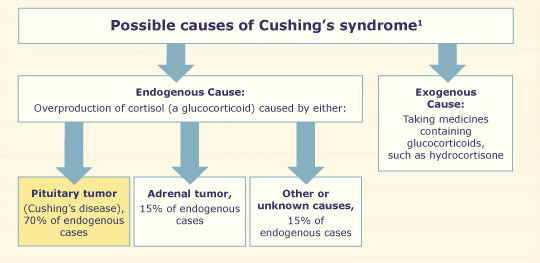
Cushing’s syndrome can occur one of two ways: Endogenous or Exogenous. Endogenous is caused by the body (usually through tumors). Exogenous is caused by medication. In both cases, the body produces too much cortisol.
Symptoms: Severe fatigue/muscle weakness, high blood sugar and high blood pressure, upper body obesity, thin arms/legs, bruising easily
Treatment: The cure and treatment for Cushing’s disease can come through medicine, surgery, or by lowering the dosage of your current synthetic hormone treatment. Cushing’s syndrome can be cured.
Cushing’s disease is the most common form of endogenous Cushing’s syndrome and is likely treatable. Caused by a tumor in the pituitary gland secreting too much Adrenocorticotropic hormone (ACTH), this type of tumor does not spread and can be removed through surgery.
Nutrition: See a nutritionist or dietician for your condition. Mostly, avoid excess sodium. High blood sugar (hyperglycemia) and high blood pressure can easily occur with this condition. Bone loss density is common with this condition, so be extra aware of your calcium (800 – 1200 mg per day, based upon age) and Vitamin D intake (5mcg from age 0-50, increasing up to 10 mcg 50-71, and 15 mcg after 71). Eating healthy, balanced and whole food (versus processed) is extremely important.
(Resource: http://www.aboutcushings.com/understanding-cushings-disease/causes-and-differences.jsp)
Addison’s disease
Opposite from Cushing’s syndrome, Addison’s disease doesn’t make “enough” of the sex hormones and cortisol. The result of this disease causes our immune system to attack our tissue, damaging our adrenal glands.
Symptoms: Weight loss, muscle weakness, increasingly worse fatigue, low blood pressure and patchy or dark skin.
Treatment: If left untreated, the condition can be fatal. Lifetime hormone treatment is usually required. Addison disease patients should always carry medical/emergency ID on them, listing their medication, dosage and disease
Lab tests can confirm that you have Addison’s disease. If you don’t treat it, it can be fatal. You will need to take hormone pills for the rest of your life. If you have Addison’s disease, you should carry an emergency ID. It should say that you have the disease, list your medicines and say how much you need in an emergency.”
(Ref: http://www.nlm.nih.gov/medlineplus/cushingssyndrome.html, NIH: National Institute of Neurological Disorders and Stroke) Learning how to balance our stress-filled lives is extremely important to our overall health. Healthy nutrition always contributes benefits to our overall wellness. We can overwhelm our endocrine system by simply not eating nutritionally. Understanding that “Food is a drug” is vitally important to how we help our body naturally heal itself. The above two conditions are the result of our body not handling the stress we are putting it through, causing our body to producing too much or too little of the sex hormones and cortisol.
Unless we first address what we can do naturally through nutrition, the medicine we consume will only do so much in helping our body heal completely. You simply cannot continue doing the same thing over and over again, expecting the medicine to do all the work. Some diseases are brought upon us through our environment (emotionally as well as physically) as well as our diet/nutrition. Reviewing our entire wellness is always wisdom whenever we’re diagnosed with anything.
Certainly listen to your doctor and their advice. But also ask your doctor to refer you to a nutritionist or clinical/registered dietician for a complete evaluation that includes a review of your nutritional diet/wellness. Too often we reach for a pill or a procedure to “fix” our health problems, ignoring what we should be doing on our own to help our body heal. Medical intervention is the result of providing our body with what it cannot produce on its own. Nutrition should always be the “natural” medicine we take, as well as what we might need through prescribed medication.
Adapted from (Spelling errors corrected) http://hamptonroads.com/2013/10/remaining-calm-reducing-illness
Filed under: adrenal, Cushing's, pituitary, Treatments | Tagged: ACTH, Addison's disease, adrenal, Adrenocorticotropic hormone, blood pressure, blood sugar, bruising, cortisol, Cushing's Disease, Cushing's Syndrome, dexamethasone, endogenous, epin, exogenous, fatigue, medic alert, muscle weakness, obesity, patchy skin, pituitary, sex hormones, weight loss | 2 Comments »




 CushieBlog