Hair Analysis Provides a Historical Record of Cortisol Levels in Cushing’s Syndrome

Exp Clin Endocrinol Diabetes. Author manuscript; available in PMC 2010 Sep 24.
Published in final edited form as:
PMCID: PMC2945912
NIHMSID: NIHMS235640
Hair Analysis Provides a Historical Record of Cortisol Levels in Cushing’s Syndrome

Abstract

The severity of Cushing’s Syndrome (CS) depends on the duration and extent of the exposure to excess glucocorticoids. Current measurements of cortisol in serum, saliva and urine reflect systemic cortisol levels at the time of sample collection, but cannot assess past cortisol levels. Hair cortisol levels may be increased in patients with CS, and, as hair grows about 1 cm/month, measurement of hair cortisol may provide historical information on the development of hypercortisolism.

We attempted to measure cortisol in hair in relation to clinical course in six female patients with CS and in 32 healthy volunteers in 1 cm hair sections. Hair cortisol content was measured using a commercially available salivary cortisol immune assay with a protocol modified for use with hair.

Hair cortisol levels were higher in patients with CS than in controls, the medians (ranges) were 679 (279–2500) and 116 (26–204) ng/g respectively (P <0.001). Segmental hair analysis provided information for up to 18 months before time of sampling. Hair cortisol concentrations appeared to vary in accordance with the clinical course.

Based on these data, we suggest that hair cortisol measurement is a novel method for assessing dynamic systemic cortisol exposure and provides unique historical information on variation in cortisol, and that more research is required to fully understand the utility and limits of this technique.

Keywords: glucocorticoids, pituitary adenoma, cancer, adrenal gland, hormones, cushing hair

Crooke’s changes common in patients with Cushing’s syndrome, high cortisol production


Evidence of Crooke hyaline changes in the pituitary gland points to a higher likelihood of Cushing’s syndrome in adults, with the changes in basophil cells occurring in 75% to 80% of patients with the hormonal disorder, according to research in The Journal of Clinical Endocrinology & Metabolism.

In a retrospective review of hospital patient records from adults with Cushing’s syndrome who underwent pituitary surgery, researchers also found that a higher degree of cortisol production, as well as exposure to excess glucocorticoids, are often associated with Crooke’s changes in adults.

“The presence of Crooke’s changes is a clear indication of the presence of Cushing’s syndrome, although the absence of Crooke’s changes does not exclude it,” the researchers wrote.

Edward H. Oldfield, MD, FACS, of the department of neurological surgery at University of Virginia Health System, and colleagues analyzed electronic hospital data from 213 consecutive patients with Cushing’s syndrome who received pituitary surgery between 2008 and March 2014. Researchers reviewed analysis of the normal pituitary tissue included with the specimens obtained at surgery, as well as cortisol production measured by 24-hour urine.

Within the cohort, Crooke’s changes occurred in 74% of patients; Crooke’s changes occurred in 81% of patients with an adrenocorticotropic hormone tumor.

Researchers also found that 91% of patients with an adrenocorticotropic hormone-producing tumor and a urinary free cortisol test at least fourfold the upper limit of normal had evidence of Crooke’s changes vs. 74% of patients with a urine cortisol amount that was less than fourfold the upper limit of normal (P = .008).

“Our results clearly demonstrate a correlation between the degree of cortisol production and the presence of Crooke’s changes,” the researchers wrote. “Patients with cortisol production exceeding fourfold upper limit almost all had Crooke’s changes.”

Researchers said study results indicate that the presence of Crooke’s changes may be used to indicate that a patient has Cushing’s syndrome following a pituitary surgery in which no tumor is found.

“However, the absence of Crooke’s changes does not reliably indicate the absence of Cushing’s syndrome, as 19% of patients with a proven [adrenocorticotropic hormone-producing tumor] did not have Crooke’s changes,” the researchers wrote. by Regina Schaffer

Disclosure: The researchers report no relevant financial disclosures.

From http://www.healio.com/endocrinology/adrenal/news/online/%7B838a3557-f284-4fda-b93d-73dbb4823667%7D/crookes-changes-common-in-patients-with-cushings-syndrome-high-cortisol-production

Cushing’s Syndrome

Prof André Lacroix, MDcorrespondence,  Richard A Feelders, MD, Constantine A Stratakis, MD, Lynnette K Nieman, MD

Cushing’s Syndrome | Seeking Alpha

Looking at the dizzying volatility in the government bond space and in continuation of our recent theme dealing with “alkaloids,” we remembered Cushing’s syndrome when choosing our title analogy, also known as “hypercortisolism” which is a collection of signs and symptoms due to prolonged exposure to cortisol (or QEs). Cushing’s syndrome is generally associated with rapid weight gain (bond prices), moodiness, irritability or depression to name a few.

The most common cause of Cushing’s syndrome is “exogenous” administration of glucortocoides prescribed by a health practitioner to treat other diseases such as asthma and rheumatoid arthritis. In our “market case,” one could argue that the most common cause of the sudden rise in government bond yields could be linked to the exogenous administration of “QEs” prescribed by central bankers in order to treat weak aggregate demand (AD). Strictly, Cushing’s syndrome refers to excess cortisol of any etiology (as syndrome means a group of symptoms).


Government bonds and Cushing’s Syndrome analogy from Cushing’s Syndrome | Seeking Alpha.

Cushing’s Awareness Challenge 17

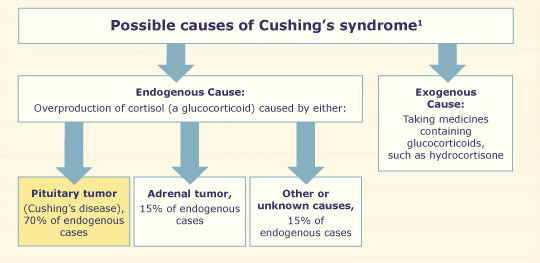
robin-causes

Another of Robin’s wonderful images.

A similar image from the CushieWiki

cushings-causes

No wonder Cushing’s is so hard to diagnose!

maryo colorful zebra