Cushing’s Syndrome | Seeking Alpha

Looking at the dizzying volatility in the government bond space and in continuation of our recent theme dealing with “alkaloids,” we remembered Cushing’s syndrome when choosing our title analogy, also known as “hypercortisolism” which is a collection of signs and symptoms due to prolonged exposure to cortisol (or QEs). Cushing’s syndrome is generally associated with rapid weight gain (bond prices), moodiness, irritability or depression to name a few.

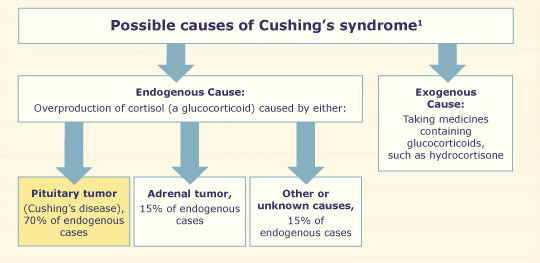
The most common cause of Cushing’s syndrome is “exogenous” administration of glucortocoides prescribed by a health practitioner to treat other diseases such as asthma and rheumatoid arthritis. In our “market case,” one could argue that the most common cause of the sudden rise in government bond yields could be linked to the exogenous administration of “QEs” prescribed by central bankers in order to treat weak aggregate demand (AD). Strictly, Cushing’s syndrome refers to excess cortisol of any etiology (as syndrome means a group of symptoms).


Government bonds and Cushing’s Syndrome analogy from Cushing’s Syndrome | Seeking Alpha.

Cushing’s Awareness Challenge 17

robin-causes

Another of Robin’s wonderful images.

A similar image from the CushieWiki

cushings-causes

No wonder Cushing’s is so hard to diagnose!

maryo colorful zebra

Perspectives on the management of adrenal insufficiency

Source

Oxford Centre for Diabetes, Endocrinology and Metabolism, Churchill Hospital, University of Oxford, Headington, Oxford OX3 7EJ, UK.

Abstract

BACKGROUND:

Conventional glucocorticoid (GC) replacement for patients with adrenal insufficiency (AI) is inadequate. Patients with AI continue to have increased mortality and morbidity and compromised quality of life despite treatment and monitoring.

OBJECTIVES:

i) To review current management of AI and the unmet medical need based on literature and treatment experience and ii) to offer practical advice for managing AI in specific clinical situations.

METHODS:

The review considers the most urgent questions endocrinologists face in managing AI and presents generalised patient cases with suggested strategies for treatment.

RESULTS:

Optimisation and individualisation of GC replacement remain a challenge because available therapies do not mimic physiological cortisol patterns. While increased mortality and morbidity appear related to inadequate GC replacement, there are no objective measures to guide dose selection and optimisation. Physicians must rely on experience to recognise the clinical signs, which are not unique to AI, of inadequate treatment. The increased demand for corticosteroids during periods of stress can result in a life-threatening adrenal crisis (AC) in a patient with AI. Education is paramount for patients and their caregivers to anticipate, recognise and provide proper early treatment to prevent or reduce the occurrence of ACs.

CONCLUSIONS:

This review highlights and offers suggestions to address the challenges endocrinologists encounter in treating patients with AI. New preparations are being developed to better mimic normal physiological cortisol levels with convenient, once-daily dosing which may improve treatment outcomes.

PMID:
24031090
[PubMed – in process] 
PMCID:
PMC3805018
 [Available on 2013/12/1]

From http://www.mdlinx.com/endocrinology/newsl-article.cfm/4829245/ZZ4747461521296427210947/?news_id=2364&newsdt=110713&subspec_id=1509&utm_source=Focus-On&utm_medium=newsletter&utm_content=Top-New-Article&utm_campaign=article-section

Cushing’s syndrome – A structured short- and long-term management plan for patients in remission

European Journal of Endocrinology, 08/30/2013  Review Article

harvey-bookRagnarsson O et al. – One–hundred years have passed since Harvey Williams Cushing presented the first patient with the syndrome that bears his name.

The focus of the long–term specialized care should be to identify cognitive impairments and psychiatric disorders, evaluate cardiovascular risk, follow pituitary function and to detect possible recurrence of Cushing’s syndrome.


Source

O Ragnarsson, Department of Endocrinology, Sahlgrenska University Hospital, Gothenburg, Sweden.

Abstract

One-hundred years have passed since Harvey Williams Cushing presented the first patient with the syndrome that bears his name. In patients with Cushing’s syndrome body composition, lipid-, carbohydrate- and protein-metabolism is dramatically affected and psychopathology and cognitive dysfunction is frequently observed.

Untreated patients with Cushing’s syndrome have a grave prognosis with an estimated five-year survival of only 50%. Remission can be achieved by surgery, radiotherapy and sometimes with medical therapy.

Recent data indicate that the adverse metabolic consequences of Cushing’s syndrome are present for years after successful treatment. In addition, recent studies have demonstrated that health related quality of life and cognitive function is impaired in patients with Cushing’s syndrome in long-term remission.

The focus of specialized care should therefore not only be on the diagnostic work-up and the early post-operative management, but also the long-term follow-up.

In this paper we review the long-term consequences in patients with Cushing’s syndrome in remission with focus on the neuropsychological effects and discuss the importance of these findings for long-term management. We also discuss three different phases in the postoperative management of surgically treated patients with Cushing’s syndrome, each phase distinguished by specific challenges; the immediate post-operative phase, the glucocorticoid dose tapering phase and the long-term management. The focus of the long-term specialized care should be to identify cognitive impairments and psychiatric disorders, evaluate cardiovascular risk, follow pituitary function and to detect possible recurrence of Cushing’s syndrome.

PMID:
23985132
[PubMed – as supplied by publisher]

From http://www.ncbi.nlm.nih.gov/pubmed/23985132

Adrenal Glands

adrenal-glandsAnatomy of the adrenal glands:

Adrenal glands, which are also called suprarenal glands, are small, triangular glands located on top of both kidneys. An adrenal gland is made of two parts: the outer region is called the adrenal cortex and the inner region is called the adrenal medulla.

Function of the adrenal glands:

The adrenal glands work interactively with the hypothalamus and pituitary gland in the following process:

  • the hypothalamus produces corticotropin-releasing hormones, which stimulate the pituitary gland.
  • the pituitary gland, in turn, produces corticotropin hormones, which stimulate the adrenal glands to produce corticosteroid hormones.

Both parts of the adrenal glands — the adrenal cortex and the adrenal medulla — perform very separate functions.

What is the adrenal cortex?

The adrenal cortex, the outer portion of the adrenal gland, secretes hormones that have an effect on the body’s metabolism, on chemicals in the blood, and on certain body characteristics. The adrenal cortex secretes corticosteroids and other hormones directly into the bloodstream. The hormones produced by the adrenal cortex include:

  • corticosteroid hormones
    • hydrocortisone hormone – this hormone, also known as cortisol, controls the body’s use of fats, proteins, and carbohydrates.
    • corticosterone – this hormone, together with hydrocortisone hormones, suppresses inflammatory reactions in the body and also affects the immune system.
  • aldosterone hormone – this hormone inhibits the level of sodium excreted into the urine, maintaining blood volume and blood pressure.
  • androgenic steroids (androgen hormones) – these hormones have minimal effect on the development of male characteristics.

What is the adrenal medulla?

The adrenal medulla, the inner part of the adrenal gland, is not essential to life, but helps a person in coping with physical and emotional stress. The adrenal medulla secretes the following hormones:

  • epinephrine (also called adrenaline) – this hormone increases the heart rate and force of heart contractions, facilitates blood flow to the muscles and brain, causes relaxation of smooth muscles, helps with conversion of glycogen to glucose in the liver, and other activities.
  • norepinephrine (also called noradrenaline) – this hormone has little effect on smooth muscle, metabolic processes, and cardiac output, but has strong vasoconstrictive effects, thus increasing blood pressure.

From: University of Maryland Center for Diabetes and Endocrinology