Helping others learn more about Cushing’s/Acromegaly

I found this article especially interesting.  This question was asked of a group of endos at an NIH conference a few years ago – if you saw someone on the street who looked like they had symptoms of fill-in-the disease, would you suggest that they see a doctor.  The general answer was no.  No surprise there.

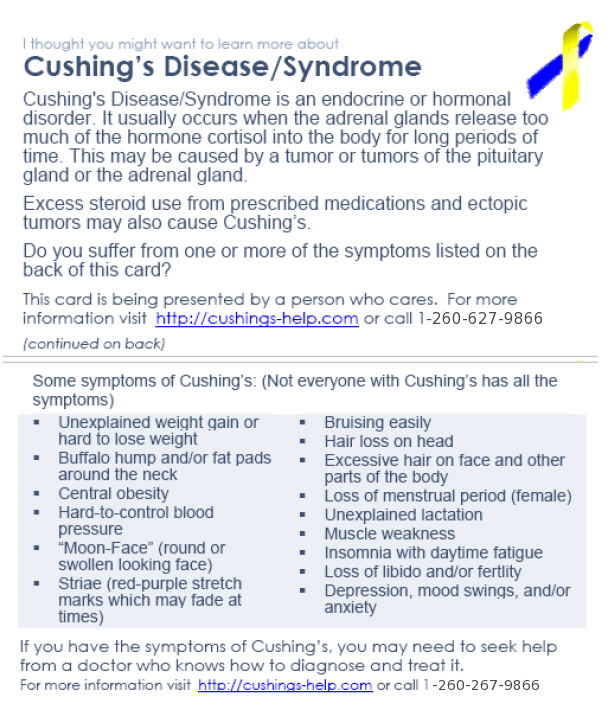
Patients, if you see someone who looks like s/he has Cushing’s, give them a discrete card.

Spread The Word! Cushing’s Pocket Reference

Robin Writes:

This has been a concern of mine for some time. Your post spurred me on to do something I’ve been meaning to do. I’ve designed something you can print that will fit on the business cards you can buy just about anywhere (Wal-mart included). You can also print on stiff paper and cut with a paper cutter or scissors. I’ve done a front and a back.

Cushing's Pocket Reference

Here are the links:

Front: This card is being presented by a person who cares.
Back (The same for everyone)

This Topic on the Message Boards

~~~~~~~~~~~~~~~~~~

And now, the article from http://www.guardian.co.uk/lifeandstyle/2009/nov/03/doctor-diagnosis-stranger:

Are doctors ever really off duty?

Which potentially serious symptoms would prompt them to stop and advise a stranger on a bus?

By Lucy Atkins

Bus

Passengers on a London bus. Photograph: David Levene

A Spanish woman of 55, Montse Ventura, recently met the woman she refers to as her “guardian angel” on a bus in Barcelona. The stranger – an endocrinologist – urged Ventura to have tests for acromegaly, a rare disorder involving an excesss of growth hormone, caused by a pituitary gland tumour. How had the doctor made this unsolicited diagnosis on public transport? Apparently the unusual, spade-like shape of Ventura’s hands was a dead giveaway.

But how many off-duty doctors would feel compelled to alert strangers to symptoms they spot? “If I was sitting next to someone on a bus with a melanoma, I’d say something or I wouldn’t sleep at night,” says GP Mary McCullins. “We all have a different threshold for interfering and you don’t want to terrify people, but this is the one thing I’d urge a total stranger to see a doctor about.” So what other symptoms might prompt a doctor to approach someone on the street?

Moon face

Cushing’s syndrome is another rare hormone disorder which can be caused by a non-cancerous tumour in the pituitary gland. “A puffy, rounded ‘moon face’ is one of the classic signs of Cushing’s,” says Dr Steve Field, chair of the Royal College of GPs. “In a social situation, I wouldn’t just say, ‘You’re dangerously ill’ but I’d try to elicit information and encourage them to see a doctor.”

Different-sized pupils

When one pupil is smaller than the other, perhaps with a drooping eyelid, it could be Horner’s syndrome, a condition caused when a lung tumour begins eating into the nerves in the neck. This can be the first obvious sign of the cancer. “I’d encourage someone to get this checked out,” says Dr Simon Smith, consultant in emergency medicine at the Oxford Radcliffe Hospitals Trust. “People often have an inkling that something’s wrong, and you might spur them to get help sooner.”

Clubbing fingers

Some people are born with club-shaped fingers, but if, over time, they become “drumstick-like”, this could signify serious problems such as lung tumours, chronic lung infections or congenital heart disease. “Because it happens gradually, some people disregard clubbing,” says Smith. “But I’d say something because it can be an important symptom in many serious illnesses.”

Lumpy eyelids

Whitish yellowy lumps around the eyelids can be a sign of high cholesterol, a major factor in heart disease. Sometimes you also get a yellow circle around the iris. “I would suggest they got a cholesterol test with these symptoms,” says Smith. “They can do something about it that could save their life.”

Suntan in unlikely places

A person with Addison’s disease, a rare but chronic condition brought about by the failure of the adrenal glands, may develop what looks like a deep tan, even in non sun-exposed areas such as the palms. Other symptoms (tiredness, dizziness) can be non-specific so the condition is often advanced by the time it is diagnosed. Addison’s is treatable with lifelong steroid replacement therapy. “If someone was saying they hadn’t been in the sun but had developed a tan, alarm bells would ring and I’d probably ask how they were feeling,” says McCullins.

Trench mouth

Putrid smelling breath – even if the teeth look perfect – can be a sign of acute necrotising periodontitis. “I’d be able to tell when someone walks through the door,” says dentist Laurie Powell. “But people become accustomed to it and don’t notice.” Untreated, the condition damages the bones and connective tissue in the jaw. It can also be a sign of other diseases such as diabetes or Aids.

Millennial Woman Hasn’t Slept the Night in 19 Months—Viewers Shocked Why

“I haven’t had a proper night’s sleep in 19 months,” Aleksa Diaz told Newsweek. “Even if I’m physically exhausted, I can’t fall asleep. I wake up more than ten times a night—fully conscious. I only get about two to four hours of broken sleep.”

The 30-year-old from Austin, Texas, has shared her experience on TikTok (@aleksaheals) earning 94,000 views. During the video, she points out that she has not “crashed” once and wonders how her body is continuing to function.

Diaz says that her insomnia began in January 2024 and is linked to a benign tumor in her pituitary gland—a small, hormone-producing gland at the base of the brain—known as a pituitary adenoma.

According to the American Brain Tumor Association (ABTA), about 13,770 pituitary tumors are diagnosed each year in the U.S., accounting for roughly 17 percent of all primary tumors in the central nervous system (CNS).

Symptoms of Pituitary Tumors

Pituitary tumors and cysts typically arise from two main causes: pressure on the gland and surrounding structures, or overproduction of hormones. The severity and type of symptoms depend on the tumor’s size and the specific hormones involved.

The ABTA notes that when the tumor presses on the pituitary gland or nearby structures, it can lead to:

  • Headaches
  • Visual loss
  • Hair loss
  • Diminished libido
  • Weight fluctuations
  • Skin changes
  • Fatigue or low energy

Symptoms Caused by Excess Hormone Production

Approximately 70 percent of pituitary tumors are “secreting,” meaning they release excess hormones. These include:

  • Growth hormone: Overproduction can cause localized excess growth (‘acromegaly’) in adults and gigantism in children.
  • Prolactin: Leads to menstrual changes and abnormal milk production.
  • Sex hormones: Can cause menstrual irregularities and sexual dysfunction.
  • Thyroid hormones: Can trigger hyperthyroidism, with symptoms such as weight loss, heart rhythm changes, anxiety, bowel changes, fatigue, thinning skin and sleep problems.
  • Adrenal hormones: Excess can lead to Cushing’s disease, characterized by a moon-shaped face, excess body hair, easy bruising, menstrual irregularities and high blood pressure.

A Long Road to Diagnosis

Diaz told Newsweek that she has experienced many of these symptoms, beginning with severe hair loss at just 18.

“I started to feel off and suddenly began losing hair,” she recalled. “I was shedding over 300 hairs a day—just brushing my hair or running my fingers through it.”

Initially, doctors diagnosed her with polycystic ovary syndrome (PCOS). “I didn’t have any other symptoms, but I just thought it must be what they said,” Diaz explained.

By the time she turned 22, the hair loss was severe and unrelenting.

“It wasn’t stopping,” she said. “I went to a dermatologist and had a brain MRI—then they found a 5mm tumor on my pituitary gland.”

Around the same time, Diaz began gaining weight that wouldn’t budge despite dieting and regular exercise.

“I developed depression and always had a puffy, inflamed face,” she said. “The hair loss was causing me a lot of self-esteem issues.”

Over the years, Diaz’s symptoms multiplied—dry skin, dry eyes, low libido, anxiety, twitching legs and hip pain after exercise. She estimates she has consulted around 40 doctors and spent 500–600 hours researching her condition.

In 2018, she was formally diagnosed with a pituitary adenoma and prescribed metformin to lower hormone levels. “They told me to wait and see,” she said. When her insomnia worsened, Diaz suspected the tumor was causing multiple hormone-related conditions, but doctors did not confirm it.

By January 2024, she noticed new symptoms: vaginal dryness, hip pain and worsening sleep. Tests revealed her estrogen was abnormally low for her age.

“I take medication for that now and progesterone too,” she said. After years of trying everything—dermatologists, supplements and expensive hair treatments—she finally saw some hair regrowth.

Still, Diaz’s diagnosis of hypopituitarism means her pituitary gland underproduces several critical hormones.

The ABTA notes that doctors often recommend monitoring small tumors, since they typically grow slowly and cause no symptoms. But Diaz, whose tumor is 5 mm, disagrees.

She said: “Doctors believe that because the tumor is under 1 cm it can’t possibly be causing enough symptoms to risk doing surgery. The main risk is developing another hormone deficiency post-op.

“However, surgeons who do this surgery say it’s routine and not super risky, so it’s confusing as a patient.

“Cases like mine of mild hypopituitarism are often ignored, leading to a slow progression of hormone deficiencies—the very thing that is a risk of surgery.”

When she was 29, Diaz started taking hormone replacement therapy (HRT)—a treatment that replaces female hormones, mainly estrogen and progesterone, which fall to low levels during menopause.

She told Newsweek: “Doctors don’t understand why I’m basically in menopause. We don’t know the risks of long-term HRT. The medications make me feel better, but it’s not safe as a long-term solution.”

Living with the Emotional Toll

Alongside her physical symptoms, Diaz has developed severe depression and feels “literally running on empty.”

“I feel like I have hope for the future only when I manage a decent night’s sleep,” she said. “I don’t want to see anyone or socialize. I haven’t gone out in six months. It’s affected my job—I was almost fired in March.

“I’ve become very forgetful, I miss meetings and tasks and I sometimes can’t remember what I did yesterday. It’s like I have severe ADHD, but it’s not.”

A Call for Change in Treatment

Now financially and emotionally exhausted, Diaz fears what will happen if she continues to be denied further testing or surgical treatment.

“I’m worried something will happen to me,” she said. “I’ve reached my limit financially. My physical and mental health are exhausted.”

Diaz believes her struggle is far from unique. “From the time you have symptoms to when you get a diagnosis it can take 10 years,” she said.

“A lot of women have expressed they don’t feel like they are being taken seriously—and that has been my experience. Being young is a disadvantage. I’m on six medications now to manage my hormones. I’ve lost weight and my hair is growing back, so doctors think I must be fine. But they don’t see what’s really going on.”

Do you have a tip on a health story that Newsweek should be covering? Do you have a question about pituitary tumors? Let us know via health@newsweek.com.

https://www.newsweek.com/millennial-woman-sleep-insomnia-pituitary-tumor-10821739

Double Synchronous Functional Pituitary Adenomas Causing Acromegaly and Subclinical Cushing Disease

Abstract

Double pituitary adenomas with growth hormone (GH) and adrenocorticotropic hormone (ACTH) secretion are very rare. They are responsible for acromegaly with hypercortisolism. Subclinical corticotropic adenomas are exceptional.
Herein, we report the case of a patient with double functional pituitary adenomas causing acromegaly and subclinical Cushing’s disease. A 45-year-old woman was referred to our Department for suspected acromegaly. Her past medical history included diabetes mellitus treated with oral antidiabetic drugs and hypertension.
On physical examination, she had a large prominent forehead, thickened lips, increased interdental spacing, prognathism, and enlarged hands and feet. No signs of hypercortisolism were found. Biological investigations showed an elevated insulin growth factor-1 (IGF-1) level at 555 ng/mL, a GH nadir after 75 g oral glucose tolerance test at 2 ng/mL, a morning cortisol level at 158 ng/mL, an ACTH level at 64 pg/mL, a thyroid stimulating hormone (TSH) level at 2.26 mIU/L, and a free thyroxine (FT4) level at 12.8 pmol/L. Cortisol level after low-dose dexamethasone suppression test was 86 ng/mL.
The diagnosis of acromegaly associated with Cushing’s disease was established. Pituitary magnetic resonance imaging showed a pituitary macroadenoma with no clear limits. The patient underwent transsphenoidal tumor resection. The pathological examination revealed two separate pituitary adenomas. The positivity to ACTH and GH was 100% and 80%, respectively.
This case emphasizes the necessity of an evaluation of all the pituitary axes in case of adenoma in order not to miss a double hormonal secretion or more even in the absence of suggestive clinical signs.

Day 20, Cushing’s Awareness Challenge

And today, we talk about pink jeeps and ziplines…

How in the world did we get here in a Cushing’s Challenge?  I’m sliding these in because earlier I linked (possibly!) my growth hormone use as a cause of my cancer – and I took the GH due to Cushing’s issues.  Clear?  LOL

I had found out that I had my kidney cancer on Friday, April 28, 2006 and my surgery on May 9, 2006.  I was supposed to go on a Cushie Cruise to Bermuda on May 14, 2006.  My surgeon said that there was no way I could go on that cruise and I could not postpone my surgery until after that cruise.

I got out of the hospital on the day that the other Cushies left for the cruise and realized that I wouldn’t have been much (ANY!) fun and I wouldn’t have had any.

An especially amusing thread from that cruise is The Adventures of Penelopee Cruise (on the Cushing’s Help message boards).  Someone had brought a UFC jug and  decorated her and had her pose around the ship.

The beginning text reads:

Penelopee had a lovely time on Explorer of the Seas which was a five day cruise to Bermuda. She needed something to cheer her up since her brother, Tom, went off the deep end, but that’s another story!

Penelopee wanted to take in all of the sights and sounds of this lovely vessel. Every day she needed to do at least one special thing. Being a Cushie, she didn’t have enough spoons to do too much every day.

On the first day, she went sunning on the Libido deck……she didn’t last too long, only about 10 minutes. Goodness, look at her color! Do you think maybe her ACTH is too high?

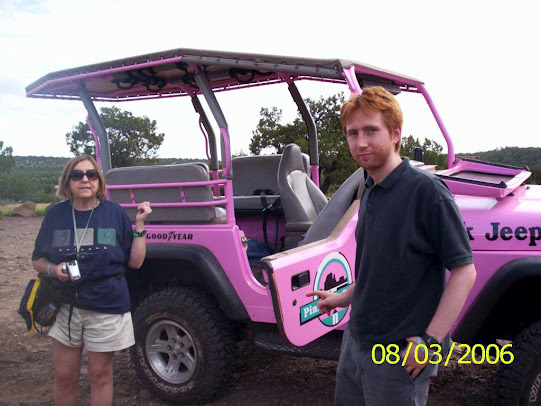
Although I missed this trip, I was feeling well enough to go to Sedona, Arizona in August, 2006.  I convinced everyone that I was well enough to go off-road in a pink jeep,  DH wanted to report me to my surgeon but I survived without to much pain and posed for the header image.

In 2009, I figured I have “extra years” since I survived the cancer and I wanted to do something kinda scary, yet fun. So, somehow, I decided on ziplining. Tom wouldn’t go with me but Michael would so I set this up almost as soon as we booked a Caribbean cruise to replace the Cushie Cruise to Bermuda.

Each person had a harness around their legs with attached pulleys and carabiners. Women had them on their chests as well. In addition, we had leather construction gloves and hard hats.

We climbed to the top of the first platform and were given brief instructions and off we went. Because of the heavy gloves, I couldn’t get any pictures. I had thought that they would take some of us on the hardest line to sell to us later but they didn’t. They also didn’t have cave pictures or T-Shirts. What a missed opportunity!

This was so cool, so much fun. I thought I might be afraid at first but I wasn’t. I just followed instructions and went.

Sometimes they told us to break. We did that with the right hand, which was always on the upper cable.

After the second line, I must have braked too soon because I stopped before I got to the platform. Michael was headed toward me. The guide on the end of the platform wanted me to do some hand over hand maneuver but I couldn’t figure out what he was saying so he came and got me by wrapping his legs around me and pulling me to the platform.

After that, no more problems with braking!

The next platform was very high – over 70 feet in the air – and the climb up was difficult. It was very hot and the rocks were very uneven. I don’t know that I would have gotten to the next platform if Michael hadn’t cheered me on all the way.

We zipped down the next six lines up to 250-feet between platforms and 85-feet high in the trees, at canopy level. It seemed like it was all over too soon.

But, I did it! No fear, just fun.

Enough of adventures – fun ones like these, and scary ones like transsphenoidal surgery and radical nephrectomy!

Day 15, Cushing’s Awareness Challenge

Today’s Cushing’s Awareness Challenge post is about kidney cancer (renal cell carcinoma). You might wonder how in the world this is related to Cushing’s. I think it is, either directly or indirectly.

I alluded to this a couple days ago when I said:

I finally started the Growth Hormone December 7, 2004.
Was the hassle and 3 year wait worth it?
Stay tuned for tomorrow, April 15, 2016 when all will be revealed.

So, as I said, I started Growth Hormone for my panhypopituitarism on December 7, 2004.  I took it for a while but never really felt any better, no more energy, no weight loss.  Sigh.

April 14 2006 I went back to the endo and found out that the arginine test that was done in 2004 was done incorrectly. The directions were written unclearly and the test run incorrectly, not just for me but for everyone who had this test done there for a couple years. My endo discovered this when he was writing up a research paper and went to the lab to check on something.

So, I went off GH again for 2 weeks, then was retested. The “good news” was that the arginine test is only 90 minutes now instead of 3 hours.

Wow, what a nightmare my arginine retest started! I went back for that Thursday, April 27, 2006. Although the test was shorter, I got back to my hotel and just slept and slept. I was so glad that I hadn’t decided to go right home after the test.

Friday I felt fine and drove back home, no problem. I picked up my husband for a biopsy he was having and took him to an outpatient surgical center. While I was there waiting for the biopsy to be completed, I started noticing blood in my urine and major abdominal cramps.

There were signs all over that no cellphones were allowed so I sat in the restroom (I had to be in there a lot, anyway!) and I left messages for several of my doctors on what I should do. It was Friday afternoon and most of them were gone 😦  I finally decided to see my PCP after I got my husband home.

When Tom was done with his testing, his doctor took one look at me and asked if I wanted an ambulance. I said no, that I thought I could make it to the emergency room ok – Tom couldn’t drive because of the anaesthetic they had given him. I barely made it to the ER and left the car with Tom to park. Tom’s doctor followed us to the ER and instantly became my new doctor.

They took me in pretty fast since I was in so much pain, and had the blood in my urine. At first, they thought it was a kidney stone. After a CT scan, my new doctor said that, yes, I had a kidney stone but it wasn’t the worst of my problems, that I had kidney cancer. Wow, what a surprise that was! I was admitted to that hospital, had more CT scans, MRIs, bone scans, they looked everywhere.

My new “instant doctor” felt that he wasn’t up to the challenge of my surgery, so he called in someone else.  My next new “instant doctor” came to see me in the ER in the middle of the night.  He patted my hand, like a loving grandfather might and said “At least you won’t have to do chemotherapy”.  And I felt so reassured.

It wasn’t until later, much after my surgery, that I found out that there was no chemo yet that worked for my cancer.  I was so thankful for the way he told me.  I would have really freaked out if he’d said that nothing they had was strong enough!

My open radical nephrectomy was May 9, 2006 in another hospital from the one where the initial diagnosis was made. My surgeon felt that he needed a specialist from that hospital because he believed preop that my tumor had invaded into the vena cava because of its appearance on the various scans. Luckily, that was not the case.

My entire left kidney and the encapsulated cancer (10 pounds worth!) were removed, along with my left adrenal gland and some lymph nodes. Although the cancer (renal cell carcinoma AKA RCC) was very close to hemorrhaging, the surgeon believed he got it all.

He said I was so lucky. If the surgery had been delayed any longer, the outcome would have been much different. I will be repeating the CT scans every 3 months, just to be sure that there is no cancer hiding anywhere. As it turns out, I can never say I’m cured, just NED (no evidence of disease). This thing can recur at any time, anywhere in my body.

I credit the arginine re-test with somehow aggravating my kidneys and revealing this cancer. Before the test, I had no clue that there was any problem. The arginine test showed that my IGF is still low but due to the kidney cancer I couldn’t take my growth hormone for another 5 years – so the test was useless anyway, except to hasten this newest diagnosis.

So… either Growth Hormone helped my cancer grow or testing for it revealed a cancer I might not have learned about until later.

My five years are up now.  When I was 10 years free of this cancer my kidney surgeon *thought* it would be ok to try the growth hormone again.  I was a little leery about this, especially where I didn’t notice that much improvement.

What to do?

BTW, I decided to…