Day 13, Cushing’s Awareness Challenge

UVA 2004
Cushing’s Conventions have always been special times for me – we learn a lot, get to meet other Cushies, even get referrals to endos!

As early as 2001 (or before) my pituitary function was dropping.  My former endo tested annually but did nothing to help me with the symptoms.

In the fall of 2002 my endo refused to discuss my fatigue or anything at all with me until I lost 10 pounds. He said I wasn’t worth treating in my overweight condition and that I was setting myself up for a heart attack. He gave me 3 months to lose this weight. Those 3 months included Thanksgiving, Christmas and New Years.  Needless to say, I left his office in tears, again.

Fast forward 2 years to 2004.  I had tried for a while to get my records from this endo. He wouldn’t send them, even at doctors’ or my requests.

I wanted to go see Dr. Vance at UVa but I had no records so she wouldn’t see me until I could get them.

Finally, my husband went to the former endo’s office and threatened him with a court order. The office manager managed to come up with about 13 pages of records. For going to him from 1986 to 2001 including weeks and weeks at NIH and pituitary surgery, that didn’t seem like enough records to me.

In April of 2004, many of us from the message boards went to the UVa Pituitary Days Convention. That’s where the picture above comes in.  Other pictures from that convention are here.

By chance, we met a wonderful woman named Barbara Craven. She sat at our table for lunch on the last day and, after we learned that she was a dietitian who had had Cushing’s, one of us jokingly asked her if she’d do a guest chat for us. I didn’t follow through on this until she emailed me later. In the email, she asked how I was doing. Usually I say “fine” or “ok” but for some reason, I told her exactly how awful I was feeling.

Barbara emailed me back and said I should see a doctor at Johns Hopkins. I said I didn’t think I could get a recommendation to there, so SHE referred me. The doctor got right back to me, set up an appointment. Between his vacation and mine, that first appointment turned out to be Tuesday, Sept 14, 2004.

Just getting through the maze at Johns Hopkins was amazing. They have the whole system down to a science, moving from one place to another to sign in, then go here, then window 6, then… But it was very efficient.

My new doctor was wonderful. Understanding, knowledgeable. He never once said that I was “too fat” or “depressed” or that all this was my own fault. I feel so validated, finally.

He looked through my records, especially at my 2 previous Insulin Tolerance Tests (ITT). From those, he determined that my growth hormone has been low since at least August 2001 and I’ve been adrenal insufficient since at least Fall, 1999 – possibly as much as 17 years! I was amazed to hear all this, and astounded that my former endo not only didn’t tell me any of this, he did nothing. He had known both of these things – they were in the past records that I took with me. Perhaps that was why he had been so reluctant to share copies of those records. He had given me Cortef in the fall of 1999 to take just in case I had “stress” and that was it.

The new endo took a lot of blood (no urine!) for cortisol and thyroid stuff. I went back on Sept. 28, 2004 for arginine, cortrosyn and IGF testing.

He said that I would end up on daily cortisone – a “sprinkling” – and some form of GH, based on the testing the 28th.

For those who are interested, my new endo is Roberto Salvatori, M.D.
Assistant Professor of Medicine at Johns Hopkins

Medical School: Catholic University School of Medicine, Rome, Italy
Residency: Montefiore Medical Center
Fellowship: Cornell University, Johns Hopkins University
Board Certification: Endocrinology and Metabolism, Internal Medicine

Clinical Interests: Neuroendocrinology, pituitary disorders, adrenal disorders

Research Interests: Control of growth hormone secretion, genetic causes of growth hormone deficiency, consequences of growth hormone deficiency.

Although I have this wonderful doctor, a specialist in growth hormone deficiency at Johns Hopkins, in November, 2004, my insurance company saw fit to over-ride his opinions and his test results based on my past pharmaceutical history! Hello??? How could I have a history of taking GH when I’ve never taken it before?

Of course, I found out late on a Friday afternoon. By then it was too late to call my case worker at the drug company, so we had to appeal on Monday. My local insurance person also worked on an appeal, but the whole thing was  just another long ordeal of finding paperwork, calling people, FedExing stuff, too much work when I just wanted to start feeling better by Thanksgiving.

As it turned out the insurance company rejected the brand of hGH that was prescribed for me. They gave me the ok for a growth hormone was just FDA-approved for adults on 11/4/04. The day this medication was approved for adults was the day after my insurance said that’s what is preferred for me. In the past, this form of hGH was only approved for children with height issues. Was I going to be a ginuea pig again?

The new GH company assigned a rep for me, submitted info to pharmacy, and waited for insurance approval, again.

I finally started the Growth Hormone December 7, 2004.

Was the hassle and 3 year wait worth it?

Stay tuned for April 15, 2016 when all will be revealed.

Read

Read Dr. Barbara Craven’s Guest Chat, October 27, 2004

Thanks for reading 🙂

MaryO

Day 3: Cushing’s Awareness Challenge

me-tired

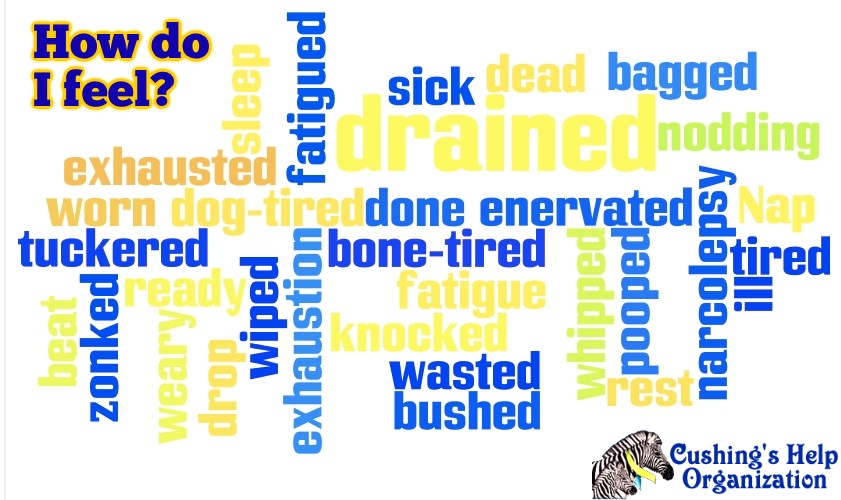
Sleep.  Naps.  Fatigue, Exhaustion.  I still have them all.  I wrote on my bio in 1987 after my pituitary surgery “I am still and always tired and need a nap most days. I do not, however, still need to take whole days off just to sleep.

That seems to be changing back, at least on the weekends.  A recent weekend, both days, I took 7-hour naps each day and I still woke up tired. That’s awfully close to taking a whole day off to sleep again.

In 2006, I flew to Chicago, IL for a Cushing’s weekend in Rockford.  Someone else drove us to Lake Geneva, Wisconsin for the day.  Too much travel, too Cushie, whatever, I was too tired to stay awake.  I actually had put my head down on the dining room table and fallen asleep but our hostess suggested the sofa instead.  Amazing that I traveled that whole distance – and missed the main event 😦

This sleeping thing really impacts my life.  Between piano lessons, I take a nap.  I sleep as late as possible in the mornings and afternoons are pretty much taken up by naps.  I nod off at night during TV. One time I came home between church services and missed the third service because I fell asleep.

I only TiVo old tv shows that I can watch and fall asleep to since I already know the ending.

Since  mid-February, I have been doing physical therapy twice a week for 2 hours at a time for a knee injury (read more about that in Bees Knees).  I come home from that exhausted – and in more pain than I went.  I know it’s working and my knee is getting better, but it’s such a time and energy sapper.  Neither of which I can really spare.

Maybe now that I’m nearly 10  years out from my kidney cancer (May 9, 2006) I could theoretically go back on Growth Hormone again.  My surgeon says he “thinks” it’s ok.  I’m sort of afraid to ask my endo about it, though.  I want to feel better and get the benefits of the GH again but I don’t want any type of cancer again and I certainly can’t afford to lose another kidney.

I’ll probably just muddle through without it.  I always laugh when I see that commercial online for something called Serovital.  I saw it in Costco the other day and it mentions pituitary right on the package.  I wish I could take the people buying this, sit them down and tell them not to mess with their pituitary glands.  But I won’t.  I’ll take a nap instead because I’m feeling so old and weary today, and yesterday.

And tomorrow…

Acromegaly: Chronic disease root of young man’s abnormally gray hair and facial changes

A chronic, progressive disease was discovered to be the reason why a man in his 20s experienced a sudden increase of gray hair and facial changes, local doctors said.

The man recently went to Renji Hospital to find out why the changes had taken place.

Doctors suspected he suffered from acromegaly, a chronic disease characterized by enlargement of head bones, soft parts of the feet and hands and sometimes other parts of the body due to excessive secretion of growth hormones by the pituitary gland.

Doctors conducted an MRI and found a pituitary tumor, which caused the man’s acromegaly. To their surprise, doctors also found a cyst in his brain.

Doctors conducted one successful surgery to treat both problems simultaneously.

Dr Ma Jing, director of Renji Hospital’s endocrinology department, said acromegaly is an endocrine metabolism disease that has no symptoms in its early stages, and most people are not diagnosed with it until they are 40 or 50, commonly 4.5 to 9 years after originally contracting the disease — in some extreme cases, 20 years later.

In addition to affecting the hands, feet and face, the disease can afflict the cardiovascular system, causing problems like hypertension and poor heart function. Those with the disease also have a higher risk of diabetes, thyroid and intestinal tumors, Ma said.

“Since people with acromegaly usually have abnormal endocrine function, early screening and diagnosis is important,” she said.

From https://www.shine.cn/news/metro/2105078537/

No Association Between Long-Term Gh Replacement, Comorbidities In Nonfunctioning Pituitary Adenoma

Hammarstrand C, et al. Eur J Endocrinol. 2018;doi:10.1530/EJE-18-0370.

Patients with growth hormone deficiency due to nonfunctioning pituitary adenoma experienced excessive morbidity due to cerebral infarction and sepsis regardless of whether they received long-term GH therapy, whereas treatment was associated with a normal incidence of type 2 diabetes, despite higher BMI and more severe hypopituitarism in treated patients, according to findings from an observational, registry-based study.

“Although growth hormone replacement therapy is well-established and reverses most of the features associated with GH [deficiency], one of the safety concerns is the reduction in insulin sensitivity and the potential risk of developing type 2 diabetes mellitus,” Daniel S. Olsson, MSc, MD, PhD, professor at the Sahlgrenska Academy Institute of Medicine at the University of Gothenburg, Sweden, and colleagues wrote in the study background.

Studies examining whether there is an association have produced mixed results, the researchers wrote, and it remains unknown to what extent GH deficiency — and GH therapy —contribute to the development of type 2 diabetes and other comorbidities, including cerebral infarction, malignant tumors, myocardial infarction or fractures.

Olsson and colleagues analyzed data from 426 patients treated or followed for nonfunctioning pituitary adenoma between 1997 and 2011, selected from the Swedish National Patient Register. Researchers assessed information on tumor treatment, hormone therapy, antihypertensive medication, BMI and duration of GH therapy. For patients with type 2 diabetes, researchers assessed HbA1c values, insulin treatment, oral antidiabetes therapies and lipid-lowering therapies. Researchers followed the cohort through December 2014 or until death. Patients were stratified by use of GH therapy. Researchers calculated standardized incidence ratios (SIRs) based on the observed number of comorbidities among patients with nonfunctioning pituitary adenoma vs. the expected number of comorbidities in the background population.

Within the cohort, 207 patients received GH therapy (145 men) and 219 did not (129 men). Median duration of GH therapy was 11.7 years; mean age at diagnosis was 56 years for treated patients and 65 years for untreated patients. Median follow-up time for treated and untreated patients was 12.2 years and 8.2 years, respectively.

Incidence of cerebral infarction was increased for the whole cohort regardless of GH therapy status, with an SIR of 1.39 (95% CI, 1.03-1.84), and was most evident among 97 patients who underwent radiotherapy, in which 19 cerebral infarctions occurred vs. the expected number of 9.8 (P = .011).

“The study showed an increased overall incidence of cerebral infarction in patients with [nonfunctioning pituitary adenoma] compared to the general population that was related to previous radiotherapy, but not to GH [replacement therapy],” the researchers wrote.

Incidence of myocardial infarction was similar for treated and untreated patients, with SIRs of 1.18 (95% CI, 0.73-1.8) and 1.23 (95% CI, 0.82-1.78), respectively. Incidence of receiving medical treatment for hypertension was also similar between groups.

In assessing incidence of type 2 diabetes, the researchers found that the SIR was higher among untreated patients (1.65; 95% CI, 1.06-2.46) vs. treated patients, who had an SIR similar to the background population (0.99; 95% CI, 0.55-1.63). Treated patients with type 2 diabetes had higher BMI vs. untreated patients with type 2 diabetes (P = .01), according to researchers, and glycemic status was similar among treated and untreated patients.

The incidence of sepsis requiring hospitalization was also similar between treated and untreated patients, with rates for both groups close to double that of the background population (P < .001). Incidence of malignant tumors was not increased for treated or untreated patients when compared against the background population, according to the researchers. – by Regina Schaffer

DisclosuresThe Gothenburg Growth Hormone Database is supported partly through unrestricted grants from Novo Nordisk, Pfizer and Sandoz. Olsson reports he has served as a consultant for Ipsen, Pfizer and Sandoz. Another author reports he has served as a consultant to AstraZeneca and Viropharma/Shire, and received lecture fees from Novo Nordisk, Otsuka and Pfizer.

From https://www.healio.com/endocrinology/neuroendocrinology/news/in-the-journals/%7B0739a3a3-f592-4352-93f0-2ee5b5a89251%7D/no-association-between-long-term-gh-replacement-comorbidities-in-nonfunctioning-pituitary-adenoma

Health Alert: Adrenal Crisis Causes Death in Some People Who Were Treated with hGH

Doctors conducting the follow-up study of individuals treated with hGH looked at causes of death among recipients and found some disturbing news. Many more people have died from a treatable condition called adrenal crisis than from CJD (MaryO’Note: Creutzfeldt-Jakob Disease). This risk does not affect every recipient. It can affect those who lack other hormones in addition to growth hormone. Please read on to find out if this risk applies to you. Death from adrenal crisis can be prevented.

Adrenal crisis is a serious condition that can cause death in people who lack the pituitary hormone ACTH. ACTH is responsible for regulating the adrenal gland. Often, people are unaware that they lack this hormone and therefore do not know about their risk of adrenal crisis.

Most people who were treated with hGH did not make enough of their own growth hormone. Some of them lacked growth hormone because they had birth defects, tumors or other diseases that cause the pituitary gland to malfunction or shut down. People with those problems frequently lack other key hormones made by the pituitary gland, such as ACTH, which directs the adrenal gland to make cortisol, a hormone necessary for life. Having too little cortisol can be fatal if not properly treated.

Treatment with hGH does not cause adrenal crisis, but because a number of people lacking growth hormone also lack ACTH, adrenal crisis has occurred in some people who were treated with hGH. In earlier updates we have talked about how adrenal crisis can be prevented, but people continue to die from adrenal crisis, which is brought on by lack of cortisol. These deaths can be prevented. Please talk to your doctor about whether you are at risk for adrenal crisis.

  • Why should people treated with hGH know about adrenal crisis? Among the people who received hGH, those who had birth defects, tumors, and other diseases affecting the brain lacked hGH and often, other hormones made by the pituitary gland. A shortage of the hormones that regulate the adrenal glands can cause many health problems. It can also lead to death from adrenal crisis. This tragedy can be prevented.
  • What are adrenal hormones? The pituitary gland makes many hormones, including growth hormone and ACTH, a hormone which signals the adrenal glands to make cortisol, a hormone needed for life. If the adrenal gland doesn’t make enough cortisol, replacement medications must be taken. The most common medicines used for cortisol replacement are:
    • Hydrocortisone
    • Prednisone
    • Dexamethasone
  • What is adrenal crisis? Adrenal hormones are needed for life. The system that pumps blood through the body cannot work during times of physical stress, such as illness or injury, if there is a severe lack of cortisol (or its replacement). People who lack cortisol must take their cortisol replacement medication on a regular basis, and when they are sick or injured, they must take extra cortisol replacement to prevent adrenal crisis. When there is not enough cortisol, adrenal crisis can occur and may rapidly lead to death.
  • What are the symptoms of lack of adrenal hormones? If you don’t have enough cortisol or its replacement, you may have some of these problems:
    • feeling weak
    • feeling tired all the time
    • feeling sick to your stomach
    • vomiting
    • no appetite
    • weight loss

    When someone with adrenal gland problems has weakness, nausea, or vomiting, that person needs immediate emergency treatment to prevent adrenal crisis and possible death.

  • Why are adrenal hormones so important? Cortisol (or its replacement) helps the body respond to stress from infection, injury, or surgery. The normal adrenal gland responds to serious illness by making up to 10 times more cortisol than it usually makes. It automatically makes as much as the body needs. If you are taking a cortisol replacement drug because your body cannot make these hormones, you must increase the cortisol replacement drugs during times of illness, injury, or surgery. Some people make enough cortisol for times when they feel well, but not enough to meet greater needs when they are ill or injured. Those people might not need cortisol replacement every day but may need to take cortisol replacement medication when their body is under stress. Adrenal crisis is extremely serious and can cause death if not treated promptly. Discuss this problem with your doctor to help decide whether you need more medication or other treatment to protect your health.
  • How is adrenal crisis treated? People with adrenal crisis need immediate treatment. Any delay can cause death. When people with adrenal crisis are vomiting or unconscious and cannot take medicine, the hormones can be given as an injection. Getting an injection of adrenal hormones can save your life if you are in adrenal crisis. If you lack the ability to make cortisol naturally, you should carry a medical ID card and wear a Medic-Alert bracelet to tell emergency workers that you lack adrenal hormones and need treatment. This precaution can save your life if you are sick or injured.
  • How can I prevent adrenal crisis?
    • If you are always tired, feel weak, and have lost weight, ask your doctor if you might have a shortage of adrenal hormones.
    • If you take hydrocortisone, prednisone, or dexamethasone, learn how to increase the dose when you become ill.
    • If you are very ill, especially if you are vomiting and cannot take pills, seek emergency medical care immediately. Make sure you have a hydrocortisone injection with you at all times, and make sure that you and those around you (in case you’re not conscious) know how and when to administer the injection.
    • Carry a medical ID card and wear a bracelet telling emergency workers that you have adrenal insufficiency and need cortisol. This way, they can treat you right away if you are injured.

Remember: Some people who lacked growth hormone may also lack cortisol, a hormone necessary for life. Lack of cortisol can cause adrenal crisis, a preventable condition that can cause death if treated improperly. Deaths from adrenal crisis can be prevented if patients and their families recognize the condition and are careful to treat it right away. Adrenal crisis is a medical emergency. Know the symptoms and how to adjust your medication when you are ill. Taking these precautions can save your life.

From https://www.niddk.nih.gov/health-information/endocrine-diseases/national-hormone-pituitary-program/health-alert-adrenal-crisis-causes-death-people-treated-hgh