Cortisol Dysregulation and Alcoholism: Consequence, Correlation or Causality?

What

The National Institute on Alcohol Abuse and Alcoholism (NIAAA), part of the National Institutes of Health, announces that Gary S. Wand, M.D., will deliver the 7th Annual Jack Mendelson Honorary Lecture. Dr. Wand is an internationally recognized neuroendocrinologist and the inaugural Rivière Professor in Endocrinology and Metabolism at The Johns Hopkins University School of Medicine. The title of his presentation is “Cortisol Dysregulation and Alcoholism: Consequence, Correlation or Causality?”

Who

Dr. Wand’s research has advanced our understanding of the genetic and environmental determinants of the stress response and has elucidated how excessive stress hormone production may contribute to neurobiological conditions such as alcohol or drug disorders.

Some of Dr. Wand’s seminal discoveries include identifying unique pharmacological responses to naloxone in individuals at increased risk for alcohol use disorders, identifying specific hormonal responses in subjects with alcohol use disorders, and characterizing human brain neurochemical changes using imaging in subjects with substance use disorders.

Dr. Wand is studying the epigenetic modulation of stress and cortisol exposure in rodent and human models, based on the hypothesis that specific epigenetic events affect how much cortisol an individual produces, which in turn influences dopamine transmission.

Dr. Wand received his medical degree and subsequent training in internal medicine from the George Washington University. Following post-doctoral training in Endocrinology and Metabolism at The Johns Hopkins University School of Medicine, he was a fellow in the peptide laboratories of Richard Mains, Ph.D. and Betty Eipper, Ph.D. in JHU’s Department of Neuroscience. Dr. Wand then joined the faculty of the Johns Hopkins University School of Medicine.

In 2000, NIAAA and the NIH honored Dr. Wand with a 10-year Merit Award to continue his research on the role of the HPA axis in alcoholism. He has also received numerous local and national “Best Doctor” awards. Dr. Wand is the author of more than 175 articles and chapters and is on the editorial board of several journals.

When

Thursday, March 19th at 1:30 p.m. EDT

Where

Masur Auditorium, NIH Building 10, Bethesda, Maryland

Background

NIAAA established the Jack Mendelson Honorary Lecture Series as a tribute to Dr. Jack Mendelson, who made remarkable scientific contributions to the field of clinical alcohol research. The purpose of this honorary lecture series is to highlight clinical/human research in the alcohol field by an outstanding investigator who has made significant and long-term contributions to our understanding of alcoholism susceptibility, alcohol’s effects on the brain and other organs, and the prevention and treatment of alcohol use disorders. NIAAA is pleased to present this series of scientific lectures to acknowledge the advances researchers are making in a wide range of alcohol-related areas of clinical research, and to honor the memory of an individual whose exciting and pioneering research with human alcoholics remains relevant today.

For additional information about the lecture see: http://www.niaaa.nih.gov/about-niaaa/our-work/research-portfolio/projects-initiatives/keller-and-mendelson-honorary-lecture

The Mendelson Honorary Lecture is free and open to the public. Sign language interpreters will be provided. For other reasonable accommodations or further information call Joanna Mayo, 301-443-3860, or visit www.niaaa.nih.gov. For TTY callers, please call the above number through the Federal Relay Service at 1-800-877-8339.

The National Institute on Alcohol Abuse and Alcoholism, part of the National Institutes of Health, is the primary U.S. agency for conducting and supporting research on the causes, consequences, prevention, and treatment of alcohol abuse, alcoholism, and alcohol problems. NIAAA also disseminates research findings to general, professional, and academic audiences. Additional alcohol research information and publications are available at http://www.niaaa.nih.gov.

About the National Institutes of Health (NIH): NIH, the nation’s medical research agency, includes 27 Institutes and Centers and is a component of the U.S. Department of Health and Human Services. NIH is the primary federal agency conducting and supporting basic, clinical, and translational medical research, and is investigating the causes, treatments, and cures for both common and rare diseases. For more information about NIH and its programs, visit www.nih.gov.

Someone Asked What I Did For Rare Disease Day…

world-rare-disease-2015


My husband and I went to the Rare Disease Day at NIH and told everyone who would listen about Cushing’s.  We passed out a whole box of Cushing’s business cards.

Tweeting/retweeting info about Cushing’s and Rare Disease Day today.

Adding info to one of my blogs about Cushing’s and RDD.

Adding new and Golden Oldies bios to another blog.

Getting the next Cushing’s Awareness Blogging Challenge set up for April.

And updating https://www.facebook.com/CushingsInfo with a bunch of info today (and every day!)

Rare Disease Day, 2015

rare-disease-day-2015


On February 27, 2015, the National Institutes of Health (NIH) will celebrate the eighth annual Rare Disease Day with a day-long celebration and recognition of the various rare diseases research activities supported by the NCATS’ Office of Rare Diseases Research, the NIH Clinical Center, and other NIH Institutes and Centers; the Food and Drug Administration’s (FDA) Office of Orphan Product Development; other Federal Government agencies; the National Organization for Rare Disorders; the Genetic Alliance; Global Genes; and Uplifting Athletes. Rare Disease Day at NIH will be held in the Masur Auditorium (Clinical Center, Building 10) from 8:30 a.m. to 5:00 p.m. Attendance is free and open to the public.

Rare Disease Day at NIH is appropriate for patients and patient advocates, health care providers, researchers, industry representatives, and government employees. We will have talks from academic and government scientists, industry representatives, and the lay community.

In addition to the various scheduled talks (see agenda), posters and exhibits from many groups relevant to the rare diseases research community will be displayed. In association with Global Genes, we again encourage all attendees to wear their favorite pair of jeans.

The Rare Disease Day 2015 event will also be webcast and Clinical Center tours will be available for in-person attendees.

Register Here.


Rare neuroendocrine tumours may be misdiagnosed as Cushing’s disease

By Eleanor McDermid, Senior medwireNews Reporter

Ectopic tumours secreting corticotropin-releasing hormone (CRH) and adrenocorticotropic hormone (ACTH) are very rare in children and can result in a misdiagnosis of Cushing’s disease (CD), say researchers.

Three of the patients in the reported case series had pituitary hyperplasia and underwent transsphenoidal surgery for apparent CD before the tumour that was actually causing their symptoms was located. The hyperplasia was probably caused by release of CRH from the ectopic tumour, which stimulated the pituitary gland, giving the impression of an ACTH-secreting pituitary adenoma, explain Maya Lodish (National Institutes of Health, Bethesda, Maryland, USA) and study co-authors.

These three patients were part of a series of seven, which Lodish et al describe as “a relatively large number of patients, considering the infrequency of this disease.”

The patients were aged between 1.8 and 21.3 years. Three had neuroendocrine tumours located in the pancreas ranging in size from 1.4 to 7.0 cm, two had thymic carcinoids ranging from 6.0 mm to 11.5 cm, one patient had a 12.0 cm tumour in the liver and one had a 1.3 cm bronchogenic carcinoid tumour of the right pulmonary lobe.

Four of the patients had metastatic disease and, during up to 57 months of follow-up, three died of metastatic disease or associated complications and two patients had recurrent disease.

“Our series demonstrates that these are aggressive tumors with a high mortality rate,” write the researchers in the Journal of Clinical Endocrinology & Metabolism. “It is important to follow the appropriate work up, regarding both biochemical and imaging tests, which can lead to the correct diagnosis and to the most beneficial therapeutic approach.”

The team found the CRH stimulation test to be helpful, noting, for example, that none of the patients had a rise in cortisol that was consistent with CD, with all patients showing smaller responses ranging from 2% to 15%. Likewise, just one patient had an ACTH rise higher than 35% on CRH administration, and four patients had a “flat” response, which has previously been associated with ectopic neuroendocrine tumours.

Of note, six patients had normal or high plasma CRH levels, despite all having high cortisol levels, which would be expected to result in undetectable plasma CRH due to negative feedback, implying another source of CRH production. Five patients had blunted diurnal variation of both cortisol and ACTH levels consistent with Cushing’s syndrome.

The patients also underwent a variety of imaging procedures to identify the source of ACTH/CRH production, some of which, such as octreotide scans, are specialist and not available in most hospitals, the researchers note, potentially contributing to inappropriate diagnosis and management.

From http://www.news-medical.net/news/20141030/Rare-neuroendocrine-tumours-may-be-misdiagnosed-as-Cushinge28099s-disease.aspx

Cushing’s Awareness Challenge: Day 11

robin-uncontrolled

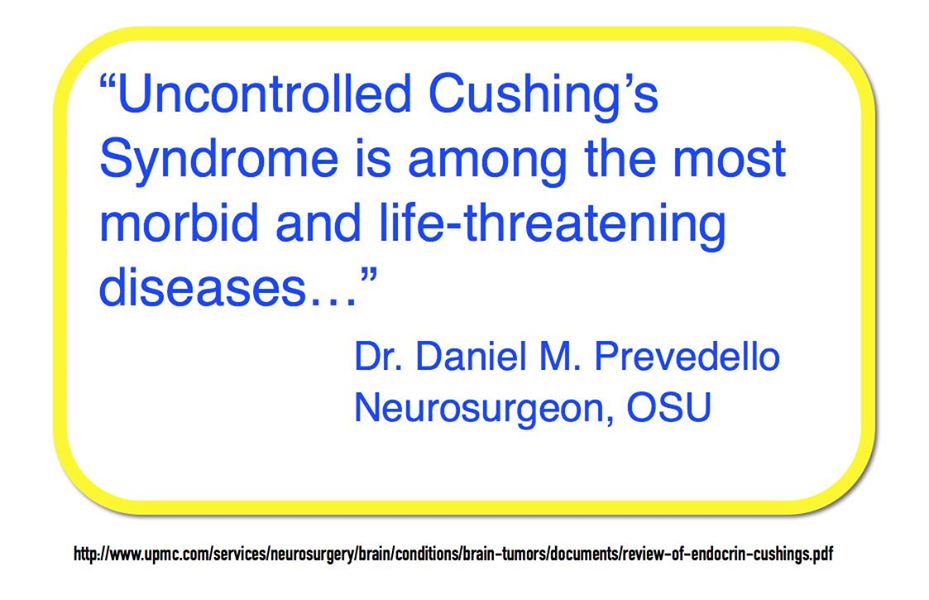
Robin has shared this quote from Dr. Prevedallo.  You can read more at the link at http://brainsurgery.upmc.com/_pdf/Review-of-Endocrin-Cushings.pdf

Over the years, I have seen that this is true, sometimes even for controlled Cushing’s.  Far too many Cushies have died.

Here are some of those that I know of:

Cushing’s is a terrible disease.

There is another Cushie I should add to this list. During the time I was home from NIH just before pituitary surgery, a college classmate of mine (I didn’t know her) did die at NIH of a Cushing’s-related problem. I’m so glad I didn’t find out until a couple months later!  I still have the college alumni magazine that mentioned this.  I’ll have to find that and add it to the In Memory list.

My husband shared a bit about her in my bio:

During the same time Mary was at NIH, another woman had the same operation. She came from Mary’s home town. They were class mates at college. They had the same major. They were the same age. They had the same surgical and medical team. Mary recovered. The other woman died during surgery.


I know we’re always fighting with doctors to get diagnosed, to get treated but reading the stories of these people will hopefully inspire people to fight even harder to be heard.

Stay safe – don’t get added to this list!

8e1d2-maryo_colorful_zebra