8th Annual Johns Hopkins Pituitary Patient Day

Johns Hopkins Pituitary Patient Day

Join us on Saturday, September 17, 2016

8th Annual Johns Hopkins Pituitary Patient Day
Saturday, September 17, 2016, 9:30 a.m.
Location:
Johns Hopkins Mt. Washington Conference Center
5801 Smith Avenue
Baltimore, MD 21209
map and directions

This is a free event, but seating is limited. Reserve your space now: Please R.S.V.P. by September 9, 2016 by email (preferred) to PituitaryDay@jhmi.edu  or by calling Alison Dimick at 410-955-3921.

Agenda

9:30 – 9:55 a.m.: Registration

9:55 – 10:00 a.m.: Welcome and Acknowledgements

10:00 – 10:25 a.m.: Different Kinds of Tumors in the Pituitary Area: Non-Functioning, Acromegaly, Cushing, etc. (Roberto Salvatori, M.D.)

10:25 – 10:50 a.m.: The Pituitary Gland, Cortisol and Stress (Gary Wand, M.D.)

10:50 – 11:10 a.m.: A Patient’s Story

11:10 – 11:30 a.m.: The Eye and the Pituitary Gland: Why It’s Important to SEE the Right Doctor (Pun Intended) (Dan Gold, D.O.)

11:30 – 11:50 a.m.: Surgery for Pituitary Tumors: (Not So Scary) Pictures from the Operating Room Treating Acromegaly, Cushing and Non-Functioning Tumors (Gary Gallia, M.D., Ph.D.)

11:50 a.m. – 12:10 p.m.: Coordinating the Care of Pituitary Patients: It Takes a Village (Pituitary Nurse)

12:10 – 12:30 p.m.: Radiation Therapy for Cushing, Acromegaly and Non-Functioning Tumors: A Good Option when Needed (Lawrence Kleinberg, M.D.)

12:30 – 1:25 p.m.: Lunch

1:30 – 3:00 p.m. Round Table Discussions:

  • Medical: Making Sense of So Many Medications
  • Surgical: Meet Surgeons and Patients Who Have Had Pituitary Surgery
  • Radiation: Share Your eX-peRience!

Cushing’s disease recurrence predictive factors: Outcome analysis of patients in VANCOUVER over 30 years

Screenshot 2016-05-27 13.12.55


Pituitary Disorders/Neuroendocrinology

R Chen, J Levi, M Almalki, S Yi, M Johnson, E Ur

Summary: The objective of this study was to describe the management and outcomes of patients with Cushing’s disease (CD) in the Vancouver region over a 30-year period and to investigate the predictive factors of CD recurrence. Researchers found CD recurrence in 45.8% of patients who received initial transsphenoidal surgery (TSS), and that a post-operative serum cortisol level > 140nmol/L may be a positive predictor of recurrence in these patients.

Methods:

  • Researchers retrospectively reviewed the clinical charts from endocrinologists in Vancouver who provided consent to participate in this study.
  • Included in this study were 48 patients diagnosed with CD since 1985.

Results:

  • All 48 patients received initial TSS; the mean follow-up time was 11.73 (±6.98) years.
  • More than half of the patients (n=26, 54.2%) remained in remission, and 22 patients (45.8%) received subsequent interventions due to CD recurrence.
  • Second-line therapies included repeat TSS (40.9%), stereotactic radiotherapy (18.2%), and bilateral adrenalectomy (36.4%).
  • Among patients with disease recurrence, the average post-operative serum cortisol level was significantly higher (489.0 nmol/L vs 114.7nmol/L; P=0.003).
  • The positive predictive value for recurrence with post-operative serum cortisol > 140nmol/L was 76.5% (P=0.049), while serum cortisol < 140nmol/L had an 80% predictive value for non-recurrence (P=0.035).

From http://www.mdlinx.com/endocrinology/conference-abstract.cfm/ZZ37C4C5D3BF1A4FAE9C479A696660535B/57894/?utm_source=confcoveragenl&utm_medium=newsletter&utm_content=abstract-list&utm_campaign=abstract-AACE2016&nonus=0

Primary versus revision transsphenoidal resection for nonfunctioning pituitary macroadenomas: matched cohort study


Departments of 1Neurosurgery and 2Otolaryngology-Head and Neck Surgery, University of Virginia Health System, Charlottesville, Virginia; and 3Department of Neurosurgery, Brigham and Women’s Hospital, Harvard Medical School, Boston, Massachusetts

ABBREVIATIONS DI = diabetes insipidus; GTR = gross-total resection; NFPMA = nonfunctioning pituitary macroadenoma; PFS = progression-free survival;SIADH = syndrome of inappropriate antidiuretic hormone; SRS = stereotactic radiosurgery; STR = subtotal resection; TSR = transsphenoidal resection.

INCLUDE WHEN CITING Published online May 20, 2016; DOI: 10.3171/2016.3.JNS152735.

Correspondence John A. Jane Jr., Department of Neurological Surgery, University of Virginia, Box 800212, Charlottesville, VA 22908. email:.

Abstract

OBJECTIVE

The object of this study was to compare the outcomes of primary and revision transsphenoidal resection (TSR) of nonfunctioning pituitary macroadenomas (NFPMAs) using endoscopic methods.

METHODS

The authors retrospectively reviewed the records of 287 consecutive patients who had undergone endoscopic endonasal TSR for NFPMAs at their institution in the period from 2005 to 2011. Fifty patients who had undergone revision TSR were retrospectively matched for age, sex, and duration of follow-up to 46 patients who had undergone primary TSR. Medical and surgical complications were documented, and Kaplan-Meier analysis was performed to assess rates of radiological progression-free survival (PFS).

RESULTS

The median follow-up periods were 45 and 46 months for the primary and revision TSR groups, respectively. There were no significant differences between the primary and revision groups in rates of new neurological deficit (0 in each), vascular injury (2% vs 0), postoperative CSF leak (6% vs 2%), transient diabetes insipidus (DI; 15% vs 12%), chronic DI (2% vs 2%), chronic sinusitis (4% vs 6%), meningitis (2% vs 2%), epistaxis (7% vs 0), or suprasellar hematoma formation (0 vs 2%). However, patients who underwent primary TSR had significantly higher rates of syndrome of inappropriate antidiuretic hormone (SIADH; 17% vs 4%, p = 0.04). Patients who underwent primary operations also had significantly higher rates of gross-total resection (GTR; 63% vs 28%, p < 0.01) and significantly lower rates of adjuvant radiotherapy (13% vs 42%, p < 0.01). Radiological PFS rates were similar at 2 years (98% vs 96%) and 5 years (87% vs 80%, p = 0.668, log-rank test).

CONCLUSIONS

Patients who underwent primary TSR of NFPMAs experienced higher rates of SIADH than those who underwent revision TSR. Patients who underwent revision TSR were less likely to have GTR of their tumor, although they still had a PFS rate similar to that in patients who underwent primary TSR. This finding may be attributable to an increased rate of adjuvant radiation treatment to subtotally resected tumors in the revision TSR group.

From http://thejns.org/doi/abs/10.3171/2016.3.JNS152735?journalCode=jns

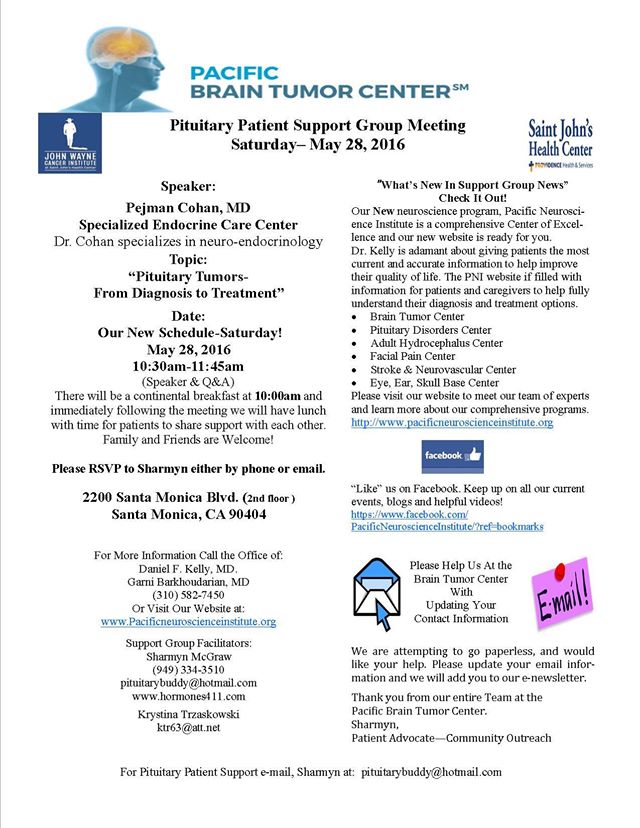
Pituitary Patient Support Group Meeting

pituitary-meeting

Pituitary Patient Support Group Meeting, Saturday May 28, 2016.

Neuro Endocrine expert Dr. Pejman Cohan will be speaking. “From Diagnosis to Treatments”

There will be time for Q&A and lunch served after the meeting.

Meeting 10:30am-11:45am Lunch 11:45am-1:00pm

Location: John Wayne Cancer Institute- 2nd floor conference room, 2200 Santa Monica Blvd. Santa Monica, CA 90404

Free parking with validation, behind building in the JWCI parking lot.

Please RSVP to Sharmyn at  pituitarybuddy@hotmail.com

Download flyer here.

A Team Effort to Treat a Pea-Sized Gland

HYANNIS – Endoscopic surgery for pituitary tumors involves the use of small instruments, but neurosurgeon Nicholas Coppa, MD, FAANS, is quick to say it takes a big team to make the surgeries a success.

“It’s very much a collaborative effort among endocrinology, neurosurgery and otolaryngology specialties,” he said.

Dr. Coppa frequently works with endocrinologist Catalina Norman, MD, PhD, and ear, nose and throat surgeon Ross Johnston, MD.

The pituitary gland sits at the base of the brain. It makes important hormones that control several different systems in the body and help maintain normal body function.

“The overwhelming majority of patients with big tumors present with visual problems,” said Dr. Coppa. “They get tunnel vision from a tumor putting pressure on the vision nerves.

Many patients’ pituitary problems are detected incidentally while the physician is trying to diagnose a set of symptoms, most commonly headaches, he added. A variety of asymptomatic tumors are detected this way.

A subset of pituitary tumors secrete excess hormones, which create syndromes characterized by whatever hormone is being secreted in excess, Dr. Coppa added. Oftentimes these problems are diagnosed by an endocrinologist.

Before coming to Neurosurgeons of Cape Cod – now known as Cape Cod Healthcare Neurosurgery – in 2013, Dr. Coppa was professor of skull base surgery at Oregon Health and Science University’s Northwest Pituitary Center. He has performed more than 200 endoscopic surgeries for pituitary tumors, sinonasal malignancies and anterior skull base encephaloceles. The procedure is fairly new on Cape Cod, he said.

The pituitary gland is about the size of a pea, so operating on it is a tricky and delicate procedure.

The surgeon commonly works with an endoscope inserted through one nostril, and microsurgical instruments through the other nostril. This allows him to maneuver to the surgical area.

According to the Northwest Pituitary Center’s web site, “The tube is connected to a TV monitor that helps your doctor see the surgical area even more clearly than with a microscope. Your doctor can also use intraoperative neuro-navigation to perform image-guided surgery, based on a pre-operative CT scan or MRI. This helps the doctor see exactly where the tumor is and avoid damaging healthy brain tissue that is nearby.”

Nasal endoscopy for the neurosurgeon has really taken off in the last 10 years, according to Dr. Coppa. The main reason for the increase is because the technique allows better visualization of the anatomy, he said.

“We find that it allows, at least in my experience, more maneuverability of your micro-surgical instruments. That’s been very satisfying for patients. The nasal morbidity [adverse effects] is lower compared to historic ways of doing it.”

Ear, nose and throat doctors use trans-nasal surgery to treat many sinus conditions, said Dr. Coppa. But the procedure is predominantly used by neurosurgeons for pituitary tumors, other tumors of the skull base and malignancies of the sinus cavity that often invade the brain.

After endoscopic pituitary surgery, patients are typically in the hospital for several days and resume day-to-day activities within that first week.

By BILL O’NEILL, OneCape Health News


From http://www.capecod.com/newscenter/a-team-effort-to-treat-a-pea-sized-gland/