Posted on November 17, 2025 by MaryO
Abstract
Context
Cushing syndrome (CS) impairs quality of life (QoL) and mood. Prospective real-life data on post-treatment recovery and predictors of improvement are limited.
Objectives
Evaluate changes in QoL, depression, and anxiety in patients with CS, before and after biochemical control, and identify predictors of clinically meaningful improvement.
Design and Setting
Prospective observational study at a tertiary center.
Patients
67 patients with endogenous CS (60 pituitary, 7 adrenal) were assessed with active disease and again after achieving biochemical control through surgery and/or medication.
Outcomes
Patient-reported outcomes included CushingQoL, Beck Depression Inventory-II (BDI-II), and State-Trait Anxiety Inventory (STAI).
Results
Mean and longest follow-up was 2.3 and 11.5 years, respectively. Treatment led to improvements in mean scores across all domains (QoL: +18.2±20.9, BDI: –6.8±8.6, STAI-State: –9.6±12.5, STAI-Trait: –8.6±12.6; all p < 0.001). However, minimal important difference was achieved in 64.6% for QoL, 67.9% for BDI, 53.2% and 52.8% for STAI subscales. After multivariable analysis, QoL improvements were predicted by lower baseline BMI, pre-treatment symptoms ❤ years, post-operative hydrocortisone replacement >6 months, and normal follow-up late-night salivary cortisol (LNSC). Depression improvements were predicted by symptoms ❤ years, normal follow-up LNSC, and surgical treatment. Anxiety improvements were predicted by younger age and >6 months post-operative hydrocortisone. Depression improved more gradually than QoL and anxiety.
Conclusions
Although effective treatment improves mood and QoL in CS, clinically meaningful recovery is variable and incomplete for some patients. Our findings highlight the need to limit diagnostic delay and provide comprehensive post-treatment care that includes normalization of cortisol circadian rhythm.
Accepted manuscripts
Accepted manuscripts are PDF versions of the author’s final manuscript, as accepted for publication by the journal but prior to copyediting or typesetting. They can be cited using the author(s), article title, journal title, year of online publication, and DOI. They will be replaced by the final typeset articles, which may therefore contain changes. The DOI will remain the same throughout.
This content is only available as a PDF.
© The Author(s) 2025. Published by Oxford University Press on behalf of the Endocrine Society.
This is an Open Access article distributed under the terms of the Creative Commons Attribution-NonCommercial-NoDerivs licence (
https://creativecommons.org/licenses/by-nc-nd/4.0/), which permits non-commercial reproduction and distribution of the work, in any medium, provided the original work is not altered or transformed in any way, and that the work is properly cited. For commercial re-use, please contact reprints@oup.com for reprints and translation rights for reprints. All other permissions can be obtained through our RightsLink service via the Permissions link on the article page on our site—for further information please contact journals.permissions@oup.com. See the journal About page for additional terms.
Filed under: adrenal, Clinical trials, Cushing's, pituitary, Treatments | Tagged: adrenal, anxiety, depression, endogenous, pituitary, quality of life, recovery | Leave a comment »
Posted on April 15, 2014 by MaryO
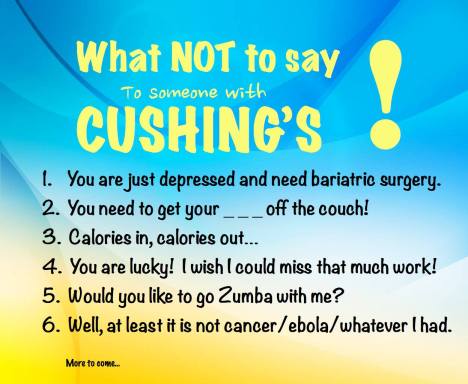
A continuation of the last post with another of Robin’s great images. I’ve also heard many of these comments.
I did have #6, cancer – kidney cancer or renal cell carcinoma – in 2006 and the diagnosis was much faster/easier than Cushing’s. My cancer diagnosis took about an hour in the emergency room. Cushing’s took about 5 years or so. Cancer surgery recovery was faster with fewer long-term consequences.
When I told people I had cancer, everyone understood. When I told them I had Cushing’s, no one did.
That being said, I don’t recommend getting either cancer or Cushing’s!

Filed under: Cancer, Cushing's | Tagged: Cancer, Cushing's, Cushing's Awareness Challenge 2014, diagnosis, kidney cancer, recovery, renal cell carcinoma, surgery | Leave a comment »



 CushieBlog