This study is currently recruiting participants.
Summary
| Number |
13-CH-0170 |
| Sponsoring Institute |
National Institute of Child Health and Human Development (NICHD) |
| Recruitment Detail |
Type: Participants currently recruited/enrolled
Gender: Male & Female
Min Age: 6
Max Age: 17 |
| Referral Letter Required |
No |
| Population Exclusion(s) |
None |
| Special Instructions |
Currently Not Provided |
| Keywords |
Child;
Cushing Syndrome;
Metabolism;
Mifepristone;
Pharmacokinetic-Pharmacodynamic |
| Recruitment Keyword(s) |
None |
| Condition(s) |
Cushing’s Syndrome;
Cushing Syndrome |
| Investigational Drug(s) |
Mifepristone |
| Investigational Device(s) |
None |
| Intervention(s) |
Drug: mifepristone |
| Supporting Site |
National Institute of Child Health and Human Development |
Background:
– There are currently no approved therapies for children with Cushing’s disease who are not cured by surgery alone. A drug called mifepristone has been approved to treat adults with Cushing’s syndrome and elevated blood glucose caused by Cushing’s. The drug is marketed under the name Korlym(Registered Trademark). The study drug may have a different effect on a child’s body than an adult’s, so researchers want to know how much of the drug to give children and what effect it will have. They want to learn if mifepristone improves Cushing’s disease in children as it does in adults. They also want to know about the drug’s side effects in children.
Objectives:
– To study the effect of a medication called mifepristone in children with Cushing’s disease that has not been helped by pituitary surgery.
Eligibility:
– Children ages 6 to 17 with active Cushing’s disease following pituitary surgery and who have a body weight higher than expected for their height and age.
Design:
– Participants will be screened for up to 8 weeks with a physical exam, medical history, and medical tests including blood tests and X-rays.
– Participants will take tablets of the study drug each day for 12 weeks.
– Participants will stay at the clinic for 4 nights at the beginning of the study. They will have three 1-day visits during the study. They will stay at the clinic the last 3 days of the study.
– At these visits, participants will be given several tests. In one test, a small wire is inserted under the skin of the belly and a small monitor is attached taped to the belly. In another, the participant drinks a liquid and blood samples are taken.
– Follow-up visits will occur 4 weeks and 12 weeks after the study ends.
–Back to Top–
Eligibility
INCLUSION CRITERIAPatients who are eligible for enrollment must meet the following eligibility criteria:
– Males and females 6-17 years at informed consent
– Active Cushing’s disease as demonstrated by the following:
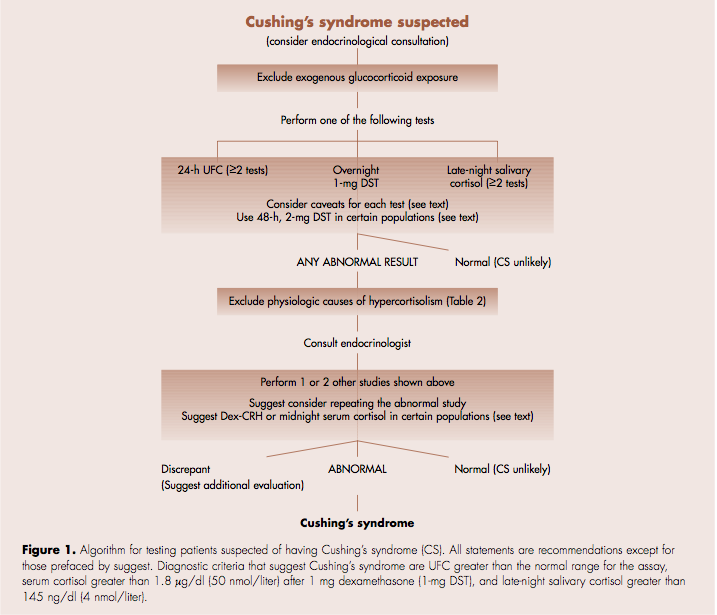
–24 hour Urinary Free Cortisol greater than the upper limit of normal for age on two urine collections during screening and
— midnight serum cortisol > 4.4 mcg/dL (mean of two determinations on a single day at 2330 and 2400 during screening)
– Previous trans-sphenoidal surgery (TSS) for ACTH secreting pituitary tumor at least 3 months prior to screening
– Increased body weight defined by BMI Z-score of 1.5 or above
– Able to provide consent/assent
– Able to swallow study drug tablets (not crushed or split)
– Willing to use non-hormonal method of contraception in patients of reproductive potential
– Primary health care provider in home location
EXCLUSION CRITERIA:
– Hypercortisolism not due to Cushing’s disease.
– Type 1 diabetes mellitus
– HbA1c geater than or equal to 9.5% at Screening
– Body weight < 25 kg
– Use of certain medications that are CYP3A substrates with narrow therapeutic ranges, such as simvastatin, lovastatin, cyclosporine, dihydroergotamine, ergotamine, fentanyl, pimozide, quinidine, sirolimus, and tacrolimus during the 4 weeks prior to starting study drug. Use of these medications is also prohibited until 2 weeks after end of dosing.
– Use of certain medications that are strong CYP3A inhibitors such as itraconazole, nefazodone, ritonavir, nelfinavir, indinavir, atazanavir, amprenavir, fosamprenavir, boceprevir, clarithromycin, conivaptan, lopinavir, mibefradil, posaconazole, saquinavir, telaprevir, telithromycin, and voriconazole during the 2 weeks prior to starting study drug.
Use of these medications is also prohibited until 2 weeks after end of dosing. Grapefruit and grapefruit juice are prohibited during this time frame.
– Use of certain medications that are strong inducers on CYP3A such as rifampin, rifabutin, rifapentin, phenobarbital, phenytoin, carbamazepine, St. John’s wort during the 2 weeks prior to starting study drug. Use of these medications is also prohibited until 2 weeks after end of dosing.
– Use of medications used to treat hypercortisolism from the duration indicated below prior to Day 1. Use of the medications is also prohibited until after the end of study 4 week follow up visit.
–steroidogenesis inhibitors such as ketoconazole, metyrapone: 4 weeks
–cabergoline, bromocriptine, somatostatin analogs such as octreotide, lanreotide, pasireotide long acting formulations: 8 weeks (immediate release formulations: 2 weeks)
–mitotane: 8 weeks
– Use of systemic glucocorticoid medications beginning 1 month prior to screening or anticipated use of these medications except for the treatment of adrenal insufficiency. Use of glucocorticoid medications is prohibited during the study until after the end of study 4 week study visit.
– Inflammatory, rheumatological, proliferative or other disorder(s) that would be anticipated to worsen with glucocorticoid blockade (e.g. inflammatory bowel disease, rheumatoid arthritis, psoriasis, etc.).
– Uncontrolled hypo- or hyperthyroidism.
– Uncorrected hypokalemia (< 3.5 mEq/L). The screening period may be used to correct hypokalemia prior to starting study drug. Use of potassium and/or mineralocorticoid antagonists is permitted during the study.
– QTc geater than or equal to 450 msec on Screening electrocardiogram
– Unexplained vaginal bleeding in females and/or any history of endometrial pathology.
– Positive pregnancy test in females.
From http://clinicalstudies.info.nih.gov/cgi/detail.cgi?A_2013-CH-0170.html
Filed under: Clinical trials, Cushing's, pituitary, Rare Diseases | Tagged: 24-hour urine free cortisol test, ACTH, blood tests, children, Clinic, Cushing's Disease, drug, Korlym, midnight serum cortisol, mifepristone, NIH, pituitary, surgery, therapy, transsphenoidal, UFC, weight, X-rays | Leave a comment »




 CushieBlog