Patient Finds Relief After Adrenal Gland Tumor Removed by Baylor Endocrine Surgeon

Hanna Pierce didn’t expect to learn she had a tumor on her adrenal gland during a CT scan. Just two weeks after delivering her second child and recovering from COVID-19, she went to urgent care with concerns about a possible blood clot. Instead, imaging revealed a tumor in her adrenal gland. “I didn’t have symptoms,” she said. “They were checking for something else and just happened to find it.”

That unexpected discovery in 2021 launched Pierce into a years-long journey that ultimately led to robotic surgery at Baylor Medicine with Dr. Feibi Zheng, an endocrine surgeon who specializes in treating adrenal tumors.

“Many people haven’t heard much about the adrenal glands,” said Zheng, assistant professor in the Division of Surgical Oncology. “They sit on top of the kidneys and produce hormones like cortisol that regulate everything from metabolism to the body’s stress response. If a tumor is overproducing cortisol, it can silently wreak havoc on the body over time.”

Doctors told Pierce that her tumor was consistently producing slightly elevated cortisol, a red flag. “My doctor told me if we left it alone, it could develop into diabetes or full-blown Cushing’s syndrome. At first, we just monitored it,” she said.

In the months and years that followed, Pierce did experience symptoms but attributed them to the demands of motherhood. “After my second child, I couldn’t lose weight no matter what I did. I had anxiety, constant fatigue in the afternoons, and I wasn’t sleeping well,” she recalled. “But I just chalked it up to being a mom of two.”

By 2024, her endocrinologist said it was time to act and referred her to Zheng, who confirmed the tumor was still producing excess cortisol. “Dr. Zheng told me I was going to feel so much better and explained what she was going to do,” Pierce said. “When I went to see her for the consultation, she was very informative. She didn’t pressure me to have surgery but explained everything to me.”

The Baylor Medicine endocrine surgery team, including Zheng and supported by physician assistant Holly Clayton, provided a seamless and collaborative care experience. “Our team-based model allows for better coordination and patient support,” said Clayton, who helped manage Pierce’s preoperative workup and performed her postop visit via telemedicine. “It was clear she wanted answers and a plan, and we were glad to be able to guide her through this process together.”

Zheng performed the adrenalectomy robotically, using a posterior approach — an advanced technique that involves going through the back instead of the front of the abdomen. “It’s a less common approach, but for the right patients, it can reduce pain and speed up recovery,” Zheng said.

Pierce said she felt calm going into the procedure. “Usually, I have white coat syndrome and feel anxious, but this time I didn’t. Everyone gave me step-by-step instructions, and Dr. Zheng explained everything clearly. I really felt like I was in good hands.”

Within a week or two of her June surgery, Pierce noticed changes. “I dropped four pounds almost immediately,” she said. “My face wasn’t as puffy. I felt less anxious and more like myself. Even though I was still recovering, I had more energy, and my body felt like it had reset.”

“Surgery to correct cortisol-producing tumors can make a major difference in quality of life, even if patients don’t meet the full criteria for a Cushing’s diagnosis,” Zheng said. “Mrs. Pierce’s case is a perfect example. She didn’t feel well, but she didn’t know why. Her endocrinologist saw [that] her metabolic parameters were getting worse. Now that the tumor is gone, her symptoms are improving, and her health trajectory is back on track.”

Just a month after surgery, Pierce says she has more energy and is continuing to lose weight. She’s relieved that a straightforward procedure made such a noticeable difference in how she feels.

From https://blogs.bcm.edu/2025/07/23/patient-finds-relief-after-adrenal-gland-tumor-removed/

Dr. Friedman: Update on Compounded GLP-1s

The landscape for compounded weight loss medicines is changing rapidly. Some availability depends on the state you live in. You may have heard that a U.S. federal judge has denied an injunction that would have allowed compounding pharmacies to keep making copies of Eli Lilly’s weight-loss and diabetes drugs Zepbound and Mounjaro (generic name Tirzepatide) in the United States. This was based on Lilly saying the shortage of Zepbound and Mounjaro has ended which most experts say is not true.

The Outsourcing Facility Association that filed the lawsuit said that the number of patients taking compounded GLP-1s as in the millions, so banning compounding pharmacies from providing these medicines will cause a shortage. This injunction does not current affect the Novo Nordisk’s drugs Ozempic or Wegovy (generic name Semaglutide), although it may in April 2025. Hundreds of Dr. Friedman’s patients have benefited from these compounded GLP-1s which are available in syringes allowing individual dosing that is not possible with the commercial medicines. Compounded GLP-1s do not require insurance pre-authorization and are much more affordable.

Compounding Pharmacies that Dr. Friedman works with
Dr. Friedman works with several compounding pharmacies to provide affordable and safe GLP-1 drugs that have improved patients’ health and weight. Dr. Friedman has communicated with representatives from the three compounding pharmacies he works with University Compounding Pharmacy (UCP), Strive Pharmacy and Empower Pharmacy and each pharmacy with each companies’ availability below. Dr. Friedman’s philosophy is that compounded pharmacies are supplying “Tirzepatide” and “Semaglutide” and not “Ozempic”, “Wegovy”, “Zepbound” and “Mounjaro” and that they are supplying customized dosing that are not available with the fixed doses supplied by the pharmaceutical companies.

According to the Wall Street Journal, Hims & Hers referred to a March 2 social-media post by Chief Executive Andrew Dudum saying the firm would stop selling commercially available doses in mid-May but would keep providing compounded versions if they have been getting a personalized dosing regimen. Thus, the personalized dosing regimen of GLP-1s (syringes that allow patients to adjust dosing) may allow them to continue to supply these compounds.

Legal Status as of April 1, 2025
Eli Lilly is suing two pharmacies for compounding Zepbound and Mounjaro, claiming the companies are skirting the Food and Drug Administration’s ban on the practice and luring people away from Lilly’s medicines. In lawsuits filed April 1, 2025 in Delaware and New Jersey, Lilly alleges the two companies — Strive Pharmacy and Empower Pharmacy — are falsely marketing their products as personalized versions of the drugs that have been clinically tested and are made using stringent safety standards. Lilly argues these claims are turning people toward compounded drugs and away from its FDA-approved treatments.

Tirzepatide versus Semaglutide 
Overall, Dr. Friedman prefers Tirzepatide over Semaglutide as it gives more weight loss and less side effects but is currently available in CA only in the sublingual form. Dr. Friedman’s top recommendations are in red.

Siblingual Tirzepatide at UCP– is an excellent choice. Patients pay UCP. Tirzepatide injections have been discontinued but they have sublingual (under the tongue) Tirzepatide (10 mg/mL). One can start with 2.5 mg (0.25 mL) twice a week for 2 weeks, then go up to 5 mg (0.5 mL) twice a week for 4 weeks and then go up to 10 mg under the tongue twice a week, which is the final recommended dose. The price for 10 mL (lasts about 2 months) is $199. The 20 mL is $299. It needs to be refrigerated and can be used for 90 days after opening the bottle. It comes with a syringe that can withdraw the liquid from the vial and put under the tongue, where it should be held for 1 minute and then swallowed. It is best to take with a “dry” mouth and not to drink/eat for 30 minutes after administration. Because the sublingual product is new, its weight-loss properties compared to injectable Tirzepatide are not known.

Compounded Semaglutide/ B12 FIVE is available from UCP until April 22, 2025, and is available in 44 states including Califormia. A 5 mg vial that last about 2 months is $299.

Strive Pharmacy Strive Pharmacy, which compounds Semaglutide (brand name Ozempic, Wegovy), and Tirzepatide (brand name Mounjaro, Zepbound) is a 503B compounding pharmacy that offers GLP-1RAs to patients at a low price in 31 states including California. For Strive pharmacy, patients pay Dr. Friedman directly. There are several options available at Strive Pharmacy, with the common 3 options seen in this table:

Strive How to order Mg per vial Use for which dose Theoretical doses per vial* Cost per vial* State
Semaglutide# 2.5 mg/ml – 2 ml vial 5 mg 0.25 mg weekly for 4 weeks, then .5 mg weekly for 4 weeks, then 1 mg weekly for 2 weeks 10 $299 CA
Semaglutide/Glycine/B12 5mg/5mg/1mg/mL 2 ml vial 10 mg 0.25 mg weekly for 4 weeks, then 0.5 mg weekly for 4 weeks, then 1 mg weekly for 7 weeks 15 $299 Out of CA
Tirzepatide/Glycine/B12 10mg/5mg/500mcg/mL 2 ml vial 20 mg 1 mg (0.1 ml) weekly for 2 weeks, then 2 mg (0.2 ml) weekly for 4 weeks, then 4 mg (0.4 ml) weekly 9 $299 Out of CA

Empower compounding pharmacy ships to all states but CA, WI and IA. Patients pay Empower directly.
Semaglutide / Cyanocobalamin Injection
1/0.5 mg/mL 1 mL $94.68
1/0.5 mg/mL 2.5 mL $118.96
5/0.5 mg/mL 1 mL $132.18
5/0.5 mg/mL 2.5 mL $219.49
Tirzepatide / Niacinamide Injection
8/2 mg/mL 2.5 mL $188.20
17/2 mg/mL 2 mL $308.53
17/2 mg/mL 4 mL $559.21

Zepbound Glass Vials For those patients who insist on non-compounded preparations, Zepbound Glass Vials from Lilly Direct are an option. The cost for the 4 of the 10 mg vials is $499 for the first vial and $499 if renewed within 45 days or $699 if renewed after 45 days. Patients need to register on LillyDirect.lilly.com and purchase syringes for a small fee. Each vial is 0.5 ml, so the concentration is 2 mg/0.1 ml. Although the company discourages using the vial for multi-dosing (it doesn’t contain a preservative), one option would be to inject 1 mg (0.05 mL) weekly for 2 weeks, 2 mg (0.1 mL) weekly for 2 weeks, then 4 mg (0.2 ml) weekly. The box of 4 vials would last about 10 weeks.

Because of the different options for compounded GLP-1s, Dr. Friedman is advising his patients to make a 10-minute followup appointment to discuss options.

For more information, please read about compounded GLP-1s, and listen to listen Dr. Friedman’s original GoodHormoneHealth Webinar on November 17, 2024 on compounded Tirzepatide vs Semaglutide for patients with endocrine problems

https://www.facebook.com/goodhormonehealth, https://www.goodhormonehealth.com/webinars or on your podcast channel.

Dr. Friedman discussed the updated situation for compounded GLP-1s at his most recent GoodHormoneHealth Webinar on Sunday March 23rd at 6:00 PM after his talk on “How can Blue Zones and Maimonides’ principles be applied to lead a healthy life for patients with endocrine problems?”

It is available on YouTube:

Protect access to compounded medications — make your voice heard. Sign the Petition!  

For more information go to Dr. Friedman’s website https://www.goodhormonehealth.com or contact his office at mail@goodhormonehealth.com.

Atypical Presentation of Cushing’s Disease With Weight Loss and Hypokalemia

Abstract

Summary

ACTH-secreting pituitary adenomas causing Cushing’s disease (CD) typically present with weight gain, whereas weight loss and hypokalemia in endogenous Cushing’s patients are suggestive of ectopic ACTH production. We report a case of CD presenting with atypical features of marked weight loss and hypokalemia. A 75-year-old female was admitted to the hospital with a history of profound weight loss, associated with uncontrolled hypertension, hyperglycemia, severe proximal muscle weakness, and hypokalemia. Subsequent investigations, including 24-h urinary free cortisol, 48-h low-dose dexamethasone suppression test, MRI of the sella, and bilateral inferior petrosal sinus sampling, confirmed CD without any evidence of ectopic ACTH production. She became eucortisolemic with medical therapy of ketoconazole and cabergoline, subsequently regained her weight, and became normokalemic. This case illustrates that patients with CD may present with symptoms and biochemical findings that would otherwise suggest ectopic ACTH production.

Learning points

  • Patients with CD do not always present with classical clinical features and may present with symptoms and biochemical findings that would otherwise suggest ectopic ACTH production.
  • While most patients with CD typically lose weight after biochemical remission, some patients gain weight after the normalization of cortisol levels.
  • This case highlights the need to entertain a broad differential in patients presenting with hypokalemia and weight loss and the need to exclude hypercortisolemia.

Background

Pituitary corticotropin (ACTH)-induced Cushing’s disease (CD) accounts for approximately 70% of patients presenting with Cushing’s syndrome (1). ACTH-producing pituitary adenomas are typically microadenomas and, in over a third of CD patients, there is no demonstrable lesion on MRI (2). Clinical and biochemical diagnosis of CD may be challenging, as patients can present with varied symptoms that overlap with other comorbidities. Progressive weight gain associated with central adiposity is a common manifestation of CD occurring during the early stage of the disease. While nonspecific features such as hypertension, diabetes, cardiac hypertrophy, arterial and venous thrombosis, electrolyte abnormalities, and psychiatric disturbances also occur frequently, the more discriminatory signs of hypercortisolemia include proximal myopathy, facial plethora, easy bruising, and wide striae (2). Weight loss with associated hypokalemia typically suggests an underlying ectopic ACTH production. Here we report an unusual case of pituitary ACTH-induced CD who presented with significant hypokalemia and marked weight loss which resolved with medical control of CD.

Case presentation

A 75-year-old female with a history of type 2 diabetes, hypertension, osteoporosis, and coronary artery disease presented to the emergency department (ED) with profound proximal muscle weakness associated with a serum potassium of 2.4 mmol/L (normal = 3.6–5.2 mmol/L). She also reported a weight loss of 90 lbs over the previous 2 years. In addition, she had uncontrolled hypertension despite taking three anti-hypertensive agents and worsening glycemic control requiring increasing anti-hyperglycemic therapy; her hemoglobin A1c at presentation was 9.3%.

Investigation

During hospitalization, she underwent further investigation for hypokalaemia and resistant hypertension, which showed an elevated 24-h urine free cortisol (24-h UFC) of 1904.4 nmol/d (upper limit of normal: 485.4 nmol/d) and consequently was referred to Endocrinology for further assessment. Repeat outpatient-based investigations after discharge from the hospital confirmed an elevated 24-h UFC of 1578.4 nmol/d, elevated AM serum cortisol of 1749.2 nmol/L (normal: 80–477.3 nmol/L), non-suppressed serum cortisol of 1238.8 nmol/L (normal response: < 50 nmol/L) after a 48-h low dose dexamethasone suppression test, and an elevated serum ACTH at 8.2 pmol/L (normal: 0.5–2.2 pmol/L). MRI of the sella as well as gallium DOTATATE PET-CT did not show any demonstrable lesion (Figs 1AB and 2AB). Subsequently, she underwent bilateral inferior petrosal sinus sampling (BIPSS) using 100 µg ovine CRH, which showed a post-CRH central to peripheral ACTH ratio of 3, lateralizing to the right with a ratio of 2.1. Based on these findings, a diagnosis of MRI-negative CD was made.

Figure 1View Full Size
Figure 1
(A and B) MRI Sella post-GAD coronal and sagittal sections showing no pituitary lesion.

Citation: Endocrinology, Diabetes & Metabolism Case Reports 2024, 3; 10.1530/EDM-24-0011

Figure 2View Full Size
Figure 2
(A and B) Ga68 DOTATATE scan. PET-CT showing non-specific uptake through the distal esophagus and proximal stomach, but otherwise within normal physiological limits.

Citation: Endocrinology, Diabetes & Metabolism Case Reports 2024, 3; 10.1530/EDM-24-0011

Treatment

While awaiting surgical opinion, the patient was started on Ketoconazole 200 mg po TID. She was unable to tolerate a larger dose; therefore, cabergoline 1 mg twice a week was added. The options of trans-sphenoidal pituitary surgery and bilateral adrenalectomy were discussed with the patient, which she declined, and decided to continue with medical therapy.

Outcome and follow-up

Medical therapy was adjusted over the next several weeks until 24-h UFC normalized and remained normal during 24 months of follow-up with the most recent being 85 nmol/d. With biochemical remission of CD, her blood pressure normalized, and she required a reduction in the dose of anti-hypertensive and anti-hyperglycaemic therapy. Her serum potassium levels also normalized. She initially regained 15 lbs but called the clinic when, despite taking medical therapy, she once again began losing weight and her serum potassium dropped to 2.7 mmol/L. Repeat serum AM cortisol was significantly elevated at 935.3 nmol/L, as was 24h UFC at 1457.3 nmol/d. Further inquiry revealed that she had been prescribed omeprazole therapy by her family physician for symptoms of reflux. Omeprazole was discontinued due to its potential effect on decreasing the efficacy of ketoconazole therapy, and her cortisol and potassium levels rapidly normalized. Since then, she has regained 50 lbs, being almost back to her baseline weight, and her mobility and strength have improved from being initially bed-bound to now mobilizing independently using a walker. Pre and post therapy values are summarized in Table 1.

Table 1Key investigations at presentation and recent follow-up visit.

Test Reference range At presentation Recent follow-up
24-h urine cortisol (nmol/TV) ULN=486 1908  85
AM cortisol (nmol/L) 133-537 2371 796
Cortisol post-48h low DMS dose (nmol/L) <1.8 44.9 NA
ACTH (pmol/L) 2.3-10.1 37.5 14
Potassium (mmol/L) 3.6-5.2  2.4 4.5

DMS= dexamethasone suppression; NA = Not Applicable; ULN = upper limit of normal.

Discussion

Here we report an unusual case of CD presenting with features that were initially highly suggestive of ectopic ACTH production with weight loss rather than the usual weight gain. All of the initial symptoms resolved following biochemical control of hypercortisolemia. In our review of the literature, CD associated with weight loss has previously only been reported in association with severe depression, psychosis, eating disorders, or malignancy (34). For instance, a case of familial CD was reported in a child who also had an intercurrent eating disorder (anorexia), which led to weight loss despite CD (3). Weight loss due to ectopic ACTH-induced CD has also been previously reported, where weight loss was thought to be due to the underlying malignancy (4). However, our patient had well-documented pituitary ACTH-induced CD.

Chronic hypercortisolemia is associated with increased abdominal adiposity that is thought to be caused by the downregulation of adenosine monophosphate-activated protein kinase (AMPK), which is responsible for regulating lipid metabolism (5). Furthermore, glucocorticoids also induce a direct orexigenic effect, which leads to weight gain (6). Weight loss in association with hypercortisolemia, on the contrary, can be a presenting feature of ectopic ACTH-producing tumors such as small cell lung cancer. While the underlying mechanism of weight loss is not fully understood, it is thought to be partly due to cAMP/Protein kinase A (PKA) pathway activation, with an increase in PKA activity resulting in altered downstream regulation of cAMP-related lipogenic and lipolytic proteins (6). In addition, high ACTH secretion and the malignant characteristics of the neoplastic process are also thought to play roles in weight loss (7). Our patient had no evidence of ectopic ACTH production.

A previous study (8) comparing the clinical features of CD in older vs younger patients reported that weight gain was more common in younger individuals, whereas older patients typically presented with catabolic changes, likely due to age-related variability in tissue sensitivity to glucocorticoid receptors and intracellular cortisol signaling. The overall rates of central adiposity were 71.1% in older patients compared with 80.0% in younger patients (8).

Another unusual feature was hypokalemia, which is generally associated with ectopic ACTH production. However, up to 10% of CD patients present with low potassium. Hypokalemia is caused by the mineralocorticoid effect of excess cortisol. Supraphysiologic production of cortisol tends to saturate 11β-hydroxysteroid dehydrogenase type II (11β-HSD2) activity in the renal tubule, which is primarily responsible for converting active cortisol into inactive cortisone. This could lead to excess binding of cortisol to mineralocorticoid receptors, resulting in an increase in potassium excretion and thus hypokalemia. While some studies have suggested that ACTH can also lead to lowering 11β-HSD2 activity causing hypokalemia, others have not found any such correlation (910). In our patient, serum potassium normalized after she achieved eucortisolemia with medical therapy.

Declaration of interest

The authors declare that there is no conflict of interest that could be perceived as prejudicing the impartiality of the study reported.

Funding

This research did not receive any specific grant from any funding agency in the public, commercial, or not-for-profit sector.

Patient consent

Written informed consent for publication of their clinical details and/or clinical images was obtained from the patient/parent/guardian/relative of the patient.

Author contribution statement

All authors reviewed the results and approved the final version of the manuscript.

Acknowledgements

We thank Dr Brian Moses (Yarmouth Regional Hospital, NS, Canada) and Dr Scott Lee (Valley Regional Hospital, NS, Canada) for their contributions in managing the patient.

References

Day 15, Cushing’s Awareness Challenge

Today’s Cushing’s Awareness Challenge post is about kidney cancer (renal cell carcinoma). You might wonder how in the world this is related to Cushing’s. I think it is, either directly or indirectly.

I alluded to this a couple days ago when I said:

I finally started the Growth Hormone December 7, 2004.
Was the hassle and 3 year wait worth it?
Stay tuned for tomorrow, April 15, 2016 when all will be revealed.

So, as I said, I started Growth Hormone for my panhypopituitarism on December 7, 2004.  I took it for a while but never really felt any better, no more energy, no weight loss.  Sigh.

April 14 2006 I went back to the endo and found out that the arginine test that was done in 2004 was done incorrectly. The directions were written unclearly and the test run incorrectly, not just for me but for everyone who had this test done there for a couple years. My endo discovered this when he was writing up a research paper and went to the lab to check on something.

So, I went off GH again for 2 weeks, then was retested. The “good news” was that the arginine test is only 90 minutes now instead of 3 hours.

Wow, what a nightmare my arginine retest started! I went back for that Thursday, April 27, 2006. Although the test was shorter, I got back to my hotel and just slept and slept. I was so glad that I hadn’t decided to go right home after the test.

Friday I felt fine and drove back home, no problem. I picked up my husband for a biopsy he was having and took him to an outpatient surgical center. While I was there waiting for the biopsy to be completed, I started noticing blood in my urine and major abdominal cramps.

There were signs all over that no cellphones were allowed so I sat in the restroom (I had to be in there a lot, anyway!) and I left messages for several of my doctors on what I should do. It was Friday afternoon and most of them were gone 😦  I finally decided to see my PCP after I got my husband home.

When Tom was done with his testing, his doctor took one look at me and asked if I wanted an ambulance. I said no, that I thought I could make it to the emergency room ok – Tom couldn’t drive because of the anaesthetic they had given him. I barely made it to the ER and left the car with Tom to park. Tom’s doctor followed us to the ER and instantly became my new doctor.

They took me in pretty fast since I was in so much pain, and had the blood in my urine. At first, they thought it was a kidney stone. After a CT scan, my new doctor said that, yes, I had a kidney stone but it wasn’t the worst of my problems, that I had kidney cancer. Wow, what a surprise that was! I was admitted to that hospital, had more CT scans, MRIs, bone scans, they looked everywhere.

My new “instant doctor” felt that he wasn’t up to the challenge of my surgery, so he called in someone else.  My next new “instant doctor” came to see me in the ER in the middle of the night.  He patted my hand, like a loving grandfather might and said “At least you won’t have to do chemotherapy”.  And I felt so reassured.

It wasn’t until later, much after my surgery, that I found out that there was no chemo yet that worked for my cancer.  I was so thankful for the way he told me.  I would have really freaked out if he’d said that nothing they had was strong enough!

My open radical nephrectomy was May 9, 2006 in another hospital from the one where the initial diagnosis was made. My surgeon felt that he needed a specialist from that hospital because he believed preop that my tumor had invaded into the vena cava because of its appearance on the various scans. Luckily, that was not the case.

My entire left kidney and the encapsulated cancer (10 pounds worth!) were removed, along with my left adrenal gland and some lymph nodes. Although the cancer (renal cell carcinoma AKA RCC) was very close to hemorrhaging, the surgeon believed he got it all.

He said I was so lucky. If the surgery had been delayed any longer, the outcome would have been much different. I will be repeating the CT scans every 3 months, just to be sure that there is no cancer hiding anywhere. As it turns out, I can never say I’m cured, just NED (no evidence of disease). This thing can recur at any time, anywhere in my body.

I credit the arginine re-test with somehow aggravating my kidneys and revealing this cancer. Before the test, I had no clue that there was any problem. The arginine test showed that my IGF is still low but due to the kidney cancer I couldn’t take my growth hormone for another 5 years – so the test was useless anyway, except to hasten this newest diagnosis.

So… either Growth Hormone helped my cancer grow or testing for it revealed a cancer I might not have learned about until later.

My five years are up now.  When I was 10 years free of this cancer my kidney surgeon *thought* it would be ok to try the growth hormone again.  I was a little leery about this, especially where I didn’t notice that much improvement.

What to do?

BTW, I decided to…

Cushing’s Disease Associated With Partially Empty Sella Turcica Syndrome

Abstract

The association between empty sella turcica (EST) syndrome and Cushing’s disease has been rarely reported. It is plausible to hypothesize that EST syndrome in association with Cushing’s disease can be attributed to intracranial hypertension. In this case report, we present a 47-year-old male patient who presented with weight loss, fatigue, easy bruising, acanthosis nigricans, and skin creases hyperpigmentation. Investigations revealed hypokalemia and confirmed the diagnosis of Cushing’s disease. Magnetic resonance imaging (MRI) brain showed a partial EST syndrome and a new pituitary nodule as compared with previous brain imaging. Transsphenoidal surgery was pursued and was complicated by cerebrospinal fluid leakage. This case reflects the rare association of EST syndrome and Cushing’s disease, suggesting the increased risk of postoperative complications in this setting and the diagnostic challenge that EST syndrome imposes. We review the literature for a possible mechanism of this association.

Introduction

Cushing’s disease is commonly caused by an adrenocorticotropic hormone (ACTH)-producing pituitary adenoma, which can be very challenging to be seen on brain magnetic resonance imaging (MRI) [1]. Empty sella turcica (EST) syndrome is a radiological diagnosis of apparently empty turcica secondary to outpouching of the arachnoid mater into the turcica, which can be attributed to intracranial hypertension (ICHTN). This can make the visual diagnosis of pituitary adenoma even more challenging in clinical practice. ICHTN has been also associated with Cushing’s disease and might explain this infrequent association between EST and Cushing’s disease [1]. EST syndrome can be either partial or complete, primary or secondary and has been seen infrequently with Cushing’s disease. In this setting, not only that it is likely to obscure an underlying pituitary lesion, but also it does contribute to the risk of postoperative complications [2].

Case Presentation

A 47-year-old male presented to the emergency department (ED) with slowly progressive generalized limb muscle weakness affecting both distal and proximal muscles over a few weeks and gait instability for three days prior to presentation. He also reported unintentional 40 pounds weight loss over the previous four months. Past medical history was significant for type II diabetes mellitus, hypothyroidism, hypertension, and dyslipidemia. In the ED, vital signs included a blood pressure of 140/90 mmHg, a heart rate of 66 beats per minute, a respiratory rate of 16 cycles per minute, and SpO2 of 97% on room air. Body mass index has decreased to 22 kg/m2 from a baseline of 26 kg/m2 one month prior. On the physical exam, he exhibited cachexia, easy bruising, acanthosis nigricans, and hyperpigmentation of skin creases. All other systems were negative. Complete metabolic panel and complete blood count were obtained showing hyperglycemia of 311 mg/dl, see Table 1. Further lab evaluation showed elevated salivary cortisol at 2.96 microgram/dl (reference range 0.094-1.551 mcg/dl), elevated 24-hour urinary free cortisol at 156 mcg/24 hour (reference 10-100 mcg/24h), positive overnight dexamethasone suppression test with serum cortisol at 2.8 mcg/dl (reference more than 2 mcg/dl), negative anti-adrenal antibodies, normal aldosterone, and elevated dehydroepiandrostenedione at 401 mcg/dl (reference 32-240 mcg/dl), with lack of suppression of the ACTH level at 35.1 pg/ml (reference 10-60 pg/ml). This confirmed the diagnosis of Cushing’s disease.

Variable Finding Reference
Random glucose 311 Less than 200 mg/dl
Sodium 141 137-145 mmol/L
Potassium 2.5 3.5-5.1 mmol/L
Chloride 96 98-107 mmol/L
Bicarbonate 32 22-30 mmol/L
Blood urea nitrogen 32 9-20 mg/dl
Creatinine 0.52 0.66-1.25 mg/dl
Calcium 8.7 8.6-10.3 mg/dl
Total protein 5.5 6.5-8.5 g/dl
Albumin 3.3 3.5-5 g/dl
Total bilirubin 0.6 0.2-1.3 mg/dl
Alkaline phosphatase 115 38-126 U/L
Aspartate transaminase 17 17-59 U/L
Alanine transaminase 39 Less than 49 U/L
White blood cell count 10×10^3 cells/mcl 4-10×1063 cells/mcl
Hemoglobin 15.3 13.7-17.5 g/dl
Platelet 281 150-400×10^3 cells/mcl
Table 1: Lab Findings

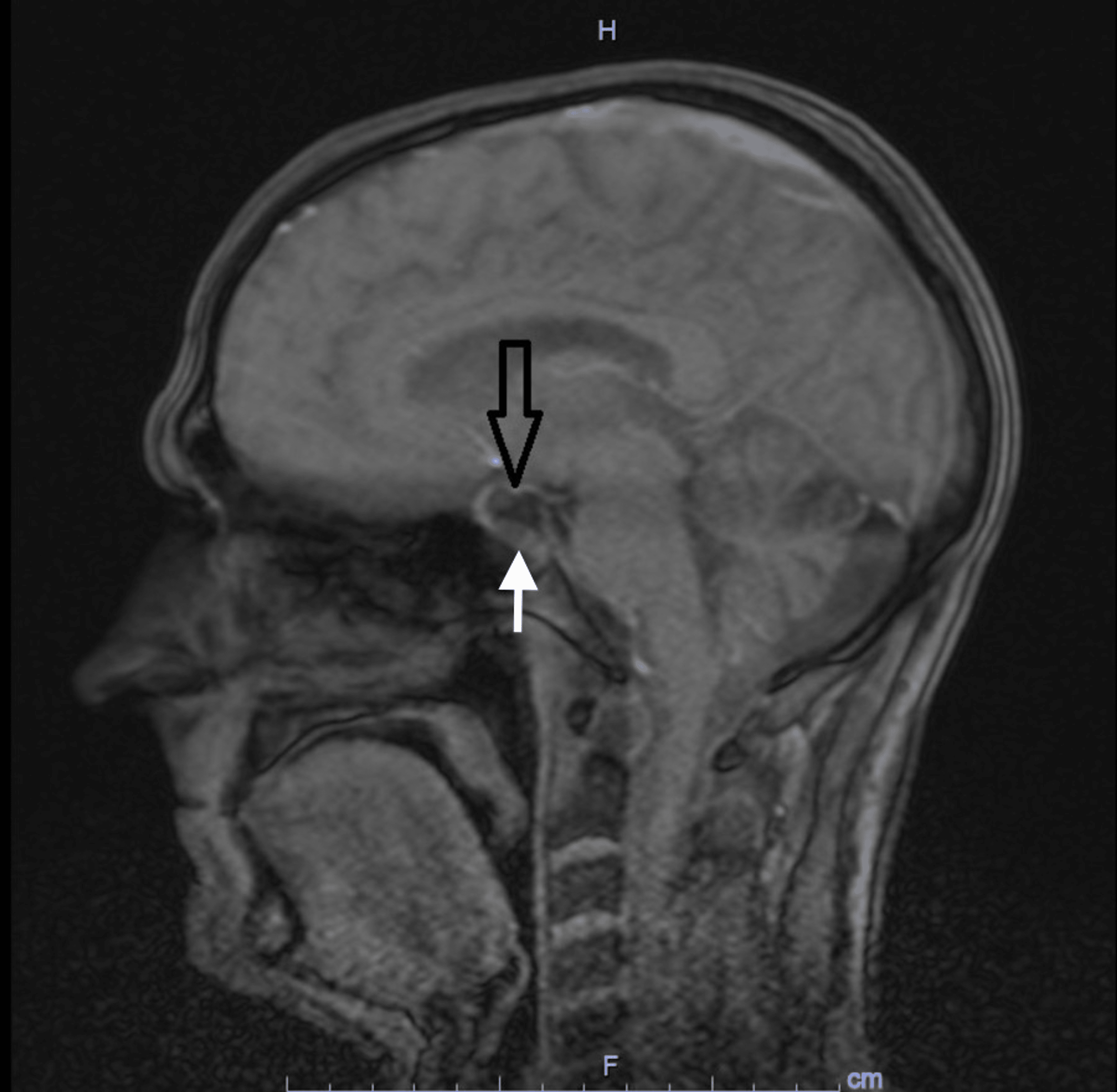
Computed tomography (CT) scan of the head was unremarkable. CT scan of the chest was also unremarkable. CT scan of abdomen and pelvis showed no adrenal mass. Ultrasound of the kidneys was unremarkable. Pituitary MRI brain protocol for adenoma showed a partial EST, shortening within neurohypophysis and a new 10 x 8 x 4 mm nodule along the floor of pituitary sella as compared to MRI four years ago (Figure 1).

Magnetic-Resonance-Imaging-(MRI)-Brain
Figure 1: Magnetic Resonance Imaging (MRI) Brain

MRI brain showing partially empty sella turcica syndrome ( black arrow) with a small nodule at the floor of the turcica (white arrow).

The diagnosis of Cushing’s disease was confirmed, and the patient underwent trans-sphenoidal resection of pituitary adenoma. Histological examination showed positive CAM 5.2, positive chromogranin, and ACTH immunostains. The patient presented to the ED five days after discharge home. He stated that he noticed drainage from the nose that transitioned from bloody to clear fluid and has been increasing in quantity for two days with associated intermittent headaches since the surgery. He was afebrile with stable vital signs. No signs of infection were noted on basic labs. These were significant only for mild asymptomatic hyponatremia of 131 mmol/L and hypokalemia of 3.3 mmol/L. The patient was diagnosed with cerebrospinal fluid (CSF) leakage and had a lumbar drain trial. The trial was unsuccessful after several days, and the patient underwent a transnasal endoscopic repair of CSF rhinorrhea using nasoseptal flaps. At an outpatient follow-up one month and three months after the surgery, prior lab abnormalities including hypokalemia, hyponatremia, and hyperglycemia resolved. No further evidence of CSF leakage was appreciated, and he remained asymptomatic.

Discussion

EST syndrome is characterized by herniation of the subarachnoid space into the intrasellar space with compression of the pituitary gland into the posteroinferior wall [3]. This is likely to obscure the presence of underlying pituitary mass. The incidence of EST syndrome in the general population is estimated at 20%. The association between EST syndrome and Cushing’s disease has been reported infrequently. A retrospective study of 68 patients with Cushing’s disease found that 16% of these have EST syndrome [3].

Cushing’s disease usually results from pituitary adenomas secreting ACTH, and even the smallest microadenomas can produce a systemic disease. These microadenomas can be very difficult to recognize on brain MRI [4]. This is complicated in EST syndrome and even further with the possibility of ectopic ACTH production. A retrospective study of 197 patients diagnosed with Cushing’s disease concluded that EST syndrome is associated with higher prevalence of MRI-negative Cushing’s disease. This was attributed to ICHTN and pituitary gland compression [1]. Although surgery is curative in 70-90% of cases, EST syndrome was found to have higher risk of postoperative complications among those with Cushing’s disease including diabetes insipidus, hypopituitarism, and CSF leakage [3]. This is usually because in the case of MRI-negative Cushing’s disease with total EST syndrome, empiric surgical exploration is sought after inferior petrosal sampling confirms the pituitary origin of excess ACTH, and postoperative remission indicates adequate tumor resection [2]. This entails a higher chance of uncertainty and injury to healthy pituitary tissue.

EST syndrome can be either primarily due to defects in the sellar diaphragm or anatomical variant or secondary to ICHTN. EST syndrome has been reported in association with many conditions associated with elevated intracranial pressure including tumors, thrombosis, meningitis, hydrocephalus, and Arnold-Chiari malformation [5]. Reversal of EST syndrome has been reported in those with idiopathic ICHTN with therapy by acetazolamide, ventriculoperitoneal shunt, and lumbar puncture [6,7]. A study has shown correlation between CSF circulation impairment or blockage and EST syndrome [8]. The incidence of EST syndrome in association with symptomatic intracranial hypertension is variable and ranges from 2.5% for total EST syndrome to 94% for partial EST syndrome [9]. Impaired CSF circulation and dynamics have been reported in 77% of patients with EST syndrome [10]. In addition to intracranial hypertension, EST syndrome has also been described in association with obesity, meningioma, pediatric nevoid basal cell carcinoma, therapy for growth hormone deficiency and even in healthy individuals [9]. Lack of symptoms of intracranial hypertension in this patient does not rule it out as intracranial hypertension in EST syndrome represents a spectrum that ranges from asymptomatic, milder intracranial hypertension to symptomatic intracranial hypertension with headache, visual disturbance, and papilledema [10]. This explains the fact that only 8-14% of EST syndrome progress to symptomatic ICHTN, while symptomatic ICHTN has been associated with EST syndrome in 94% of cases.

ICHTN has been seen in association with disturbance of the hypothalamic-pituitary-adrenal axis. This has been reported after surgical and medical treatment of Cushing’s disease, withdrawal of long-term steroid therapy, initial presentation of Addison’s disease, or relative glucocorticoids deficiency [11]. Cortisol excess increases CSF production and reduces its absorption, hence increasing intracranial pressure [12]. Another possible mechanism is the expression of both mineralocorticoid responsive epithelial sodium channel receptors on the basolateral membrane of the CSF producing epithelial cells of the choroid plexus as well as the expression of 11-beta hydroxysteroid dehydrogenase type 1 enzyme, which is a bidirectional enzyme that mainly functions to convert the inactive cortisone to active cortisol. These mechanisms play a role in maintaining the balance between CSF production and absorption [13,14].

In this case, the patient presented some clinical findings that are rarely associated with Cushing’s disease, combined with a radiological feature that masked the true diagnosis. Our patient presented with significant weight loss, rather than central obesity, which is normally associated with Cushing’s disease. Although possible, the increase in ACTH due to Cushing’s disease is not sufficient to cause hyperpigmentation, which is a classical finding of Addison’s disease, where the entire adrenal cortex is usually affected due to an autoimmune destruction; however, the zona glomerulosa of the adrenal cortex produces aldosterone and its deficiency would lead to hyperkalemia [15]. Our patient presented with both hyperpigmentation and hypokalemia.

Conclusions

EST syndrome is an uncommon radiological finding of apparently EST that has been reported in association with ICHTN. The latter has also been seen in association with Cushing’s disease/syndrome. This is likely to result from glucocorticoid excess-induced change in CSF flow dynamics. EST has been infrequently described in association with Cushing’s disease. This association has a clinical implication as it is likely to obscure the visualization of pituitary lesions responsible for Cushing’s disease, contribute to diagnostic uncertainty, and increase the risk of healthy pituitary tissue injury and the risk of postoperative complications including CSF leakage.

References

  1. Himes BT, Bhargav AG, Brown DA, Kaufmann TJ, Bancos I, Van Gompel JJ: Does pituitary compression/empty sella syndrome contribute to MRI-negative Cushing’s disease? A single-institution experience. Neurosurg Focus. 2020, 48:E3. 10.3171/2020.3.FOCUS2084
  2. Sun Y, Sun Q, Fan C, et al.: Diagnosis and therapy for Cushing’s disease with negative dynamic MRI finding: a single-centre experience. Clin Endocrinol (Oxf). 2012, 76:868-76. 10.1111/j.1365-2265.2011.04279.x
  3. Manavela MP, Goodall CM, Katz SB, Moncet D, Bruno OD: The association of Cushing’s disease and primary empty sella turcica. Pituitary. 2001, 4:145-51. 10.1023/a:1015310806063
  4. Chatain GP, Patronas N, Smirniotopoulos JG, et al.: Potential utility of FLAIR in MRI-negative Cushing’s disease. J Neurosurg. 2018, 129:620-8. 10.3171/2017.4.JNS17234
  5. Friedman DI, Jacobson DM: Diagnostic criteria for idiopathic intracranial hypertension. Neurology. 2002, 59:1492-5. 10.1212/01.wnl.0000029570.69134.1b
  6. Triggiani V, Giagulli VA, Moschetta M, Guastamacchia E: An unusual case of reversible empty sella. Endocr Metab Immune Disord Drug Targets. 2016, 16:154-6. 10.2174/1871530315666151001141507
  7. Wind JJ, Lonser RR, Nieman LK, DeVroom HL, Chang R, Oldfield EH: The lateralization accuracy of inferior petrosal sinus sampling in 501 patients with Cushing’s disease. J Clin Endocrinol Metab. 2013, 98:2285-93. 10.1210/jc.2012-3943
  8. Brismar K, Bergstrand G: CSF circulation in subjects with the empty sella syndrome. Neuroradiology. 1981, 21:167-75. 10.1007/BF00367338
  9. Ranganathan S, Lee SH, Checkver A, Sklar E, Lam BL, Danton GH, Alperin N: Magnetic resonance imaging finding of empty sella in obesity related idiopathic intracranial hypertension is associated with enlarged sella turcica. Neuroradiology. 2013, 55:955-61. 10.1007/s00234-013-1207-0
  10. Maira G, Anile C, Mangiola A: Primary empty sella syndrome in a series of 142 patients. J Neurosurg. 2005, 103:831-6. 10.3171/jns.2005.103.5.0831
  11. Zada G, Tirosh A, Kaiser UB, Laws ER, Woodmansee WW: Cushing’s disease and idiopathic intracranial hypertension: case report and review of underlying pathophysiological mechanisms. J Clin Endocrinol Metab. 2010, 95:4850-4. 10.1210/jc.2010-0896
  12. Sinclair AJ, Ball AK, Burdon MA, Clarke CE, Stewart PM, Curnow SJ, Rauz S: Exploring the pathogenesis of IIH: an inflammatory perspective. J Neuroimmunol. 2008, 201:212-20. 10.1016/j.jneuroim.2008.06.029
  13. Sinclair AJ, Onyimba CU, Khosla P, et al.: Corticosteroids, 11beta-hydroxysteroid dehydrogenase isozymes and the rabbit choroid plexus. J Neuroendocrinol. 2007, 19:614-20. 10.1111/j.1365-2826.2007.01569.x
  14. Amin MS, Wang HW, Reza E, Whitman SC, Tuana BS, Leenen FH: Distribution of epithelial sodium channels and mineralocorticoid receptors in cardiovascular regulatory centers in rat brain. Am J Physiol Regul Integr Comp Physiol. 2005, 289:R1787-97. 10.1152/ajpregu.00063.2005
  15. Stratakis CA: Skin manifestations of Cushing’s syndrome. Rev Endocr Metab Disord. 2016, 17:283-6. 10.1007/s11154-016-9399-3

From https://www.cureus.com/articles/161111-cushings-disease-associated-with-partially-empty-sella-turcica-syndrome-a-case-report#!/