Day Ten, Cushing’s Awareness Challenge 2015

In March of 1987, after the endo finally  confirmed that I had Cushing’s, I was sent to a local hospital where they repeated all those same tests for another week and decided that it was not my adrenal gland (Cushing’s Syndrome) creating the problem. The doctors and nurses had no idea what to do with me, so they put me on the brain cancer ward.

When I left this hospital after a week, we didn’t know any more than we had before.

As luck would have it, NIH (National Institutes of Health, Bethesda, Maryland) was doing a clinical trial of Cushing’s. I live in the same area as NIH so it was not too inconvenient but very scary at first to think of being tested there. At that time I only had a choice of NIH, Mayo Clinic and a place in Quebec to do this then-rare pituitary surgery called a Transsphenoidal Resection.

My husband asked my endo if it were his wife, if he would recommend this surgery.  The endo responded that he was divorcing his wife – he didn’t care what happened to her.  Oh, my!

I chose NIH – closest and free. After I was interviewed by the doctors there, I got a letter that I had been accepted into the clinical trial.

The night before I was admitted, I signed my will.  I was sure I was going to die there.  If not during testing, as a result of surgery.

The first time I was there was for 6 weeks as an inpatient. More of the same tests.

There were about 12 of us there and it was nice not to be alone with this mystery disease. Many of these Cushies (mostly women) were getting bald, couldn’t walk, having strokes, had diabetes. One was blind, one had a heart attack while I was there. Several were from Greece.

My first roommate was a nurse.  She spent the entire first night screaming in pain.  I was very glad when they moved me to a new room!

Towards the end of my testing period, I was looking forward to the surgery just to get this whole mess over with – either a cure or dying. While I was at NIH, I was gaining about a pound a day!

During the time I was home the weekend  before surgery, a college classmate of mine (I didn’t know her) DID die at NIH of a Cushing’s-related problem. I’m so glad I didn’t find out until reading the alumnae magazine a couple months later!  She was the same class, same major, same home-town, same disease…

We have a Scottish doctor named James Lind to thank for the clinical trial.  He  conducted the first ever clinical trial in 1747 and developed the theory that citrus fruits cured scurvy.  Lind  compared the effects of various different acidic substances, ranging from vinegar to cider, on groups of afflicted sailors, and found that the group who were given oranges and lemons had largely recovered from scurvy after 6 days.

I’d like to think that I advanced the knowledge of Cushing’s at least a little bit by being a guinea  pig in 1987-1989.

From the NIH: http://endocrine.niddk.nih.gov/pubs/cushings/cushings.aspx

Hope through Research

Several components of the National Institutes of Health (NIH) conduct and support research on Cushing’s syndrome and other disorders of the endocrine system, including the National Institute of Diabetes and Digestive and Kidney Diseases, the National Institute of Child Health and Human Development (NICHD), the National Institute of Neurological Disorders and Stroke, the National Cancer Institute, and the National Center for Research Resources.

NIH-supported scientists are conducting intensive research into the normal and abnormal function of the major endocrine glands and the many hormones of the endocrine system. Researchers continue to study the effects of excess cortisol, including its effect on brain structure and function. To refine the diagnostic process, studies are under way to assess the accuracy of existing screening tests and the effectiveness of new imaging techniques to evaluate patients with ectopic ACTH syndrome. Researchers are also investigating jugular vein sampling as a less invasive alternative to petrosal sinus sampling. Research into treatment options includes study of a new drug to treat the symptoms of Cushing’s syndrome caused by ectopic ACTH secretion.

Studies are under way to understand the causes of benign endocrine tumor formation, such as those that cause most cases of Cushing’s syndrome. In a few pituitary adenomas, specific gene defects have been identified and may provide important clues to understanding tumor formation. Endocrine factors may also play a role. Increasing evidence suggests that tumor formation is a multistep process. Understanding the basis of Cushing’s syndrome will yield new approaches to therapy.

The NIH supports research related to Cushing’s syndrome at medical centers throughout the United States. Scientists are also treating patients with Cushing’s syndrome at the NIH Clinical Center in Bethesda, MD. Physicians who are interested in referring an adult patient may contact Lynnette Nieman, M.D., at NICHD, 10 Center Drive, Room 1-3140, Bethesda, MD 20892-1109, or by phone at 301-496-8935. Physicians interested in referring a child or adolescent may contact Constantine Stratakis, M.D., D.Sc., at NICHD, 10 Center Drive, Room 1-3330, Bethesda, MD 20892-1103, or by phone at 301-402-1998.

Cortisol Testing for Cushing’s: How to Catch a Sneaky Jerk in Action

Cushing’s can behave in one of two ways. The first kind is called “florid” Cushing’s. In this case, the tumor is a jerk all of the time. He is busy pumping out ACTH or cortisol (depending on his location) at all times of the day. Since this little guy has no sense of subtly he is relatively easy to catch – pretty much any time you test your cortisol, you are going to discover he is active and therefore your cortisol is abnormally high.

The second kind of Cushing’s is called “episodic” or “cyclic.” In episodic cases, the tumor is a real sneaky little jerk…

attot's avatara tale of two tumors

Cushing’s can behave in one of two ways.  The first kind is called “florid” Cushing’s.  In this case, the tumor is a jerk all of the time.  He is busy pumping out ACTH or cortisol (depending on his location) at all times of the day.  Since this little guy has no sense of subtly he is relatively easy to catch – pretty much any time you test your cortisol, you are going to discover he is active and therefore your cortisol is abnormally high.

The second kind of Cushing’s is called “episodic” or “cyclic.”  In episodic cases, the tumor is a real sneaky little jerk.  He only spits out hormones once in awhile and although this sounds better in many ways than the florid jerks, it is a unique kind of hell in many other ways.  Episodic tumors put their host on a hormonal roller coaster, causing episodic patients to…

View original post 787 more words

Higher Cortisol Levels Found in Hair of Patients With Adrenal Insufficiency Using Hydrocortisone

Patients on hydrocortisone replacement for adrenal insufficiency appear to have elevated cortisol concentrations in their scalp hair, according to recent findings.

In the cross-sectional study, Nienke R. Biermasz, MD, PhD, of Leiden University Medical Center in the Netherlands, and colleagues evaluated patients treated at the outpatient clinical of the medical center between July 2012 and January 2014. Participants included 132 adults with primary or secondary adrenal insufficiency being treated with hydrocortisone (group 1) and 42 controls with a pituitary disease receiving hydrocortisone (group 2). A third group of 195 healthy controls were also included in the analysis.

The researchers collected locks of roughly 150 hairs cut as close to the scalp as possible. The most proximal 3 cm of hair were used in the analysis to correlate with the most recent 3 months. The researchers extracted cortisol from the hair and used ELISA to measure cortisol concentration.

The researchers found that compared with healthy controls and group 2, group 1 had a higher hair cortisol concentration (P < .001) and hair cortisol concentration was associated with hydrocortisone dose (P = .04).

Male participants in group 1 had higher hair cortisol concentrations compared with women in the group (P < .001).

Compared with healthy controls, group 1 had a higher mean BMI (P < .001) and BMI was associated with hair cortisol concentration in the overall sample. The association between hair cortisol concentration and BMI was especially strong in men.

According to the researchers, further studies are needed to better understand the sex-specific associations between hair cortisol concentrations and hydrocortisone use in this population.

“Intriguingly, this gender effect seems to be specific for hydrocortisone use, since it is not present in controls with an intact [hyptothalamic-pituitary-adrenal axis],” the researchers wrote. “In female patients, higher self-reported hydrocortisone intake was associated with higher [hair cortisol concentration], whereas this association was not found in male patients who demonstrated on average higher [hair cortisol concentration] even in the lower dose range.” – by Jennifer Byrne

Disclosure: The researchers report no relevant financial disclosures.

From http://www.healio.com/endocrinology/adrenal/news/online/%7B1d2660eb-3f68-4302-94b2-321f73a4ee89%7D/higher-cortisol-levels-found-in-hair-of-patients-with-adrenal-insufficiency-using-hydrocortisone

Time to Recovery of Adrenal Function After Curative Surgery for Cushing’s Syndrome Depends on Etiology

Address all correspondence and requests for reprints to: Martin Reincke, MD, Medizinische Klinik und Poliklinik IV, Klinikum der Universität München, Ziemssenstr. 1, D-80336 Munich, Germany. E-mail: .

Successful tumor resection in endogenous Cushing’s syndrome (CS) results in tertiary adrenal insufficiency requiring hydrocortisone replacement therapy.

The aim was to analyze the postsurgical duration of adrenal insufficiency of patients with Cushing’s disease (CD), adrenal CS, and ectopic CS.

We performed a retrospective analysis based on the case records of 230 patients with CS in our tertiary referral center treated from 1983–2014. The mean follow-up time was 8 years.

We included 91 patients of the three subtypes of CS undergoing curative intended surgery and documented followup after excluding cases with persistent disease, pituitary radiation, concurrent adrenostatic or somatostatin analog treatment, and malignant adrenal disease.

The probability of recovering adrenal function within a 5 years followup differed significantly between subtypes (P = .001). It was 82% in ectopic CS, 58% in CD and 38% in adrenal CS. In the total cohort with restored adrenal function (n = 52) the median time to recovery differed between subtypes: 0.6 years (interquartile range [IQR], 0.03–1.1 y) in ectopic CS, 1.4 years (IQR, 0.9–3.4 y) in CD, and 2.5 years (IQR, 1.6–5.4 y) in adrenal CS (P = .002). In CD the Cox proportional-hazards model showed that the probability of recovery was associated with younger age (hazard ratio, 0.896; 95% confidence interval, 0.822–0.976; P = .012), independently of sex, body mass index, duration of symptoms, and basal ACTH and cortisol levels. There was no correlation with length and extend of hypercortisolism or postoperative glucocorticoid replacement doses.

Time to recovery of adrenal function is dependent on the underlying etiology of CS.

Day Nine, Cushing’s Awareness Challenge 2015

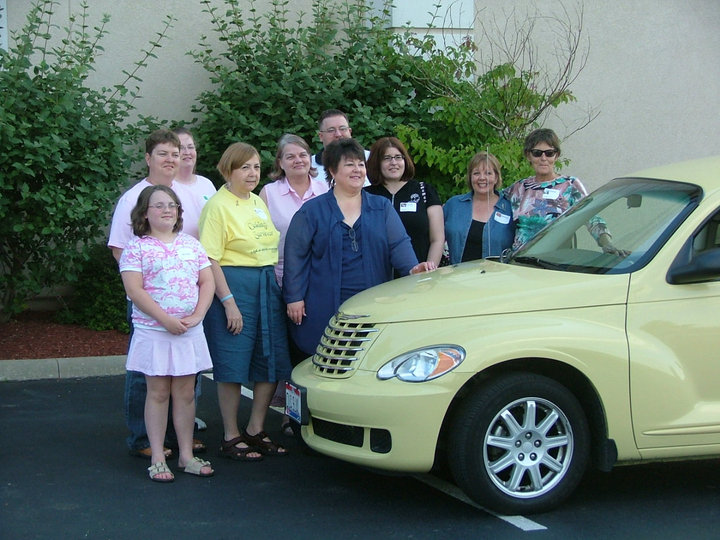
Blue and Yellow – we have those colors on ribbons, websites, T-shirts, Cushing’s Awareness Challenge logos and even cars.

This is the yellow PT cruiser I had rented for the Columbus, OH meeting in 2007.  I didn’t ask for yellow.  That’s just what the rental company gave me.  Somehow, they knew.

This meeting is the one when we all met at Hoggy’s for dinner although some of us travelers stayed at this hotel.

I’m the one in yellow and blue.


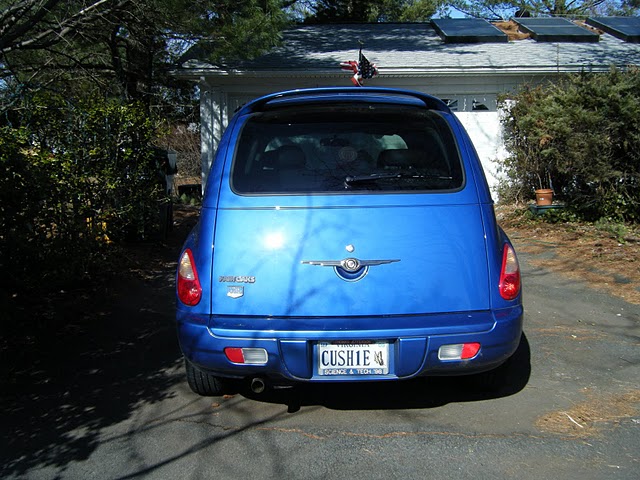
Later in 2007, I bought my own truly Cushie Car.  I even managed to get a butterfly on the tags.

So, where did all this blue and yellow come from, anyway?  The answer is so easy and without any thought that it will amaze you!

In July of 2000, I was talking with my dear friend Alice, who ran a wonderful menopause site, Power Surge.  We wondering why there weren’t many support groups online (OR off!) for Cushing’s and I wondered if I could start one myself and we decided that maybe I could.

This website (http://www.cushings-help.com) first went “live” July 21, 2000.  It was a one-page bit of information about Cushing’s.  Nothing fancy.  No message boards, no blogs, no wiki, no image galleries…  Certainly no Cushing’s Awareness Challenges.

I didn’t know much about HTML (yet!) but I knew a little from what Alice had taught me and I used on my music studio site.  I didn’t want to put as much work <COUGH!> into the Cushing’s site as I had on the music studio site so I used a WYSIWYG web editor called Microsoft FrontPage.

One of their standard templates was – you guessed it! – blue and yellow.

TaDa!  Instant Cushie color scheme forever.  Turns out that the HTML that this software churned out was really awful and had to be entirely redone as the site grew.  But the colors stuck.

Now, in this day of mobile web browsers and people going online on their cellphones, the website is being redone yet again.  But the colors are still, and always, blue and yellow.