Decreased prefrontal functional brain response in women with Cushing’s syndrome in remission

endo2016


April 03, 2016

Poster Session: Cushing’s Syndrome and Primary Adrenal Disorders

Decreased prefrontal functional brain response in women with Cushing’s syndrome in remission

O Ragnarsson, A Stomby, P Dahlqvist, JA Evang, M Ryberg, T Olsson, J Bollerslev, L Nyberg, G Johannsson

Summary: Neuropsychiatric symptoms including impairment of memory, attention, and executive function are important features of Cushing’s syndrome (CS). Notably, patients with CS in remission commonly demonstrate residual cognitive dysfunction, which has been suggested to be linked to incomplete recovery of neuronal function. Researchers sought to assess whether functional brain responses are altered during cognitive testing in patients with CS in remission. During episodic memory, women with CS in long-term remission have reduced functional brain responses in the prefrontal cortex and in the hippocampus.

Methods:

  • Included in this study were 19 women previously treated for CS (14 Cushing’s disease and 5 cortisol producing adrenal adenomas) and 19 controls, matched for age, gender, and education.
  • The median (interquartile range) remission time was 7 (6-10) years.
  • Researchers studied brain activity with functional magnetic resonance imaging during an episodic-memory face-name task.
  • The primary regions of interest were the prefrontal cortex and the hippocampus.
  • A voxel wise comparison of functional brain responses in patients and controls was performed, and an uncorrected P < 0.001 was considered significant.

Results:

  • During memory encoding, patients displayed lower functional brain responses in the left and right prefrontal gyrus (Brodmann areas [BA] 44, 45, and 46) as well as the right inferior occipital gyrus (BA 18) compared to controls (P < 0.001 for all).
  • Patients displayed lower functional brain responses in several brain areas including the prefrontal, parietal, occipital, and cerebellar cortices bilaterally during memory retrieval.
  • The most predominant difference was found in the right prefrontal cortex (BA 46 and 48; P < 0.001).
  • Reduced functional response in left dorsolateral prefrontal cortex was seen for patients during both encoding and retrieval.
  • Researchers compared the functional brain responses in four hippocampal clusters that were significantly activated during memory encoding among all participants (P < 0.05, FDR).
  • Patients had a trend toward lower functional brain responses in the left anterior hippocampus compared to controls (P=0.05).

From http://www.mdlinx.com/endocrinology/conference-abstract.cfm/ZZ6AA1CEC190F5428EA690616DAA054518/56991/?utm_source=confcoveragenl&utm_medium=newsletter&utm_content=abstract-list&utm_campaign=abstract-ENDO2016&nonus=0

Cushing’s Syndrome and Primary Adrenal Disorders

endo2016


April 03, 2016

Oral Session: Cushing’s Syndrome and Primary Adrenal Disorders

Patients with diabetes mellitus diagnosed with Addison’s disease have a markedly increased additional risk of death

D Chantzichristos, A Persson, B Eliasson, M Miftaraj, S Franzén, R Bergthorsdottir, S Gudbjörnsdottir, A-M Svensson, G Johannsson

Summary: Researchers sought to determine if patients with diabetes (DM) who are diagnosed with Addison’s disease (AD) have an increased risk of mortality (DM+AD). They concluded that patients diagnosed with DM+AD had a nearly 4-fold increased risk of mortality compared to controls.

Methods:

  • Researchers identified patients who were first diagnosed with DM (type 1 or 2) and then AD using both the Swedish National Diabetes Register (NDR) and the National Inpatient Register between January 1st, 1996 and December 31th, 2012.
  • Each patients was matched with 5 controls based on sex, year of birth, type of DM, year when DM was diagnosed, and period of time in NDR were selected in NDR.
  • Researchers obtained causes of death data for both groups during the same time period from the Swedish Register for Cause-Specific Mortality.

Results:

  • A total of 1,355 patients were identified: 226 patients had DM (type 1 or 2) and AD and 1,129 matched DM controls.
  • At baseline, patients with DM+AD and patients with DM had a mean (±SD) age of 52.3 (±20.1) and 54.1 (±18.9) years, respectively.
  • In both groups, 47% were women and 65% had type 1 DM.
  • Mean (±SD) HbA1c at baseline was 7.8% (±3.5%) or 62.0 (±14.7) mmol/mol for the DM+AD group and 7.6% (±3.5%) or 59.6 (±14.7) mmol/mol for the DM controls.
  •  More than one-quarter of patients with DM+AD (64/226, 28%) died vs 112 of 1,129 controls (10%).
  • The estimated relative risk increase (hazard ratio) in overall mortality in the DM+AD group was 3.83 (95% confidence interval, 2.80 to 5.24) compared with the DM controls.
  • There was no significant association between type of DM and gender on relative mortality risk.
  • The most common cause of death in both groups was cardiovascular diseases (33% and 34%, respectively).
  • The second most common cause of death in DM+AD patients was DM and its related complications (23%) and cancer in the DM group (29%).
  • Fourteen percent of DM+AD patients died from cancer.

From http://www.mdlinx.com/endocrinology/conference-abstract.cfm/ZZ6AA1CEC190F5428EA690616DAA054518/56981/?utm_source=confcoveragenl&utm_medium=newsletter&utm_content=abstract-list&utm_campaign=abstract-ENDO2016&nonus=0

Preclinical Data for ALD1613 at ENDO 2016

Alder BioPharmaceuticals, Inc. (“Alder”) (NASDAQ:ALDR), today announced that preclinical data on ALD1613, its anti-adrenocorticotropic hormone (ACTH) antibody for the treatment of congenital adrenal hyperplasia (CAH) and Cushing’s disease, were presented today by Andrew L. Feldhaus, Ph.D., in a poster presentation at ENDO 2016, the Endocrine Society’s 98th Annual Meeting in Boston, Mass. The presentation entitled “A Novel Anti-ACTH Antibody (ALD1613) Neutralizes ACTH Activity and Reduces Glucocorticoids in Rats and Nonhuman Primates” was presented as a late-breaking abstract.

Key Points:

  • In vitro, ALD1613 inhibits ACTH-induced cortisol secretion in a mouse adrenal cell line.
  • ALD1613 administration in rats with artificially elevated ACTH and corticosterone levels resulted in a rapid and durable reduction of plasma corticosterone levels.
  • In non-human primates, ALD1613 demonstrated stable and durable reductions in plasma cortisol levels by >50%.

Quote:

Randall C. Schatzman, Ph.D., President and Chief Executive Officer of Alder, said, “Existing therapeutic options for patients with congenital adrenal hyperplasia and Cushing’s disease comprise treatments that provide limited disease control and involve significant side effects. We believe these limitations indicate a clear need for new therapies such as ALD1613, which targets ACTH to diminish the overproduction of cortisol. The data presented today demonstrate the capacity of ALD1613 to reduce corticosteroid levels in preclinical settings. We intend to use these studies as part of an IND filing that we plan to submit to the FDA in the second half of 2016.”

From https://globenewswire.com/news-release/2016/04/03/825231/0/en/Alder-Presents-Preclinical-Data-for-ALD1613-at-ENDO-2016.html

Action For Adrenal Disease

Watch online Saturday April 16 at 1:00 PM eastern at https://plus.google.com/events/cpjbd8celcbfgngp8und662s198?hl=en
Secondary Adrenal Insufficiency and Addison’s Disease can be deadly, mostly because of the lack of education and awareness. We have lost too many and need to be proactive in preventing unnecessary deaths! Join us as we educate on what these diseases are, how easily they can become deadly and preventive measures we can all take to help this community. Brought to you by the National Adrenal Disease Foundation, with speakers who have personal experience with these diseases.

Our program will include:

Senior Administrator Nichole Klute Rushton••• of the Addison’s Disease Support Group (https://www.facebook.com/groups/addisons.support/) on Facebook, will speak in detail about the unfortunate adrenal insufficient patients who have tragically passed, reminding us that the danger of loss of life is a reality for every person with adrenal insufficiency who doesn’t receive the vital hormones they need

Administrator Debby Hunter ••• of the Living With Addison’s Disease Support on Facebook (https://www.facebook.com/groups/LivingWithAddisonsDisease/) who will give us tips on how we can approach our local emergency facilities and hospitals with information about adrenal insufficiency and its care in a crisis situation. She will also share her own personal experience with going through an adrenal crisis.

Deputy Sheriff Chris Spires••• who will speak on life as the husband of an Addison’s disease patient, and share with us how the law enforcement community views adrenal insufficient patients

Melanie Wong ••• National Adrenal Disease Foundation (http://www.NADF.us) Executive Director, who will speak about the recent tragic losses, and the vital importance of reminding the medical community about adrenal insufficiency, as well as NADF’s latest project to get NADF Adrenal Crisis Care posters displayed in every emergency room facility in the United States.

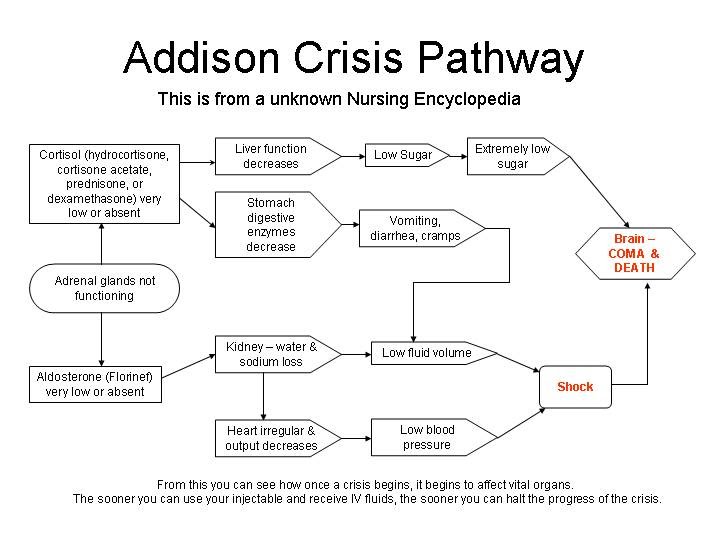
Adrenal Insufficiency Patients Require More Education on Adrenal Crisis

adrenalcrisispathway

Greater efforts to educate patients with adrenal insufficiency and their families about prevention of adrenal crisis may be necessary, according to data presented at the American Association of Clinical Endocrinologists (AACE) 24th Annual Scientific & Clinical Congress.

Additionally, the researchers, who looked at patients treated for adrenal insufficiency, found that many are not being adequately trained or equipped to deal with an adrenal crisis.

“These patients can crash and we are not doing enough to help prevent problems,” study investigator Nitika Malhotra, MD, endocrinologist in Lansing, Michigan, said. “We did this study because we think this is a big problem.”

Malhotra, who presented the study findings at the meeting, explained that patients with adrenal insufficiency are at risk for developing adrenal crisis, and it is now estimated that 8% of patients with adrenal insufficiency are hospitalized for adrenal crisis each year.

The problem, according to Malhotra, is that far too many patients are failing to receive crises prevention education. Moreover, they are not receiving emergency glucocorticoid kits.

“All of the families need to be taught and that is not happening,” Malhotra said in an interview with Endocrinology Advisor. “It will reduce the morbidity and mortality and the hospitalization, and it may improve the quality of life of patients too.”

For their study, Malhotra and her colleagues collected data from patients with adrenal insufficiency who were seen at a single institution between March 2009 and March 2014.

The investigators conducted a retrospective chart review and examined age, gender, causes of adrenal insufficiency, glucocorticoid dose, and monitoring for hyponatremia and hyperkalemia. They also looked at postural blood pressure, crises prevention education for glucocorticoid dose adjustments during stress, and whether patients had a Medic Alert ID or a parenteral glucocorticoid kit.

The researchers identified 85 patients (29 males and 56 females) with adrenal insufficiency. Of these patients, 33 patients had primary adrenal insufficiency (38.8%) and 52 had secondary adrenal insufficiency (61.2%). The mean age of the patients was 55.8 years.

Among the 85 patients, 23 (27%) had postural blood pressures checked — five of whom were positive (21.7%). Seventy-seven patients (90.6%) were monitored for electrolytes, and 41 patients (48.2%) were on steroid doses above 20 mg per day.

However, the researchers found that only 57 patients (67.1%) had received steroid dose adjustment instructions. In addition, only 29 patients (34.1%) had a Medic Alert ID, and only 17 patients (20%) were setup with emergency parenteral glucocorticoid kits.

Even though this study has many inherent limitations, Malhotra said, it appears that the preventive strategies for adrenal crisis in patients with adrenal insufficiency are not being consistently followed.

Patient education is paramount for achieving a successful prevention strategy for adrenal crisis, and endocrinologists have a responsibility to make sure that all patients with adrenal insufficiency have a Medic Alert ID and access to emergency glucocorticoid kits, according to Malhotra.

Furthermore, she said families should receive adequate education about parenteral steroid administration and steroid dose adjustments in stressful situations.

At her institution, Malhotra said, endocrinologists are introducing an automated electronic alert in their electronic medical records to determine if this electronic prompt will improve adherence.

Reference

  1. Malhotra N et al. Abstract #102. Presented at: American Association of Clinical Endocrinologists (AACE) 24th Annual Scientific & Clinical Congress; May 13-17, 2015; Nashville, Tenn.


From http://www.endocrinologyadvisor.com/aace-2015/adrenal-crisis-in-adrenal-insufficiency/article/415123/