Utility of Intraoperative Ultrasound in Identifying Pituitary Adenoma Hidden Behind a Cystic Lesion in Cushing’s Disease

Highlights

  • Intraoperative ultrasound enhances tumor localization during endoscopic pituitary surgery for MRI-negative Cushing’s disease.
  • Our findings support intraoperative US as a valuable adjunct in cases where preoperative imaging fails to reveal a lesion.
  • Further studies are expected to validate the efficacy of intraoperative ultrasound as a useful tool for MRI-negative Cushing’s disease.

Abstract

Cushing’s disease with inconclusive MRI findings presents a significant diagnostic and surgical challenge due to the difficulty in localizing the causative pituitary adenoma. This case report highlights the use of intraoperative ultrasound as an adjunct for tumor detection and successful resection in a Cushing disease patient with hidden adenoma. A 55-year-old female with a history of hypertension, diabetes, and a recent cerebral infarction presented with clinical and biochemical features of Cushing’s disease. Brain MRI revealed a 10 mm non-enhancing cystic lesion in the sella, making it difficult to confirm the underlying pathology. Inferior petrosal sinus sampling suggested a right-sided lesion, leading to an endoscopic endonasal transsphenoidal surgery. Intraoperatively, ultrasound was employed to assess the sellar region, initially identifying a cystic structure consistent with a Rathke’s cleft cyst. Following fluid drainage, ultrasound revealed an iso-echoic lesion with a distinct margin, which was subsequently resected and confirmed as a pituitary adenoma on histopathological examination.
The patient experienced postoperative biochemical remission, with normalization of ACTH levels and resolution of hypertension and diabetes. This case demonstrates that intraoperative ultrasound can be a valuable tool for tumor localization in suspicious MRI-negative Cushing’s disease. By aiding in the identification of adenomas obscured by cystic lesions or surrounding structures, intraoperative ultrasound may improve surgical outcomes. Further studies are warranted to validate its efficacy in routine clinical practice.

Introduction

Cushing’s disease is caused by an adrenocorticotropic hormone (ACTH)-secreting pituitary adenoma, leading to hypercortisolism and significant metabolic disturbances. Magnetic resonance imaging (MRI) is the primary imaging modality for detecting pituitary adenomas; however, in approximately 30–40 % of cases, no visible adenoma is detected, a condition known as MRI-negative Cushing’s disease [1,2]. The absence of a discernible lesion on MRI poses a diagnostic and therapeutic challenge, often necessitating additional testing such as bilateral inferior petrosal sinus sampling (IPSS) to confirm pituitary-dependent Cushing’s syndrome [3]. Given the limitations of imaging, treatment strategies for MRI-negative Cushing’s disease require a multimodal approach.
The first-line treatment for Cushing’s disease, regardless of MRI findings, is transsphenoidal surgery. However, MRI-negative cases are associated with lower remission rates due to the difficulty in localizing the microadenoma intraoperatively [4]. When surgery fails or is not feasible, alternative treatments such as repeat surgery, radiotherapy, bilateral adrenalectomy, or medical therapy are considered [5]. Despite these therapeutic options, long-term disease control remains challenging, highlighting the need for improved diagnostic tools and targeted treatment strategies.
The authors aim to report the use of intraoperative ultrasound in a Cushing disease patient with hidden adenoma, demonstrating its possibility to detect tumors that were not visible on MRI and facilitate successful tumor resection, ultimately leading to remission.

Section snippets

Case report

A 55-year-old female patient was referred from the endocrinology department for evaluation of Cushing’s disease. She had been on medication for hypertension and diabetes for the past seven years. Two months prior, she suffered an acute cerebral infarction, resulting in left-sided hemiparesis.
The endocrinology department diagnosed her with Cushing’s disease based on a dexamethasone suppression test. Brain MRI revealed a 10 mm non-enhancing cystic mass in the right side of the sella. (Fig. 1) Due…

Diagnostic approach for MRI-negative cushing’s disease

Diagnosing MRI-negative Cushing’s disease is particularly challenging due to the absence of a visible pituitary adenoma on standard imaging. A stepwise diagnostic approach is necessary to confirm the presence of ACTH-dependent hypercortisolism, differentiate between pituitary and ectopic sources, and localize the tumor. The initial step involves biochemical confirmation of endogenous hypercortisolism through tests such as the 24-hour urinary free cortisol, and the low-dose dexamethasone…

Conclusion

MRI-negative Cushing’s disease presents significant challenges not only for neurosurgeons but also for endocrinologists. The conventional hypophysectomy is invasive and has a high risk of causing other complications. The present case report showed that intraoperative ultrasound can be used effectively in a Cushing disease patient with hidden adenoma. We hope to derive more definitive conclusions through future case studies.

CRediT authorship contribution statement

Min Ho Lee: Writing – review & editing, Writing – original draft, Data curation, Conceptualization. Tae-Kyu Lee: Writing – review & editing, Conceptualization.

Ethics approval

The study was approved by the appropriate institutional research ethics committee and certify that the study was performed in accordance with the ethical standards as laid down in the 1964 Declaration of Helsinki and its later amendments or comparable ethical standards.
Informed consent was obtained from the patient included in this study.

Declaration of competing interest

The authors declare that they have no known competing financial interests or personal relationships that could have appeared to influence the work reported in this paper.

References (28)

More at https://www.sciencedirect.com/science/article/abs/pii/S0967586825002516

Changes in Clinical Features of Adrenal Cushing Syndrome

Abstract

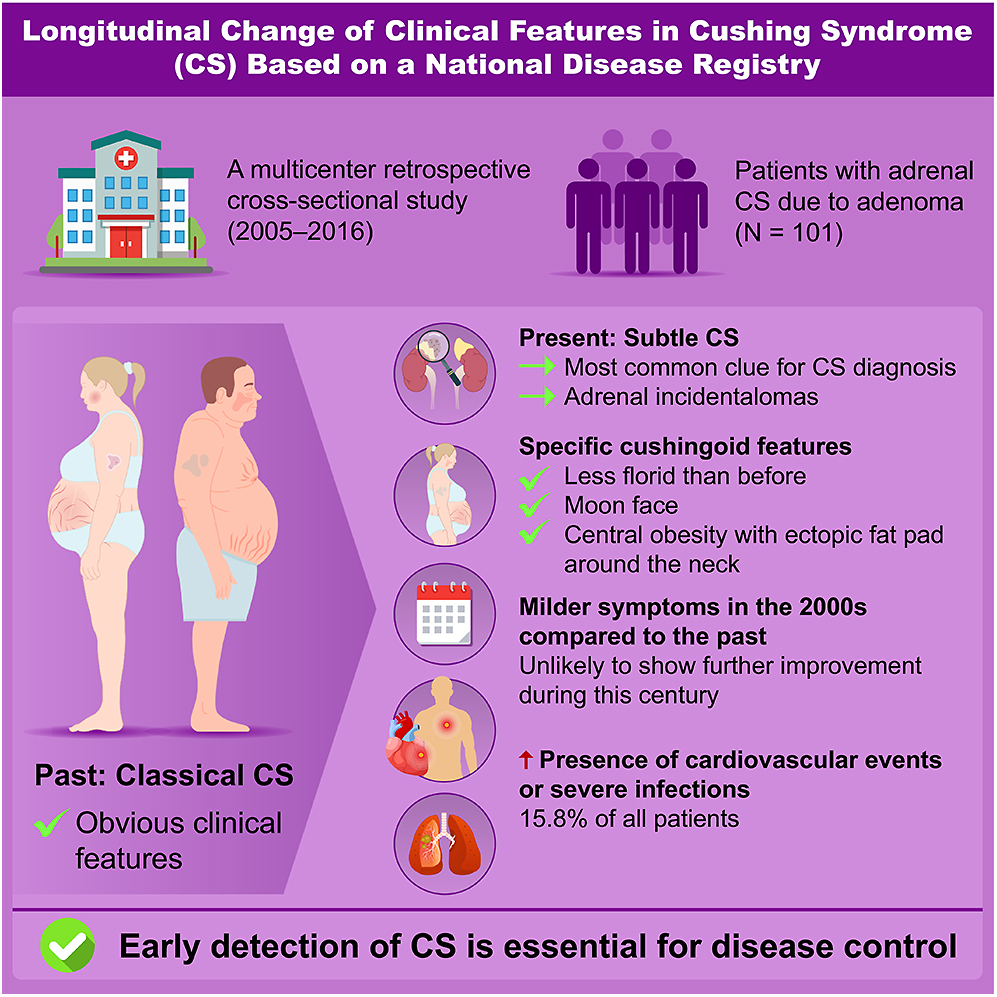
Adrenal Cushing syndrome (CS) has been rarely studied in recent years in Japan. This study aimed to investigate clinical characteristics and their changes over time in patients with adrenal CS. We analyzed 101 patients with adrenal CS caused by adenoma, dividing them into two groups based on diagnosis period: December 2011–November 2016 (later group, n = 50) and August 2005–November 2011 (earlier group, n = 51). Differences between the groups and comparisons with previous reports were assessed. Patients with subclinical CS were excluded. Adrenal incidentalomas were the most frequent reason for CS diagnosis (34%). Most patients exhibited few specific cushingoid features (2.5 ± 1.3), with moon faces and central obesity being the most common. Compared to earlier reports, specific cushingoid features were less frequent; nonetheless, no significant differences were observed between the earlier and later groups. All patients had midnight and post-dexamethasone suppression test serum cortisol levels exceeding 5 μg/dL. No significant differences were found between the groups regarding non-specific symptoms, endocrinological findings related to cortisol secretion, cardiometabolic commodities or infections, except for glucose intolerance and bone complications. The prevalence of metabolic disorders other than glucose intolerance and osteoporosis fluctuated over time. Sixteen patients developed cardiovascular diseases or severe infections. In conclusion, adrenal CS became less florid in the 2000s, showed no improvement in the following years, and remained associated with a high complication rate. Further research is needed to establish an early detection model for CS.

Plain language summary

Our study found that one-sixth of patients with adrenal Cushing syndrome continued to develop severe complications in this century despite their specific cushingoid features being less pronounced than in the past. Notably, the findings provide clinical insights that may aid in earlier disease diagnosis.

Introduction

Chronic exposure to excess glucocorticoids leads to Cushing syndrome (CS), with hypercortisolism causing a range of symptoms, signs and comorbidities, including arterial hypertension, diabetes mellitus, osteoporosis, severe infections and cardiovascular disease, all of which contribute to increased mortality (12345). CS also negatively impacts quality of life and cognitive function, leading to worsening socioeconomic conditions; moreover, some of these effects persist even after remission (67). Early diagnosis is therefore essential to reducing morbidity and mortality. A recent study (8) suggests that florid CS has become less common than previously reported, yet the time from symptom onset to diagnosis remains as long as 4 years (910). A similar trend toward an increase in less florid CS is expected in Japan. However, to our knowledge, no nationwide epidemiological survey of adrenal CS has been conducted in Japan in recent decades.

The number of adrenal incidentalomas (AIs) detected through abdominal imaging has been increasing (1112), potentially aiding in the early diagnosis of adrenal CS. However, in most studies from other countries, adrenal CS accounts for a smaller proportion of all CS cases compared to Japan (20–47 vs >50%, respectively), despite a rise in incidence in recent reports (1013141516). Consequently, there is limited evidence regarding diagnostic clues, clinical presentation, endocrinological findings and disease progression in a large cohort of patients with adrenal CS caused by adenomas in this century. This study aimed to examine the clinical phenotype, comorbidities and biochemical characteristics of Japanese patients with adrenal CS due to adenomas in the 2000s and to identify differences from previously reported findings.

Materials and methods

Study design and participants

This retrospective observational study was part of the Advancing Care and Pathogenesis of Intractable Adrenal Diseases in Japan (ACPA-J) study, which involved 10 referral centers (171819). The ACPA-J was established to develop a disease registry and cohort for patients with subclinical adrenal CS, adrenal CS, primary macronodular adrenal hyperplasia or adrenocortical carcinoma. The study group collected clinical, biochemical, radiological and pathological data at enrollment to generate new evidence and inform clinical guidelines. Data were obtained from patients aged 20–90 years who were diagnosed with CS due to an adrenal adenoma between August 2005 and November 2016. The dataset used in this study were validated in March 2019. The study protocol was approved by the Ethics Committee of the National Center for Global Health and Medicine (Approval No.: NCGM-S-004259) and the ethics committees of the participating centers. This study adhered to the clinical research guidelines of the Ministry of Health, Labour and Welfare, Japan (MHLWJ) and the principles of the Declaration of Helsinki. Informed consent was obtained through an opt-out option available on the websites of each referral center.

In the ACPA-J study, adrenal diseases, including CS, were initially diagnosed by attending physicians. Patients with iatrogenic CS or CS caused by primary macronodular adrenal hyperplasia or adrenocortical carcinoma were excluded. Of the 106 patients diagnosed with adrenal CS due to adenomas, five were excluded for the following reasons: baseline plasma adrenocorticotropic hormone (ACTH) ≥10 pg/mL (n = 1) or significant missing data related to the hypothalamic-pituitary-adrenal axis (n = 4). None of the patients met the criteria for subclinical CS according to the Japan Endocrine Society clinical practice guidelines (20). Except for three cases, adrenal adenomas were pathologically confirmed through surgical specimens. In patients who did not undergo surgery, a tumor was classified as an adenoma if it appeared round or oval, hypodense (i.e., ≤10 Hounsfield units), homogeneous and well-defined on computed tomography (12). As a result, the final analysis included 101 patients with adrenal CS due to adrenal adenomas (Fig. 1).

Figure 1View Full Size
Figure 1

Flowchart of patient selection. ACTH, adrenocorticotropic hormone; UFC, urinary free cortisol.

Citation: Endocrine Connections 14, 5; 10.1530/EC-24-0684

The diagnosis of adrenal CS was validated based on the diagnostic criteria established by the Research on Intractable Diseases, Research Committee on Disorders of Adrenal Hormones from the MHLWJ in 2016 (21). These criteria included a combination of the following: the presence of specific and non-specific cushingoid features, confirmation of cortisol hypersecretion through elevated morning serum cortisol levels (generally ≥20 μg/dL) and/or high 24 h urinary free cortisol (UFC; typically more than four times the upper limit of normal (ULN) for the assay used at each center), disruption of the circadian rhythm in serum cortisol levels (serum cortisol at 21:00–23:00 h ≥5 μg/dL), suppression of ACTH secretion (morning plasma ACTH <10 pg/mL and/or a blunted response to corticotropin-releasing hormone (CRH) stimulation, defined as either an increase of <1.5 times the baseline ACTH or peak ACTH <10 pg/mL), failure to suppress serum cortisol levels (≥5 μg/dL) after the standard overnight 1 mg and/or 8 mg dexamethasone suppression test (DST), and the presence of an adrenal tumor on imaging.

Measurements

The collected data included patient demographics such as age at diagnosis, sex, body mass index (BMI) and the reason for diagnosing CS. Specific cushingoid features recorded were moon face, dorsocervical or subclavian fat pad, central obesity, easy bruising, thin skin, muscle weakness, purple striae and facial plethora. Non-specific cushingoid features included acne, virilism or hirsutism in women, psychiatric disorders, menstrual irregularity and leg edema. Biochemical and hormonal profiles were assessed, including hemoglobin A1c (HbA1c), low-density lipoprotein cholesterol (LDL-C), high-density lipoprotein cholesterol (HDL-C), triglycerides (TG), morning and midnight serum cortisol, serum cortisol after the 1 mg or 8 mg DST, plasma ACTH before and after CRH stimulation, 24 h UFC and plasma dehydroepiandrosterone sulfate (DHEA-S). Comorbidities examined included hypertension, impaired glucose tolerance, dyslipidemia, obesity, bone fracture, osteoporosis, venous thromboembolism, cerebral infarction, cerebral hemorrhage, angina pectoris, myocardial infarction, heart failure, pneumonia, sepsis, deep abscess and other infections. Adrenal tumor diameter was assessed using imaging. To systematically assess various measurements, including specific and non-specific cushingoid features in patients with adrenal CS, we predefined survey items before initiating the study. We did not predefine the period for the major adverse cardiovascular and cerebrovascular events (MACCEs) and serious infections. The diseases were registered only if attending physicians determined they were associated with hypercortisolism. Missing data were excluded from the analysis. UFC and serum cortisol levels were partially expressed as multiples of the ULN or lower limit of normal (LLN) due to changes in assay methods. Further details on assay methods are provided in the supplementary data (see section on Supplementary materials given at the end of the article).

Hypertension was defined as a blood pressure of ≥140/90 mmHg or the use of antihypertensive medication (22). Due to inconsistencies in registration data, prediabetes and type 2 diabetes have been classified together under impaired glucose tolerance. Impaired glucose tolerance was defined as a fasting plasma glucose level of ≥110 mg/dL, a 2 h plasma glucose level of ≥140 mg/dL after a 75 g oral glucose load, an HbA1c level of ≥6.2% or current antidiabetic therapy (23). Dyslipidemia was defined by LDL-C levels ≥140 mg/dL, HDL-C levels <40 mg/dL, TG levels ≥150 mg/dL or the use of lipid-lowering therapy (24). Obesity was classified as a BMI ≥25 kg/m2, following the criteria of the Japan Society for the Study of Obesity (25). Osteoporosis was diagnosed based on a T-score ≤−2.5 standard deviation (SD) on dual-energy X-ray absorptiometry, in accordance with World Health Organization criteria (26). The presence of other symptoms, signs or comorbidities beyond the listed conditions was determined by the attending physicians based on medical records. The prevalence of MACCEs was also calculated. The CRH loading test is used to assess ACTH suppression in patients with suspected ACTH-independent hypercortisolism (20). A normal ACTH response to CRH stimulation was defined as plasma ACTH levels exceeding 10 pg/mL and increasing by more than 50% from baseline.

Classification of participants according to the date of diagnosis

The primary objective of this study was to examine temporal changes in the clinical presentation of adrenal CS, necessitating classification based on the date of diagnosis. We also sought to clarify recent trends in CS diagnosis. The most recent diagnosis among study participants was recorded in November 2016. To analyze changes in clinical presentation over 10 years, we classified patients into two groups: those diagnosed within 5 years of the most recent case (i.e., December 2011–November 2016, later group; n = 50) or those diagnosed earlier (i.e., August 2005–November 2011, earlier group; n = 51).

Changes in the clinical pictures over time

To examine changes in the clinical picture over time, we compared the prevalence of symptoms, signs and comorbidities in this study with findings from a nationwide survey conducted by the Research on Intractable Diseases, Research Committee on Disorders of Adrenal Hormones under the MHLWJ in 1997 (16) and data from traditional reports compiled by Rosset et al. (8). The nationwide survey was conducted in 1997 and 1998 using questionnaires sent to 4,060 departments. It included 737 patients with CS, covering adrenal CS caused by adenoma and bilateral hyperplasia, pituitary CS and ectopic ACTH syndrome, with adrenal CS accounting for 47.1% of cases. While the later research did not provide details on patient numbers, study duration or data collection methods, the data sources were clearly stated.

Statistical analysis

Statistical analyses were conducted using SPSS (version 26.0; IBM Corp., USA) or EZR (Saitama Medical Center, Jichi Medical University, Japan) (27). Results are expressed as means ± SDs and frequencies (positive/total observations) unless otherwise specified. Data distributions were assessed using the Kolmogorov–Smirnov test. Quantitative variables were compared between groups using the Student’s t-test, while the categorical variables were analyzed using the χ 2 test or Fisher’s exact test. We used a single-sample binomial test to compare our variable frequencies with those in previous studies (8). Statistical significance was defined as a P-value of <0.05.

Results

Clinical characteristics

This study included 101 patients with adrenal CS, with a higher prevalence in women than men. The average age of participants was 46.9 ± 13.3 years, with only 20% aged over 60 (Table 1). Notably, AIs were the most frequent finding leading to a CS diagnosis, followed by hypertension. Specific cushingoid features, such as moon face and muscle weakness, prompted diagnosis in approximately 15% of cases. The mean maximum diameter of the adenomas was approximately 3 cm. More than 90% of patients (94/101) had adrenal adenomas >2 cm. Bilateral adenomas were observed in nearly 20% of the study population. No significant differences were observed between the earlier and later groups regarding age, sex distribution, diagnostic triggers (except fractures), adenoma size or the prevalence of bilateral adenomas.

Table 1Clinical characteristics of patients with Cushing syndrome.

All patients with Cushing syndrome Earlier group Later group P-value
n = 101 n = 51 n = 50
Age, years 46.9 (13.3) 45.9 (13.3) 47.8 (13.4) 0.459
20–39/40–59/>60, n (%) 30/50/20 (30.0%/50.0%/20.0%) 19/21/10 (38.0%/42.0%/20.0%) 11/29/10 (22.0%/58.0%/20.0%) 0.181
Female, n (%) 90/100 (90.0%) 45/50 (90.0%) 45/50 (90.0%) 0.999
BMI, kg/m2 24.6 (4.3) 24.9 (4.3) 24.4 (4.2) 0.545
Reasons leading to Cushing syndrome diagnosis
 Incidentaloma, n (%) 34/101 (33.7%) 17/51 (33.3%) 17/50 (34.0%) 0.999
 Hypertension, n (%) 30/101 (29.7%) 16/51 (31.4%) 14/50 (28.0%) 0.828
 Moon face, n (%) 11/101 (10.9%) 8/51 (15.7%) 3/50 (6.0%) 0.2
 Weight gain, n (%) 10/101 (9.9%) 4/51 (7.8%) 6/50 (12.0%) 0.525
 Edema, n (%) 10/101 (9.9%) 5/51 (9.8%) 5/50 (10.0%) 0.999
 Fracture, n (%) 8/101 (7.9%) 1/51 (2.0%) 7/50 (14.0%) 0.031
 Muscle weakness, n (%) 4/101 (4.0%) 3/51 (5.9%) 1/50 (2.0%) 0.617
Bilateral adrenal tumors, n (%) 17/101 (16.8%) 11/51 (21.6%) 6/50 (12.0%) 0.308
Maximum diameter of tumor (mm) 28.4 (7.6) 27.2 (7.2) 29.6 (7.9) 0.111
≥20 mm, n (%) 94 (94.0%) 47 (92.2%) 47 (95.9%) 0.678

Data are presented as mean (SD) or number of patients (%). Patients were categorized into two groups based on their diagnosis date: within 5 years of the most recent case (December 2011–November 2016, later group) or earlier (August 2005–November 2011, earlier group).

P-values were calculated using Student’s t-test. Proportions between the before and after groups were compared using the X 2 or Fisher’s exact tests.

BMI, body mass index.

Specific and non-specific cushingoid features

Most patients with CS exhibited a limited number of specific features (mean ± SD, 2.5 ± 1.3) (Table 2). Nearly 40% of patients had two or fewer specific cushingoid features, while only 5% had five or more. The most frequently observed feature was moon face, followed by central obesity with a dorsocervical or subclavian fat pad, easy bruising or thin skin, facial plethora and muscle weakness or purple striae. The two most common features were present in over 50% of patients. Non-specific cushingoid features, including menstrual irregularity, acne, psychiatric disorders, hirsutism, virilization in women and edema, were observed in fewer than 25% of cases. The mean number of non-specific features was approximately one (0.6 ± 0.7). No significant differences in symptoms and signs of CS were found between the earlier and later groups.

Table 2Presence of specific and non-specific cushingoid features.

All patients with Cushing syndrome Earlier group Later group P-value
Cushingoid appearance, n (%) 99/101 (98.0%) 51/51 (100%) 48/50 (96.0%) 0.243
Specific features
 (1) moon face, n (%) 85/101 (84.2%) 41/51 (80.4%) 44/50 (88.0%) 0.439
 (2) central obesity, n (%) 60/101 (59.4%) 32/51 (62.7%) 28/50 (56.0%) 0.626
 (3) easy bruising or thin skin, n (%) 45/101 (44.6%) 19/51 (37.3%) 26/50 (52.0%) 0.163
 (4) facial plethora, n (%) 25/101 (24.8%) 10/51 (19.6%) 15/50 (30.0%) 0.327
 (5) muscle weakness, n (%) 21/101 (20.8%) 10/51 (19.6%) 11/50 (22.0%) 0.959
 (6) purple striae, n (%) 21/101 (20.8%) 14/51 (27.5%) 7/50 (14.0%) 0.156
Non-specific features
 (7) menstrual irregularity, n (%) 20/79 (25.3%) 10/37 (27.0%) 10/42 (23.8%) 0.945
 (8) acne, n (%) 15/101 (14.9%) 8/51 (15.7%) 7/50 (14.0%) 0.999
 (9) psychiatric disorders, n (%) 13/101 (12.9%) 7/51 (13.7%) 6/50 (12.0%) 0.999
 (10) hirsutism or virilization in female, n (%) 9/85 (10.6%) 6/41 (14.6%) 3/44 (6.8%) 0.303
 (11) leg edema, n (%) 4/101 (4.0%) 4/51 (7.8%) 0/50 (0.0%) 0.118
Number of items
In specific features ((1)–(6)), mean (SD) 2.5 (1.3) 2.5 (1.2) 2.6 (1.4) 0.562
In non-specific features ((7)–(11)), mean (SD) 0.6 (0.7) 0.7 (0.8) 0.5 (0.7) 0.258

Data are presented as mean (SD) or number of patients (frequency). Patients were categorized into two groups based on their diagnosis date: within 5 years of the most recent case (December 2011–November 2016, later group) or earlier (August 2005–November 2011, earlier group).

P-values were calculated using Student’s t-test. Proportions between the before and after groups were compared using the X 2 or Fisher’s exact tests.

Endocrinological findings

Serum cortisol levels after the 1 mg or 8 mg DST and midnight serum cortisol levels exceeded 5.0 μg/dL in all participants who underwent these tests (Table 3). In addition, all patients had markedly low baseline plasma ACTH levels. More than 50% of patients had morning serum cortisol levels below the ULN, while over 25% had UFC levels below this threshold (Fig. 2). Absolute serum cortisol concentrations (μg/dL) following the 8 mg DST were higher in the earlier group than in the latter group. However, when expressed as multiples of the LLN, there was no difference between groups, suggesting that this discrepancy was due to variations in assay methods. In contrast, baseline plasma ACTH levels were higher in the earlier group than in the latter group. Other parameters related to the hypothalamic-pituitary-adrenal axis, such as morning, midnight and post-DST serum cortisol levels, UFC levels, serum DHEA-S levels and plasma ACTH levels after CRH stimulation, were comparable between groups. The CRH stimulation test was performed in about 33% of participants. All but one patient had peak plasma ACTH levels below 10 pg/mL after CRH loading.

Table 3Endocrinological findings.

All patients with Cushing syndrome Earlier group Later group P-value
n = 101 n = 51 n = 50
Morning serum cortisol levels (n = 100) μg/dL 17.7 (5.7) 18.4 (4.8) 17.0 (6.5) 0.232
× the ULN times 0.90 (0.3) 0.96 (0.3) 0.88 (0.4) 0.264
Midnight serum cortisol levels (n = 97) μg/dL 17.6 (5.3) 18.6 (4.7) 16.7 (5.8) 0.088
≥5 μg/dL n (%) 97/97 (100%) 48/48 (100%) 49/49 (100%) N/A
× the lower limit of normal times 3.2 (1.3) 3.2 (1.3) 3.2 (1.3) 0.846
Plasma ACTH levels in the morning (n = 100) pg/mL 1.9 (1.7) 2.6 (2.0) 1.2 (0.9) <0.001
<10 pg/mL n (%) 100/100 (100%) 50/50 (100%) 50/50 (100%) N/A
DHEA-S (n = 97) μg/dL 40.7 (50.6) 35.2 (34.3) 45.8 (61.8) 0.313
Urinary free cortisol (n = 91) mg/24 h 283.1 (329.8) 279.8 (273.2) 285.8 (372.5) 0.932
× the ULN times 3.5 (4.1) 3.5 (3.4) 3.6 (4.6) 0.928
Serum cortisol levels after 1 mg DST (n = 96) μg/dL 18.6 (5.4) 19.3 (4.4) 17.9 (6.2) 0.202
≥5 μg/dL n (%) 96/96 (100%) 48/48 (100%) 48/48 (100%) N/A
× the LLN times 3.4 (1.4) 3.3 (1.3) 3.5 (1.4) 0.566
Serum cortisol levels after 8 mg DST (n = 71) μg/dL 18.6 (5.2) 19.9 (5.2) 17.0 (5.0) 0.017
≥5 μg/dL n (%) 71/71 (100%) 38/38 (100%) 33/33 (100%) N/A
× the LLN times 3.4 (1.3) 3.5 (1.5) 3.4 (1.2) 0.775
Peak plasma ACTH value after CRH stimulation test (n = 36) pg/mL 3.4 (3.4) 3.9 (1.5) 2.9 (4.3) 0.413

Data are presented as mean (SD) or number of patients (%). Patients were categorized into two groups based on their diagnosis date: within 5 years of the most recent case (Dec 2011–Nov 2016, later group) or earlier (Aug 2005–Nov 2011, earlier group).

P-values were calculated using Student’s t-test. Proportions between the before and after groups were compared using the X 2 or Fisher’s exact tests.

ACTH, adrenocorticotropic hormone; CRH, corticotropin-releasing hormone; DHEA-S, dehydroepiandrosterone sulfate; DST, dexamethasone suppression test; N/A, not available; LLN, lower limit of normal; ULN, upper limit of normal.

Figure 2View Full Size
Figure 2

Distribution of the ratio of morning serum (left) cortisol and (right) urinary free cortisol levels to the upper limit of normal (ULN).

Citation: Endocrine Connections 14, 5; 10.1530/EC-24-0684

Comorbidities

Among cardiometabolic conditions, hypertension was the most prevalent comorbidity (79.2%), followed by dyslipidemia, bone disorders, obesity and glucose intolerance (Table 4). The incidence of venous thromboembolism was 4.2%. Apart from all fractures or osteoporosis, no significant differences in complication rates were observed between the groups. Table 5 presents the frequency of MACCEs and severe infections among participants. Thirteen MACCEs (10.9%), including cerebral infarction or hemorrhage, angina pectoris, myocardial infarction and heart failure, were reported in 11 patients. In addition, six patients (6.0%) developed severe infections, such as pneumonia, sepsis or deep abscesses. Overall, 16 (15.8%) patients experienced serious illnesses. The prevalence of these conditions did not differ significantly between the earlier and later groups.

Table 4Comorbidities in patients with Cushing syndrome.

All patients with Cushing syndrome Earlier group Later group P-value
n = 101 n = 51 n = 50
Cardiometabolic
 Hypertension, n (%) 80/101 (79.2%) 42/51 (82.4%) 38/50 (76.0%) 0.588
 Dyslipidemia, n (%) 61/99 (61.6%) 32/50 (64.0%) 29/49 (59.2%) 0.775
 Obesity (BMI ≥25 kg/m2), n (%) 39/96 (40.6%) 23/48 (47.9%) 16/48 (33.3%) 0.212
 Impaired glucose tolerance, n (%) 33/101 (32.7%) 17/51 (33.3%) 16/50 (32.0%) 1
Bone
 All fractures, n (%) 25/93 (26.9%) 9/45 (20.0%) 16/48 (33.3%) 0.224
 Osteoporosis, n (%) 42/90 (46.7%) 17/42 (40.5%) 25/48 (52.1%) 0.374
 All fractures or osteoporosis, n (%) 48/101 (47.5%) 18/51 (35.3%) 30/50 (60.0%) 0.017
Coagulopathy
 Venous thromboembolism, n (%) 4/96 (4.2%) 3/50 (6.0%) 1/46 (2.2%) 0.670

Patients were categorized into two groups based on their diagnosis date: within 5 years of the most recent case (December 2011–November 2016, later group) or earlier (August 2005–November 2011, earlier group). BMI, body mass index.

Table 5Number of cardiovascular disease and infection events.

All patients with Cushing syndrome Earlier group Later group P-value
n = 101 n = 51 n = 50
MACCEs, n (%) 11/101 (10.9%) 6/51 (11.8%) 5/50 (10%) 1
 Cerebral infarction, n (%) 2/101 (2.0%) 1/51 (2.0%) 1/50 (2.0%) 1
 Cerebral hemorrhage, n (%) 0/101 (0%) 0/51 (0%) 0/50 (0%) N/A
 Angina pectoris, n (%) 2/101 (2.0%) 2/51 (3.9%) 0/50 (0%) 0.484
 Myocardial infarction, n (%) 2/101 (2.0%) 1/51 (2.0%) 1/50 (2.0%) 1
 Heart failure, n (%) 7/101 (6.9%) 4/51 (7.8%) 3/50 (6.0%) 1
Severe infection, n (%) 6/101 (6.0%) 4/51 (7.8%) 2/50 (4.1%) 0.678
 Pneumonia, n (%) 2/101 (2.0%) 1/51 (2.0%) 1/50 (2.0%) 1
 Deep abscess, n (%) 2/101 (2.0%) 1/51 (2.0%) 1/50 (2.0%) 1
 Sepsis, n (%) 1/101 (1.0%) 1/51 (2.0%) 0/50 (0%) 1
 Other infections, n (%) 1/101 (1.0%) 1/51 (2.0%) 0/50 (0%) 1

Patients were categorized into two groups based on their diagnosis date: within 5 years of the most recent case (December 2011–November 2016, later group) or earlier (August 2005–November 2011, earlier group). MACCEs, major adverse cardiovascular and cerebrovascular events; N/A, not available.

Changes in the clinical presentation over time

To assess temporal changes in the clinical presentation, we compared the prevalence of symptoms, signs and comorbidities in this study with data from a nationwide survey conducted by the MHLWJ in 1997 (16) and traditional reports compiled by Rosset et al. (8) (Supplementary Table 1). The frequency of specific cushingoid features, except for moon face, and non-specific cushingoid features, such as diabetes mellitus, menstrual irregularities, obesity and dyslipidemia, was significantly lower in our cohort compared with previous reports. The trends in hypertension, depression and osteoporosis varied by region. In addition, significant differences in the prevalence of easy bruising, hypertension and osteoporosis were observed between the earlier and later groups.

Discussion

This multicenter study in Japan demonstrated that fully developed adrenal CS has been identified less frequently in the twenty-first century compared with the previous century, and clinical outcomes did not improve during the 2000s. One possible reason for the increased detection of less florid CS is the higher likelihood of encountering AIs, as AIs discovery led to CS diagnosis in approximately 33% of the study cohort. Similar trends have been observed in West and North Africa (10141516). In addition, Braun et al. (28) reported that the presence of AIs independently increased the likelihood of a CS diagnosis. However, the incidence of AIs far exceeds that of CS (1112). Given that the Endocrine Society’s practice guidelines for CS (29) advise against widespread testing for all suspected cases, additional information is needed to enhance the pretest probability for detecting CS. In this study, only one patient (1/100, 1%) was male with an adrenal tumor smaller than 2.0 cm (7/101, 6.0%), suggesting that clinical evaluation can significantly reduce the likelihood of CS.

To assess the impact of AIs on early CS detection, we categorized adrenal CS patients into two groups based on whether their diagnosis resulted from AIs (n = 34) or not (n = 67). The mean number of specific cushingoid features was comparable between the two groups (2.3 ± 1.4 vs 2.7 ± 1.2, P = 0.119, data not shown). Similar trends were observed in non-specific cushingoid features, endocrinological findings, comorbidities and MAACEs. Conversely, when categorized based on having fewer than two specific cushingoid features (n = 21) versus two or more (n = 80), the detection rate of AIs tended to be higher, and serum cortisol levels at midnight or after a 1 mg DST were lower in those with fewer features than in those with more pronounced features (52.4 vs 28.7%, P = 0.067; 15.4 ± 4.4 μg/dL vs 18.2 ± 5.4 μg/dL, P = 0.031; and 16.3 ± 5.0 μg/dL vs 19.1 ± 5.3 μg/dL, P = 0.03, respectively, data not shown). Furthermore, the Cochran–Armitage test indicated that the trend across the diagnosis rate of CS leading to AIs rose with an increasing number of positive findings of specific cushingoid features (P = 0.035, data not shown). These findings suggest that while AIs may aid in identifying patients with less florid CS, they are unlikely to contribute to earlier diagnosis.

Cushingoid features can be categorized as specific or non-specific. Specific features help differentiate patients with severe CS from those without CS or those with cardiometabolic disorders or AIs with mild autonomous cortisol secretion (30). In this study, a moon face was observed in over 80% of participants, making it the most prevalent specific cushingoid feature. This suggests that a moon face may appear early and/or serve as the first distinct sign in most CS cases. Therefore, when evaluating patients at risk for CS, physicians should compare past and current photographs to facilitate early diagnosis. The development of advanced facial recognition software capable of detecting facial changes over time could further aid in preventing missed diagnoses of CS (3132). In addition, central obesity, defined by a dorsocervical and/or subclavian fat pad, was present in over 50% of CS cases, whereas obesity based on BMI criteria was observed in approximately 40% (24). The rising global prevalence of overweight and obesity complicates the diagnosis of CS. However, general obesity may negatively impact CS prediction (33). Our findings suggest that body shape, fat distribution – including the presence of a distinct fad pad – and facial contour are more relevant than body weight in distinguishing CS from general obesity. This distinction may help reduce unnecessary testing for CS.

Consistent with previous studies (3334), cardiometabolic conditions such as metabolic syndrome and bone comorbidities (i.e., osteoporosis and fractures) were frequently observed in patients with CS. However, as noted earlier, the prevalence of AIs with mild cortisol hypersecretion is significantly higher than that of CS, and non-specific cortisol-related cardiometabolic comorbidities are also common in AIs (34). Because these conditions are prevalent in the general population, broad screening has not been endorsed, as some non-specific features (e.g., hypertension, obesity and glucose intolerance) are more likely to indicate non-CS (35). Therefore, as recommended by clinical guidelines (29), additional factors – such as comorbidities that develop atypically with age, worsen over time or appear sequentially – should be considered before initiating screening. Moreover, in this study, 19 MACCEs or severe infections requiring hospitalization were reported in 16 patients (15.8%). This underscores the fact that, even in the 2000s, delays in diagnosing adrenal CS persist, necessitating improvements to reduce complications. Similarly, Rubinstein et al. (10) found no evidence of earlier CS diagnosis in patients treated after 2000 compared to studies conducted before 2000.

Our study revealed four notable findings in the endocrinological data. First, we confirm that CS should not be ruled out even if morning serum cortisol levels are normal, as this was observed in 66% of our patients. Endocrinologists must inform general practitioners to prevent missed diagnoses of CS. Second, post-1 mg DST serum cortisol levels in our cohort were much higher than the 1.8 μg/dL (50 nmol/L) cutoff recommended by the Endocrine Society Practical Guideline (29), consistently exceeding 5.0 μg/dL (138 nmol/L). Ceccato et al. (33) suggested a new threshold of 7.1 μg/dL (196 nmol/L) to distinguish CS from AIs without CS and 2.4 μg/dL (66 nmol/L) to differentiate CS from non-CS. We considered adjusting DST cutoffs based on the patient’s circumstances (e.g., the presence or absence of AIs or specific cushingoid features). Recent guidelines state that cortisol autonomy exists on a biological continuum, without a distinct separation between nonfunctioning and functioning adenomas with varying degrees of cortisol excess (12). Any post-DST cortisol cutoff value generally demonstrates poor accuracy in predicting prevalent comorbidities in patients with AIs. However, this finding applies to patients without overt CS, as the risk of developing CS is very low in the absence of clinical signs at the initial assessment. Furthermore, adrenal adenomas associated with overt CS have shown a distinct mutation profile compared to those with mild autonomous cortisol secretion (36). These results suggest that the two types of adenomas should be distinguished. Our data indicate that if serum cortisol levels after DST are significantly higher than the current cutoff value (i.e., 1.8 μg/dL), physicians should carefully assess patients for specific cushingoid features. A large-scale nationwide study in Japan, including adrenal CS, AIs with autonomous cortisol secretion, and non-CS, is needed to determine the optimal serum cortisol level cutoff after a DST for diagnosing adrenal CS in the Japanese population.

Third, normal UFC levels were found in 25% of participants despite elevated serum cortisol levels after the DST or at midnight in all patients. Several factors such as urinary volume, adherence to proper urine collection, day-to-day variability, and the number of measurements can affect UFC levels (37). To assess the impact of renal function on these results, we analyzed the estimated glomerular filtration rate (eGFR) in patients with normal UFC levels. The mean UFC levels were lower in patients with an eGFR <60 mL/min/m2 (n = 22) than in those with an eGFR ≥60 mL/min/m2 (n = 68) (1.0 ± 0.8 × ULN vs 4.0 ± 4.3 × ULN, P = 0.016), suggesting that renal impairment partially contributed to the discrepancies. Unfortunately, other factors affecting the results were not available in our data. Finally, all but one patient (97.3%) had peak plasma ACTH levels <10 pg/mL after CRH stimulation. This test may yield pseudo-positive results, as the exceptional patient had five specific cushingoid features along with typical autonomous cortisol secretion in CS (e.g., serum cortisol levels at midnight and after 1 mg DST near 20 μg/dL). Thus, the CRH stimulation test may not provide additional information for most patients with adrenal CS exhibiting clear ACTH suppression.

This study has several limitations, primarily due to its retrospective, cross-sectional design. First, selection bias may have occurred due to differences in data handling across participating centers, endocrine tests related to CS, or assay methods for CS-related comorbidities. Second, there were varying numbers of patients available for each measurement. Third, the absence of a predefined diagnostic protocol for CS and its comorbidities may have contributed to inconsistencies in diagnosis. Fourth, comparisons were challenging due to the wide variability in assay methods. Fifth, a 5-year period may be insufficient to evaluate changes in the clinical presentation of CS over time. Finally, as the study was conducted solely in Japan and primarily referenced Japanese CS and/or subclinical CS clinical guidelines (2021), its findings may not be generalizable. However, a key strength of this study is its involvement of multiple centers and a larger sample size compared to previous studies.

In conclusion, cases of adrenal CS in the 2000s were less florid than in previous decades although no further clinical improvement was observed during this century. A new model for the early detection of CS is necessary, as the prevalence of CS-related complications remains high. To reduce the time to diagnosis of adrenal CS, it is important to avoid overlooking moon face and central obesity with dorsocervical and/or subclavian fat pad, assess morning ACTH and serum cortisol after a DST with higher cutoff values than those recommended by the Endocrine Society, use abdominal computed tomography, and consider tumor size and patient sex when evaluating patients with suspected CS. Additional studies are needed to create a more effective diagnostic method for earlier identification of CS.

Supplementary materials

This is linked to the online version of the paper at https://doi.org/10.1530/EC-24-0684.

Declaration of interest

The authors declare that there are no conflicts of interest that could be perceived as affecting the impartiality of the research presented.

Funding

This research was supported by the National Center for Global Health and Medicine, Japan (grant numbers 21A1015, 24A1004), the MHLWJ (grant number Nanbyo-Ippan-23FC1041) and AMED, Japan (grant numbers JP17ek010922, JP20ek0109352).

Author contribution statement

Takuyuki Katabami (conceptualization (lead), methodology (lead), validation (equal), visualization (lead), writing–original draft (lead), writing–review and editing (equal)), Shiko Asai (data curation (lead), formal analysis (lead), investigation (equal), software (equal), visualization (equal), writing–review and editing (equal)), Ren Matsuba (data curation (equal), formal analysis (lead), investigation (equal), software (equal), visualization (equal), writing–review and editing (equal)), Masakatsu Sone (data curation (equal), investigation (supporting), writing–review and editing (supporting)), Shoichiro Izawa (data curation (equal), investigation (supporting), writing–review and editing (supporting)), Takamasa Ichijo (data curation (equal), investigation (supporting), writing–review and editing (supporting)), Mika Tsuiki (data curation (equal), investigation (supporting), writing–review and editing (supporting)), Shintaro Okamura (data curation (equal), investigation (supporting), writing–review and editing (supporting)), Takanobu Yoshimoto (data curation (equal), investigation (supporting), writing–review and editing (supporting)), Michio Otsuki (data curation (equal), investigation (supporting), writing–review and editing (supporting)), Yoshiyu Takeda (data curation (equal), investigation (supporting), writing–review and editing (supporting)), Mitsuhide Naruse (data curation (equal), project administration (equal), supervision (lead), validation (lead), writing–review and editing (lead)), Akiyo Tanabe (data curation (equal), funding acquisition (lead), project administration (equal), resource (lead), supervision (lead), validation (lead), writing–review and editing (lead)), ACPA-J Study Group (data curation (equal), investigation (supporting), writing–review and editing (supporting)).

Data availability

The data supporting this article cannot be shared publicly due to restrictions imposed by the authors’ institutes. Data can be made available upon reasonable request to the corresponding author.

Acknowledgments

We acknowledge the contributions of the ACPA-J Study Group members, including Daisuke Taura (Kyoto University), Mukai Kosuke (Osaka University), Shigeatsu Hashimoto (Fukushima Medical University Aizu Medical Center), Masanori Murakami (Tokyo Medical and Dental University), Norio Wada (Sapporo City General Hospital), Mai Asano (Kyoto Prefectural University), Yutaka Takahashi (Nara Medical University), Hidenori Fukuoka (Nara Medical University) and Tomoko Suzuki (International University of Health and Welfare).

References

Therapeutic Options for the Prevention of Thromboses in Cushing’s Syndrome

Abstract

Introduction

Cushing’s syndrome, or hypercortisolism, occurs after prolonged exposure to excess cortisol, and can be characterized by moon facies, central fat redistribution, proximal limb muscle weakness and wasting, and abdominal striae. Medical literature points to a relationship between hypercortisolism and hypercoagulability, with higher rates of venous thromboembolism noted. Current guidelines recommend prophylaxis with low-molecular weight heparin (LMWH), but there is little evidence to support LMWH over other forms of anticoagulation.

Methods

We utilized TriNetX US Collaborative Network (TriNetX, LLC, Cambridge, Massachusetts, United States) to investigate the efficacy of different forms of anticoagulation in patients with hypercortisolism, defined by International Classification of Diseases, Tenth Revision (ICD-10) codes. Adult patients with hypercortisolism and prescribed enoxaparin, a form of LMWH, were compared to patients with hypercortisolism prescribed unfractionated heparin, warfarin, apixaban, and aspirin at 81 mg. Groups were propensity-matched according to age at index event, sex, race, ethnicity, and comorbid conditions. The outcomes studied included pulmonary embolism (PE), upper extremity deep vein thrombosis (UE DVT), lower extremity deep venous thrombosis (LE DVT), superficial venous thrombosis (superficial VT), bleeding, transfusion, and all-cause mortality.

Results

No significant differences in outcomes were noted between enoxaparin and heparin, warfarin, or apixaban in patients with hypercortisolism of any cause. Uniquely, the enoxaparin cohort had significantly higher risk of PE, LE DVT, and all-cause mortality compared to the aspirin 81 mg cohort (PE: hazard ratio (HR) 1.697, 95%CI 1.444-1.994, p=0.0345; LE DVT: HR 1.492, 95%CI 1.28-1.738, p=0.0017; mortality: HR 1.272, 95%CI 1.167-1.386, p=0.0002). With further sub-analysis of pituitary-dependent (Cushing’s Disease), enoxaparin continued to demonstrate a higher risk for LE DVT (HR 1.677, 95%CI 1.353-2.079, p=0.0081), and all-cause mortality (HR 1.597, 95%CI 1.422-1.794, p=0.0005).

Conclusion

Although LMWH is currently recommended as the gold standard for anticoagulation in patients with hypercortisolism, our evidence suggests that low-dose antiplatelets such as aspirin 81 mg could outperform it. Further research is warranted to confirm and replicate our findings.

Introduction

Cortisol is produced within the zona fasciculata of the adrenal cortex and is typically released under stress [1]. Cushing’s Syndrome, first defined in 1912 by American neurosurgeon Harvey Cushing, is a state of prolonged hypercortisolism, presenting with classic phenotypic manifestations, including moon facies, central fat deposition, proximal limb muscle weakness and muscle wasting, and abdominal striae [2]. Cushing’s syndrome can be exogenous (medication-induced/iatrogenic) or endogenous (ectopic adrenocorticotrophic hormone (ACTH), pituitary-dependent, or adrenal adenoma/carcinoma) [3]. Pituitary adenomas causing ACTH-dependent cortisol excess account for 80% of endogenous cases of Cushing’s Syndrome and are more specifically termed Cushing’s Disease [4]. Overall, however, the most common cause of Cushing’s Syndrome is iatrogenic, from exogenous corticosteroid administration [5].

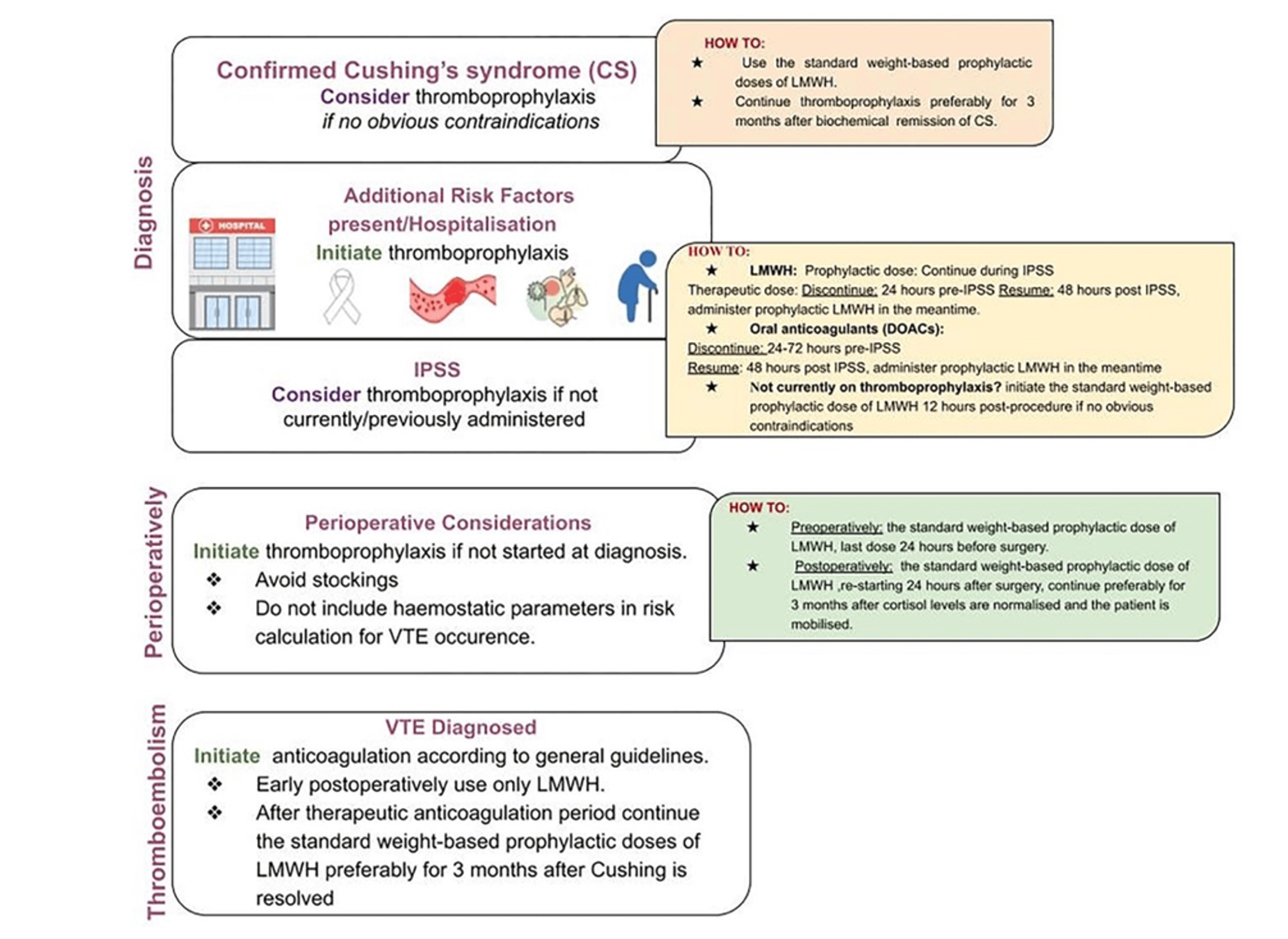
Hypercortisolism has also been demonstrated to affect coagulation, though the mechanism is unclear [6]. Both venous thromboemboli and pulmonary emboli rates are increased among these patients [7]. The Endocrine Society Guidelines for Treatment of Cushing Syndrome describe altered coagulation profiles that take up to one year to normalize [8]. As a result, limited guidelines recommend prophylactic anticoagulation in Cushing syndrome; while low-molecular-weight heparin (LMWH) is the gold standard, there is little evidence behind this recommendation [9]. Furthermore, few studies assessed individual Cushing’s Syndrome subtypes and associated clotting risks or anticoagulation impact. It is currently unknown whether the antagonistic effects of cortisol will be augmented or hindered by anticoagulation other than LMWH.

This retrospective multicenter study aimed to address this paucity in data by analyzing differences among various forms of anticoagulation. Patients with Cushing syndrome who were on one of three common anticoagulants, or aspirin, were compared to patients with Cushing’s Syndrome on enoxaparin, an LMWH considered the gold standard for prophylaxis in this population. Primary objectives included end-points concerning thromboses (such as pulmonary embolism (PE), upper and lower extremity deep vein thromboses (DVTs), and superficial venous thrombosis (VT)). Secondary objectives included analyzing safety profiles (bleeding, transfusion requirements, and all-cause mortality).

Materials & Methods

Eligibility criteria

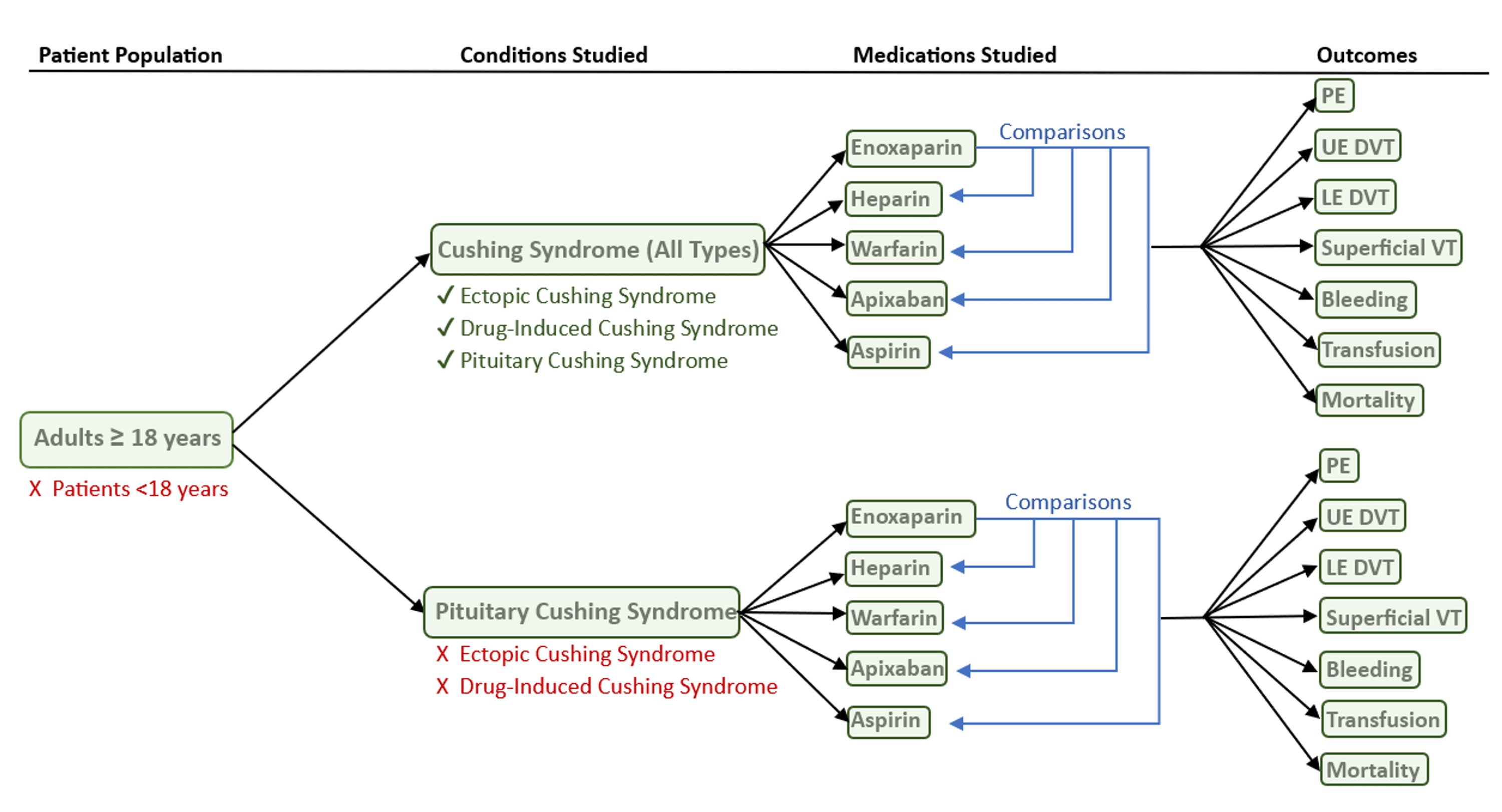
TriNetX Global Collaborative network (TriNetX, LLC, Cambridge, Massachusetts, United States), a nationwide database of de-identified health data across multiple large healthcare organizations (HCOs), was utilized to compile patients according to International Classification of Diseases, Tenth Revision (ICD-10) codes (Figure 1).

Flow-chart-for-inclusion-and-exclusion-criteria-for-the-study
Figure 1: Flow chart for inclusion and exclusion criteria for the study

PE: pulmonary embolism; VT: venous thrombosis; DVT: deep vein thrombosis; UE: upper extremity; LE: lower extremity

ICD-10 codes included those related to Cushing’s Syndrome and one of five studied medications: enoxaparin, heparin, apixaban, warfarin, and aspirin, included in Tables 1 and 2, respectively. ICD-10 codes also included those related to outcomes, including PE, upper extremity (UE) DVT, lower extremity (LE) DVT, superficial VT, bleeding, transfusion, and all-cause mortality (Table 3). Measures of association involved calculating risk differences and relative risks (RRs) with 95% confidence intervals (CIs) to compare the proportion of patients experiencing each outcome across cohorts.

Cushing’s Syndrome Type ICD-10 Code
Cushing Syndrome (unspecified) Drug-Induced Cushing Syndrome (UMLS:ICD10CM:E24.2)
Other Cushing Syndrome (UMLS:ICD10CM:E24.8)
Cushing Syndrome, Unspecified (UMLS:ICD10CM:E24.9)
Pituitary-Dependent Cushing Disease (UMLS:ICD10CM:E24.0)
Cushing Syndrome (UMLS:ICD10CM:E24)
Ectopic ACTH Syndrome (UMLS:ICD10CM:E24.3)
Cushing Syndrome (pituitary) Pituitary-Dependent Cushing Disease (UMLS:ICD10CM:E24.0  )
Table 1: International Classification of Disease (ICD)-10 codes utilized to identify patients with Cushing Syndrome in the TriNetX database
Medication ICD-10 Code
Enoxaparin NLM:RXNORM:67108
Warfarin NLM:RXNORM:11289
Heparin NLM:RXNORM:5224
Apixaban NLM:RXNORM:1364430
Aspirin NLM:RXNORM:1191
Table 2: International Classification of Disease (ICD)-10 codes utilized to identify anticoagulants and antiplatelets studied in the TriNetX database
Outcome ICD-10 Codes
Pulmonary Embolism Pulmonary Embolism UMLS:ICD10CM:I26
Upper Extremity DVT Acute embolism and thrombosis of deep veins of unspecified upper extremity UMLS:ICD10CM:I82.629
Chronic embolism and thrombosis of deep veins of unspecified upper extremity UMLS:ICD10CM:I82.729
Acute embolism and thrombosis of deep veins of right upper extremity UMLS:ICD10CM:I82.621
Acute embolism and thrombosis of deep veins of left upper extremity UMLS:ICD10CM:I82.622
Acute embolism and thrombosis of deep veins of upper extremity, bilateral UMLS:ICD10CM:I82.623
Chronic embolism and thrombosis of deep veins of right upper extremity UMLS:ICD10CM:I82.721
Chronic embolism and thrombosis of deep veins of left upper extremity UMLS:ICD10CM:I82.722
Chronic embolism and thrombosis of deep veins of upper extremity, bilateral UMLS:ICD10CM:I82.723
Lower Extremity DVT Acute embolism and thrombosis of unspecified deep veins of unspecified lower extremity UMLS:ICD10CM:I82.409
Chronic embolism and thrombosis of unspecified deep veins of unspecified lower extremity UMLS:ICD10CM:I82.509
Chronic embolism and thrombosis of unspecified deep veins of lower extremity UMLS:ICD10CM:I82.50
Chronic embolism and thrombosis of unspecified deep veins of lower extremity, bilateral UMLS:ICD10CM:I82.503
Acute embolism and thrombosis of unspecified deep veins of lower extremity UMLS:ICD10CM:I82.40
Acute embolism and thrombosis of unspecified deep veins of left lower extremity UMLS:ICD10CM:I82.402
Acute embolism and thrombosis of unspecified deep veins of right lower extremity UMLS:ICD10CM:I82.401
Chronic embolism and thrombosis of unspecified deep veins of left lower extremity UMLS:ICD10CM:I82.502
Chronic embolism and thrombosis of unspecified deep veins of right lower extremity UMLS:ICD10CM:I82.501
Chronic embolism and thrombosis of left femoral vein UMLS:ICD10CM:I82.512
Chronic embolism and thrombosis of right femoral vein UMLS:ICD10CM:I82.511
Acute embolism and thrombosis of right iliac vein UMLS:ICD10CM:I82.421
Chronic embolism and thrombosis of femoral vein, bilateral UMLS:ICD10CM:I82.513
Chronic embolism and thrombosis of unspecified deep veins of unspecified distal lower extremity UMLS:ICD10CM:I82.5Z9
Chronic embolism and thrombosis of unspecified tibial vein UMLS:ICD10CM:I82.549
Acute embolism and thrombosis of deep veins of lower extremity UMLS:ICD10CM:I82.4
Chronic embolism and thrombosis of deep veins of lower extremity UMLS:ICD10CM:I82.5
Chronic embolism and thrombosis of other specified deep vein of unspecified lower extremity UMLS:ICD10CM:I82.599
Acute embolism and thrombosis of unspecified deep veins of unspecified proximal lower extremity UMLS:ICD10CM:I82.4Y9
Superficial VT Embolism and thrombosis of superficial veins of unspecified lower extremity UMLS:ICD10CM:I82.819
Acute embolism and thrombosis of superficial veins of unspecified upper extremity UMLS:ICD10CM:I82.619
Chronic embolism and thrombosis of superficial veins of unspecified upper extremity UMLS:ICD10CM:I82.719
Bleeding Hematemesis UMLS:ICD10CM:K92.0
Hemoptysis UMLS:ICD10CM:R04.2
Hemorrhage from respiratory passages UMLS:ICD10CM:R04
Hemorrhage from other sites in respiratory passages UMLS:ICD10CM:R04.8
Hemorrhage from other sites in respiratory passages UMLS:ICD10CM:R04.89
Melena UMLS:ICD10CM:K92.1
Hemorrhage of anus and rectum UMLS:ICD10CM:K62.5
Epistaxis UMLS:ICD10CM:R04.0
Transfusion Transfusion of Nonautologous Whole Blood into Peripheral Vein, Percutaneous Approach UMLS:ICD10PCS:30233H1
Transfusion of Nonautologous Whole Blood into Central Vein, Percutaneous Approach UMLS:ICD10PCS:30243H1
Transfusion of Nonautologous Red Blood Cells into Peripheral Vein, Percutaneous Approach UMLS:ICD10PCS:30233N1
Transfusion, blood or blood components UMLS:CPT:36430
Transfusion of Nonautologous Red Blood Cells into Central Vein, Percutaneous Approach UMLS:ICD10PCS:30243N1
Transfusion of Nonautologous Frozen Red Cells into Peripheral Vein, Percutaneous Approach UMLS:ICD10PCS:30233P1
Transfusion of Nonautologous Red Blood Cells into Peripheral Artery, Percutaneous Approach (deprecated 2020) UMLS:ICD10PCS:30253N1
Transfusion of Nonautologous Frozen Red Cells into Central Vein, Percutaneous Approach UMLS:ICD10PCS:30243P1
Transfusion of Nonautologous Red Blood Cells into Central Artery, Percutaneous Approach (deprecated 2020) UMLS:ICD10PCS:30263N1
Transfusion of Nonautologous Frozen Red Cells into Peripheral Artery, Percutaneous Approach (deprecated 2020) UMLS:ICD10PCS:30253P1
Transfusion of Nonautologous Frozen Red Cells into Central Artery, Percutaneous Approach (deprecated 2020) UMLS:ICD10PCS:30263P1
Transfusion of blood product UMLS:SNOMED:116859006
Transfusion of red blood cells UMLS:SNOMED:116863004
Mortality Deceased Deceased (demographic)
Table 3: International Classification of Disease (ICD)-10 codes utilized to identify outcomes followed in the TriNetX database

DVT: Deep Venous Thrombosis; VT: Venous Thrombosis

Cohort definitions

For each medication listed, two cohorts were compared: (i) a cohort of patients with hypercortisolism on enoxaparin and (ii) a cohort of patients with hypercortisolism on heparin, warfarin, apixaban, or aspirin at 81 mg (Table 4). The cohorts strictly assessed only adult patients (defined as at least 18 years of age); pediatric patients were not analyzed.

Cohort Run
Enoxaparin 146 HCOs with 99 providers responding with 12,885 patients
Heparin 145 HCOs with 97 providers responding with 16,376 patients
Warfarin 145 HCOs with 82 providers responding with 3,230 patients
Apixaban 146 HCOs with 91 providers responding with 3,982 patients
Aspirin (81 mg) 144 HCOs with 51 providers responding with 8,200 patients
Table 4: Outputs of healthcare organization queries as defined in corresponding tables

HCO: Healthcare Organization

Statistical analysis

Index events and time windows were defined to analyze patient outcomes. The index event was defined as the first date a patient met the inclusion criteria for a cohort. The time window was defined as the five years after the index event during which a pre-defined outcome could occur. Outcomes of interest were identified using ICD-10 codes as outlined in Table 1, and included PE, UE DVT, LE DVT, superficial VT, bleeding, transfusion, and all-cause mortality. Cohorts were propensity score-matched 1:1 according to age at index event, sex, race and ethnicity, and comorbid conditions, including endocrine, cardiac, pulmonary, gastrointestinal, and genitourinary conditions (Table 5). Propensity score-matching was performed using TriNetX, with a greedy (nearest) neighbor matching algorithm (caliper of 0.1 pooled standard deviations).

Variable ICD-10 Code
Demographics Age at Index (AI)
Female (F)
Black/African American (2054-5)
Male (M)
White (2106-3)
American Indian/Alaskan Native (1002-5)
Unknown Race (UNK)
Native Hawaiian/Other Pacific Islander (2076-8)
Unknown Gender (UN)
Not Hispanic/Latino (2186-5)
Hispanic/Latino (2135-2)
Other Race (2131-1)
Asian (2028-9)
Diagnosis Endocrine, nutritional and metabolic diseases (E00-E89)
Factors influencing health status and contact with health services (Z00-Z99)
Diseases of the musculoskeletal system and connective tissue (M00-M99)
Diseases of the circulatory system (I00-I99)
Diseases of the digestive system (K00-K95)
Diseases of the nervous system (G00-G99)
Diseases of the respiratory system (J00-J99)
Diseases of the genitourinary system (N00-N99)
Diseases of the blood and blood-forming organs and certain disorders involving the immune mechanism (D50-D89)
Neoplasms (C00-D49)
Diseases of the skin and subcutaneous tissue (L00-L99)
Table 5: International Classification of Disease (ICD)-10 codes utilized to propensity match cohorts in the TriNetX database

Three analytical approaches were performed for this study, including measures of association, survival analysis, and frequency analysis. The measure of association analysis involved calculating RRs (and risk differences) with 95%CIs, comparing the proportion of patients across each cohort experiencing an outcome. Survival analysis was performed with Kaplan-Meier estimators (evaluating time-to-event outcomes), with Log-Rank testing incorporated to compare the survival curves. Furthermore, Cox proportional hazard models were incorporated to provide an estimate of the hazard ratios (HR) and 95%CIs. Patients who exited a cohort before the end of the time window were excluded from the survival analysis. The frequency analysis was performed by calculating the proportion of patients in each cohort who experienced an outcome during the defined period of five years.

For statistically significant associations, an E-value was calculated to assess the potential impact of unmeasured confounders, quantifying the minimum strength of association that would be required by an unmeasured confounder to explain the observed effect (beyond our measured covariates); an E-value of above 2.0 was considered modestly robust, and above 3 was considered strongly robust. Additionally, a limited sensitivity analysis assessing Pituitary Cushing’s (the most common cause of endogenous Cushing’s Syndrome) was performed. All analyses were conducted through TriNetX, with statistical significance defined as a p-value < 0.05.

Results

Cushing’s syndrome, unspecified

Enoxaparin and Heparin

After propensity-score matching, 8,658 patients were identified in each cohort. The average age at index event for the enoxaparin cohort was 54.5 + 16.5 years, compared to 53.1 + 17.3 years for the heparin cohort. The enoxaparin cohort had 6,216 females (71.8%), compared to 6,000 (69.3%) in the heparin cohort. Within the enoxaparin cohort, 6035 (69.7%) were Caucasian patients, followed by 987 (11.4%) African American patients, 753 (8.7%) Hispanic/Latino patients, and 216 (2.5%) Asian patients. The heparin cohort was similar in ethnicity, with 5,800 (67.0%) Caucasian patients, 1,099 (12.7%) African American patients, 753 (8.7%) Hispanic/Latino patients, and 268 (3.1%) Asian patients. The enoxaparin and heparin cohorts demonstrated no significant differences in PE (HR 1.171, 95%CI 1.017-1.348, p=0.1797), UE DVT (HR 1.067, 95%CI 0.837-1.362, p=0.8051), LE DVT (HR 1.066, 95%CI 0.931-1.222, p=0.1922), superficial VT (HR 0.974, 95%CI 0.672-1.41, p=0.4576), bleeding (HR 0.948, 95%CI 0.855-1.05, p=0.3547), transfusion (HR 0.873, 95%CI 0.786-0.969, p=0.1767), or all-cause mortality (HR 1.036, 95%CI 0.966-1.11, p=0.9954). A comprehensive summary of the results is demonstrated in Table 6.

p-value Medication 1 Medication 2 PE UE DVT LE DVT S VT Bleeding Transfusion Mortality
enoxaparin heparin 0.1797 0.8051 0.1922 0.4576 0.3547 0.1767 0.9954
enoxaparin warfarin 0.3828 0.6 0.1963 0.0995 0.7768 0.5715 0.15
enoxaparin apixaban 0.6491 0.6275 0.723 0.4198 0.4356 0.4299 0.2628
enoxaparin aspirin 81 mg 0.0345 0.587 0.0017 0.4218 0.246 0.2057 0.0002
HR Medication 1 Medication 2 PE UE DVT LE DVT S VT Bleeding Transfusion Mortality
enoxaparin heparin 1.171 1.067 1.066 0.974 0.948 0.873 1.036
enoxaparin warfarin 0.936 0.969 0.708 0.655 0.961 1.127 1.042
enoxaparin apixaban 0.798 0.666 0.684 4.059 0.933 1.089 1.041
enoxaparin aspirin 81 mg 1.697 1.398 1.492 1.718 1.107 1.347 1.272
95% CIs Medication 1 Medication 2 PE UE DVT LE DVT Superficial VT Bleeding Transfusion Mortality
enoxaparin heparin 1.017-1.348 0.837-1.362 0.931-1.222 0.672-1.41 0.855-1.05 0.786-0.969 0.966-1.11
enoxaparin warfarin 0.755-1.161 0.692-1.356 0.583-0.859 0.376-1.142 0.812-1.137 0.95-1.336 0.93-1.167
enoxaparin apixaban 0.608-1.047 0.431-1.03 0.593-0.788 1.156-14.258 0.771-1.129 0.892-1.33 0.912-1.189
enoxaparin aspirin 81 mg 1.444-1.994 1.06-1.845 1.28-1.738 1.011-2.92 0.986-1.243 1.185-1.532 1.167-1.386
Table 6: Hazard Ratio, 95% Confidence Intervals and p-values for anticoagulation and antiplatelet comparisons in all causes of Cushing’s Syndrome

HR: hazard ratio; CI: confidence interval; PE: pulmonary embolism; VT: venous thrombosis; DVT: deep vein thrombosis; UE: upper extremity; LE: lower extremity

Enoxaparin and Warfarin

After propensity-score matching, 2,786 patients were identified in each cohort. The average age at index event for the enoxaparin cohort was 54.8 + 16.4 years, compared to 58.9 + 15.9 years for the warfarin cohort. The enoxaparin cohort had 2,020 female patients (72.5%) compared to 1,861 (66.8%) in the warfarin cohort. Within the enoxaparin cohort, 2,000 (71.8%) were Caucasian patients, followed by 334 (12.0%) African American patients, 220 (7.98%) Hispanic/Latino patients, and 64 (2.3%) Asian patients. The warfarin cohort was similar, with 2,056 (73.8%) Caucasian patients, 312 (11.2%) African American patients, 170 (6.1%) Hispanic/Latino patients, and 92 (3.3%) Asian patients. The enoxaparin and warfarin cohorts demonstrated no significant differences in PE (HR 0.936, 95%CI 0.755-1.161, p=0.3828), UE DVT (HR 0.969, 95%CI 0.692-1.356, p=0.6), LE DVT (HR 0.708, 95%CI 0.583-0.859, p=0.1963), superficial VT (HR 0.655, 95%CI 0.376-1.142, p=0.0995), bleeding (HR 0.961, 95%CI 0.812-1.137, p=0.7768), transfusion (HR 1.127, 95%CI 0.95-1.336, p=0.5715), or all-cause mortality (HR 1.042, 95%CI 0.93-1.167, p=0.15) (Table 6).

Enoxaparin and Apixaban

After propensity-score matching, 2,429 patients were identified in each cohort. The average age at index event for the enoxaparin cohort was 54.6 + 16.4 years, compared to 61.2 + 15.2 years for the apixaban cohort. The enoxaparin cohort had 1,746 female patients (71.9%) compared to 1,571 (64.7%) in the apixaban cohort. Within the enoxaparin cohort, 1632 (67.2%) were Caucasian patients, 318 (13.1%) African American patients, 219 (9.0%) Hispanic/Latino patients, and 68 (2.8%) Asian patients. A similar composition was noted in the apixaban cohort, with 1,683 (69.3%) Caucasian patients, 321 (13.2%) African American patients, 141 (5.8%) Hispanic/Latino patients, and 53 (2.2%) Asian patients. The enoxaparin and apixaban cohorts demonstrated no significant differences in PE (HR 0.798, 95%CI 0.608-1.047, p=0.6491), UE DVT (HR 0.666, 95%CI 0.431-1.03, p=0.6275), LE DVT (HR 0.684, 95%CI 0.593-0.788, p=0.723), superficial VT (HR 4.059, 95%CI 1.156-14.258, p=0.4198), bleeding (HR 0.933, 95%CI 0.771-1.129, p=0.4356), transfusion (HR 1.089, 95%CI 0.892-1.33, p=0.4299), or all-cause mortality (HR 1.041, 95%CI 0.912-1.189, p=0.2628) (Table 6).

Enoxaparin and Aspirin 81 mg

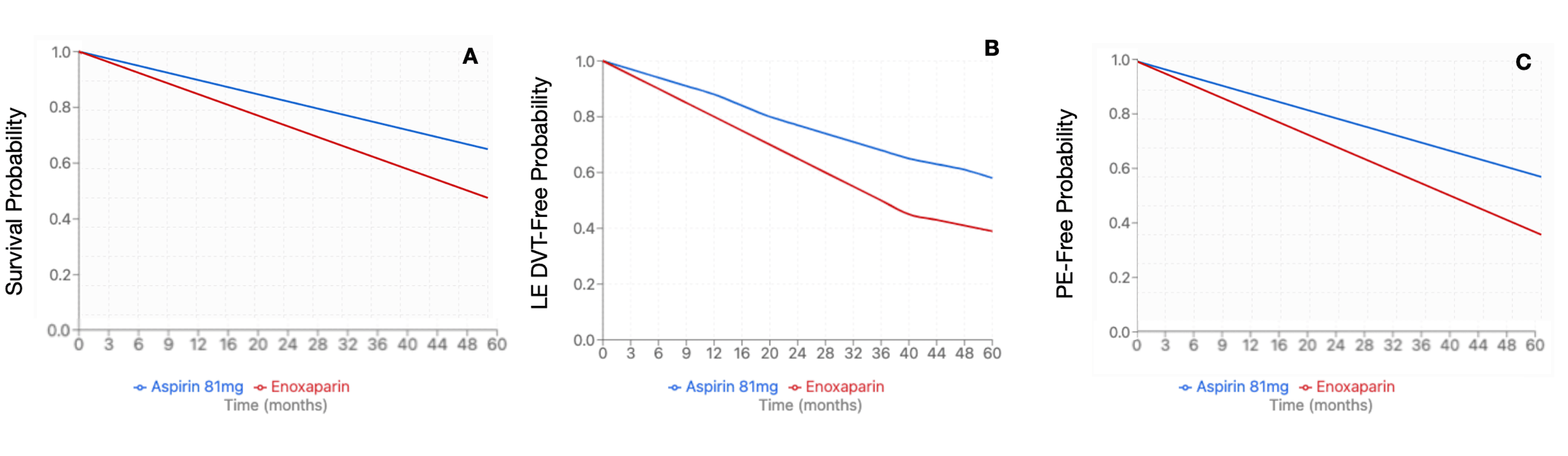
After propensity-score matching, 6,433 patients were identified in each cohort. The average age at index event for the enoxaparin cohort was 54.5 + 16.6 years, compared to the aspirin 81 mg cohort at 58.8 + 14.9 years. The enoxaparin cohort had 4664 female patients (72.5%) compared to 4,445 (69.1%) in the aspirin 81 mg cohort. Within the enoxaparin cohort, 4,522 (70.3%) were Caucasian patients, followed by 766 (11.9%) African American patients, 521 (8.1%) Hispanic/Latino patients, and 193 (3.0%) Asian patients. Similar demographics were noted within the Aspirin 81 mg cohort, with 4,670 (72.6%) Caucasian patients, 817 (12.7%) African American patients, 425 (6.6%) Hispanic/Latino patients, and 167 (2.6%) Asian patients. The enoxaparin cohort demonstrated a significantly higher risk of PE (HR 1.697, 95%CI 1.444-1.994, p=0.0345), LE DVT (HR 1.492, 95%CI 1.28-1.738, p=0.0017), and all-cause mortality (HR 1.272, 95%CI 1.167-1.386, p=0.0002) compared to the aspirin 81 mg cohort (Figure 2). There was no significant difference in rates of UE DVT (HR 1.398, 95%CI 1.06-1.845, p=0.587), superficial VT (HR 1.718, 95%CI 1.011-2.92, p=0.4268), bleeding (HR 1.107, 95%CI 0.986-1.243, p=0.246), or transfusion (HR 1.347, 95%CI 1.185-1.532, p=0.2057) (Table 6). Due to a significant difference between enoxaparin and Aspirin 81 mg, an E-value was calculated for PE (E-value = 2.783), LE DVT (E-value = 2.348), and all-cause mortality (E-value = 1.860).

Kaplan-Meier-survival-curve-for-pituitary-Cushing's-subtype-(mortality,-LE-DVT,-and-PE)
Figure 2: Kaplan-Meier survival curve for pituitary Cushing’s subtype (mortality, LE DVT, and PE)

(A) Mortality of enoxaparin compared to aspirin 81mg (HR 1.272, 95% CI 1.167-1.386, p=0.0002); (B) LE DVT risk with enoxaparin compared to aspirin 81 mg (HR 1.492, 95%CI 1.28-1.738, p=0.0017); (C) PE risk with enoxaparin compared to aspirin 81 mg (HR: 1.697, 95%CI 1.444-1.994, p=0.0345)

DVT: deep vein thrombosis; LE: lower extremity; PE: pulmonary embolism

Pituitary hypercortisolism (Cushing’s disease)

Enoxaparin and Heparin

Propensity-score matching identified 5,602 patients per cohort. The average age at index for the enoxaparin cohort was 53.9 + 16.7 years, compared to 53.7 + 16.9 years in the heparin cohort. The enoxaparin cohort had 4,088 female patients (72.97%) compared to 4,066 (72.58%) in the heparin cohort. The enoxaparin cohort was predominantly Caucasian patients (n=3,948; 70.47%), followed by 641 (11.45%) African American patients, 424 (7.57%) Hispanic/Latino patients, and 139 (2.48%) Asian patients. The heparin cohort was also predominantly Caucasian (n=3,947; 70.46%), followed by 669 (11.94%) African American patients, 401 (7.16%) Hispanic/Latino patients, and 148 (2.64%) Asian patients. There were no significant differences in rates of PE (HR 1.208, 95%CI 1.007 – 1.451, p=0.5803), UE DVT (HR 1.156, 95%CI 0.841 – 1.59, p=0.6863), LE DVT (HR 1.246, 95%CI 1.063 – 1.46, p=0.8996), superficial VT (HR 1.347, 95%CI 0.874 – 2.075, p=0.3731), bleeding (HR 0.916, 95%CI 0.809 – 1.037, p=0.1578), transfusion (HR 0.912, 95%CI 0.798 – 1.042, p=2119), or all-cause mortality (HR 1.02, 95%CI 0.935 – 1.112, p=0.8734). A comprehensive summary of the results is demonstrated in Table 7.

p-value Medication 1 Medication 2 PE UE DVT LE DVT Superficial VT Bleeding Transfusion Mortality
enoxaparin heparin 0.5189 0.2468 0.7586 0.7708 0.5894 0.6273 0.8433
enoxaparin warfarin 0.4842 0.7763 0.9651 0.682 0.1996 0.5309 0.399
enoxaparin apixaban 0.1047 0.0423 0.647 0.4824 0.2698 0.1122 0.1044
enoxaparin aspirin 81 mg 0.9651 0.6358 0.8448 0.9765 0.1167 0.4854 0.5001
HR Medication 1 Medication 2 PE UE DVT LE DVT Superficial VT Bleeding Transfusion Mortality
enoxaparin heparin 1.186 1.332 1.232 1.183 0.876 0.963 1.016
enoxaparin warfarin 0.804 0.76 0.688 0.815 1.008 1.009 0.976
enoxaparin apixaban 0.875 0.761 0.954 3.068 1.084 1.359 1.115
enoxaparin aspirin 81 mg 1.173 1.157 1.226 1.165 0.908 0.915 1.028
95% CIs Medication 1 Medication 2 PE UE DVT LE DVT Superficial VT Bleeding Transfusion Mortality
enoxaparin heparin 0.983-1.433 0.941-1.885 1.032-1.47 0.776-1.803 0.769-0.998 0.808-1.147 0.929-1.112
enoxaparin warfarin 0.612-1.055 0.467-1.235 0.539-0.877 0.447-1.489 0.816-1.246 0.76-1.34 0.843-1.13
enoxaparin apixaban 0.659-1.162 0.456-1.271 0.736-1.236 0.843-11.166 0.845-1.381 0.962-1.921 0.944-1.317
enoxaparin aspirin 81mg 0.969-1.419 0.827-1.619 1.03-1.46 0.763-1.78 0.797-1.035 0.772-1.085 0.938-1.127
Table 7: Hazard ratio, 95% confidence intervals, and p-values for anticoagulation and antiplatelet comparisons in pituitary Cushing’s syndrome

HR: hazard ratio; CI: confidence interval; PE: pulmonary embolism; VT: venous thrombosis; DVT: deep vein thrombosis; UE: upper extremity; LE: lower extremity

Enoxaparin and Warfarin

Propensity-score matching was performed with 1,694 patients per cohort identified. The average age at index for the enoxaparin cohort was 58.1 + 15.8 years, compared to 58.1 + 15.9 years in the warfarin cohort. The enoxaparin cohort had 1,142 female patients (67.41%) compared to 1,143 (67.47%) in the warfarin cohort. Within the enoxaparin cohort, 1,224 (72.2%) were Caucasian patients, followed by 194 (11.45%) African American patients, 97 (5.73%) Hispanic/Latino patients, and 57 (3.37%) Asian patients. The warfarin cohort had similar demographics, with 1,223 (72.2%) Caucasian patients, followed by 194 (11.45%) African American patients, 102 (6.02%) Hispanic/Latino patients, and 65 (3.84%) Asian patients. There were no significant differences in rates of PE (HR 0.907, 95%CI 0.694 – 1.186, p=0.8117), UE DVT (HR 0.988, 95%CI 0.628 – 1.555, p=0.9848), LE DVT (HR 0.739, 95%CI 0.589 – 0.929, p=0.4445), superficial VT (HR 0.815, 95%CI 0.44 – 1.511, p=0.8098), bleeding (HR 1.001, 95%CI 0.814 – 1.231, p=0.0987), transfusion (HR 1.106, 95%CI 0.889 – 1.376, p=0.4904), or all-cause mortality (HR 0.951, 95%CI 0.83 – 1.089, p=0.1656) (Table 7).

Enoxaparin and Apixaban

Propensity-score matching identified 1,489 patients per cohort. The enoxaparin cohort was 61.1 + 15.1 years old at the index event, versus the apixaban cohort at 61.4 + 14.9 years. The enoxaparin cohort had 1,054 (70.79%) female patients compared with 1,029 (69.11%) in the apixaban cohort. The enoxaparin cohort was primarily Caucasian patients (n=1,105; 74.21%), followed by 179 (12.02%) African American patients, 74 (4.97%) Hispanic/Latino patients, and 27 (1.81%) Asian patients. The apixaban cohort demonstrated similar demographics with 1,080 (72.53%) Caucasian patients, followed by 180 (12.09%) African American patients, 76 (5.1%) Hispanic/Latino patients, and 27 (1.81%) Asian patients. There were no significant differences in rates of PE (HR 0.949, 95%CI 0.673 – 1.339, p=0.4372), UE DVT (HR 0.832, 95%CI 0.472 – 1.466, p=0.1538), LE DVT (HR 1.166, 95%CI 0.869 – 1.566, p=0.8595), superficial VT (HR 5.323, 95%CI 1.19 – 23.815, p=0.493), bleeding (HR 1.218, 95%CI 0.948 – 1.565, p=0.4021), transfusion (HR 1.319, 95%CI 0.993 – 1.753, p=0.1663), or all-cause mortality (HR 1.131, 95%CI 0.966 – 1.325, p=0.0839) (Table 7).

Enoxaparin and Aspirin 81 mg

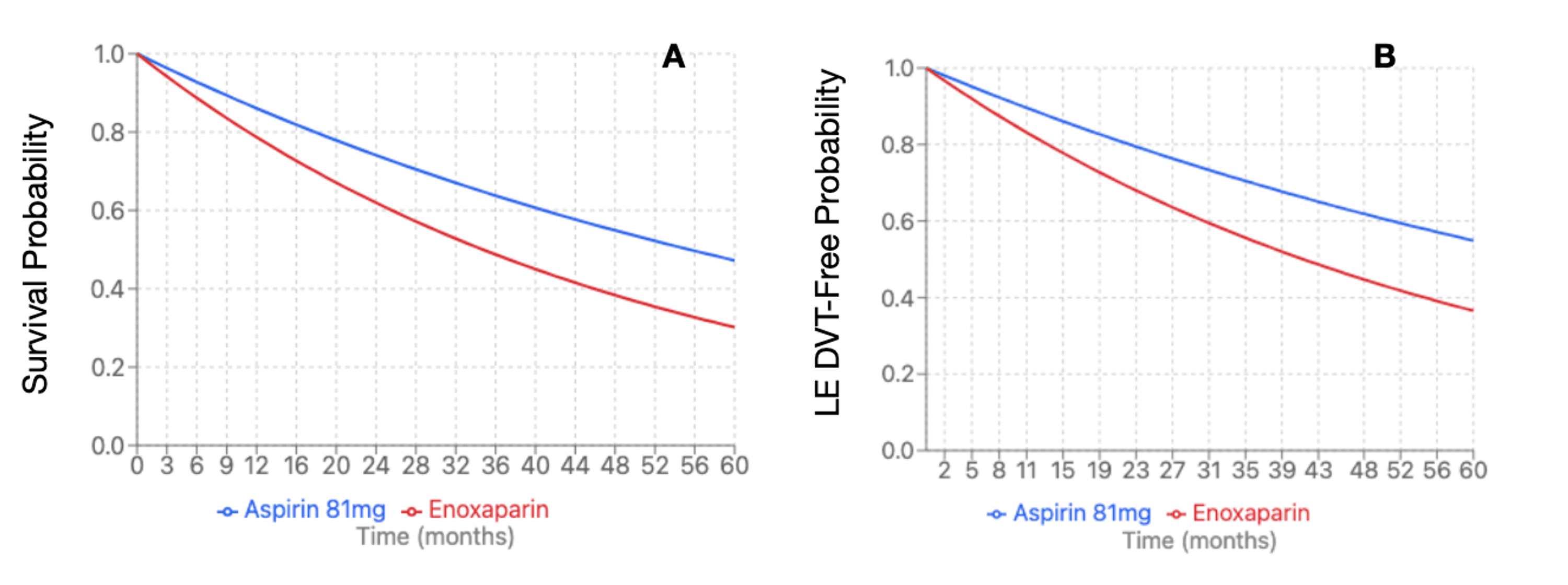
Propensity-score matching revealed 3,475 patients per cohort. The enoxaparin cohort was 58.8 + 15.3 years at index event, compared to the aspirin cohort at 58.2 + 14.3 years. The enoxaparin cohort had 2,438 (70.16%) female patients compared to the aspirin cohort with 2,445 (70.36%). Within the enoxaparin cohort, 2,539 (73.06%) were Caucasian patients, followed by 378 (10.88%) African American patients, 182 (5.24%) Hispanic/Latino patients, and 74 (2.13%) Asian patients. The aspirin cohort demonstrated similar demographics with 2,554 (73.5%) Caucasian patients, followed by 363 (10.45%) African American patients, 196 (5.64%) Hispanic/Latino patients, and 68 (1.96%) Asian patients. The enoxaparin cohort demonstrated significantly increased risk of LE DVT (HR 1.677, 95%CI 1.353 – 2.079, p=0.0081) and all-cause mortality (HR 1.597, 95%CI 1.422 – 1.794, p=0.0005) (Figure 3). There were no significant differences in rates of PE (HR 1.74, 95%CI 1.354 – 2.236, p=0.2408), UE DVT (HR 1.773, 95%CI 1.108 – 2.837, p=0.8625), superficial VT (HR 4.273, 95%CI 1.969 – 9.273, p=0.5196), bleeding (HR 1.093, 95%CI 0.937 – 1.275, p=0.8554), or transfusion (HR 1.896, 95%CI 1.556 – 2.311, p=0.2609) (Table 7). Due to a significant difference between enoxaparin and Aspirin 81 mg, an E-value was calculated for LE DVT (E-value = 2.744) and all-cause mortality (E-value = 2.574).

Kaplan-Meier-survival-curve-for-pituitary-Cushing's-subtype-(mortality-and-LE-DVT)
Figure 3: Kaplan-Meier survival curve for pituitary Cushing’s subtype (mortality and LE DVT)

(A) Mortality of enoxaparin compared to aspirin 81 mg (HR 1.597, 95%CI 1.422-1.794, p=0.0005); (B) LE DVT of enoxaparin compared to aspirin 81 mg (HR 1.677, 95%CI: 1.353-2.079, p=0.0081)

HR: hazard ration; DVT: deep vein thrombosis; LE: lower extremity

Discussion

The concept of hypercoagulability in the setting of hypercortisolemia has been documented since the 1970s [10]. Estimates suggest an 18-fold risk of venous thromboembolism in patients with Cushing’s syndrome compared to the general population [11]. Furthermore, venous thromboembolism accounts for up to 11% of all deaths in Cushing’s syndrome [12]. Patients are often noted to have a “coagulation paradox” in Cushing’s syndrome, whereby there is a heightened risk for thrombosis, with concurrent bruising of the skin; thromboembolism is due to an imbalance between pro- and anti-coagulant pathways, whereas bruising is due to atrophy of the skin and capillary fragility [11]. As noted by Feelders and Nieman, two prominent phases for the development of thromboembolic events include the untreated (active) hypercortisolemia and the postoperative phases [11]. Population-based studies have demonstrated a heightened risk for venous thromboembolism prior to diagnosis (in some studies as early as three years before diagnosis) [9].

Despite this heightened risk for venous thromboembolic events, there appears to be a lack of awareness amongst institutions (and individual practitioners), along with improper management. Fleseriu and colleagues, however, do note that in 2020, the awareness of hypercoagulability in Cushing’s syndrome increased around fourfold in two years, with routine prophylaxis increasing to 75% (from 50%) perioperatively (however, most patients only received prophylaxis for up to two weeks postoperatively) [13]. Another survey was performed by the European Reference Network on Rare Endocrine Conditions, noting concerns of heterogeneity with timing, type, and duration of prophylaxis, noting most centers do not have a thromboprophylaxis protocol (identifying only one reference center had a standardized thromboprophylaxis protocol for Cushing’s syndrome) [14]. From the European survey, it was noted that prophylaxis was initiated at diagnosis in 48% of patients, with 17% preoperatively, 26% on the day before (or of) surgery, 13% postoperatively, and 9% “depending on the presentation”. With regards to discontinuation of thromboprophylaxis, in centers with a standardized protocol (35% of reference centers), 38% of centers stopped at one month post-operatively, 25% between two and four weeks, and 37% between one week before and two weeks after surgery, between four and six days postoperatively, and at three months postoperatively. When cessation was individualized (in the remaining 65% of reference centers), 60% discontinued thromboprophylaxis once the patient was mobile, 40% with achievement of remission, 27% regarding patient status, and 7% dependent upon hemostatic parameters [14].

There is limited guidance concerning thromboprophylaxis recommendations in Cushing’s syndrome. For example, the Endocrine Society merely recommends assessing the risk of thrombosis in Cushing’s syndrome and administering perioperative prophylaxis if undergoing surgery, but provides no further recommendations [8]. The Pituitary Society highlights the absence of standardized practice for both pre- and postoperative thromboprophylaxis in patients with Cushing’s syndrome [15]. There appears to only be one set of guidelines for thromboprophylaxis in Cushing’s syndrome, known as the “Delphi Panel Consensus”, which forms the basis for the guidelines from the European Society for Endocrinology [9]. The Delphi Panel Consensus recommends considering anticoagulation for all patients with Cushing’s syndrome (in the absence of contraindications), regardless of the underlying etiology, and is recommended in the presence of risk factors [9]. Moreover, thromboprophylaxis is advised to begin at the time of diagnosis [9]. Currently, there is not enough evidence to provide a recommendation for thromboprophylaxis in mild autonomous cortisol secretion [9]. As with any medical patient, thromboprophylaxis should be initiated in all patients with active Cushing’s syndrome who are hospitalized (without contraindications) [9, 15]. Apart from chemical prophylaxis, anti-embolic stockings are not recommended due to the risk of skin fragility and friability [9]. The Delphi Consensus Panel furthermore advises to continue prophylactic anticoagulation for at least three months after biochemical remission (eucortisolemia) has occurred, and note those without additional risk factors (such as obesity, immobility, prior history of venous thromboembolism, or cardiac risk factors) can be considered candidates to stop the medication; one caveat, however, is for patients medically managed with mitotane (which can alter liver function and coagulation factor metabolism), there is an increased risk of bleeding, for which careful monitoring of renal function and bleeding risk is advised [9]. The Pituitary Society provides additional recommendations, such as discontinuing estrogen therapy in women (if used for contraception) [15]. While the Delphi Consensus Panel does not comment upon pediatric patients, the Pituitary Society advises against the use of thromboprophylaxis in the pediatric population due to bleeding risks [15].

The Delphi Consensus Panel furthermore recommend considering thromboprophylaxis at the time of inferior petrosal sinus sampling (if not started before this), due to the risk of thrombosis associated with this intervention; for those who are receiving prophylaxis, it is recommended to continue throughout the procedure, however, if has not been started, it is advised to initiate 12 hours post procedure. Similarly, if thromboprophylaxis was not considered earlier in a patient’s course, it should be reconsidered in the perioperative period, with the last dose of LMWH administered 24 hours prior to surgery and reinitiated 24 hours postoperatively [9]. Isand et al. recommend continuing thromboprophylaxis for three months after cortisol levels normalize (< 5 μg/dL) and when patients can mobilize [9]. In patients for whom a venous thromboembolism develops, patients are advised to receive a therapeutic dose of anticoagulation (preferably LMWH) for three to six months, followed by prophylaxis for three months after resolution of Cushing’s syndrome [9]. The Delphi Consensus Panel provides a summary of their recommendations, shown in Figure 4.

Algorithm-for-thromboprophylaxis-in-Cushing's-syndrome
Figure 4: Algorithm for thromboprophylaxis in Cushing’s syndrome

IPSS: inferior petrosal sinus sampling; VTE: venous thromboembolism; LMWH: low-molecular-weight heparin; DOAC: direct oral anticoagulant

Source: Isand et al., 2025 [9]; Published with permission.

Although intuitively, one may expect the procoagulant profile of Cushing’s syndrome to resolve upon attainment of eucortisolemia with medical management, studies have failed to demonstrate a reduction in venous thromboembolism with medical therapy [16]. Additionally, while one may expect resolution of hypercoagulability with surgical intervention (transsphenoidal sinus surgery or adrenalectomy), the risk maintains in the postoperative period, comparable to that of orthopedic surgery, at times up to one year and beyond to normalize [17]; data from European Register on Cushing’s Syndrome (ERCUSYN) database suggest the risk is greatest six months postoperatively [18]. The estimated risk for postoperative venous thromboembolism in pituitary-dependent Cushing’s is around 4.3% (compared to 0% with a non-functional pituitary adenoma); regarding adrenal surgery, the risk is estimated at around 2.6% [11]. Although the underlying mechanism for the persistent risk for venous thromboembolism remains unknown, it is hypothesized that a sudden drop in cortisol can lead to an inflammatory response (itself activating the coagulation cascade) [16]. Lopes and colleagues note an increase in the number of lymphocytes (because of loss of Th1 cell suppression), with increases in cytokines (such as interferon-gamma, interleukin-2, and transforming growth factor-beta) [16]. Comorbidities such as osteoporosis and myopathy (from hypercortisolemia) may be associated with decreased mobility in the postoperative period, influencing the risk for thrombosis [16].

Whilst all subtypes of Cushing’s syndrome can be associated with a heightened risk for venous thromboembolism (pituitary adenoma, adrenal adenoma, medication-induced, ectopic ACTH, and adrenal carcinoma), the latter two are often associated with malignant disease, which itself poses a risk for hypercoagulability from the underlying neoplasm [11]. Patients with Cushing’s syndrome have been found to demonstrate a reduction in activated partial thromboplastin time (aPTT), alongside increases in clot lysis time, procoagulant factors (such as factor VIII, von-Willebrand factor and fibrinogen) and fibrinolysis inhibitors (including plasminogen activator-inhibitor-1, thrombin activatable fibrinolysis inhibitor, and alpha-2 antiplasmin) [11,12,17]. Varlamov et al. have also noted an increase in thrombin, thromboxane A2, and platelets. Other studies have additionally demonstrated elevated proteins C and S as well as antithrombin III, which are hypothesized to be increased as a compensatory mechanism from the state of hypercoagulability [12]. Barbot et al. demonstrate elevation in factor VIII and von-Willebrand factor within the first few months after transsphenoidal sinus surgery, along with abnormally large von-Willebrand multimers (which are typically found in the cellular components), which can induce spontaneous platelet aggregation [17].

Lopes et al. note that altered von-Willebrand factor levels are not a constant feature reported in Cushing’s syndrome, and state it depends upon the polymorphism of the gene promoter, providing an example of haplotype 1 of the gene promoter conferring the greatest risk for elevated von-Willebrand factor levels by cortisol [16]. Barbot and colleagues furthermore note ABO blood groupings as an additional influencer of the procoagulant state; as an example, blood group-O patients have a near one-quarter reduction in levels of von-Willebrand factor [17]. Feelders and Nieman note heterogeneity in coagulation profiles based on individual characteristics and differing assay techniques [11]. van Haalen and colleagues note an absence of a correlation between severity of hypercortisolism and hemostatic abnormalities [14]; this is echoed by Varlamov et al., stating there is no linear relationship between coagulation parameters and venous thromboembolic events, nor with urinary free cortisol elevation [12]. Varlamov and colleagues further note that a subset of patients may have unaltered coagulation parameters, for which they advise against stratifying patients’ risk based on coagulation parameters [12].

In 2016, Zilio and colleagues posed a scoring system to stratify patients with active Cushing’s syndrome, including both clinical and biochemical parameters, including age (> 69 = 2 points), reduction in mobility (2 points), acute severe infection (1 point), prior cardiovascular event(s) (1 point), midnight plasma cortisol (> 3.15 times upper limit of normal = 1 point), and shortened aPTT (1 point) [19]. Lopes et al. describe the stratification as follows: 2 points (low risk), 3 points (moderate risk), 4 points (high risk), and > 5 points (very high risk) [16]. It should be noted, however, that Zilio et al.’s study was performed on only 176 patients and has not been validated in other studies [19]. Further drawbacks include the failure to account for postoperative events (a major source of venous thromboembolism in Cushing’s syndrome), and despite the stratification categories, no recommendations for treatment are provided.

LMWH is the first-line medication, consistent across differing societies. Despite being the gold standard, there are limited studies demonstrating a beneficial reduction in venous thromboembolic events in such cohorts; similarly, studies are lacking in analysis of the other classes of anticoagulants in head-to-head comparisons against LMWH for thromboprophylaxis in hypercortisolism. Another limitation is the fact that certain studies solely address thromboprophylaxis in the postoperative period. As an example, McCormick et al. performed one of the only trials comparing unfractionated heparin and LMWH (enoxaparin), noting no differences in hemorrhagic complications or thromboses; however, this was analyzed in patients undergoing transsphenoidal sinus surgery [10].

The current study retrospectively analyzed the various anticoagulant agents for the prevention of venous thromboembolism in Cushing’s syndrome (of any subtype), compared to the gold standard, LMWH (in this study, enoxaparin). When analyzing Cushing’s syndrome, our study demonstrated no significant differences in outcomes between enoxaparin and warfarin, apixaban, or unfractionated heparin; however, aspirin 81 mg demonstrated a lower risk of all-cause mortality, PE, and LE DVT. With subanalysis of Cushing’s disease (pituitary-related), there was no significant difference between enoxaparin and warfarin, apixaban or unfractionated heparin; aspirin 81 mg again noted a reduced all-cause mortality and LE DVT (but did not lower the risk of PE, compared with Cushing’s syndrome of all types combined). With E-value sensitivity analysis, the association remained moderately robust with PE (all Cushing’s types combined), LE DVT (all Cushing’s types and pituitary Cushing’s), and mortality (solely pituitary Cushing’s), however, mortality was weak-to-moderate with Cushing’s syndrome of all types (Table 8).

Outcome Hazard Ratio E-value Interpretation
PE (All Cushing’s Types) 1.697 2.783 Moderate
LE DVT (All Cushing’s Types) 1.492 2.348 Moderate
LE DVT (Pituitary) 1.677 2.744 Moderate
Mortality (All Cushing’s Types) 1.272 1.860 Weak
Mortality (Pituitary) 1.597 2.574 Moderate
Table 8: E-value sensitivity analyses for significant findings

DVT: deep vein thrombosis; LE: lower extremity; PE: pulmonary embolism

Aspirin, a non-steroidal anti-inflammatory drug, was first identified to irreversibly inhibit platelet function in the 1950s by Dr. Lawrence Craven [20]. Data is scarce in terms of aspirin’s role in thromboprophylaxis in hypercortisolemia. In 1999, Semple and Laws Jr. initially reported the use of aspirin postoperatively for six weeks (starting postoperative day one) in patients with Cushing’s disease who underwent transsphenoidal sinus surgery; while the authors mentioned a reduction in rates of venous thromboemboli, no factual data was provided (including dose of aspirin, complications experienced, and number of venous thromboemboli before and after) [21]. In 2015, Smith et al. performed an additional study with 81 mg of aspirin again administered starting postoperative day one (alongside sequential compression devices and mobilization), reporting that none of the 82 patients developed DVTs (with only two cases of epistaxis) [22]. It was not until 1994, however, in the Antiplatelet Trialists’ Collaborations’ meta-analysis, that aspirin demonstrated a reduced risk for venous thromboembolism, with similar findings replicated in the Pulmonary Embolism Prevention trial in 2000 and the WARFASA (Warfarin and Aspirin) and ASPIRE (Aspirin to prevent recurrent venous thromboembolism) trials in 2012 [23]. In 2012, the American College of Chest Physicians [24,25] were the first to recommend aspirin as thromboprophylaxis following total hip or knee replacement, followed by the National Institute for Health and Care Excellence in 2018 (advising LMWP followed by aspirin) and the American Society of Hematology in 2019 (advising either aspirin or oral anticoagulation after total hip or knee replacement) [25]. Despite recognition of the reduction in venous thromboembolism by aspirin (and its incorporation into guidelines), its role in thromboprophylaxis is largely limited to orthopedic surgery. The mechanisms of aspirin and its reduction in venous thromboembolism is not entirely understood, but believed to occur via differing mechanisms, including inhibition of cyclooxygenase-1 (which reduces thromboxane A2, a promoter of platelet aggregation), prevention of thrombin formation and thrombin-mediated coagulant reactions, acetylation of proteins involved in coagulation (such as fibrinogen), and enhancing fibrinolysis [23,26].

Strengths and limitations

To the best of our knowledge, a study specifically comparing the impact of aspirin with that of LMWP in Cushing’s syndrome has not been performed; as a result, our study adds to the paucity of literature pertaining to this topic. Notable strengths in the study include a large sample size (allowing robust comparisons amongst treatment arms), incorporation of propensity-score matching (allowing for internal validity through balancing baseline comparison groups), and comprehensive measurable outcomes.

Limitations to our study are multifold, and include retrospective design, for which intrinsic biases are inherent and can affect causal inference (despite matching techniques). Furthermore, data collection (via TriNetX) relied on correct ICD-10 coding, which could be a source of potential error if conditions and medications are coded improperly, or if our queries missed ICD-10 codes that could also correspond with outcomes. Similarly, TriNetX also relies on queries of healthcare organizations, many of which may not have responded with data, which could inaccurately skew the results. Although TriNetX uses global data, the majority of patient data was derived from the United States population, which could result in less generalizable data to the global public. These findings should be interpreted within the correct context and with caution to prevent misrepresentation. Compliance was a variable that could not be controlled for. Moreover, those who had taken the medication before the index event were excluded from analysis. While aspirin 81 mg demonstrated a reduction in LE DVT and mortality in Cushing’s disease along with PE with Cushing’s syndrome, we only performed a subgroup analysis concerning pituitary-related causes of Cushing’s syndrome (Cushing’s disease); it remains unclear why the risk of PE was not reduced in the latter subgroup. Due to limitations in ICD-10 coding, further subgroup analyses were not performed (such as adrenal adenoma, adrenal adenocarcinoma, or ectopic ACTH syndrome), for which the implications of treating with aspirin 81 mg cannot be inferred from our data. Similarly, further subgroup analyses, such as gender and race, were not performed. Our study assessed adult patients with Cushing’s syndrome, and not pediatric patients, which limits the applicability of our findings to such a cohort. Further studies are required to confirm and replicate our findings in a prospective fashion, stratifying subtypes of Cushing’s Syndrome.

Conclusions

Cushing’s syndrome is associated with a heightened risk for venous thromboembolism, regardless of the underlying etiology. Currently, LMWHs such as enoxaparin remain the gold standard for both thromboprophylaxis and treatment in such patients. There is limited data to support superiority over alternative agents. Our study analyzed enoxaparin against warfarin, unfractionated heparin, and apixaban, for which there was no significant risk difference. When compared to aspirin, enoxaparin demonstrated a greater risk for the development of PE, LE DVT, and all-cause mortality. Further prospective trials are required to replicate our findings and confirm the superiority of aspirin over LMWH.

References

  1. Ulrich-Lai YM, Figueiredo HF, Ostrander MM, Choi DC, Engeland WC, Herman JP: Chronic stress induces adrenal hyperplasia and hypertrophy in a subregion-specific manner. Am J Physiol Endocrinol Metab. 2006, 291:E965-73. 10.1152/ajpendo.00070.2006
  2. Lindholm J: Cushing’s syndrome: historical aspects. Pituitary. 2000, 3:97-104. 10.1023/a:1009905808033
  3. Raff H, Carroll T: Cushing’s syndrome: from physiological principles to diagnosis and clinical care. J Physiol. 2015, 593:493-506. 10.1113/jphysiol.2014.282871
  4. Newell-Price J, Bertagna X, Grossman AB, Nieman LK: Cushing’s syndrome. Lancet. 2006, 367:1605-17. 10.1016/S0140-6736(06)68699-6
  5. Savas M, Mehta S, Agrawal N, van Rossum EF, Feelders RA: Approach to the patient: diagnosis of Cushing syndrome. J Clin Endocrinol Metab. 2022, 107:3162-74. 10.1210/clinem/dgac492
  6. Suarez MG, Stack M, Hinojosa-Amaya JM, et al.: Hypercoagulability in Cushing syndrome, prevalence of thrombotic events: a large, single-center, retrospective study. J Endocr Soc. 2020, 4:bvz033. 10.1210/jendso/bvz033
  7. St-Jean M, Lim DS, Langlois F: Hypercoagulability in Cushing’s syndrome: from arterial to venous disease. Best Pract Res Clin Endocrinol Metab. 2021, 35:101496. 10.1016/j.beem.2021.101496
  8. Nieman LK, Biller BM, Findling JW, Murad MH, Newell-Price J, Savage MO, Tabarin A: Treatment of Cushing’s syndrome: an endocrine society clinical practice guideline. J Clin Endocrinol Metab. 2015, 100:2807-31. 10.1210/jc.2015-1818
  9. Isand K, Arima H, Bertherat J, et al.: Delphi panel consensus on recommendations for thromboprophylaxis of venous thromboembolism in endogenous Cushing’s syndrome: a position statement. Eur J Endocrinol. 2025, 192:R17-27. 10.1093/ejendo/lvaf017
  10. McCormick JP, Sun M, Shafqat I, Heaney AP, Bergsneider M, Wang MB: Venous thromboembolic (VTE) prophylaxis in Cushing Disease patients undergoing transsphenoidal surgery. Interdiscip Neurosurg. 2022, 27:10.1016/j.inat.2021.101371
  11. Feelders RA, Nieman LK: Hypercoagulability in Cushing’s syndrome: incidence, pathogenesis and need for thromboprophylaxis protocols. Pituitary. 2022, 25:746-9. 10.1007/s11102-022-01261-9
  12. Varlamov EV, Langlois F, Vila G, Fleseriu M: Management of endocrine disease: cardiovascular risk assessment, thromboembolism, and infection prevention in Cushing’s syndrome: a practical approach. Eur J Endocrinol. 2021, 184:R207-24. 10.1530/EJE-20-1309
  13. Fleseriu M, Biller BM, Grossman A, Swearingen B, Melmed S: Hypercoagulability in Cushing’s disease: a risk awareness and prophylaxis survey on behalf of the Pituitary Society. 15th International Pituitary Congress: Program and Abstracts. The Pituitary Society, Orlando, FL; 2017. 35.
  14. van Haalen FM, Kaya M, Pelsma IC, et al.: Current clinical practice for thromboprophylaxis management in patients with Cushing’s syndrome across reference centers of the European Reference Network on Rare Endocrine Conditions (Endo-ERN). Orphanet J Rare Dis. 2022, 17:178. 10.1186/s13023-022-02320-x
  15. Fleseriu M, Auchus R, Bancos I, et al.: Consensus on diagnosis and management of Cushing’s disease: a guideline update. Lancet Diabetes Endocrinol. 2021, 9:847-75. 10.1016/S2213-8587(21)00235-7
  16. Lopes V, Marques O, De Sousa Lages A: Preventive strategies for hypercoagulation in Cushing’s syndrome: when and how. Thromb J. 2023, 21:72. 10.1186/s12959-023-00515-1
  17. Barbot M, Daidone V, Zilio M, et al.: Perioperative thromboprophylaxis in Cushing’s disease: what we did and what we are doing?. Pituitary. 2015, 18:487-93. 10.1007/s11102-014-0600-y
  18. Isand K, Feelders R, Brue T, et al.: High prevalence of venous thrombotic events in Cushing’s syndrome: data from ERCUSYN and details in relation to surgery. Eur J Endocrinol. 2024, 190:75-85. 10.1093/ejendo/lvad176
  19. Zilio M, Mazzai L, Sartori MT, et al.: A venous thromboembolism risk assessment model for patients with Cushing’s syndrome. Endocrine. 2016, 52:322-32. 10.1007/s12020-015-0665-z
  20. Zaorsky NG, Buyyounouski MK, Li T, Horwitz EM: Aspirin and statin nonuse associated with early biochemical failure after prostate radiation therapy. Int J Radiat Oncol Biol Phys. 2012, 84:e13-7. 10.1016/j.ijrobp.2012.02.050
  21. Semple PL, Laws ER Jr: Complications in a contemporary series of patients who underwent transsphenoidal surgery for Cushing’s disease. J Neurosurg. 1999, 91:175-9. 10.3171/jns.1999.91.2.0175
  22. Smith TR, Hulou MM, Huang KT, Nery B, de Moura SM, Cote DJ, Laws ER: Complications after transsphenoidal surgery for patients with Cushing’s disease and silent corticotroph adenomas. Neurosurg Focus. 2015, 38:E12. 10.3171/2014.10.FOCUS14705
  23. Diep R, Garcia 😧 Does aspirin prevent venous thromboembolism?. Hematology Am Soc Hematol Educ Program. 2020, 2020:634-41. 10.1182/hematology.2020000150
  24. Maddukuri RK, Chava H, Kondaveeti ST, Mutthineni MV, Vegesana BP: Aspirin for prophylaxis of VTE in patients with hip/ knee replacement: systematic review and meta-analysis of non-randomized studies. Indian J Pharmacol. 2024, 56:420-9. 10.4103/ijp.ijp_732_21
  25. Spoladore R, Milani M, Spreafico LP, Agnelli G, Savonitto S: Prevention of thromboembolism after a fracture: is aspirin enough?. Eur Heart J Suppl. 2024, 26:i102-7. 10.1093/eurheartjsupp/suae025
  26. Undas A, Brummel-Ziedins KE, Mann KG: Antithrombotic properties of aspirin and resistance to aspirin: beyond strictly antiplatelet actions. Blood. 2007, 109:2285-92. 10.1182/blood-2006-01-010645

From https://www.cureus.com/articles/371036-therapeutic-options-for-the-prevention-of-thromboses-in-cushings-syndrome-a-propensity-matched-retrospective-cohort-analysis?score_article=true#!/

Osilodrostat Treatment of Cushing Syndrome in Real-World Clinical Practice

Abstract
Context
In clinical trials, osilodrostat (11β-hydroxylase inhibitor) effectively reduced cortisol levels in patients with endogenous Cushing syndrome (CS).
Objectives
A real-world study (ILLUSTRATE) was conducted evaluating osilodrostat use in patients with various etiologies of CS in the United States.
Methods
A retrospective chart-review study was conducted of adults with CS treated with osilodrostat between May 1, 2020, and October 29, 2021.
Results
A total of 42 patients (Cushing disease, n = 34; CS due to adrenal adenoma, n = 5; ectopic adrenocorticotropin syndrome [EAS], n = 3) were included. Starting doses were 2 mg twice daily in 27/42 patients (64.3%), maintenance doses were 2 mg twice daily in 6 of 9 patients (66.7%) attaining them. During osilodrostat treatment, urinary free cortisol (UFC) decreased below the upper limit of normal (ULN) in 14 of 20 patients (70.0%) with pretreatment UFC greater than the ULN. Osilodrostat response was observed across a range of doses (2-20 mg/day). In Cushing disease, median UFC and late-night salivary cortisol decreased from 3.03 and 2.39 × ULN, respectively, to 0.71 and 1.13 × ULN at last assessment in those with available data (n = 17 and 8, respectively). UFC decreased in all patients with adrenal CS or EAS with available data (n = 2 each). There were no unexpected safety signals; the most common adverse events (incidence ≥20%) were fatigue, nausea, and lower-extremity edema. Glucocorticoid withdrawal syndrome and/or adrenal insufficiency were reported in 12 of 42 patients (28.6%) after osilodrostat initiation, resulting in treatment discontinuation in 4.
Conclusion
In routine practice with dosing individualized according to clinical condition, response, and tolerability, osilodrostat was effective and well tolerated regardless of CS etiology and severity.
Cushing disease, ectopic adrenocorticotropin syndrome, adrenal Cushing syndrome, osilodrostat, retrospective, real world
Subject Pituitary and Neuroendocrinology
Issue Section: Clinical Research Article
Endogenous neoplastic Cushing syndrome (CS) is a serious endocrine condition characterized by excessive endogenous cortisol secretion [1, 2]. Untreated, hypercortisolism has serious cardiovascular, metabolic, neuropsychiatric, and infectious consequences, which negatively affect patients’ quality of life [2-4]. The risk of mortality is higher in patients with CS than in the general population, mainly because of greater mortality from cardiovascular and infectious diseases [2-5]. More recently, it has been shown that cancer risk is increased in population cohorts with CS [6, 7].
Most cases of CS are caused by excess secretion of adrenocorticotropin (ACTH) from a pituitary adenoma (Cushing disease), which results in excess cortisol release from the adrenal glands [2, 4]. However, some patients may present with ectopic ACTH syndrome (EAS; also referred synonymously as ectopic CS) or ACTH-independent cortisol excess from adrenal adenomas, adrenocortical cancers, or bilateral nodular adrenal hyperplasia (adrenal CS) [2, 4].
Osilodrostat is a potent oral inhibitor of 11β-hydroxylase, the enzyme that catalyzes the final step of cortisol synthesis in the adrenal cortex [8]. In phase 3 trials in patients with Cushing disease, osilodrostat was associated with a rapid and sustained reduction in cortisol levels, as well as improvements in cardiovascular and metabolic parameters, the physical manifestations of Cushing disease, and patients’ quality of life [9-13]. The clinical development program for osilodrostat also included a phase 2 study in patients with EAS or adrenal CS, which demonstrated that osilodrostat can lower cortisol regardless of the etiology of CS [14]. Based on these data, osilodrostat was licensed for use in adults with Cushing disease for whom pituitary surgery is not an option or has not been curative (United States) [15] and in adults/patients with endogenous CS (Europe [16]/Japan [17]).
Although prospective clinical trials are essential for demonstrating the efficacy and safety of drug therapies, they entail enrollment of selected patient populations and a tightly controlled research setting [18]. Real-world observational studies, in which the drug is used according to physicians’ clinical practice, provide complementary and helpful information in this context. Previous real-world studies conducted in patients with CS in Europe have shown that osilodrostat reduces cortisol levels and improves comorbidities, with no unexpected safety signals [19-22]. The present study, osIlodrostat reaL-worLd Utilization Study To Retrospectively Assess paTient Experience (ILLUSTRATE), was conducted in multiple clinical practices in the United States to evaluate the dosing, effectiveness, and safety of osilodrostat in patients with CS, irrespective of its etiology.
Materials and Methods
ILLUSTRATE was a retrospective chart-review study of patients in the United States treated with osilodrostat between May 1, 2020, and October 29, 2021. The index date for each patient was defined as the date of the first osilodrostat prescription (between May 1, 2020, and October 29, 2021). Preprescription data were collected from the 12 months before each patient’s index date to provide baseline data for that patient.
Patients were eligible for inclusion if aged 18 years or older, with a diagnosis of endogenous neoplastic CS (due to a pituitary adenoma, adrenal adenoma, or ectopic tumor) and a documented prescription for osilodrostat on or after May 1, 2020. As osilodrostat was approved for Cushing disease in the United States earlier the same year (March 6, 2020) [23], the start date for ILLUSTRATE was selected to avoid inclusion of patients treated with osilodrostat in clinical trials. The study was approved by a central independent review board (Western Institutional Review Board). As the study employed secondary data collection of anonymized patient data, a waiver of consent was granted under the privacy rule of HIPPA (the Health Insurance Portability and Accountability Act).
If available, the following data were extracted from patients’ medical records into an electronic case report form (eCRF): demographic details (age, sex, race, ethnicity); clinical history (date of CS diagnosis, signs and symptoms, prior surgery and/or radiotherapy); duration of disease prior to osilodrostat prescription; other therapies (cortisol-lowering medications, concomitant steroid use or replacement, antihypertensive and antidiabetic medications); laboratory data (urinary free cortisol [UFC], late-night salivary cortisol [LNSC], morning serum cortisol, serum potassium, testosterone [female patients only]); osilodrostat use (starting dose, uptitration, downtitration, duration of treatment); and adverse events (AEs). AEs were selected from a dropdown list that included the following: hypotension, hyperkalemia, hypokalemia, prolonged QT interval on electrocardiogram, lower-extremity edema, dizziness, rash, constipation, fatigue, alopecia, headache, nausea, vomiting, pituitary tumor size, hypertension, hirsutism, acne, irregular menstruation, brain fog or other cognitive changes, insomnia, striae, muscle weakness, depression, anxiety, other emotional changes, arthralgia/myalgia, and sleep changes.
The following variables were derived from the information recorded in the eCRF: time to maintenance dose (maintenance dose was defined as the first dose that was not modified between two consecutive visits, which could include the baseline visit); titration interval (time between osilodrostat dose changes; if patients had multiple dose changes, the average was reported); and proportion of patients on osilodrostat 6 months after the index prescription. In patients who had dose changes after reaching the maintenance dose, the time between these dose changes was included in the calculation of average titration interval.
Investigator-reported events of glucocorticoid withdrawal syndrome (GWS) and adrenal insufficiency (AI) were evaluated by two of the authors (J.L.S.-S. and K.C.D.) and adjudicated according to symptoms and the level of morning serum cortisol, where available. If the symptoms were consistent with GWS and serum cortisol at the time of the event was greater than 10 µg/dL (>276 nmol/L), these cases were classified as GWS. If the symptoms were more severe or cortisol levels were less than or equal to 10 µg/dL (≤276 nmol/L), AI could not be ruled out, and these cases were classified as such. If the investigator recorded GWS and AI in the same patient at the same visit, they were classified as a single event.
Descriptive statistics were used for all variables based on the number of patients with data available for each variable. Laboratory measures were reported as n times the upper limit of normal (ULN). Independent quality assessments were conducted to check content, inconsistencies, and missing fields in the eCRF.
Results
Overall, 42 patients were included in the study: 34 patients with Cushing disease, 5 patients with adrenal CS as a result of adrenal adenoma, and 3 patients with EAS. Two patients with Cushing disease had only a single clinical encounter and were included in the baseline results only. Four patients (9.5%), all with Cushing disease, discontinued osilodrostat during follow-up; in all cases, this was because of GWS or AI.
Baseline Characteristics
Baseline demographics and clinical characteristics are summarized in Table 1. Mean age was 43.7 years, and most patients (76.2%) were female. Mean disease duration before osilodrostat prescription was 57.3 months, and most patients had previously undergone surgery (81.0%) and/or received one or more medical therapies (61.9%). In the subgroup of patients with adrenal CS (n = 5), 2 patients had undergone surgery and 2 patients had expressed a preference not to undergo surgery; in the final patient, information on previous surgery was not recorded in the eCRF. In the overall study population, median UFC, LNSC, and morning serum cortisol levels were 2.54, 2.39, and 1.16 × ULN, respectively. Twelve and 5 patients, respectively, had morning serum cortisol levels and UFC less than the ULN at baseline; of these, 6 (50.0%) and 3 (60.0%), respectively, had received previous medical therapy.
Table 1.Open in new tabBaseline demographic and clinical characteristics (overall and by etiology)
  All patients
(n = 42) Cushing disease (n = 34) Adrenal CS (n = 5)a EAS
(n = 3)b
Mean age (SD), y 43.7 (15.0) 40.8 (13.9) 49.2 (14.0) 66.7 (3.5)
Sex, n (%)
 Female 32 (76.2) 27 (79.4) 2 (40.0) 3 (100)
 Male 10 (23.8) 7 (20.6) 3 (60.0) 0
Race, n (%)
 White 22 (52.4) 17 (50.0) 4 (80.0) 1 (33.3)
 Black or African American 10 (23.8) 8 (23.5) 1 (20.0) 1 (33.3)
 Asian 2 (4.8) 1 (2.9) 0 1 (33.3)
 Multiracial 1 (2.4) 1 (2.9) 0 0
 Unknown 7 (16.7) 7 (20.6) 0 0
Ethnicity, n (%)
 Hispanic, Latino, or Spanish origin
  Yes 8 (19.0) 8 (23.5) 0 0
  No 28 (66.7) 20 (58.8) 5 (100) 3 (100)
 Unknown 6 (14.3) 6 (17.6) 0 0
Mean age at CS diagnosis (SD), y 37.7 (14.8) 34.9 (12.7) 40.0 (14.8) 66.3 (3.1)
Mean duration of disease prior to osilodrostat prescription (SD), mo 57.3 (82.0) 64.8 (86.7) 30.4 (26.6) 1.2 (0.3)
Previous pituitary or adrenal surgery for CS, n (%) 34 (81.0) 32 (94.1) 2 (40.0) 0
Radiotherapy for CS in last 5 y, n (%) 10 (23.8) 10 (29.4) 0 0
Previous medical therapy for CS,c n (%) 26 (61.9) 21 (61.8) 3 (60.0) 2 (66.7)
 Pasireotide 3 (7.1) 3 (8.8) 0 0
 Cabergoline 7 (16.7) 7 (20.6) 0 0
 Ketoconazole 10 (23.8) 8 (23.5) 0 2 (66.7)
 Metyrapone 2 (4.8) 1 (2.9) 1 (20.0) 0
 Mitotane 1 (2.4) 0 1 (20.0) 0
 Mifepristone 6 (14.3) 5 (14.7) 1 (20.0) 0
UFC,d × ULN n = 32 n = 25 n = 4 n = 3
 Mean (SD) 7.67 (14.84) 3.14 (2.98) 13.93 (15.25) 37.03 (36.46)
 Median (min-max) 2.54
(0.09-75.20) 2.28
(0.09-11.17) 13.77
(0.42-27.76) 33.33
(2.57-75.20)
LNSC,d × ULN n = 18 n = 16 n = 1 n = 1
 Mean (SD) 4.80 (8.18) 5.25 (8.59) 0.55 1.82
 Median (min-max) 2.39
(0.44-36.33) 2.78
(0.44-36.33) 0.55 1.82
Morning serum cortisol,d × ULN n = 32 n = 24 n = 5 n = 3
 Mean (SD) 1.23 (0.77) 1.13 (0.42) 1.08 (0.97) 2.33 (1.78)
 Median (min-max) 1.16
(0.19-4.38) 1.18
(0.19-1.88) 0.83
(0.39-2.76) 1.43
(1.17-4.38)
Potassium levels,d mmol/L n = 41 n = 33 n = 5 n = 3
 Mean (SD) 4.1 (0.6) 4.3 (0.5) 3.7 (0.5) 3.6 (0.9)
 Median (min-max) 4.0
(2.6-5.6) 4.2
(3.6-5.6) 3.4
(3.3-4.5) 3.7
(2.6-4.4)
Potassium levels <LLN,e n (%) n = 37
5 (13.5) n = 30
1 (3.3) n = 5
3 (60.0) n = 2
1 (50.0)
Testosterone levels,f × ULN n = 11 n = 9 n = 1 n = 1
 Mean (SD) 1.00 (1.48) 0.96 (1.56) 0.07 2.29
 Median (min-max) 0.36
(0.03-5.02) 0.36
(0.03-5.02) 0.07 2.29
ULNs varied between study centers, ranging from 32 to 64 µg/24 hours (88.3-176.6 nmol/L) for UFC, 0.01 to 0.112 µg/dL (0.28-3.09 nmol/L) for LNSC, 18.4 to 25 µg/dL (507.8-690.0 nmol/L) for morning serum cortisol, and 41 to 100 ng/dL (1.42-3.47 nmol/L) for testosterone (female patients).
Abbreviations: CS, Cushing syndrome; EAS, ectopic adrenocorticotropin syndrome; LLN, lower limit of normal; max, maximum; min, minimum; ULN, upper limit of normal.
aAll patients had adrenal adenoma.
bIn 1 patient, the primary tumor could not be located; in the other 2 patients, the location of the ectopic tumor was not recorded.
cReasons for stopping these therapies and switching to osilodrostat were not collected as part of this study.
dNot all patients had values recorded at baseline (see n numbers in each column).
eLLN was not available for all patients with available potassium data.
fFemale patients only.
Osilodrostat Dosing
Information on osilodrostat dosing is summarized in Table 2. The most common starting dose of osilodrostat was 4 mg/day in 28 of 47 patients (66.7%; Fig. 1A), comprising 2 mg twice daily in 27 patients and 4 mg once daily in 1 patient. Some patients with Cushing disease and adrenal CS were initiated on lower doses (1 mg once daily [n = 2] or twice daily [n = 10], or 2 mg once daily [n = 1]).
A, Total osilodrostat daily starting dose* in all patients (n = 42) and B, dose changes postinitiation (by etiology) in patients with at least one clinical encounter after initiating osilodrostat (n = 40). *Osilodrostat starting doses were given twice daily in all except 3 patients with Cushing disease (initiated on 1 mg once daily, 2 mg once daily, and 4 mg once daily) and 1 patient with adrenal CS (initiated on 1 mg once daily).
Figure 1.A, Total osilodrostat daily starting dose* in all patients (n = 42) and B, dose changes postinitiation (by etiology) in patients with at least one clinical encounter after initiating osilodrostat (n = 40). *Osilodrostat starting doses were given twice daily in all except 3 patients with Cushing disease (initiated on 1 mg once daily, 2 mg once daily, and 4 mg once daily) and 1 patient with adrenal CS (initiated on 1 mg once daily).
Open in new tabDownload slide
Abbreviations: CS, Cushing syndrome; EAS, ectopic adrenocorticotropin syndrome.
Table 2.Open in new tabOsilodrostat treatment (overall and by etiology)
  All patients
(n = 42) Cushing disease (n = 34) Adrenal CS (n = 5) EAS
(n = 3)
No. of patients with initial dose information 42 34 5 3
Starting total daily dose, mg
 Mean (SD) 3.4 (1.1) 3.4 (1.1) 3.0 (1.4) 4.0 (0.0)
 Median (min-max) 4 (1-6) 4 (1-6) 4 (1-4) 4 (4-4)
Starting dose schedule, n (%)
 Twice daily 38 (90.5) 31 (91.2) 4 (80.0) 3 (100)
 Once daily 4 (9.5) 3 (8.8) 1 (20.0) 0
Starting dose and schedule, n (%)
 1 mg once daily 2 (4.8) 1 (2.9) 1 (20.0) 0
 1 mg twice daily 10 (23.8) 9 (26.5) 1 (20.0) 0
 2 mg once daily 1 (2.4) 1 (2.9) 0 0
 2 mg twice daily 27 (64.3) 21 (61.8) 3 (60.0) 3 (100)
 3 mg twice daily 1 (2.4) 1 (2.9) 0 0
 4 mg once daily 1 (2.4) 1 (2.9) 0 0
No. of patients with postinitiation clinical encounters 40 32 5 3
Patients who reached maintenance dose by last interaction, n (%) 9 (22.5) 7 (21.9) 1 (20.0) 1 (33.3)
Time to maintenance dose or end of follow-up, wk
 Mean (SD) 34.7 (18.0) 36.7 (19.1) 23.0 (11.7) 33.6 (3.3)
 Median (min-max) 33 (0.7-78.1) 37 (0.7-78.1) 17 (13.0-37.6) 32 (31.3-37.4)
Maintenance dose,a n (%)
 2 mg twice daily 6 (66.7) 4 (57.1) 1 (100) 1 (100)
 4 mg twice daily 2 (22.2) 2 (28.6) 0 0
 10 mg twice daily 1 (11.1) 1 (14.3) 0 0
Patients with dose change, n (%) 25 (62.5) 21 (65.6) 2 (40.0) 2 (66.7)
Titration period in patients with dose change, wk
 Mean (SD) 13.8 (12.4) 14.8 (13.2) 4.9 (3.2) 13.0 (0.0)
 Median (min-max) 11 (2.6-57.0) 11 (4.6-57.0) 5 (2.6-7.1) 13 (13.0-13.0)
Osilodrostat treatment interruption,b n (%) 9 (22.5) 7 (21.9) 1 (20.0) 1 (33.3)
Duration of exposure up to treatment interruption or study end, wk
 Mean (SD) 35.2 (22.0) 36.5 (22.5) 26.8 (26.3) 35.8 (4.5)
 Median (min-max) 35 (0.7-78.1) 38 (0.7-78.1) 14 (4.0-69.7) 37 (30.7-39.3)
Duration of treatment up to study end,c wk
 Mean (SD) 37.0 (20.9) 38.2 (21.5) 29.4 (24.0) 36.0 (4.2)
 Median (min-max) 37 (0.7-78.1) 40 (0.7-78.1) 17 (13.0-69.7) 37 (31.3-39.3)
Patients on osilodrostat for ≥6 mo prior to study end,c,d n (%) 28 (96.6) 23 (95.8) 2 (100) 3 (100)
Duration of therapy prior to study endc in patients with ≥6 mo persistence, wk
 Mean (SD) 47.3 (15.2) 48.5 (15.3) 51.6 (25.6) 36.0 (4.2)
 Median (min-max) 44.9 (28.1-78.1) 45.7 (28.1-78.1) 51.7 (33.6-69.7) 37.4 (31.3-39.3)
Abbreviations: CS, Cushing syndrome; EAS, ectopic adrenocorticotropin syndrome.
aIn those who reached a maintenance dose (defined as a dose that was not modified between 2 consecutive visits) by last interaction.
bDefined as a break in osilodrostat treatment for 30 days or longer.
cOr treatment discontinuation (n = 4).
dIn 29 patients with 6 months’ follow-up (n = 24, 2, and 3 for Cushing disease, adrenal CS, and EAS, respectively).
Mean titration interval was 13.8 weeks for all patients (4.9 weeks in patients with adrenal CS, 13.0 weeks in patients with EAS, and 14.8 weeks in patients with Cushing disease). Nine patients (22.5%; 7 patients with Cushing disease and 1 patient each with adrenal CS and EAS) achieved a maintenance dose of osilodrostat (defined as no dose modification between 2 consecutive visits) after a mean (SD) of 34.7 (18.0) weeks. The most common maintenance dose was 2 mg twice daily (see Table 2).
Overall, 25 of 40 patients (62.5%) had their osilodrostat dose adjusted during the study. In most of these cases (n = 20), the dose was increased; 2 patients had a dose decrease and 3 patients had doses both increased and decreased (Fig. 1B). In those who had an osilodrostat dose increase only, most (14/20; 70.0%) had only a single dose increase; in the remaining patients, 4 (20.0%) had 2 dose increases and 2 (10.0%) had 4 dose increases. In those who had dose adjustments, there was no observable pattern between starting and final osilodrostat doses (Table 3). Overall, 9 of 40 patients (22.5%) had osilodrostat treatment temporarily interrupted, which occurred in the first 3 months of treatment in 5 patients, between treatment months 3 and 6 in 2 patients, and after 6 months in 2 patients. Reasons for temporary interruption were hypocortisolism-related AEs, patient undergoing surgery, lack of availability of osilodrostat in the hospital setting, and insurance noncoverage.
Table 3.Open in new tabShift table showing starting and final doses for those patients who had dose adjustments during the study period (n = 26)
Starting dosea Final dose, No. of patients
  1 mg/d 2 mg/d 4 mg/d 5 mg/d 6 mg/d 8 mg/d 10 mg/d 14 mg/d 20 mg/d
Cushing diseaseb
1 mg/d (n = 1)1
2 mg/d (n = 10)811
4 mg/d (n = 11) 1 1 1 4 2 2
Adrenal CS
1 mg/d (n = 1)1
4 mg/d (n = 1)1
EAS
4 mg/d (n = 2)11
Some patients had the same starting and final doses as their doses were increased then decreased during the study.
Abbreviations: CS, Cushing syndrome; EAS, ectopic adrenocorticotropin syndrome.
aOsilodrostat starting doses were given twice daily in all except 3 patients with Cushing disease (initiated on 1 mg once daily, 2 mg once daily, and 4 mg once daily) and 1 patient with adrenal CS (initiated on 1 mg once daily).
bOne patient had only their osilodrostat starting dose reported.
Mean (SD) duration of follow-up was 37.1 (20.5) weeks, and mean (SD) duration of osilodrostat treatment was 37.0 (20.9) weeks; almost all patients with postinitiation clinical encounters (96.6%) received treatment for 6 months or longer (see Table 2).
Changes in Cortisol Levels During Osilodrostat Treatment
In patients with available assessments, median values for all cortisol parameters decreased during osilodrostat treatment, regardless of CS etiology (Table 4). In the subgroup of patients with Cushing disease, median UFC and morning serum cortisol levels were less than the ULN at the last assessment (0.71 and 0.68 × ULN, respectively), while median LNSC levels were slightly higher than the ULN (1.13 × ULN). In patients with UFC, LNSC, and morning serum cortisol levels greater than the ULN at baseline, 12 of 16, 3 of 8, and 8 of 15, respectively, had levels less than the ULN during osilodrostat treatment (Fig. 2); the final osilodrostat doses in these patients ranged from 1 to 20 mg/day. Neither of the patients who had a final dose of 20 mg/day were receiving concomitant glucocorticoids (ie, they were not being treated with a “block-and-replace” approach). In those with UFC and morning serum cortisol less than the ULN at baseline, levels remained less than the ULN in 1 of 1 and 7 of 8 patients, respectively.
Changes in A, UFC; B, LNSC; and C, morning serum cortisol in individual patients. *In patient 23, the first and last doses recorded were both 2 mg twice daily; during the follow-up period, 2 changes in dose were recorded the same day on 2 separate occasions.
Figure 2.Changes in A, UFC; B, LNSC; and C, morning serum cortisol in individual patients. *In patient 23, the first and last doses recorded were both 2 mg twice daily; during the follow-up period, 2 changes in dose were recorded the same day on 2 separate occasions.
Open in new tabDownload slide
Abbreviations: CS, Cushing syndrome; EAS, ectopic adrenocorticotropin syndrome; LNSC, late-night salivary cortisol; NA, not available; UFC, urinary free cortisol; ULN, upper limit of normal.
Table 4.Open in new tabMedian (minimum-maximum) urinary free cortisol, late-night salivary cortisol, and morning serum cortisol levels (overall and by etiology)
  All patients Cushing disease Adrenal CS EAS
UFC, × ULN n = 21 n = 17 n = 2 n = 2
 Baseline 3.73 (0.09-75.20) 3.03 (0.09-11.17) 14.40 (1.03-27.76) 54.27 (33.33-75.20)
 Last assessment 0.71 (0.02-11.82) 0.71 (0.07-4.19) 6.18 (0.53-11.82) 1.44 (0.02-2.86)
LNSC, × ULN n = 8 n = 8 n = 0 n = 0
 Baseline2.39 (1.44-5.89)2.39 (1.44-5.89)
 Last assessment1.13 (0.44-4.44)1.13 (0.44-4.44)
Morning serum cortisol, × ULN n = 30 n = 23 n = 5 n = 2
 Baseline 1.15 (0.19-4.38) 1.16 (0.19-1.88) 0.83 (0.39-2.76) 2.91 (1.43-4.38)
 Last assessment 0.67 (0.02-2.76) 0.68 (0.19-1.87) 0.61 (0.05-2.76) 0.47 (0.02-0.93)
Results are based on patients with both baseline and postosilodrostat prescription data available.
Abbreviations: CS, Cushing syndrome; EAS, ectopic adrenocorticotropin syndrome; LNSC, late-night salivary cortisol; UFC, urinary free cortisol; ULN, upper limit of normal.
The effect of osilodrostat on UFC and morning serum cortisol levels in individual patients with adrenal CS or EAS and available data are shown in Fig. 2A and 2C, respectively. In patients with adrenal CS, UFC levels were reduced in the 2 patients with data available, and morning serum cortisol levels were reduced in 2 of 5 patients with data available. In patients with EAS, there were substantial reductions both in UFC and morning serum cortisol (n = 2).
The time course of cortisol changes and corresponding osilodrostat doses in 2 patients with Cushing disease and 2 patients with EAS are illustrated in Fig. 3.
Individual osilodrostat dosing, UFC, and serum cortisol levels during the study period in illustrative patients. ULN for UFC was 50 μg/24 hours for patients 11, 4, and 1 and 42 μg/24 hours for patient 2. *ULN for serum cortisol was not provided for this patient, so it was estimated to be approximately 18 µg/dL.
Figure 3.Individual osilodrostat dosing, UFC, and serum cortisol levels during the study period in illustrative patients. ULN for UFC was 50 μg/24 hours for patients 11, 4, and 1 and 42 μg/24 hours for patient 2. *ULN for serum cortisol was not provided for this patient, so it was estimated to be approximately 18 µg/dL.
Open in new tabDownload slide
Abbreviations: BID, twice daily; EAS, ectopic adrenocorticotropin syndrome; UFC, urinary free cortisol; ULN, upper limit of normal.
Safety and Tolerability
Overall, 29 patients (69.0%) had an AE reported. The most common AEs (incidence ≥20%) were fatigue, nausea, and lower-extremity edema (Table 5).
Table 5.Open in new tabAdverse events reported during osilodrostat treatment (overall patient population)a
AE, n (%) n = 42a
Any AE 29 (69.0)
Fatigue 23 (54.8)
Nausea 12 (28.6)
Lower-extremity edema 11 (26.2)
Headache 6 (14.3)
Dizziness 6 (14.3)
Hypokalemia 6 (14.3)
Alopecia 4 (9.5)
Vomiting 3 (7.1)
Hypotension 2 (4.8)
Hyperkalemia 1 (2.4)
Prolonged QT interval on electrocardiogram 1 (2.4)
Abbreviation: AE, adverse event.
aIncludes 2 patients who had no postinitiation interaction before study end.
According to the events reported by the investigators, 13 patients had GWS (n = 3), AI (n = 3), or both (n = 7). Of these, osilodrostat treatment was interrupted in 3 patients, the dose was decreased in 2 patients, and there was no change in dose in 4 patients; in the remaining 4 patients, osilodrostat treatment was discontinued. Glucocorticoid use was reported in 4 patients overall; this included 2 patients in whom AI and/or GWS were reported. The first patient reported to have AI and GWS by the investigator was prescribed hydrocortisone 5 mg twice daily for 2 weeks. The second patient (AI) was also prescribed hydrocortisone at a dose of 20 mg/day (duration not specified).
On author adjudication, using the criteria outlined in “Materials and Methods,” 1 case of AI was reclassified as GWS and 5 cases reported to be both GWS and AI by the investigator were reclassified as AI only. Another case of AI was excluded as the symptoms of AI had started before initiation of osilodrostat; this patient had been treated with pasireotide in the 5 months before starting osilodrostat. Thus, the number of author-adjudicated cases during osilodrostat treatment was 12: 4 for GWS, 6 for AI, and 2 for both (ie, patients experiencing ≥1 distinct episode of GWS and AI).
To illustrate different presentations and management practices of AI and GWS, we describe details regarding individual cases. In 1 patient with GWS, symptoms were dizziness, nausea, and fatigue, with serum cortisol levels remaining above 10 µg/dL (276 nmol/L). The symptoms occurred early in the course of treatment and were managed by reducing the osilodrostat dose. In another patient with GWS, symptoms occurred after prolonged treatment, and osilodrostat was discontinued. In 2 patients with AI, symptoms were also dizziness, nausea, and fatigue, but serum cortisol levels were less than or equal to 10 µg/dL (≤276 nmol/L). In the first patient, osilodrostat was maintained at the same dose; symptoms resolved and cortisol levels increased slightly, to above 10 µg/dL (276 nmol/L). Treatment was interrupted in the second patient, but further information on the symptoms and cortisol levels were unavailable.
In patients with available data at baseline and last assessment (n = 38), median (minimum-maximum) serum potassium levels were 4.0 (2.6-5.6) and 4.3 (3.7-5.5) mmol/L, respectively. In those who were normokalemic at baseline (n = 30), 2 patients had potassium levels less than the lower limit of normal during osilodrostat treatment; in those who were hypokalemic at baseline (n = 4), 3 patients had potassium levels reverting to normal during treatment. In female patients with available data at baseline and last assessment (n = 4), mean testosterone levels were 1.48 × ULN at baseline and 1.52 × ULN at the last posttreatment assessment.
Discussion
This study evaluated the real-world use of osilodrostat in patients in the United States with CS during the period shortly after osilodrostat was approved by the US Food and Drug Administration for the treatment of adults with Cushing disease for whom pituitary surgery is not an option or has not been curative. The results highlight the importance of selecting a starting dose and titration regimen according to each patient’s circumstances, clinical response, and tolerability, as the dose required to normalize cortisol levels varies between patients and does not appear to depend on baseline levels. Most of the patients in the study (n = 34/42 [81.0%]) had Cushing disease, as expected. In this subgroup, most patients (n = 21/34 [61.8%]) were initiated on the approved starting dose of osilodrostat (2 mg twice daily), but many (n = 11/34 [32.4%]) were started on lower doses. All patients with Cushing disease who were initiated on doses lower than 2 mg twice daily required a dose increase during the study. A dose of 2 mg twice daily was also the most common maintenance dose in those with Cushing disease who reached a maintenance dose: a total of 57.1% remained on 2 mg twice daily, while 28.6% and 14.3% were uptitrated to 4 mg twice daily and 10 mg twice daily, respectively. In phase 3 clinical trials of osilodrostat in patients with Cushing disease (LINC 3 and LINC 4), median (interquartile range) average doses at the end of the extension periods were 7.4 (3.5-13.6) mg/day in LINC 3 and 4.6 (3.7-9.2) mg/day in LINC 4 [9, 11]. In the present study, most patients whose dose was uptitrated required only one dose increase. Mean duration of the titration period in patients with Cushing disease, defined as the period between any osilodrostat dose changes, was 14.8 weeks. In LINC 3 and LINC 4, doses were increased according to UFC levels in the first 12 weeks, after which dose adjustments were permitted during the remainder of the 48-week core period based on efficacy and tolerability [10, 12]. In both trials, starting and final osilodrostat doses were lower in Asian patients with Cushing disease than in non-Asian patients, regardless of body mass index, likely because of differences in bioavailability [24].
In the subgroup of patients with Cushing disease, most of those with UFC and morning serum cortisol levels greater than the ULN at baseline had their levels reduced to normal during treatment (12/16 and 8/15, respectively). Some patients had UFC and morning serum cortisol levels less than the ULN when osilodrostat was initiated, presumably reflecting a switch to osilodrostat from another medical therapy (eg, because of tolerability issues). More than 60% of patients had received one or more medical therapies before starting osilodrostat, but the reasons for stopping these therapies were not collected as part of the study. In patients with normal levels at study baseline, levels remained less than the ULN in 1 of 1 patient for UFC and 6 of 8 patients for morning serum cortisol. Median levels of UFC and morning serum cortisol in the subgroup of patients with Cushing disease decreased to within the normal range during osilodrostat treatment. These real-world results are consistent with those from the 48-week core phases of LINC 3 and LINC 4 [10, 12, 13].
The present study also included a small number of patients with adrenal CS (n = 5) and EAS (n = 3). The starting dose was 2 mg twice daily in all patients with EAS; in patients with adrenal CS, the starting dose was 2 mg twice daily (n = 3), 1 mg twice daily (n = 1), and 1 mg once daily (n = 1). Baseline median UFC, which was higher in the adrenal CS and EAS subgroups than in patients with Cushing disease, decreased during osilodrostat treatment but remained above the ULN. Median morning serum cortisol levels decreased from above to within the normal range in patients with EAS and remained within the normal range in patients with adrenal CS. Notably, baseline levels of morning serum cortisol, mean UFC, or LNSC did not necessarily predict the osilodrostat dose needed for biochemical normalization. Again, these results emphasize the need to individualize the starting dose and titration regimen based on each patient’s clinical circumstances and response to treatment. Differences in the pathophysiology of CS subtypes may also influence decisions about osilodrostat titration; for example, unlike in Cushing disease, ACTH rarely rises during inhibition of cortisol synthesis in EAS, and the rise in ACTH is delayed after cortisol normalization in adrenal CS. The results for the adrenal CS and EAS subgroups in the present study should be interpreted with caution given the small number of patients, and data from individual patients are perhaps more illustrative in this context. Individual UFC and morning serum cortisol levels were reduced in all patients with adrenal CS or EAS except for 2 patients (both with adrenal CS), whose morning serum cortisol levels did not change; in one of these patients, morning serum cortisol was within the normal range at baseline. Data on LNSC levels should also be interpreted with caution given the small number of patients with data available for this parameter.
The safety profile of osilodrostat was similar to that observed in clinical trials [10, 12, 14], with no unexpected safety signals. GWS and AI are recognized as potential side effects of osilodrostat based on its mechanism of action, but they can be difficult to differentiate as many of their symptoms overlap [25]. In the present study, there were 12 cases of GWS and/or AI after initiation of osilodrostat (28.6% of patients); this rate is lower than in the LINC 3 clinical trial (54.0% of patients with hypocortisolism-related AEs) [9] and similar to that seen in LINC 4 (27.4%) [11]. In LINC 3 and LINC 4, most hypocortisolism-related AEs were classified by the investigator as AI [11], but further evaluation to differentiate between this and GWS was not possible. For the present study, we were able to evaluate the symptoms and biochemical changes associated with these AEs, and we confirmed that it was often not possible for clinicians to accurately distinguish GWS and AI based on symptoms alone. As GWS and AI may require different management approaches, measurement of serum cortisol levels is essential to help guide the management strategy in these cases. In the present study, most cases of GWS and AI were managed by reducing the dose or temporarily interrupting treatment, which is consistent with the results from LINC 3 and LINC 4 [9-12]; only 4 patients (9.5%) with AI or GWS in the present study had discontinued treatment as a result. Treatment with glucocorticoids was recorded in 2 patients; the timing of treatment indicates that glucocorticoids were used to treat the symptoms of AI/GWS rather than as part of a “block-and-replace” strategy, in which glucocorticoids are administered concomitantly with osilodrostat [21, 26]. Slower dose escalation may reduce the risk of hypocortisolism-related AEs; the longer titration interval in LINC 4 (every 3 weeks) than in LINC 3 (every 2 weeks) may explain the lower incidence of hypocortisolism-related AEs during LINC 4 [10, 12]. Regardless, and as with all steroidogenesis inhibitors, all patients treated with osilodrostat should be monitored regularly and educated on the signs and symptoms of GWS and AI. Case reports have described rare episodes of delayed cortisol reduction during chronic osilodrostat therapy and prolonged AI after its discontinuation, which emphasizes the importance of lifelong, close monitoring of symptoms and serum cortisol levels [27-29].
The results of the present study are consistent with those of previous studies demonstrating the efficacy and safety of osilodrostat in patients with EAS or adrenal CS. In a prospective phase 2 study conducted in Japan, mean UFC levels decreased in all patients and normalized in most following 12 weeks of treatment [14]. In LINC 7, a retrospective study conducted in France, 103 patients with adrenal CS or EAS were followed up retrospectively for up to 36 months; at last assessment, mean UFC was normalized in most patients [30]. Compared with LINC 7, the starting and maintenance doses of osilodrostat were lower in the present study, once again emphasizing the importance of individualizing osilodrostat dosing. In a second real-world study in France, which was conducted in 30 patients with EAS, median UFC decreased significantly following osilodrostat monotherapy (when used both first and second line) and combination therapy with other cortisol-lowering drugs [21]. There were also substantial improvements in hypertension, hyperglycemia, and hypokalemia, allowing the discontinuation or dose reduction of concomitant treatments. Several other case series and case reports have documented effective control of cortisol levels and good tolerability in patients with adrenal CS or EAS [26, 31-38], adding to the body of evidence supporting the use of osilodrostat in patients with CS irrespective of severity and etiology.
Limitations of the present study include the small patient numbers, particularly in the groups with adrenal CS and EAS. As the study was conducted shortly after osilodrostat was approved in the United States for patients with Cushing disease for whom pituitary surgery is not an option or has not been curative, the predominance of patients with Cushing disease was expected, albeit slightly higher (81%) than the overall prevalence of Cushing disease (up to 70%), vs other causes of CS in a clinical setting [2]. Another limitation is that data were extracted retrospectively from patients’ medical records rather than recorded prospectively according to a study protocol; this resulted in many missing data points, especially for laboratory data. Despite these limitations, the results provide invaluable information on the real-world use of osilodrostat in the United States, for which data are currently lacking. The design of the study also allowed adjudication of AI vs GWS events by the authors in some patients as morning cortisol levels were available. In addition, ILLUSTRATE is the only completed multicenter study in the United States to date that evaluates the effect of osilodrostat not only in Cushing disease, but also in adrenal CS and EAS, providing data on the cortisol-lowering effectiveness of osilodrostat across the spectrum of hypercortisolism etiologies.
Conclusions
Results of this real-world study are consistent with those from clinical trials and other real-world studies, showing that osilodrostat was effective and well tolerated in patients with varying etiologies and severities of CS when used by physicians in routine clinical practice. The results also highlight the importance of individualizing the osilodrostat dose and titration regimen according to each patient’s clinical condition, response, and tolerability.
Acknowledgments
We thank all clinicians and patients who participated in the study.
Funding
This work was supported by Recordati Rare Diseases Inc, Bridgewater, New Jersey, United States. AMICULUM provided medical editorial assistance, funded by Recordati Rare Diseases Inc.
Disclosures
M.F. reports grants to her university from Crinetics and Sparrow and occasional scientific consulting fees from Crinetics, Recordati Rare Diseases, Sparrow, and Xeris Pharmaceuticals; she served as a member of the LINC 3 steering committee. R.J.A. reports grants and personal fees from Xeris Pharmaceuticals, Spruce Biosciences, Neurocrine Biosciences, Corcept Therapeutics, Diurnal Ltd, Sparrow Pharmaceuticals, Crinetics Pharmaceuticals, and Recordati Rare Diseases and personal fees from Adrenas Therapeutics, Quest Diagnostics, H Lundbeck A/S, Novo Nordisk, and Besins Pharmaceuticals. W.H. reports grants to his institution from CinCor, Corcept, Crinetics, Spruce, and Ascendis and honoraria from Novo Nordisk, Recordati Rare Diseases, Chiesi, Crinetics, Neurocrine, Camurus, and Spruce. J.L.S.-S. reports research grants from Recordati Rare Diseases and scientific consulting fees from Crinetics, Recordati Rare Diseases, and Corcept. K.C.J.Y. reports grants to his institution from Corcept, Sparrow, Chiesi, and Ascendis and honoraria from Novo Nordisk, Ascendis, Chiesi, Recordati Rare Diseases, Xeris, Crinetics, Camurus, and Neurocrine. K.C.D. and J.P. are employees of Recordati Rare Diseases Inc. E.K.B. was an employee of Recordati Rare Diseases Inc at the time the study was conducted (current affiliation: Inizio Engage, Yardley, Pennsylvania, USA). A.K.D., C.C., and M.S.B. are employees of PHAR, which received funding from Recordati Rare Diseases Inc to conduct the analysis. A.G.I. reports grants to her university from Recordati Rare Disease, Xeris Pharmaceuticals, and Chiesi and occasional consulting fees from Xeris Pharmaceuticals, Crinetics, Camurus, and Chiesi.
Data Availability
Some data sets generated and/or analyzed during the present study are not publicly available but are available from the corresponding author on reasonable request.
References
1 Fleseriu   M, Varlamov   EV, Hinojosa-Amaya   JM, Langlois   F, Melmed   S. An individualized approach to the management of Cushing disease. Nat Rev Endocrinol. 2023;19(10):581‐599.
Google ScholarCrossrefPubMedWorldCat
2 Gadelha   M, Gatto   F, Wildemberg   LE, Fleseriu   M. Cushing’s syndrome. Lancet. 2023;402(10418):2237‐2252.
Google ScholarCrossrefPubMedWorldCat
3 Braun   LT, Vogel   F, Reincke   M. Long-term morbidity and mortality in patients with Cushing’s syndrome. J Neuroendocrinol. 2022;34(8):e13113.
Google ScholarCrossrefPubMedWorldCat
4 Reincke   M, Fleseriu   M. Cushing syndrome: a review. JAMA. 2023;330(2):170‐181.
Google ScholarCrossrefPubMedWorldCat
5 Mondin   A, Ceccato   F, Voltan   G, et al.  Complications and mortality of Cushing’s disease: report on data collected over a 20-year period at a referral centre. Pituitary. 2023;26(5):551‐560.
Google ScholarCrossrefPubMedWorldCat
6 Rudman   Y, Fleseriu   M, Dery   L, et al.  Endogenous Cushing’s syndrome and cancer risk. Eur J Endocrinol. 2024;191(2):223‐231.
Google ScholarCrossrefPubMedWorldCat
7 Wu   WC, Wu   JL, Huang   TS, Li   CY, Li   HY. Cushing’s syndrome is associated with a higher risk of cancer—a nationwide cohort study. J Clin Endocrinol Metab. Published online June 13, 2024. Doi:10.1210/clinem/dgae405
WorldCatCrossref
8 Creemers   SG, Feelders   RA, de Jong   FH, et al.  Osilodrostat is a potential novel steroidogenesis inhibitor for the treatment of Cushing syndrome: an in vitro study. J Clin Endocrinol Metab. 2019;104(8):3437‐3449.
Google ScholarCrossrefPubMedWorldCat
9 Fleseriu   M, Newell-Price   J, Pivonello   R, et al.  Long-term outcomes of osilodrostat in Cushing’s disease: LINC 3 study extension. Eur J Endocrinol. 2022;187(4):531‐541.
Google ScholarCrossrefPubMedWorldCat
10 Gadelha   M, Bex   M, Feelders   RA, et al.  Randomized trial of osilodrostat for the treatment of Cushing disease. J Clin Endocrinol Metab. 2022;107(7):e2882‐e2895.
Google ScholarCrossrefPubMedWorldCat
11 Gadelha   M, Snyder   PJ, Witek   P, et al.  Long-term efficacy and safety of osilodrostat in patients with Cushing’s disease: results from the LINC 4 study extension. Front Endocrinol (Lausanne). 2023;14:1236465.
Google ScholarCrossrefPubMedWorldCat
12 Pivonello   R, Fleseriu   M, Newell-Price   J, et al.  Efficacy and safety of osilodrostat in patients with Cushing’s disease (LINC 3): a multicentre phase III study with a double-blind, randomised withdrawal phase. Lancet Diabetes Endocrinol. 2020;8(9):748‐761.
Google ScholarCrossrefPubMedWorldCat
13 Pivonello   R, Fleseriu   M, Newell-Price   J, et al.  Improvement in clinical features of hypercortisolism during osilodrostat treatment: findings from the phase III LINC 3 trial in Cushing’s disease. J Endocrinol Invest. 2024;47(10):2437‐2448.
Google ScholarCrossrefPubMedWorldCat
14 Tanaka   T, Satoh   F, Ujihara   M, et al.  A multicenter, phase 2 study to evaluate the efficacy and safety of osilodrostat, a new 11β-hydroxylase inhibitor, in Japanese patients with endogenous Cushing’s syndrome other than Cushing’s disease. Endocr J. 2020;67(8):841‐852.
Google ScholarCrossrefPubMedWorldCat
15 Recordati Rare Diseases. Osilodrostat prescribing information. 2023. Accessed September 2024. https://isturisa.com/wp-content/themes/isturisa-patient/dist/pdf/isturisa-prescribing-information.pdf
16 European Medicines Agency. Osilodrostat summary of product characteristics. 2024. Accessed September 2024. https://www.ema.europa.eu/en/documents/product-information/isturisa-epar-product-information_en.pdf
17 Pharmaceuticals and Medical Devices Agency. Isturisa® Japan prescribing information. 2021. Accessed October 2024. https://www.pmda.go.jp/PmdaSearch/iyakuDetail/GeneralList/24990A5
18 Dang   A. Real-world evidence: a primer. Pharmaceut Med. 2023;37(1):25‐36.
Google ScholarPubMedWorldCat
19 Bonnet-Serrano   F, Poirier   J, Vaczlavik   A, et al.  Differences in the spectrum of steroidogenic enzyme inhibition between osilodrostat and metyrapone in ACTH-dependent Cushing syndrome patients. Eur J Endocrinol. 2022;187(2):315‐322.
Google ScholarCrossrefPubMedWorldCat
20 Detomas   M, Altieri   B, Deutschbein   T, Fassnacht   M, Dischinger   U. Metyrapone versus osilodrostat in the short-term therapy of endogenous Cushing’s syndrome: results from a single center cohort study. Front Endocrinol (Lausanne). 2022;13:903545.
Google ScholarCrossrefPubMedWorldCat
21 Dormoy   A, Haissaguerre   M, Vitellius   G, et al.  Efficacy and safety of osilodrostat in paraneoplastic Cushing syndrome: a real-world multicenter study in France. J Clin Endocrinol Metab. 2023;108(6):1475‐1487.
Google ScholarCrossrefPubMedWorldCat
22 Dzialach   L, Sobolewska   J, Respondek   W, Szamotulska   K, Witek   P. Cushing’s disease: long-term effectiveness and safety of osilodrostat in a Polish group of patients with persistent hypercortisolemia in the experience of a single center. Biomedicines. 2023;11(12):3227.
Google ScholarCrossrefPubMedWorldCat
23 US Food and Drug Administration. FDA approves new treatment for adults with Cushing’s disease. 2020. Accessed September 2024. https://www.fda.gov/news-events/press-announcements/fda-approves-new-treatment-adults-cushings-disease
24 Shimatsu   A, Biller   BM, Fleseriu   M, et al.  Osilodrostat treatment in patients with Cushing’s disease of Asian or non-Asian origin: a pooled analysis of two phase III randomized trials (LINC 3 and LINC 4). Endocr J. 2024;71(12):1103‐1123.
Google ScholarCrossrefPubMedWorldCat
25 He   X, Findling   JW, Auchus   RJ. Glucocorticoid withdrawal syndrome following treatment of endogenous Cushing syndrome. Pituitary. 2022;25(3):393‐403.
Google ScholarCrossrefPubMedWorldCat
26 Hána   V, Brutvan   T, Krausová   A, Kršek   M, Hána   V. Severe Cushing’s syndrome from an ectopic adrenocorticotropic hormone-secreting neuroendocrine tumour treated by osilodrostat. Endocrinol Diabetes Metab Case Rep. 2023;2023(4):23-0076.
Google ScholarPubMedWorldCat
27 Castinetti   F, Amodru   V, Brue   T. Osilodrostat in Cushing’s disease: the risk of delayed adrenal insufficiency should be carefully monitored. Clin Endocrinol (Oxf). 2023;98(4):629‐630.
Google ScholarCrossrefPubMedWorldCat
28 Ferriere   A, Salenave   S, Puerto   M, Young   J, Tabarin   A. Prolonged adrenal insufficiency following discontinuation of osilodrostat treatment for intense hypercortisolism. Eur J Endocrinol. 2024;190(1):L1‐L3.
Google ScholarCrossrefPubMedWorldCat
29 Poirier   J, Bonnet-Serrano   F, Thomeret   L, Bouys   L, Bertherat   J. Prolonged adrenocortical blockade following discontinuation of osilodrostat. Eur J Endocrinol. 2023;188(6):K29‐K32.
Google ScholarCrossrefPubMedWorldCat
30 Tabarin   A, Bertherat   J, Decoudier   B, et al.  Safety and effectiveness of osilodrostat in patients with non-pituitary Cushing’s syndrome: results from the retrospective observational LINC 7 study. ENDO. 2024:poster SAT-671.
31 Amodru   V, Brue   T, Castinetti   F. Synergistic cortisol suppression by ketoconazole-osilodrostat combination therapy. Endocrinol Diabetes Metab Case Rep. 2021;2021:21-0071.
Google ScholarPubMedWorldCat
32 Bessiène   L, Bonnet   F, Tenenbaum   F, et al.  Rapid control of severe ectopic Cushing’s syndrome by oral osilodrostat monotherapy. Eur J Endocrinol. 2021;184(5):L13‐L15.
Google ScholarCrossrefPubMedWorldCat
33 Haissaguerre   M, Puerto   M, Nunes   ML, Tabarin   A. Efficacy and tolerance of osilodrostat in patients with severe Cushing’s syndrome due to non-pituitary cancers. Eur J Endocrinol. 2020;183(4):L7‐L9.
Google ScholarCrossrefPubMedWorldCat
34 Heleno   CT, Hong   SPD, Cho   HG, Kim   MJ, Park   Y, Chae   YK. Cushing’s syndrome in adenocarcinoma of lung responding to osilodrostat. Case Rep Oncol. 2023;16(1):124‐128.
Google ScholarPubMedWorldCat
35 Malik   RB, Ben-Shlomo   A. Adrenal Cushing’s syndrome treated with preoperative osilodrostat and adrenalectomy. AACE Clin Case Rep. 2022;8(6):267‐270.
Google ScholarCrossrefPubMedWorldCat
36 Sawabe   F, Hayafusa   R, Kosugi   R, Ariyasu   H. A case of an ectopic ACTH-producing tumor with adrenal shrinkage during osilodrostat administration. JCEM Case Rep. 2024;2(2):luae008.
Google ScholarCrossrefPubMedWorldCat
37 Stasiak   M, Witek   P, Adamska-Fita   E, Lewiński   A. Response to osilodrostat therapy in adrenal Cushing’s syndrome. Drug Healthc Patient Saf. 2024;16:35‐42.
Google ScholarCrossrefPubMedWorldCat
38 Tabarin   A, Haissaguerre   M, Lassole   H, et al.  Efficacy and tolerance of osilodrostat in patients with Cushing’s syndrome due to adrenocortical carcinomas. Eur J Endocrinol. 2022;186(2):K1‐K4.
Google ScholarCrossrefPubMedWorldCat
Abbreviations
ACTH
adrenocorticotropin
AE
adverse event
AI
adrenal insufficiency
CS
Cushing syndrome
EAS
ectopic adrenocorticotropin syndrome
eCRF
electronic case report form
GWS
glucocorticoid withdrawal syndrome
ILLUSTRATE
osIlodrostat reaL-worLd Utilization Study To Retrospectively Assess paTient Experience
LLN
lower limit of normal
LNSC
late-night salivary cortisol
UFC
urinary free cortisol
ULN
upper limit of normal
© The Author(s) 2025. Published by Oxford University Press on behalf of the Endocrine Society.
This is an Open Access article distributed under the terms of the Creative Commons Attribution License (https://creativecommons.org/licenses/by/4.0/), which permits unrestricted reuse, distribution, and reproduction in any medium, provided the original work is properly cited. See the journal About page for additional terms.

New Advances For Treating Complex Pituitary Tumors

Pituitary tumors can vary widely in severity, with some requiring surgical intervention. While certain pituitary tumors are more straightforward to remove, those that extend beyond the medial wall of the cavernous sinus (MWCS) are considered complex. A delicate region near the pituitary gland, the MWCS contains critical structures like cranial nerves and the carotid artery, which present additional surgical challenges.

Historically, surgeons avoided entering the cavernous sinus due to the risk of damaging these vital structures, but new advancements have made it possible to remove tumors more effectively and safely. Innovative surgical techniques, such as endoscopic endonasal approaches, are allowing neurosurgeons to navigate these delicate areas with greater precision and confidence than ever before.

Neurosurgeon Dr. Kaisorn Chaichana, who has performed well over 100 such procedures at Mayo Clinic in Jacksonville, Florida, says, “The latest advancements in pituitary surgery are driven by improved camera optics. Angled scopes now let us see around corners, helping us distinguish the pituitary gland from the tumor with far greater precision than traditional microscopes. Doppler and ultrasound also allow us to identify critical structures like the carotid artery, ensuring safer, more complete tumor removal.”

If a tumor that extends into the MWCS is not removed, it may continue producing excessive hormones, leaving patients with persistent symptoms. “It’s almost as if they didn’t have surgery at all because there’s still that tumor there causing that hormonal imbalance. That’s why achieving total removal is so critical for long-term success,” said Dr. Chaichana.

Although the procedure is not entirely new, widespread adoption is relatively recent, and only a few institutions perform this surgery regularly. The complexity of the procedure requires expert knowledge of the surrounding anatomy, as well as careful coordination between neurosurgeonsear, nose, and throat (ENT) specialists, and post-operative care led by an endocrinologist. “The cavernous sinus is an area a lot of surgeons aren’t comfortable with, and that’s why we specialize in that surgery here,” added Dr. Chaichana. Mayo Clinic’s multidisciplinary approach has improved patient outcomes, allowing for safer tumor removal with reduced complications.

For patients with recurrent tumors or those initially deemed inoperable, re-evaluating surgical options at a specialized center may provide new hope. If the tumor is confined to one side of the carotid artery, surgeons can often achieve a complete resection. However, if it extends beyond this point, additional treatments such as radiation or medical therapy may be required.

Patients facing pituitary surgery should seek a neurosurgeon with experience in endoscopic techniques at a specialized facility with extensive expertise in pituitary tumor treatment.

Choosing the right surgical team can significantly impact outcomes, particularly for complex cases. While not all tumors require MWCS resection, for those that do, this approach offers a path to better surgical success and long-term remission. With ongoing advancements in pituitary surgery, more patients than ever have access to safer, more effective treatment options.

For more information or to request an appointment, please visit Pituitary Tumor Care – Mayo Clinic