High Cortisol Levels, as Seen in Cushing’s, Can Lead to Greater Risk of Heart Disease, Study Finds

People with high cortisol levels have lower muscle mass and higher visceral fat deposits, putting them at a greater risk for cardiovascular disease, new research shows.

High levels of cortisol can result from a variety of reasons, including Cushing’s disease and adrenal tumors. Most adrenal tumors are found to be non-functioning, meaning they do not produce excess hormones. However, up to 47 percent of patients have mild autonomous cortisol excess (MACE).

The study, “Impact of hypercortisolism on skeletal muscle mass and adipose tissue mass in patients with adrenal adenomas,” was published in the journal Clinical Endocrinology.

Long-term studies have shown that as a group, patients with MACE tend to have increased cardiovascular risk factors, such as hypertension, type 2 diabetes mellitus (DM2), obesity, and high lipid levels, which are associated with higher cardiovascular death rates.

Abdominal adiposity, which refers to fat deposits around the abdomen and stomach, and central sarcopenia, referring to loss of skeletal muscle mass, are both known to be linked to higher cardiovascular risk and increased mortality.

Overt hypercortisolism is known to lead to increased visceral adiposity (body fat stored within the abdominal cavity) and muscle loss. However, little is known about the body composition of patients with adrenal adenomas and MACE.

Therefore, researchers set out to determine whether central sarcopenia and adiposity are present in patients with MACE, and whether they can be markers of disease severity in patients with adrenal adenomas. To determine this, researchers used body composition measurements of 25 patients with Cushing’s disease, 48 patients with MACE, and 32 patients with non-functioning adrenal tumors (NFAT) using abdominal CTs.

Specifically, researchers looked at visceral fat, subcutaneous fat, and total abdominal muscle mass. Visceral fat refers to fat around organs, and it is “deeper” than subcutaneous fat, which is closer to the skin.

Results showed that, compared to patients with non-functional tumors, those with Cushing’s disease had a higher visceral to total (V/T) fat ratio but a lower visceral to subcutaneous (V/S) fat ratio. In MACE patients, however, both ratios were decreased compared to patients with non-functional tumors.

Cushing’s disease patients also had 10 cm2  less total muscle mass, compared to patients with non-functional tumors.

An overnight dexamethasone suppression test was conducted in these patients to determine levels of cortisol in the blood. The next morning, cortisol levels were checked. High levels of cortisol indicate the presence of a disease, such as MACE or Cushing’s disease.

After administering the test, researchers determined that for an increase in cortisol in the morning, there was a correlating increase in the V/T ratio and the V/S fat ratio, and a decrease in the mean total muscle mass.

Therefore, the higher the degree of hypercortisolism, the lower the muscle mass and the higher the visceral adiposity.

These results could prove to be clinically useful as both visceral adiposity and low muscle mass are risk factors of a number of diseases, including cardiovascular disease.

“Body composition measurement may provide an additive value in making a diagnosis of clinically important MACE and aid in individualizing management of patients with ACAs and MACE,” the researchers concluded.

From https://cushingsdiseasenews.com/2017/11/30/cushings-disease-high-cortisol-levels-leads-to-greater-risk-heart-disease/

The Challenge of Obesity in Diagnosing Cushing’s Syndrome and Strategies to Improve Methods

The effects of obesity on the diagnosis of Cushing’s syndrome and strategies to alter the traditional approaches have been addressed in a new review study.

The study, “Diagnosis and Differential Diagnosis of Cushing’s Syndrome,” appeared in The New England Journal of Medicine. The author was Dr. Lynn D. Loriaux, MD and PhD, and a professor of medicine at the Division of Endocrinology, Diabetes and Clinical Nutrition at the School of Medicine, Oregon Health & Science University (OHSU), in Portland, Oregon.

Traditionally, exams of patients with glucocorticoid excess focused on the presence of changes in anabolism (the chemical synthesis of molecules). Given the increase in obesity in the general population, changes in anabolism can no longer distinguish Cushing’s syndrome from metabolic syndrome.

However, analyses of anti-anabolic changes of cortisol – including osteopenia (lower bone density), thin skin, and ecchymoses (injury that causes subcutaneous bleeding) – are an effective way to make this distinction.

The worldwide prevalence of metabolic syndrome in obese people is estimated at about 10%. Conversely, the incidence of undiagnosed Cushing’s syndrome is about 75 cases per 1 million people.

Cushing’s and metabolic syndrome share significant clinical similarities, including obesity, hypertension, and type 2 diabetes. Therefore, “making the diagnosis is the least certain aspect in the care of patients with [Cushing’s],” Loriaux wrote.

Regarding a physical examination, patients with osteoporosis, reduced skin thickness in the middle finger, and three or more ecchymoses larger than 1 cm in diameter and not associated with trauma are more likely to have Cushing’s. Researchers estimate the probability of people with all three of these symptoms having Cushing’s syndrome is 95%.

Measuring 24-hour urinary-free cortisol levels allows the assessment of excess glucocorticoid effects, typical of Cushing’s syndrome. The test, which should be done with the most stringent techniques available, averages the augmented secretion of cortisol in the morning and the diminished secretion in the afternoon and at night.

Dexamethasone suppression is one of the currently used screening tests for Cushing’s syndrome. Patients with obesity and depression should not show decreased plasma cortisol levels when dexamethasone is suppressed. However, given its low estimated predictive value (the proportion of positive results that are “true positives”), “this test should not influence what the physician does next and should no longer be used” to screen for Cushing’s, the author wrote.

Some patients may show evidence of Cushing’s syndrome at a physical examination, but low urinary free cortisol excretion. This may be due to glucocorticoids being administered to the patient. In this case, the glucocorticoid must be identified and discontinued. Periodic Cushing’s assessments that measure urinary free cortisol should be performed.

The opposite can also occur: no clinical symptoms of Cushing’s, but elevated urinary free cortisol excretion and detectable plasma levels of the hormone corticotropin. In these patients, the source of corticotropin secretion, which can be a tumor or the syndrome of generalized glucocorticoid resistance, must be determined.

The disease process can be corticotropin-dependent or independent, depending on whether the hormone is detectable. Corticotropin in Cushing’s syndrome can come from the pituitary gland (eutopic) or elsewhere in the body (ectopic).

Loriaux recommends that the source of corticotropin secretion be determined before considering surgery. Up to 40% of patients with pituitary adenomas have nonfunctioning tumors (the tumor does not produce any hormones) and the corticotropin source is elsewhere. If misdiagnosed, patients will likely undergo an unnecessary surgery, with a mortality rate of 1%.

Patients with an ectopic source of corticotropin should undergo imaging studies in the chest, followed by abdominal and pelvic organs. If these tests fail to detect the source, patients should undergo either the blockade of cortisol synthesis or an adrenalectomy (removal of adrenal glands).

However, corticotropin-independent Cushing’s is usually caused by a benign adrenal tumor that uniquely secretes cortisol.

“Such tumors can be treated successfully with laparoscopic adrenalectomy,” Loriaux wrote. If the tumor secretes more than one hormone, it is likely malignant. Surgical to remove the tumor and any detectable metastases should be conducted.

Overall, “the treatment for all causes of [Cushing’s syndrome], other than exogenous glucocorticoids, is surgical, and neurosurgeons, endocrine surgeons, and cancer surgeons are needed,” Loriaux wrote in the study.

“This level of multidisciplinary medical expertise is usually found only at academic medical centers. Thus, most, if not all, patients with [Cushing’s syndrome] should be referred to such a center for treatment.”

From https://cushingsdiseasenews.com/2017/10/24/diagnosing-cushings-syndrome-amid-challenge-of-obesity-and-strategies-to-improve-methods/

Blood Sample from Tributary Adrenal Gland Veins May Help to Diagnose Subclinical Cushing’s Syndrome

Researchers report a new technique for collecting blood samples from tiny veins of the adrenal glands, called super-selective adrenal venous sampling (ssAVS). The technique can be used to help diagnose diseases marked by excessive release of adrenal hormones, such as subclinical Cushing’s syndrome (SCS) or primary aldesteronism (PA).

The study, titled “A Novel Method: Super-selective Adrenal Venous Sampling,” was published in JOVE, the Journal of Visualized Experiments. JOVE has also made a video that demonstrates the procedure.

The adrenal glands are a pair of glands found above the kidneys that produce a variety of hormones, including adrenaline and the steroids aldosterone and cortisol. Excessive production of cortisol in the adrenal glands is the cause SCS, and aldosterone of PA.

These glands have central veins running through them, and three tributary veins (veins that empty into a larger vein). Conventional AVS collects blood from the central veins, but these veins have blood from the adrenal glands as well as blood in wider circulation flowing through them.

ssAVS uses tiny catheters — very long, narrow tubes inserted into blood vessels, called microcatheters — to collect blood from the tributary veins in both adrenal glands. Only blood from the adrenal glands flows through the tributary veins, making analysis of hormone levels easier, and pinpointing the region, or segment, of the gland that is not working properly.

A medical imaging technique, known as angiography, is used to track the positions of the microcatheters. Angiography is a procedure widely used to visualize the inside of blood vessels and organs, and takes roughly 90 minutes.

The paper reported on the use of ssAVS in three patients with adrenal gland disorders, and one (case #2) was diagnosed with SCS and PA. “Overall, in Cases #1 and #2, the ssAVS method clearly indicated segmental adrenal hormone production, not only for aldosterone, but for cortisol, and enabled these patients to be treated by surgery,”  the researchers reported.

Conventional AVS measures hormone levels in whole glands. It is useful for identifying which of the two glands is diseased, and the type of hormone that is overproduced. But sometimes both glands are affected, and only removal of the diseased parts in both glands is safe and effective.

That’s one of the reasons why ssAVS is so useful. By sampling the smaller, tributary veins in three different regions of each gland, the diseased parts can be identified. The diseased parts can then be removed from both glands, if medically advisable, leaving the healthy parts of the glands intact and functional.

ssAVS is also useful because it collects samples of blood coming directly from the adrenal glands, making analysis of hormone levels more reliable.

Researchers concluded that ssAVS is useful in both the diagnosis of adrenal gland disorders and for research that might lead to new therapies.

“Between October 2014 and September 2015, two angiographers … performed ssAVS on 125 cases … with a 100 % success rate and within a reasonable time (58 – 130 min) without adrenal rupture or thrombosis that required surgery,” they wrote. “The ssAVS method is not difficult for expert angiographers, and, thus, is recommended worldwide to treat PA cases for which cAVS does not represent a viable surgical treatment option.”

From https://cushingsdiseasenews.com/2017/10/17/subclinical-cushings-syndrome-may-be-diagnosed-via-blood-from-tributary-adrenal-gland-veins/

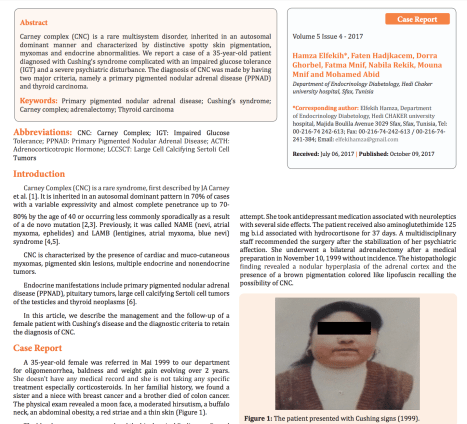
Cushing’s Syndrome Revealing Carney Complex: A Case Report


Carney complex (CNC) is a rare multisystem disorder, inherited in an autosomal dominant manner and characterized by distinctive spotty skin pigmentation, myxomas and endocrine abnormalities.

We report a case of a 35-year-old patient diagnosed with Cushing’s syndrome complicated with an impaired glucose tolerance (IGT) and a severe psychiatric disturbance. The diagnosis of CNC was made by having two major criteria, namely a primary pigmented nodular adrenal disease (PPNAD) and thyroid carcinoma.

Read the entire report here: Cushing’s Syndrome Revealing Carney Complex: A Case
Report

A 12-year-old boy died from Addison’s disease after the chance of lifesaving treatment was ‘missed’

The death of a 12-year-old boy who was suffering from undiagnosed Addison’s disease was preventable, an inquest heard.

Ryan Lee Morse had been unwell from July 2012, with his parents noticing his skin darkening and him becoming lethargic and losing weight.

His condition worsened over the following months and he died during the early hours of December 8, 2012.

During the time he was unwell, Ryan’s mother, Carol Ann Morse, took him to Abernant Surgery in Abertillery several times.

She said: “Ryan was rarely ill as a child. In June 2012, which was towards the end of Ryan’s first comprehensive school year, I noticed his skin colour changing.

“His skin seemed to be getting darker.”

She said his joint areas, including elbows and knees, were getting darker. Under his eyes, it looked as if he had not slept for a month. I don’t suppose it worried me at the time because it was gradual.”

A post mortem was held on December 12 by Dr E. J. Lazda, a consultant pathologist at University Hospital of Wales in Cardiff who concluded that Ryan died as a result of Addison’s disease.

An inquest into Ryan’s death was held at Newport Coroner’s Court on Thursday.

Dr Yvette Cloette, a consultant paediatrician since 2004, was called during the early hours of December 8, 2012, by a registrar where she was told the details of Ryan’s death.

She said: “Ryan’s parents told me he had been unwell since July.

“It was thought Ryan had been particularly unwell since the Thursday before he passed away. He had to be collected from school that day. On (the) Friday morning, she said he hallucinated. His temperature did settle that afternoon but then he had diarrhoea.

“As his mum was cleaning him, she noticed his genitalia were black.

“I then examined Ryan. At this time I formed the opinion that Ryan may have had Addison’s disease. I didn’t share this with the family at the time because I didn’t have enough evidence.

“I believe that Ryan’s death was preventable. Addison’s is a disease which, once recognised, can be treated.”

She said it was easier to put things together retrospectively, as opposed to when treating an acute illness as a GP.

David Bowen, senior coroner for Gwent, paid tribute to Ryan’s family during the hearing.

“Before summing up, I think it’s right that I pay tribute to the dignity that has been shown by Mrs Morse and her family.

“It can’t have been easy for them to rehear events that took place over five years ago.

“Please accept my belated condolences.”

Mr Bowen told the inquest that Ryan had been fit and well up until July 2012.

“However at about that time, his parents began to notice a gradual change in his skin and a fluctuation in his general health.”

He had been diagnosed with a viral infection and prescribed Paracetamol, he said.

Over the next six to eight weeks, he did not improve.

Mr Bowen said: “Consequently, his mother took him back to the doctor. The GP was more concerned about the rash, it seems to me, than any of the other symptoms.

“He prescribed tablets and cream for that condition.”

Mr Bowen said that during October and November 2012, “Ryan’s health became much more of a concern for his parents.”

He suffered from headaches, pains in his legs, and occasional episodes of projectile vomiting.

On November 7, Mrs Morse took Ryan back to the GP surgery, where she described symptoms to Dr Rudling, who took samples of blood.

On November 21, they returned to receive the blood test results.

The results revealed a “slightly lower than normal” white blood cell count. The inquest heard Ryan was told he was still suffering from a viral infection that had been diagnosed some months earlier.

Mr Bowen said: “It appears that about this time, there was an outbreak of Norovirus or vomiting and sickness in the area that may have confused the diagnosis.”

Mrs Morse said: “I’d been told to bring Ryan back in January so I thought I would just get Christmas out of the way and take him back. I’d been a carer for 9-10 years but my job didn’t give me any insight into what Ryan had.”

On November 29, 2012, Ryan returned to school, but around a week later on December 6 he was so ill that his mum had to collect him early.

The following day, on December 7, Mrs Morse rang Abernant Surgery saying she needed to speak to a doctor.

Between 8.50am and 8.55am, she received a call from Dr Lyndsey Elizabeth Thomas.

Mrs Morse said: “She asked if he’d been given Paracetamol and I explained he wouldn’t take it. She asked what his temperature was like.

“I’d said Ryan was awake (that morning) and talking rubbish.”

The inquest heard Mrs Morse was asked to take Ryan to the surgery, but she said she was unable to.

“She then told me to give Ryan some dissolvable Paracetamol and see how it goes until dinner. She said fetch him up if you need to.”

Dr Lyndsey Elizabeth Thomas said her contact with Ryan was limited to a single telephone conversation with his mother on December 7.

She said: “I considered whether Ryan needed to be seen or admitted to hospital.

“I clearly recall explaining that if she had any concerns or if Ryan’s delirium or temperature didn’t improve in two hours, he would need to be seen, I would be able to go and visit him at the end of the morning surgery if necessary.”

Mrs Morse said she later noticed that her son’s genitals were black.

She rang the surgery and was put her through to Dr Rudling.

Mrs Morse said: “She said ‘it’s all to do with his hormones’. Phone Monday and we’ll fit him in. At this point I didn’t know what to think.

“I was thinking I’ll take him in on Monday and see what they say. There was no more temperature, no more sickness and no more diarrhoea.”

The inquest heard Dr Joanne Louise Rudling, who qualified in 1993, joined Abernant in August 2011.

She said her first contact with Ryan was in November 2012.

On December 7, Dr Rudling said the receptionist took a call from Ryan’s mother while she was in reception.

Dr Rudling said: “I decided to speak to Ryan’s mother in reception there and then.

“She also asked if this could be age related, I said it could be but I would have to examine him first.

“The impression I got was Ryan was improving. His mother was concerned about the darkening of his genitalia.”

Ryan’s father said goodnight around 10.15pm and went to bed. At around 11.10pm Mrs Morse could see Ryan had fallen asleep, and went to sleep herself at around 11.30pm.

She said: “I woke up and saw it was 4.10am and then I looked at Ryan and looking at his chest could see he wasn’t breathing.

“I started to do chest compressions, dialled 999, continued chest compressions until the paramedics arrived. They took over. They told me Ryan had died.”

Mr Bowen said: “This is a rare but natural disease, one which apparently GPs will not normally encounter.

“Unfortunately, neither doctor nor parents thought it necessary to refer Ryan to hospital, where the true nature of his illness may have been diagnosed.”

Recording a narrative conclusion, Mr Bowen said Ryan died of natural causes.

He said: “The opportunity to administer life-saving treatment was missed.”

Speaking after the inquest, Ryan’s sister Christina Morse said: “First of all I would like to thank everyone involved with Ryan and Ryan’s case.

“Today, after five long years, the coroner has come to the conclusion that Ryan’s death was due to natural causes and that Ryan’s death was preventable.”

From http://www.walesonline.co.uk/news/wales-news/boy-died-addisons-disease-after-13687355