Clinical Trial for Cortendo

Cortendo Clinical Trial


About the Study

OBJECTIVE:

The purpose of this study is to test the effects of different doses of COR-003 on people with endogenous Cushing’s syndrome, primarily by measuring the cortisol levels in urine and secondarily by measuring other health parameters such as blood pressure, weight, liver function, etc. This study is also being conducted to find out if COR-003 is safe to use. This study is open-label, which means both the health providers and the participants in the study are aware of the drug or treatment being given.

STUDY DESIGN:

  • The study will begin with a screening period to make sure subjects are eligible to participate in the study.
  • After the screening period, subjects who are eligible for participation will each be given several different doses of COR-003, to be taken by mouth in tablet form.
  • After an individualized dose has been selected, participants will take COR-003 for 6 months.
  • Finally, participants will continue in the study for an additional 6 months at doses to be determined by the study doctor.
  • Throughout the study, participants will meet regularly with a study doctor and will take part in a variety of medical tests to make sure they are doing well and to see if COR-003 is working.
  • Participants in the study should be sure they have the time to participate. Participants will generally be followed for over a year.

See if you may be eligible for this clinical study. By providing your contact information, you will receive more information about the study and your eligibility.

About Cortendo

Cortendo is the sponsor of this study. This means Cortendo planned and organized this study. Cortendo will also collect and analyze the data from the study.

Cortendo is a global pharmaceutical company primarily focused on researching and providing treatments for rare diseases in endocrinology, such as Cushing’s syndrome. The company was founded in Sweden and its worldwide headquarters is located just outside of Philadelphia.

Fill out this form for more information: https://www.cushingssyndromestudy.com/registration.aspx

What Causes Cushing’s Disease?

0276f-pituitary-gland


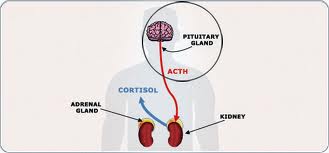
A condition in which the body produces too much cortisol, Cushing’s disease occurs when a tumor on the pituitary gland makes the gland create too much ACTH, the hormone that stimulates the production and release of cortisol (also known as “the stress hormone”). It may also occur with excess growth of the pituitary gland, known as hyperplasia. For most patients, Cushing’s disease will show itself through symptoms like red lines on the abdomen, abdominal weight gain and roundness to the face. And while the condition only affects 10 to 15 people per million per year, patients who suffer with it understandably wonder why. What are the causes? Where would a pituitary gland tumor come from? What leads to excess growth of that gland? To help answer these questions, here’s a look at Cushing’s disease causes:

Causes of Cushing’s Disease

The most common cause for Cushing’s disease is adenoma, a usually benign tumor on the pituitary gland. Because the tumors are normally pretty small, they can be hard to diagnose. For this reason, many patients who have Cushing’s disease don’t find out right away. Meeting with an endocrinologist can help the diagnosis process, improving your chances for a fast, successful recognition of the disease.

Risk Factors for Cushing’s Disease

Even though it’s a rare condition, Cushing’s disease occurs more commonly in women, particularly those between the ages of 20 and 50. Other factors that may increase the risk of Cushing’s disease include obesity, type 2 diabetes, poorly controlled blood sugar levels and high blood pressure. While none of these factors are a direct cause of the condition, they are associated with higher prevalence of it.

Cushing’s Disease vs. Cushing’s Syndrome

Often mistaken for one another, Cushing’s disease and Cushing’s syndrome are actually not the same condition. What they have in common is that they both involve the body’s producing too much cortisol. Cushing’s disease is a medical condition, however, while Cushing’s syndrome is a symptom of it. Cushing’s syndrome will often occur when a patient is taking corticosteroid medication.

Why You Should See an Endocrinologist

If you believe you or someone you love may have Cushing’s disease, it is best to see a specialist. Symptoms develop slowly and sometimes in cycles, so without proper testing it can be hard to identify what’s happening. A skilled endocrinologist can conduct hormone blood tests to measure blood cortisol levels at different times. He or she can also schedule an MRI for an individual who is not taking cortisol medications, in order to isolate the location of any tumors.

Have you been dealing with the symptoms of elevated cortisol levels, such as unexplained weight gain, particularly in the abdominal area and/or back of the neck? Is your skin or vision changing? These symptoms could be indicating a deeper problem in your body — so schedule an appointment to have your condition evaluated by a professional as soon as you can. Through proper treatment, you may be able to reduce or even eliminate your symptoms and be restored to full health again.

From http://www.hormone.org/diseases-and-conditions/pituitary/secretory-tumors/cushings-disease/cushings-disease-causes

Battleground Diagnosis: The War to Survive Cushing’s Disease

Battleground Diagnosis, directed by filmmaker, Marc Harris, is a feature length documentary film that shares the stories of the survivors of a rare illness, Cushings Syndrome/Disease.

Marc Harris is the cousin of Karen Thames, Cushings survivor. He witnessed Karen go from a vibrant young Clinical Psychologist in practice, to someone whose health deteriorated due to the symptoms of Cushings, as she tried for many years to get answers from professionals. As she continued to eat a healthy, 1000 calorie per day diet, engage in exercise with multiple personal trainers, and follow through with referrals to consult with dietitians; Karen continued to gain weight at a rate of 5 pounds per week and experience rapidly declining health. Finally, after watching a Cushings episode of Mystery Diagnosis, Karen Found her answer! Ultimately, she sought the expertise of and treatment from a team of experts at the Seattle Pituitary Center in Seattle, WA. Karen had brain surgery in Seattle on November 16th, 2011. After a recurrence of Cushings, Karen had a Bilateral Adrenalectomy (BLA) in Wisconsin on August 21st, 2013.   This leaves Karen with Adrenal Insufficiency for life. However, she continues to fight and thrive!

After having a discussion with Marc in which Karen described that she knew hundreds of others who also had been through long journeys with Cushings, the diagnostic and treatment process; In November, 2012, Marc and Karen decided to document these stories.  Since that decision, Marc has traveled all over the country to interview Cushings patients who are all known to Karen. They all share their stories of struggle, pain, and triumph in the hopes that they can help the world to understand this rare disease.

Marc has also interviewed experts including Endocrinologists with expertise in Cushings, neurosurgeons, BLA surgeons, and mental health experts.

Karen’s continues to thrive everyday as a wife, a mother, and an overcomer! She has made the empowered conscious choice to use her professional background to advocate for the Cushing’s community and to be a voice for all of these brave warriors-Battleground!

We want to shout out loud to the world and spread the word about this documentary, which we hope will affect change and help save lives!

Follow our page and continue to support:http://www.Facebook.com/Hug.A.Cushie

Thank you! Thank you! Thank you!

Subscribe to Karen’s Thunderclap here: https://www.thunderclap.it/projects/23028-hug-a-cushie-battleground

Does a normal urine free cortisol result rule out Cushing’s syndrome?

ENDO_2015


March 07, 2015

SAT 379-412-Cushing’s Syndrome

Does a normal urine free cortisol result rule out Cushing’s syndrome?

ST Sharma, LK Nieman

Summary: Researchers conducted this study to assess the diagnostic accuarcy of urine free cortisol (UFC) and 24-hour urine 17-hydroxycorticosteroids (170HCS) in patients with Cushing’s syndrome, concluding that in patients with mild CS, UFC can be falsely normal or only minimally elevated. Further, they found that to help in making a diagnosis and prevent treatment delays, clinicians may consider incorporating multiple collections and use of complimentary screening tests including 24-hour urine 17OHCS and late night salivary cortisol (LNSC) testing.

Methods:

  • For this retrospective study, researchers included all CS patients evaluated at the National Institutes of Health (NIH) from 2009 to 2014.
  • The screening tests used for CS included UFC, 17OHCS, midnight serum cortisol and low dose (1 mg overnight or 2-day 2 mg/day) dexamethasone suppression test (DST).
  • They defined abnormal as values above reference range for UFC, 17OHCS and LNSC, a midnight serum cortisol ≥7.5 mcg/dL, and post-dexamethasone cortisol values ≥1.8 mcg/dL.
  • Hourly 24-hour sampling for cortisol was performed in a few cases with a mild clinical phenotype and equivocal test results.
  • Researchers measured UFC using liquid chromatography/tandem mass spectrometry (LC-MS/MS), and 17OHCS was measured using colorimetric methodology with Porter-Silber reaction (reported as mg/g of creatinine).
  • For this study, they used the mean of the first two UFC and 17OHCS values (appropriate collection by urine volume and creatinine) obtained within 30 days of initial NIH presentation.

Results:

  • In all, 72 patients were diagnosed with CS (aged 18-77 years, 51 females), 51 of whom had CD, 10 had ectopic CS, and 2 had an adrenal source of Cushing’s based on pathology.
  • Biochemical tests such as inferior petrosal sinus sampling (IPSS) suggested ectopic CS, but no tumor was found (occult) in 6 patients.
  • In 2 patients with failed transsphenoidal surgery, IPSS was indicative of a pituitary source, and one patient did not complete evaluation for ACTH-dependent CS.
  • UFC results were available in all patients, 17OHCS in 70, LNSC in 21, midnight serum cortisol in 68, and DST results in 37 patients.
  • UFC was falsely normal in 6 patients and only minimally elevated (<2 x ULN) in 13 patients (normal renal function, no history of cyclicity, all had CD); of these 19 patients, 24-hour 17OHCS was abnormal in all, LNSC was abnormal in 12, midnight serum cortisol was abnormal in 18, and DST was abnormal in 12 patients.
  • Hourly 24-hour sampling for cortisol performed in 3 of these patients revealed abnormal nadir (>7.5 mcg/dL) and mean daily serum cortisol (>9 mcg/dL) levels.

From http://www.mdlinx.com/endocrinology/conference-abstract.cfm/ZZ5BA369FDE9DE4CED82CB6A7CD5BFD1BE/42581/?utm_source=confcoveragenl&utm_medium=newsletter&utm_content=abstract-list&utm_campaign=abstract-ENDO2015&nonus=0

Day 3 Coverage of ENDO 2015

ENDO_2015


OR24-Adrenal Tumors: Clinical Implications of the Recent Molecular and Genetic Findings

Long term follow-up of a pivotal phase 2 study of Ultratrace® Iobenguane I-131 (AZEDRA) in patients with malignant relapsed/refractory pheochromocytoma/paraganglioma
C Jimenez, DA Pryma, DC Sullivan, JK Schwarz, RB Noto, N Stambler, T Armor, JD Jensen, RJ Israel


OR27-Hyperandrogenic Ovarian Dysfunction — Winner: Outstanding Abstract Award

The neurokinin B receptor antagonist AZD4901 decreases LH and testosterone secretion in women with PCOS: A randomized, double-blind, placebo-controlled clinical trial
JT George, R Kakkar, J Marshall, ML Scott, R Finkelman, T Ho, S McIntosh, JD Veldhuis, RA Anderson, L Webber


OR28-Lipids – Liver, Muscle, and Patient Bench to Bedside

Diagnosing familial hypercholesterolemia (FH) in the United States: Results from the CASCADE FH patient registry
Z Ahmad, C Newman, E O’Brien, P Shrader, EM deGoma, CD Ahmed, PM Moriarty, MRF Linton, MD Shapiro, PB Due, CM Ballantyne, WA Neal, D Duffy, L Hudgins, LC Hemphill, JA Underberg, KE Watson, SS Gidding, S Baum, K Wilemon, D Pickhardt, I Kindt, DJ Rader, M Roe, JW Knowles


OR30-Neuroendocrinology

Assessment of primary cancers in growth hormone-treated pediatric patients compared to population databases: An epidemiological analysis of a large, multinational, prospective observational study
CJ Child, AG Zimmermann, N Jia, LL Robison, JH Bramswig, WF Blum


Hypophysitis in the age of cancer immunotherapy: Experience in a large cancer center
MJoelle Pitteloud, R Dadu, ME Cabanillas, K Shah, MI-N Hu, MA Habra, SG Waguespack


OR34-Testosterone Replacement Therapy: Risks and Benefits

The association between testosterone use and major adverse cardiovascular events (MACE): An exploratory retrospective cohort analysis of two large, contemporary, coronary heart disease clinical trials
S Janmohamed, G Cicconetti, CE Koro, RV Clark, E Tarka


Oral Presentations in Reproductive Science–Winner: Oral Abstract Award in Reproductive Science

Effects of androgens and estrogens on cardiometabolic parameters in young adult men
EW Yu, H Lee, S-AM Burnett-Bowie, SC Hirsch, G Abrishamian-Garcia, LF Borges, DW Goldstein, AP Taylor, KE Wulczyn, AF Moore, JS Finkelstein


PP27-Hyperandrogenic Ovarian Dysfunction

Role of insulin resistance and hyperandrogenemia in early vascular dysfunction in adolescents with PCOS
SK Bartz, MC Caldas, R Krishnamurthy, R Krishnamurthy, FF Bacha


SAT 379-412-Cushing’s Syndrome

Does a normal urine free cortisol result rule out Cushing’s syndrome?
ST Sharma, LK Nieman


SAT 418-443-Biochemical, Genetic and Pharmacological Studies of the Pituitary and Hypothalamus

Clinical and molecular differences between invasive and non-invasive pituitary adenomas
DA Cano, M Mendez-Muros, E Venegas, N Gros, E Dios, N Garcia-Hernandez, A Madrazo-Atutxa, I Martin-Scheffer, E Cardenas, A Kaen, F Roldan, A Soto-Moreno