Resolution of the physical features of Cushing’s syndrome in a patient with a cortisol secreting adrenocortical adenoma after unilateral adrenalectomy

A 37-year-old woman developed clinical manifestations of Cushing’s syndrome over a span of 2 years. Physical examination revealed features that best describe Cushing’s syndrome, such as wide purple striae (>1 cm) over the abdomen, facial plethora and easy bruisability.1  Other features observed were hypertension, moon facies, acne, a dorsocervical fat pad, central obesity and dyslipidaemia.

The diagnosis of hypercortisolism was confirmed using a 1 mg overnight dexamethasone suppression test (19.7 ng/dL, N: <1.8) and 24 h urine free cortisol (185.9 μg/24 h, N: 3.5–45). A suppressed adrenocorticotropic hormone (ACTH) level (4 pg/mL, N: 5–20) and a lack of hyperpigmentation suggested ACTH-independent Cushing’s syndrome. Further work up using CT with contrast of the adrenals showed a 2.4×2.3×2.4 cm right adrenal mass. The patient then underwent laparoscopic adrenalectomy of the right adrenal gland. Steroids was started postoperatively and tapered over time. Histopathology results were consistent with an adrenocortical adenoma (2.5 cm widest dimension). Six months after surgery, there was resolution of the physical features, weight loss and improvement in blood pressure.

Figure 1 is a serial photograph of the physical features seen in Cushing’s syndrome, such as moon facies, a dorsocervical fat pad and wide purple striae, taken preoperatively, and at 3 and 6 months after surgery. With treatment, physical and biochemical changes of Cushing’s syndrome both resolve through time.2 The time course of the resolution of these changes, however, is varied.2 ,3 We observed that the physical features were ameliorated at 3 months and resolved at 6 months.

Learning points

  • Physicians as well as patients should be aware that improvement of the features of Cushing’s syndrome after treatment does not occur immediately.

  • Dramatic resolution of the physical features of Cushing’s syndrome, however, can be observed as early as 6 months after surgery.

Figure 1

Physical features of Cushing’s syndrome (top to bottom: moon facies, a dorsocervical fat pad and wide purple striae (>1 cm) over the abdomen) documented before surgery, and at 3 and 6 months after surgery.

Footnotes

  • Twitter Follow John Paul Quisumbing at @jpquisumbingmd

  • Contributors JPMQ worked up the case and wrote the case report. MASS reviewed the case report and critically appraised it. JPMQ incorporated his suggestions.

  • Competing interests None declared.

  • Patient consent Obtained.

  • Provenance and peer review Not commissioned; externally peer reviewed.

References

From http://casereports.bmj.com/content/2016/bcr-2016-215693.short?rss=1

Day 28, Cushing’s Awareness Challenge 2016

Over the years, we went on several Windjammer Barefoot Cruises.  We liked them because they were small, casual and were fairly easy on the wallet.

They sailed around the Caribbean to a variety of islands, although they sometimes changed itineraries depending on weather, crew, whatever.  One trip we were supposed to go to Saba but couldn’t make port.  A lot of people got off at the next port and flew home.

The captains were prone to “Bedtime Stories” which were often more fiction than true but they added to the appeal of the trip.  We didn’t care if we missed islands or not – we were just there to sail over the waves and enjoy the ride.

The last trip we took with them was about two years before I started having Cushing’s problems.  (You wondered how I was going to tie this together, right?)

The cuise was uneventful, other than the usual mishaps like hitting docks, missing islands and so on.  Until it was a particularly rough sea one day.  I was walking somewhere on deck and suddenly a wave came up over the deck making it very slippery.  I fell and cracked the back of my head on the curved edge of a table in the dining area.  I had the next-to-the-worse headache I have ever had, the worst being after my pituitary surgery. At least after the surgery I got some morphine.

We asked several doctors later if that hit could have contributed to my Cushing’s but doctors didn’t want to get involved in that at all.

The Windjammer folks didn’t fare much better, either. In October 1998, Hurricane Mitch was responsible for the loss of the s/v Fantome (the last one we were on).

All 31 crew members aboard perished; passengers and other crew members had earlier been offloaded in Belize.

The story was recorded in the book The Ship and the Storm: Hurricane Mitch and the Loss of the Fantome  by Jim Carrier.  The ship, which was sailing in the center of the hurricane, experienced up to 50-foot (15 m) waves and over 100 mph (160 km/h) winds, causing the Fantome to founder off the coast of Honduras.

This event was similar to the Perfect Storm in that the weather people were more interested in watching the hurricane change directions than they were in people who were dealing with its effects.

I read this book and I was really moved by the plight of those crew members.

I’ll never know if that hit on my head contributed to my Cushing’s but I have seen several people mention on the message boards that they had a traumatic head injury of some type in their earlier lives.

Day 25, Cushing’s Awareness Challenge 2016

bestday


I wrote parts of this in 2008, so all the “yesterdays” and “last weeks” are a little off. 

Wow.  That’s about all I can say.  Yesterday was possibly the best day of my life since I started getting Cushing’s symptoms, and that was over 25 years ago.  A quarter of a century of feeling exhausted, fatigued.  A quarter of my life spent taking naps and sleeping.

Last week  in this post I wrote in part:

I went to the endo yesterday.  Nothing has changed for me.  Nothing will.  He wants me to take more cortef.  I don’t want to gain weight again.  He looked up Provigil and it’s not indicated for panhypopituitarism.  So he won’t prescribe it.  My kidney surgeon probably won’t let me take, anyway, but it was worth a try.

He did mention that in “only” 2.5 years maybe I can go back on growth hormone.  I don’t want to live like this another year let alone 2.5.  But then, when I was on GH before it didn’t help me like it helps most everyone else.

I’m tired of catering to a kidney that may or may not fail sometime anyway, tired of being so exhausted all the time.  I feel like I’ve lost nearly half my life to this Cushing’s stuff already.

So, yesterday I was supposed to go to a conference on web design for churches.  My church sent me because they want me to spiff up their site and make them a new one for Christmas.  I wanted to go because, well, I like learning new stuff about the web.  I figured that I would learn stuff that would also be useful to me in others of my sites.

And I did!

But the amazing thing is this.  My son had told me  about a medication that was very similar to Provigil, that he had tried it while he was writing his doctoral thesis and it had helped him.

So, having tried the official doctor route and being rebuffed – again – I had decided to try this stuff on my own.

Just the night before I had written a response on Robin’s wonderful blog that reads in part:

I hate this disease, too.

I was just talking to a friend today about how I’d try nearly anything – even if it ruined my one remaining kidney – to have a few days where I felt good, normal, where I could wake up in the morning rested and be able to have energy for the day.

I want to go out and have fun, to be able to drive for more than 45 minutes without needing to rest, to be have people over for dinner, whatever. I hate being restricted by my lack of energy.

My endo says to cheer up. In two and a half years I can try the growth hormone again. Whoopee. Didn’t work the first time and maybe gave me, or contributed to, cancer growth. Why would I want to look forward to trying that again?

I want to feel good now. Today.

I hate that this disease kills but I also hate that it’s robbed me of half my life already.

I wish doctors would understand that even though we’ve “survived”, there’s no quality of life there.

I hate Cushing’s. It robs so much from so many of us. 😦

As I said earlier, I have a history of daily naps of at least 3 hours a day.  It cuts into everything and prevents me from doing many things.  I have to schedule my life around these naps and it’s awful.

rockford-2006-sue 12-18-2006 2-09-18 pmA few years ago I went on a Cushie trip to Rockford.  I’ve been there a few times and it’s always so much fun.  But this first year, we were going to another Cushie’s home for barbecue.  I didn’t drive, I rested in the back of the car during the drive.  We got there and I managed to stay awake for a little while.  Them I put my head down on the dining room table and fell asleep. Our hostess kindly suggested that I move over to the sofa.

So, I have a long history of daily naps, not getting through the day, yadda, yadda.

So, I was a little nervous about yesterday.  I really wanted to go to this conference, and was afraid I’d have to go nap in my car.

I got up at 5:30 am yesterday.  Before I left at 7:15, I took my Cortef and then I took my non-FDA approved simulated Provigil.  (Although it’s not FDA approved, it is not illegal to possess without a prescription and can be imported privately by citizens)

I stayed awake for the whole conference, went to a bell rehearsal, did Stacey’s interview, had dinner and went to bed about 10:30PM.  NO NAP!  I did close my eyes a little during the 4:00PM session but it was also b-o-r-i-n-g.

I stayed awake, I enjoyed myself, I learned stuff, I participated in conversations (completely unlike shy me!).

I felt like I think normal people feel.  I was amazed.  Half my life wasted and I finally (thank you Michael!) had a good day.

My kidney doctor and my endo would probably be appalled but it’s about time that I had some life again!  Maybe in another 25 years, I’ll take another pill.  LOL


Well, the energy from the Adrafinil was a one day thing.  I felt great on Thursday.   Friday and Saturday I slept more than usual.  Saturday, today, was one of those days where I sleep nearly all day.  Maybe if I took the drug more it would build up in my system, maybe not.  But it was still worth having that one day where I felt what I imagine normal to be.

While I was being a slug today, my husband painted the entire house.

I’m not sure if I would have been this tired today or if I was somehow making up for the nap I didn’t get on Thursday.  Whatever the case, I’m glad that I had the opportunity to try this and to experience the wonderful effects, if only for one day.

Information from a site that sells this:

Alertness Without Stimulation

Adrafinil is the prototype of a new class of smart drug – the eugeroics (ie, “good arousal”) designed to promote vigilance and alertness. Developed by the French pharmaceutical company Lafon Laboratories, adrafinil (brand name, Olmifon) has been approved in many European countries for treating narcolepsy, a condition characterized by excessive daytime sleepiness and other unusual symptoms.

Non-narcoleptic users generally find that adrafinil gives them increased energy and reduces fatigue, while improving cognitive function, mental focus, concentration, and memory. It has been reported that quiet people who take adrafinil become more talkative, reserved people become more open, and passive people become more active.

Of course, many stimulant drugs, ranging from caffeine to methamphetamine, are known to produce similar alerting/energizing effects. Adrafinil has been described by some users as a “kinder, gentler” stimulant, because it provides these benefits but usually with much less of the anxiety, agitation, insomnia, associated with conventional stimulants.

Adrafinil’s effects are more subtle than those of the stimulants you may be used to, building over a period of days to months. They appear to be based on its ability to selectively stimulate 1-adrenergic receptors in the brain.2 These receptors normally respond to norepinephrine (noradrenaline), a neurotransmitter linked to alertness, learning, and memory. This is in contrast to conventional stimulants, which stimulate a broader spectrum of brain receptors, including those involving dopamine. Its more focused activity profile may account for adrafinil’s relative lack of adverse side effects.

There’s more info about Adrafinil on Wikipedia

It’s interesting that that snipped report that people become more talkative.  I reported that in the original post, too, even though I didn’t realize that this was a possibility.

A good quote that I wish I could relate to better:

“Time is limited, so I better wake up every morning fresh and know that I have just one chance to live this particular day right, and to string my days together into a life of action and purpose.”

Lance Armstrong (1971 – )
Cyclist, seven-time Tour de France champion and cancer survivor


2011 stuff starts here:

Awhile ago I went to a handbell festival. I took a bit of adrafinil on the main day to try to stay awake for the whole day. It didn’t seem to keep me as on as it did before. I can’t be used to it already. Maybe I’m just that much more tired than I was before.

Our son lives in New York and every few years he gives us tickets to see a Broadway show.  A couple years ago we took the train to NY to see Wicked.  Usually my DH wants to go out and see sights while we’re there.  I usually want to nap.

This time we got up on Saturday morning, went out for breakfast.  I wanted to take in the whole day and enjoy Wicked so I took some Adrafinil.  We got back to the hotel and got ready to go to a museum or other point of interest.

But, DH wanted to rest a bit first.  Then our son closed his eyes for a bit…

So, I found myself the only one awake for the afternoon.  They both work up in time for the show…

Sigh  It was a great show, though.

A recent Christmas I was going to get my son some Adrafinil as a gift.  The original place we bought it didn’t have any more stock so I tracked it down as a surprise.  He was going to give me some, as well, but couldn’t get it from the original source, either.  So he found something very similar called Modafinil.  GMTA!


20-years-vaf


And this year…

Saturday, 4/23/16 really was one of the best days I’ve had in a long time.

I’ll be writing a longer post about that later on my travel blog but here’s the original plan: https://maryoblog.com/2016/04/23/busy-saturday/

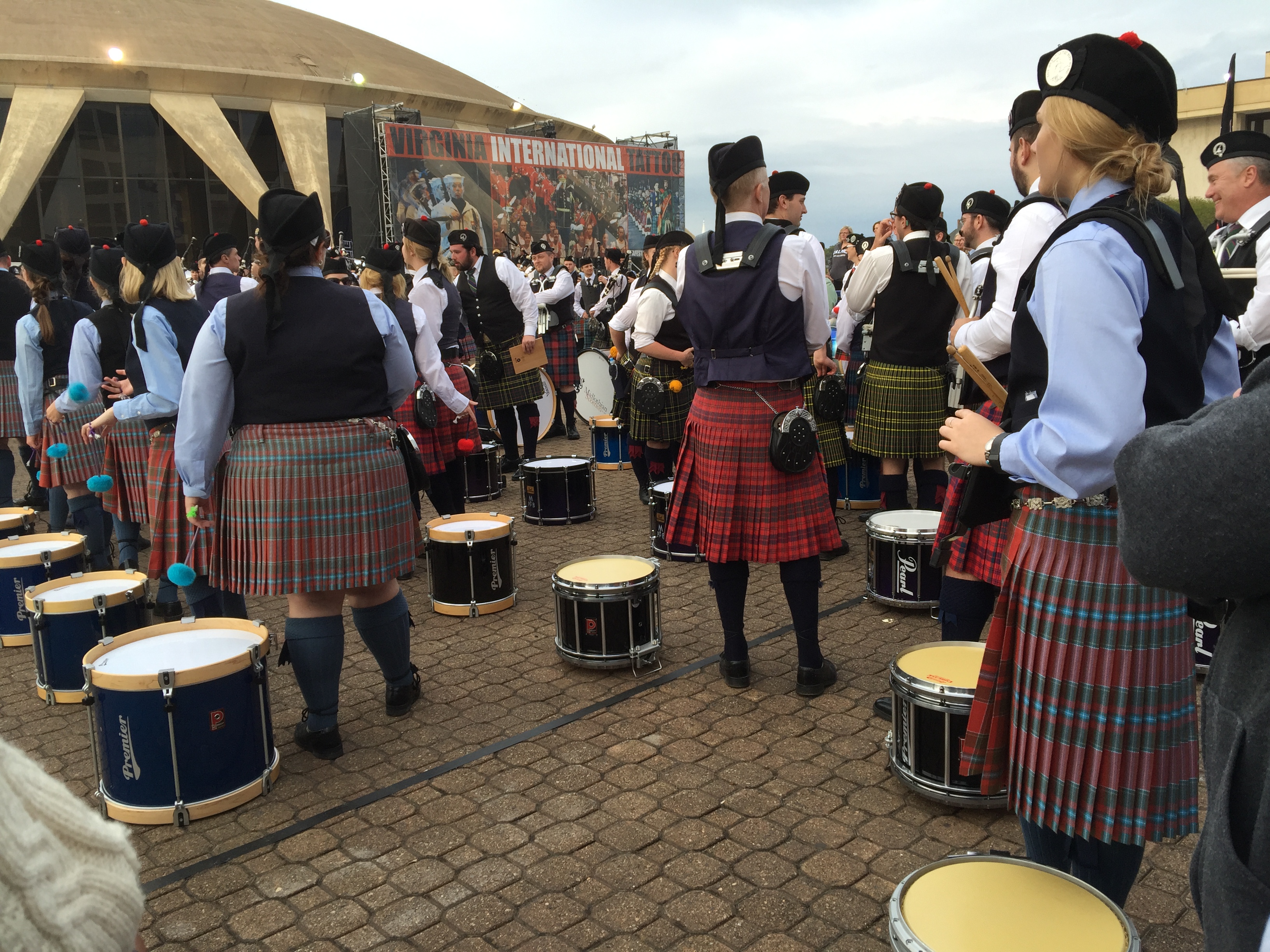
Suffice it to say, we arrived at the Tattoo and I got no nap at all, all day!

IMG_0936

IMG_0940


Day 14, Cushing’s Awareness Challenge 2016

Way back when we first got married, my husband thought we might have a big family with a lot of kids.  He was from a family of 6 siblings, so that’s what he was accustomed to.  I am an only child so I wasn’t sure about having so many.

I needn’t have worried.

In January, 1974 I had a miscarriage.  I was devastated. My father revealed that my mother had also had a miscarriage.  I had no idea.

At some point after this I tried fertility drugs.  Clomid and another drug.  One or both drugs made me very angry/depressed/bitchy (one dwarf I left off the image)  Little did I know that these meds were a waste of time.

Eventually,  I did get pregnant and our wonderful son, Michael was born.  It wasn’t until he was seven that I was finally, actually diagnosed with Cushing’s.

When I had my early Cushing’s symptoms, I thought I was pregnant again but it was not to be.

I’ll never forget the fall when he was in second grade.  He was leaving for school and I said goodbye to him.  I knew I was going into NIH that day for at least 6 weeks and my future was very iffy.  The night before, I had signed my will – just in case.  He just turned and headed off with his friends…and I felt a little betrayed.

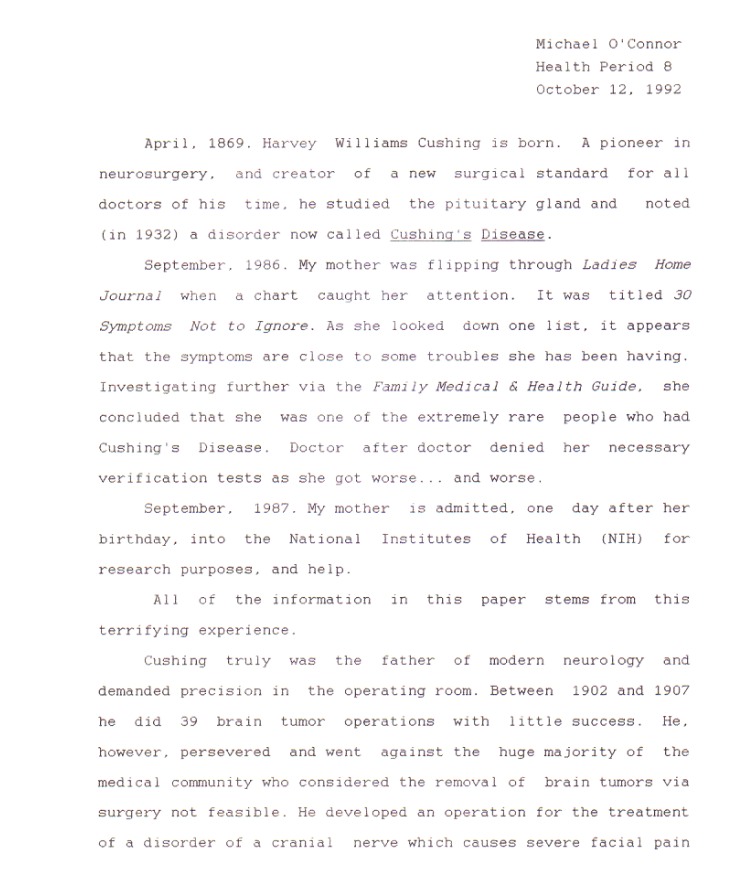
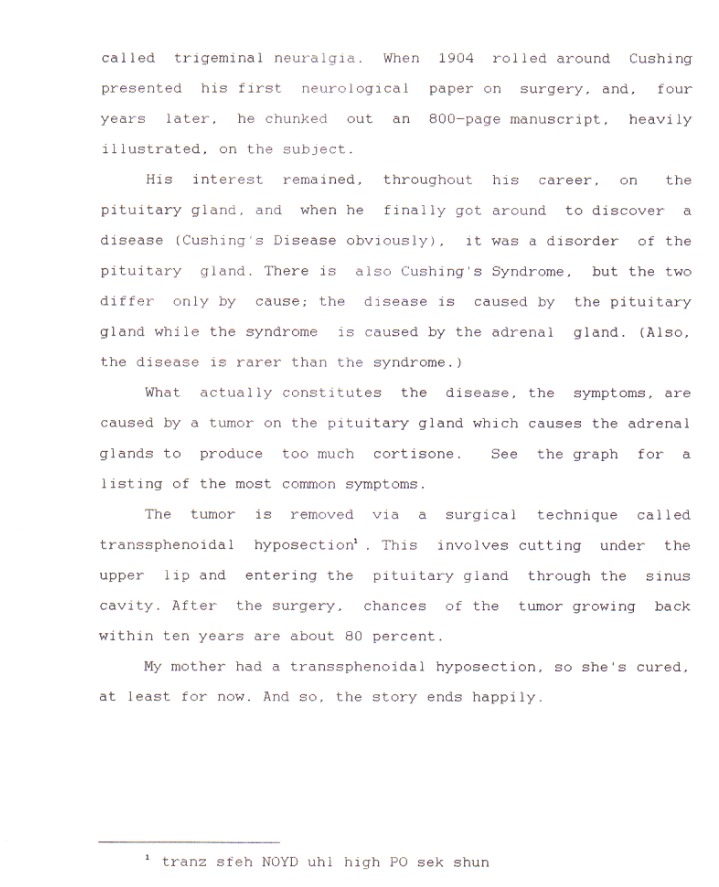
Michael wrote this paper on Cushing’s when he was in the 7th grade. From the quality of the pages, he typed this on typing paper – no computers yet!

Click on each page to enlarge.

When Michael started having headache issues in middle school, I had him tested for Cushing’s.  I had no idea yet if it could be familial but I wasn’t taking any chances.  It turned out that my father had also had some unnamed endocrine issues.  Hmmm…

I survived my time and surgery at NIH and Michael grew up to be a wonderful young man, if an only child.  🙂

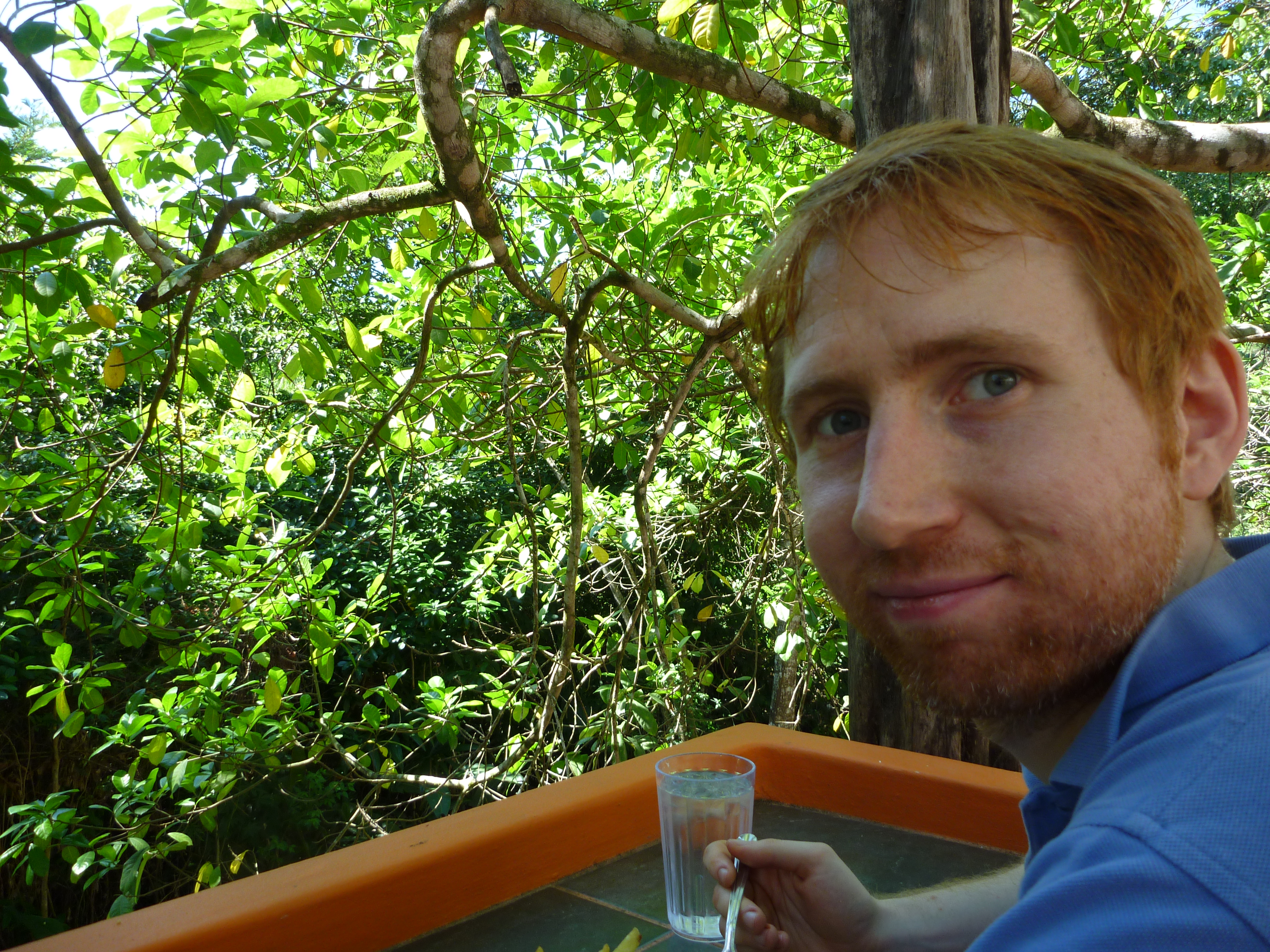
After I survived kidney cancer (Day Twelve, Cushing’s Awareness Challenge 2015) Michael and I went zip-lining – a goal of mine after surviving that surgery.  This photo was taken in a treetop restaurant in Belize.

For the mathematically inclined, this is his blog.  Xor’s Hammer.  I understand none of it.  He also has a page of Math and Music, which I also don’t understand.

I know it doesn’t fit into a Cushing’s awareness post but just because I’m a very proud mama – Michael got a PhD in math from Cornell and his thesis was Using Tree Automata to Investigate Intuitionistic Propositional Logic


proud-mom


Day 7, Cushing’s Awareness Challenge 2016

On Becoming Empowered. Adapted from my blog post Participatory Medicine

The Society for Participatory Medicine - MemberThis is kind of a “cheat” post since it’s a compilation of other posts, web pages, message board posts and some original thoughts.  I wrote it to submit to Robin’s Grand Rounds, hosted  on her blog.

For all of my early life, I was the good, compliant, patient.  I took whatever pills the doctor prescribed, did whatever tests h/she (most always a he) wrote for.  Believed that whatever he said was the absolute truth.  He had been to med school.  He knew what was wrong with me even though he didn’t live in my body 24/7 and experience what I did.

I know a lot of people are still like this.  Their doctor is like a god to them.  He can do no wrong – even if they don’t feel any better after treatment, even if they feel worse.  “But the doctor said…”

Anyway, I digress.

All this changed for me in 1983.

At first I noticed I’d stopped having my periods and, of course, I thought I was pregnant. I went to my Gynecologist who had no explanation. Lots of women lose their periods for a variety of reasons so no one thought that this was really significant.

Then I got really tired, overly tired. I would take my son to a half hour Choir rehearsal and could not stay awake for the whole time. I would lie down in the back of the van, set an alarm and sleep for the 30 minutes.

A whole raft of other symptoms started appearing – I grew a beard (Hirsuitism), gained weight even though I was on Weight Watchers and working out at the gym nearly every day, lost my period, everything hurt, got what is called a “moon face” and a “buffalo hump” on the back of my neck. I also got stretch marks. I was very depressed but it’s hard to say if that was because of the hormone imbalance or because I felt so bad and no one would listen to me.

I came across a little article in the Ladies Home Journal magazine which said “If you have these symptoms…ask your doctor about Cushing’s”. After that, I started reading everything I could on Cushing’s and asking my doctors. Due to all my reading at the library and medical books I bought, I was sure I had Cushing’s but no one would believe me. Doctors would say that Cushing’s Disease is too rare, that I was making this up and that I couldn’t have it.

I asked doctors for three years – PCP, gynecologist, neurologist, podiatrist – all said the now-famous refrain.  It’s too rare.  You couldn’t have Cushing’s.  I kept persisting in my reading, making copies of library texts even when I didn’t understand them, keeping notes.  I just knew that someone, somewhere would “discover” that I had Cushing’s.

My husband was on the doctors’ sides.  He was sure it was all in my mind (as opposed to all in my head!) and he told me to just think “happy thoughts” and it would all go away.

A Neurologist gave me Xanax. Since he couldn’t see my tumor with his Magnetic Resonance Imaging (MRI) machine there was “no possibility” that it existed. Boy was he wrong!

Later in 1986 I started bruising incredibly easily. I could touch my skin and get a bruise. On New Year’s Day of 1987 I started bleeding under the skin. My husband made circles around the outside perimeter each hour with a marker, like the rings of a tree. When I went to my Internist the next day he was shocked at the size. He now thought I had a blood disorder so he sent me to a Hematologist/Oncologist.

Fortunately, the Hematologist/Oncologist ran a twenty-four hour urine test and really looked at me. Both he and his partner recognized that I had Cushing’s. Of course, he was sure that he did the diagnosis.  No matter that I had been pursuing this with other doctors for 3 years.

It was not yet determined if it was Cushing’s Disease (Pituitary) or Syndrome (Adrenal). However, he couldn’t help me any further so the Hematologist referred me to an Endocrinologist.

The Endocrinologist, of course, didn’t trust the other tests I had had done so I was back to square one. He ran his own multitude of tests. He had to draw blood at certain times like 9 AM. and 5 PM. There was a dexamethasone suppression test where I took a pill at 10 p.m. and gave blood at 9 am the next day. I collected gallons of urine in BIG boxes (Fun in the fridge!). Those were from 6 a.m. to 6 a.m. to be delivered to his office by 9 a.m. same day. I was always worried that I’d be stopped in rush hour and the police would ask about what was in that big container. I think I did those for a week. He also did standard neurological tests and asked lots of questions.

When the endo confirmed that I had Cushing’s in 1987 he sent me to a local hospital where they repeated all those same tests for another week and decided that it was not my adrenal gland (Cushing’s Syndrome) creating the problem. The doctors and nurses had no idea what to do with me, so they put me on the brain cancer ward.

When I left this hospital after a week, we didn’t know any more than we had before.

As luck would have it, NIH (National Institutes of Health, Bethesda, Maryland) was doing a clinical trial of Cushing’s. I live in the same area as NIH so it was not too inconvenient but very scary at first to think of being tested there. At that time I only had a choice of NIH, Mayo Clinic and a place in Quebec to do this then-rare pituitary surgery called a Transsphenoidal Resection. I chose NIH – closest and free. After I was interviewed by the Doctors there, I got a letter that I had been accepted into the clinical trial. The first time I was there was for 6 weeks as an inpatient. More of the same tests.

There were about 12 of us there and it was nice not to be alone with this mystery disease. Many of these Cushies (mostly women) were getting bald, couldn’t walk, having strokes, had diabetes. One was blind, one had a heart attack while I was there. Towards the end of my testing period, I was looking forward to the surgery just to get this whole mess over with. While I was at NIH, I was gaining about a pound a day!

The MRI still showed nothing, so they did a Petrosal Sinus Sampling Test. That scared me more than the prospect of surgery. (This test carries the risk of stroke and uncontrollable bleeding from the incision points.) Catheters were fed from my groin area to my pituitary gland and dye was injected. I could watch the whole procedure on monitors. I could not move during this test or for several hours afterwards to prevent uncontrolable bleeding from a major artery. The test did show where the tumor probably was located. Also done were more sophisticated dexamethasone suppression tests where drugs were administered by IV and blood was drawn every hour (they put a heplock in my arm so they don’t have to keep sticking me). I got to go home for a weekend and then went back for the surgery – the Transsphenoidal Resection. I fully expected to die during surgery (and didn’t care if I did) so I signed my will and wrote last letters to those I wanted to say goodbye to. During the time I was home just before surgery, a college classmate of mine (I didn’t know her) did die at NIH of a Cushing’s-related problem. I’m so glad I didn’t find out until a couple months later!

November 3, 1987, the surgeon, Dr. Ed Oldfield, cut the gum above my front teeth under my upper lip so there is no scar. He used tiny tools and microscopes. My tumor was removed successfully. In some cases (not mine) the surgeon uses a plug of fat from the abdomen to help seal the cut. Afterwards, I was in intensive care overnight and went to a neurology ward for a few days until I could walk without being dizzy. I had some major headaches for a day or two but they gave me drugs (morphine) for those. Also, I had cotton plugs in my nostrils. It was a big day when they came out. I had diabetes insipidus (DI) for a little while, but that went away by itself – thank goodness!

I had to use a foam product called “Toothies” to brush my teeth without hitting the incision. Before they let me go home, I had to learn to give myself an injection in my thigh. They sent me home with a supply of injectible cortisone in case my level ever fell too low (it didn’t). I was weaned gradually off cortisone pills (scary). I now take no medications. I had to get a Medic Alert bracelet. I will always need to tell medical staff when I have any kind of procedure – the effects of my excess cortisone will remain forever.

I went back to the NIH for several follow-up visits of a week each where they did all the blood and urine testing again. After a few years NIH set me free. Now I go to my “outside” endocrinologist every year for the dexamethasone suppression test, 24-hour urine and regular blood testing.

As I get further away from my surgery, I have less and less chance that my tumor will grow back. I have never lost all the weight I gained and I still have the hair on my chin but most of my other symptoms are gone. I am still and always tired and need a nap most days. I do not, however, still need to take whole days off just to sleep.

I consider myself very lucky that I was treated before I got as bad as some of the others on my floor at NIH but think it is crazy that these symptoms are not taken seriously by doctors.

My story goes on and if you’re interested some is on this blog and some is here:

Forbes Magazine | MaryO’s bio | Cushing’s and Cancer Blog | Guest Speakers | Interview Archive  1/3/08 | Cushing’s Awareness Day Testimonial Archive |

Because of this experience in getting a Cushing’s diagnosis – and later, a prescription for growth hormone – I was concerned that there were probably other people not being diagnosed with Cushing’s. When I searched online for Cushing’s, all the sites that came up were for dogs and horses with Cushing’s.  Not what I was looking for!

In July of 2000, I was talking with my dear friend Alice, who ran a wonderful menopause site, Power Surge, wondering why there weren’t many support groups online (OR off!) for Cushing’s.  This thought percolated through my mind for a few hours and I realized that maybe this was my calling.  Maybe I should be the one to start a network of support for other “Cushies” to help them empower themselves.

I wanted to educate others about the awful disease that took doctors years of my life to diagnose and treat – even after I gave them the information to diagnose me.  I didn’t want anyone else to suffer for years like I did.  I wanted doctors to pay more attention to Cushing’s disease.

The first website (http://www.cushings-help.com) went “live” July 21, 2000.  It was just a single page of information. The message boards began September 30, 2000 with a simple message board which then led to a larger one, and a larger.  Today, in 2016, we have over 12 thousand members and many others on Facebook.  Some “rare disease”!

The message boards are now very active and we have weekly online text chats, weekly live interviews, local meetings, conferences, email newsletters, a clothing exchange, a Cushing’s Awareness Day Forum, podcasts, phone support and much more. Because I wanted to spread the word to others not on “the boards” we have extended out to social networking sites – twitter groups, facebook groups, interviews, websites, chat groups, LinkedIn, Tumblr, Pinterest and much, much more.

People are becoming more empowered and participating in their own diagnoses, testing and treatment.  This have changed a lot since 1983!

When I had my Cushing’s nearly 30 years ago, I never thought that I would meet another Cushing’s patient in real life or online. Back then, I’d never even been aware that there was anything like an “online”. I’m so glad that people struggling with Cushing’s today don’t have to suffer anymore thinking that they’re the only one who deals with this.

Because of my work on the websites – and, believe me it is a ton of work! – I have had the honor of meeting over a hundred other Cushies personally at local meetings, conferences, at NIH (the National Institutes of Health in Bethesda, MD where I had my final diagnosis and surgery). It occurred to me once that this is probably more than most endocrinologists will ever see in their entire career. I’ve also talked to countless others on the phone. Amazing for a “rare” disease!

I don’t know what pushed me in 1983, how I got the confidence and self-empowerment to challenge these doctors and their non-diagnoses over the years.  I’m glad that I didn’t suffer any longer than I did and I’m glad that I have a role in helping others to find the medical help that they need.

What do *YOU* think?  How are you becoming empowered?