Causes of Cushing’s Syndrome

Cushing’s syndrome—also referred to as hypercortisolism—is fairly rare. However, researchers have boiled down a few key causes of Cushing’s syndrome, which you’ll read about below.

The cause of Cushing’s syndrome boils down to: Your body is exposed to too much cortisol. There are a few ways that this over-exposure can happen, including taking certain medications and having a tumor on your pituitary gland or adrenal gland.

Can Taking Corticosteroids Cause Cushing’s Disease?
One particular type of medication can cause Cushing’s syndrome: corticosteroids. But rest assured: Not all steroid medications cause Cushing’s syndrome. It’s more common to develop Cushing’s syndrome from steroids you take in pill form or steroids you inject. Steroid creams and steroids you inhale are not common causes of Cushing’s syndrome.

Some steroid medications have the same effect as the hormone cortisol does when produced in your body. But as with an excessive production of cortisol in your body, taking too much corticosteroid medications can, over time, lead to Cushing’s syndrome.

It’s common for people with asthma, rheumatoid arthritis, and lupus to take corticosteroids. Prednisone (eg, Deltasone) is an example of a corticosteroid medication.

Other Cushing’s Disease Causes
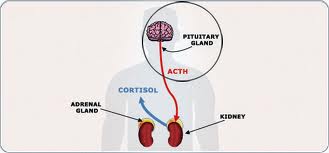
Your body can over-produce cortisol or adrenocorticotropic hormone (ACTH). The pituitary gland secretes ACTH, which is in charge of stimulating the adrenal glands to produce cortisol, and the adrenal glands are responsible for releasing cortisol into the bloodstream.

Cortisol performs important tasks in your body, such as helping to maintain blood pressure and regulate how your body metabolizes proteins, fats, and carbohydrates, so it’s necessary for your body to maintain normal levels of it.

The following can cause excessive production of cortisol or ACTH, leading to Cushing’s syndrome.

  • Pituitary gland tumors: A benign (non-cancerous) tumor of the pituitary gland can secrete an excess amount of ACTH, which can cause Cushing’s syndrome. Also known as pituitary adenomas, benign tumors of the pituitary gland affect women 5 times more often than men.
  • Adrenal gland tumors: A tumor in one of your adrenal glands can lead to Cushing’s syndrome by causing too much cortisol to enter your bloodstream. Most of these tumors are non-cancerous (called adrenal adenomas).

    Cancerous adrenal tumors—called adrenocortical carcinomas—are relatively rare. These types of tumors typically cause extremely high levels of cortisol and very rapid development of symptoms.

  • Other tumors in the body: Certain tumors that develop outside the pituitary gland can also produce ACTH. When this happens, it’s known as ectopic ACTH syndrome. Ectopic means that something is in an abnormal place or position. In this case, only the pituitary gland should produce ACTH, so if there is a tumor producing ACTH and it isn’t located on the pituitary, it’s ectopic.

    It’s unusual to have a tumor that secretes ACTH outside the pituitary. These tumors are usually found in the pancreas, lungs, or thyroid, and they can be benign or malignant (cancerous).

    The most common forms of ACTH-producing tumors are small cell lung cancer, which accounts for about 13% of all lung cancer cases, and carcinoid tumors—small, slow-growing tumors that arise from hormone-producing cells in various parts of the body.

  • Familial Cushing’s syndrome: Although it’s rare, Cushing’s syndrome can develop from an inherited tendency to have tumors on one or more of your endocrine glands. Some inherited conditions, such as multiple endocrine neoplasia (MEN 1), can involve tumors that over-produce cortisol or ACTH, leading to Cushing’s syndrome.

If you think you could have Cushing’s syndrome or you have questions about the causes of Cushing’s syndrome, talk to your doctor immediately.

Written by | Reviewed by Daniel J. Toft MD, PhD, adapted from  http://www.endocrineweb.com/conditions/cushings-syndrome/cushings-syndrome-causes

Pituitary Patient Support Group Meeting in Santa Monica, CA

patient-support-meeting

Pituitary Patient Support Group Meeting!
Saturday–November 19th, 2016
“We will be Live Streaming on Facebook!!!”

Speaker: Garni Barkhoudarian, MD
Topic: “Advancements in Pituitary Surgery-Better Treatments, Better Quality of Life”
Meeting: 10:00am-11:00am
Breakfast Snack will be served 10:00am-11:00am
Lunch will be served 11:30am following the meeting
Family and Friends Welcome!
Please RSVP: Sharmyn McGraw at pituitarybuddy@hotmail.com or message on FB

“How can you leave her like this?”

A mother has revealed the anguish her family suffered after her daughter (16), who is in need of brain surgery, was turned away from Beaumont Hospital.

The National Centre for Neurosurgery had no beds or theatre access for nine patients with malignant brain tumours last Friday.
One of the people who was turned away was 16-year-old Chloe Holian from Donegal.

Her mother Caitriona explained to the Anton Savage Show on TodayFM that the road to treatment has been fraught with setbacks.

“I can’t stress how happy I am with the neurosurgeon and his team are there but it seems our consultant’s hands are tied, what am I supposed to do?” she said.

Chloe was diagnosed in July with a recurrence of Cushing’s syndrome, a metabolic disorder which is caused by abnormally high levels of the hormone cortisol in the blood stream.

After being promised treatment in July and then August, the Letterkenny girl was finally admitted on Thursday and was fasting for a procedure on Friday morning when she was told it was cancelled.

“When we got down they told us that they decided to put off the surgery for a couple of days,” said Caitriona.

She was told that the doctors wanted to perform a dexamethasone suppression test first to confirm that Chloe was, in fact, suffering from Cushing’s – despite previous diagnosis revealing that she was.

However, she soon found out that the test couldn’t be performed.

“At 11am someone in scrubs came around to say it wasn’t fair but he had to tell us she won’t be doing the surgery… and she wouldn’t be getting the major test either,” said Caitriona.

She said he was very empathetic of their situation.

“I felt sorry for him having to tell us that news… I asked him ‘how can you leave her like this?’

“He promised that he was going to organise this test himself. It was quite difficult as you need four people in the surgery to do this test, you need the radiographer, neurosurgeon, endocrinologist and anesthetist.”

Unfortunately, an anesthetist was not available for the test.

Caitriona said that Chloe was quite upset at the news. One of the side-effects of her condition is excessive weight gain and the student has gained six stone since last September.

“She had psyched herself up for the surgery,” explained her mother.

“Everybody was around her encouraging her, they threw a party for her before she went because it was a big thing. Chloe has no confidence because she’s put on an extra six stone. She was looking forward to getting her old self back, she just wanted to go and do this operation and get it over and done with.

“For anybody to have a little bit of a weight gain they can be conscious of it but if you’re 16-years-old and you’ve gained six stone and you can’t explain it…”

Caitriona said the family were forced to pack their bags and return to Donegal but, as of today, they have still not received a rescheduled appointment.

The mother-of-three is struggling to juggle home life with trips to Dublin but she said the family’s life is on hold until the tumour is removed.

This is the second time that Chloe has developed Cushing’s, in 2009 she was sent to London for surgery as treatment was not yet available in Ireland.

Patients lives are being threatened by delays, according to the head of the country’s national brain surgery centre. Clinical Director Mohsen Javadpour says people are at risk of dying while they’re waiting for treatment.

From http://www.independent.ie/life/how-can-you-leave-her-like-this-mothers-anguish-as-daughter-16-in-need-of-brain-surgery-is-turned-away-from-beaumont-35029557.html

All About the Pituitary Gland

0276f-pituitary-gland


The pituitary gland stimulates all the other endocrine glands to produce their own hormones. It produces a number of hormones including Human Growth Hormone (hGH) responsible for bone and muscle growth and Follicle Stimulating Hormone (FSH) which stimulates the production of the female egg or male sperm.  It is found at the base of the brain.
What can happen when it goes wrong?

When the pituitary gland doesn’t produce enough ‘trigger’ hormones, hypopituitarism occurs. Most often, it is caused by a benign tumor of the pituitary gland although it can also be caused by infections, head injury or even stroke.

Symptoms?
Excessive tiredness, reduced fertility, irregular periods, weight gain, poor libido, dry skin and headaches.
Treatment?
If caused by a tumor, surgery will be required to remove it. Regardless of whether this is successful, daily hormones will then be required to replace those no longer produced.

Adapted from http://www.hippocraticpost.com/palliative/whole-story-hormones/

Experimental Drug Improves Cushing’s Disease

International phase 3 trial is largest study ever of rare endocrine disorder

A new investigational drug significantly reduced urinary cortisol levels and improved symptoms of Cushing’s disease in the largest clinical study of this endocrine disorder ever conducted.

Results of the clinical trial conducted at centers on four continents appear in the March 8 issue of the New England Journal of Medicine and show that treatment with pasireotide cut cortisol secretion an average of 50 percent and returned some patients’ levels to normal.

“Cushing’s disease is a rare disorder, with three to five cases per million people. It can affect all ages and both genders but is most common in otherwise healthy young women,” says Harvard Medical School Professor of Medicine Beverly M.K. Biller of the Massachusetts General Hospital (MGH) Neuroendocrine Unit, senior author of the study.

“Often misdiagnosed, Cushing’s is associated with a broad range of health problems – causing physical changes, metabolic abnormalities, and emotional difficulties – and if not controlled, significantly increases patients’ risk of dying much younger than expected,” Biller says.

Cushing’s disease, one of several conditions that lead to Cushing’s syndrome, is characterized by chronically elevated secretion of the hormone cortisol. The disease is caused by a benign pituitary tumor that oversecretes the hormone ACTH, which in turn induces increased cortisol secretion by the adrenal glands.

Symptoms of Cushing’s syndrome include weight gain, hypertension, mood swings, irregular or absent periods, abnormalities of glucose processing (insulin resistance, glucose intolerance, and type 2 diabetes), and cardiovascular disease. Because those symptoms are associated with many health problems, physicians may not consider the rare possibility of Cushing’s. The diagnosis can be difficult to make and usually requires the expertise of an endocrinologist. Because cortisol levels normally fluctuate during the day, a single blood test is unlikely to identify chronic elevation, and thus the most common diagnostic test measures a patient’s 24-hour urinary output.

First-line treatment for Cushing’s disease is surgical removal of the ACTH-secreting tumor, which leads to remission in 65 to 90 percent of patients. But symptoms return in 10 to 30 percent of those patients, requiring repeat surgery, radiation therapy, or treatment with drugs that interfere with part of the cortisol control system. Until last month, there was no specific FDA-approved medical treatment for Cushing’s syndrome; the newly approved drug mifepristone should benefit some patients, but it does not affect the pituitary source of the condition or reduce cortisol levels.

The current phase 3 trial of pasireotide — the first drug that blocks ACTH secretion by binding to somatostatin receptors on the pituitary tumor — was sponsored by Novartis Pharma. The trial enrolled 162 patients at 62 sites in 18 countries. Nearly 85 percent of participants had either persistent disease that had not responded to surgery or had recurrent disease; the other 15 percent were recently diagnosed but not appropriate candidates for surgery.

Participants were randomly assigned to two groups, one starting at two daily 600-microgram injections of pasireotide and the other receiving 900-microgram doses. Three months into the 12-month trial, participants whose urinary cortisol levels remained more than twice the normal range had their dosage levels increased. During the rest of the trial, dosage could be further increased, if necessary, or reduced if side effects occurred.

At the end of the study period, many patients had a significant decrease in their urinary cortisol levels, with 33 achieving levels within normal range at their original dosage by month six of the trial. Participants whose baseline levels were less than five times the upper limit of normal were more likely to achieve normal levels than those with higher baseline levels, and the average urinary cortisol decrease across all participants was approximately 50 percent. Many Cushing’s disease symptoms decreased, and it became apparent within the first two months whether or not an individual was going to respond to pasireotide.

Transient gastrointestinal discomfort, known to be associated with medications in the same family as pasireotide, was an expected side effect. Another side effect was elevated glucose levels in 73 percent of participants, something not seen to the same extent with other medications in this family. These elevated levels will require close attention, because many Cushing’s patients already have trouble metabolizing glucose. Biller explains, “Those patients who already were diabetic had the greatest increases in blood sugar, and those who were pre-diabetic were more likely to become diabetic than those who began with normal blood sugar. However, elevations were even seen in those who started at normal glucose levels, so this is real and needs to be monitored carefully.”

Additional trials of pasireotide are in the works, and a phase 3 study of a long-acting version of the drug was recently announced. Biller notes that the potential addition of pasireotide to available medical treatments for Cushing’s disease would have a number of advantages. “It’s very important to have medications that work at different parts of the cortisol control system – which is the case for the currently used medications that work at the adrenal gland level; pasireotide, which works at the pituitary gland; and mifepristone, which blocks the action of cortisol at receptors in the body. Having more options that work in different ways is valuable because not all patients respond to one medicine and some may be unable to tolerate a specific drug’s side effects.

“As we have more drugs available to treat Cushing’s,” Biller adds, “I think in the long run we may start using combinations of drugs, which is the approach we use in some patients with acromegaly, another disorder in which a pituitary tumor causes excess hormone secretion. Ultimately, we hope to be able to give lower doses leading to fewer overall side effects, but that remains to be determined by future studies.”

Annamaria Colao, University of Naples, Italy, is the lead author of the report. Additional co-authors are Stephan Petersenn, University of Duisberg-Essen, Germany; John Newell-Price, University of Sheffield, U.K.; James Findling, Medical College of Wisconsin, Milwaukee; Feng Gu, Peking Union Medical College Hospital, Beijing; Mario Maldonado, Ulrike Schoenherr, and David Mills, Novartis Pharma; and Luiz Roberto Salgado, University of São Paulo Medical School, Brazil.

From http://dailyrecords.us/experimental-drug-improves-cushings-disease/