Adrenal Crisis

Robin wrote a great blog post about Jackie and Sam dealing with Adrenal Crisis.  This is a very important article that all should read.  Be your own advocate!

New PDF! Managing Adrenal Insufficiency

New Podcast! Podcast: Adrenal Crisis

If left untreated, adrenal insufficiency can cause serious illness or death. But by working with their doctors and nurses, patients can learn how to manage this condition.

A Paramedic wrote on the message boards:

I’d like to add a couple things from the perspective of a Paramedic…

A lot of us are not taught about adrenal insufficiency during our education….nor do many of us (if any at all) have a protocol to administer Injectable for AI unless we are able to contact the ER doctor for permission. So…if any of you should have an AI crisis please gently nudge your paramedic to contact the receiving physician for permission to administer the medication. I know this sounds like a lot of responsibility on the part of the patient…but you have to realize that we’re taught to recognize the most common life threats and endocrine disorders (other than diabetes) most usually do not present with life threats (we all know that as cushing’s is more recognized that this will change)…and our protocols cover the most common life threats….so while we may recognize that you are hypotensive and need fluids (IV) and are sweaty, nauseated, decreased level of responsiveness etc…we are not equipped to deal with the actual cause unless you help educate us….

Also…please don’t get angry with us….if we are having problems understanding…just gently insist that a call be made to your doctor or the receiving ED (usually not feasible for us to call your doctor since they do not come to the phone for just anybody but if you have access to them, as many cushies do, it would be great to talk to them)…

Paramedicine is evolving….someday soon, hopefully, our education will include more diagnostic skills…untill just in the past 5 years or so we were NEVER to make a diagnosis at all…just treat the symptoms!!!! So there is hope out there for futher understanding of such a critical problem for those without adrenal (or asleep adrenals) glands….

The medical alert jewerly is a life-saver and we do look for it….

Be sure to print this page to carry with you.

From the NIH. This information was developed by the patient care staff of the Clinical Center to help patients with adrenal insufficiency (AI) understand their condition and how to take care of it. It explains what causes adrenal insufficiency and how it can be controlled. If left untreated, adrenal insufficiency can cause serious illness or death. But by working with their doctors and nurses, patients can learn how to manage this condition.

National Endocrine and Metabolic Diseases Information Service

6 Information Way
Bethesda, MD 20892–3569
Phone: 1–888–828–0904
TTY: 1–866–569–1162
Fax: 1–703–738–4929
Email: // <![CDATA[
var prefix = 'ma' + 'il' + 'to';
var path = 'hr' + 'ef' + '=';
var addy41985 = 'endoandmeta' + '@';
addy41985 = addy41985 + 'info' + '.' + 'niddk' + '.' + 'nih' + '.' + 'gov';
var addy_text41985 = 'endoandmeta' + '@' + 'info' + '.' + 'niddk' + '.' + 'nih' + '.' + 'gov';
document.write( '‘ );
document.write( addy_text41985 );
document.write( ‘
‘ );
//n
// –>
// ]]>endoandmeta@info.niddk.nih.gov // <![CDATA[
document.write( '‘ );
// ]]>This e-mail address is being protected from spambots. You need JavaScript enabled to view it // <![CDATA[
document.write( '’ );
// ]]>

Internet: http://endocrine.niddk.nih.gov/

The National Endocrine and Metabolic Diseases Information Service is an information dissemination service of the National Institute of Diabetes and Digestive and Kidney Diseases (NIDDK). The NIDDK is part of the National Institutes of Health (NIH), which is part of the U.S. Department of Health and Human Services.

The NIDDK conducts and supports biomedical research. As a public service the NIDDK has established information services to increase knowledge and understanding about health and disease among patients, health professionals and the public.

Publications produced by the NIDDK are carefully reviewed by both NIDDK scientists and outside experts.

This publication is not copyrighted. The NIDDK encourages users of this publication to duplicate and distribute as many copies as desired.

From http://endocrine.niddk.nih.gov/pubs/creutz/alert.htm


DebMV suggested that you should have a Medic Alert bracelet from medicalert.org

Toll free number in the USA is: by phone 7 days a week, 24 hours a day: 888-633-4298
209-668-3333 from outside the U.S.


Lorrie got this important info for us.

Alternative names:

adrenal crisis; Addisonian crisis; acute adrenal insufficiency

Definition:

An abrupt, life-threatening state caused by insufficient cortisol, a hormone produced and released by the adrenal gland.

Causes, incidence, and risk factors:

The two adrenal glands are located on top of the kidneys. They consist of the outer portion, called the cortex, and the inner portion, called the medulla. The cortex produces three types of hormones, which are called corticosteroids. The androgens and estrogens affect sexual development and reproduction. The glucocorticoids maintain glucose regulation, suppress the immune response, and provide for the response to stress (cortisol). The mineralocorticoids regulate sodium and potassium balance. These hormones are essential for life.

Acute adrenal crisis is an emergency caused by decreased cortisol. The crisis may occur in a person with Addison’s disease, or as the first sign of adrenal insufficiency. More uncommonly, it may be caused by a pituitary gland disorder. It may also be caused by sudden withdrawal of corticosteroids, removal or injury of the adrenal glands, or destruction of the pituitary gland. Risk factors are stress, trauma, surgery, or infection in a person with Addison’s disease, or injury or trauma to the adrenal glands or the pituitary gland. The incidence is 4 out of 100,000 people.

Prevention:

People who have Addison’s disease should be taught to recognize signs of potential stress that may precipitate an acute adrenal crisis (cause it to occur suddenly and unexpectedly). Most people with Addison’s disease are taught to give themselves an emergency injection of hydrocortisone in times of stress. It is important for the individual with Addison’s disease to always carry a medical identification card that states the type of medication and the proper dose needed in case of an emergency. Never omit medication. If unable to retain medication due to vomiting, notify the health care provider.

Symptoms:

  • headache
  • profound weakness
  • fatigue
  • slow, sluggish, lethargic movement
  • nausea
  • vomiting
  • low blood pressure
  • dehydration
  • high fever
  • chills shaking
  • confusion or coma
  • darkening of the skin
  • rapid heart rate
  • joint pain
  • abdominal pain
  • unintentional weight loss
  • rapid respiratory rate
  • unusual and excessive sweating on face and/or palms
  • skin rash or lesion may be present
  • flank pain
  • appetite, loss

Signs and tests:

  • An ACTH (cortrosyn) stimulation test shows low cortisol.
  • The cortisol level is low.
  • The fasting blood sugar may be low.
  • The serum potassium is elevated.
  • The serum sodium is decreased.
  • This disease may also alter the results of the following tests:
    • sodium, urine
    • 17-hydroxycorticosteroids

Treatment:

In adrenal crisis, an intravenous or intramuscular injection of hydrocortisone (an injectable corticosteroid) must be given immediately. Supportive treatment of low blood pressure is usually necessary. Hospitalization is required for adequate treatment and monitoring. Low blood pressure may be treated with intravenous fluids. If infection is the cause of the crisis, antibiotic therapy is indicated.

Expectations (prognosis):

Death may occur due to overwhelming shock if early treatment is not provided.

Complications:

  • shock
  • coma
  • seizures

Birthday of the Message Boards

September 30, 2000 - Birth of the Message Boards

September 30, 2000 – Birth of the Message Boards

Today  is the birthday, or anniversary, of the boards starting September 30, 2000 (The rest of the site started earlier that year in July)

As of today, we have 73,357 members who have made well over 380,324 posts.

Find the message boards here: http://cushings.invisionzone.com/

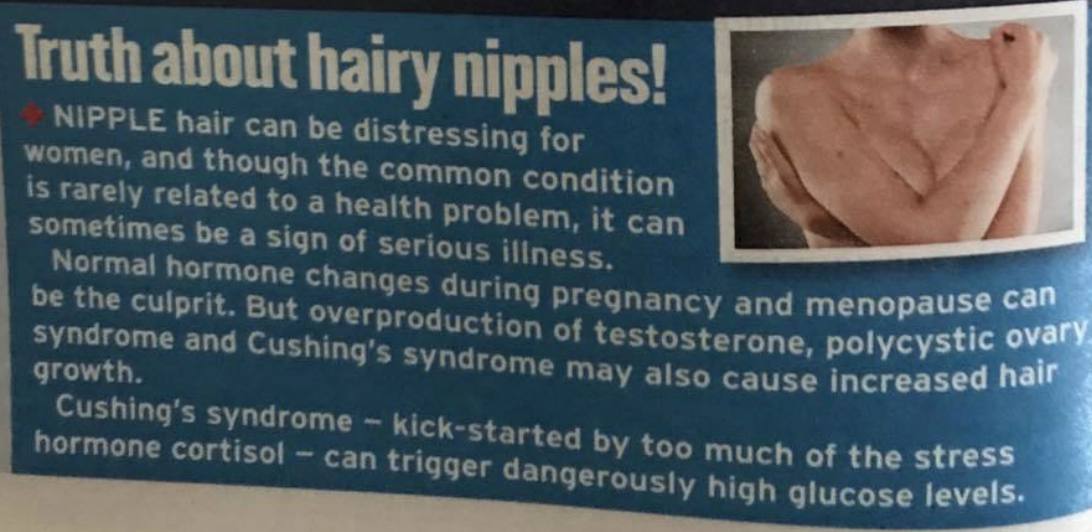
Cushing’s and Hairy Nipples

Hairy nipples are a common condition in women. The amount of hair on the nipples varies, but some women find that the hair becomes long, coarse, and dark, which can be distressing.

Hairy nipples are rarely a cause for concern and are usually not a sign of any underlying health issues. However, occasionally they can signify something more serious, in which case, it is essential to consult a doctor.

Almost every part of a person’s skin is covered in hair and hair follicles. On certain parts of the body, such as the top of the head, the hair usually grows longer and thicker, while on other parts, it is thin and transparent.

Fast facts on hairy nipples:

  • It is not known how common hairy nipples are or how many women have them.
  • Many women do not report the condition and instead manage it themselves.
  • It is possible for hair that used to be fine and light to turn coarse and dark with age.

Causes of hairy nipples in women

There are several underlying reasons that might cause nipple hairs to grow. These are:

Cushing’s syndrome

Cushing’s syndrome is another condition caused by hormonal imbalance. When it occurs, there is an excess of cortisol in the body. In this case, a person may experience several symptoms, such as:

  • increased hair growth
  • abnormal menstrual periods
  • high blood pressure
  • a buildup of fat on the chest and tummy, while arms and legs remain slim
  • a buildup of fat on the back of the neck and shoulders
  • a rounded and red, puffy face
  • bruising easily
  • big purple stretch marks
  • weakness in the upper arms and thighs
  • low libido
  • problems with fertility
  • mood swings
  • depression
  • high blood glucose level

Cushing’s syndrome is fairly rare, and the cause is usually associated with taking glucocorticosteroid medicine, rather than the body overproducing the hormone on its own.

It is possible, however, that a tumor in the lung, pituitary gland, or adrenal gland is the cause.

Also:

Hormonal changes and fluctuations

Hormonal changes in women can cause many different symptoms, one of which is changes in nipple hair growth and color.

Some common hormonal changes happen during pregnancy and menopause.

However, hormonal changes can also occur when a woman is in her 20s and 30s, which may cause nipple hair to change appearance or become noticeable for the first time.

Overproduction of male hormones

It is possible for hormonal imbalances to cause hairy nipples. Overproduction of male hormones, including testosterone, can cause hair growth, while other symptoms include:

  • oily skin that can lead to breakouts and acne
  • menstrual periods stopping
  • increase in skeletal muscle mass
  • male pattern baldness, leading to a woman losing hair on her head

If overproduction of male hormones is suspected, it is a good idea to make an appointment with a doctor who can confirm this with a simple test.

Polycystic ovary syndrome

Polycystic ovary syndrome (PCOS) occurs because of a hormonal imbalance. PCOS is a condition that affects the way the ovaries work.

Common symptoms of PCOS are:

  • infertility
  • irregular menstrual periods
  • ovarian cysts
  • excessive hair growth in unusual places, such as the nipples

PCOS is believed to affect around 1 in 5 women.

Medication

The side effects of particular medicines can cause unusual hair growth.

Medicines, such as testosterone, glucocorticosteroids, and certain other immunotherapy drugs may cause hairy nipples.

What are the treatment options?

Treatment for hairy nipples is not usually necessary for health reasons.

However, many women with the condition prefer to try and reduce or get rid of the appearance of hair on their nipples for cosmetic purposes.

There are several methods by which they can try and do this:

Trimming the nipple hair

Trimming the nipple hair may be enough to reduce its appearance. Small nail scissors are ideal, and hair can be cut close to the skin. It is essential to do this carefully and avoid catching the skin.

Trimming will need to be carried out regularly when the hair grows back.

Tweezing the nipple hair

Tweezing nipple hair is an effective way to get rid of unwanted nipple hair. However, this option can be painful as the skin around the nipple area is particularly soft and sensitive.

It is also important to bear in mind that the hair will return, and tweezing the hair increases the risk of infection and ingrown hairs.

Shaving the nipple hair

Shaving is another option to reduce the appearance of nipple hair. However, it is advisable to do so with caution to avoid nicking the sensitive skin.

This option also carries an increased risk of developing ingrown hairs and infection.

Waxing

Sugaring or waxing is a good hair removal option, though either one is likely to be painful. A salon is the best place to get this treatment type, as doing this at home may cause damage to the skin. Infection and ingrown hairs are again a risk.

Laser hair removal

These popular treatments can help to reduce the hair growth and slow or even prevent regrowth for a while. However, they can be painful, too.

Laser treatment is by far the most expensive option, as it will need to be performed by a plastic surgeon or cosmetic dermatologist.

Hormonal treatment

If a hormonal imbalance is the cause of hairy nipples, a doctor may prescribe or adjust a woman’s medication therapy to restore a healthy hormonal balance.

Other treatments and how to choose

The above treatments are all commonly used to remove and reduce nipple hair and usually have minimal side effects.

Bleaching or using hair removal cream to treat the condition, however, is not advised as these methods are usually too harsh for this sensitive area and may cause irritation and damage.

At what point should you see a doctor?

Hairy nipples in women are quite common, and there is usually no need to see a doctor. However, if they are accompanied by any other unusual symptoms, it is a good idea to make an appointment.

A doctor will be able to perform tests to determine whether an underlying cause, such as PCOS, is causing the growth of nipple hair. If so, they will give advice and medication therapy to help manage the condition.

A doctor will also be able to advise how to remove nipple hair safely.

Takeaway

For the majority of women, nipple hair may seem unsightly, but it is not a cause for any concerns about their health.

However, because some medical conditions can cause nipple hair to darken and grow, it is important to see a doctor if any other symptoms are experienced.

Nipple hair can usually be easily treated and managed, should a woman choose to try to remove the hair for cosmetic reasons.

Adapted from https://www.medicalnewstoday.com/articles/320835.php


Postsurgical treatment often necessary in persistent, recurrent Cushing’s disease

Nearly half of adults with Cushing’s disease that persists or recurs after surgical treatment require second and sometimes third therapeutic interventions, including pituitary surgical reintervention, radiotherapy, pharmacotherapy or bilateral adrenalectomy, study data from Mexico show.

Moisés Mercado, MD, FRCPC, of the ABC Hospital Neurological and Cancer Centers in Mexico City, and colleagues evaluated 84 adults (median age, 34 years; 77 women) with Cushing’s disease to determine the long-term efficacy of secondary interventions for persistent and recurrent Cushing’s disease. Median follow-up was 6.3 years.

Overall, 81 participants were primarily treated with transsphenoidal surgery. More than half experienced long-lasting remission (61.7%); disease remained active in 16%, who were diagnosed with persistent Cushing’s disease; and 22% experienced relapse after remission and were diagnosed with recurrent Cushing’s disease.

After the initial procedure, 18 participants required pituitary surgical reintervention, including 10 with recurrent and eight with persistent disease. Radiation therapy was administered to 14 participants, including two as primary therapy and 12 after failed pituitary surgery. Pharmacologic treatment with ketoconazole was prescribed for 15 participants at one point during the course of disease. Bilateral adrenalectomy was performed in 12 participants.

Pituitary surgical reintervention was the most commonly used secondary treatment (22.2%), followed by pharmacologic therapy with ketoconazole (16%), radiotherapy (14.8%) and bilateral adrenalectomy (14.8%). More than half of participants experienced early remissions after a second operation (66.6%) and radiotherapy (58.3%), whereas long-lasting remission was reached in only 33.3% of participants who underwent a second surgery and 41.6% of participants who underwent radiotherapy. Half of participants who underwent bilateral adrenalectomy were diagnosed with Nelson’s syndrome.

Overall, 88% of participants achieved remission, and disease was biochemically controlled with pharmacologic treatment in 9.5% of participants after their initial, secondary and third-line treatments.

“The efficacy of treatment alternatives for recurrent or persistent [Cushing’s disease] vary among patients, and often, more than one of these interventions is required in order to achieve a long-lasting remission,” the researchers wrote. – by Amber Cox

Disclosure: The researchers report no relevant financial disclosures.

From http://www.healio.com/endocrinology/adrenal/news/in-the-journals/%7B5519b312-5912-4c65-b2ed-2ece3f68e83f%7D/postsurgical-treatment-often-necessary-in-persistent-recurrent-cushings-disease

Sharmyn McGraw on Blogtalk Radio

sharm


March 22, 2016 7:00pm Eastern  Sharmyn speaks to medical professionals about the spiritual side of pain advocacy for patients with pituitary tumors and hormonal related disorders!  She’ll share how she turned the darkest part of her life into the best part.  Watch out because Sharmyn will also use Tumor Humor to keep the message light and fun.

Sharmyn will be be speaking with her good friend Garrett Miller, Rated G Radio. Garrett is fun, smart and to say creative is an understatement.

Garrett and Sharmyn will be having a conversation about how she turned being misdiagnosed for seven horrible years with Cushing’s disease into one of the best parts of her life.

Many of you have heard her talk about Cushing’s, but very few people have heard the back story, the personal and raw part of Sharmyn’s journey… well join them on March 22, at 7:00pm eastern and you can hear it all and join in also.

Use the call in number and let’s chat.

Sharmyn McGraw joins the show Tuesday to talk about turning Pain into Passion and Passion into Action!

Listen to the archives at http://www.blogtalkradio.com/ratedgradio/2016/03/22/sharmyn-mcgraw-turning-pain-into-passion