Day 3 Coverage of ENDO 2015

ENDO_2015


OR24-Adrenal Tumors: Clinical Implications of the Recent Molecular and Genetic Findings

Long term follow-up of a pivotal phase 2 study of Ultratrace® Iobenguane I-131 (AZEDRA) in patients with malignant relapsed/refractory pheochromocytoma/paraganglioma
C Jimenez, DA Pryma, DC Sullivan, JK Schwarz, RB Noto, N Stambler, T Armor, JD Jensen, RJ Israel


OR27-Hyperandrogenic Ovarian Dysfunction — Winner: Outstanding Abstract Award

The neurokinin B receptor antagonist AZD4901 decreases LH and testosterone secretion in women with PCOS: A randomized, double-blind, placebo-controlled clinical trial
JT George, R Kakkar, J Marshall, ML Scott, R Finkelman, T Ho, S McIntosh, JD Veldhuis, RA Anderson, L Webber


OR28-Lipids – Liver, Muscle, and Patient Bench to Bedside

Diagnosing familial hypercholesterolemia (FH) in the United States: Results from the CASCADE FH patient registry
Z Ahmad, C Newman, E O’Brien, P Shrader, EM deGoma, CD Ahmed, PM Moriarty, MRF Linton, MD Shapiro, PB Due, CM Ballantyne, WA Neal, D Duffy, L Hudgins, LC Hemphill, JA Underberg, KE Watson, SS Gidding, S Baum, K Wilemon, D Pickhardt, I Kindt, DJ Rader, M Roe, JW Knowles


OR30-Neuroendocrinology

Assessment of primary cancers in growth hormone-treated pediatric patients compared to population databases: An epidemiological analysis of a large, multinational, prospective observational study
CJ Child, AG Zimmermann, N Jia, LL Robison, JH Bramswig, WF Blum


Hypophysitis in the age of cancer immunotherapy: Experience in a large cancer center
MJoelle Pitteloud, R Dadu, ME Cabanillas, K Shah, MI-N Hu, MA Habra, SG Waguespack


OR34-Testosterone Replacement Therapy: Risks and Benefits

The association between testosterone use and major adverse cardiovascular events (MACE): An exploratory retrospective cohort analysis of two large, contemporary, coronary heart disease clinical trials
S Janmohamed, G Cicconetti, CE Koro, RV Clark, E Tarka


Oral Presentations in Reproductive Science–Winner: Oral Abstract Award in Reproductive Science

Effects of androgens and estrogens on cardiometabolic parameters in young adult men
EW Yu, H Lee, S-AM Burnett-Bowie, SC Hirsch, G Abrishamian-Garcia, LF Borges, DW Goldstein, AP Taylor, KE Wulczyn, AF Moore, JS Finkelstein


PP27-Hyperandrogenic Ovarian Dysfunction

Role of insulin resistance and hyperandrogenemia in early vascular dysfunction in adolescents with PCOS
SK Bartz, MC Caldas, R Krishnamurthy, R Krishnamurthy, FF Bacha


SAT 379-412-Cushing’s Syndrome

Does a normal urine free cortisol result rule out Cushing’s syndrome?
ST Sharma, LK Nieman


SAT 418-443-Biochemical, Genetic and Pharmacological Studies of the Pituitary and Hypothalamus

Clinical and molecular differences between invasive and non-invasive pituitary adenomas
DA Cano, M Mendez-Muros, E Venegas, N Gros, E Dios, N Garcia-Hernandez, A Madrazo-Atutxa, I Martin-Scheffer, E Cardenas, A Kaen, F Roldan, A Soto-Moreno

Myth: “All types of Cushing’s are the same”

Myth: “All types of Cushing’s are the same”

myth-busted

Fact: In the words of our dear friend and advocate, Robin Ess, “There are many genetic varieties with quite a few discovered in the past couple of years. Plus, there are several types such as adrenal, ectopic, and pituitary. And so on”….Amazingly, some doctors do not realize that there are different varieties of Cushing’s and that the symptoms can come from a different source.

For instance, a doctor might rule out a pituitary tumor and completely dismiss the patient, even with biochemical evidence of Cushing’s. That doctor, instead of dismissing the patient, should thoroughly look for other potential sources, such as an adrenal tumor, or yet another source. Did you know that tumors on one’s lungs can even cause Cushing’s? Most people don’t know that.

For more information about the different types of Cushing’s, please read: http://www.mayoclinic.org/diseases-conditions/cushing-syndrome/basics/causes/con-20032115

Another great article regarding ectopic Cushing’s can be found here: http://www.nejm.org/doi/full/10.1056/NEJM199809243391304#.VH-80v5f2s8.facebook

MaryONote: Folks might be interested in listening to this podcast episode with Jayne, a Cushing’s patient who had pituitary surgeries and a bilateral adrenalectomy before finding the true source of her ectopic Cushing’s – lung tumors.

http://www.blogtalkradio.com/cushingshelp/2008/01/31/tentative-date-an-interview-with-jayne-cyclical-cushings-patient

Interview May 7 with Kathy C, Pituitary Patient

My name is Kathy Casey. I am a 63 year old retired school nurse. I am married with two wonderful sons and a grandson. My husband and I live in the mountain town of Mt. Shasta in northern California. I have always been athletic.

In 1995, I was diagnosed with a pituitary tumor. At the time the only symptom I was aware of was a severe headache. I had a transphenoidal resection by Dr. Wilson at UCSF Medical Center followed by radiation therapy for 23 days. At the time they said they could not remove all of the tumor.

In 2008/2009. I exhibited symptoms of Cushing’s and my cortisol level was outrageous, and I had to be hospitalized initially for a potassium level of 2. I returned to UCSF and Dr. Anwar Sandeep operated . By removing part of the tumor. My Cushing symptoms resolved. However, he said that the tumor was not encapsulated and was invading the cavernous sinus and stella turcica so it was still not possible to remove it all.

I was OK until December 2013 when I began exhibiting the symptoms of Cushings. One of my 24 hr. urines was 14,000. I had to be hospitalized for a potassium level of 1.9. Dr. Heaney said he has never seen a cortisol level that high. This time I decided to go to the UCLA Pituitary Tumor and Endocrinology Program where they were more oriented to follow-up and treating this disorder. Dr. Bergsneider decided that surgery was not an option. He and Dr. Heaney decided radiation was not an option. So now I am being followed by Dr. Heaney to see if medication can help.

I am now on Cabergoline 0.5 mg three tabs twice a week and Signifor 0.9 mg subcutaneosly twice a day. I think they are alleviating some of the symptoms. However, the Signifor caused my blood sugar to rise, and I had to go on Metformin which is causing nausea to a point where I have a hard time eating.

Anyway, this whole situation is depressing and overwhelming. I am tryng to stay positive, but I wonder how it will turn out. I am fortunate to have a supportive and helpful husband.

I am interested in communicating with people who may be going through a similar experience and learning more about this rare condition.

Kathy will be interviewed May 7, 2014 in BlogTalkRadio

HOME | Contents | Adrenal Crisis! | Abbreviations | Glossary | Forums | Donate | Bios | Add Your Bio

Cushing’s Awareness Challenge 16

robin-support

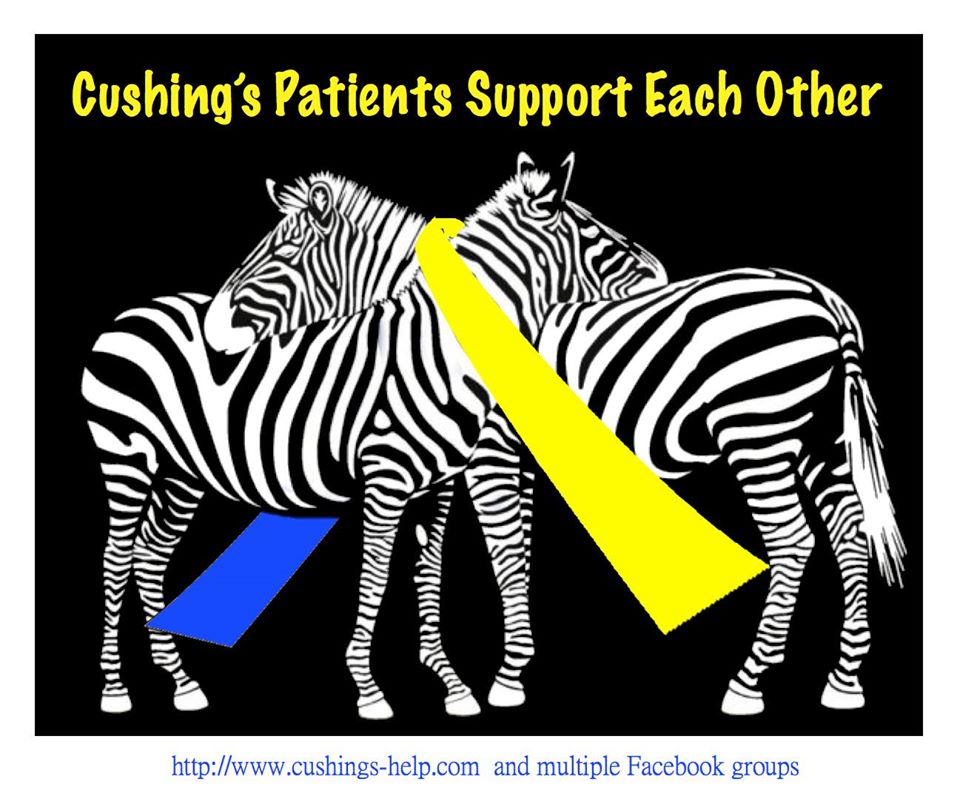
That’s for sure!  Cushing’s patients have a lot of support these days, at least online.  I’m not seeing much offline in the way of regular group support meetings.

Over the years, there have been lots of local meetings but they’re mostly one-time events.  There are pictures of some of the past meetings here: https://www.facebook.com/CushingsInfo/photos_albums listed by place and date.

Many Cushing’s patients on the message boards and in Facebook groups exchange phone numbers and email addresses to get offline support.

Other ways to help support others you may never meet are to agree to be interviewed in a live voice chat (these are added to the podcast for later listening) or submit a bio.

The more you share, the more support others get…and the more they’ll share with you.


maryo colorful zebra


Tonight! Interview with Miriam K (Meeks089), Pituitary Success Story

Miriam writes in her bio:

“I suffered for eight long years with Cushings disease . I had surgery on August 1 , 2012 , I look like a different person , and act like a different person. I would love to share my journy . One that was an emotional roller coaster .

It was a long hellish journey .However I would not trade it for anything else in the world.

Although I suffered immensly, Cushings has made me who I am today. I have become strong from this disease. Although I suffered many symptoms, the emotional ones were by far the worst.

I would love to be interveiwed because I vowed when I was ill to help people when I got better.

I want to give people hope .”

MaryONote:  Miriam will be interviewed on BlogTalkRadio podcasts December 4, 2013 at 6:00PM Eastern.

If you want to ask Miriam a question, please use the call-in number: (646) 200-0162

Archives will be available at Cushings-Help on BlogTalkRadio a few hours after the conclusion of this interview.